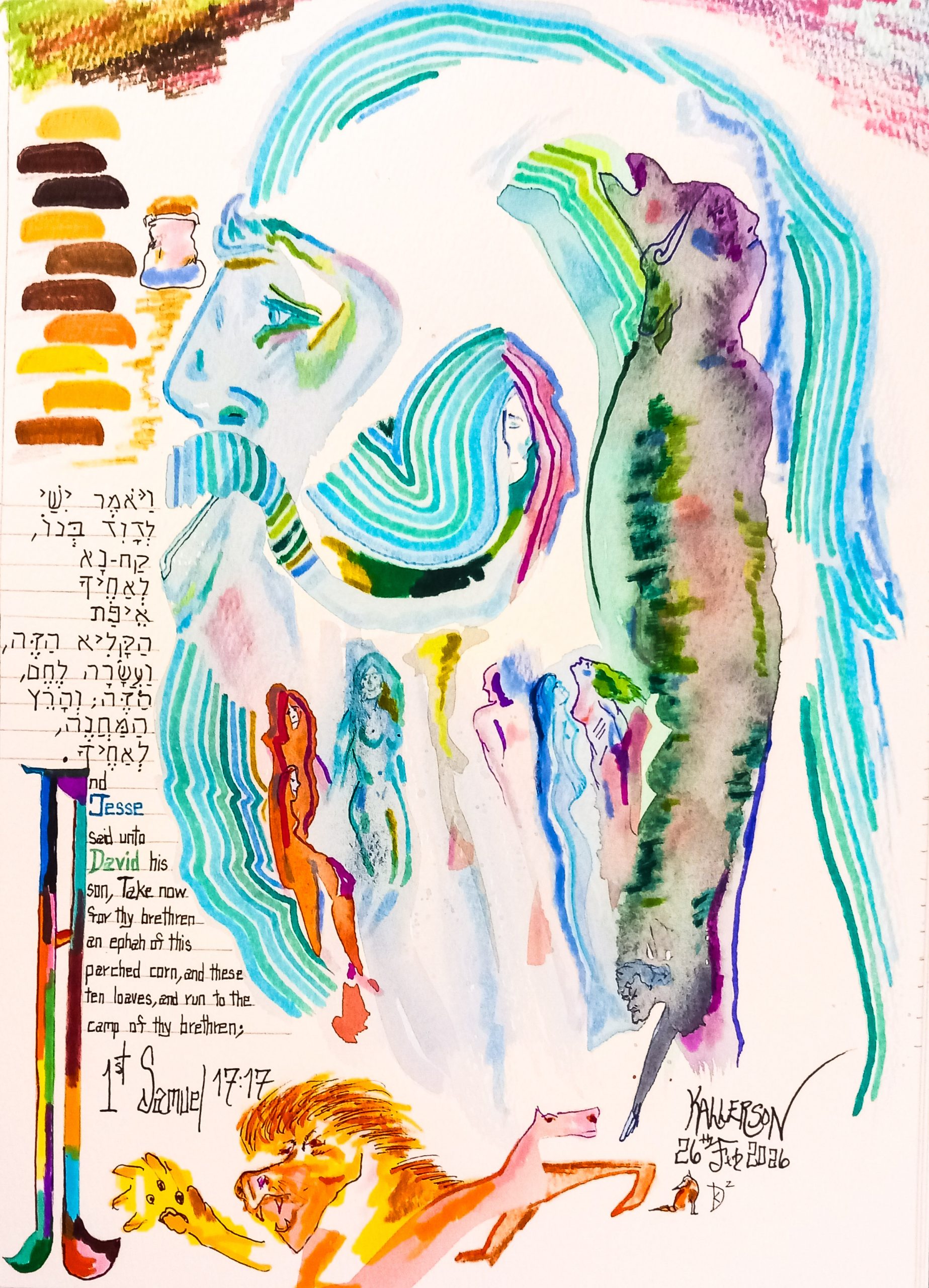
Artwork by Douglas Kallerson
1 Samuel 17:12-27
(David and Goliath, Part II)
(Typed 17 November 2025) In 1 Samuel 17, the Hebrew is much different from the Septuagint, the Greek translation. The verses from 12 to 31, along with verse 41, are missing. Further, verses 54 to the end of the chapter are omitted. Of this, Adam Clarke, someone I generally agree with, says the following –
“Notwithstanding what Bishop Warburton and others have done to clear the chronology of the present printed Hebrew, it is impossible to make a clear consistent sense of the history, unless these verses are omitted. Let any one read the eleventh verse in connection with the thirty-second, leave out the forty-first, and connect the fifty-fourth with the sixth of 1 Samuel 18, and he will be perfectly convinced that there is nothing wanting to make the sense complete; to say nothing of the other omissions noted above. If the above be taken in as genuine, the ingenuity of man has hitherto failed to free the whole from apparent contradiction and absurdity. I must confess that where every one else has failed, I have no hope of succeeding: I must, therefore, leave all farther attempts to justify the chronology; and refer to those who have written for and against the genuineness of this part of the common Hebrew text.” Adam Clarke
Clarke can’t make sense of the passage because it appears oddly arranged, repetitive, and otherwise unfathomable to him. I have always taken the exact opposite view, even though much of it is hard to follow. After the study (meaning the verses we will look at today), they not only appear genuine, but they are also ingenious.
I feel bad for people who find that the word is in error. With a bit of study, it is evident how beautifully laid out the word is, and how marvelously detailed it all is. Charles Ellicott agrees with this assessment –
“…the LXX. translation not un-frequently adding or subtracting from the text when anything met them which they could not readily understand. The passage, as we find it, is undoubtedly genuine.” Charles Ellicott
Text Verse: “No king is saved by the multitude of an army;
A mighty man is not delivered by great strength.
17 A horse is a vain hope for safety;
Neither shall it deliver any by its great strength.
18 Behold, the eye of the Lord is on those who fear Him,
On those who hope in His mercy,
19 To deliver their soul from death,
And to keep them alive in famine.
20 Our soul waits for the Lord;
He is our help and our shield.
21 For our heart shall rejoice in Him,
Because we have trusted in His holy name.
22 Let Your mercy, O Lord, be upon us,
Just as we hope in You.” Psalm 33:16-22
What a hopeful portion of Scripture! The Lord is our help and our shield. Do you really believe that? If so, how much do you REALLY believe that? Would you be willing to put your life on the line to find out? The fact is that all men are destined to die. Well, unless the Lord comes for His church first.
Does it really (I mean really) matter when? Is there something that will make your possible death today worse than whatever way you might die tomorrow? The battle ranks of Israel apparently felt it was so, because – as we have seen in our verses – nobody stepped forward for forty days.
For all we know, a few of them died from boredom, from bad meat, or from getting bitten by a snake lurking in a tent over the past forty days.
They will be off to meet the same God whom those coming later will meet. But how shameful to think that they met Him while lacking faith during their time encamped in the Valley of Elah.
Think it through. “Where is your faith? It’s time for you to ask yourself what you believe.” (Yes, I stole that line from a movie). The Lord is watching us as we live our lives. Be people of faith. Have trust in His promises. And live for Him no matter what giants you might face.
These are marvelous lessons we can learn from His superior word. And so, let us turn to that precious word once again and… May God speak to us through His word today and may His glorious name ever be praised.
I. And He Neared, the Philistine (verses 12-16)
Verses 12-15 are parenthetical, providing key information to set up the narrative concerning David.
12 Now David
vedavid – “And David.” David was introduced into the biblical narrative in Ruth 4. He was also seen several times in the previous chapter. Here, he is introduced into this narrative concerning Goliath. The name David means Beloved.
12 (con’t) was the son of that Ephrathite
ben ish ephrati ha’zeh – “son man Ephrathite, the this.” The seemingly odd wording, “Ephrathite, the this” is given because David was already introduced into the narrative in the previous chapter. This affirms it is the same David. Therefore, the words “that Ephrathite” could be paraphrased as “the person who was mentioned before.”
As for saying, “Ephrathite,” it designates the location where they reside. In this case, it is…
12 (con’t) of Bethlehem Judah,
mibeith lekhem yehudah – “from Bethlehem Judah.” David is from a line of people who settled in Bethlehem in the land belonging to Judah. The ancient name of the same location, as seen in Genesis 35, was Ephrath. Depending on the root word, the name Ephrath means both Fruitful and Ashes.
Bethlehem comes from beith, house, and lekhem, bread. Thus, it signifies House of Bread. However, there is a secondary meaning derived from the word lakham, which is the same spelling as lekhem.
The verb lakham means to do battle. It is identical with the verb lakham, to eat or use as food. Thus, it also means House of Battle (War). The secondary meaning fits marvelously into the narrative of David and Goliath. Judah means “Praise.”
12 (con’t) whose name was Jesse,
ushemo Yishai – “And his name, Jesse.” Jesse means My Husband, but it also means Yehovah Exists. As such, the name contains the weighty notion that human marriage reflects divine revelation.
12 (con’t) and who had eight sons.
velo shemonah vanim – “And to him, eight sons.” These words take the reader’s mind back to Chapter 16, where David was selected from among his brothers and anointed King of Israel by the prophet Samuel. There it said –
“And he took, Samuel, horn the oil, and he anointed him in midst his brothers. And it surged, Spirit Yehovah, unto David from the day, the it, and upward. And he arose, Samuel, and he walked the Ramah-ward.” 1 Samuel 16:13
The number eight, shmonah, comes from the word shamen, meaning “fat” or “robust.” Bullinger defines the number, saying –
“In Hebrew the number eight is Sh’moneh, from the root Shah’meyn, ‘to make fat,’ ‘cover with fat,’ ‘to super-abound.’ As a participle it means ‘one who abounds in strength,’ etc. As a noun it is ‘superabundant fertility,’ ‘oil,’ etc. So that as a numeral it is the superabundant number.” E.W. Bullinger
As such, there was a play on words found in the narrative of David’s anointing. The word in that verse, translated as “oil,” is shemen, coming from the same root as shamen, the root of shmonah, eight.
Thus, David was anointed with oil (shemen), being the one who abounds in strength, noted by his position as the shmonah, eighth son of Jesse.
Not to confuse the narrative, but as an interesting point of fact, the Greek name of Jesus, IESOUS, numerically equals 888, the superabundance of the superabundant number. One can see how numbers are used consistently in Scripture in both testaments.
12 (con’t) And the man was old, advanced in years, in the days of Saul.
vehaish bime shaul zaqen ba vaanashim – “And the man, in days Saul, he aged – he went in men.” The Hebrew wording is odd and highly debated, but the sense is either that he was too old to go to battle, and thus excused, or that he is noted among men, being a man of esteem.
The latter seems less likely, but it still may be the case. Jesse was too old to engage in battle, but he was also noted among men, as David seems to proudly proclaim in verse 57. Because of his state, the account continues with a note concerning the family. They were not opposed to serving. Instead, several were a part of Saul’s army…
13 The three oldest sons of Jesse had gone to follow Saul
vayelekhu shelosheth bene Yishai ha’gedolim halekhu akhare shaul – “And they walked, three sons Jesse, the greats. They walked after Saul.” The verse begins with “and” which is unfortunately left out of the translation. The author is meticulously laying out his thoughts.
Again, the Hebrew is complicated, repeating the word halak, “to walk,” in a seemingly unnecessary way. However, it is necessary to express a completed action.
Keil correctly renders what is being said as, “And then (in Jesse’s old age) the three eldest sons followed, had followed, Saul.” This speaks of a time before the account began in verse 1.
Here in verse 13, the sons are noted as ha’gedolim, “the greats,” signifying that they are the three eldest sons of Jesse. It is these three who went…
13 (con’t) to the battle.
lamilkhamah – “to the battle.” This is where the secondary meaning of Bethlehem, House of Battle, first expresses itself in the passage. The word milkhamah, battle, comes from lakham, which we saw already is a root connected to lekhem, bread. These three from the House of Battle have gone to the battle. And…
13 (con’t) The names of his three sons who went to the battle were Eliab the firstborn, next to him Abinadab, and the third Shammah.
veshem shelosheth banav asher halekhu bamilkhamah eliav ha’bekhor u-mishnehu avinadav ve’hashelishi shamah – “And name, three his sons who they walked to the battle: Eliab the firstborn, and his duplicate Abinadab, and the third Shammah.”
The account specifically names the three. This sets the tone for everything that follows. It is dependent on what was seen in Chapter 16, where Jesse’s sons were brought before Samuel to see which one the Lord had chosen as king to replace Saul.
Out of all the seven of David’s brothers, only three were named. They are the same three who are again named in Chapter 17. David is thus being set in contrast to them. Their names mean: Eliab – God Is Father, or My God Is Father. Abinabdab – My Father Is Generous, or My Father Is Noble. Shammah – Desolation, Astonishment, or Horror.
14 David was the youngest.
vedavid hu ha’qatan – “And David, he, the diminutive.” Again, the verse begins with “and” which is left off by the translators. The word qatan means “youngest,” but the root qut gives the sense of “to feel a loathing.” Thus, the youngest is the lesser or least important.
Therefore, the words, “And David, he the diminutive,” are set in contrast to the term, ha’gedolim, the greats, used to describe the three eldest. To further set the contrast, the next clause is repeated from the previous verse…
14 (con’t) And the three oldest followed Saul.
u-sheloshah ha’gedolim halekhu akhare shaul – “And three the greats, they walked after Saul.” Chapter 16 already revealed the anointing of David to be king, but everything here is given to show that what is said about the Lord there is true. He does not look to the externals, but to the internals.
The account is slowly leading to a crescendo, which would be completely lacking without the methodical, step-by-step, fine detail being presented.
And, although over a much wider scale, the exact same thing is done concerning Christ Jesus in Scripture. David was introduced as the anointed king, and yet he continues to be described in terms that make him appear inconsequential. All the while, however, he is the focus of the narrative.
The Bible repeats this pattern concerning Jesus, such as in Isaiah 53, where it says –
“Who has believed our report?
And to whom has the arm of the Lord been revealed?
2 For He shall grow up before Him as a tender plant,
And as a root out of dry ground.
He has no form or comeliness;
And when we see Him,
There is no beauty that we should desire Him.
3 He is despised and rejected by men,
A Man of sorrows and acquainted with grief.
And we hid, as it were, our faces from Him;
He was despised, and we did not esteem Him.” Isaiah 53:1, 2
The parallel between David and Jesus is not to be missed. Concerning David, the account continues…
15 But David occasionally went and returned from Saul to feed his father’s sheep at Bethlehem.
vedavid holekh vashav meal shaul liroth eth tson aviv beith lakhem – “And David, walking and returning from upon Saul to pasture flock his father – Bethlehem.”) This verse ends the parenthetical thought that began with verse 12.
There was the explanation that the three oldest sons followed Saul, indicating that they are men of war remaining in the war camp. David, however, was more of an apprentice to the ways of the camp and would come and go between his house and the camp.
This anticipates what is coming in the next verse. The army of Israel will be in this location for forty days. During this extended period, David, who is not a soldier and thus not expected to enter battle, would go to his home, which was nearby, tend to the sheep, and then bring supplies back to the camp for those who remained to engage in the battle.
Many find contradictions here and throughout the narrative. For example, it said in verse 16:21 that David became Saul’s armorbearer. That is then, supposedly, a contradiction to the account now. How could his armorbearer leave the camp?
Understanding the categorical, not chronological, structure of 1 Samuel resolves the tension. The note concerning David and Saul in 1 Samuel 16:21-23 occurs after this account.
Even then, it doesn’t say David became “the” armorbearer to Saul, only that he was Saul’s armorbearer. In 2 Samuel 18:15, Joab is seen to have ten armorbearers in the battle with him. For all we know, he may have had ten more back at the camp as apprentices. The same could be true with Saul. For every supposed contradiction, there is always a valid explanation.
There is no reason to claim the text is in error. The narrative is given in a precise and particular manner to highlight the contrast between David and the surrounding people and events.
With the parenthetical thought of verses 12-15 complete, the main discourse that ended last week resumes with…
16 And the Philistine drew near and presented himself forty days, morning and evening.
Rather: vayigash ha’pelishti hashkem vehaarev vayithyatsev arbaim yom – “And he neared, the Philistine, cause to rise early and cause to darken, and he stationed himself forty day.” The NKJV jumbles the clauses and gives a poor rendering of what is said.
These words follow naturally in chronology after verse 11. It indicates that what was presented about David in the previous four verses was an intentional parenthetical statement for emphasis and contrast concerning him.
Because of the layout of the land, with a ravine between the two armies, neither army was willing to be the first to attack, lest they be at a disadvantage and their effort end in defeat. Therefore, during the period, the Philistine took advantage of the situation to mock Israel.
Goliath approached Israel as a taunting challenge twice a day. Rather than saying “morning and evening,” verbs are used to indicate the time of day. As the sun was being caused to rise, and as it was being caused to darken, Goliath would go out and challenge the Israelites to a duel.
What seems likely, because they are in a valley where voices would carry across the ravine, is that Goliath purposefully went out each day when the Israelites had their morning and evening prayers. At that time, they would recite the Shema from Deuteronomy 6:4 – shema Yisrael Yehovah elohenu Yehovah ekhad – “Hear Israel, Yehovah our God, Yehovah is one.”
Israel worshiped at the time when the morning and evening sacrifices were conducted. At the same time, Goliath would call out his taunts to Israel. Thus, he was not merely taunting Israel, but he was defying the God of Israel – directly and openly. This explains the meaning of David’s words coming in verse 45 –
“And he said, David unto the Philistine, You come unto me in sword and in the spear, and in javelin. And I come unto you in Name – Yehovah Sabaoth – God arrangements Israel whom you exposed.’” 1 Samuel 17:45
As for the evening sacrifice, which actually took place in the afternoon, there is no reason to dismiss the words “cause to darken” as not meaning that. The sun is at its brightest at noon. Any time after that, and especially in the afternoon, the sun becomes increasingly less bright.
This routine taunting continued for forty days. The number forty is defined by Bullinger as –
“…a period of probation, trial, and chastisement … where it relates to enlarged dominion, or to renewed or extended rule, then it does so in virtue of its factors 4 and 10, and in harmony with their signification.”
A connection can be made to this temptation of Israel, and the tempting of Christ by the devil for forty days. The temptation itself is not in relation to David (as the one tempted), but rather to Israel, of whom David becomes the deliverer.
In other words, Jesus is shown to be the greater and true Israel, and David’s accomplishments here on behalf of Israel prefigure what is seen in Christ.
Forty days, he has derided us
He calls out threats and spews bile
That giant bag of wind throws a fuss
The things he says are loathsome and vile
Morning and evening, he keeps on saying
Words that are like venom from the snake
Evil words that giant bag of wind is relaying
And yet, we will sit here, and his words we will take
We don’t have the strength to challenge him
Who among us could even try?
Our chances are dour and grim
Anyone who faces him will surely die
II. Pledges You Must Take (verses 17-19)
17 Then Jesse said to his son David, “Take now for your brothers an ephah of this dried grain and these ten loaves, and run to your brothers at the camp.
vayomer Yishai ledavid beno qakh na leakhekha ephath ha’qali ha’zeh vaasarah lekhem ha’zeh veharets hamakhaneh leakhekha – “And he said, Jesse to David his son, ‘You must take, I pray, to your brothers ephah the roasted, the this, and ten bread, the this. And you must cause to run – the camp, to your brothers.’”
Dried grain means parched grain. It is roasted and will last well beyond the harvest season. Its amount is an ephah. According to Exodus 16:36, an ephah is comprised of ten omers. According to Exodus 16:16, an omer is enough food for one person for one day.
Therefore, the grain alone would take care of the three brothers for more than three days. With the bread added in, it would be enough for them to have a good meal for the better part of a week.
As a campaign would normally be a few days, the forty days of delay for the battle necessitated that food be brought in at regular intervals until the fighting was engaged and completed. As for ten, Bullinger says –
“Completeness of order, marking the entire round of anything, is, therefore, the ever-present signification of the number ten. It implies that nothing is wanting; that the number and order are perfect; that the whole cycle is complete.”
18 And carry these ten cheeses to the captain of their thousand,
veeth asereth kharitse he’khalav ha’eleh tavi lesar ha’aleph – “And ten cuts the milk, the these, you will cause to bring to commander the thousand.” Of the phrase, “ten cuts the milk,” Adam Clarke says that “they press the milk but slightly, and carry it in rush baskets. It is highly salted, and little different from curds.”
These curds or actual cheese may be what is referred to. But the Hebrew term “cuts of milk” is a specific description for us to consider. This gift was probably to seek the favor of the captain so that he would look positively on Jesse’s sons.
18 (con’t) and see how your brothers fare,
veeth akhekha tiphqod leshalom – “And your brothers, you will visit to peace.” This means, “Check on your brothers and see how they are doing. Are they well? Are they getting enough rest? Are they encountering any difficulties or needs?”
18 (con’t) and bring back news of them.”
veeth arubatham tiqakh – “and their pledges, you will take.” The word arubah, pledge, is introduced. It is only found here and in Proverbs 17 –
“A man devoid of understanding shakes hands in a pledge,
And becomes surety [arubah] for his friend.” Proverbs 17:18
It is derived from arab, to intermix and thus to give in pledge. One intermixes his destiny when a pledge is given. There are several ideas of what the use of this word means. One is that Jesse is asking for confirmation that they are ok, or to guarantee that David actually took the supplies, and this would prove he did. However, John Gill seems to have the proper take on it. He says –
“…that is, if they had been obliged for want of money to pawn any of their clothes, or what they had with them to buy food with, that he would redeem and take up the pledge, by paying the money for which they were pawned; for it is thought that soldiers at this time were not maintained at the expense of the king and government, but at their own, and the families to which they belonged.” John Gill
This is more closely what is being referred to. David is being asked to personally carry any debt of his brothers so that payment can be made. With this matter presented, Jesse continues…
19 Now Saul and they and all the men of Israel were in the Valley of Elah, fighting with the Philistines.
veshaul vehemah vekhal ish yisreal beemeq ha’elah nilkhamim im pelishtim – “And Saul, and they, and all man Israel, in Valley the Elah being fought with Philistines.” Many translations ascribe these words to the narrator, but they are more likely Jesse speaking to David.
David had been out with the sheep for some period of time. Jesse was alerted to the current situation of the army. He knew that supplies were needed by now. It may even be the reason he told David to bring back the pledges, because they may already be out of supplies and selling their things just to eat. Therefore, Jesse gives these final words.
Bring back news of Your brothers
Tell Me about how it goes for them, too
Let Me know about the battle and all the others
Have many died, or just a few?
Carry these things to accomplish the task
Bring them good things from Your Father’s house, to sustain
Give them bread and milk from this flask
Refresh their souls and make them new again
Go with care, My Son, the mission must be done
The sheep will be watched while You are gone
The keeper will watch over every single one
Stay tonight, and begin your mission at dawn
III. To Expose Israel, He Has Ascended (verses 20-27)
20 So David rose early in the morning, left the sheep with a keeper, and took the things and went as Jesse had commanded him.
vayashkem David baboqer vayitosh eth ha’tson al shomer vayisa vayelekh kaasher tsivahu Yishai – “And he caused to rise early, David, in the morning. And he spread the flock upon guarder. And he lifted, and he walked according to which he charged him, Jesse.” An interesting word is seen here, natash, translated as disperse.
It means to pound. When something is pounded, it spreads out. Thus, David has given the flock to a guarder, spreading it out before him.
In these words, the willingness of David is seen in the words, “he arose early, David, in the morning.”
The care of David is seen in the words, “he cast the flock upon guarder.”
The obedience of David is seen in the words, “according to which he charged him, Jesse.”
David was sent on a mission. He was given a new charge in the process, and he was given specifics about that mission. In these things, he exactingly fulfilled his duties without complaint or delay. As such, he makes a marvelous type of the coming Messiah.
20 (con’t) And he came to the camp
vayavo ha’magalah “And he came the circular-ward.” There is a new word, magalah, circular. It comes from the same root as egel, calf. Both come from agol, “round.” Therefore, it is an entrenchment, probably encompassed by the wagons of the army, and thus providing protection for the camp within.
This is, of course, a best guess as we weren’t there, but it appears likely from the words and from the concept of both warfare and defense. Elsewhere, the word is translated as “tracks,” or “paths,” or even figuratively as the “ways” of a person’s conduct.
20 (con’t) as the army was going out to the fight
veha’khayil ha’yotse el ha’maarakhah – “and the valorous, the ‘going unto the arrangement.’” It is an independent clause. As David was arriving, the troops were lining up in their ranks for the battle.
Some background information, much of which is speculation but appropriate, needs to be understood. It is about a 13-mile walk from Bethlehem to the Valley of Elah. It is most likely spring. In 2 Samuel 11:1, it says, “in the spring of the year, at the time when kings go out to battle.”
In Israel, it is way too hot to battle in the summer, and too cold and/or wet to battle in the autumn or winter. The sun rises in Israel during the spring, either side of 6 am. Rising early in the morning would thus mean 4 or 5 am. Whenever the predawn light was enough, off he would go.
It takes 3+ hours to walk 13 miles. David, being young and energetic, even carrying the supplies, would have no problem with this. Therefore, he would arrive sometime around the morning prayers. In fact, knowing the battle lines would be excitedly reciting the Shema at that time, which is about 9 am, he would probably want to see that soul-stirring moment.
With this in mind, it says…
20 (con’t) and shouting for the battle.
vehereu bamilkhamah – and they caused to shout in the battle.” It is a pregnant construction, “in the battle.” They weren’t actually fighting, but were on both sides of the ravine facing one another and raising a war cry against the opposing forces.
David’s arrival was at the time of the daily show of bravado by both sides. Although speculative, one can imagine the flow of events. The camps are getting ready for the day. At the hour of sacrifice, incense, and prayer, Israel calls out the Shema.
During this time, while the forces are engaged in calling out to their God/gods, Goliath steps forward to defy the army of Israel, and indeed the God of Israel.
But… despite all the displays of great bravado, no one stepped out of the ranks to fight the champion, and neither side rushed forward to take on the enemy. This is the scene that continued for forty days in Valley the Elah.
The whole scene is raised to the highest levels of human emotion and pride, and is given to contrast what lies ahead concerning the faith and action of a shepherd boy named David.
21 For Israel and the Philistines had drawn up in battle array, army against army.
Rather: vataarokh Yisrael u-phelishtim maarakhah liqrath maarakhah – “And it arranged, Israel and Philistines, arrangement to encounter arrangement.” The fighting men of the encampment went out to fight. Others in the camp, also part of the army, remained behind.
It is the bravest, most prepared, and most battle-hardened who have gone out to face the foe. The scene continues to be elevated in intensity, preparing the reader to stop and contemplate the enormity of what lies ahead when it is put into its proper perspective.
With all of the crying out, flashing spears and swords, and clashing of shields, another figure comes into the scene…
22 And David left his supplies in the hand of the supply keeper, ran to the army,
vayitosh David eth ha’kelim mealav al yad shomer ha’kelim – “And he cast, David, the vessels from upon him, upon hand guarder the vessels.” The things given to David by Jesse, which may include the payment for pledges, replacements for anything they pawned off, and any other supplies he brought along for himself, were given into the care of the keeper of the supplies.
As soon as that was taken care of, it says he “ran” to the ranks, and the men of battle lined up for war. It shows complete bravery on his part to enter into what could turn into an engagement of battle at any moment. As he had just arrived, he would not know that an actual battle wasn’t moments away.
Rather than staying in the camp until the war lines had withdrawn, he exposed himself right in the midst of the fray on Israel’s side. As soon as he arrived, it notes…
22 (con’t) and came and greeted his brothers.
vayarats ha’maarakhah vayavo vayishal leekhav leshalom – “And he ran – the arrangement. And he came, and he asked to his brothers to peace.” In other words, he immediately asked about the welfare of his brothers. The main concern of David, even at the risk of exposing himself to danger, was their welfare.
One might think he would ask, “How’s the battle going?” or something similar. Instead, his desire is the status of his brothers. It shows the heart of David for his family, a heart that will be seen many times in his lifetime towards his close family.
23 Then as he talked with them, there was the champion,
vehu medaber imam vehineh ish ha’benayim oleh – “And he talking with them. And behold! Man, the middleman, ascending.” This is the second and last use of benayim, middleman, in the Bible. The two armies had shown a whole giant heap of outward bravado, but nothing more. And so, to once again spite Israel, the middleman becomes the focus of the narrative. He ascends from the ranks of Philistia for his irksome taunting…
23 (con’t) the Philistine of Gath, Goliath by name, coming up from the armies of the Philistines;
galeyath ha’pelishti shemo migath mimaaroth pelishtim – “Goliath the Philistine his name, from Gath, from caves [k.] Philistines.” The written and the oral Hebrew differ. The written says, “from caves.” The oral says, “from ranks.” The words kind of look the same, with only one letter different –
מִמַּעֲרֹות
מִמַּעַרְכֹ֣ות
There is no need to deviate from the written. Goliath was probably a troglodyte, and the text is stating it as a fact.
The word mearah, cave, comes from ur, to be exposed, bare, or made naked.
Goliath, from the caves of Gath in Philistia, stepped out of the ranks intending to start the momentum for a battle. As he ascended from there, it is in the direction of Israel…
23 (con’t) and he spoke according to the same words.
vaydaber kadevarim ha’eleh – “And he spoke according to the words, the these.” His words are the same words that he has called out repeatedly from verse 10 for forty days, “I, I expose arrangements Israel the day, the this. You must give to me man, and let us be fought together.” On this day, however, there is a difference. Unlike the previous days, another person is there…
23 (con’t) So David heard them.
vayishma David – “And he heard, David.” The narrative is beautifully succinct. And yet, it leaves no doubt in the mind of the reader that a complete contrast has been set forth between all the fighting ranks of Israel, and a shepherd boy on a mission from his father to feed his hungry brothers, make payment for their outstanding debts, and return with word about their condition to him…
24 And all the men of Israel, when they saw the man, fled from him and were dreadfully afraid.
It is singular: vekhol ish Yisrael birotham eth ha’ish vayanusu mipanav vayireu meod – “And all man Israel in their seeing the man, and they fled from his faces, and they feared vehemently.” Even if the thought is intended collectively, each man contrasted himself against the giant.
In his contemplation, fear sets in, and, as it says of them all, “they fled from his faces.” A spirit of cowardice filled every man in the ranks so that when Goliath spoke, each man felt he was being spoken to all by himself.
No one wanted to be the one to step forward, nor did he want to be the last one standing there when everyone else fled. Therefore, they fled (it is plural) from him. And their condition is almost painfully stated, “they feared vehemently.”
The words call out the clearest and most complete contrast possible between Israel, each man in Israel, and the shepherd boy who had now arrived in the camp of Israel.
25 So the men of Israel said,
vayomer ish Yisrael – “And he said, man Israel.” Once again, it is singular. One person is speaking to David. He conveys the following…
25 (con’t) “Have you seen this man who has come up? Surely he has come up to defy Israel;
hareithem ha’ish ha’oleh ha’zeh ki le’khareph eth Yisrael oleh “You saw the man, the ascender, the this? For to expose Israel, ascended.” The one ascending has a set goal and purpose. It is the driving force of his existence at this time, which is to defy Israel. Israel means He Strives With God.
The implication to their foes is that they strive with God on God’s behalf. Therefore, to defy Israel is to defy the God of Israel, laying bare His authority and greatness by exposing the cowardly hearts and incapable actions of the people.
Because of the magnitude of the challenge set before him, Saul has promised any victor over Goliath three things…
25 (con’t) and it shall be that the man who kills him the king will enrich with great riches,
vehayah ha’ish asher yarkenu yaserenu ha’melekh osher gadol – “And it was, the man who he will cause to strike him, he will cause to accumulate him, the king – wealth great.” The first promised honor is to make the victor wealthy.
A draft of soldiers will usually take from the poor people who would otherwise want to stay and help the family. A king would appoint richer people to positions in the government or make them officers. Thus, this would be a nice enticement for someone who probably grew up in poverty.
25 (con’t) will give him his daughter,
veeth bito yiten lo – “And his daughter, he will give to him.” The second promise is marriage to the king’s daughter. A daughter means friendliness with the king, prestige, and royal blessing. The thought includes sonship.
25 (con’t) and give his father’s house exemption from taxes in Israel.”
veeth beith aviv yaaseh khapheshi beyisrael – “And house his father, he will make exempt in Israel.’” This means that the house of the soldier’s father, meaning him and all his sons, would be free in Israel. The exact meaning of “free” is debated, but it could mean free from being drafted to war, free from taxes, and/or free from personal services to the king.
Whatever the final benefit is, the result is great honor from the king for the one who slew his great enemy. Note, however, that God is not mentioned in them. The king promised great things to the man who killed the Philistine. Saul’s expectation is that the battle will be won by men and that one man in the battle will kill Goliath.
26 Then David spoke to the men who stood by him, saying,
vayomer David el ha’anashim ha’omedim imo lemor – “And he said, David, unto the men, the ‘standing with him,’ to say.” David just heard what was promised to the man who killed the Philistine. Despite this, and at first, he seems to want clarification of the matter. And so he asks…
26 (con’t) “What shall be done for the man who kills this Philistine and takes away the reproach from Israel?
mah yeaseh laish asher yakeh eth ha’pelishti halaz vehesir kherpah meal Yisrael – “What it will be done to the man who he will cause to strike the Philistine, this, and he caused to veer reproach from upon Israel?” The question seems completely out of place. He was just told what would be done for the man who kills the Philistine, and yet he asks what will be done for the man who kills the Philistine.
The reason it seems out of place is because of the erroneous translation of the previous verse – “So the men of Israel said.” As we learned, it was a single person who said that. David took the words of one man and asked them to be confirmed by many men.
But even more, it is a direct challenge to all who hear. One must put himself into the time and place of the event. David heard about the rewards that would be granted for meeting the challenge. Then, certainly with voice elevated – and maybe even accusatory – he calls out to all standing by him, probably heavily stressing the words “the man.”
Even if David understands that all these things will be his if he wins, he is not looking for self-enrichment, a king’s daughter, or exemption in Israel. Rather, he is looking much higher. Remember the words of the text verse –
“No king is saved by the multitude of an army;
A mighty man is not delivered by great strength.” Psalm 33:16
David heard the supposedly exciting, but otherwise boring, news about the king’s offer, and he was almost mocking it. He has set the bounds by contrasting the two parties – “this Philistine” and “Israel.” David’s care was not bound up in earthly riches. It was bound up in the honor of the Lord his God. As he next says…
26 (con’t) For who is this uncircumcised Philistine,
Rather: ki mi ha’pelishti hearel ha’zeh – “For who the Philistine, the foreskinned, the this?” David is not looking to fight Goliath. He is not looking for glory. He is not looking to deprive his brothers of their chance to lead the family.
Instead, his intent is to inspire those of Israel to do what has been promised to them all along: trust in the Lord, and He will fight the battles for you. Just trust and have confidence in Him.
By calling Goliath “the foreskinned,” David is saying that there is no covenant relationship to God. Because of this, not only can he be defeated, but he will be defeated. If the Lord is God, and David has every confidence He is, then the battle cannot be lost. And to boost that to an even higher note, he next says…
26 (con’t) that he should defy the armies of the living God?”
ki khereph maarkhoth elohim khayim – “For he exposed arrangements God living!’” David is speaking to the soldiers, not about his challenge, but about the challenge they are to make. He is not a soldier; he has no commission. But they do, and they represent the living God – each of them circumcised in the flesh as a sign of the covenant between them and the Lord.
“Our God is alive, not a dead idol. Our God stands with Israel, not this Philistine. Our God is Yehovah, the LIVING GOD.” David is giving a motivational speech, hoping that His representatives on the battlefield will respond…
*27 (fin) And the people answered him in this manner, saying, “So shall it be done for the man who kills him.”
vayomer lo ha’am kadavar ha’zeh lemor koh yeaseh la’ish asher yakenu – “And he said to him, the people, according to the word, the this, to say, ‘Thus it will be done to the man who he will cause to strike him.’” The verses end on an almost hopeless note. All of the people turn right back to that which is temporary, fleeting, and of no true value. “See what Saul has promised! It is just as said by that guy. Riches! A daughter of the king! Exemption in Israel!”
But that is not worth dying over. A dead man cannot enjoy the riches of life. No man accepted the challenge, even for forty days. Not a man stood worthy of the honor of killing the Philistine, because not a man among them cared about the honor of the Lord, nor did they have faith in His assurances.
Where will Israel get such a man? From where will their own hero arise? Not from the warring ranks of Israel, apparently.
Despite the almost depressing tone as we finish, it is a marvelous place to do so, nonetheless. The army of Israel has a great and awesome challenge set before it, and it must be met.
As we await more from the wonderful passage, we can think on the supposed greatness of the things we are tempted with in life. We can then contrast them with the greater things that the Lord offers us.
All He asks us to do is to simply trust in His covenant promises. That is what David attempted to get the ranks of Israel to do, but they would not heed. They lacked the faith of the proverbial mustard seed, and they could neither slay giants nor move mountains.
However, by faith in Christ, we not only destroy the works of the devil in our lives, but through faith in Christ, we become children of God. All that He asks us for in order for this to happen is to simply receive by faith what He has done.
This is what I would implore you. Think on your life, put the things you cherish here into their proper perspective, and then determine to conduct your life with the long-term view of life in Christ.
Trust the Lord God, live for Him, and be pleasing to the One who sent His Son on a mission to bring us back to Himself.
Closing Verse: “Now I know that the Lord saves His anointed;
He will answer him from His holy heaven
With the saving strength of His right hand.
7 Some trust in chariots, and some in horses;
But we will remember the name of the Lord our God.” Psalm 20:6, 7
Next Week: 1 Samuel 17:28-40 With questions, Saul will David plyeth… just wait and see… (David and Goliath, Part III)
The Lord has you exactly where He wants you. He has a good plan and purpose for you. He is the One who abases the haughty and exalts the humble. He regards the lowly, and the proud, He knows from afar. So yield yourself to Him, trust Him, and believe His word. In this, He will do great things for you and through you.
1 Samuel 17:12-27 (CG)
(12And David, son man Ephrathite, the this, from Bethlehem Judah. And his name, Jesse. And to him, eight sons. And the man, in days Saul, he aged – he went in men. 13And they walked, three sons Jesse, the greats. They walked after Saul to the battle. And name, three his sons who they walked to the battle: Eliab the firstborn, and his duplicate Abinadab, and the third Shammah. 14And David, he, the diminutive. And three the greats, they walked after Saul. 15And David, walking and returning from upon Saul to pasture flock his father – Bethlehem.)
16And he neared, the Philistine, cause to rise early and cause to darken, and he stationed himself forty day.
17And he said, Jesse to David his son, “You must take, I pray, to your brothers ephah the roasted, the this, and ten bread, the this. And you must cause to run – the camp, to your brothers.’ 18And ten cuts the milk, the these, you will cause to bring to commander the thousand. And your brothers, you will visit to peace and their pledges, you will take. 19And Saul, and they, and all man Israel, in Valley the Elah being fought with Philistines.”
20And he caused to rise early, David, in the morning. And he spread the flock upon guarder. And he lifted, and he walked according to which he charged him, Jesse. And he came the circular-ward, and the valorous, the ‘going unto the arrangement,’ and they caused to shout in the battle. 21And it arranged, Israel and Philistines, arrangement to encounter arrangement. 22And he cast, David, the vessels from upon him, upon hand guarder the vessels. And he ran – the arrangement. And he came, and he asked to his brothers to peace. 23And he talking with them. And behold! Man, the middleman, ascending. Goliath the Philistine His name, from Gath, from caves [k.] Philistines. And he spoke according to the words, the these. And he heard, David. 24And all man Israel in their seeing the man, and they fled from his faces, and they feared vehemently. 25And he said, man Israel, “You saw the man, the ascender, the this? For to expose Israel, ascended. And it was, the man who he will cause to strike him, he will cause to accumulate him, the king – wealth great. And his daughter, he will give to him. And house his father, he will make exempt in Israel.”
26And he said, David, unto the men, the ‘standing with him,’ to say, “What it will be done to the man who he will cause to strike the Philistine, this, and he caused to veer reproach from upon Israel? For who the Philistine, the foreskinned, the this? For he exposed arrangements God living!”
27And he said to him, the people, according to the word, the this, to say, “Thus it will be done to the man who he will cause to strike him.”
1 Samuel 17:12-27 (NKJV)
12 Now David was the son of that Ephrathite of Bethlehem Judah, whose name was Jesse, and who had eight sons. And the man was old, advanced in years, in the days of Saul. 13 The three oldest sons of Jesse had gone to follow Saul to the battle. The names of his three sons who went to the battle were Eliab the firstborn, next to him Abinadab, and the third Shammah. 14 David was the youngest. And the three oldest followed Saul. 15 But David occasionally went and returned from Saul to feed his father’s sheep at Bethlehem.
16 And the Philistine drew near and presented himself forty days, morning and evening.
17 Then Jesse said to his son David, “Take now for your brothers an ephah of this dried grain and these ten loaves, and run to your brothers at the camp. 18 And carry these ten cheeses to the captain of their thousand, and see how your brothers fare, and bring back news of them.” 19 Now Saul and they and all the men of Israel were in the Valley of Elah, fighting with the Philistines.
20 So David rose early in the morning, left the sheep with a keeper, and took the things and went as Jesse had commanded him. And he came to the camp as the army was going out to the fight and shouting for the battle. 21 For Israel and the Philistines had drawn up in battle array, army against army. 22 And David left his supplies in the hand of the supply keeper, ran to the army, and came and greeted his brothers. 23 Then as he talked with them, there was the champion, the Philistine of Gath, Goliath by name, coming up from the armies of the Philistines; and he spoke according to the same words. So David heard them. 24 And all the men of Israel, when they saw the man, fled from him and were dreadfully afraid. 25 So the men of Israel said, “Have you seen this man who has come up? Surely he has come up to defy Israel; and it shall be that the man who kills him the king will enrich with great riches, will give him his daughter, and give his father’s house exemption from taxes in Israel.”
26 Then David spoke to the men who stood by him, saying, “What shall be done for the man who kills this Philistine and takes away the reproach from Israel? For who is this uncircumcised Philistine, that he should defy the armies of the living God?”
27 And the people answered him in this manner, saying, “So shall it be done for the man who kills him.”