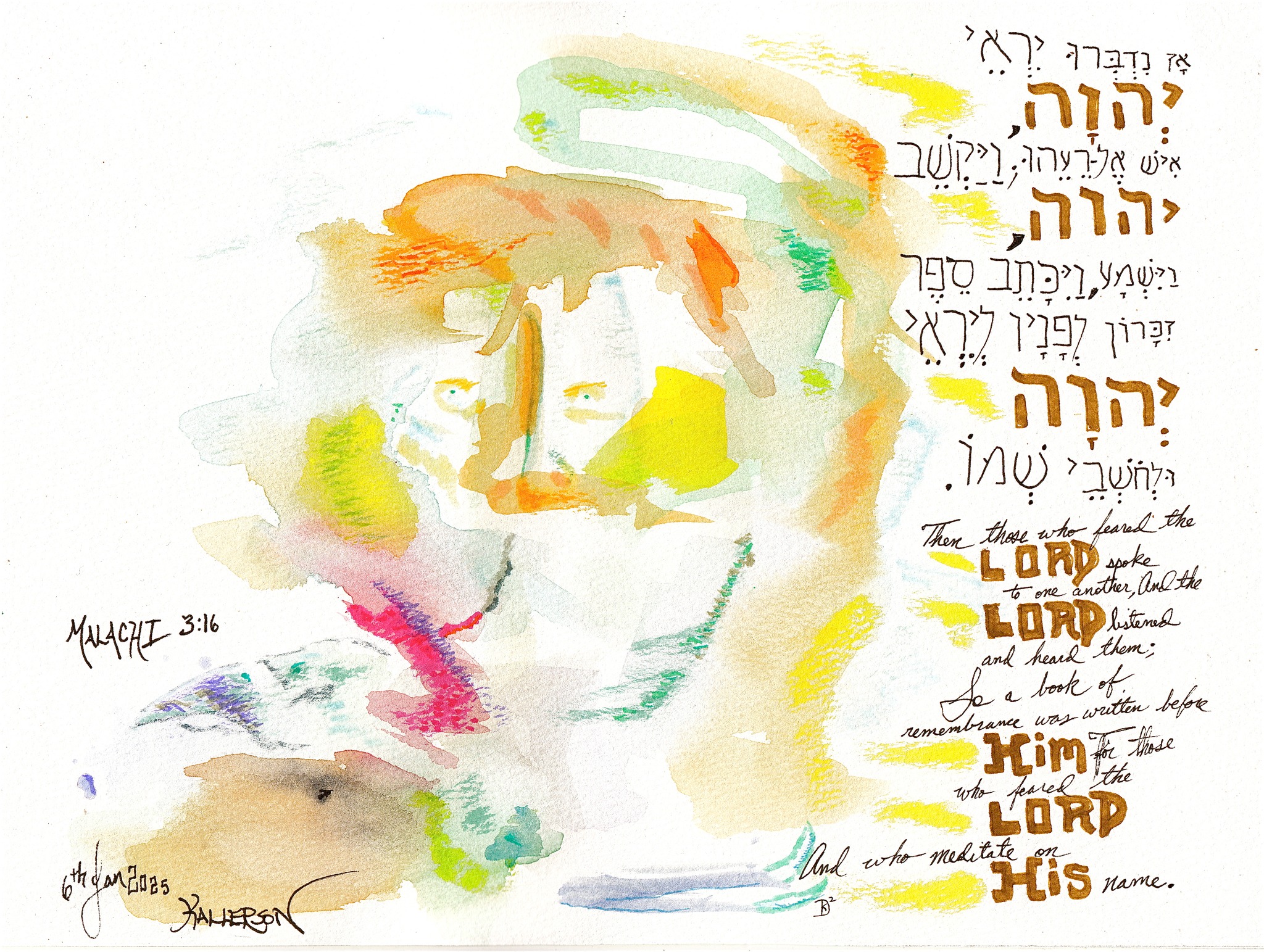
Artwork by Douglas Kallerson.
Malachi 3:13-18
And Hearkens, Yehovah, and Hears
(Typed 21 October 2024) The Lord is direct with Israel in His words through Malachi. He is clear that their attitude as a nation and a people is completely unacceptable. There is no way to sugarcoat this, and it would be pointless to attempt to do so.
Nothing has changed in the world today, so I don’t attempt to sugarcoat my words about them either. When they do well in the world, I compliment them. Because the Lord has called them back to the land He promised them, I support them in light of that.
And yet, concerning their demeanor, their attitude towards the Lord, and their arrogance in their national and cultural thinking, I don’t hold back how I feel. There is nothing antisemitic about this. If one generally evaluates the Jewish people based on their compliance with Scripture, they would be given an F-.
Overall, their humility towards God is lacking, their morals aren’t just in the john, they were flushed eons ago, and their generally superior attitude is completely unjustified. Yes, this sounds harsh, but only until we realize that Israel is merely a microcosm of the larger world.
Can anyone say any differently about most of the politicians in the world? Or about most of those who run big tech or other big corporations? Are there not feelings of superiority welling up in nations, cultures, religions, and even denominations within Christianity?
Text Verse: “And the Lord said to Moses, ‘Whoever has sinned against Me, I will blot him out of My book.’” Exodus 32:33
The faults of Israel and the Jewish people are different from the rest for one important reason: they covenanted with God. There is a benefit to this. Despite their incredibly horrible conduct before the Lord, He has promised that they will forever remain as a people before Him.
That’s a good thing, because were it not for this, the record of their conduct as found in Scripture would have merited utter annihilation eons ago. On the other hand, there are definite drawbacks to their relationship with the Lord when they fail to honor Him as they agreed.
Those drawbacks are openly and clearly recorded in the Pentateuch, especially Leviticus 26 and Deuteronomy 28. When they came about, they were obviously self-inflicted wounds, but this doesn’t make it any less tragic.
For example, and let’s be honest, from a biblical perspective – meaning taking things in context and literally – would the Holocaust have happened if the Jews were right with the Lord? Would the pogroms have happened? Would they have been exiled? The answers are obvious, even if they (and many others) will not admit it.
Israel’s Holocaust Museum, the Yad Vashem, as sad and horrific as it is to visit, is a testimony to Israel’s unfaithfulness to the Lord. Whether saying that disturbs you or makes you angry doesn’t change the fact that it is so. The book of Zechariah, which will be quoted from today, along with so many other passages of Scripture, clearly and unambiguously reveals this to us.
But again, Israel as a nation, and the Jewish people as a cultural entity, are merely a microcosm of the rest of the world. When we point our fingers at Israel and blame them for the world’s problems, we are taking a myopic view of things.
The guilt is everywhere, and it is increasing daily. This is for one main reason: the rejection of Jesus Christ. Israel was exiled and has faced many woes. The world will be joining them in the tribulation period, the time of Jacob’s trouble, for exactly this.
Remember this as we continue through and complete Chapter 3 of Malachi. When I pick on some of the Jews of the world, highlighting them for their ways, it is because they are the focus of the words of Malachi. But these words are a part of the Bible. Thus, they are instructive for all people.
This is a certain truth that is to be found in His superior word. And so, let us turn to that precious word once again, and… May God speak to us through His word today, and may His glorious name ever be praised.
I. Built Doing Wickedness (verses 13-15)
13 “Your words have been harsh against Me,”
Says the Lord,
Apart from Malachi 1:2 and 1:13, the wording is unique in the book: khazqu alay divrekhem amar Y’hovah –
“‘Seized upon Me your words,’ said Yehovah.”
In Malachi 1:2, it says, amar Y’hovah, “said Yehovah.” That is repeated in 1:13 and in this verse. Every other instance where a proclamation is made by Yehovah, it says, amar Y’hovah ts’vaoth – “said Yehovah Sabaoth.”
Rather than a proclamation from the Lord of Hosts who wields all the power of His many legions of angels, it is a pained cry from the self-existent Lord who called Israel to be His own special possession. Because of this, one can see the personal nature of the words –
1:2 – “‘I loved you, said Yehovah.’
And said, ‘In how loved us?’”
1:13 – And brought stripped, and the lame, and the rubbing.
And brought the present!
Accept it from your hand?’
Said Yehovah.”
3:1 – “‘Seized upon Me your words,’ said Yehovah.
And said, ‘What spoken upon You?’”
As such, one can see that the Lord is wounded by the event being conveyed. He loved Israel and yet their words seized Him. It was as if they violently grabbed Him with them, painfully stating things that then marred the relationship between them.
The words of the NKJV, “Your words have been harsh against Me,” are somewhat of a paraphrase, but they do get the intent across. Yehovah, who reads the hearts and minds of His people, and who is aware of every word they speak, is personally affected by the discourse He hears and the intent behind the spoken words…
13 (con’t) “Yet you say,
‘What have we spoken against You?’
vaamartem mah nidbarnu alekha – “And said, ‘What spoken upon You?’” In this, one can see that Israel understood the intent of what Yehovah said –
“‘Seized upon Me your words,’ said Yehovah.”
“And said, ‘What spoken upon You?’”
The words seized and spoken are in apposition. Israel questions what they have said that so seized Yehovah. And, as has been the case throughout the book, they ask it as if they have no idea what He is talking about, “Wha.. What? Spoken upon You? What are You talking about?”
The main issue here is essentially a denial of the omniscience of Yehovah. The form of the verb spoken, nidbarnu, is what is known as a niphal. It is either a passive or reflexive voice. Thus, these weren’t words spoken to the Lord but about Him, either muttering to themselves or among one another.
The Lord is telling them that He hears and is fully aware of what they are saying. They fail to recognize this quality and go about muttering their complaints, not considering that He is aware of every word that passes over their lips.
If one considers and takes to heart the tenth commandment, “You shall not covet,” he understands this quality and ability of the Lord. Coveting is something that occurs inside a person. It may lead to outward words or actions, but the state of coveting is only truly known to the individual and God.
In stating, “You shall not covet,” the Lord was letting them know that He was aware of their inner desires. Paul shows that this is true in Romans 7 –
“What shall we say then? Is the law sin? Certainly not! On the contrary, I would not have known sin except through the law. For I would not have known covetousness unless the law had said, ‘You shall not covet.’ 8 But sin, taking opportunity by the commandment, produced in me all manner of evil desire. For apart from the law sin was dead. 9 I was alive once without the law, but when the commandment came, sin revived and I died. 10 And the commandment, which was to bring life, I found to bring death. 11 For sin, taking occasion by the commandment, deceived me, and by it killed me. 12 Therefore the law is holy, and the commandment holy and just and good.” Romans 7:7-12
How can sin be imputed for an internal act, coveting, unless the Lord is aware of the act, meaning the evil desire, which then leads to other sins? The same is true here in Malachi concerning the words uttered in private that seized upon the Lord. Understanding this, the Lord, through Malachi, continues with his proclamation…
14 You have said,
‘It is useless to serve God;
amartem shav avod elohim – “Said, ‘Emptiness serving God.’” The word is shav, coming from sho, desolation. Thus, it is a state of nothingness or emptiness. This tells us that the words referred to in the previous verse are not unlike those of verse 2:17 –
“Gasped, Yehovah in your words,
And said, ‘In what gasped?’
In your saying, ‘All doing evil good in eye Yehovah.
And in them He inclined.’
Or, ‘Where God the verdict?’”
The actions of the people are equated to their words as if their actions are openly proclaiming the intent of the heart. The word “words” in verse 2:17 is not to be taken literally. The words being referred to are not specifically the words spoken by the people, but what was spoken by them leads to the thought being expressed by Yehovah.
The people may have said, “Why are we wasting our time with offerings, sacrifices, and tithes? The nations around us don’t do these things and they are all prospering. We are no worse off when we don’t do these things, and we are no better off when we do them.” This type of attitude is equated to “Emptiness serving God.”
This demonstrates a fundamental misunderstanding of Israel’s position before the Lord. They, as a nation and a people, agreed to the conditions of the Mosaic covenant. Throughout the years, they voluntarily recommitted to it time and time again.
The requirement to serve God as a nation was not optional. Their fathers had entered into the covenant for them, and it was binding upon them. What seemed to them to be emptiness (meaning pointless) was still required, whether they liked it or not.
To understand, one might consider the Jews in America today. They are prosperous, famous, intellectuals, movie stars, etc. They might say, “Why do I need to read the Bible? Why do I need to know about the conditions set forth in the law? Why do I need to worship Yehovah? I am rich, famous, and have power and influence!”
That attitude is then returned to them with the words, “Said (pl.), ‘Emptiness serving God.’” The attitude of the Jews of America is that they are already okay with the Lord. They have everything anyone could ask for. Tossing Him into their everyday lives is completely unnecessary because they are already full of all they could ever want.
Now take the opposite circumstances. The Jews of Nazi Germany considered themselves the people of the Lord. And yet, they were being exterminated by the government of the nation in which they lived. They might say, “Why should we serve the Lord? We are His people, and yet we are being led as sheep to the slaughter. What good has He ever been to us?” This is what the people of Jeremiah’s time essentially said.
Again, it reflects a complete misunderstanding of who they are in relation to the Lord. It is not their choice. That decision was made for them in the past. They are under obligation to serve Yehovah. Until they come to Jesus, that means living and dying by the Mosaic Law.
But even more, the words of the Lord, which reflect the sentiment of the people, say, “Emptiness serving God.” Yehovah is God, but the people have distanced themselves from this truth, trying to shake off their calling altogether. They think not only is it pointless to serve Yehovah (who is God), but it is pointless to serve God in general.
It is the atheistic attitude that permeates the Jewish society to this day. Even when they proclaim that they are the people of the Lord and the chosen of God, their actions deny that they accept either.
This isn’t just a diatribe against Israel. Rather, the same attitude permeates other religions and cultures as well. During the elections, Kamala Harris claimed to be a Christian and allowed people to equate her to Jesus or a “spiritual” Christian in various ways.
And yet, when she openly spoke about abortion, someone in the crowd called out, “Jesus is Lord.” Her response spoke volumes about her supposed “faith.” She belittled him, saying that he was “at the wrong rally” further demeaning him by saying, “No, I think you meant to go to the smaller one down the street.”
This is the arrogant and vile attitude on display in Malachi and which Isaiah called out. Jesus cited it, saying –
“These people draw near to Me with their mouth,
And honor Me with their lips,
But their heart is far from Me.” Matthew 15:8
One can see this attitude in the continued words…
14 (con’t) What profit is it that we have kept His ordinance,
And that we have walked as mourners
Before the Lord of hosts?
u-mah betsa ki shamaru mishmarto v’ki halakhnu q’doranith mipne Y’hovah ts’vaoth –
“And what gain, for kept His watch,
And for walked blackishly in faces Yehovah Sabaoth.”
Here is a word found only this one time in Scripture, the adverb qedoranith. It comes from qadar, to be blackish. Thus, it literally means blackishly. Figuratively, it gives the sense of mourning.
Though using a different word translated as “mourning,” the sense is understood from Zechariah 7 –
“Then the word of the Lord of hosts came to me, saying, 5 ‘Say to all the people of the land, and to the priests: “When you fasted and mourned in the fifth and seventh months during those seventy years, did you really fast for Me—for Me? 6 When you eat and when you drink, do you not eat and drink for yourselves? 7 Should you not have obeyed the words which the Lord proclaimed through the former prophets when Jerusalem and the cities around it were inhabited and prosperous, and the South and the Lowland were inhabited?”’” Zechariah 7:4-7
The Lord charges the people with their words which were reflective of their conduct. “Why are we bothering with considering the Lord, keeping His watch, and mourning before Him? Nothing changes regardless of what we do.”
Here, however, they say Y’hovah ts’vaoth, Yehovah Sabaoth. They have demonstrated an atheistic attitude, essentially mocking Him. “If He is the Lord of Hosts, why isn’t He using His hosts to exalt us as He promised?”
Yehovah is supposedly God. He supposedly has all of heaven’s power at His disposal, and yet, they believe doing things they are supposed to do is no different than if they don’t do them. Never mind that Israel almost never did what they were supposed to do. Because of this attitude…
15 So now we call the proud blessed,
The words are emphatic: v’atah anakhnu m’ashrim zedim – “And now, we straighten arrogant.” In verses 3:10-12, the Lord promised the people that if they did what was right, He would bless them even to overflowing. In 3:12, it says, “And straightened you, all the nations.”
In essence, “All nations will call you blessed.” However, the people essentially turn around and say, “Oh yeah! Serving You counts for nothing. There is no benefit in it. Instead of the nations calling us blessed, we call the arrogant blessed.”
The word translated as arrogant, zed, comes from zud, to boil. Thus, “Those who are proud and boastful are the ones who get ahead! Why should we serve Yehovah blackishly when we can be proud, boastful, and arrogant while living comfortably?” This is the attitude that the people are displaying and which continues today. This is because…
15 (con’t) For those who do wickedness are raised up;
They even tempt God and go free.’”
gam nivnu ose rishah gam bakhanu elohim vayimaletu –
“Also built doing wickedness,
Also tested God and escape.”
The clauses are parallel and highlighted by the word gam, also. Thus, they build upon the first clause. The arrogant are considered straightened (blessed). Also those who are doing wickedness are built up, and also those who test God escape from any judgment.
This is the attitude of the Jewish people. Mel Brooks is a good example. Even if his movies are funny, they show a disregard for the Lord and His word. Much of what he put forth is simply wickedness, and yet he has been abundantly built up in fame and fortune.
And more, at times his films actually test God in a mocking, dismissive, or belligerent attitude. Despite this, he has had a long life (98 years so far) with no harm or trouble. People see this type of thing going on in the world and naturally question God’s ways, dismiss the Lord, neglect the covenant, and go about pursuing the same perverse life that they see as rewarding.
Now, after all of this chiding by the Lord, if we go back to Malachi 1, the reason for speaking against Edom ought to be obvious. Israel was (and remains to this day) intolerable before the Lord. The only thing that set them apart and which has spared them for millennia has been God’s covenant affection toward them –
A lifting – word Yehovah unto Israel in hand Malachi.
2 “‘I loved you said Yehovah.’
And said, ‘In how loved us?’
‘Not brother, Esau, to Jacob?’
Utterance Yehovah.
‘And I love Jacob.
3 And Esau, I hate,
And set his mountains – a devastation.
And his inheritance to jackals wilderness.’”
4 “For says Edom,
‘Demolished! And return, and build wastelands.’”
“Thus said Yehovah Sabaoth:
‘They build, and I raze.
And called to them Territory Wickedness,
And “the people whom frothed Yehovah until vanishment.”
5 And your eyes see,
And you say,
‘Magnified, Yehovah, from upon to border Israel.””
Whereas Edom was destroyed and lost as a nation, Israel has continued, but only because of the Lord’s faithfulness to them.
Look at how much money he has!
Despite all the rotten things he does
He has cars and boats and all that jazz
And he always gets a pass when arrested by the Fuzz
Everyone knows he is a total crook
And yet he prospers everywhere he turns
Obviously, God doesn’t care or look
From him, the rest of society notices and learns
Where is the God who judges us?
It is useless to serve Him, so we can tell
Why should we fear rejecting Jesus?
When doing wrong, everything stays swell
II. Between Just to Wicked (verses 16-18)
Despite the overall conduct of Israel, there are those who actually care about their relationship with the Lord. They are the faithful remnant noted throughout the Bible. Paul refers to them in Romans 11 –
“I say then, has God cast away His people? Certainly not! For I also am an Israelite, of the seed of Abraham, of the tribe of Benjamin. 2 God has not cast away His people whom He foreknew. Or do you not know what the Scripture says of Elijah, how he pleads with God against Israel, saying, 3 ‘Lord, they have killed Your prophets and torn down Your altars, and I alone am left, and they seek my life? 4 But what does the divine response say to him? ‘I have reserved for Myself seven thousand men who have not bowed the knee to Baal.’ 5 Even so then, at this present time there is a remnant according to the election of grace. 6 And if by grace, then it is no longer of works; otherwise grace is no longer grace. But if it is of works, it is no longer grace; otherwise work is no longer work.” Romans 11:1-6
Of this faithful remnant at Malachi’s time, the words next convey three identifying factors concerning them…
16 Then those who feared the Lord spoke to one another,
az nidbru yire Y’hovah ish eth reehu – “Then spoke, ‘fear Yehovah,’ man to his friend.” There are two identifying characteristics stated here. One is there are those who fear the Lord. As it says elsewhere –
“And to man He said,
‘Behold, the fear of the Lord, that is wisdom,
And to depart from evil is understanding.’” Job 28:28
Second, those who fear the Lord speak about their fear of Him. They don’t just keep quiet, but rather, they share their hope in Him.
As for the first word, az, it signifies “at that time.” In other words, what is said here is the exception within Israel. The words of the nation as a whole seized upon the Lord. However, at that time, there were those within the nation who feared the Lord and each spoke to his friend from that perspective.
As for the meaning, it may be as the NKJV translates it. There are those in Israel who have a fear of Yehovah. They speak to their friends who also fear Yehovah. Or it could mean that those who had a fear of Him spoke, “man to his friend,” in order to convince his friend to fear Him.
Either way, there are those who fear the Lord and who speak about Him in a right, positive manner. This is not unknown or ignored by Him. Rather…
16 (con’t) And the Lord listened and heard them;
Rather: vayaqshev Y’hovah vayishma – “And hearkens, Yehovah, and hears.” The inserted word “them” may or may not be correct based on what was said before. It may be that the previous clause refers to discourse between two parties. Or it may be individuals who fear the Lord and tell others to do so as well.
Either way, the Lord hears their words and hearkens to them. In His hearkening and hearing…
16 (con’t) So a book of remembrance was written before Him
vayikathev sepher zikaron l’phanav – “And writes book remembrance to His faces.” The words here are written for our benefit, not the Lord’s. There is nothing He needs to remember, nor is there anything He either doesn’t know or could forget.
As such both the words “remembrance” and “book” are to be taken figuratively or anthropomorphically. This is true in other such references to books referred to in the Bible in this manner.
It is true that God could have a book written up with all the deeds of man in it, but the idea of a “book” here is more likely just a way of saying that God, who knows and remembers all things, will remind us of every good or evil deed we have done.
However He will accomplish this, the remembrance of those who fear Him and speak rightly concerning Him will come to pass. With that understood, the thought is confirmed with the words…
16 (con’t) For those who fear the Lord
And who meditate on His name.
l’yire Y’hovah ul’khoshve sh’mo –
“To ‘fear Yehovah,’
And reckoning His name.”
The first identifying characteristic is restated here as those who fear Yehovah. That is then followed by a third characteristic, those who are reckoning His name. The use of the participle, reckoning, shows the ongoing nature of their conduct.
They don’t just reckon Him and move on, but they continue to think about Him. As for the word translated as reckon, khashav, this is its only use in Malachi. It signifies to plait or interpenetrate. Such a person weaves the knowledge of God into his thoughts and actions.
Thus, the use of this word is parallel to but also expands upon, the thought of those who “spoke” in the first clause. Their speaking about the Lord is based on their fear of Him which is reckoned by them. One can speak without thinking, but these fear, consider, and then speak. Of them…
17 “They shall be Mine,” says the Lord of hosts,
Rather, the verb is in the perfect aspect: v’hayu li amar Yehovah ts’vaoth –
“‘And became to Me,’
Said Yehovah Sabaoth.”
It is already done, not in the future, even if the benefit is future. That is not unlike our salvation. In God’s eyes, it is done. We are His, even if we are still here living in sin-sacks and offending Him daily. The day we called on Jesus, we became the Lord’s.
What we possess is not a dubious claim that can be lost through negligence or faithlessness. Rather, we have assurance, even when we might not feel assured. Such is true with these people. Those fearing Yehovah stood before Him justified…
17 (con’t) “On the day that I make them My jewels.
Rather: layom asher ani oseh s’gulah – “‘To the day which I making possession.” Those who feared the Lord are remembered by Him. They had become His, and this was for a set time and purpose. The day is one determined by Him but which will come to pass. The purpose is that they will be a part of His possession.
The word is s’gullah. It is from the passive participle of an unused root meaning to shut up. One might shut up wealth, treasure, jewels, etc. The NKJV dubiously paraphrases the thought with “My jewels,” but it simply signifies a possession.
The thought here is in line with that of 1 John 5:19, 20. There he says –
“We know that we are of God, and the whole world lies under the sway of the wicked one.
20 And we know that the Son of God has come and has given us an understanding, that we may know Him who is true; and we are in Him who is true, in His Son Jesus Christ. This is the true God and eternal life.”
In other words, because of Jesus, we move from the power of the devil to that of Christ. This is true with the Old Testament saints, even though Christ had not yet come. They lived by faith in the Lord and in the anticipation of the Messiah. Today, we live by faith in the Messiah who has come.
Those who became the Lord’s before Christ’s coming will be a part of His possession that is to be expressed in the millennial reign of Christ. Those who are Christ’s after His coming will be taken at the rapture to be a part of His eternal heavenly kingdom. As for those Old Testament saints…
17 (con’t) And I will spare them
As a man spares his own son who serves him.”
v’khamalti alehem kaasher yakhmol ish al b’no ha’oved oto –
“And commiserate upon them,
According to which commiserates man upon his son – the ‘serving him.’”
The word is khamal, to commiserate. As such, it is quite often rendered to spare or have pity on. In this case, because of the additional word al, upon, saying commiserate is appropriate. But more, He adds in the thought that this will be as a man commiserates upon the son who faithfully serves him.
It is a wonderful set of words. The relationship between the Lord and those who are faithful to Him is as close as that of a father and his beloved and faithful son, who appropriately and devotedly serves him.
This tells us that the Lord will have sympathy upon the faithful of Israel, even while He is judging the unfaithful and sending them to their just punishment. That overall thought is then expressed in the final verse of the chapter…
18 Then you shall again discern
Between the righteous and the wicked,
v’shavtem urithem ben tsadiq l’rasha – “And returned and seen between just to wicked.” The thought here speaks of the nation that will be realized in the millennium. In other words, those who have been spoken of will be commiserated upon by the Lord.
They will be raised before the millennium. They will be a part of the generation who is returned to Israel, having understood the fullness of the redemptive narrative as it has played out in the nation of Israel. This is seen in two separate thoughts.
The first is the state of the Old Testament saints before Christ’s coming, such as Daniel –
“And many of those who sleep in the dust of the earth shall awake,
Some to everlasting life,
Some to shame and everlasting contempt.” Daniel 12:2
These will be a part of what is known as “the first resurrection” in Revelation 20, a resurrection that will include those who were beheaded for Jesus during the tribulation and who did not receive the mark of the beast.
Along with them, there will be those of Israel who survive through the tribulation and who will be alive at the second coming of Christ. They are detailed in Zechariah 12:10-14.
Together, they will comprise those who enter the millennium and receive the promises made throughout the Old Testament to the nation of Israel. They will at that time discern “between just to wicked,” meaning they will understand how the Lord deals with His people from the just even to the wicked. That thought is taken and further explained with our final words of the day…
*18 (fin) Between one who serves God
And one who does not serve Him.
ben oved elohim laasher lo avado – “Between serving God to whom not Him served.” The thought takes us right back to verse 3:14 where it said, “Emptiness serving God.” Those who found serving God pointless will see the error of their thinking.
They think that life is about them, their prosperity, their contentment, and so forth. That is not the point of serving God. Those who faithfully serve Him are found in almost every condition imaginable.
Some were wealthy and attained a good old age, like Abraham. Some were called to lives without wives and children and who suffered constantly at the hands of the people, like Jeremiah. David became king and led the nation. Others lived lives of almost total obscurity.
Serving God is not at all about us and our happiness. It is an attitude that comes from within and transcends whatever situation we find ourselves in. David was a man after God’s own heart while reigning as king. Other kings completely ignored the Lord, boasted against Him, walked away from Him, etc.
The people in the millennium will return and discern who is righteous and who is wicked. They will understand what faithful service to the Lord means, and they will be His people in that day. Chapter 4 will further explain the difference between such people.
For now, it is to be remembered by each of us that God is not inattentive to our lives and actions. If He is God, He knows everything about us, everything we think, and every action we take.
This isn’t intended to scare us. Rather, it is simply a truth that exists. What should scare us is when we are unprepared for the inevitable meeting we will have with Him. If we are wise, we will heed the words of Scripture and have a reverent fear of the Lord.
Today, that no longer means what it did during Malachi’s time. The Lord spoke to Israel as a nation. The nation as a whole turned and talked back to the Lord, denied their guilt, rejected His ways, and said that it was pointless to serve Him as they had been directed.
There were some who took the words of Malachi to heart and stood against this national trend by remaining faithful to their God according to the plan set forth by Moses. With the coming of Christ, a new direction was set. The people were no longer to cling to Moses, but to Jesus, of whom Moses wrote.
As a nation, they failed at this. But as Paul explained, a remnant of Israel has remained faithful to God through their allegiance to Jesus. And more, the Gentiles have come to Jesus in droves. This is what pleases God, faith in what He has done through Jesus.
Despite our failings, that God sees and knows in minute detail, if we have called on Christ in faith, we will be remembered on that great day when He calls, and we will be taken to glory. No promise of God will fail, and no person who has lived since Adam will be overlooked in His judgment of humanity.
Be prepared for that day by being set apart to Him through the precious blood of Christ. The tithes and offerings of the past find their fulfillment in Him. Those things, and indeed all of the precepts of the Law of Moses, were simply an instructional tool to lead Israel to understand their need for Christ.
Their failure to grasp this in no way negates that Scripture, which tells us of Israel, is intended for the same purpose: to lead us to Jesus. Let us not get bogged down in law observance but rather rightly understand what God is doing in and through Israel as detailed in His word. May it be so, to the glory of God who gave us Jesus.
Closing Verse: Now Enoch, the seventh from Adam, prophesied about these men also, saying, “Behold, the Lord comes with ten thousands of His saints, 15 to execute judgment on all, to convict all who are ungodly among them of all their ungodly deeds which they have committed in an ungodly way, and of all the harsh things which ungodly sinners have spoken against Him.” Jude 1:14, 15
Next Week: Malachi 4:1-6 Can’t you just hear the drummers drumming (The Day is Coming) (10th and final Malachi Sermon)
The Lord has you exactly where He wants you. He has a good plan and purpose for you. He has sent His Messenger to carry the good news to all people. Jesus! God promised, and God delivered. The time of the law has ended, and grace has come. Praise God for Jesus.
Malachi 3:13-18 (CG)
13 “‘Seized upon Me your words,’ said Yehovah.
And said, ‘What spoken upon You?’
14 Said, ‘Emptiness serving God,
And what gain, for kept His watch,
And for walked blackishly in faces Yehovah Sabaoth.
15 And now, we straighten arrogant,
Also built doing wickedness,
Also tested God and escape.’”
16 Then spoke, ‘fear Yehovah,’ man to his friend,
And hearkens, Yehovah, and hears,
And writes book remembrance to His faces,
To ‘fear Yehovah,’
And reckoning His name.
17 “‘And became to Me,’
Said Yehovah Sabaoth.”
“To the day which I making possession.
And commiserate upon them,
According to which commiserates man upon his son – the ‘serving him.’
18 And returned and seen between just to wicked,
Between serving God to whom not Him served.”
(NKJV)
13 “Your words have been harsh against Me,”
Says the Lord,
“Yet you say,
‘What have we spoken against You?’
14 You have said,
‘It is useless to serve God;
What profit is it that we have kept His ordinance,
And that we have walked as mourners
Before the Lord of hosts?
15 So now we call the proud blessed,
For those who do wickedness are raised up;
They even tempt God and go free.’ ”
16 Then those who feared the Lord spoke to one another,
And the Lord listened and heard them;
So a book of remembrance was written before Him
For those who fear the Lord
And who meditate on His name.
17 “They shall be Mine,” says the Lord of hosts,
“On the day that I make them My jewels.
And I will spare them
As a man spares his own son who serves him.”
18 Then you shall again discern
Between the righteous and the wicked,
Between one who serves God
And one who does not serve Him.