Saturday, 21 November 2026
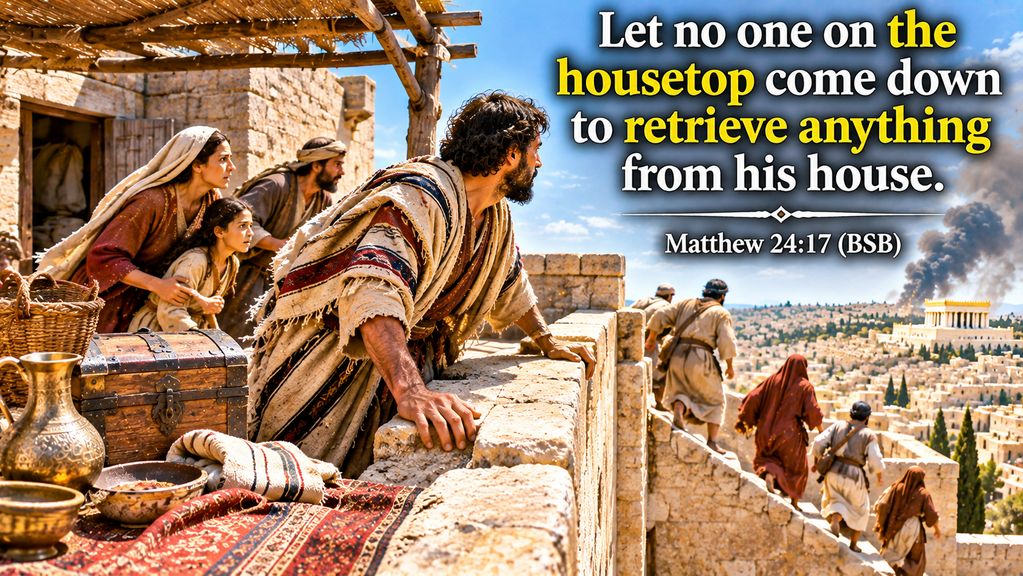
Let him who is on the housetop not go down to take anything out of his house. Matthew 24:17
Note: You can listen to today’s commentary courtesy of our friends at the “Bible in Ten” podcast. (Click Here to listen)
You can also read this commentary, scrolling with music, courtesy of our friends at “Discern the Bible” on YouTube. (Click Here to listen), or at Rumble (Click Here to listen).
“The ‘upon the roof’, not he must descend to take the ‘from the house, his’.” (CG)
In the previous verse, Jesus warned those in Judea who will see the ‘detestation, the despoliation’ standing in the holy place to flee upon the mountains. He continues, saying, “The ‘upon the roof’.”
In the Middle East, the roof is considered a part of the house. People barbecue on it, set out chairs for guests and gatherings, and some even sleep on the roof if the weather is nice. Jesus uses this place of rest, family, and fellowship to heighten the urgency of His words, saying, “not he must descend to take the ‘from the house, his’.”
To get to the roof, there might be a couple of staircases: one from the road or lawn and one from the living spaces inside. Within a city, the houses are built one next to the other so that people can walk along the tops of the houses, even to the walls or gated area.
The definite article before ‘from the house, his’ is plural. Hence, the word anything or “those” provides the needed sense. The meaning is that the people were to take the outside way down, whether the second staircase or a path to the city gate, but they were not to go back to their own living area and worry about taking things.
In doing so, they would waste time needed to get away, and they would unnecessarily burden themselves with things that could not profit them in the day of disaster. The idea is expressed in Lamentations –
“How the gold has become dim!
How changed the fine gold!
The stones of the sanctuary are scattered
At the head of every street.” Lamentations 4:1
In a day of calamity, things that seem to have great value will be unhelpful, only a burden, and eventually just cast aside. Jesus’ words carry the urgency of the warning for Lot to get out of Sodom. There was to be no hesitation and nothing to burden them in their flight.
Life application: When Mount Vesuvius blew in AD79, there was little chance to get away, and yet, the bodies of people who were entombed in the ash were found to have tools, jewelry, and other items clutched in their hands. Instead of fleeing, they stopped to pick things up.
One woman was found holding gold, silver, bronze coins, and a pair of gold and pearl earrings. A man was found to have grabbed a bag packed with bronze and silver coins, a slate slab for preparing medicine, and some metal surgical instruments like scalpels and tweezers. It is believed he was a doctor who grabbed his medical kit hoping to preserve his livelihood.
Others like them looked to secure the future, which would never arrive by retrieving and holding on to the things of the world. In such a situation, it is important not to look at what one has, but at how to survive without such things. Starting again is something many have done successfully, but one cannot start again if he is entombed in volcanic ash.
As for preparedness, the one thing we must get right before the day of calamity is our relationship with God. Nothing else matters when our final moment arrives. There is no going back and getting that issue resolved when you are flying out of a car window because you didn’t buckle your seatbelt before the accident.
True wisdom is found in seeking God while He may be found. In the end, without Him, our eternal state will be hell.
Lord God, may we think through our lives, considering if we are prepared for the moment when they will end. If we have called on Jesus, help each of us to carefully evaluate our priorities, ensuring others also know that there is a day ahead when we must stand before You. May we be willing to tell them how to make it a happy event. Amen.