
Thursday, 19 November 2026
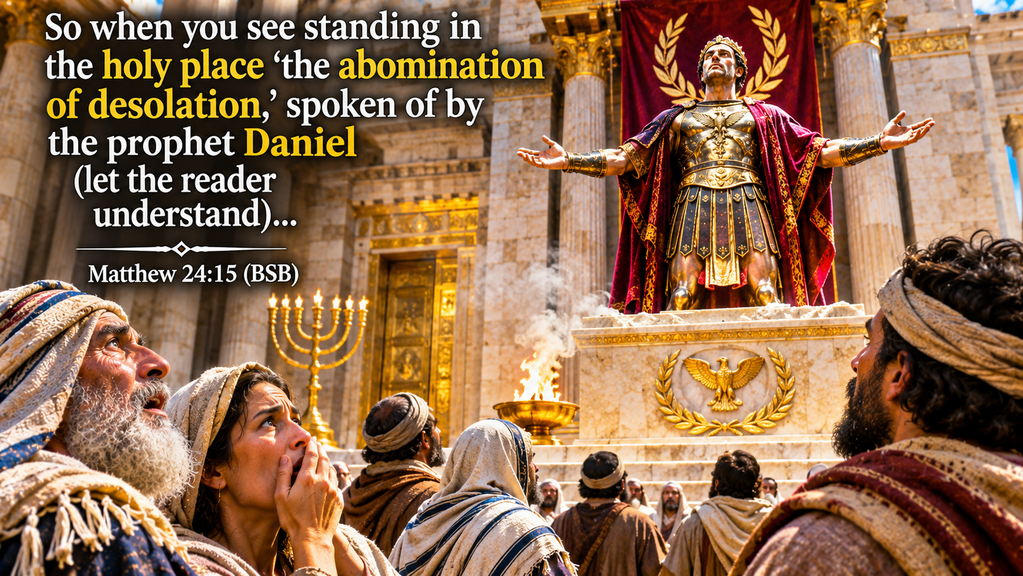
“Therefore when you see the ‘abomination of desolation,’ spoken of by Daniel the prophet, standing in the holy place” (whoever reads, let him understand), Matthew 24:15
Note: You can listen to today’s commentary courtesy of our friends at the “Bible in Ten” podcast. (Click Here to listen)
You can also read this commentary, scrolling with music, courtesy of our friends at “Discern the Bible” on YouTube. (Click Here to listen), or at Rumble (Click Here to listen).
“When, therefore, you shall see the ‘detestation, the despoliation’, the ‘having been uttered through Daniel the prophet’ having stood in ‘place, holy’ (the ‘reading’, let him understand),” (CG)
In the previous verse, Jesus said the gospel of the kingdom would be proclaimed throughout the world as a testimony to all nations. After that, the conclusion will come. He next says, “When, therefore, you shall see the ‘detestation, the despoliation’.”
Two new words are seen here. The first is bdelugma, a detestation. HELPS Word Studies says, “to reek with stench.” It is something disgustingly abhorrent. This is not limited to physical stinkiness. Vincent’s Word Studies says, “The cognate verb, βδελύσσομαι [bdelussomai], means to feel a nausea or loathing for food: hence used of disgust generally. In a moral sense it denotes an object of moral or religious repugnance.” The stinkiness can be spiritual or otherwise figurative.
The second word is erémósis, despoilation or desolation. HELPS Word Studies says “desolation (desecration) that results from being cut off (isolated).” Jesus continues His words of this reeking despoilation, saying, “the ‘having been uttered through Daniel the prophet’.”
In other words, Jesus confirms the prophetic reliability of Daniel the prophet. Something will occur that was prophesied by Daniel that would be the fulfillment of his words. Jesus’ words match the Greek of Daniel 12:11. There it says, to bdelugma eremoseos, the ‘detestation, despoilation’. In Matthew, it says, to bdelugma tes eremoseos, the ‘detestation, the despoilation’.
The additional article makes this a specific and identifiable thing. Of this reeking thing, Ellicott says, “What analogous desecration our Lord’s words point to, is a question that has received very different answers. … The answer is probably to be found in the…” From there, he continues with suppositions, all of which point to events that took place during the destruction of the temple in AD70. This is a common view for much of the church. It is viewed as an event that took place two thousand years ago.
As for Ellicott’s and others’ thought process, it means something so precisely stated by Jesus has to be guessed at by us today. That seems incredulous. Why would Jesus cite the prophet, state what will be seen, and then it not be certain what it was? Jesus continues His specificity, referring to that “having stood in ‘place, holy’.”
A perfect participle is used. Something will be stationed in the holy place, and it will continue to be stationed there. The holy place can mean nothing other than the temple. Jesus is speaking to His disciples, and that is the obvious reference to His words.
Daniel confirms this, saying, “And from the time that the daily sacrifice is taken away, and the abomination of desolation is set up, here shall be one thousand two hundred and ninety days. 12 Blessed is he who waits, and comes to the one thousand three hundred and thirty-five days” (Daniel 12:11, 12).
The problem with tying this to the temple destruction in AD70 is that Daniel 12:1-3 speaks of this same time of trouble that Jesus refers to in Matthew 24. At the end of that period, it says that there will be a resurrection. That did not happen in AD70. There is also no historical point that matches the time periods mentioned in Daniel 12:11, 12.
For such precise prophecies, there will be a set and easy-to-match historical event. None has occurred. Rather, what Jesus refers to in this passage points to something in the future to us now. This means there will be another temple in Israel, sacrifices will take place, and those sacrifices will be stopped. At that time, the ‘destruction, the despoilation’ will be set up. With this anticipation, Jesus says, “the ‘reading’, let him understand.”
The meaning is that the one who reads Daniel should consider his words, contemplate them, and understand what the prophecy recorded there points to. For those in Israel who are willing to pay heed, they will know that the fulfillment of the prophecy has arrived.
We are not left without further explanation of this event. Paul refers to it in 2 Thessalonians 2 –
“Now, brethren, concerning the coming of our Lord Jesus Christ and our gathering together to Him, we ask you, 2 not to be soon shaken in mind or troubled, either by spirit or by word or by letter, as if from us, as though the day of Christ had come. 3 Let no one deceive you by any means; for that Day will not come unless the falling away comes first, and the man of sin is revealed, the son of perdition, 4 who opposes and exalts himself above all that is called God or that is worshiped, so that he sits as God in the temple of God, showing himself that he is God.” 2 Thessalonians 2:1-4
In 2 Thessalonians 2, Paul’s words provide the exact timeline of the rapture of the church. He says exactly what will take place and the order in which it will occur. There will be a pre-tribulation rapture. After that, the antichrist will be revealed because he will be the one to execute a seven-year peace deal as outlined in Daniel 9. Eventually, he will enter the holy place, setting up his position of authority there, and proclaiming himself to be God. This is the ‘detestation, the despoilation’ Jesus refers to now.
Life application: The words of Jesus, combined with those of the prophets as well as the New Testament writers, tell us with all certainty that God is not done with Israel. The church has not replaced Israel, and what is coming in the future will not include the church.
Paul’s timeline is exactingly precise. However, when the words of Jesus, which refer to events about Israel and the Jewish people, are mixed with what happens to the church, only confusion will result. Proper understanding of eschatology demands that dispensational lines be carefully maintained.
To overlap what Jesus says in Matthew 24 with events that pertain to the church obliterates any possibility of understanding what will take place in the future. Therefore, be sure not to obliterate your understanding of what will take place in the future! Keep your dispensational lines set and fixed.
Lord God, because of Your great faithfulness to Your people, despite our continuous failure to do what we should, we are kept according to Your word. You have kept disobedient Israel for thousands of years, despite their conduct. And You have promised to keep us because of the covenant You made through the blood of Christ. Thank You for Your faithfulness. Amen.