
Friday, 30 October 2026
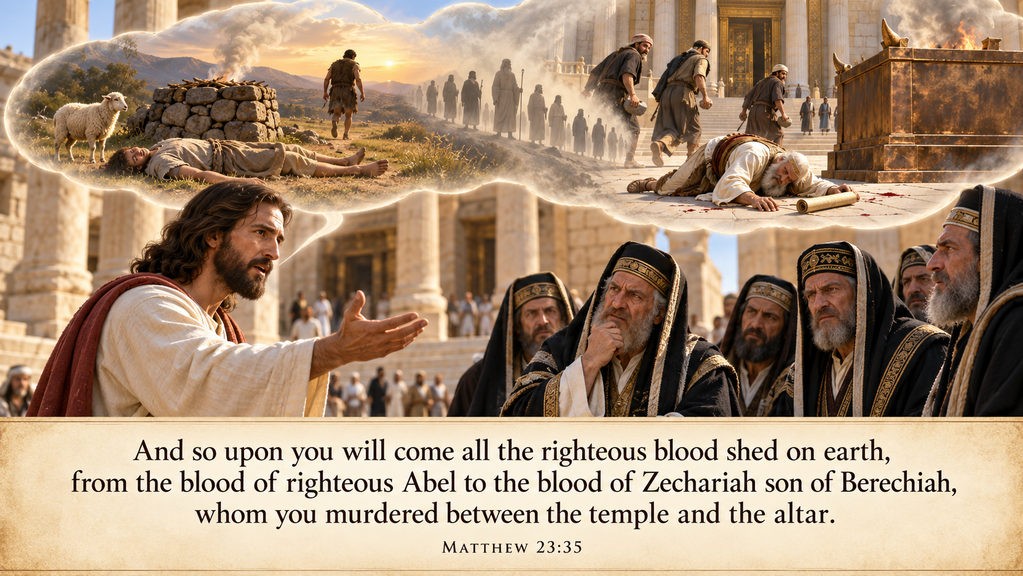
that on you may come all the righteous blood shed on the earth, from the blood of righteous Abel to the blood of Zechariah, son of Berechiah, whom you murdered between the temple and the altar. Matthew 23:35
Note: You can listen to today’s commentary courtesy of our friends at the “Bible in Ten” podcast. (Click Here to listen)
You can also read this commentary, scrolling with music, courtesy of our friends at “Discern the Bible” on YouTube. (Click Here to listen), or at Rumble (Click Here to listen).
“That it should come upon you all ‘blood, righteous’ being outpoured upon the earth, from the ‘blood, Abel, the righteous’ until the ‘blood, Zechariah, son, blessed of Yah’ whom you murdered between the temple and the altar.” (CG)
In the previous verse, Jesus told the scribes and Pharisees that He would send them prophets, wise men, and scribes, noting that they would crucify some, and some they would scourge or persecute. He next explicitly states what the result of this will be, saying, “That it should come upon you all ‘blood, righteous’ being outpoured upon the earth.”
The meaning of “upon you” is the bloodguilt of the righteous who had been killed. There is a constant stream of the righteous being killed in the pages of Scripture. The Jews had confirmed that they are the sons of those who had done those things through their building of tombs and adorning sepulchers. Thus, there was an admission by them of the connection to the guilt of that outpoured blood.
Jesus says that the judgment and punishment for this was to come upon them. This includes the bloodguilt of every single such person in the Hebrew Scriptures, as witnessed by His next words, which begin with, “from the ‘blood, Abel, the righteous’.”
Abel is introduced here in the New Testament. His name is from havel, vanity, or emptiness. Abel was the first person recorded as having been killed in the Bible. The record of it is found in Genesis 4:8 –
“Now Cain talked with Abel his brother; and it came to pass, when they were in the field, that Cain rose up against Abel his brother and killed him.”
Jesus calls Abel “the righteous” because he did what was right by bringing an offering in faith before the presence of the Lord. Jesus’ all-inclusive list goes “until the ‘blood, Zechariah, son, blessed of Yah’.”
The record of this name has given as much difficulty to the narrative as anything found in the book of Matthew. Jesus is detailing a list of people noted in Scripture by using a “first and last” reference, which sit as bookends to the entire list of those who logically fall between them.
The Hebrew canon does not end with Malachi, as does the common Christian canon of the Old Testament. Rather, the Hebrew Scriptures go from Genesis to Chronicles (1 & 2 Chronicles are considered one book). The last martyr noted in the book of Chronicles is found in 2 Chronicles 24 –
“Then the Spirit of God came upon Zechariah the son of Jehoiada the priest, who stood above the people, and said to them, ‘Thus says God: “Why do you transgress the commandments of the Lord, so that you cannot prosper? Because you have forsaken the Lord, He also has forsaken you.”’ 21 So they conspired against him, and at the command of the king they stoned him with stones in the court of the house of the Lord.” 2 Chronicles 24:20, 21
Thus, Jesus’ listing implies every person between and including these two men. The problem in Matthew is that he says Zechariah the son of Berechiah, not Jehoiada. The only Zechariah, son of Berechiah, is the prophet Zechariah who wrote the book of Zechariah (see Zechariah 1:1 and 1:7).
Because of this, various suggestions have arisen. The standard liberal suggestion is that this is an error in the text. Some say it is a later interpolation by some unknown scribe. Some say this is the same as Zechariah, son of Baruch, mentioned by Josephus.
That is obviously wrong because Baruch and Berechiah are not the same name. It would further blow the obvious structure of Jesus’ words being an all-inclusive list from Genesis to Chronicles. Further, Josephus’ writings date after the time of Jesus. We know that Jesus is making such an all-inclusive list because of His final words, “whom you murdered between the temple and the altar.”
Jesus makes this murder of Zechariah the closing death recorded in His all-inclusive list. It is a summary His audience would have understood perfectly. But because the name is not the same, the difficulty remains. Therefore, other suggestions have been given, none of which seem to explain the intent. This is because they are tying the name to a genealogy.
However, in the Bible, a son does not always refer to a genealogical identity between a father (or greater ancestor) and a child. Rather, the word son is just as commonly used to signify identity, such as “son of murderers,” “son of death,” “son of God,” etc.
Both names, Zechariah and Berechiah, are introduced here. Zechariah is from zakar, to remember, or zakar, a male, and Yah, a shortened form of Yehovah. The name means Remembered of the Lord, Yah Remembers, Male of Yah, or something similar.
Berechiah comes from berek, the knee, and Yah. The noun berek corresponds to the verb barak, to bless. The reason is that a blessing comes from a position of kneeling, either as an act of adoration or as a benefit.
For example, it says in Genesis 1:22 that God blessed (barak) the creatures, telling them to be fruitful and multiply. Thus, there is benefit bestowed as if kneeling took place. To resolve the issue of Jesus’ words, note that Abel is defined by an identity. Jesus called him righteous. Zechariah is also identified not by his father’s name, but as being a “son of ‘blessed of Yah’.”
Thus, this does not have to be a proper name at all. Rather, it is a proclamation of identity. In translating the name, the difficulty is removed. It also provides a suitable parallel to the identity of Abel to explain Jesus’ intent –
From:
the ‘blood, Abel, the righteous’
until –
the ‘blood, Zechariah, son, blessed of Yah’
Life application: There are difficulties in Scripture, but there is no reason to take the immediate and default position that so many do and assume there is an error. The explanation for the difficulty is that this verse forms a parallel structure, something common in the Bible. It is a way of highlighting a matter to be considered.
Abel, who was considered only vanity by his mother at his birth, was considered righteous by God in his death. Zechariah, Yah Remembers, was considered blessed of Yah in his death. No such blood spilled will be forgotten by God, and all wrongdoing will be judged by Him.
Lord God, thank You that regardless of how the world views Your people, You not only know them, but because of their faith, they are considered righteous before You. Being righteous, we are blessed by You with the surety of being raised to eternal life. Thank You for the assurances we possess in Christ! Amen.