
Monday, 26 October 2026
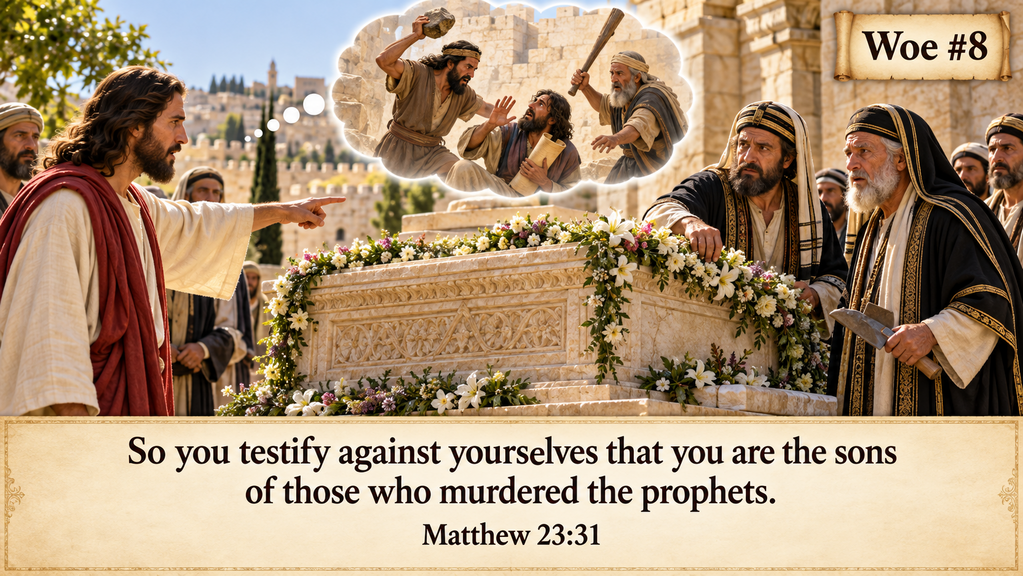
“Therefore you are witnesses against yourselves that you are sons of those who murdered the prophets. Matthew 23:31
Note: You can listen to today’s commentary courtesy of our friends at the “Bible in Ten” podcast. (Click Here to listen)
You can also read this commentary, scrolling with music, courtesy of our friends at “Discern the Bible” on YouTube. (Click Here to listen), or at Rumble (Click Here to listen).
“Thus, you witness to yourselves that sons, you are – the ‘having murdered the prophets’.” (CG).
In the previous verse, Jesus noted the “would have been” nature of the scribes and Pharisees who built tombs for the prophets and adorned the sepulchers of the righteous. They claimed that if they lived in those days, they would not have joined in the guilt of their blood. But Jesus notes that their actions speak against them, saying emphatically, “Thus, you witness to yourselves.”
The building and adorning they participated in were their own witness against them. Think of it. When the North won the Civil War, what did they do? They put up statues of those who won their battles. It was a witness to what they did.
The memorial battlefields at Gettysburg, Antietam, and elsewhere witness to the battles that took place. The statues erected there witness to who lived and who died, and who won and who lost.
The memorials from the South, honoring their generals and heroes, witness to the North’s acceptance that this was a national battle and that despite their victory, they were willing to allow the losing side to maintain its honor and dignity. Military bases and naval ships, to this day, have the names of heroes from both sides of the conflict. These things bear witness to what happened, who prevailed, who lost, and the gracious nature of the victors.
Understanding this, Jesus says, “that sons, you are – the ‘having murdered the prophets’.” The very fact that these men participated in the building and adornment of these tombs and sepulchers witnessed to the fact that they descended from those who were guilty of the blood of those men of the past.
They were taking an abstract structural outline of the deeds of their fathers and reshaping them into a tangible witness of what they had done. It is as if they were proclaiming, “My father was guilty of the blood of this prophet! This tomb bears witness to that. This is my way of atoning for what I would never have done.”
This is what such memorials are for. The problem is that these things do not atone for what the fathers did. Nor do they sever the connection between the fathers and the descendants. Rather, they more firmly establish it.
Life application: Today in Israel, there are monuments to the past that are set up, identifying events that took place, who took part in them, and when these things happened. One, for example, is a model of the temple where Jesus spent much of His last week before His crucifixion.
They testify to the events of the past in order to establish a connection to the present. The intent is that Israel can say, “We have a historical connection to this land. It was ours, and these things prove it.”
This is good because it establishes the truth denied by much of the world. But at the same time, the people are (maybe unwittingly) testifying that they are the people recorded in Scripture. Scripture validates the message of the coming Messiah. It also validates that when He came, He was rejected by His own people –
“He was in the world, and the world was made through Him, and the world did not know Him. 11 He came to His own, and His own did not receive Him.” John 1:10, 11
This is fine if Jesus was just another Jew who claimed to be the Messiah and turned out to be false. He would be chalked up on the board of a list long enough to go buy a few more boards. However, if Jesus is the true Messiah, and the Bible bears witness to the truth that He is, then their claims to the land witness against them in this regard.
We cannot disassociate Jesus’ words from the context of them: He is speaking to Israel. They are under the Law of Moses. It is the week of Jesus’ Passion. He is about to be rejected and killed by the leaders. From there, the nation as a whole will follow suit, be destroyed, and exiled.
His addressees are sons of those who “denied and killed their Messiah” (Acts 2:23, etc.). They cannot have it both ways. Nor can we. We cannot say, “I support Israel” unless we have a valid reason to do so that is in line with what the Bible says about Jesus. If we say, “I support Israel because they are God’s people”, we must define what “God’s people” means.
It cannot mean that they are God’s chosen race for salvation at this time. Only Jesus saves. If they are those who rejected and killed Jesus, they cannot be His people for salvation. Those of the church who have received Jesus are in that category.
The Bible tells us exactly how Israel today fits into God’s plans. It tells us who they are in relation to God now and in the future. It tells us why these things are and when they will change. And these things, in turn, tell us of the gracious nature of God as well as His covenant-keeping faithfulness.
If you support the nation of Israel, you must explain it from a properly evaluated analysis of Scripture, or you are actually fighting against God’s purposes. And this is going on in far too many churches around the world.
Many are fighting against them by saying the Jews have been replaced and are permanently forsaken by God. On the other hand, many are fighting against them by calling them God’s chosen people without properly defining what that means. In both, harm to the exalted name of Jesus is the result. Jesus’ words in Matthew 23:31 testify to this.
Lord God, help us to be responsible, sober, and precise in how we deal with the name of Jesus. You sent Him to save. That will not take place if His name is not placed above all else in the hearts and minds of the people of the world. Help us in this, O God. Amen.