
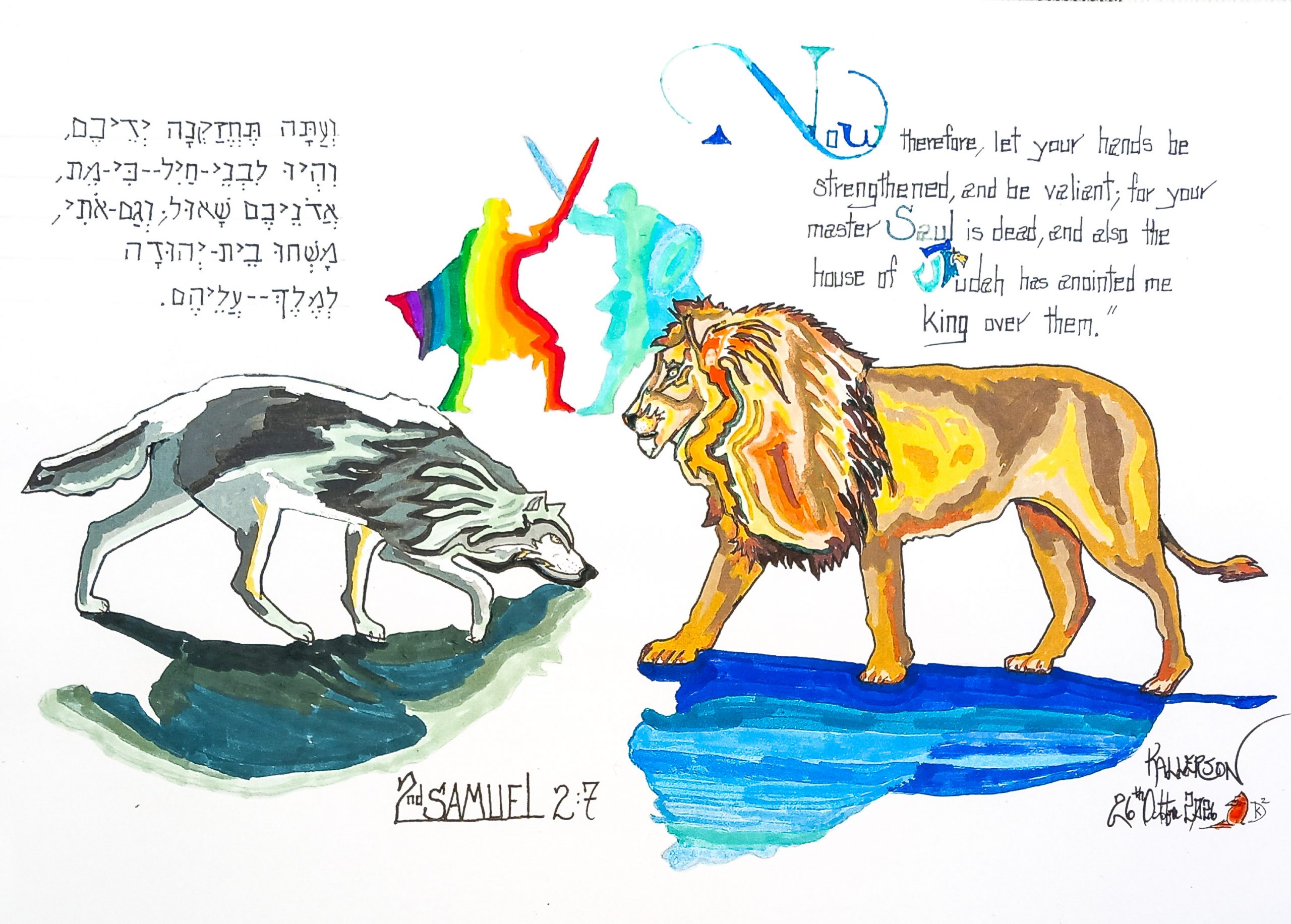
Artwork by Douglas Kallerson
2 Samuel 2:1-11
Man of Shame, Part I
(Typed 29 June 2026) There are things in life which are axiomatic: If you want the house to go up properly and according to budget (well, hopefully), you will follow the blueprint. If you want the TV to work properly, you will follow the setup instructions. And if you want to avoid a speeding ticket, then don’t speed.
What should also be obvious to every Christian is that if you want to be pleasing to the Lord, you will follow His word. It makes no sense to assume that things will go well for you when you are disobedient to His will. And you cannot know what His will is unless you have access to it.
Your church may provide proper instruction in what it teaches, but considering that there are 18 billion denominations out there (plus or minus a few), each with its own doctrine, is it wise to put your life in the hands of someone else’s teaching?
It’s fine to listen to your pastor, but the old saying, “trust, but verify”, doesn’t go far enough. I would drop the trust part and go straight to the verify if I were you.
Israel has the choice between two directions in this passage. One of them is by the will of the Lord. The other isn’t. Which do you think will ultimately succeed?
Text Verse: “When You said, ‘Seek My face,’
My heart said to You, ‘Your face, Lord, I will seek.’” Psalm 27:8
The first sentence of this chapter says that David inquired of the Lord. He indeed had a source of inquiry that we do not possess today. But I would suggest that our means of inquiring of the Lord is preferable to what David possessed.
God is not directing the redemption of the world to get us to Jesus. If He were, we would still have prophets occasionally telling people what to do. Rather, Jesus came. We now have the completed word of God that tells about it.
We don’t need to be directed by prophets any longer. Instead, we are instructed to live according to the word that has been provided. People who expect a prophetic word today have misunderstood what the Bible says, or maybe they are looking for an easy way out by not picking it up and reading it.
Whatever the case is, we have the blueprint. We are expected to know what it says and apply it to our lives. If we do this, we will know if we are in the will of the Lord.
That doesn’t mean our lives will be great. Troubles, trials, and temptations are a part of human existence. But we can know that even through those things, we are doing what He expects when we follow His word. Let each of us determine to read His word daily.
Remaining in the will of the Lord is an important tenet that is found in His superior word. And so, let us turn to that precious word once again, and… May God speak to us through His word today, and may His glorious name ever be praised.
I. They Sat in ‘Cities, Hebron’ (verses 1-7)
It happened after this that David inquired of the Lord, saying, “Shall I go up to any of the cities of Judah?”
vayhi akhare khen vayishal david bəyehovah lemor ha’eeleh bəakhath are yəhudah – “And it was, after thus, and he asked, David, in Yehovah, to say, ‘I will ascend in one, ‘cities, Judah’?’” David was in Ziklag when word about Saul and Jonathan came to him, as detailed in 2 Samuel 1.
With Saul dead, he now has the opportunity to return to Judah and prepare to reign over the people. David means Beloved. Thus far, he has typologically pictured accepting the doctrines of Christ. This may change as he assumes his new role in the redemptive narrative. Either way, we will continue to look carefully for each bit of typology. Judah means Praise.
The words contain a chronological timestamp, akhare khen, after thus. It doesn’t say how long after Saul and Jonathan’s deaths it was, but it can be assumed it was not long. There would be no need to lollygag around Ziklag if Saul was dead.
David had the anointing oil and knew he would rule. Therefore, he probably very quickly asked the Lord for guidance. With Abiathar and an ephod, David is able to directly inquire of the Lord concerning what he should do next. In response…
1 (con’t) And the Lord said to him, “Go up.”
The verb is imperative: vayomer Yəhovah elav aleh – “And He said, Yehovah, unto him, ‘You must ascend!’” The time has come for David’s reign to begin. Therefore, it is time to leave the lower coastal area and ascend into the higher terrain where he will establish a foothold in the land.
The next question is an obvious one. Instead of going where he wished, David again inquires of the Lord…
1 (con’t) David said, “Where shall I go up?”
vayomer david anah eeleh – “And he said, David, ‘Whither I will ascend?’” The Lord has directed David’s movement. Therefore, He has a plan and a purpose for him. To ensure that he remained in the will of the Lord, he asks for specificity concerning his destination. Where the Lord directed, he would go…
1 (con’t) And He said, “To Hebron.”
vayomer khevronah – “And He said, ‘Hebron-ward.’” Hebron is a logical choice. It is in the mountains, and thus readily defensible. The main city is a priestly one. In verse 3, the plural “cities” means it was essentially a metropolis at this point, being filled with agriculture and trade.
Hebron is not just a city, but it includes the surrounding area. It is within Judah, so David would be among those of his tribe.
Hebron also had connections to the promises of the past. Abraham, Sarah, Isaac, and Jacob were buried there. The area was granted to Caleb after the land was subdued, as seen in Joshua 14:6-15.
At this time, Jerusalem was under the control of the Jebusite. It was also on the border of Judah and Benjamin. Therefore, because of the coming events, starting in Jerusalem was not a proper choice. The Lord directed David first to Hebron.
Only later will Jerusalem get its special standing within the nation. Hebron means Alliance.
2 So David went up there, and his two wives also, Ahinoam the Jezreelitess, and Abigail the widow of Nabal the Carmelite.
vayaal sham david vəgam shəte nashav akhinoam ha’yizrəelith va’avigayil esheth naval ha’karməli – “And he ascended there, David, and also ‘two, his wives’, Ahinoam the Jezreelitess, and Abigail, ‘wife, Nabal, the Carmelite’.” Rather than a general statement, such as, “And David took his wives…,” the record carefully details their names.
This has happened a couple of times already, allowing for typology to be considered in relation to their names. Ahinoam means Kindred to Sweetness. Jezreel comes from zara, to scatter seed or sow, and el, God. Thus, it means God Sows.
Abigail is derived from av, father, and giyl, joy or exultation. That is derived from gil, to spin around, which gives the sense of rejoicing. Her name means Father of Joy, she being the source of the joy. Nabal means Dolt. Carmel means Vineyard of God.
3 And David brought up the men who were with him, every man with his household. So they dwelt in the cities of Hebron.
va’anashav asher imo heelah david ish uveitho vayeshəvu bəare khevron – “And his mortals who with him, he caused to ascend, David, man and his house. And they sat in ‘cities, Hebron’.” This would be a very large contingent.
First are the six hundred men noted in 1 Samuel 30:9. This also would have included the wives, children, and livestock. That alone would be a large caravan of people pulling into Hebron all at once.
Along with them, 1 Chronicles 12 details men from various tribes who defected to David prior to Saul’s death , including Benjamin, Gad, Manasseh, Judah, etc. In 1 Chronicles 12:22, it says, “it was a great army, like the army of God.”
Thus, it was a sizeable contingent moving into the cities of Hebron. From that point, the number will increase significantly as David solidifies his position before the people. That establishment of power begins to be seen next…
4 Then the men of Judah came, and there they anointed David king over the house of Judah.
vayavou anshe yəhudah vayimshəkhu-sham eth-david ləmelekh al-beith yəhudah – “And they came, ‘mortals, Judah’, and they anointed, there את David to king upon ‘house, Judah’.” The tribe of Judah knew David was to be king. With Saul dead, they knew this was the time for that to take place, at least in Judah.
Therefore, they came to him at Hebron intending to bring about this new kingdom. Samuel first anointed David in 1 Samuel 16:13 –
“And he took, Samuel, ‘horn, the oil’, and he anointed him in ‘inward, his brothers’. And it surged, Spirit Yehovah, unto David from the day, the it, and upward. And he arose, Samuel, and he walked the Ramah-ward.” (CG)
That anointing gave David the right to the kingdom at whatever time God determined. Saul was still the king, and that continued as the Lord saw fit.
With Saul dead, there could be no hint of David having attempted to usurp the throne from him. Saul’s kingdom was prophesied to end. Therefore, because of what transpires between David in the coming verse, it cannot be seen as a rebellion against the duly established government.
In Hebron, with the approval and anointing of the men of Judah, David has been granted authority over the kingdom of Judah.
The rest of the land was still under the reign of Saul’s house, despite Samuel’s prophecy that Saul’s reign would end and be given to another. In 1 Samuel 28, the name of that person was made explicit –
“And He did, Yehovah, to Him according to which He spoke in my hand. And He rent, Yehovah, the kingdom from your hand, and He gave it to your associate, to David.” 1 Samuel 28:17 (CG)
While with David, these men of Judah inform him of something that would help him solidify power. This is his first recorded official act as king. It is a means of establishing an alliance outside of Judah…
4 (con’t) And they told David, saying, “The men of Jabesh Gilead were the ones who buried Saul.”
vayagidu lədavid lemor anshe yavesh gilad asher qavəru eth-shaul – “And they caused to declare to David, to say, ‘Mortals, Jabesh Gilead’, who, they interred את Saul.’” The sentence seems abrupt and out of place unless, as seems likely, David asked about Saul’s burial. With that being supposed, the form of the words is natural.
It could also be that this was prompted by the men of Judah as a means of spurring David toward securing favor with those east of the Jordan. Without such suppositions, the reason for the inclusion of the clause is abrupt and mystifying.
Jabesh Gilead is on the other side of the Jordan. Jabesh comes from the verb yavesh, to be dry, dried up, or withered. It is used to describe the drying up of a river, land, bones, etc. It also applies to the withering of grass. Gilead means Perpetual Fountain. Thus, Jabesh Gilead means Dry Perpetual Fountain. Saul means Asked.
The details of the disposition of the bodies of Saul and his sons was recorded in 1 Samuel 31:11-13 –
“And they heard, unto it, ‘sitting Jabesh Gilead’ what they did, Philistines, to Saul. 12And they arose, all ‘man, valorous’, and they walked all the night, and they took ‘body, Saul’, and ‘bodies, his sons’, from ‘rampart, Beth Shan’. And they came Jabesh-ward, and they burned them there. 13And they took their bones, and they interred under the tamarisk in Jabesh-ward. And they fasted seven days.”
Because of their actions…
5 So David sent messengers to the men of Jabesh Gilead,
vayishlakh david malakhim el-anshe yavesh gilad – “And he sent, David, messengers unto ‘mortals, Jabesh Gilead’.” This is a sign of gratitude for their bravery and honoring of the fallen king. However, it is also more than that. It is an opportunity for conveying news of the new kingdom and giving them a chance to align with David…
5 (con’t) and said to them, “You are blessed of the Lord, for you have shown this kindness to your lord, to Saul, and have buried him.
vayomer alehem bərukhim atem ləYəhovah asher asithem ha’khesed ha’zeh im-adonikhem im-shaul vatiqbəru otho – “and he said unto them, ‘Blessed, you, to Yehovah, for you did the kindness, the this, with your (exalted) lord, with Saul, and you interred him.’” David acknowledged that their kindness toward Saul means he would have done the same if the opportunity was given to him.
It means that David was kindly disposed toward Saul, not a usurper of him. This understanding is important to convey the sense that what has transpired since Saul’s death was only because of Saul’s death.
Had Saul still been alive, David would have remained subject to him. However, with Saul now dead and the anointing resting on David, it was time for a new direction in the leadership of Israel. And so…
6 And now may the Lord show kindness and truth to you.
vəatah yaas-Yəhovah imakhem khesed və’emeth – “And now, may he do, Yehovah, with you kindness and stability.” David brings in the name of the Lord, petitioning for His hand to bless those in Jabesh Gilead. He then tells them how that kindness and stability will come about, saying…
6 (con’t) I also will repay you this kindness, because you have done this thing.
Rather: vəgam anokhi eeseh itəkhem ha’tovah ha’zoth asher asithem ha’davar ha’zeh – “and also, I myself I will do with you the goodness, the this, for you did the word, the this.” David is not offering repayment but to act as Yehovah’s instrument for bringing about the blessing of kindness and stability upon them –
“And now, may he do, Yehovah, with you kindness and stability.”
“and also, I myself I will do with you the goodness, the this.”
In other words, “the goodness” David promises them is the “kindness and stability” that he has petitioned the Lord to grant them. He essentially says to them, “I will be the Lord’s representative to do this for you.” The reason he can do this is found in the next verse…
7 Now therefore, let your hands be strengthened, and be valiant;
vəatah tekhĕzaqnah yədekhem vihyu livne-khayil – “And now, they will seize, your hands, and you must be to ‘faces, valor’.” Jabesh Gilead was the location attacked by Nahash the Ammonite in 1 Samuel 11. The first engagement Saul took on was saving them. It is what truly established him as king in the minds of the people.
David telling them to strengthen themselves and be valiant means that they are probably going to face an onslaught of enemies, just as they had before. This is because…
7 (con’t) for your master Saul is dead,
ki-meth adonikhem shaul – “For he died, your (exalted) lord, Saul.” Saul, the great defender of Jabesh Gilead, was dead. Without him, the surrounding nations would be tempted to return to Jabesh and take it, paying Israel back for the loss they had suffered in the past.
However, David said he would deal with Jabesh Gilead with the goodness of Yehovah (kindness and stability). And how could he do that? It is because…
7 (con’t) and also the house of Judah has anointed me king over them.”
vəgam-othi masəhkhu veith-yəhudah ləmelekh-alehem – “And also את me, they anointed, ‘house, Judah’ to king upon them.” David acknowledged his allegiance to Saul while he was alive. He thanked those who tended to Saul in his death, and he said he would do the Lord’s goodness to them.
He reminded them of what the peril of Saul’s death meant for them, and he informed them that he now stands as the anointed king of Judah in Saul’s place, ready to tend to them as Saul did.
The whole package of thought is complete. It basically says, “Align with me and I will tend to you as our beloved Saul did.” The first act of David as king somewhat mirrors the first act of Saul as king.
Both have been directed toward the security of the men of Jabesh Gilead. Having them align with David would mean the rest of those east of the Jordan would possibly side with him as well.
While David presses his diplomacy toward them, something else is happening that could interfere with David’s petition…
When vying for control, you must do what’s right
Following what the Lord would have you do
With all your soul, and with all your might
Doing His will is what is proper for you
To usurp His will can only lead to a bad end
So stay away from that dangerous path
Be sure that the things you intend
Will add up to His approval, so do the math!
When David was patient and did what was right
Things came out as they should
But when he strayed and diverted his sight
Things ended up not so good
Ishbosheth started out wrong
And his two years to reign weren’t that long
II. Surely, ‘House, Judah’, They Were After David (verses 8-11)
8 But Abner the son of Ner, commander of Saul’s army,
və’avner ben-ner sar-tsava asher ləshaul – “And Abner, ‘son, Ner, commander, host’ which to Saul.” Abner somehow managed to survive the battle with the Philistines that took the lives of Saul and his sons.
Abner was related to Saul in some manner. The difficulty rests in the names found in 1 Samuel 9. Abner’s father is Ner. In 1 Samuel 9:1, it says that Kish, Saul’s father, is the son of Abiel. In 1 Chronicles 8 & 9, it says that Kish is the son of Ner.
Several suggestions were given to rectify the matter. Ner means Lamp. Abner means Father Is a Lamp and thus, Father of Light. Whatever the case, Abner and Saul were somehow related in their genealogies.
Abner was also Saul’s commander. It was an army that was significantly reduced in the battle with the Philistines. As the Philistines moved into the areas of Israel east of Jezreel and west of the Jordan, Abner…
8 (con’t) took Ishbosheth the son of Saul and brought him over to Mahanaim;
laqakh eth-ish-bosheth ben-shaul vayaavirehu makhanayim – “he took את ‘Ishbosheth, son, Saul’ and he caused to traverse him – Mahanaim.” Ishbosheth is introduced here. He is noted as a son of Saul, but he is not in the listing of Saul’s sons in 1 Samuel 14:49.
Based on what it says later in the chapter, when rightly understood, it is likely he was born after Saul became king. Ishbosheth means Man of Shame. He is named as Esh-baal in 1 Chronicles 8 & 9.
Names that include baal, master, in Chronicles are commonly given names with a form of bosheth, shame, here. The reason normally given is that baal eventually became synonymous with something shameful rather than indicating “master.”
This view is held by pretty much everyone. However, that is a poor explanation for two reasons. The first is that it is putting the cart before the horse.
The Chronicles were compiled long after these names were recorded in 2 Samuel. Using that logic, it would be the other way around, where baal would be noted here and bosheth would be noted there.
The second problem with this view is that the term baal continued to be used as “master” even until the time of the pre-exilic minor prophets, and even when referring to the Lord, such as in Nahum 1:2, where Yehovah is called baal khemah, Master of Heat (meaning fury).
Because of this, it would be ridiculous to say that using baal had pagan intent. The word simply means master, regardless of whether it is used by pagans in relation to their false gods.
As Chronicles was compiled later, this should not be taken as Chronicles changing “shame” back to “Baal.” Rather, Chronicles likely preserves an older genealogical name-form, while Samuel reflects a form of shame-substitution, replacing baal, “lord/master,” with bosheth, “shame.”
As the common noun baal continued in Hebrew usage, the concern was not the word itself, but its presence as a rhetorical shame-tag. This is seen in the change of the name Jerubbaal found in Judges to Jerubbesheth in 2 Samuel 11:21.
Gideon was named Jerubbaal as an honorific. The name Jerubbaal is not a name honoring Baal, but a taunt. It means Let Baal Contend, and it was given because Gideon had torn down Baal’s altar.
Samuel even used the name Jerubbaal in 1 Samuel 12:11. Therefore, the substitution of besheth/bosheth, “shame,” cannot be explained simply as avoiding a pro-Baal name.
Instead, it reflects a broader textual tendency in 2 Samuel alone to replace baal in personal names with bosheth/besheth, regardless of whether the original use of baal was positive, neutral, or polemical.
It is not merely because the word baal could no longer be spoken, as scholars suggest, since Jerubbaal remains unchanged in 1 Samuel 12:11, and the older baal forms are preserved in Chronicles.
Rather, 2 Samuel employs these shame-forms of the names in the aftermath of Saul’s death, where the narrative repeatedly displays the humiliation and decline of Saul’s house.
In the case of Jerubbesheth in place of Jerubbaal, it recalls the shameful death of Abimelech the son of Gideon (called Jerubbesheth in 2 Samuel 11:21) brought on by foolish military actions which cost him his life. In Judges 9, Abimelech pictured those who reject Christ, ultimately fulfilled in the Antichrist.
Summed up, the evidence suggests not a universal ban on baal in names, but a localized shame-substitution found only here in 2 Samuel, especially suited to the post-Saul narrative world of humiliation, dynastic collapse, and exposed folly.
Mahanaim is east of the Jordan. It was a Levitical city not too far from the Jabbok River. It means Two Camps. Abner took Ishbosheth there…
9 and he made him king over Gilead,
Rather: vayamlikhehu el-ha’gilad – “And he caused to reign, him, unto the Gilead.” With the prefixed article, the Gilead means The Perpetual Fountain. It says he reigned unto the Gilead. Also…
9 (con’t) over the Ashurites, over Jezreel, over Ephraim, over Benjamin, and over all Israel.
və’el-ha’ashuri və’el-yizrəel və’al-ephrayim və’al-binyamin və’al-yisrael kuloh – “and unto the Ashurite, and unto Jezreel, and upon Ephraim, and upon Benjamin, and upon Israel, it all.” Other than the SLT, all translations I checked botch the intent. In this clause, there are two more untos and then three upons.
The intent is that of showing continual growth. First, Ishbosheth was made king in Mahanaim up to the point of the Gilead, then up to the point of the Ashurite, and then up to the point of Jezreel.
He did not necessarily reign over them all at once. Rather, it indicates that there is expansion. He reigned over those in the named areas “up to” and possibly including the “untos.”
Later, his rule became inclusive of Ephraim, Benjamin, and all Israel. The “over all Israel” is a general statement that any of Israel not ruled by David were, by default, under the rule of Ishbosheth.
Who the Ashurite is referring to is highly debated. The term normally signifies the Assyrians, but at this point in history, they were too far east for it to mean them.
Some take it as a misspelling of Asher, but that would mean he probably ruled the area at the very northwest of Israel while the Philistines were still in control of some of the areas. Further, the definite article before Ashurite negates the thought of it being Asher.
Regardless of where he dwelt, the Ashurite is defined by Abarim as Level Plain, Step, Happy, or Just. Jezreel means God Sows. Ephraim has two meanings: Twice Fruitful and Of the Dust. Benjamin means Son of the Right Hand. Israel means He Strives with God.
The reign of Ishbosheth, because of the military prowess of Abner, slowly expanded outward from Mahanaim…
10 Ishbosheth, Saul’s son, was forty years old when he began to reign over Israel,
ben-arbaim shanah ish-bosheth ben-shaul bəmaləkho al-yisrael – “‘Son forty year, Ishbosheth, son, Saul’, in his reigning upon Israel.” The numbers seem so incomprehensible to scholars that there is little agreement among them. Nothing seems to match in relation to what is said, including Saul’s age, the timing of David’s reign, meaning before or after these two years, etc.
However, there is no need for consternation. The way to reconcile the many conflicting things that surround Ishbosheth’s age and time of rule is to tie them to the contents of verse 9, which is why that lengthy detail was provided.
Ishbosheth was made king from Mahanaim unto the Gilead and all the other untos, and then he ruled over Ephraim, then Benjamin, then all Israel. The verse gives a step-by-step process until he reigned over all Israel. Until that happened, it could not be stated that he was king over Israel.
But once the progressive steps were complete, some years after going to Mahanaim, he finally began to rule over all Israel. This occurred at the time when he was forty years old.
This is why it said that Abner made him king unto the Gilead, and then it later says that he reigned over Israel. It is the same person reigning, but it does not refer to the same scope of his reign. The latter is the culmination of the process. As for his age, Bullinger says forty is –
“…associated with a period of probation, trial, and chastisement—(not judgment, like the number 9, which stands in connection with the punishment of enemies, but the chastisement of sons, and of a covenant people). It is the product of 5 and 8, and points to the action of grace (5), leading to and ending in revival and renewal (8). This is certainly the case where forty relates to a period of evident probation. But where it relates to enlarged dominion, or to renewed or extended rule, then it does so in virtue of its factors 4 and 10, and in harmony with their signification.”
10 (con’t) and he reigned two years. Only the house of Judah followed David.
u-shətayim shanim malakh akh beith-yəhudah hayu akhare David – “and two years he reigned. Surely ‘house, Judah’, they were after David.” This is referring to the point that Ishbosheth ruled over all of Israel, minus Judah. At that point, he reigned. This reign then lasted for two years.
Two is the number of division or difference. This would make him forty-two at the time of his death. It’s a fun number associated with the antichrist. Bullinger says –
“Being a multiple of seven, it might be supposed that it would be connected with spiritual perfection. But it is the product of six times seven. Six, therefore, being the number of Man, and man’s opposition to God, forty-two becomes significant of the working out of man’s opposition to God.”
11 And the time that David was king in Hebron over the house of Judah was seven years and six months.
vayhi mispar ha’yamim asher hayah david melekh bəkhevron al-beith yəhudah sheva shanim vəshishah khodashim – “And it was, ‘number, the days’ that he was, David, king in Hebron upon ‘house, Judah’ seven years and six renewals.” This shows that the analysis concerning Ishbosheth’s rule is correct.
The words of this verse only deal with David’s rule over Judah. In 2 Samuel 5, it will say –
“Son, thirty year’, David, in his reigning. Forty year, he reigned. 5In Hebron, he reigned upon Judah seven years and six renewals. And in Jerusalem he reigned thirty and three year upon all Israel and Judah.” 2 Samuel 5:4, 5
One is only ruler over the extent of the kingdom he rules. David first ruled over Judah only, and that happened all at once, not progressively, like Ishbosheth. David’s rule over Judah was for seven years and six renewals of the moon.
If Ishbosheth and David began ruling at the same time, Ishbosheth was about thirty-five when he began to reign from Mahanaim. At forty, he reigned over all Israel, and he died at forty-two.
If Ishbosheth’s death occurred closer to the time when David began his reign over all of Israel, then the numbers would be different by that much, up to two years. If so, it would mean he was closer to 37 when he began to reign in Mahanaim. It would just make the progression over all Israel that much less. Either way, there is no problem with the dating.
What will happen in the coming verses occurs during the period just examined. They detail an interesting story that would be improper to divide at some random point. Because of that, this is a good place to finish up for now.
As we have seen, David took the time to consult the Lord before acting. By doing so, he was in line with the Lord’s will and was directed accordingly. Abner surely knew that the kingdom was to pass to David.
Saul would not have kept that from him once he was told by Samuel. This means that Abner was working against the will of the Lord by attempting to reestablish the house of Saul under Ishbosheth. It was a plan destined to fail.
We can look at the world around us and, in many cases, we can tell what will fail and what will succeed by using this same metric. Iran says that Israel will disappear as a nation.
They have come out over the years with definite dates by which Israel will be gone. But Israel is still here, and it will continue to be here even after a giant coalition, which includes Iran, comes against them in the days ahead.
Israel will continue to exist through the tribulation period, and throughout the millennium. How can we know this? Because the Lord’s word says so.
We can know which churches will still be here when the rapture happens. Faithful Christians will be taken out while innumerable others will be left behind. How can we know? All we need to do is pick up the Bible and see what it says.
When we follow the will of the Lord, we can be certain of the outcome. When His will is rejected, we can be certain of another outcome. This isn’t complicated. It is a simple equation.
If you want to receive eternal life, receive Jesus by believing the gospel. When you do, you will be saved. If you want to be pleasing to the Lord after that, read His word and do what He says. In doing so, you will receive rewards. If you don’t, you will lose them. Again, this is not complicated.
David asked the Lord if he should go and where he should go. The Lord directed him. We can be certain that David did not ask the Lord what he should do about Bathsheba, and he certainly didn’t adhere to the written word of the Lord when he went into her. In failing to do so, it cost him.
Follow the simple steps God has laid out for us, and things will go well for you. Believe the gospel, follow His word, and be sure to give Him thanks and praise in all you do. In this, you will do well.
Closing Verse: “Ponder the path of your feet,
And let all your ways be established.
27 Do not turn to the right or the left;
Remove your foot from evil.” Proverbs 4:26, 27
Next Week: 2 Samuel 2:12-23 Who is to blame, who who who?… (Man of Shame, Part II) (4th 2 Samuel Sermon)
The Lord has you exactly where He wants you. He has a good plan and purpose for you. He is the One who abases the haughty and exalts the humble. He regards the lowly, and the proud, He knows from afar. So yield yourself to Him, trust Him, and believe His word. In this, He will do great things for you and through you.
2 Samuel 2:1-11 (CG)
2 And it was, after thus, and he asked, David, in Yehovah, to say, “I will ascend in one, ‘cities, Judah’?”
And He said, Yehovah, unto him, “You must ascend!”
And he said, David, “Whither I will ascend?”
And He said, “Hebron-ward.”
2And he ascended there, David, and also ‘two, his wives’~ Ahinoam the Jezreelitess, and Abigail, ‘wife, Nabal, the Carmelite’. 3And his mortals who with him, he caused to ascend, David, man and his house. And they sat in ‘cities, Hebron’.
4And they came, ‘mortals, Judah’, and they anointed, there את David to king upon ‘house, Judah’. And they caused to declare to David, to say, “‘Mortals, Jabesh Gilead’, who, they interred את Saul. 5And he sent, David, messengers unto ‘mortals, Jabesh Gilead’. And he said unto them, “Blessed, you, to Yehovah, for you did the kindness, the this, with your (exalted) lord, with Saul, and you interred him. 6And now, may he do, Yehovah, with you kindness and stability. And also, I myself I will do with you the goodness, the this, for you did the word, the this. 7And now, they will seize, your hands, and you must be to ‘faces, valor’. For he died, your (exalted) lord, Saul. And also את me, they anointed, ‘house, Judah’ to king upon them.”
8And Abner, ‘son, Ner, commander, host’ which to Saul. He took את ‘Ishbosheth, son, Saul’ and he caused to traverse him – Mahanaim. 9And he caused to reign, him, unto the Gilead, and unto the Ashurite, and unto Jezreel~ and upon Ephraim, and upon Benjamin, and upon Israel, it all. 10‘Son forty year, Ishbosheth, son, Saul’, in his reigning upon Israel, and two years he reigned. Surely ‘house, Judah’, they were after David. 11And it was, ‘number, the days’ that he was, David, king in Hebron upon ‘house, Judah’~ seven years and six renewals.
2 Samuel 2:1-11 (NKJV)
It happened after this that David inquired of the Lord, saying, “Shall I go up to any of the cities of Judah?”
And the Lord said to him, “Go up.”
David said, “Where shall I go up?”
And He said, “To Hebron.”
2 So David went up there, and his two wives also, Ahinoam the Jezreelitess, and Abigail the widow of Nabal the Carmelite. 3 And David brought up the men who were with him, every man with his household. So they dwelt in the cities of Hebron.
4 Then the men of Judah came, and there they anointed David king over the house of Judah. And they told David, saying, “The men of Jabesh Gilead were the ones who buried Saul.” 5 So David sent messengers to the men of Jabesh Gilead, and said to them, “You are blessed of the Lord, for you have shown this kindness to your lord, to Saul, and have buried him. 6 And now may the Lord show kindness and truth to you. I also will repay you this kindness, because you have done this thing. 7 Now therefore, let your hands be strengthened, and be valiant; for your master Saul is dead, and also the house of Judah has anointed me king over them.”
8 But Abner the son of Ner, commander of Saul’s army, took Ishbosheth the son of Saul and brought him over to Mahanaim; 9 and he made him king over Gilead, over the Ashurites, over Jezreel, over Ephraim, over Benjamin, and over all Israel. 10 Ishbosheth, Saul’s son, was forty years old when he began to reign over Israel, and he reigned two years. Only the house of Judah followed David. 11 And the time that David was king in Hebron over the house of Judah was seven years and six months.