
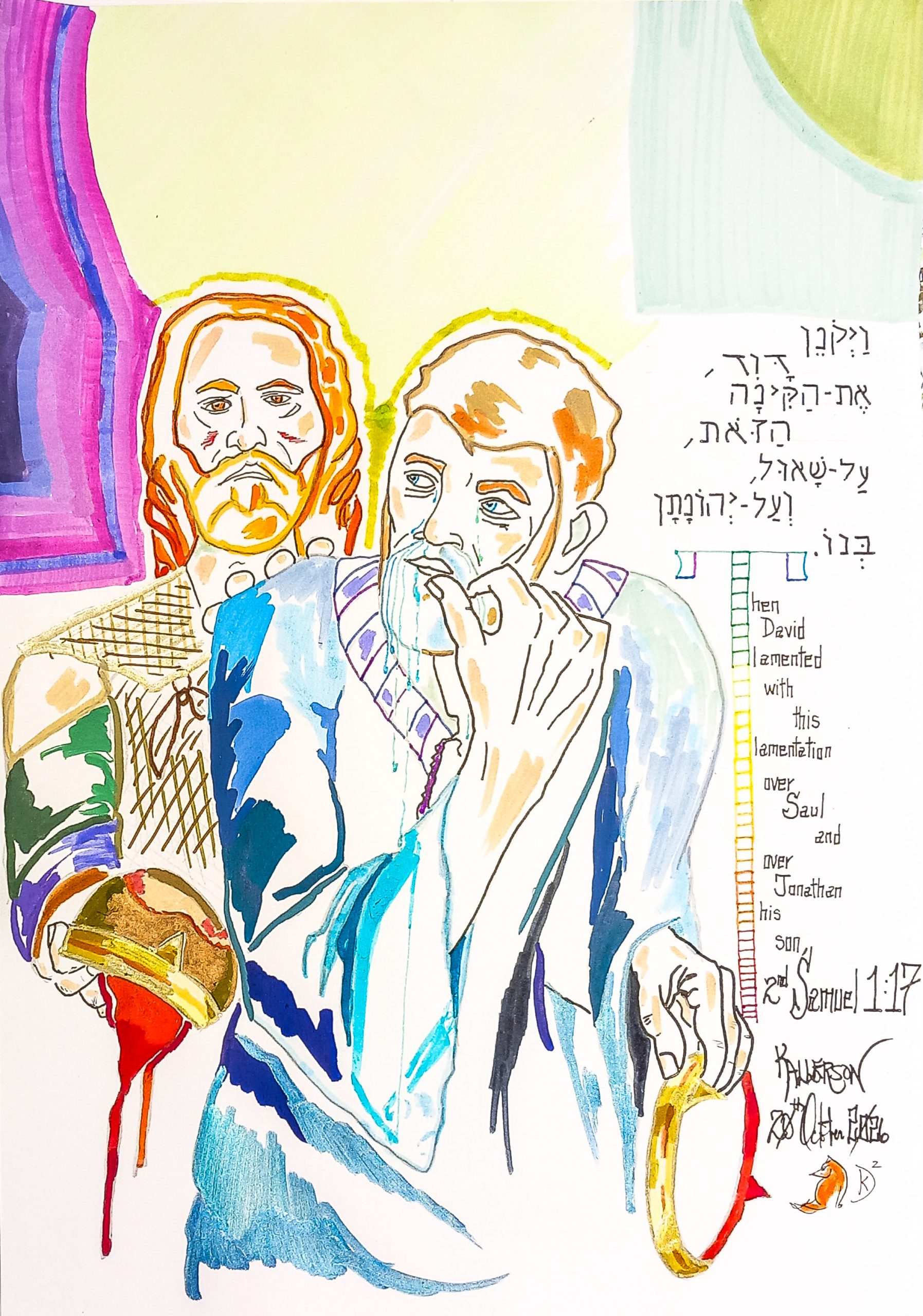
Artwork by Douglas Kallerson
2 Samuel 1:17-27
The Bow
(Typed 22 June 2026) I like watching war documentaries on YouTube. They have real stories of the men who fought in various wars, from the Revolutionary War through the most current battles we have engaged in.
Seeing how men fought, the locations of the battles, and the strength of the enemy is exciting for me to contemplate. Time and again, stories of the most unlikely soldiers to become war heroes come up on my feed.
Medal of Honor recipients are highlighted. Some give their own testimonies, while others are referred to posthumously. But their achievements are always worth hearing. Recently, a couple of videos have come up that truly amazed me.
With the advance of Super Intelligence, things that we could not have imagined a few years ago can be done with a few clicks of a computer keyboard. Someone took old photographs from the Civil War, put them into AI, and not only colorized the faces, but they also animated them as well. It was as if those long-dead soldiers were alive and posing for their photo right in front of you.
They smiled, moved their heads, and some even got up and changed position. It brought a sense of reality to photos that we may otherwise just glance at and move on to the next one without a lot of consideration.
How close to reality the animations were is only speculation, but it was an incredible thing to see.
Text Verse: “And afterward they asked for a king; so God gave them Saul the son of Kish, a man of the tribe of Benjamin, for forty years.” Acts 13:21
Saul reigned as king of Israel about a thousand years before the coming of Christ, but because his kingship was recorded in the Bible, people in Jesus’ time spoke of him as a historical figure who they could imagine as they recounted facts from his life.
Another two thousand years later, we continue to do the same thing every time we read or hear the story of his life. We have no clue what he actually looked like outside the few details given concerning his stature.
If there were a photo of him, it, too, could be put into AI to make him appear alive. What is even more impressive than that is the fact that someday Saul will be raised from the dead along with all humans who have ever lived to receive the reward for the lives they lived.
In the passage today, we will learn about David’s sense of loss over Saul and Jonathan. The emotions expressed in this dirge are the same ones we all have faced or will face. It is a part of the human experience to suffer the loss of those around us.
But thanks be to God who has promised us restoration. If we simply acknowledge Him and what He has done through Christ Jesus, we don’t need to have AI programs to remind us of what others were like.
Someday, we will be raised to eternal life. All God asks us to do is believe the simple gospel. Once we are saved, we can read, contemplate, and apply His word to our lives. David composed instruction for the sons of Judah and for us to learn from.
We now have the whole counsel of God. Let us take full advantage of it as we walk through this world. Great things are to be found in His superior word. And so, let us turn to that precious word once again, and… May God speak to us through His word today, and may His glorious name ever be praised.
I. How They Fell, Mighties (verses 17-22)
17 Then David lamented with this lamentation over Saul and over Jonathan his son,
vayqonen david eth-ha’qinah ha’zoth al-shaul və’al-yəhonathan beno – “And he dirged*, David את the dirge, the this, upon Saul, and upon Jehonathan his son.” Saul, the anointed of Israel and a man David never felt personal enmity towards, along with Jonathan, his beloved friend, are dead. David does what he often did in times of stress, distress, sadness, joy, etc. He put pen to parchment, writing what was on his heart.
In this instance, a new word in the Bible is seen, qonen, to chant or wail at a funeral. Along with that, the noun form, qinah, is also introduced in this verse. The words are connected with the thought of striking a musical note or beating on the breasts.
David means Beloved. Saul means Asked. Jonathan means Yah Has Given. His name will be mentioned five times in these verses. All five times, it will be spelled with the additional letter hey (our h). It is the fifth letter of the aleph-bet and means look, reveal, and breath –
יוֹנָתָ֗ן
יְהוֹנָתָ֜ן
A funeral dirge is not just something David wrote and sang to ease his own distress. Rather, like the National Anthem, David wanted the music to be remembered in the collective conscience of the people as a testimony to the fallen king and his anticipated heir. Thus, this was intended to be a historical song for Israel…
18 and he told them to teach the children of Judah the Song of the Bow;
vayomer ləlamed bəne-yəhudah qashet – “And he said to train ‘sons, Judah’ – Bow.” The word lamad, to goad as with a rod, is used. It is usually translated as teach, but that doesn’t always give the sense of a deeper instilling of what is being conveyed. David wants the dirge to be trained into the people so that they will remember it, just as we remember the Star-Spangled Banner.
In this case, the name of the dirge is qeshet, Bow. The word is from qashah, which gives the sense of being stiffened. Wood, when it is put under tension, such as when formed into a bow, stiffens. What may be the case, and how I will present it, is that this song was to be committed to memory while practicing the bow.
In other words, it would be a military song, sung by the people as they were in training, just as military men sing while marching. In this case, it would be while shooting arrows at targets. Some translations seem to imply this is what they thought as well. Through the use of various inserted words, they say –
“Also he bade them teach the children of Iudah to shoote…” Geneva
“Also he bade them teach the children of Judah the use of the bow…” KJV
Others, such as the NKJV, take the clause to mean that the song alone is being referred to. The people were to learn the song for the sake of learning it, apart from any military application. That is possible, but using the song as a means of both memorization and military discipline seems to suit the context better.
It is speculation, but it matches what we could expect for those sons of Judah while in military training. Of this Song of the Bow…
18 (con’t) indeed it is written in the Book of Jasher:
hineh khetuvah al-sepher ha’yashar – “Behold! Written upon ‘Book, the Upright.” The word ha’yashar is common in the Old Testament, such as in Deuteronomy 6:18, “And you will do the upright [ha’yashar] and the good in ‘eyes, Yehovah’ to intent: it will wellify to you…”
However, this word is used twice to indicate a particular book, sepher ha’yashar, ‘Book, the Upright’. Quite commonly it is only transliterated as the Book of Jasher. It is noted twice in the Bible, here and in Joshua 10 –
“Then he will speak, Joshua, to Yehovah in ‘day, giving Yehovah the Amorite’ to ‘faces, sons, Israel’, and he said to ‘eyes, Israel’:
Sun in Gibeon, you must mute!
And moon in ‘Valley, Aijalon’!
13And it muted, the sun,
And moon, it stood,
Until he will avenge ‘nation, his hatings’.
(Indeed) not it written upon ‘Book, the Upright’? And it stood, the sun, in ‘half, the heavens’, and not it pressed to go according to ‘day, complete’.” (CG) Joshua 10:12, 13
From these two uses, it appears likely that it is a poetical book of the heroic deeds of the people. It very well may be the same book called “the Book of the Wars” in Numbers 21. The poetic verses cited in that chapter are said to be written there.
It was probably a collection of songs or psalms that celebrated the great acts of the Lord and the powerful deliverances the people experienced through His personal action.
Later, in Deuteronomy, the name Jeshurun, Upright, was used by Moses to describe Israel. As such, it very well may be that the Book of the Wars was renamed the Book of the Upright to indicate the wars of Israel under the Lord.
This is speculation, but it fits with how the narrative developed. Putting these words side by side, one can see the similarity of the Hebrew, and how each plays upon the name Israel –
Israel – Yisrael: יִשְׂרָאֵל
Jeshurun – Yeshurun: יְשֻׁרוּן
The Upright – ha’yashar: הַיָּשָׁ֑ר
As a side note, there is a book available on the internet called The Book of Jasher. It has nothing to do with the Book of Jasher noted in Scripture. It is a later forgery, and a poor one at that, containing references to France and Italy, confirming it was written much later, probably during the 16th century.
With the introduction complete, David next begins the Bow…
19 “The beauty of Israel
ha’tsevi yisrael– “The ‘splendor, Israel’.” The word tsviy, splendor, is translated as gazelle at times, because of their grace and beauty. Because of this, the Aramaic translations and some scholars argue that this verse should say ‘gazelle, Israel’, referring to Jonathan, who was like a gazelle.
That is not a sound analysis. The dirge is about Saul and Jonathan together, united as the ‘splendor, Israel’. Verse 19 forms an epigraph to the song where David sets the theme for the main body.
David sums up the personages of Saul and Jonathan as the ‘splendor, Israel’ because Saul, as the king, stands as the epitome of the kingdom. He is like a beacon of light to the kingdom. Likewise, his heir-apparent, Jonathan, is included because he was the one set to carry the name of the House of Saul forward.
One can imagine a line of men training with the bow, raising them in unison and saying ha’tsevi yisrael, while considering the splendor of Saul’s house continuing over the nation. But that will never come to pass because this splendor…
19 (con’t) is slain on your high places!
al-bamotekha khalal – “Upon your elevations – pierced!” Saul and Jonathan, along with Saul’s other sons, died together on Mount Gilboa –
“And Philistines ‘being fought’ in Israel. And they fled, ‘mortals, Israel’, from ‘faces, Philistines’. And they fell, pierced, in ‘Mount, the Gilboa’. 2And they caused to impinge, Philistines, Saul and his sons. And they caused to strike, Philistines, Jehonathan, and Abinadab, and Malki-shua, ‘sons, Saul’. 3And it enweighed, the battle, unto Saul. And they found him, the ‘causing to flow mortals’ in the bow. And he whirled, vehemently, from the ‘flowers’.” 1 Samuel 31:1-3 (CG)
Imagine the bowmen with their bows fully raised, drawing back the bowstring, shouting out al-bamotekha (upon your elevations), and then releasing the arrow while calling out khalal, pierced!
The shouts of the men as they let flow the arrows, would match the scene in their minds of Saul and Jonathan being pierced through as they battled on Mount Gilboa. After that, the men would lower their bows, just as if Saul and Jonathan were falling to the ground in battle. As their bows went to that state of rest, the men would call out…
19 (con’t) How the mighty have fallen!
eikh naphəlu gibborim – “How they fell, mighties.” With the cadence and substance of their words matching the raising, shooting, and falling of the bows, one could easily replay the sad ballet of the deaths of Saul and Jonathan in his mind.
It is easy to see how such a song would be perfect for military instruction and remembrance every time an archer would go out to practice. It would be so ingrained in him that he would automatically repeat the song, just as those in a march do when the cadence caller shouts out.
This phrase, eikh naphəlu gibborim, is repeated three times in the song, resounding like a dirge-bell repeatedly being struck, “How they fell, mighties!” It sets the tone, carries the grief, and binds the lament together.
At the same time, it serves another purpose for the archers. It would steel their minds, preparing them for battle as they mentally determined to never again allow such a loss among their nation. They would take the initiative. They would pierce the enemy. They would be the victors, remembering Saul and Jonathan in their battle cry, while anticipating triumph over the foe.
20 Tell it not in Gath,
al-tagidu vəgath – “Not you will cause to declare in Gath.” Gath is close to the border of Israel, lying on Philistia’s eastern edge. Its name means Winepress. David poetically commands that the news of the deaths of Saul and Jonathan not be proclaimed in Gath. If it were, there would be a resulting commotion within the borders of Philistia. That will be seen in a moment.
Along with Gath, David says…
20 (con’t) Proclaim it not in the streets of Ashkelon—
al-təvasəru bəkhotsoth ashqelon – “Not you will announce in ‘outsides, Ashqelon’.” Ashkelon is on the west coast of Philistia. Thus, David covers the total distance across the land of the Philistines. As such, the two cities are poetically used to represent the whole of Philistia.
David is in Ziklag. It is notable that despite Ashkelon being a bit south of ancient Gath (today known as Tel es-Safi), the two cities are in a straight line from Jerusalem. It is as if the Lord inspired David to choose these two cities, using Jerusalem as the reference to do so.
The word basar, announce, more fully signifies announcing good news. David does not want Israel’s sad tidings to be proclaimed as “good tidings” in Philistia, and he certainly didn’t want it reaching the ears of the people in Ashkelon, Market. The reason for the words of these two clauses is…
20 (con’t) Lest the daughters of the Philistines rejoice,
pen-tismakhna bənoth pəlishtim – “Lest they will brighten, ‘daughters, Philistines’.” If the news of the battle reached Philistia, the women of the land would become jubilant at the victory over their foes. David would have such a time of rejoicing removed forever from their ears. Next, he uses parallelism to repeat the previous sentiment…
20 (con’t) Lest the daughters of the uncircumcised triumph.
pen-ta’alozəna bənoth ha’arelim – “Lest they will jubilate ‘daughters, foreskinned’.” This is a new word, alaz. It signifies to jump for joy. It is similar to, but maybe a bit more elevated than alats, a word first seen in 1 Samuel 2:1. They both have the same general meaning.
However, to differentiate the two, I chose the word jubilate. One can see the similarity between the two words. It is possible that over time, a mispronunciation of the two may have caused one word to stem from the other, like shibboleth and sibboleth –
עָלַז – alaz
עָלַץ – alats
David couldn’t bear the thought of the daughters of the uncircumcised enemy rejoicing from border to border over the deaths of the splendor of Israel.
Imagine the four clauses of this verse being formed into the continuing military drill. With bows down, the men would reach for another arrow from their quivers while calling out the first clause, al-tagidu vəgath.
Then they would notch the arrow and raise the bow while proclaiming, al-təvasəru bəkhotsoth ashqelon. That would be followed by drawing back the bow and aiming at the enemy while shouting pen-tismakhna bənoth pəlishtim. That would be immediately followed by a volley of arrows flying toward the enemy with the cry, pen-ta’alozəna bənoth ha’arelim.
The majestic beauty of the whirling pen of David next turns to the location where Saul and Jonathan met their end…
21 “O mountains of Gilboa,
hare vagilboa – “Mountains in the Gilboa.” The plural is poetic and geographic: the one place, Mount the Gilboa, is addressed in all its ridges, slopes, and heights. David makes the whole landscape answer for the tragedy and shame of Israel’s fall. He does this by proclaiming…
21 (con’t) Let there be no dew nor rain upon you,
al-tal və’al-matar alekhem – “Not dew and not rain upon you.” David is poetically calling for eternal drought to be on the mountain as a testament to the death of Saul and Jonathan. Just as they died, so the mountain should forever reflect their death. Next, in apposition to that…
21 (con’t) Nor fields of offerings.
The words are abstruse: usəde tərumoth – “And fields – raise-offerings.” The terumah, raise-offering, comes from rum to rise or raise. It is an offering that is presented before the Lord, raised like a presentation being lifted to Him. This type of offering included personal possessions, such as metals, fabrics, etc., for building the tabernacle.
It was used widely in Leviticus concerning animal sacrifices to the Lord. In Numbers 15, it includes dough, grain, and produce from the land. Thus, səde terumoth, fields – raise offerings, suggests fields fruitful enough to yield sacred contributions to Yehovah.
David is using the same thinking as in the previous clause. Let those fields not produce in this manner. I suggest the point is that David is mentally picturing the battle as the archers stood on the fields lifting their bows in the direction of Israel, as if they were raise-offerings, and then letting them flow toward Israel’s army, including Saul and Jonathan.
Because of this, and in memory of the event, he is calling for the fields to be desolate and unable to produce suitable offerings to Yehvoah. With more to pen concerning his beloved friends, David further explains his appeal to the mountains and fields…
21 (con’t) For the shield of the mighty is cast away there!
Rather: ki sham nig’al magen gibborim – “For there, it was detested, ‘shield, the mighties’.” David again poetically uses a plural concerning Saul. It signifies that he was the embodiment of all that is mighty in battle. However, because of the blood that was shed, which defiled the shield, it was to be detested.
This was seen in Numbers 31 when Israel took vengeance on the Midianites. Those who went to battle where people were slain were to have their implements purified with the water of purification. However, Saul died, and his shield was not purified.
It isn’t that Saul’s shield was cast away, a rendering which does not fit the Hebrew word gaal. That may be the result, but it is not the intent. The shield may be rejected, but only because it was detested.
Again, as stated before, one can imagine those training in the use of the bow following through with their practice while calling out each clause.
21 (con’t) The shield of Saul, not anointed with oil.
magen shaul bəli mashiakh bashamen – “‘Shield, Saul’ – failure: anointing in the oil.” These words are placed in apposition to the previous clause. Because the shield was not cleansed with the water of purification, it was not to be handled, including being anointed with oil, something warriors did to protect them from the elements.
Some try to align the word mashiakh with Saul, the anointed of the Lord. It is not referring to him. However, it does bring to mind that he was the mashiakh, the anointed, of the Lord. Thus, there is an implied pun where the anointed of the Lord’s shield failed to receive its anointing.
As with the previous verses, one can imagine those practicing with their bows aligning their actions with each clause. It would seem likely that as the arrows were raised to shoot, they would be aligned with the words usəde tərumoth, and ‘fields, raise-offerings’, as if the archers are responding to a battle with their own raised arrows.
It’s speculation, but it fits with David’s teaching the sons of Judah the Bow. If this is correct, the military practice would continue with the next words…
22 From the blood of the slain,
midam khalalim – “From ‘blood, the pierced’.” These words can be taken in one of two ways. The first is that David is referring to the blood of their enemies. The second is that it refers to the blood of the Israelites who fell around Saul and Jonathan as they continued the battle.
The former is correct. David is writing in parallelism. In this clause, he refers to those whose blood was shed by Jonathan. The next clause changes the subject…
22 (con’t) From the fat of the mighty,
mekhelev gibborim – “From ‘fat, mighties’.” Here David refers to those who were slain by Saul in battle. As is common in Hebrew poetry, an idea is set forth and only afterward is the subject introduced. The subject of each clause is next presented…
22 (con’t) The bow of Jonathan did not turn back,
qeshet yəhonathan lo nasog akhor – “‘Bow, Jehonathan’, not it was retreated backside.” Jonathan did not turn and run with his bow pointing in the opposite direction of the battle. Rather, he faced the enemy as long as he was physically able to do so. Placing the first and third clauses side by side, David’s intent is seen –
“From ‘blood, the pierced’,
‘Bow, Jehonathan’ not it was retreated backside.”
The parallelistic arrangement continues…
22 (con’t) And the sword of Saul did not return empty.
vəkherev shaul lo tashuv reqam – “And ‘sword, Saul’, not it will return emptily.” Until he could no longer fight, Saul kept up the battle, cutting into his foes as they came before him. The parallelism is seen in the second and fourth clauses –
“From ‘fat, mighties’,
… ‘sword, Saul’ not it will return emptily.”
As before, the clauses would be memorized by practicing archers, learning both the song and the skill of the bow. When they entered into real battle, they would carry the imagery in their minds, targeting their enemies and standing fast, just as Saul and Jonathan did.
One can almost sense what a U.S. Marine might think while engaged in battle –
“Here’s health to you and to our Corps
Which we are proud to serve;
In many a strife we’ve fought for life
And never lost our nerve.”
David next changes direction to speak of the men intimately…
Strong warriors engaged in battle
Saul and Jonathan fighting Philistines
The arrows flow, and the swords rattle
Their time has come, so it seems
As one and then another fall around the men
They continue to fight. Hear their swords rattle
The arrows hit their mark again and again
For them, it is the end of the battle
But it is not the end for those who know
For those who serve the God of Israel
Even death cannot win – that mighty blow
He will keep His people from the clutches of hell
II. My Brother, Jonathan (verses 23-27)
23 “Saul and Jonathan were beloved and pleasant in their lives,
shaul vihonathan ha’ne’ehavim vəhanə’imim bəkhayehem –
“Saul and Jehonathan –
The ‘being cherished’, and the delightful in their livings.”
David refers to both of them with these descriptions. He is not trying to explain a relationship between the two (Cambridge et al.). Rather, David conveys how he (and others) viewed Saul and Jonathan. They were affectionately seen as united.
Throughout their days, they were “being cherished.” The participle signifies that they were cherished and continued to be cherished throughout their lives. David overlooks Saul’s many faults, recognizing him as the beloved leader of Israel with Jonathan at his side.
The “delightful in their livings” signifies that they were people worthy of emulation. Others would see them and strive to be like them. David thus erases every fault Saul was known for in his gracious eulogy. Having joined them in life as examples others could aspire to, David also unites them as their lives closed out…
23 (con’t) And in their death they were not divided;
uvəmotam lo niphradu – “And in their death, not they were parted.” As a team, the king of Israel and his heir-apparent stood together in battle and then faced death as one. It is a high compliment that after the death of one, the other stood fast and continued the fight until he, too, succumbed to death on the battlefield.
David continues the united accolades…
23 (con’t) They were swifter than eagles,
Rather: min-nəsharim qalu – “From eagles, they lightened.” The word qalal signifies to be or make light. This doesn’t speak of the eagle’s swiftness but of its soaring nature. David refers to their exalted status. Just as an eagle soars in the heavens, Saul and Jonathan soared above the people, and even more than eagles. And more…
23 (con’t) They were stronger than lions.
me’arayot gaveru – “From lions, they prevailed.” All translations that I know of except the ISV say stronger or mightier. That is certainly the case, but it does not exhaust David’s intent. The ISV says that they were “more valiant than lions.” Even that only provides one trait of the lion.
The word gavar signifies to prevail, such as when the waters prevailed and increased over the earth during the flood. David is drawing on the nature of the lion itself.
The lion is strong, bold, watchful, stealthy, fierce, majestic, patient, commanding, fearless, and more. It is also predatory and ferocious, something applicable to the best of military men when engaged in combat. In whatever way a lion is regarded as noble, formidable, or surpassing among beasts, Saul and Jonathan prevailed beyond it.
David has placed Saul and Jonathan at the height of human excellence. As eagles surpass in the heavens with their lofty majestic soaring, and as lions surpass all beasts in strength and majesty, so these two men surpassed even these creatures in the qualities for which they were renowned.
One can imagine warriors practicing the bow calling out these words, strengthening their own resolve, and desiring to be like Saul and Jonathan. With his accolades of Saul and Jonathan complete, the dirge takes another direction…
24 “O daughters of Israel, weep over Saul,
bənoth yisrael el-shaul bəkhenah – “‘Daughters, Israel’, unto Saul, you must weep.” Saul was the king of Israel. He led the army against Nahash the Ammonite, saving the people from a collective national embarrassment.
He also battled Philistines, Amalekites, Moabites, Edomites, and the kings of Zobah to secure his borders and rid the land of Israel’s enemies. His battles allowed the women of Israel to live lives of peace and prosperity. David implores them to weep for their slain king…
24 (con’t) Who clothed you in scarlet, with luxury;
ha’malbishkhem shani im-adanim – “The ‘causing to clothe you’ – scarlet, with pleasures.” Such items as scarlet were expensive. The words “with pleasures” mean that it came in a variety of ways, such as garments, sheets, coverings, etc. These things had to be labored for, traded for, or taken in battle. However they were acquired, Saul made it possible for the daughters of Israel to possess them. And more…
24 (con’t) Who put ornaments of gold on your apparel.
ha’ma’aleh adi zahav al-ləvushəkhen – “The ‘causing to ascend’ ‘finery, gold’ upon your clothing.” This may be referring to gold thread or gold ornamentation upon their clothes. Either way, these are things that reveal a prosperous society. Saul, through his leadership abilities, was able to secure the nation and plunder its enemies.
The women should consider his life and devotion to leading the nation and mourn over their fallen hero. And more, there is every reason to assume that those practicing the bow would call out these words as well. They were men of Israel with families of their own to protect. Each arrow they practiced with would be in defense of the women of Israel.
25 “How the mighty have fallen in the midst of the battle!
eikh naphəlu gibborim bətokh ha’milkhama – “How they fell, mighties, in ‘midst, the battle’.” Again, David’s lament turns on the words eikh naphəlu gibborim, “How they fell, mighties.” It is the song’s burden, its refrain, and its ache. David was stunned at the loss –
“And he caused to seize, David, in his garment, and he rent them, and also all the mortals who with him. 12And they lamented, and they wept, and they fasted until the evening upon Saul, and upon Jehonathan his son, and upon ‘people, Yehovah’, and upon ‘house, Israel’, for they fell in the sword.” 2 Samuel 1:11, 12
Even after collecting himself, the thought of the defeat haunted him as he penned out the words of this dirge. The mighty warriors of Israel had fallen in battle, and chief among them were Saul and Jonathan. With that in mind, David’s most personal loss comes to the forefront…
25 (con’t) Jonathan was slain in your high places.
yəhonathan al-bamotekha khalal – “Jehonathan, upon your elevations – pierced.” David would have remembered the time Jonathan and his armorbearer alone took on an entire garrison of Philistines. The achievement would have been considered heroic by all who heard of it. His military fame would have been legendary.
One can imagine a line of warriors with their bows remembering David’s pain and not wanting it to be repeated in their own lives. And so, while practicing their skills, they call out the Bow.
For David, the thought that Jonathan was gone would come flooding back into his mind time and again, wondering if it was just a nightmare he would wake up from. How could Jonathan be gone? And so his lament continues…
26 I am distressed for you, my brother Jonathan;
tsar-li alekha akhi yəhonathan – “It ‘cramped’ to me, upon you, my brother, Jehonathan.” David felt like he was in a room with the walls closing in on him. His surroundings smothered him as he considered the loss of his closest and most personal friend. Anyone who has lost someone very close can immediately empathize with David’s plight. It is as if there is nothing but sadness left in life…
26 (con’t) You have been very pleasant to me;
na’amta li məod – “You sweetened to me, vehemently.” The word naem signifies to be agreeable. Thus, one gets the sense of delight, pleasantness, etc. As the verb is in the perfect aspect, the word sweetened fits David’s remembrance of Jonathan. Everything about their relationship was sweet and welcome. And more…
26 (con’t) Your love to me was wonderful,
Surpassing the love of women.
niphləathah ahavatəkha li me’ahavath nashim –
“It was marveled, your love, to me,
From ‘love, women’.”
David’s remembrance of their fellowship, how they stood with one another in adversity and trial, the covenant they cut, all of it was more personal and memorable than even the love of a woman.
There is nothing sexual or physically intimate to be considered. Rather, it is the fellowship of warriors whose lives became completely intermingled with the most personal events humans can experience.
The soldiers, working on their archery skills, would contemplate what it meant to lose someone so near and dear to them. It would make them all the more willing to stand in the heat day after day and practice their skills. With such a thought coming to mind, David again cries out…
27 “How the mighty have fallen,
eikh naphəlu gibborim – “How they fell, mighties.” For the third time, David sounds the mournful refrain. It is the summary burden of the song, the grief that gathers every line into itself. One can see David years later standing on the practice field with a line of men learning archery skills. As they practiced, they would call out these words of the Bow.
With each cry of these particular words, David would remember the events that caused him to write this dirge. He would remember Jonathan and consider the hoped-for right-hand man that was never to be. It would prompt him to be even more adamant that his men should be properly prepared for battle.
If Jonathan could fall, anyone could fall. The men needed to be prepared. And so, they would practice and sing the mournful words of the Bow, because if they were outmatched, the final words of the dirge would apply to their own bows…
*27 (fin) And the weapons of war perished!”
vayovədu kəle milkhama – “And they… gone, ‘vessels, battle’.” One can feel the emotion in David’s words. He equates Saul and Jonathan to weapons of war. They were used in battle and perished in the battle. He considers them, pauses, and then notes that they, like their actual battle implements, have vanished into the past, never to rise and be used again.
If the archers failed to heed instruction, they too would perish in battle. The Bow would have been a tool to remind the men of Judah of the cost of war and the importance of being prepared for it. War is something that nations face. This is reality.
Therefore, not being prepared for it by failing to consider its consequences is a fatal mistake. In a few verses, David set forth the Bow as a testament to the lives of Saul and Jonathan, but also as a tool of instruction for the sons of Judah to learn from.
The Bible serves this purpose as well. It is a testament to the work of God in Christ, who gave His life to secure His people from the greater battle all humanity faces. It is a tool of instruction for those who commit to memory and contemplate its precepts.
There is a battle being waged in the world, and people are lost to it every day. Without Jesus, they will perish, never rising to the life God offers to any who are willing to come to Him through His Son. Paul writes about the battle we are facing and the implements we possess in order to be victorious.
His words will do no good if we don’t read them and apply them to our lives. Let us learn how to engage the enemy, be prepared for his attacks, and go on the offensive against him. To wage that war, we must first yield ourselves to the Commander of the battle.
Without Him, the battle is already lost. With Him, the outcome is certain. Yes! Victory! So call on the Lord, be saved, and then engage the ongoing battle that continues to be waged around us in the world.
Closing Verse: “Therefore take up the whole armor of God, that you may be able to withstand in the evil day, and having done all, to stand.” Ephesians 6:13
Next Week: 2 Samuel 2:1-11 What an uncomfortable name, it couldn’t have been fun… (Man of Shame, Part I) (3rd 2 Samuel sermon)
The Lord has you exactly where He wants you. He has a good plan and purpose for you. He is the One who abases the haughty and exalts the humble. He regards the lowly, and the proud, He knows from afar. So yield yourself to Him, trust Him, and believe His word. In this, He will do great things for you and through you.
2 Samuel 1:17-27 (CG)
17And he dirged*, David, את the dirge, the this~ upon Saul, and upon Jehonathan his son. 18And he said to train ‘sons, Judah’ – Bow. Behold! ‘Written upon Writing, the Upright:
19The ‘splendor, Israel’’
Upon your elevations – pierced!
How they fell, mighties.
20Not you will cause to declare in Gath,
Not you will announce in ‘outsides, Ashqelon’.
Lest they will brighten, ‘daughters, Philistines’,
Lest they will jubilate*, ‘daughters, the foreskinned’.
21Mountains in the Gilboa,
Not dew and not rain upon you.
And fields – raise-offerings.
For there, it was detested, ‘shield, mighties’,
‘Shield, Saul’ – failure: anointing in the oil.
22From ‘blood, the pierced’,
From ‘fat, mighties’,
‘Bow, Jehonathan’ not it was retreated backside.
And ‘sword, Saul’ not she will return emptily.
23Saul and Jehonathan –
The ‘being cherished’, and the delightful in their livings.
And in their death, not they were parted.
From eagles, they lightened.
From lions, they prevailed.
24‘Daughters, Israel’, unto Saul, you must weep.
The ‘causing to clothe you’ – scarlet, with pleasures,
The ‘causing to ascend’ ‘finery, gold’ upon your clothing.
25How they fell, mighties, in ‘midst, the battle’.
Jehonathan, upon your elevations – pierced.
26It ‘cramped’ to me, upon you, my brother, Jehonathan.
You sweetened to me, vehemently.
It was marveled, your love, to me,
From ‘love, women’,
27How they fell, mighties,
And they… gone, ‘vessels, battle’.
*Verse 17 – Hebrew: qonen. To chant or wail at a funeral. Also, noun form, qinah, is found in this verse.
*Verse 20 – Hebrew: alaz, to jump for joy. It is similar to, but maybe a bit more elevated than alats (see 1 Samuel 2:1), which has the same general meaning.
2 Samuel 1:17-27 (NKJV)
17 Then David lamented with this lamentation over Saul and over Jonathan his son, 18 and he told them to teach the children of Judah the Song of the Bow; indeed it is written in the Book of Jasher:
19 “The beauty of Israel is slain on your high places!
How the mighty have fallen!
20 Tell it not in Gath,
Proclaim it not in the streets of Ashkelon—
Lest the daughters of the Philistines rejoice,
Lest the daughters of the uncircumcised triumph.
21 “O mountains of Gilboa,
Let there be no dew nor rain upon you,
Nor fields of offerings.
For the shield of the mighty is cast away there!
The shield of Saul, not anointed with oil.
22 From the blood of the slain,
From the fat of the mighty,
The bow of Jonathan did not turn back,
And the sword of Saul did not return empty.
23 “Saul and Jonathan were beloved and pleasant in their lives,
And in their death they were not divided;
They were swifter than eagles,
They were stronger than lions.
24 “O daughters of Israel, weep over Saul,
Who clothed you in scarlet, with luxury;
Who put ornaments of gold on your apparel.
25 “How the mighty have fallen in the midst of the battle!
Jonathan was slain in your high places.
26 I am distressed for you, my brother Jonathan;
You have been very pleasant to me;
Your love to me was wonderful,
Surpassing the love of women.
27 “How the mighty have fallen,
And the weapons of war perished!”