
Saturday, 3 October 2026
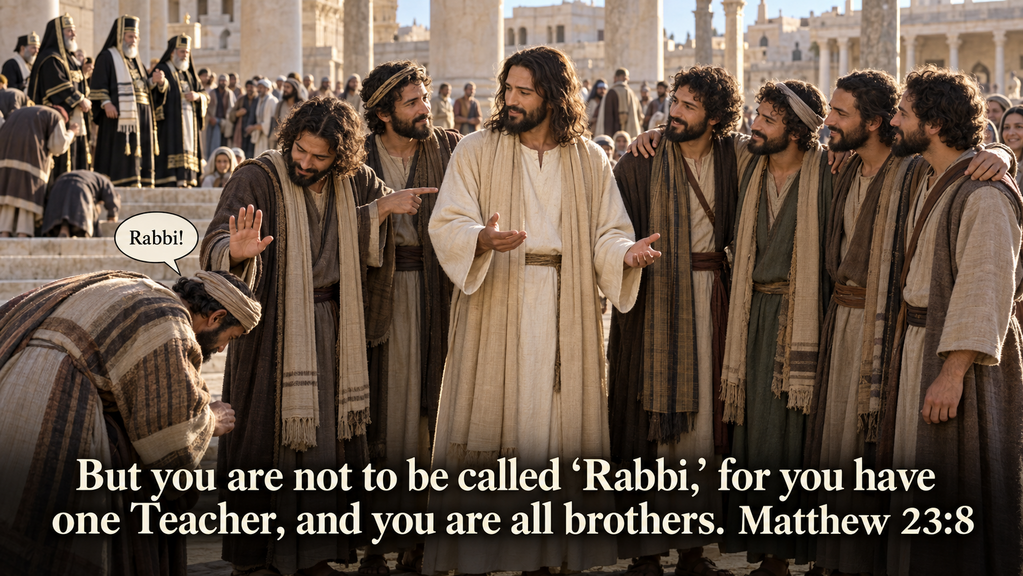
But you, do not be called ‘Rabbi’; for One is your Teacher, the Christ, and you are all brethren. Matthew 23:8
Note: You can listen to today’s commentary courtesy of our friends at the “Bible in Ten” podcast. (Click Here to listen)
You can also read this commentary, scrolling with music, courtesy of our friends at “Discern the Bible” on YouTube. (Click Here to listen), or at Rumble (Click Here to listen).
“You, also, not you should be called ‘Rabbi.’ One, indeed, He is of you the Guide: the Christ. All, also you, brothers – you are.” (CG)
In the previous verse, Jesus mentioned that the scribes and Pharisees love the greetings in the marketplaces, and to be called Rabbi, Rabbi by men. He next says words that bear emphasis, “You, also, not you should be called ‘Rabbi.’”
The words need to be considered from what was just said –
* They affectionate, … the greetings in the markets, and to be called by the ‘men’, ‘Rabbi, Rabbi.’
* You, also, not you should be called ‘Rabbi.’
The first thing to consider is the context of what is being said. Jesus is speaking to people still under the Law of Moses. He had not yet fulfilled the law. As such, the words refer to how things operate under the law and within Jewish society.
Therefore, these words are not appropriately applied in the context of the church. People attempt to use the words of Jesus to dismiss any title at all. That is ridiculous. Luke in Acts, Paul, James, Peter, and John all refer to elders within the church. Other words are used, such as overseer.
These men, teachers under the law, were seeking the attention of the title, expecting it to be their known label and designation. There was no humility in what they were doing. Instead, they were seeking the exaltation of their position. Jesus expected not to find such a thing among His audience. The reason is that “One, indeed, He is of you the Guide: the Christ.”
A new word is seen in some manuscripts, kathégétés, a guide. Figuratively, it is a teacher or master. Other manuscripts use the more common didaskalos, instructor or teacher. As noted in the previous commentary, the idea of being a rabbi is that of having superior knowledge in the law. Hence, the word rav, meaning many or much, is its root.
It should be noted that the word didaskalos is used in Acts and by Paul, the author of Hebrews, and James when referring to teachers within the church. Paul calls himself a didaskalos, teacher, in 1 and 2 Timothy. Therefore, it is obvious that Jesus is not saying what so many claim in regard to titles. Jesus gives His reason for His words, saying, “All, also you, brothers – you are.”
The point of Jesus’ words is that Christ is their Guide. They are all on the same level, and it is not appropriate for one of them to elevate himself above the others. Nor would it be right for any of them to exalt another above themselves.
The Lord gave Israel the law. Christ came to guide them in understanding the full implication of what the law was intended to do, meaning to lead the people to understand their need for Him. This is something that would actually only occur in His death and resurrection.
Life application: There are positions within the church that are designated in Scripture, such as elders, overseers, shepherds (pastors), teachers, evangelists, deacons, etc. Today, there are no apostles of Jesus. That is a position that requires having personally seen and been designated as such by Jesus. Only a sender can designate his messengers.
At times, you may hear people claim that using titles is inappropriate, but that ignores the words of the epistles, which clearly dispute this. Some people say that only titles given in the Bible should be used. But that dismisses the need to appoint people within the church for jobs not specifically stated in the epistles, but which are used to glorify God, such as the choir director.
One cannot argue that because the epistles don’t mention having a choir that there should be no choir. That is an argument from silence. Some people say that the position of pastor is not valid because it is not mentioned in the Bible. But it is. Paul uses the term shepherd in Ephesians 4:11. Pastor is simply another name for a shepherd.
Use common sense when considering such things. Don’t let know-it-alls intimidate you into submission over something so ridiculous as their silly arguments. The point Jesus makes in Matthew 23:8 must be considered in the context in which He is speaking and in light of later revelation in Scripture.
Lord God, may whatever we do glorify You. We don’t need to evaluate ourselves or others within the church in manners that draw attention away from You. At the same time, there are positions of authority which demand double honor and respect within our churches. Help us to keep these things in their proper perspective. Amen.