
Wednesday, 23 September 2026
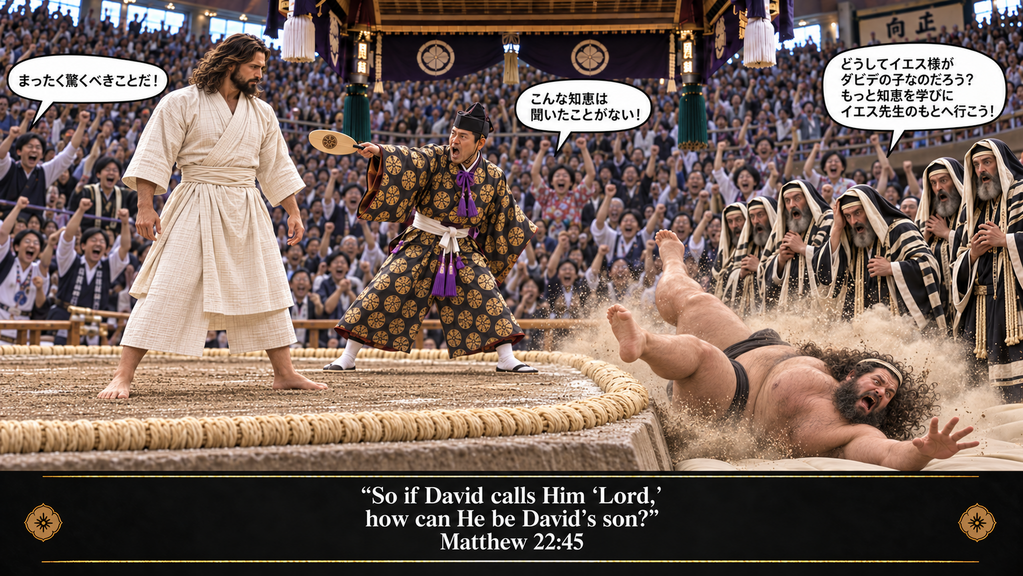
If David then calls Him ‘Lord,’ how is He his Son?” Matthew 22:45
Note: You can listen to today’s commentary courtesy of our friends at the “Bible in Ten” podcast. (Click Here to listen)
You can also read this commentary, scrolling with music, courtesy of our friends at “Discern the Bible” on YouTube. (Click Here to listen), or at Rumble (Click Here to listen).
“If therefore, David, he calls Him ‘Lord,’ how ‘Son, His’ He is?” (CG)
In the previous verse, Jesus cited Psalm 110:1. He used that as the basis for asking how it was that David, while under the inspiration of the Spirit, called the Christ Lord. He now specifically asks for them to consider David’s words, saying, “If therefore, David, he calls Him ‘Lord,’ how ‘Son, His’ He is?”
The meaning is that by calling the Christ Lord, the Christ must be David’s superior. But this would be contrary to the normal understanding of family relationships. The former is always superior to those who come later. For example, Abraham is superior to Isaac. Isaac is superior to Jacob, and so on.
Respect, including honorific titles, belongs to the one who comes first. However, One would issue from David, whom David calls Lord. In calling Him Lord, David acknowledges Christ’s preexistence in relation to himself.
The answer lies in Christ’s dual nature, He being the God/Man. This state in relation to David is found in Revelation 22 –
“I, Jesus, have sent My angel to testify to you these things in the churches. I am the Root and the Offspring of David, the Bright and Morning Star.” Revelation 22:16
David calls the Christ Lord because David stems from the work of Christ when He breathed the breath of life into Adam –
“And the Lord God formed man of the dust of the ground, and breathed into his nostrils the breath of life; and man became a living being.” Genesis 2:7
The deity of Christ is clearly evidenced in Jesus’ analysis of the psalm.
Life application: An attack on Jesus’ nature forms the basis for almost every heresy found within Christianity. Other heresies, such as the sinless nature of Mary, indirectly attack Jesus’ work on behalf of humanity. In the end, anything that diminishes Jesus’ deity, His humanity, or His all-sufficient work must be rejected.
Jesus is the Lord God come in human form. What He has done is fully sufficient to reconcile man with God. This is why inserting ourselves into the salvation equation is such an offense to the gospel message.
Jesus began the process, performed the necessary work, and then offers the results of His work to us as grace. When we claim that someone was sinless, like the Roman Catholic Church does with Mary, it negates the need for a Redeemer. If God exempted her, He could do so for each one of us, even if He chose not to do so.
The magnificence of the cross is obliterated through such a heresy. Likewise, when we hold to our works as somehow initiating or maintaining the grace of the cross in our lives, it means that the cross is not of grace at all. God is robbed of the honor of blessing His creatures in this manner. It is thus an attack against the very nature of God to set aside the grace of the cross.
Let us hold fast to the truth that God has done everything necessary for our salvation. We are granted God’s forgiveness and the righteousness of Christ through merely believing that God has done it. Trust the gospel! Don’t let anyone tell you that there is more to do to be on God’s good side. He has done it all!
Lord God, how grateful we are to You for what You have done. Jesus! He has come and brought us back to You through His all-sufficient work. We will sing the praises of our God forever and ever. Hallelujah for the exalted name of our Lord – Jesus! Amen.