
Monday, 21 September 2026
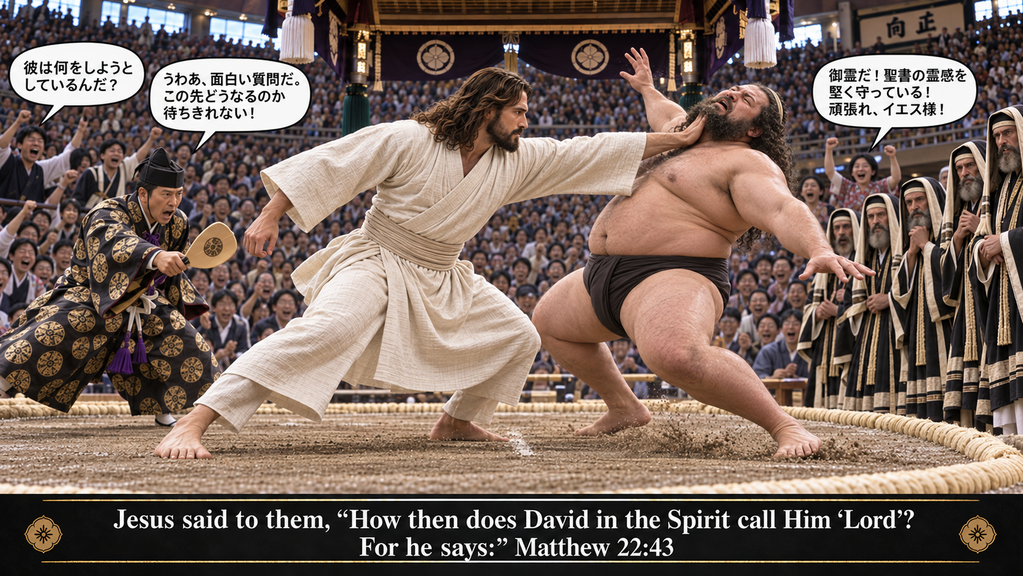
He said to them, “How then does David in the Spirit call Him ‘Lord,’ saying: Matthew 22:43
Note: You can listen to today’s commentary courtesy of our friends at the “Bible in Ten” podcast. (Click Here to listen)
You can also read this commentary, scrolling with music, courtesy of our friends at “Discern the Bible” on YouTube. (Click Here to listen), or at Rumble (Click Here to listen).
“He says to them, ‘How then, David – in Spirit, ‘Lord,’ Him, he calls, saying…’” (CG)
In the previous verse, Jesus asked the Pharisees what they thought concerning whose Son the Christ is. Their answer to him was “David.” Their answer, despite being correct, was incomplete. To get them thinking on the right lines concerning the nature of the Christ, “He says to them, ‘How then, David – in Spirit.’”
The Pharisees have said that the Christ is the Son of David. If this is so, and Scripture testifies to it as a fact, that information doesn’t tell the entire story. David himself testifies to it.
As Scripture is given by God, and as David’s words are recorded as Scripture (in Spirit), then what David said concerning the Christ must be considered. Jesus continues with what David penned while in the Spirit, saying, “‘Lord,’ Him, he calls, saying…”
At this point, what the word “Lord” signifies, or where it is recorded, isn’t stated. That will be seen in the next verse. However, it would be highly unusual for David to call one of his descendants “Lord.” In Scripture, everything traces back to its source.
Each preceding generation of humanity is considered greater due to the respect shown to the parent. Thus, the Christ, being a descendant of David, something already established as being the case as testified to elsewhere in Scripture, would be expected to call David Lord, not the other way around.
Regardless of the term from which the English word “Lord” is derived, it is an honorific being stated from a lesser to a greater. As the people were still waiting for the Christ at Jesus’ time, what David wrote about this “Son” of his asks the reader to question how it can be proper that he would be called Lord by David?
Life application: Thinking Jesus’ logic through, as recorded in this verse, is a way of determining what is going on. It will then help us come to right conclusions about what Scripture is saying.
Jesus refers to Scripture. We have not yet read which one, but that is already an understood premise of His. The assumption is that when Scripture is assigned to David as the author, it is reliably so. Jesus then says that David is in the Spirit as he pens, something also considered axiomatic among the people of Israel.
Scripture is from God. If a human penned it, the understood meaning is that the human was being led by the Spirit to write out what God intended. As this is so, there can be no error in what is written. These things are to be taken at face value from a proper interpretation of Scripture.
People can indeed deny this process actually occurs, but such people must at least admit this is what is considered biblically correct. To not agree with how the process is presented would show a bias against what is clearly understood from the Bible itself. Therefore, even a denier of the Bible being the word of God, if intellectually honest, will at least agree that this is how Scripture presents things.
Jesus confirms that truth here. He testifies to the facts as laid out. David authored what is credited to David. The Spirit led him as he wrote. The Christ is clearly identified as a Son of David in Scripture. And yet, David calls one of his own progeny, who will be the Christ, Lord. This is what Jesus is presenting to the Pharisees.
The process is undeniable. Therefore, the conclusion, if Jesus properly follows this process, will be correct. From there, what the meaning of the conclusion is must be evaluated, and a decision is to be rendered.
Following this process, as set forth by Scripture itself, and as confirmed by how Jesus has used it, will help you as you consider what is said in Scripture. When you come to a passage that presents information, ask yourself what is being conveyed. Follow the logic that you have seen in Jesus’ example. From there, you can form a conclusion about what is said.
Even an atheist can do this. If he accepts that this is how the Bible presents matters, and if he is honest about following the process to form a conclusion, his deductions will be correct, even if he doesn’t believe what the Bible says.
An example to understand this might be a person who believes in a flat earth. He has it in his head that the earth must be flat. However, he knows there is a process that round-earth proponents use to make their conclusions. If he follows that process, even if he doesn’t believe it is correct, the information he comes up with will confirm a round earth.
It is up to him to accept or deny the results, but if he is honest, he will have to admit that the process resulted in a round earth conclusion. As this process goes back to at least the time of Aristotle, he will have to admit that the standard thinking all along has been that of a round earth.
His job is to either accept a round earth, or he will have to find fault in the process. If he cannot find fault in the process, the burden of proof for a flat earth rests upon him in contradistinction to the method used to determine the earth is round.
In other words, whether evaluating the Bible or something like the round vs. flat earth debate, one must be intellectually honest in following the accepted process. Not to do so will inevitably lead to a faulty conclusion that is unsupportable by the process.
Lord God, help us to think clearly and objectively when we consider Your word. If we evaluate it fairly and properly by a set process as You have revealed in it, whatever conclusions we make should be properly in line with what You intend for us. So, Lord, help us to rightly consider Your word at all times. Amen.