
Thursday, 3 September 2026
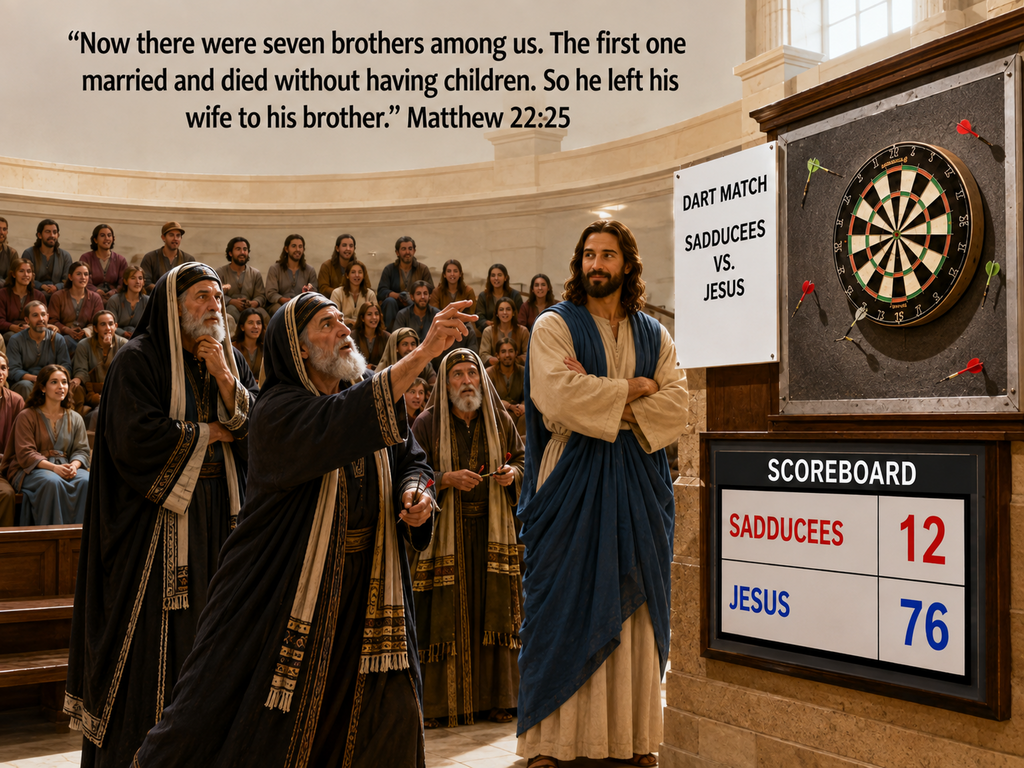
Now there were with us seven brothers. The first died after he had married, and having no offspring, left his wife to his brother. Matthew 22:25
Note: You can listen to today’s commentary courtesy of our friends at the “Bible in Ten” podcast. (Click Here to listen).
You can also read this commentary, scrolling with music, courtesy of our friends at “Discern the Bible” on YouTube. (Click Here to listen), or at Rumble (Click Here to listen).
“They were, also, among us seven brothers, and the first, having married, he died, and not having seed, he left the ‘wife, his’ to the ‘brother, his’.” (CG)
In the previous verse, the Sadducees cited the law from Moses concerning the levirate marriage. With that laid before Him, they now bring in a scenario based on that law, beginning with, “They were, also, among us seven brothers”
As the basis for their question was the levirate marriage prescription found in the law, we can already assume their question will be based on that, which necessitates an evaluation from Jesus. However, it is to be remembered that Matthew introduced the Sadducees in this section as saying there is no resurrection. That will somehow be connected to their question.
Being seven brothers, and their proposal being dependent on the prescription from Moses, the assumption is that these are seven brothers from the same father’s side of the family. The reason for this is that it is the name and inheritance that is being dealt with, something that is irrelevant to a half-brother who is from another father.
Their words continue, saying, “and the first, having married, he died.” One can already assume what the rest of this situation will be. They are speaking to Jesus about the levirate marriage. A son in the family has died. The natural assumption would thus be as is next stated, “and not having seed, he left the ‘wife, his’ to the ‘brother, his’.”
The man had no children before he died. Because of that, it is the responsibility under the law that the next son would perform the duty of raising up a son in the name of his deceased brother.
So far, there is nothing unusual about the matter at hand.
Life application: The prescription of the levirate marriage, being a part of the law, was considered mandatory. However, during the later period of the Second Temple, preserved writings note that there was a shift in thinking about it.
The obligation is that if a man married and died childless, a surviving brother was to raise up a son in his name. However, the law did allow for refusal, with a ceremony specifying what was to be done. The result, based on the prescription, was intended to shame the one who refused to fulfill his obligation.
Despite this, there came into the sages’ thinking the issue of the practice of the precept and the alternative of declining the obligation. In fulfilling the obligation, the word used to describe the matter was yabam, the act of marrying the brother’s widow. That comes from the noun yabam, the brother-in-law mentioned in Deuteronomy 25:5 and 25:7.
On the other side of the matter is halitzah, the removal, meaning the removal of the sandal noted in Deuteronomy 25:9. During the later Second Temple period, there was a historical shift in the debate about this practice. The sages debated whether performing the marriage, yabam, could be replaced with simply allowing the halitzah.
The point of approving the practice of halizah as the standard method of dealing with this was so that there was no shame attached to the matter. This would then allow the woman to marry anyone she pleased, and the name of the brother would end.
One can see the problem here. The law sets forth a requirement, and every effort imaginable is made to circumvent the unpalatable precepts. This is seen in the New Testament when Jesus debates with the religious leaders.
The matter of the obligation to help one’s aged parents is a prime example. People will openly and with a pious attitude do things that they find easy to stomach or that don’t complicate life, but those things which are more complicated, distasteful, etc., are given a workaround.
As seen in the typology explained in the previous commentary, there was to be a sense of shame for not fulfilling the law. However, in Christ’s fulfillment of it, there would then be honor. That is obliterated by those who change the intent of the law from an obligation to a general guide for right living.
It is a problem, because the law is written and it is expected to be adhered to. What is interesting, however, is that it was around the time of Jesus that the law began to go away from the original intent. As He is the fulfillment of the typology (as seen in the previous commentary), the precept is no longer needed.
It is as if the mental state of the sages could somehow get the slightest hint in their mind that the law was only a shadow of something else. Unfortunately, they never put two and two together to make the leap that the “something else” was Jesus. Because of that, they failed to come to Him. As such, every person in the nation is still bound by every single precept of a law that has already been fulfilled.
Their state of condemnation remains because of this. Only when a person steps away from the law through faith in Jesus Christ does the law’s burden come off of him. Despite this, and despite the fact that all of the world except Israel was never under the Law of Moses, people rush to place that burden upon themselves.
This is not clear thinking. Imagine giving up the glory of the cross and asking for what brought about the need for the cross in the first place to be placed on your shoulders! God is not pleased with such ridiculous thinking. Eyes on Jesus! Anything else will lead to a bad end.
Heavenly Father, we are so grateful to You for Your open hand of grace. From the smallest flower to the most beautiful sunset, You lavish us with what we do not deserve. And above it all stands the cross of Christ and freedom from the burden of sin. Thank You for Jesus. Amen.