
Saturday, 22 August 2026
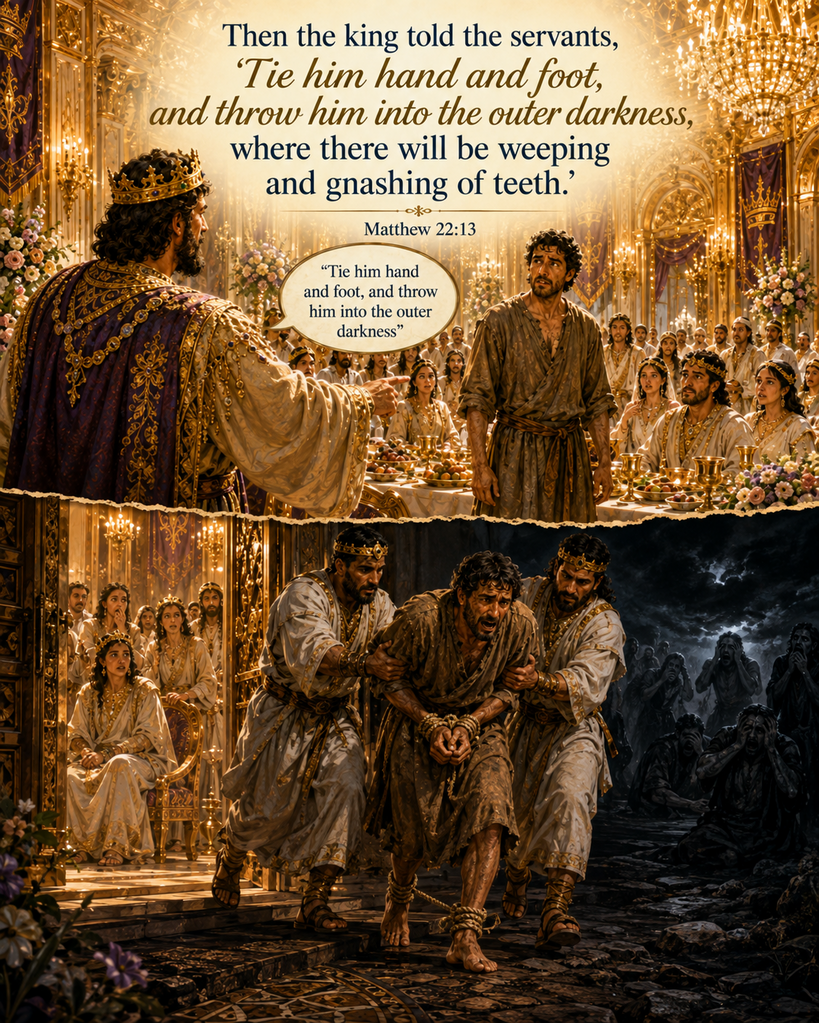
Then the king said to the servants, ‘Bind him hand and foot, take him away, and cast him into outer darkness; there will be weeping and gnashing of teeth.’ Matthew 22:13
Note: You can listen to today’s commentary courtesy of our friends at the “Bible in Ten” podcast. (Click Here to listen)
You can also read this commentary, scrolling with music, courtesy of our friends at “Discern the Bible” on YouTube. (Click Here to listen), or at Rumble (Click Here to listen).
“Then, the king, he said to the servants, ‘Having bound his feet and hands, you take him, and you cast into the ‘darkness, the outer’. There, it will be the weeping and the ‘gnash, the teeth’.’” (CG)
In the previous verse, the king asked the man how he came into the nuptial without a wedding garment. When asked, he was speechless. It next says, “Then, the king, he said to the servants.”
A different word is used here. In verse 3, it was doulos, a bondservant. Here it is diakonos, an attendant, such as a waiter at a table. It would be best not to read too much into this. Paul calls himself both in his epistles. However, the distinction may be that because the wedding ceremony is readied, the designation of the attendant is in line with voluntary service rather than that of compulsion. Of these servants, the king says, “Having bound his feet and hands.”
Things are not looking good for this fellow. As he is representative of anyone who is not properly attired, meaning covered by the righteousness of Christ, there will be many who will find out what it means to reject Him and His offer of peace with God.
As suggested in previous commentaries, the man is being used as a representative of not having Christ’s righteousness. It is not that any will somehow creep into the gathering of the saints who are not worthy, but that this is what those who are not worthy can expect. Of them, the command continues, “you take him, and you cast into the ‘darkness, the outer’.”
Some manuscripts leave off the words “you take him.” So either a scribe missed that in the original (something that is very easy to do), or maybe it was added to relieve the abrupt nature of the command without that inclusion.
Either way, the ultimate end of the man remains unchanged. He is cast into outer darkness, a thought repeated from Matthew 8:13, which followed the thought, “And I say to you that many will come from east and west, and sit down with Abraham, Isaac, and Jacob in the kingdom of heaven” (Matthew 8:12).
In both, the idea of Israel not getting a free pass is seen. They must come to God in the same manner that is set for all people. There is one way to be deemed right before God, and it centers on the Person and Work of Jesus. Understanding that, the parable continues with, “There, it will be the weeping and the ‘gnash, the teeth’.”
Again, the words follow what is said in Matthew 8:13. There will be joy and blessing for those who receive the gospel. There will be sadness and misery for those who do not. The parable details this fact. Faith in Jesus is the difference between the two.
Life application: The account of Matthew 8 detailed the faith of the centurion, a gentile who understood Jesus’ authority and capabilities. His faith exceeded that of all others in Israel (Matthew 8:10). This is what prompted Jesus’ words concerning those who would sit and dine with Abraham, Isaac, and Jacob in the kingdom.
The parable of the wedding feast parallels that thought. Though it doesn’t mention faith, it does note the unworthiness of some and the worthiness of others. Determining what makes one worthy, faith, makes the parable understandable.
It is not uncommon to hear people say that they have lost their faith because of a calamity, difficulty, or major trial in their lives. Is that a reason to lose faith? If so, it means that we are conditioning our faith on our circumstances, not on the object of proper faith, meaning Jesus.
If anything, our hope in Christ should strengthen when we face such catastrophes. If this world (not God) is weighing us down, we should want to be out of here and with God all the more, not less. Take time to evaluate why you believe what you believe. God does not promise us easy lives, freedom from pain or trial, wealth, or any such thing during this life.
He does, however, promise us a new and far better existence in His presence someday. That is what we should be focusing on. Be sure to fix your eyes on Jesus. Anything else will lead to unhappiness as you walk through this fallen, troubling world.
Lord God, it is certain that difficulties, trials, and tribulations can be expected in this life. Help us to navigate through them with our faith only increasing as we await the day when we are forever in Your presence. Give us the wisdom to stand fast on Your promises which lie ahead. Amen.