
Thursday, 23 July 2026
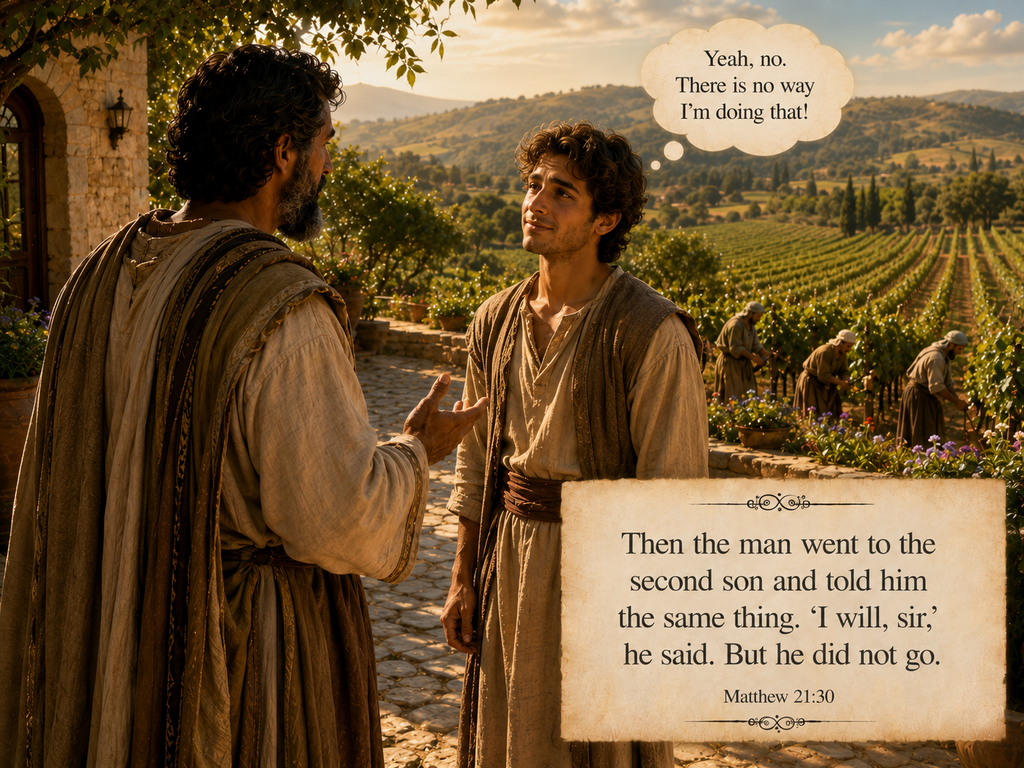
Then he came to the second and said likewise. And he answered and said, ‘I go, sir,’ but he did not go. Matthew 21:30
Note: You can listen to today’s commentary courtesy of our friends at the “Bible in Ten” podcast. (Click Here to listen)
You can also read this commentary, scrolling with music, courtesy of our friends at “Discern the Bible” on YouTube. (Click Here to listen), or at Rumble (Click Here to listen).
“Having approached, also, the second, he said as thus. The ‘also having answered’, he said, ‘I, lord.’ And not he went.” (CG)
In the previous verse, Jesus continued the parable of the two sons, noting that the first said he would not go work in the vineyard. Later, however, he regretted his words and went. Unlike him, Jesus continues with another son, saying, “Having approached, also, the second, he said as thus.”
As previously mentioned, the number two signifies division or difference. Sets of two will follow this thought. Those in this parable are no different. The man goes to the second son and says just as he did to the first.
With such a curt response from the first, he must have wondered what response he expected to find from the second. In asking, he must have been relieved. Matthew records, “The ‘also having answered’, he said, ‘I, lord.’”
The answer is short and direct. It must have filled the father with hope that this son would be a good example of the family values set forth from generations past. The words “I, lord” are a shortened form of “Here I am, lord, send me.” In other words, there is a happy acceptance of the request and the surety that it will be fulfilled. However, Matthew next records, “And not he went.”
God has a vineyard, and He expects it to be tended to. One group of people, represented by one of the sons, refuses to participate, but later regrets the thought and heads into the vineyard to work. The other group, represented by the second son, readily accepts the commission, but never follows through with it.
Jesus is showing a distinction between these groups before explaining who they are. The explanation will not be withheld for long. First, however, He will have a question for His hearers.
Life application: Jesus’ use of the parable is not unlike how an undercover reporter works. At times, they first set up a scenario by inserting themselves into a situation, becoming a part of the ongoing matter being investigated.
While involved with their target, they elicit information from them by presenting themselves as one of them, all the while standing separate from them in any real way. As the reporter learns about their true motives and intentions, he carefully records what is going on. This is the true self that is hidden from public sight.
Once the heart has been exposed through this investigative manner, the reporter then openly confronts those they are investigating with the proof of what they have been doing. They cannot deny that they have been doing it. There have been recordings, documentation of the events, and maybe witnesses have been brought in at times to verify what has been going on.
What was hidden has been exposed. The one exposing the matter has not done anything wrong. He has simply worked within the targeted group to reveal their wrongdoing.
Jesus did this with His own life, coming in the form of a man, living among the people, and doing what is right and expected while also exposing the wrong conduct of the nation. At times, He would even show them that is what He was doing by telling them in parables what He had exposed.
This was not cunning and deceptive. Rather, the prophets said He would come and reveal such things to the people, providing all the evidence necessary to turn them back to God or to further harden their hearts toward Him. None can say they weren’t warned. To this day, the record stands as recorded in Scripture that He has done this.
On the day of judgment, God will be able to present the evidence to all people of His knowledge of all things. There will be no cries that it is unfair or unjust. He is God. We are to do as He determines. When we say we will go, He expects that we will follow through with that. If we say we won’t go, but later regret that, He will know it and act accordingly.
We, too, are admonished to bring darkness to light so that people may see and learn from it. Let us do our best to help those around us to evaluate their lives in an attempt to get them to regret how they are living, reconsider their ways, and turn to the living God through Jesus Christ for salvation.
“And have no fellowship with the unfruitful works of darkness, but rather expose them. 12 For it is shameful even to speak of those things which are done by them in secret. 13 But all things that are exposed are made manifest by the light, for whatever makes manifest is light.” Ephesians 5:11-13
O God, help us to bring light to the dark recesses of this world through the pursuit of the truth. May we be ever on the advance in our knowledge of Your word so that we can lead others to right thinking concerning their need for You. Amen.