
Saturday, 18 July 2026
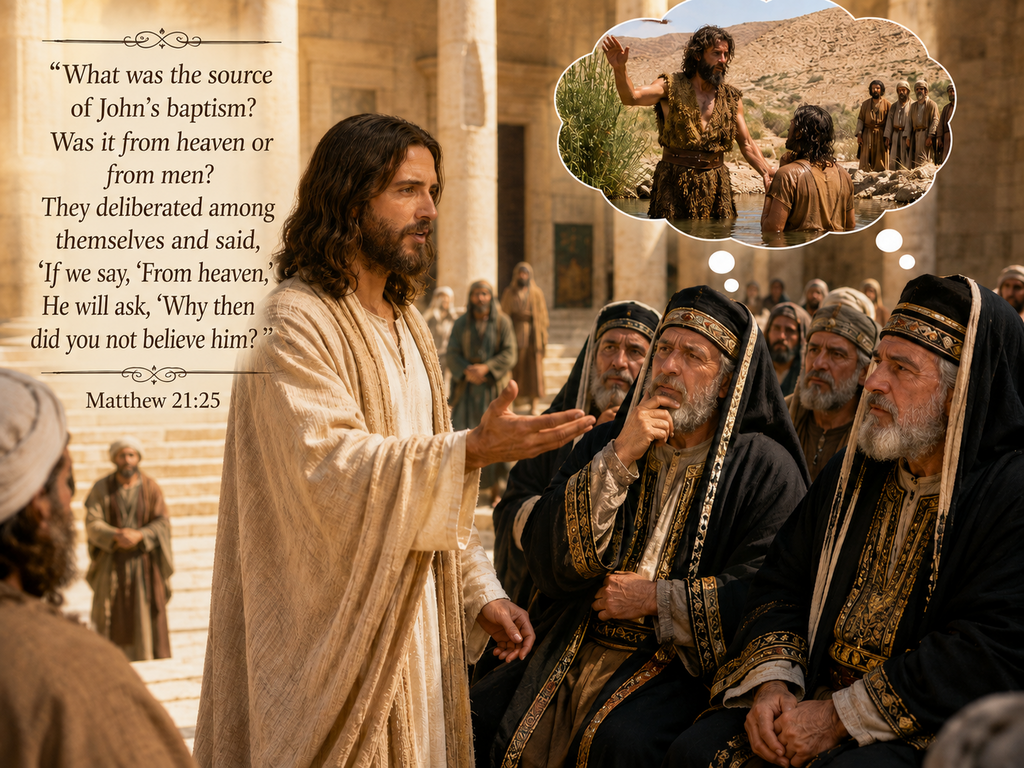
The baptism of John—where was it from? From heaven or from men?”
And they reasoned among themselves, saying, “If we say, ‘From heaven,’ He will say to us, ‘Why then did you not believe him?’ Matthew 21:25
Note: You can listen to today’s commentary courtesy of our friends at the “Bible in Ten” podcast. (Click Here to listen)
You can also read this commentary, scrolling with music, courtesy of our friends at “Discern the Bible” on YouTube. (Click Here to listen), or at Rumble (Click Here to listen).
“The ‘immersion, John’, whence it was? From heaven or from men?” These, also, they deliberated with themselves, saying, ‘If we should say, “From heaven’, He will say to us, ‘Through why, therefore, not you believed him?’” (CG)
In the previous verse, it said that Jesus, while speaking to the chief priests and elders, said that He would answer their question if they would first answer His question. Continuing, He now asks that question, beginning with, “The ‘immersion, John’.”
His question deals with John the Baptist’s work, meaning his immersing people as described earlier in Matthew. As John’s main mission was to baptize people based on acknowledging wrongdoing and reconsidering their ways, the “immersion, John” encompasses his entire ministry, all of which was as a precursor, preparing the people for the coming of the Messiah. His specific question concerning that is, “whence it was?”
In other words, these leaders had just come to Jesus asking by what authority He was doing what He did. Specifically, who gave Him the authority? Jesus, taking the initiative, asks the same basic question concerning John’s call to baptize. Where did that authority come from? He continues, asking, “From heaven or from men?”
It is a logical question. These leaders want to know who gave Jesus His authority. But John openly and explicitly testified concerning Jesus, as recorded in John 1. Therefore, before they can rightly understand Jesus’ authority, they would first need to understand and confess John’s source of authority. Was it sent by God, or was it something that he or another man conjured up? Having asked that, it next says of the leaders, “These, also, they deliberated with themselves.”
One can see they are in a pickle. If they knew the answer, they would just say it directly, unless there was a reason why they didn’t want to admit it publicly. Therefore, either they don’t know the answer, which means they have no right to know where Jesus’ authority came from, or (because John testified concerning Jesus) they knew and were unwilling to state what they believed to be true.
If this were the case, they would again have no right to an answer from Jesus. In their deliberations, they were “saying, ‘If we should say, “From heaven”, He will say to us, “Through why, therefore, not you believed him?”’”
This reveals the first part of the reason for the pickle they are in. If John’s commission was from God, then they would have to admit that Jesus was the Messiah. John openly proclaimed Him as the One, testifying that He was the promised Messiah –
“The next day John saw Jesus coming toward him, and said, ‘Behold! The Lamb of God who takes away the sin of the world! 30 This is He of whom I said, ‘After me comes a Man who is preferred before me, for He was before me.’ 31 I did not know Him; but that He should be revealed to Israel, therefore I came baptizing with water.’
32 And John bore witness, saying, ‘I saw the Spirit descending from heaven like a dove, and He remained upon Him. 33 I did not know Him, but He who sent me to baptize with water said to me, “Upon whom you see the Spirit descending, and remaining on Him, this is He who baptizes with the Holy Spirit.” 34 And I have seen and testified that this is the Son of God.’” John 1:29-34
Life application: As noted before, Jesus is not being disrespectful to these leaders. He is making an obvious case that in asking Him for the source of His authority, they would only entrap themselves by His answer when they gave it. He is giving them a chance to back up from whatever their plans were and to think the matter through logically.
Would it change their hearts or minds toward Jesus? Probably not. But it would allow Him to continue His ministry until the time appointed by the Father. If they thought about John’s source of authority and decided he was sent by God, maybe some of them would be determined to accept John’s words and believe in Jesus.
If they rejected John’s ministry, thus rejecting the One who sent him, then they would never accept Jesus. Instead, they would look for another way to have Him removed. That is what will come about, but before it does, there are a few days of His ministry left. A great deal of important information will be recorded concerning what He will tell the people of Israel.
He will detail what will come upon them because of their rejection of Him. Someday, the words He will speak in these final days will be evaluated by them, and they will see that He is, in fact, the Messiah they rejected so long ago. The leader’s failure to provide a response to Jesus at this time has allowed Jesus’ words to continue on as necessary for the people’s future eyes to be opened.
Lord God, Israel, and indeed the whole world, have difficult times ahead. As wickedness increases, our time is drawing short. Someday, You will call Your church home, and the world will have to decide where they stand in relation to Jesus. We pray that before that day comes, many eyes will be opened to the truth of His glory. Amen.