
Monday, 29 June 2026
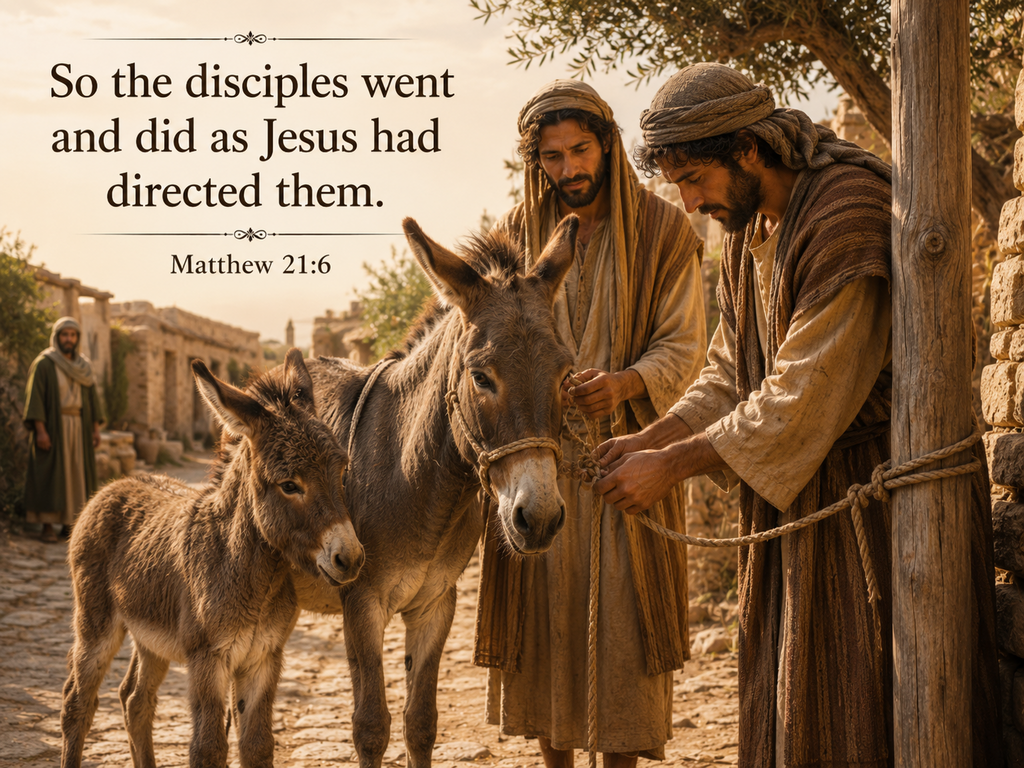
So the disciples went and did as Jesus commanded them. Matthew 21:6
Note: You can listen to today’s commentary courtesy of our friends at the “Bible in Ten” podcast. (Click Here to listen)
You can also read this commentary, scrolling with music, courtesy of our friends at “Discern the Bible” on YouTube. (Click Here to listen), or at Rumble (Click Here to listen).
“Having gone, also, the disciples, and having done just as He directed them, the ‘Jesus’.” (CG)
In the previous verse, Matthew cited the prophet concerning Jesus’ instructions about the donkey, showing that what Jesus intended was the fulfillment of those Scriptures. With that thought presented, it next says, “Having gone, also, the disciples.”
These are the two disciples mentioned in verse 1. They are not named in any of the gospel records. Despite this, it next says, “and having done just as He directed them, the ‘Jesus’.”
A new word is seen here, suntassó, to arrange jointly. Hence, it signifies to direct or appoint a matter. Mark and Luke add in content not seen in Matthew –
“So they went their way, and found the colt tied by the door outside on the street, and they loosed it. 5 But some of those who stood there said to them, ‘What are you doing, loosing the colt?’
6 And they spoke to them just as Jesus had commanded. So they let them go.” Mark 11:4-6
Luke closely matches Mark.
Life application: The Bible goes from simple truths about our state before God to deep theological explanations for who God is, what He is like, and how we can approach Him. It also deals heavily in typology in order to teach us detailed doctrinal points about a seemingly unlimited number of issues.
There is something for every age level and every level of intelligence, if we are willing to seek out what it says. As we search it out, we should not attempt to manipulate what it is saying by inserting our ideas into it. Rather, we should do our utmost to maintain the proper context, consider what it says from God’s perspective, and try to understand why God highlights and stresses particular points.
If there is an issue that takes up a lot of space in the Bible, then we should pay heed to it. For the Christian, it is obvious that the whole Bible, in some way or another, is always pointing us to Jesus. We should take that as an axiom and look to discover how each passage points to Him.
But other key points are painstakingly included as well. Probably the most pronounced one of all is that of law versus grace. So much space in Scripture is taken up on this one issue that it needs to be carefully considered.
The dispensations of time are another point that is repeatedly seen in typology. Again and again, they are highlighted to demonstrate how God is working at various times and in various ways in human history. For example, the dispensational model forms the backbone of the Book of Esther.
If this were merely a side issue, God would not repeatedly bring it into His word. But He does. As this is so, we should carefully evaluate and apply dispensations to our understanding of Scripture. If we don’t do this, our perception of what God is doing at any given time in the world (and in His word) will be skewed.
Be sure to consider things in the word carefully as you read. God is giving us information about Himself, what He expects, how we are to consider and interact with Him, and how we are to interact with the world around us.
The more effort you put into meditating on His word while considering its precepts, and then applying them to your life, the closer you will be to His heart as you live out your days in His presence.
Lord God, help us to carefully live our lives in a manner that is pleasing to You, understanding that we have a part in that process. To know what You expect, we must know Your word. From there, be with us as we walk in this world in accord with what You intend for us as Your people. Amen.