
Tuesday, 23 June 2026
A summary of Matthew Chapter 20.
Note: You can listen to today’s commentary courtesy of our friends at the “Bible in Ten” podcast. (Click Here to listen). For a summary of the Proverbs/Isaiah/Matthew links (Click Here to listen).
You can also read this commentary, scrolling with music, courtesy of our friends at “Discern the Bible” on YouTube. (Click Here to listen), or at Rumble (Click Here to listen).
After this summary is a translation of Chapter 20 of Matthew. You can view that, scrolling with music on YouTube (Click Here to listen), or at Rumble (Click Here to listen).
Chapter 17 revealed that there is a future for Israel in God’s redemptive plans. The main message of Chapter 18 was that childlike faith is required to enter into the kingdom. The final parable, that of the wicked servant, dealt with Israel’s rejection of Christ’s fulfillment of the law, showing that they would be delivered up until they entered the New Covenant. Chapter 19 took the reader through various topics to reveal what God prioritizes. The contrasts between law and faith were seen throughout the chapter.
Chapter 20 began with a parable based on Peter’s question that came toward the end of Chapter 19, “See, we have left all and followed You. Therefore what shall we have?” (Matthew 19:27). Jesus mentioned what would happen in the regeneration, meaning during the millennium, when the Son of Man would sit on the throne of His glory along with those who would sit judging the twelve tribes of Israel. The chapter closed out with Jesus’ words of verse 30, “But many who are first will be last and the last first.”
That is what precipitated the parable of the workers in the field. Those who came last during the dispensation of the law would be the first to enter into the New Covenant, receiving grace, while those throughout the dispensation of the law had to labor.
Immediately after that parable, it noted that Jesus was going up to Jerusalem (Foundation of Peace). He took His twelve disciples aside to tell them about His coming passion. The place known as the Foundation of Peace would be where peace is realized through Christ’s accomplishment of His work.
Immediately following those three verses, it noted that the mother of Zebedee’s sons came to Him. Rather than their names being stated, it called them “Zebedee’s sons”. Zebedee is from the Hebrew Zebadyah (translated as Zebadiah). That is from zabad to confer or bestow, and the shortened form of Yehovah, Yah. The name means Yah Has Bestowed (Given).
Their mother’s request was that Jesus would grant that her two sons would sit at Jesus’ left and right in His kingdom. Ironically, she was asking the Lord incarnate to bestow upon Zebedee’s (Yah Has Bestowed) sons what she requested. His answer was that it was not His to give. Instead, it was for those whom His Father had prepared.
As noted at the time, this does not mean that Jesus isn’t God, but that His humanity had to complete His mission before the Father, through Him, could make such a grant. That discourse ended with the words, “just as the Son of Man did not come to be served, but to serve, and to give His life a ransom for many” (Matthew 20:28).
The punning continued with that statement because Jesus is the fulfillment of the name Yah Has Bestowed. Despite this truth, there is an order and a propriety in all things pertaining to God. Each step in the redemptive process must be completed before the next step can be taken or before the next allowance can come to pass.
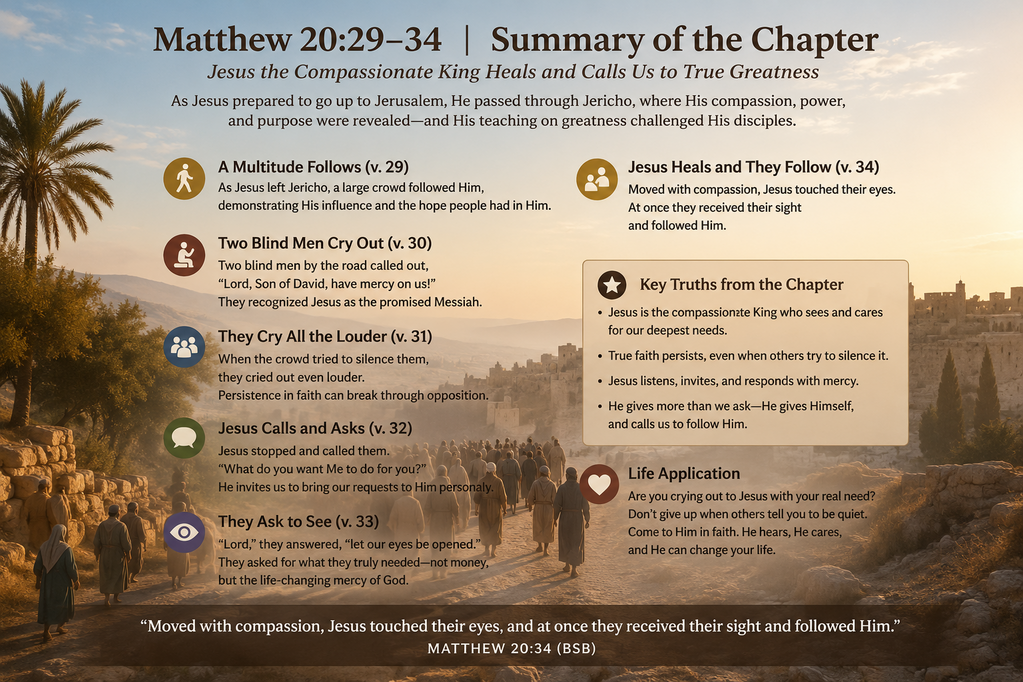
With that matter settled, the final section concerning the blind men was given. That began with, “Now as they went out of Jericho.” Jericho is Place of Fragrance. Typologically, it signifies the surety of heaven. Matthew, unlike Mark and Luke, notes that there were two blind men sitting by the road. Two is the number of division or difference. Whereas one precludes the thought of another, two signifies that there is another.
As this occurred while Jesus was going out of Jericho on His way to Jerusalem, it can be deduced that this refers to the surety of heaven (Jericho) for those who follow Christ to where He establishes peace (Jerusalem). Their cry was to the “Lord, Son of David.” They have recognized Him as the fulfillment of the messianic promises.
Because there are two in Matthew’s gospel, the number of division and difference, it can be assumed that this typologically refers to Jews and Gentiles who were previously blind, but who come to the realization that Jesus is the Christ.
They have heard the word that Jesus is passing, they have asked for their sight to be restored, and He touched their eyes, and they were restored. With that accomplished, it says that they followed Him. It is thus an anticipatory note of salvation by grace through faith based on the completed work of Christ. With that complete, the surety of heaven is realized.
The physical blindness is used as a picture of the spiritual blindness that infects all humanity and which is corrected by faith in the completed work of Jesus.
Life application: Chapter 20 is a chapter filled with hints of the transition from the dispensation of the law to the dispensation of grace. It deals with order and propriety concerning each step of the redemptive process to ensure that nothing is dealt with until the previous steps are completed.
The words from Jesus to the sons of Zebedee about being great in the kingdom show that greatness in God’s redemptive process is not based on ruling over others, but rather serving others, Jesus being the example par excellence of that concept. He is the quintessential Servant to humanity, having given His life as a ransom for many.
To procure the blessings of heaven, God has made faith in what He has done the necessary condition. Nothing more can be added to it, and without meeting that one condition, there is no chance of obtaining access. These are the precious details of this wonderful chapter of Matthew.
Lord God, thank You for the incredible details that are tucked away in Your word. We are the recipients of Your wisdom and favor when we pick it up, read it, and consider its contents. Thank You for the innumerable mysteries You have allowed us to see within it. Thank You for this precious word that tells us of our wonderful Savior, Jesus. Amen.
Matthew 20
20 Like, for, it is the ‘kingdom, the heavens’: man, housemaster, who he exited concurrently early to hire toilers into ‘vineyard, his’. 2Having also harmonized with the toilers from ‘denarius, the day,’ he sent them into the ‘vineyard, his’. 3And having exited about the third hour, he saw others having stood in the market, inactive. 4And to them, he said, “You go, also you, into the vineyard, and whatever if it should be righteous, I will give you.” And these, they departed. 5Again, having exited around ‘sixth and ninth hour’, he did likewise. 6Around, also, the eleventh hour, having exited, he found others having stood inactive. And he says to them, “Why, here, you ‘having stood all the day’ inactive?” 7They say to him, “Because no one, us, he hired.” He says to them, “You go, also you, into the vineyard, and the ‘if it should be righteous’, you will take.”
8Evening, also, having become, he says, the ‘lord, the vineyard’ to ‘commissioner, his’, ‘You call the toilers, and you pay them the reward, having commenced from the last unto the first.’ 9Having come, also, those about the eleventh hour, they took each – denarius. 10Having come, also, the first, they deemed that more, they will take, and they took, also themselves, each – denarius. 11Having taken, also, they grumbled against the housemaster. 12Saying that “These, the last, one hour they made, and equal, them, to us, you made those who were bearing the burden of the day and the blaze.” 13The ‘also answering one of them’, he said, ‘Scammer! Not I wrong you! Not for a denarius, you harmonized me? 14You bear the ‘yours’, and you go! I will, also, this: the last to give as also you. 15Or not it permits me, what I will to do in ‘these, mine’? Or the ‘eye, you’ evil, it is, because I – good, I am? 16Thus, they will be the last, first, and the first, last. Many, then, they are called; few, also, selected.’
17And ascending, the ‘Jesus to Jerusalem’, He took twelve disciples apart alone, and in the road, He said to them, 18You behold! We ascend to Jerusalem, and the ‘Son, the Man’, He will be surrendered to the chief priests and scribes, and they will sentence Him – death, 19and they will surrender Him to the Gentiles unto the ‘mock, and flog, and crucify’, and the third day, He will rise up.
20Then she approached Him, the mother – the ‘sons, Zebedee’, with the ‘sons, hers’, worshipping and asking something from Him.
21The ‘Also He said’ to her, “What do you desire?”
She says to Him, “You said that they might sit, these, the ‘two sons of mine,’ one from ‘rights, You’, and one from ‘lefts, You’, in the ‘kingdom, Yours’.”
22Answering, also, Jesus, He said, “Not you have known what you ask! Are you able to drink the cup, the ‘I, I am about to drink,’ or the immersion, the ‘I, I am immersed’ to be immersed?”
They say to Him, “We are able.”
23And He says to them, ‘The ‘indeed, ‘cup, Mine’,’ you will drink, and the immersion, the ‘I, I am immersed’ you will be immersed. The, also, to sit from ‘rights, Me’, and from ‘lefts, Me’, not it is Mine – these to give, but those it has been prepared under the ‘Father, Mine’.’
24And having heard, the ten, they outraged about the two brothers. 25The ‘also Jesus having summoned them’, He said, “You have known that the ‘rulers, the nations’ they subjugate them, and the greats, they dominate them.” 26Not thus, also, it will be in you, but whoever if he wills in you to ‘great, become’, let him be your attendant. 27And whoever, if he wills in you to be first, let him be your slave. 28Just as the ‘Son, the Man’, not He came to be attended to but to attend, and give the ‘soul, His’ – ransom for many.
29And they, proceeding from Jericho, it followed Him, ‘crowd, great’. 30And you behold! Two ‘blind’ sitting beside the road, having heard that Jesus, He passes, they croaked, saying, ‘You compassionate us, Lord, ‘Son, David’!’
31The ‘also crowd’, it admonished them that they should mute. The ‘also greater they croaked’, saying, “You compassionate us, Lord, ‘Son, David’!”
32And having stood, Jesus, He vocalized to them, and He said, ‘What you ‘will’ I should do to you?’
33They say to Him, ‘Lord, that they might be opened the ‘eyes, ours’.’ 34Having gut-wrenched, also Jesus, He touched the ‘eyes, theirs’, and immediately they up-looked, their ‘the eyes’, and they followed Him.