
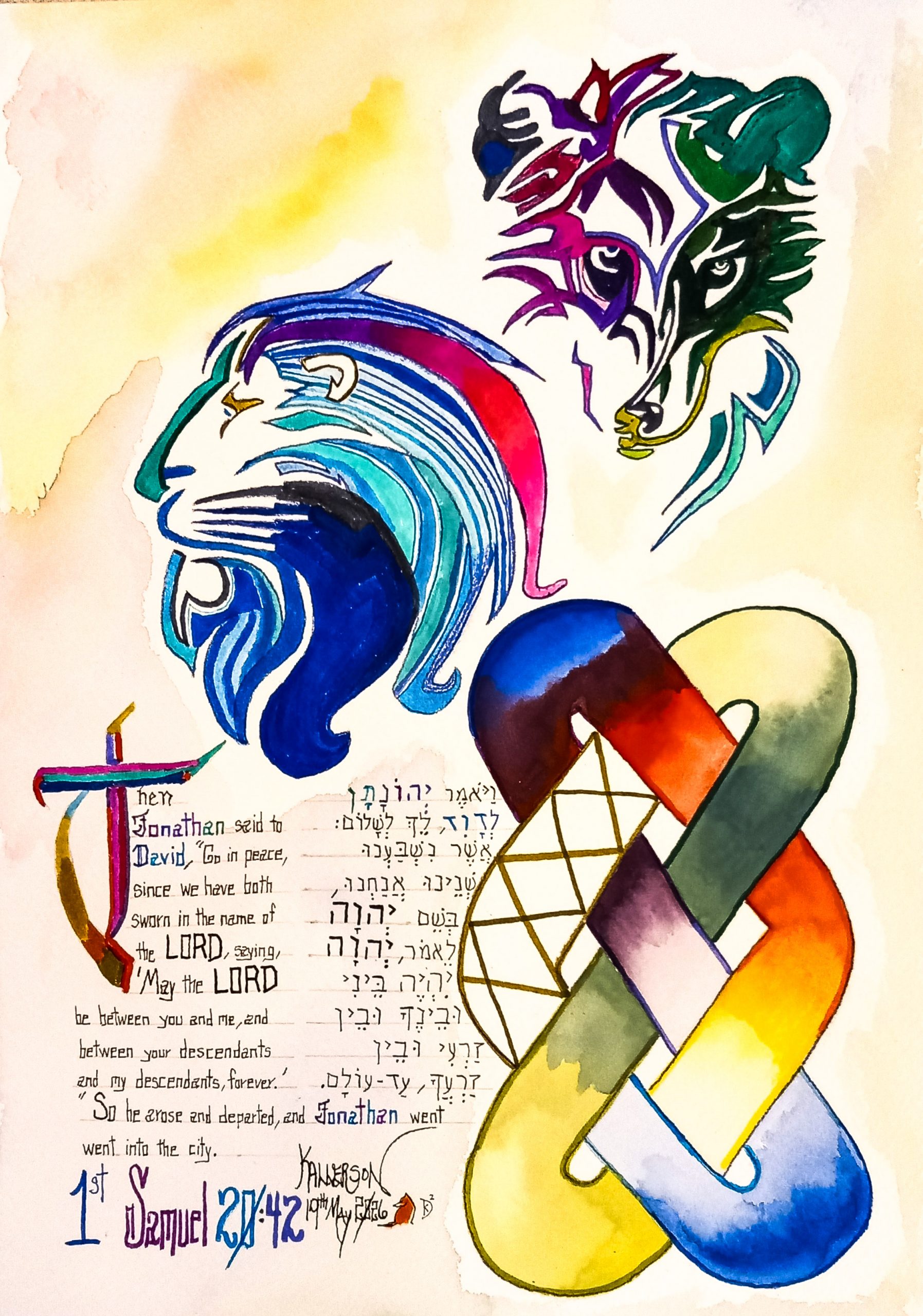
Artwork by Douglas Kallerson
1 Samuel 20:34-42
The Stone, the Departure, Part III
(Typed 12 January 2026) I never get tired of how God works things into His word. He takes real stories of actual historical events and people and uses them to typologically cover a seemingly unlimited number of things.
He reveals doctrines, truths, and future events. Some events span extended periods from past to present and into the future! One story can represent events in history that span thousands of years.
At the same time, the stories are a historical part of the lives of those He is using. When one typological picture is complete, the life of a person may go on to reveal more things in typology.
The last words of this chapter say, “And he arose, and he walked. And Jehonathan, he went – the city.” Two men were the focus of the entire chapter, revealing typology.
That alone is amazing. Making one story seamlessly fit into another part of the redemptive narrative by using select words and phrases is, by itself, an astonishing literary feat. And yet, there is more to come.
Text Verse: “For if Abraham was justified by works, he has something to boast about, but not before God. 3 For what does the Scripture say? “Abraham believed God, and it was accounted to him for righteousness.” Romans 4:2, 3
Both Jonathan and David have been used in multiple pictures already. By a simple spelling change of Jonathan’s name, an entire panorama of new or unique information can be discerned.
In some accounts, the name change has only been a couple of times out of many uses of his name. In this chapter, the additional letter is used consistently from beginning to end. Even that fact, meaning the number of times it occurs, can give us information.
Both men will continue on in the literal historical narrative, and they will also be used for different typology. The Bible is astonishing because God is amazing.
Let us revel in this glorious gift God has given us. It is, after all, His superior word. And so, let us turn to that precious word once again, and… May God speak to us through His word today, and may His glorious name ever be praised.
I. He Flowed the Arrow (verses 34-42)
34 So Jonathan arose from the table in fierce anger,
vayaqam yehonathan meim ha’shulkhan bakhori aph – “And he arose, Jehonathan, from ‘with the table’ in ‘inferno, nostril’.” Saul has become so mentally unhinged that targeting Jonathan with a spear is acceptable in his mind. This is more poignant because it was done in front of others who sat at the table. It is an issue where sides will naturally be taken when the matter is later discussed.
As for Jonathan, the more usual term for anger, burning nostril, has been replaced with the noun form of the same word. Jonathan’s anger is like an inferno contained within his head, fuming through his nostril. Because of this situation, he arose in his furious state…
34 (con’t) and ate no food the second day of the month,
velo akhal beyom ha’khodesh ha’sheni lekhem – “And not he ate in ‘day, the Renewal, the second’, bread.” There goes the meal. Regardless of how Saul acted after the outburst, everyone else would be on pins and needles as they ate. And despite this probably being the ending meal for the Feast of Acclamation, Jonathan had no desire to rejoice. His father had completely soured his mood…
34 (con’t) for he was grieved for David, because his father had treated him shamefully.
ki neetsav el David ki hikhlimo aviv – “For he was carved unto David. For he caused to humiliate him, his father.” Jonathan’s anger is not that his own father tried to pin him to the wall. That was merely an outward display reflecting the enmity Saul felt for David. In thinking Jonathan was allied with David over himself, Saul hurled the spear.
In his mind, David is the main issue. He is obsessed with the notion that David is bent on betraying him and seizing the kingdom. He is enraged that Jonathan can’t understand this simple fact. But Jonathan knows the truth about David and cannot fathom how his own father could see David as a traitor.
Jonathan’s heart is broken, and it was as if his soul was carved out of him because of the state of things…
35 And so it was, in the morning, that Jonathan went out into the field at the time appointed with David, and a little lad was with him.
Rather than the time, which was never set, it is the place of meeting that was appointed: vayhi vaboqer vayetse yehonathan ha’sadeh lemoed David venaar qaton imo – “And it was in the morning, and he went, Jehonathan – the field, to ‘appointment, David’. And the lad, diminutive, with him.” Having the lad with him, as previously planned, was a wise precaution. If Saul pulled the boy off to the side and asked what they did, he would only be able to tell him that they went out to shoot arrows.
The account specifically calls the boy diminutive. It is a purposeful selection intended to quell any suspicion that an older person might be allied with Jonathan. It is also a precaution, because little children do not snoop or ask a lot of questions. This same word was used to describe David in 1 Samuel 17 when he went to face Goliath…
36 Then he said to his lad, “Now run, find the arrows which I shoot.”
vayomer lenaaro ruts metsa na eth ha’khitsim asher anokhi moreh – “And he said to his lad, ‘You must run, you must find, pray, the arrows which I myself ‘causing to flow’.’” The scene is totally normal for anyone unaware of the prearranged meeting. The lad would have fun running after arrows, and he would be totally unsuspecting of a thing. So following Jonathan’s imperatives, he would have hurriedly headed out as Jonathan “caused to flow,” meaning shot, his arrows.
36 (con’t) As the lad ran, he shot an arrow beyond him.
ha’naar rats vehu yarah ha’khetsi lehaaviro – “The lad, he ran, and he, he ‘flowed the arrow’ to his ‘cause to traverse.’” The words “cause to traverse” are speaking of where the boy is. It is rightly paraphrased by the NKJV. Jonathan noted where the boy was and shot beyond him, thus traversing him.
In verse 20, it said that Jonathan would shoot three arrows. There is no reason to assume a lack of cohesion between the two verses. To “flow the arrow” could be a flavorful, collective way of saying that he shot multiple arrows.
We do this regularly when we use a singular to indicate repeated events, such as “At the range, Charlie shot the gun.” The indefiniteness of the action is understood to mean any number of rounds. And if Charlie goes to the range, he is going to shoot a lot. None of the uses of “the arrow” negate this…
37 When the lad had come to the place where the arrow was which Jonathan had shot,
vayavo ha’naar ad meqom ha’khetsi asher yarah yehonathan – “And he came, the lad, until ‘place, the arrow’ which he flowed, Jehonathan.” Regardless of the number of arrows, Jonathan had sent the arrow beyond the boy. Eventually, the boy arrived at the general location and…
37 (con’t) Jonathan cried out after the lad and said, “Is not the arrow beyond you?”
vayiqra yehonathan akhare ha’naar vayomer halo ha’khetsi mimekha vahaleah – “And he called, Jehonathan, after the lad, and he said, ‘(Indeed) not the arrow from ‘at you and beyond’?’” This continues to give the sense that more than one arrow was shot. The boy came to where “the arrow” was. Thus, Jonathan, using the singular, indicates that “the arrow,” collectively meaning all he shot, were from where he was and beyond.
For example, take a person who wants to collect mushrooms. He asks a local where he can get them. The guy walks with him to a point and then says, “From here and beyond you’ll find them.” He may even add, “They are everywhere after this.”
This is the agreed-upon sign from verse 20. If Jonathan called out that the arrows were beyond the lad, then David would know he was in a pickle with Saul. And this was a serious pickle, gherkin perhaps. Therefore, Jonathan calls out the gravity of the matter…
38 And Jonathan cried out after the lad, “Make haste, hurry, do not delay!”
vayiqra yehonathan akhare ha’naar meherah khutsah al taamod – “And he called, Jehonathan, after the lad, ‘Promptly! You must hurry. Not you will stand.’” The lad was unaware that this was said for David’s sake. Therefore, he probably thought Jonathan was in a hurry to shoot more or something. Not wanting to delay because of Jonathan’s rushed words, it says…
38 (con’t) So Jonathan’s lad gathered up the arrows and came back to his master.
The written and oral renderings differ: vaylaqet naar yehonathan eth ha’khetsi vayavo el adonav – “And he gleaned, ‘lad, Jehonathan’, the arrow [k.]. And he came unto his lord.” The scribes, avoiding the collective nature of the word, change the oral reading to “the arrows.” However, as with the singular “the frog” in Exodus 8:6, which is used to indicate millions of frogs, the word khetsi, arrow, here is being used collectively.
39 But the lad did not know anything. Only Jonathan and David knew of the matter.
vehanaar lo yada meumah akh yehonathan vedavid yadeu eth ha’davar – “And the lad not he knew speck. Only Jehonathan and David, they knew the word.” These words highlight their fear derived from Saul’s state. Jonathan and David wanted the matter to be completely unknown to the boy, lest he might say something under pressure from Saul that would jeopardize their own safety. Thus, the lad was kept entirely unaware of the matter.
40 Then Jonathan gave his weapons to his lad, and said to him, “Go, carry them to the city.”
vayiten yehonathan eth kelav el ha’naar asher lo vayomer lo lekh have hair – “And he gave, Jehonathan, his vessels unto the lad which to him. And he said to him, ‘You must walk, you must cause to go – the city.’” The vessels refer to his bow and arrows, but could extend to a water bottle or box lunch, anything Jonathan didn’t want to bother with.
It was the duty of such a lad to carry whatever his master wanted him to. This is an excuse to get him out of the area so Jonathan and David could meet before parting…
41 As soon as the lad had gone, David arose from a place toward the south,
ha’naar ba vedavid qam meetsel ha’negev – “The lad, he went. And David, he arose from ‘side, the south’.” After the lad’s departure, the narrative specifically focuses on David situationally, noting he arose from the south side, probably meaning the south side of the stone of the Departure.
Although the word translated as “side” is not the same as in verse 20, saying “from side, the south” is unintelligible enough, and the two words are close enough, so that many texts and some translations ascribe it to the same word –
הָאָֽזֶל the Ezel
מֵאֵ֣צֶל from side
For example, “The youth hath gone, and David hath risen from Ezel, at the south…” (YLT). This, however, is not what the text says.
The negev, south, comes from an unused root signifying being parched, as occurs when the south wind blows. As for David, once he had arisen from the south side, he…
41 (con’t) fell on his face to the ground, and bowed down three times.
vayipol leapav artsah vayishtakhu shalosh peamim – “and he fell to his nostrils earthward. And he prostrated himself three beats.” The specificity asks us to picture what is being presented. David got up from the south side, approached Jonathan, and was overwhelmed with the moment.
David knew that Jonathan had faithfully checked things out, and his warning meant this would mean a long, if not permanent, parting. David’s three prostrations before Jonathan were a sign of respect, thanks, and love all wrapped up together.
In Scripture, the number three signifies that which is solid, real, substantial, complete, and entire. In essence, it refers to divine perfection. Expanding on that, Bullinger says –
“The number three, therefore, must be taken as the number of Divine fulness. It signifies and represents the Holy Spirit as taking of the things of Christ and making them real and solid in our experience. It is only by the Spirit that we realise spiritual things. Without Him and His gracious operation, all is surface work: all is what a plane figure is to
41 (con’t) And they kissed one another;
vayishequ ish eth reehu – “And they kissed, ‘man, his associate’.” The words are unfortunately abused by those with a perverted agenda, as if there was some type of inappropriate conduct being highlighted. That has nothing to do with the culture, context, or intent.
To this day, throughout the Middle East, this is a common, natural, and accepted form of greeting. It has nothing to do with homosexuality. Rather, it is equivalent in our culture to hugging a best friend before or after a long absence, during times of distress, and so forth. The context clearly reveals the intent, including…
41 (con’t) and they wept together, but David more so.
The intent of the final clause is highly debated and widely translated: vayivku ish eth reehu ad David higdil – “And they wept, ‘man, his associate’, until David – he caused to amplify.” The word gadal means to twist. Thus, it signifies to be (or causatively, to make) large. When you twist threads, you enlarge them both in size and in strength until you have a cord and then a rope.
With this in mind, the word has many significations. A child will grow. When we praise, the Lord is magnified. A person of fame becomes great. And when one weeps uncontrollably, his sobs will amplify. In these instances, if one says “enlarge” with the intended thought in mind, though clunky, each makes sense.
Without understanding the root meaning, saying, “David, he caused to enlarge,” would have no meaning to us. But all we need to do is think about anyone who suffers great emotional trauma, and it becomes perfectly understandable. As humans, we can get ourselves so emotionally overwhelmed that our bellows of sadness are uncontrollable.
42 Then Jonathan said to David, “Go in peace, since we have both sworn in the name of the Lord,
vayomer yehonathan ledavid lekh leshalom asher nishbanu shenenu anakhnu beshem Yehovah – “And he said, Jehonathan, to David, ‘You must walk to peace which we were sevened, ‘two, us’ – we – in name Yehovah.’” Translations miss the precise nuance being conveyed. With one exception, they all essentially agree with the NKJV, which says, “Go in peace, because…” This makes one thing the result of the other.
The Peshitta skips this intent and makes it two thoughts: “Go in peace! We both have sworn in the name of LORD JEHOVAH, saying…” But that still lacks the tone. It says: “You must walk to peace which we were sevened.” A modification for clarity would be, “You must walk in the peace by which we vowed.”
Jonathan isn’t wishing David to simply go in peace, because. He is telling David he should walk in the state of peace between the two of them. It is true that it is based on their vow, but Jonathan is recalling what was said in verse 8 and then in verses 14-16 –
David to Jonathan: “And you did kindness upon your servant, for in covenant Yehovah you caused to bring your servant with you.” 1 Samuel 20:8
Jonathan to David: “And not, if I yet alive, and not you will do with me kindness Yehovah? And not I will die. 15And not you will cause to cut your kindness from with my house until vanishment. And not, in cause to cut, Yehovah, hatings David – man from upon faces the ground.” 16And he cut, Jehonathan, with house David, “And He sought, Yehovah, from hand hatings David.” 1 Samuel 20:14-16
Remembering this, Jonathan essentially says, “We have sworn to uphold our state of peace. You must walk in that state of peace.” That is why he added the emphatic, “two us – we – in name Yehovah.”
Jonathan knows David will be king. When he is, Jonathan doesn’t want him to do what his father has done, forsaking faithfulness and covenant fidelity. That is why he continues…
42 (con’t) saying, ‘May the Lord be between you and me, and between your descendants and my descendants, forever.’”
lemor Yehovah yihyeh beni u-venekha u-ven zari u-ven zarakha ad olam – “to say, ‘Yehovah, He will be between me and between you, and between my seed and between your seed until vanishment.’” The words are a close restatement of verses 14 & 15. The full thought, without being expressed because of their love and respect, would be, “You have to uphold the covenant we made, and if you don’t, may the Lord call you to account.”
The last phrase would unnecessarily offend. And so, though implied, the words have been omitted. With that reminder set forth…
*42 (fin) So he arose and departed, and Jonathan went into the city.
vayaqm vayelekh vihonathan ba ha’ir – “And he arose, and he walked. And Jehonathan, he went – the city.” The parting would have been a difficult moment in their lives. The unsurety of ever meeting again, and if so, amicably, would weigh heavily on their minds. All they could do at this point is leave the future in the hands of the Lord and live their lives remembering their friendship and striving to uphold their vows.
How long will your grace continue to last?
How long can I trust that it will still be there?
What if I die, and my time is past?
Will those after me still receive Your tender care?
How long will Your covenant promises exist?
Is there a time when they will no longer be?
Will there be a day when they fade into the mist
Or will they forever stand for those who come after me?
What is a covenant to You, O Lord my God?
We have transgressed it so many times
What is the measure of Your covenant rod?
Will Your promise be shortened because of our crimes?
II. But for How Long, Lord?
As the explanation for Chapter 19 was closed out, the reason for it said –
“The lesson of this chapter is not merely about the immediate effectiveness of the doctrines of grace, meaning salvation by grace through faith and all it entails, for God’s people. It is about the about the absolute surety of it, and is thus inclusive of the often-maligned doctrine of eternal salvation.
God is telling us in this Old Testament story that Sheol has no authority over God’s redeemed. It is a temporary place for all who go the way of Adam.”
Chapter 20 provides an explanation of the span of that truth. In verse 1, David bolted from the habitations in the Ramah. David is typical of the state of accepting the doctrines of Christ.
As seen in Chapter 19, Ramah refers to believers who are secure through their faith. Despite this, David went to Jonathan (with the additional hey, our h, the spelling used throughout the chapter).
Jonathan is emblematic of those willing to pursue the gifts God has given them. The additional letter hey (our h) pictures the saved believer, granted salvation by grace through faith and sealed with the Spirit. The name is used all twenty-nine times in this chapter.
That is its own clue to the chapter’s intent. Twenty-nine, according to Bullinger is the combination of expectation (20) and judgment (9). In Jonathan is seen the expectation of judgment on sin when allied with the doctrines of Christ.
Still in verse 1, David asked Jonathan why Saul sought his life, denying any wrongdoing. However, Jonathan said in verse 2 that David misunderstood, and all was well, noting that Saul would not hide such a thing from him.
Despite this, in verse 3, David said by oath that Saul knew the closeness between him and Jonathan. Therefore, Saul would not say anything about the matter around Jonathan. David noted that there was just a stride between him and death. Saul, the state of humanity destined for Sheol/Hades, is the king.
He wants his kingdom to continue, and that can only happen if the state of accepting the doctrines of Christ is killed. Accepting David’s premise (verse 4), Jonathan wants to know how he can assist. Thus, in verse 5, David explains that the Renewal (the seventh month New Moon) was coming, and he was expected to sit with the king to eat.
The New Moon seventh-month feast is outlined in Leviticus 23. It anticipated the birth of Christ. From that time, David said he would hide in the field (typical of the world) until the third evening, the number of divine fullness.
David’s idea is that if Saul misses him, Jonathan should tell him that he went to a sacrifice in Bethlehem, House of Bread. If Saul is good with that, they’ll know all is ok. If not, they’ll know that “it finished, the evil, from him.” If so, David was surely Saul’s target.
In verse 8, David reminded Jonathan that “in covenant Yehovah, you caused to bring your servant with you.” This is actually referring to what Paul says in Galatians 3 concerning the covenant with Abraham that set forth the doctrines of salvation by grace through faith –
“And this I say, that the law, which was four hundred and thirty years later, cannot annul the covenant that was confirmed before by God in Christ, that it should make the promise of no effect. 18 For if the inheritance is of the law, it is no longer of promise; but God gave it to Abraham by promise.” Galatians 3:17, 18
It is law that causes man to die. The kingdom of Saul (Sheol) trusts that the pit will retain what it receives. But even before the coming of Christ, the doctrines of Christ were set forth for freeing humanity. We just needed Jesus to come and actually fulfill the requirements for them to be effective.
Still in verse 8, David said that if there was perversity in him, Jonathan himself should kill him rather than take him to Saul. One can see the doctrines of Christ here, first spoken to Abraham, saying to those of faith like Abraham, “If there is fault in me, you reject me. Don’t even bother with Saul. Just kill me off now and go die by the law.”
In verse 9, Jonathan adamantly says that if he had an inkling that Saul intended to kill David, he would surely tell him. Therefore, David (verse 10) wants to know who will tell him if Saul actually has murderous intentions toward him.
That brings about Jonathan’s idea to go into the field (the world) to explain a plan. In verse 12, while in the field, Jonathan vows that he will check out his father’s intentions over the next days. If he finds out Saul’s intention is good toward David, he will let him know.
However, verse 13 noted that if Saul’s intent is evil towards David, Jonathan assured him with an oath that he would tell him in order to send him away in peace.
Verse 14 was Jonathan’s impassioned plea for David to go away in safety so that he would live and not die. Think of what is happening. David represents the doctrines of Christ. If they were destroyed by Saul, it would mean Jonathan would be heir to Saul’s kingdom.
But if Jonathan allows David (the doctrines of Christ) to go safely, his own future would be in question unless David kept him alive as vowed. In essence, will those who have trusted in the doctrines of Christ continue to be saved when the doctrines of Christ are set free and rule?
And so, Jonathan essentially begs David with sobbing, almost impenetrable words not to forget his covenant faithfulness to him and his house forever. He is staking his eternal destiny in the hands of the doctrines of Christ, even when the Lord has cut off every one of the Lord’s enemies “from upon faces the ground.”
When Jonathan said that, he used the term adamah, ground, rather than erets, earth. When every enemy of Adam’s seed is destroyed, Jonathan asks for continuance forever.
Verse 16 then said, “And he cut, Jehonathan, with house David.” The covenant has been agreed to. The doctrines of Christ have accepted the terms. With that, the verse ended with a statement of fact, not a word from Jonathan, “And He sought, Yehovah, from hand hatings David.”
In other words, from that time on, the Lord sought out all who were enemies of David. As Jonathan is not an enemy, but an ally, it is he and his seed that the Lord will favor, not turn against.
Verse 17 returned to the oath between the two, reiterating it for clarity, “And he will cause to add, Jehonathan, to cause to seven David in his love – him. For love his soul, he cherished him.” Think of it! The one who has trusted in the Lord by faith alone is said to love the doctrines of Christ as his own soul.
In verse 18, Jonathan told David the Renewal was the next day, and Saul would visit his seat. The seat represents the situation in which one exists. In verse 19, Jonathan said, “And you trebled.” Three things were to be done by David –
- He was to descend vehemently.
- He was to come unto the place where the deed would be accomplished.
- He was to remain beside ‘the stone the Departure’.
One can see Christ’s coming in this: He descended from the Father, He was here until the deed was accomplished, and He eventually departed.
While David was by the stone in the field, he would wait until Jonathan came and gave his sign. Jonathan will flow three (divine fullness) arrows to the guarding, the target. Then (verse 21), he will send his lad to find them. If he says to the lad that the arrows are between him and Jonathan, then all is ok with Saul.
However, if the arrows are beyond the lad (verse 22), then the Lord has sent David away. Regardless of that, in verse 23, Jonathan again appealed to the oath between he and David, which was to be forever.
In verse 24, David hid in the field (the world), and at the time of the Renewal, the king sat upon the bread, and he sat upon the seat, against the wall, and with Abner by his side.
Typologically, think of the leader of the state of humanity destined for the pit sitting down to feed at the time of the Renewal in the situation in which he exists (the seat), revealing his character (the wall) with the Father of Light by his side.
This is the state of things at Christ’s coming. David isn’t there for Saul to kill. Rather, he is secreted away. The doctrines of Christ are safe from Saul because of Jonathan, the Spirit-filled believer.
Verse 27 describes the second day of the Renewal. Saul asked Jonathan why the son of Jesse, Yehovah Exits, hadn’t come for two days to eat bread. In verse 28, Jonathan told him that David had asked to go to Bethlehem, the House of Bread, for a family sacrifice, having been petitioned by his brother.
Jonathan also told him that David had asked for that graciousness so that he could “be eluded” to be with his brothers. This was all a ruse to see if this would elicit a negative reaction by Saul, which it did. Verse 30 mentioned Saul’s anger at Jonathan for this, calling him, “son being crooked – the rebelliousness.”
Saul’s kingdom represents Sheol asking for rule over humanity. The people of the world are his people. If David, the state of accepting the doctrines of Christ, lives, Jonathan would never be established to rule Saul’s kingdom.
Saul is calling Jonathan a traitor to his own birthright. But Jonathan has already secured a better promise through his beloved David. Saul declared this was a shame to him and to his mother’s nakedness, meaning the family bond that existed between him and Jonathan, because Jonathan was his seed through her.
We have to remember that this represents a spiritual battle between Sheol and the promise of life in Christ. For this reason, in verse 31, Saul said, “For all the days which ‘son, Jesse’ alive upon the ground, not you will be established, you and your kingdom.”
As in verse 14, the word adamah is used again. As long as the son of Yehovah Exists is among men, the kingdom of Saul, Jonathan’s birthright, will not be established in Jonathan. Because of this, the exchange between Saul and Jonathan concerning David is recorded in verses 31 and 32.
Jonathan wanted to know why David should die. Saul responded by hurling his spear (verse 33) at Jonathan. This made it absolutely clear that the enmity from Saul (humanity destined for Sheol) toward David (salvation through the doctrines of Christ) was fixed and would not change.
Remember that the word khanith, spear, is identical to the feminine form of the word, khen, grace. It is the word from which Hannah, Grace, is ultimately derived. Saul essentially said, “You want to live by grace, here, you can die by grace.”
That did it for Jonathan. He arose from the table (verse 34), and didn’t eat “in the Renewal, the second.” In verse 35, Jonathan went into the field (representing the world) in the morning with a little lad to his appointment with David.
Once in the field, he followed the prearranged details, shooting his khatsi, arrow, and sending the lad to retrieve it. That word is identical to khatsi, half. It speaks of the division of time between the promise to Abraham until the time of Christ, and the time of Christ until the end of the age.
Jonathan called to the lad that the arrow was beyond him. That was the signal for David to hold fast and not be seen. The secret was known only to him and Jonathan.
In verse 40, Jonathan sent the lad back to the city with his vessels. With him gone, it said in verse 41 that David arose from the ‘side, the south’. The word negev, south, indicates being parched. David has been on the parched side of the Stone of Departure. That reflects the doctrines of Christ from Abraham until the coming of Christ.
Once David came out of hiding, he prostrated himself three times (divine fullness/divine perfection), and then they kissed, a sign of tangible covenant love. Along with that, they wept, until “David – he caused to amplify.” In other words, the state of accepting the doctrines of Christ was completely overwhelmed by the situation.
Those of faith steadfastly held to their faith throughout the years until Christ’s coming. Think of how Bullinger described the number three–
“The number three, therefore, must be taken as the number of Divine fulness. It signifies and represents the Holy Spirit as taking of the things of Christ and making them real and solid in our experience. It is only by the Spirit that we realise spiritual things. Without Him and His gracious operation, all is surface work: all is what a plane figure is to a solid (John 3:6).” Bullinger
In verse 42, Jonathan reminded David of their oath with the nuanced words he spoke, essentially saying, “We have sworn to uphold our state of peace. You must walk in that state of peace.” He then appealed one last time to the covenant between the two of them and between their seed forever.
With that, it noted that David departed, and Jonathan went to the city. The state of accepting the doctrines of Christ has saved people since the time of Abraham. Sheol has worked against this, greedily consuming the souls of men.
But eventually Christ came and destroyed the power of Sheol. However, believers still go to that same place. Our hope, until whatever day God ends this dispensation, is one of trust in Christ. Our walk is a walk of faith.
We are united, however, by covenant with God in Christ. That is why we have a spiritual separation between us and the state in which we exist. We can’t see Jesus, but we can remember what He did.
We aren’t yet glorified, but we can trust that the message we have heard and accepted is true and reliable. David and Jonathan had to depart, but they could remember the covenant between the two of them, trusting that each would uphold his promises.
This is what trust is, and it is based on faith. For those who believe in Jesus, we possess the absolute surety that His covenant faithfulness will be realized in us forever.
It is true that our faith falters at times, but when God looks at our profession of faith and He accepts it, that is a moment marked in eternity. The sealing of the Spirit confirms this as an irrevocable covenant.
As such, we should still do our best to live faithfully for all our days, but when we falter, God has already reckoned that into the equation. So be of good cheer and continue to trust this wonderful, covenant-keeping God.
Closing Verse: “That which is born of the flesh is flesh, and that which is born of the Spirit is spirit.” John 3:6
Next Week: 1 Samuel 21:1-15 It was covered, I wonder why-eth… (The Sword of Goliath) (46th 1 Samuel sermon)
The Lord has you exactly where He wants you. He has a good plan and purpose for you. He is the One who abases the haughty and exalts the humble. He regards the lowly, and the proud, He knows from afar. So yield yourself to Him, trust Him, and believe His word. In this, He will do great things for you and through you.
1 Samuel 20:34-42 (CG)
34And he arose, Jehonathan, from ‘with the table’ in ‘inferno, nostril’. And not he ate in ‘day, the Renewal, the second’, bread. For he was carved unto David. For he caused to humiliate him, his father.
35And it was in the morning, and he went out, Jehonathan – the field, to ‘appointment, David’. And the lad, diminutive, with him. 36And he said to his lad, “You must run, you must find, pray, the arrows which I myself ‘causing to flow’.” The lad, he ran, and he, he ‘flowed the arrow’ to his ‘cause to traverse’. 37And he came, the lad, until ‘place, the arrow’ which he flowed, Jehonathan. And he called, Jehonathan, after the lad, and he said, “(Indeed) not the arrow from ‘at you and beyond’?” 38And he called, Jehonathan, after the lad, “Promptly! You must hurry. Not you will stand.” And he gleaned, ‘lad, Jehonathan’, the arrow [k.]. And he came unto his lord. 39And the lad not he knew speck. Only Jehonathan and David, they knew the word. 40And he gave, Jehonathan, his vessels unto the lad which to him. And he said to him, “You must walk, you must cause to go – the city.”
41The lad, he went. And David, he arose from ‘side, the south’, and he fell to his nostrils earthward. And he prostrated himself three beats. And they kissed, ‘man, his associate’. And they wept, ‘man, his associate’, until David – he caused to amplify. 42And he said, Jehonathan, to David, “You must walk to peace which we were sevened, ‘two, us’ – we – in name Yehovah, to say, ‘Yehovah, He will be between me and between you, and between my seed and between your seed until vanishment.’” And he arose, and he walked. And Jehonathan, he went – the city.
Verse 38 – Qeri: “the arrows.”
1 Samuel 20:34-42 (NKJV)
34 So Jonathan arose from the table in fierce anger, and ate no food the second day of the month, for he was grieved for David, because his father had treated him shamefully.
35 And so it was, in the morning, that Jonathan went out into the field at the time appointed with David, and a diminutive lad was with him. 36 Then he said to his lad, “Now run, find the arrows which I shoot.” As the lad ran, he shot an arrow beyond him. 37 When the lad had come to the place where the arrow was which Jonathan had shot, Jonathan cried out after the lad and said, “Is not the arrow beyond you?” 38 And Jonathan cried out after the lad, “Make haste, hurry, do not delay!” So Jonathan’s lad gathered up the arrows and came back to his master. 39 But the lad did not know anything. Only Jonathan and David knew of the matter. 40 Then Jonathan gave his weapons to his lad, and said to him, “Go, carry them to the city.”
41 As soon as the lad had gone, David arose from a place toward the south, fell on his face to the ground, and bowed down three times. And they kissed one another; and they wept together, but David more so. 42 Then Jonathan said to David, “Go in peace, since we have both sworn in the name of the Lord, saying, ‘May the Lord be between you and me, and between your descendants and my descendants, forever.’” So he arose and departed, and Jonathan went into the city.