
Friday, 24 April 2026
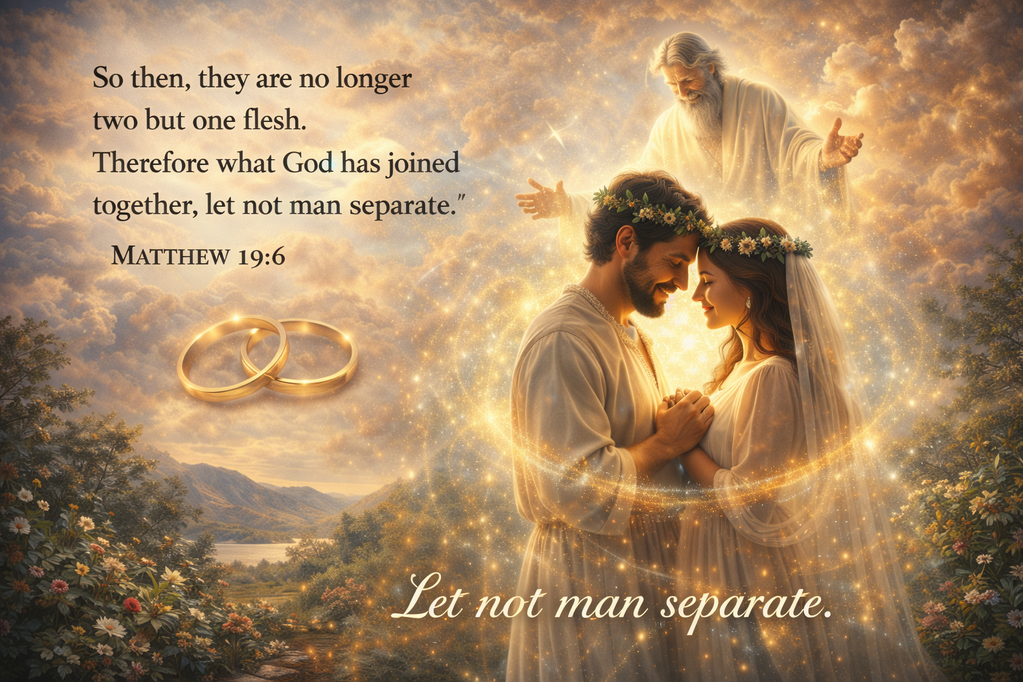
So then, they are no longer two but one flesh. Therefore what God has joined together, let not man separate.” Matthew 19:6
Note: You can listen to today’s commentary courtesy of our friends at the “Bible in Ten” podcast. (Click Here to listen).
You can also read this commentary, scrolling with music, courtesy of our friends at “Discern the Bible” on YouTube. (Click Here to listen), or at Rumble (Click Here to listen).
“So too, they are no longer two, but one flesh. Therefore, what God, He conjoined, not let him separate, man.” (CG)
In the previous verse, Jesus cited the Genesis narrative where a man is said to leave his father and mother and be joined to his wife, becoming one flesh. Based on that early Genesis record, Jesus now states that a precedent took place that pertains to all people at all times. He begins that thought, saying, “So too, they are no longer two.”
A new word is seen, ouketi. It is derived from ou, a negative particle, such as “not,” and eti, yet, still, longer, etc. Together, they form the thought “no longer.”
There is now a bond between the two which has united them as “one flesh” in God’s eyes. Though they are still two people, they have formed a single, indissoluble whole. They are not two independent units. Rather, they are two entities united into a single unit.
A comparable thought is a yoke of oxen, which form a single whole. They are two oxen, but they form one yoke fulfilling a single purpose. That is actually explicitly seen in Jesus’ conclusion, “Therefore, what God, He conjoined, not let him separate, man.”
Two new words are seen here. The first is suzeugnumi. It is derived from sun, with, and zeugos, a couple (as in yoked). Together, they signify “to yoke together” and thus, figuratively, to conjoin as in marriage. This word is found only here and in the comparable passage of Mark 10:9.
The next new word is chórizó, to place room between. It is derived from chóra, a room or a space of territory. Figuratively, chórizó thus means to put asunder, separate, etc. One could think of a couple deciding to have two separate rooms instead of one. Eventually, they decide they like it and permanently separate, divorcing and permanently breaking the bonds of marriage.
Jesus says that this should not be. God joined them as one. Therefore, what He has done is not to be undone by man.
Life application: In Ephesians, Paul confirms that Jesus’ words are not only directed to Israel during the time of the law, but at all times. He then explains that this bond of marriage anticipates something greater –
“Wives, submit to your own husbands, as to the Lord. 23 For the husband is head of the wife, as also Christ is head of the church; and He is the Savior of the body. 24 Therefore, just as the church is subject to Christ, so let the wives be to their own husbands in everything.
25 Husbands, love your wives, just as Christ also loved the church and gave Himself for her, 26 that He might sanctify and cleanse her with the washing of water by the word, 27 that He might present her to Himself a glorious church, not having spot or wrinkle or any such thing, but that she should be holy and without blemish. 28 So husbands ought to love their own wives as their own bodies; he who loves his wife loves himself. 29 For no one ever hated his own flesh, but nourishes and cherishes it, just as the Lord does the church. 30 For we are members of His body, of His flesh and of His bones. 31 ‘For this reason a man shall leave his father and mother and be joined to his wife, and the two shall become one flesh.’ 32 This is a great mystery, but I speak concerning Christ and the church. 33 Nevertheless let each one of you in particular so love his own wife as himself, and let the wife see that she respects her husband.” Ephesians 5:22-33
If God has united man and woman in marriage and says it is a permanent bond in His eyes, how do you think He considers the bond of a person who has united with Christ? The doctrine of eternal salvation is clearly and unambiguously upheld.
We look to our own broken relationships and impute our own failings to God. “My father was a loser and a drunkard. Fathers cannot be trusted, and God, who is the ‘Father’ sure can’t be trusted!” “My husband left me for another woman. He ruined my life and his own children’s lives. Jesus will be just as unfaithful as he was. And even if He is a good Husband, I will fail Him, and He will cast me away.”
This is how we view things, from our own failed perspective. But this is why God gave us the Bible and the example of Israel. Despite their constant failure to be a suitable people for Him, He faithfully has endured their troublesome ways, covenanting with them and working to ensure that they will come into the New Covenant someday.
Let us remember that God does not fail. He will perfectly fulfill every promise He has made to His people.
Lord God, thank You that we have the absolute assurance that You will bring us to Yourself in Your heavenly kingdom. You will never leave us, never forsake us, and because of Jesus, You have and will continue to forgive us of our innumerable failings. Thank You for Your infinite faithfulness, O God. Amen.