
Friday, 10 April 2026
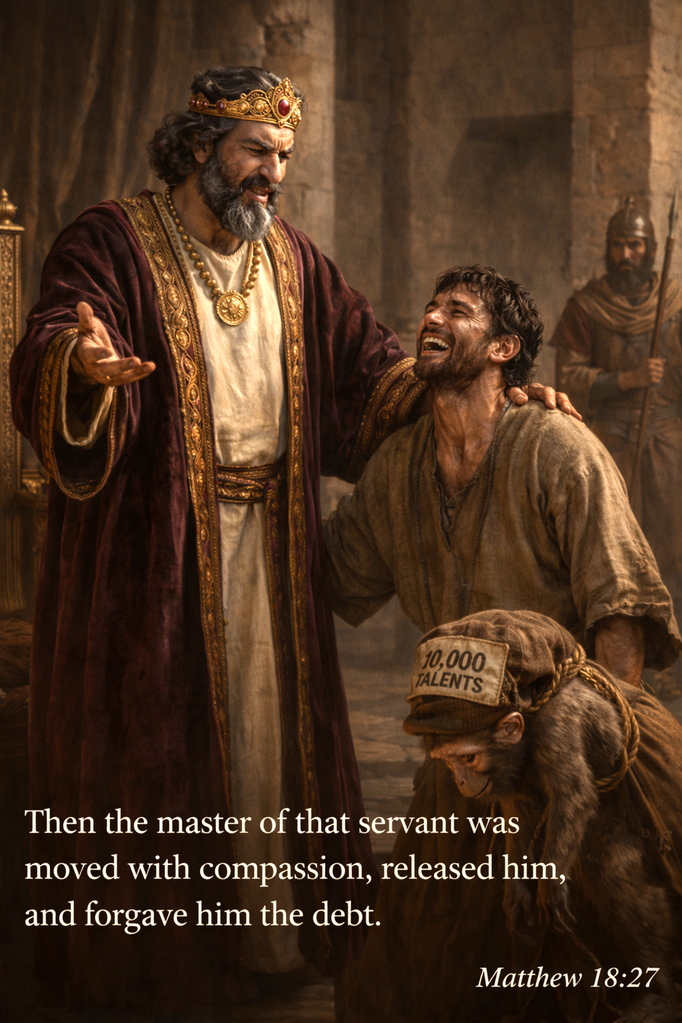
Then the master of that servant was moved with compassion, released him, and forgave him the debt. Matthew 18:27
Note: You can listen to today’s commentary courtesy of our friends at the “Bible in Ten” podcast. (Click Here to listen)
You can also read this commentary, scrolling with music, courtesy of our friends at “Discern the Bible” on YouTube. (Click Here to listen), or at Rumble (Click Here to listen).
“And having gut-wrenched, the lord of that servant, he dismissed him, and the debt, he forgave him.” (CG)
In the previous verse, the servant prostrated himself before his master, promising to repay the entire debt. With his having done this, it next says, “And having gut-wrenched, the lord of that servant.”
The paraphrased words “moved with compassion” are correct. The word signifies that the inner guts of a person churn from the situation, moving him to act in a particular way. In this case, it is in the direction of compassion. His sentence was stern and strict. After seeing the misery of the man, he relents from what he had pronounced. As it says, “he dismissed him.”
The words mean that he was released from custody. The same word is used elsewhere in this manner, such as when people are released from prison in Acts. As such, the sentence was already being carried out at the order of the king. However, he petitioned for release, and it was granted. And more, it says, “and the debt, he forgave him.”
A new word, daneion, debt, is seen here. It is from the same as the verb danizó, to loan on interest, as a business transaction. This is the only time it is seen in the New Testament. Based on what happens later in this same parable, a problem arises.
Because of circumstances, the master will deliver this servant to the torturers until he pays all that was due to him. How does that square with the forgiveness of this debt? Because this debt is forgiven, it means that more than just this particular debt is owed.
Life application: Although the debt here is pardoned, it is not an infinite amount. The previous life applications have referred to man’s sin debt as an infinite amount. Therefore, though this man owed a great deal with this debt, what he owed here cannot be equated to an individual’s sin.
Care has to be taken when parables are considered. We are being instructed on what is on God’s mind concerning particular issues. How could God forgive an infinite sin debt and then say the debt, which was infinite and forgiven, and thus meaning infinitely forgiven, then re-impute that sin? That would be a logical (and biblical) contradiction.
As such, this forgiven debt is not referring to forgiveness in Christ. What Christ forgives is, as it says in the psalms, as far as the east is from the west. Unlike the fixed north and south, there actually is no fixed east or west from a biblical perspective. As such, it is a term considered infinite in distance.
Understanding that the debt in this verse, which is forgiven by the master, is not what is owed in verse 34, the parable will be more readily understood.
Lord God, help us to always consider Your word carefully. Keep us from running ahead and, thus, running into error. Instead, may we keep things in their proper context so that our thoughts will be rightly aligned with Yours. Help us in this, O God. Amen.