
Monday, 6 April 2026
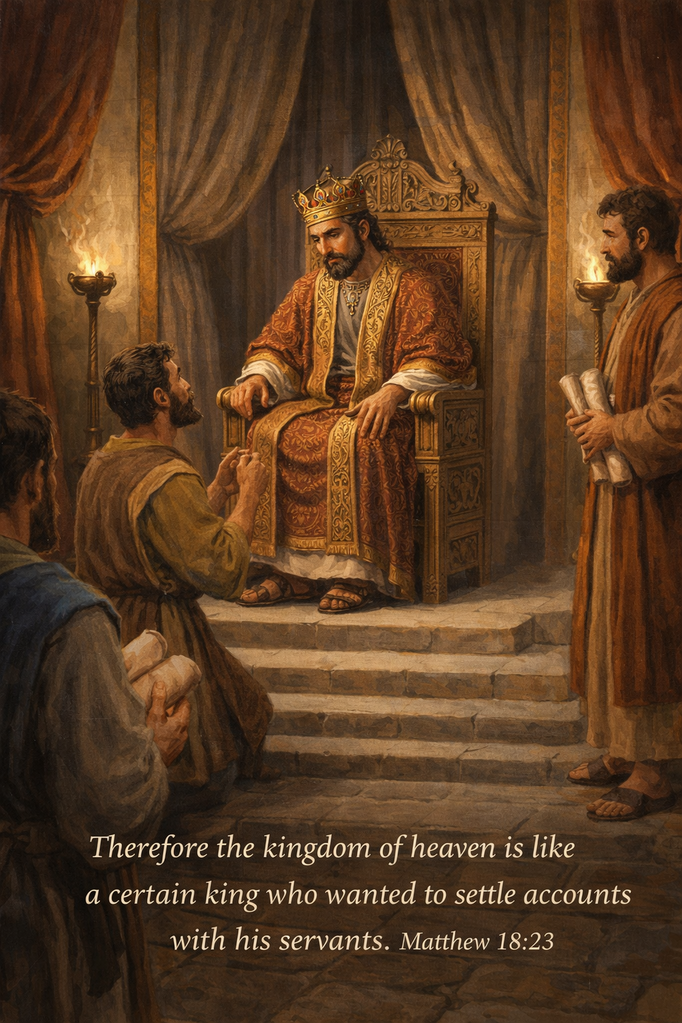
Therefore the kingdom of heaven is like a certain king who wanted to settle accounts with his servants. Matthew 18:23
Note: You can listen to today’s commentary courtesy of our friends at the “Bible in Ten” podcast. (Click Here to listen)
You can also read this commentary, scrolling with music, courtesy of our friends at “Discern the Bible” on YouTube. (Click Here to listen), or at Rumble (Click Here to listen).
“Through this, it was made to resemble the kingdom of the heavens – man, king, who he desired to balance a word with his servants.” (CG)
In the previous verse, Jesus’ response to Peter’s question about forgiveness was “Not, I say to you until sevenfold, but until seventy-fold, sevenfold!” Next, to explain the matter of forgiveness, Jesus begins with, “Through this, it was made to resemble the kingdom of the heavens.”
Jesus will give an analogy of what forgiveness in the kingdom of the heavens is like by using worldly situations and human conditions, emotions, and desires. Understanding this, He begins the example, saying, “man, king, who he desired to balance a word with his servants.”
A new word is seen, sunairó. It is derived from sun, together, and airó, to lift. In other words, there is to be a balancing of accounts. One may owe another, or the books may be lifted and shown to be equal. In order to determine the matter, the king will look over his books, and a settlement of the differences will be the determined outcome.
Being a king, he has the authority to make decisions that affect those under him. And more, he has the authority to enforce the things he has decided. In such matters, he would be the final authority over the process.
Life application: As can be seen from Jesus’ words, the way things are in the heavenly realm is the standard. Things that happen here will align with the standard, or they will not. This is what the word of God is intended to show us.
Our human cultures, governments, and decision-making processes are tainted with our fallen nature. Therefore, we cannot properly run things according to the way God expects unless we are informed of just what He expects.
And more, there are things that are set forth in the word, such as the Law of Moses, that are good and serve a good purpose, but because of our sinful natures, what is good actually becomes an overwhelming obstacle to our efforts to be pleasing to God. Paul explains this in Romans 7.
The very thing that we want to do is what we don’t do. We want to be pleasing to God, but we find that our nature will not allow us to properly do so. Law, intended for life, has actually brought about death.
This is what Jesus came to fix. By doing what other humans are incapable of doing, He fulfilled the strict demands of the law. In His fulfillment of them, He ended the law through His crucifixion. Now, for anyone who trusts Him, law is no longer the enemy to our relationship with God. We have fellowship with Him once again through Jesus’ death.
The heavenly standard of forgiveness is being explained by Jesus in a way we can understand. Like the lesson of the law, we need to consider what He says. But suppose we disagree with one evaluation or another. It has been established that we are not under law, but grace.
As this is so, even if we don’t meet the bar set forth by Jesus concerning forgiveness, there is no law to condemn those who are in Christ. Therefore, our failings will be judged in a different way and for a different purpose. This is detailed in Paul’s letters concerning the judgment seat of Christ.
Don’t fear if your ability to forgive is not perfect. Jesus is. Because you are in Him, you are already forgiven.
O God, thank You for the full cleansing and freedom from sin that Jesus provides. Being forgiven, may we faithfully do those things that You desire to the best of our ability at all times. Be glorified in how we conduct our lives. Amen.