
Thursday, 2 April 2026
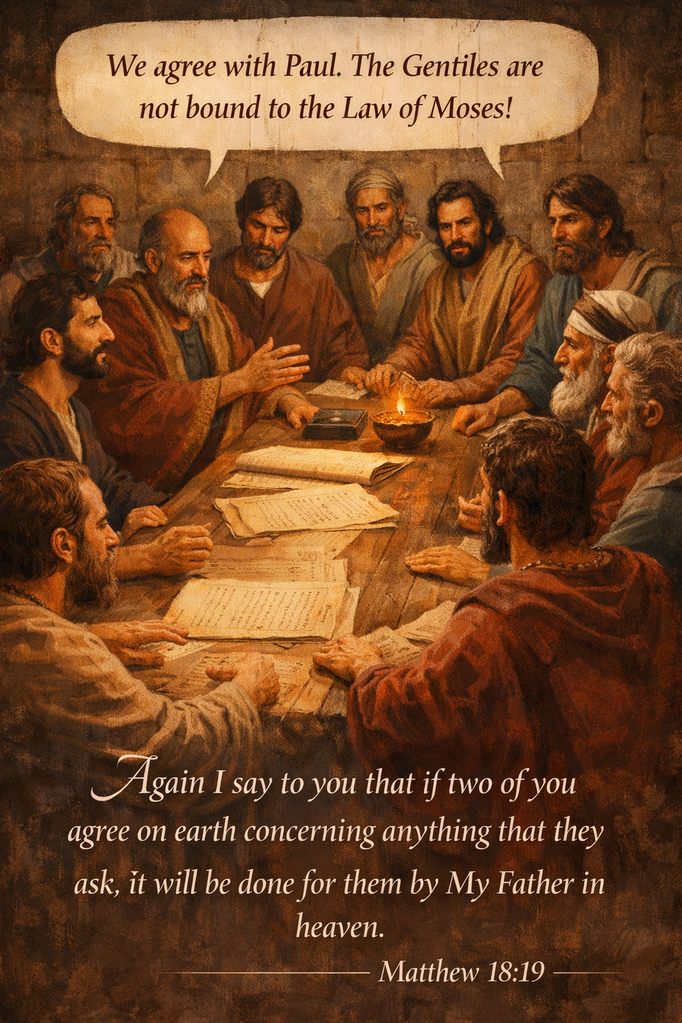
Again I say to you that if two of you agree on earth concerning anything that they ask, it will be done for them by My Father in heaven. Matthew 18:19
Note: You can listen to today’s commentary courtesy of our friends at the “Bible in Ten” podcast. (Click Here to listen)
You can also read this commentary, scrolling with music, courtesy of our friends at “Discern the Bible” on YouTube. (Click Here to listen), or at Rumble (Click Here to listen).
“Again, I say to you, that if two of you, they may harmonize upon the earth about any deed, that if they should ask, it will become to them from My Father, the ‘in heavens’.” (CG)
In the previous verse, Jesus instructed the disciples about binding on earth what is bound in heaven and loosing on earth what is loosed in heaven. Following along with that same authority, of which the context demands it is referring to these disciples, it says, “Again, I say to you, that if two of you, they may harmonize upon the earth.”
Here is a new word, sumphóneó, to be harmonious. One can see the obvious etymological ancestor of our modern word symphony. The word is derived from sýn, together with, and phōnḗ, sound or voice (think of the telephōnḗ). HELPS Word Studies says, “to be in harmony, agreeing, because in one concord.”
When a symphony plays, each voice of the instruments is playing in accord with the whole to form a tapestry of music. Jesus continues, saying that if these disciples harmonize upon the earth “about any deed.”
A second new word is seen, pragma, a deed. By extension, it refers to a material object, a business, a matter, a thing, or work in general. This word is the great-grandfather of our modern word pragmatic. From there, it became the Greek word pragmatikos (relating to a fact). That was then adopted into English.
Jesus is looking for harmony among these disciples to form a united consensus. Once that is obtained, He says, “that if they should ask, it will become to them.”
This is the main key to obtaining what is needed for the furtherance of the church in its infancy. There cannot be individual voices pulling from one side and other voices pulling from another in an attempt to obtain personal victory. That type of dealing is left up to business leaders, politicians, etc. But the early church would only properly function when they were united.
And that could only happen when the will of the Lord, a will whose general principles and main goal were already known to them, would be pursued. Should they have been united in this manner, they would receive their request, as Jesus says, “from My Father, the ‘in heavens’.”
Jesus is restating and reconfirming the thought of the previous verse. There is an ability to obtain what is asked because it has already been ordained to be so in heaven.
Life application: The words of Jesus in this verse are quite often taken to inappropriate and unintended extremes. The words are used to claim things that will not come about because the intended recipients of what Jesus says were these disciples, not the church at large, after the word was completed.
As seen in the previous commentary, an example was given concerning binding and loosening from Acts 15. In the same chapter, the decision that led to the letter sent to the believers at Antioch says –
“Then it pleased the apostles and elders, with the whole church, to send chosen men of their own company to Antioch with Paul and Barnabas, namely, Judas who was also named Barsabas, and Silas, leading men among the brethren.” Acts 15:22
This is the type of agreement Jesus was referring to. It was a necessary grant to the early church because there was no New Testament to guide the church in its decision-making process. Therefore, they came together, united in an agreement, and then disseminated that decision to where it was needed to go.
A similar type of agreement came about in Acts 6 over a matter. Today, the church’s instruction manual is Scripture. If a church body agrees on something that is contrary to the word, how could God grant that? For this to come about, every single church would have to be in perfect agreement over every point of doctrine given in Scripture.
And yet, there isn’t a single point of doctrine that every church agrees on! The words of Jesus in Matthew 18:19 are not, and indeed they cannot be speaking of people today. Using this verse as a way of supposedly settling a matter is inappropriate. The word is given to do that. It is our job to learn the word, apply the word in its proper context, and be obedient to its precepts.
Lord God, help us to remember that You have bound what we are to do and You have loosed what we are not to do. As such, our agreement in spiritual matters must be based upon the word of God, not upon a misunderstanding of what Jesus has taught. Help us to remember the context of what He instructs us. Amen.