
Tuesday, 24 February 2026
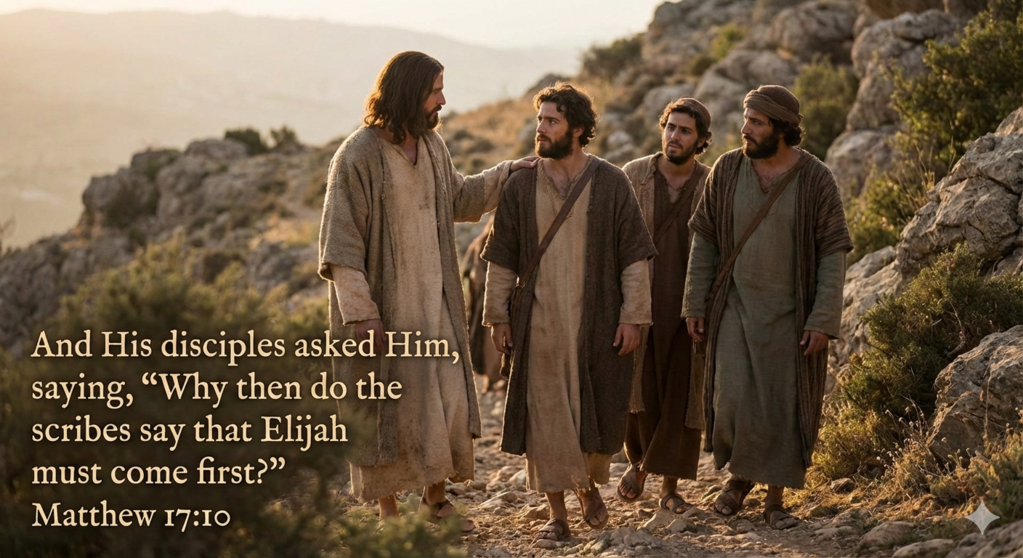
And His disciples asked Him, saying, “Why then do the scribes say that Elijah must come first?” Matthew 17:10
Note: You can listen to today’s commentary courtesy of our friends at the “Bible in Ten” podcast. (Click Here to listen)
You can also read this commentary, scrolling with music, courtesy of our friends at “Discern the Bible” on YouTube. (Click Here to listen), or at Rumble (Click Here to listen).
“And His disciples, they queried Him, saying, ‘Why therefore the scribes, they say that Elijah, it necessitates, to come first?’” (CG).
In the previous verse, Jesus told the disciples who joined Him on the mountain that they were not to tell the vision to anyone until the Son of Man arises from the dead. Continuing the conversation, it next says, “And His disciples, they queried Him.”
As with most people who grew up in a place where the Bible is discussed, these men, having grown up in Israel, would have heard all kinds of teachings that people like to focus on. Therefore, they would have an awareness of matters that related to the vision they just saw.
Jesus, telling them not to share the vision, now complicates the sequence of events in their minds. To clarify their understanding, they queried Jesus, “saying, ‘Why therefore the scribes, they say that Elijah, it necessitates, to come first?’”
The scribes, understanding the prophecies found in Malachi, stated that Elijah would come back before the Messiah was revealed to them. That is based on two thoughts from Malachi –
“Behold Me! Sending My messenger,
And he turned, road, to My faces
And instantly, He will come unto His portico,
The Lord, whom you seeking,
And Messenger, the covenant,
Whom you delighted.
Behold! Coming!
He said, Yehovah Sabaoth.” Malachi 3:1 (CG)
“Behold! I sending to you Elijah the prophet,
To faces coming day Yehovah –
The whopping and the ‘being feared,’
6 And he will cause to return, heart fathers, upon sons,
And heart sons, upon their fathers.
Lest I come, and I cause to strike the land – anathema.” Malachi 4:5, 6 (CG)
The scribes concluded that Elijah would come before the Messenger of the covenant, who is understood to be the Messiah, based on these thoughts. If this is so, and if he came in the vision they beheld, then in their minds, that would mean the prophecy was fulfilled. However, that would only be the case if people knew about it.
They could tell the people they saw a vision of Elijah and that the prophecy was fulfilled. Or Elijah could stay and reveal himself. But neither was the case. Elijah was there for a short span, and he disappeared. Along with his disappearance was the voice telling them to hear Jesus, not Elijah.
And more, Jesus just told them to tell no one of the vision until after He rose from the dead, and for all they knew, He could be speaking of the end-times resurrection. If they couldn’t tell anyone, and if Elijah had come and left, then nobody would ever know Elijah came. But the scribes were waiting for Elijah.
It would be silly to have a prophecy in the Bible that was fulfilled, but nobody knew it was so! Therefore, they could not understand how things fit together because of this.
Life application: There are things that are clear and explicit in Scripture. If Scripture is truly the word of God, then those things must come to pass. There are things that must be inferred from Scripture, or which may require taking individual sections and tying them together to conclude what is being said.
In the case of the latter, if things are put together incorrectly, a misunderstanding of what will take place will occur. The scribes have the information laid out in Malachi concerning the Lord’s messenger and the Messenger of the covenant from Malachi 3, and they have the note about Elijah from Malachi 4.
They put the two thoughts together and drew a conclusion based on those passages. However, Malachi 3 never said the Lord’s messenger was Elijah. And Malachi 4 speaks of the great and dreadful day of the Lord, something they assumed meant the time when the Messiah was set to initiate.
Their conclusion was faulty because they misunderstood the content of the verses. And this is because they misapplied what those verses were saying. This is a common thing, especially with those excited about end-times prophecy to the exclusion of the rest of Scripture. They don’t have a full understanding of what the Bible says. In fact, they may never have read the Bible through once. But they are “specialists” in eschatology.
This is as common as beans in a Mexican diner, but it is a poor way of handling the Bible. However, when people sound like they know what they are talking about in prophecy and eschatology, they are usually given an ear because people tend to really dig those things.
The answer to this problem is for people to read their Bibles and know, in advance, if the things they are being taught match up with what their own studies have made them understand. From there, it is much easier to work through the details than it is to sit blindly, accepting someone’s teaching without any clue if he is doctrinally on the right page or not.
Lord God, whatever time we have left in our lives, may we use that time wisely, reading and contemplating Your word. Help us not to get distracted by too many irrelevant things, where we will then forsake this task. Give us wisdom to know You and what You expect of us through reading Your word. Amen.