
Monday, 23 February 2026
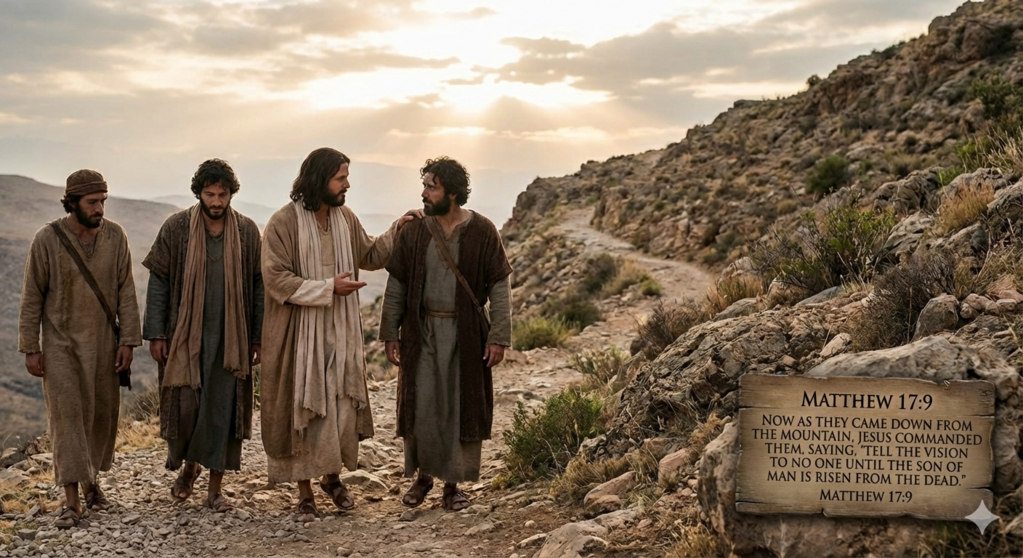
Now as they came down from the mountain, Jesus commanded them, saying, “Tell the vision to no one until the Son of Man is risen from the dead.” Matthew 17:9
Note: You can listen to today’s commentary courtesy of our friends at the “Bible in Ten” podcast. (Click Here to listen)
You can also read this commentary, scrolling with music, courtesy of our friends at “Discern the Bible” on YouTube. (Click Here to listen), or at Rumble (Click Here to listen).
“And descending, they, from the mountain, Jesus, He enjoined them, saying, ‘You tell none the vision until that the Son of Man from dead, He arose’” (CG).
In the previous verse, it was noted that when the disciples uplifted their eyes, they saw no one but Jesus. It next says, “And descending, they, from the mountain, Jesus, He enjoined them.”
They are returning to where the other disciples are. However, just as they went to the mountain separately for a reason, Jesus wants what they saw to be kept to themselves also. Therefore, He enjoins them concerning the matter, “saying, ‘You tell none the vision.’”
A new word is seen here, horama, a vision. It is derived from horaó, to stare at, and which is, at times, translated as behold. This refers to what is beheld. It is something gazed at, such as a spectacle. What these men beheld was a vision.
Looking at the various uses of this word leads to the notion that what was seen may not be a concrete event, but a mental perception of something, somewhat like a dream. For example –
“But Peter explained it to them in order from the beginning, saying: 5 ‘I was in the city of Joppa praying; and in a trance I saw a vision, an object descending like a great sheet, let down from heaven by four corners; and it came to me. 6 When I observed it intently and considered, I saw four-footed animals of the earth, wild beasts, creeping things, and birds of the air. 7 And I heard a voice saying to me, “Rise, Peter; kill and eat.” 8 But I said, “Not so, Lord! For nothing common or unclean has at any time entered my mouth.” 9 But the voice answered me again from heaven, “What God has cleansed you must not call common.” 10 Now this was done three times, and all were drawn up again into heaven.’” Acts 11:4-10
What Peter saw was real to him, but it was not necessarily real. These men saw a vision. Was it a concrete event where Moses and Elijah literally appeared with Jesus, or was a point being made concerning their ministries without them actually having been there? Being dogmatic about the matter may be barking up the wrong tree.
Regardless, what they saw was real to the disciples, and Jesus confirms that what they saw should be taken as such. But they were to refrain from speaking of it “until that the Son of Man from dead, He arose.”
Mark adds in the words, “So they kept this word to themselves, questioning what the rising from the dead meant.” The words of Jesus were perplexing to them, but they were obedient to His directive, keeping silent about the matter. But two obvious questions that arise from the event and Jesus’ admonition are, “Why weren’t all of the disciples taken along, and why should Jesus not want the other disciples to know what happened?”
It can only be speculation, but one reason that seems apparent is that if Judas had gone, or if he had been informed of what happened, he may never have betrayed Jesus. He was looking for one thing, but God had other plans. If he were aware of what took place, the necessary death of Jesus for the people of the world may not have come about in the manner it did.
For this, and any other logical reasons, the matter of the transfiguration was kept to a select few men until the time it could be freely spoken of by those who saw it.
Life application: Understanding that what the disciples saw may have been a vision without actual substance may then lead to other various points of doctrine or personal opinion falling apart. Pastors will adamantly speak of Moses’ appearance as an actual event where he literally stood there. Because of this, it is then used as a springboard to say that Moses can, in fact, be one of the two witnesses noted in Revelation 11.
This would be contradictory, however, to Hebrews 9:27, which says, “And as it is appointed for men to die once, but after this the judgment.” Because of Hebrews 9, it is clear that Moses will not be one of the two witnesses, but despite that, it would be unwise to proclaim either way that what was seen in the transfiguration was an actual physical event rather than a divinely prepared mental image, or vice versa.
Did a sheet really drop down from heaven with animals on it in front of Peter? It is unlikely at best. And yet, it seemed as real to Peter as if it actually happened. We should be careful not to be dogmatic about things we simply cannot know. Rather, whether Moses and Elijah actually stood there with Jesus or not, the point of why they were there with Jesus is what is important.
The disciples, and thus us because it is recorded in Scripture, were being taught truths concerning the ongoing plan of redemption. Jesus, not the Law and the Prophets, is who we are to focus our attention on.
Lord God, someday, we will have many answers to questions resolved. Until then, help us to not stubbornly claim things that may be debatable. Help us to contemplate Your word, consider what You are telling us, and hold fast to the truths we can glean from it. May it be so, to Your glory. Amen.