
Wednesday, 18 February 2026
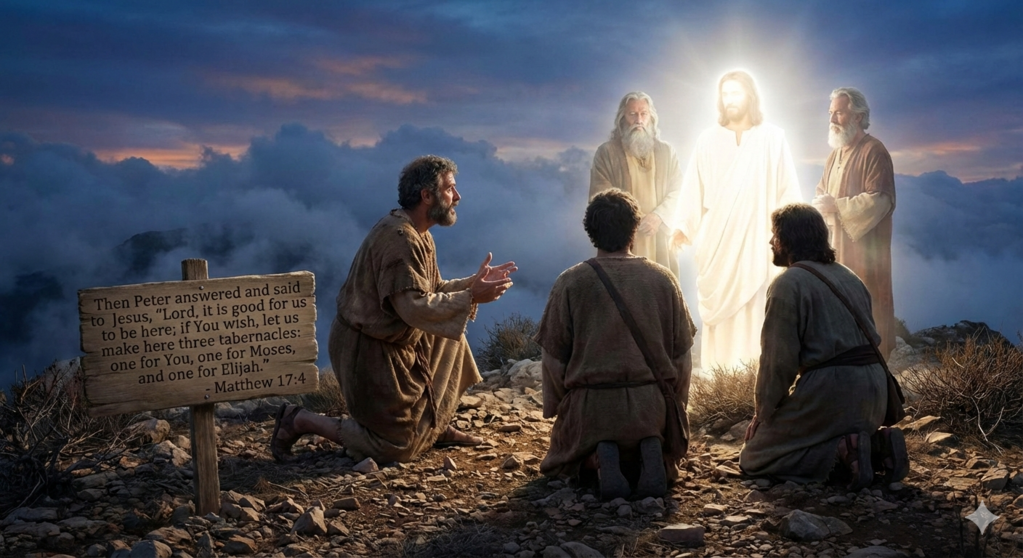
Then Peter answered and said to Jesus, “Lord, it is good for us to be here; if You wish, let us make here three tabernacles: one for You, one for Moses, and one for Elijah.” Matthew 17:4
Note: You can listen to today’s commentary courtesy of our friends at the “Bible in Ten” podcast. (Click Here to listen)
You can also read this commentary, scrolling with music, courtesy of our friends at “Discern the Bible” on YouTube. (Click Here to listen), or at Rumble (Click Here to listen).
“And answering, Peter, he said to Jesus, ‘Lord, good, it is – us to be here. If You desire, we will make here three tabernacles: You one, and Moses one, and Elijah one’” (CG).
In the previous verse, it was noted that during the transfiguration, Moses and Elijah appeared to them, talking with Jesus. Matthew next records, “And answering, Peter.”
All three gospel narratives agree that it was Peter who spoke to Jesus. However, each will show the individual preference of how Peter addressed Him. Matthew continues the narrative with, “he said to Jesus, ‘Lord.’”
Matthew records the word, kurios, lord. It is derived from kuros, supremacy. Mark records the word rhabbi. It is derived from the Hebrew rab, abundance, which is fixed to a pronominal suffix. The meaning then is “my master,” with the intent of “my great one,” or “my Mr. Full of Knowledge.” Luke records the word epistates, master. That is derived from epi, upon or over, and histemi, to stand. Thus, it is one who stands over another.
Each of them gives the same general meaning but is taken from the author’s own well of knowledge when penning the account. The word spoken by Peter would have been in Aramaic, thus rhabbi is probably what was said. With that stated, Peter next says, “good, it is – us to be here.”
The meaning probably isn’t, “It is good to be here, because…” Rather, Peter’s intent seems more akin to “What a satisfying experience it is for us to be here.” To bolster that thought, he next says, “If You desire, we will make here…”
Some manuscripts say, “I will make.” Scholars who lean toward this as correct indicate it is in line with the impetuous nature of Peter, as if “I will handle this.” However, that doesn’t change with “we.”
Depending on the situation, there is no less impetuosity if Peter volunteered others. However, it isn’t certain that we have all that was said. Rather, the gospel focuses on particular things while probably ignoring other things that may have transpired. Understanding this, Peter continues, saying, “three tabernacles.”
It is a new word, skéné, a tent. In this case, it would be referring to a tabernacle built out of whatever branches could be obtained by the disciples. The word can be used literally, as it is here, or it can be used figuratively, such as in Hebrews 9:11. Peter, assuming this may be an extended stay for them, or maybe hoping it can be extended by his suggestion, offers to build three tabernacles, which are, “You one, and Moses one, and Elijah one.”
The offer to build tabernacles, akin to the sukkah made for the Feast of Tabernacles, is made. Mark adds to the thought, saying, “For not he had known what he should say. For terrified, they were.” Luke says, “not having known what he says.”
In other words, there was confusion in his mind about how to address the issue at all, and he blurted out his words, probably in an attempt to bring some sort of control to the events around him that he could not fully understand.
Life application: One of the most common things passed on in Christian circles from this verse, and which has been repeated in innumerable sermons and commentaries, and then which is passed on by lay people, is that everyone will know everyone else in heaven immediately because Peter knew who Moses and Elijah were without being told.
How anyone can come to that conclusion is hard to figure out, but it now permeates Christian thinking. The account has already said that Moses and Elijah were conversing with Jesus. Conversing means… anyone? Having a conversation. It could have gone on for five minutes or an hour. And yet, not a word of what was said is recorded.
The general tenor of the conversation was that they “spoke of His decease which He was about to accomplish at Jerusalem” (Luke 9:31). But that is just what the conversation was about, not the details that were conveyed.
For all we know, Peter was listening and heard the names of Moses and Elijah stated by Jesus. Maybe Jesus introduced the two, saying, “Moses, this is Elijah. Elijah, this is Moses.” Or maybe the two were wearing name tags. To jump to the conclusion that everyone will know everyone else assumes too much.
It is not a good policy to make such statements without qualifiers, such as “Maybe…” The fact is, we have no idea whether we will know everybody’s name or not.
Use discretion when passing things on. To insert thoughts that may or may not be correct can only lead people down incorrect paths of thinking. One idea, such as this, can, and normally will, lead to other unfounded suppositions.
Lord God, it is good to be in Your presence and to share in Your tenderful blessings and mercies each day. We are the recipients of all of Your goodness toward mankind because of Jesus Christ, our Lord. Help us to remember this in times of troubles, trials, and difficulties. What we have coming will forever replace anything we are now suffering. Thank You for this great hope we possess. Amen.