
Friday, 13 February 2026
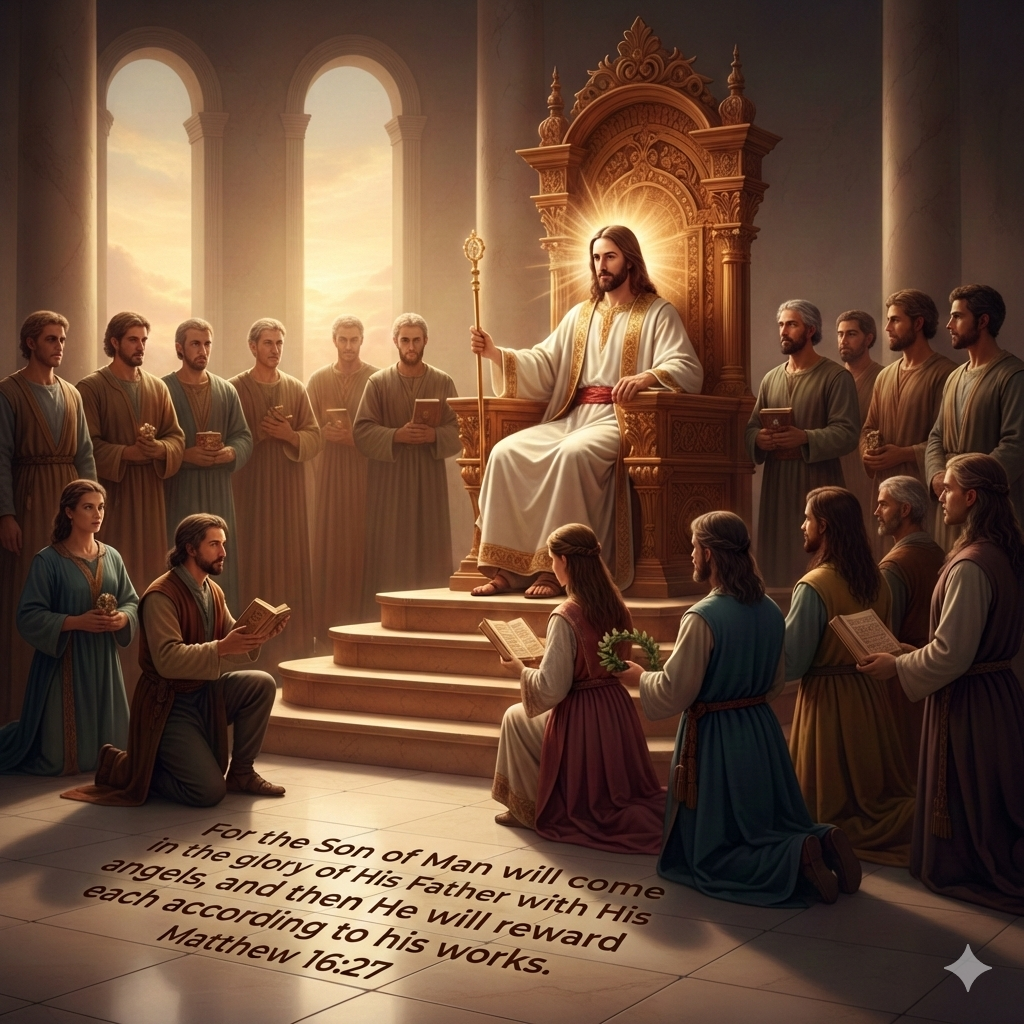
For the Son of Man will come in the glory of His Father with His angels, and then He will reward each according to his works. Matthew 16:27
Note: You can listen to today’s commentary courtesy of our friends at the “Bible in Ten” podcast. (Click Here to listen)
You can also read this commentary, scrolling with music, courtesy of our friends at “Discern the Bible” on YouTube. (Click Here to listen), or at Rumble (Click Here to listen).
“For the Son of Man is about to come in His Father’s glory with His messengers. And then He will give each according to his practice” (CG).
In the previous verse, Jesus asked what profit it would be for a man to gain the world but lose his soul. He also questioned what a man could give for his soul. Jesus next says, “For the Son of Man is about to come in His Father’s glory.”
What is Jesus talking about here? Ellicott says, “The fact that the Son of Man is about to come to execute judgment, clothes its abstract statement with an awful certainty.” The Pulpit Commentary says, “the final judgment would put things in their true light.” Gill says, “either a second time to judgment at the last day … or in his power, to take vengeance on the Jewish nation.”
These thoughts of judgment essentially sum up the overall thought of what scholars say the verse is referring to. It is true that Jesus is coming in judgment. However, His words place “about” in the emphatic position. Word for word, it reads “About for the Son the Man to come.”
With the emphasis on “about…to come,” it is a stretch to tie this into the final judgment. The chapter began with the Pharisees and Sadducees testing Him, asking for a sign from heaven. The contents of the chapter focus on faith in God’s plans as the overarching theme.
Jesus is speaking to and about Israel under the law. As this is so, the “about…to come” is likely referring to Israel’s judgment for rejecting Jesus. Understanding that this was the sign of Jonah Israel was to expect, as detailed in Matthew 16:4, it seems to be the logical explanation.
However, all three synoptic gospels mention this general idea of Jesus’ coming (Matthew 16:27, Mark 9:1, and Luke 9:27). After each, the transfiguration is mentioned. The transfiguration is something only seen by Peter and John. They were told to tell no one what they saw until the Son of Man was raised (Matthew 17:9, Mark 9:9). They complied with this as noted in Luke 9:36.
Jesus is ultimately referring to the judgment of Israel in AD 70, but His words at this time are immediately referring to the transfiguration. This continues to be seen in His next words, “with His messengers.”
When Jesus is transfigured, who is He with? Though getting ahead in the narrative, He is with Moses and Elijah. Jesus is not referring to angels. He is referring to those who received His word and passed it to the people of Israel.
Moses and Aaron are called messengers of the covenant in Acts 7:53 and Hebrews 2:2 (yes, those verses are referring to Moses and Aaron – see the corresponding Superior Word commentaries). John the Baptist is called a messenger in Malachi 3. Jesus equates him to Elijah in Matthew 11:14, and he is prophesied to come as the Lord’s representative in Malachi 4:5.
These are the messengers Jesus is referring to now. Moses represents the law, while Elijah represents the prophets of the law. They will appear with Jesus at the transfiguration. Only then are the next words stated by Jesus. “And then He will give each according to his practice.”
A new word is seen here, praxis, a practice (Sure sounds like the Klingon planet’s moon). HELPS Word Studies says, “a function, implying sustained activity and/or responsibility.”
Almost all translations make this thought a continuation of what has already been said in this verse. However, it is likely a separate sentence beginning with “And then.” There will be the transfiguration, something Peter will refer to in 2 Peter 1:18 as a witness to the truth of God in Christ.
With the testimony of these apostles, the nation of Israel can accept or reject their word. In their rejection of it, judgment will come. And it did come, just as Jesus said concerning the sign of Jonah. The temple was destroyed forty years later.
The judgment of Israel came upon each “according to his practice.” Was their practice faith in Jesus or continued trust in the law which He fulfilled? This is what Jesus is speaking about.
Life application: God’s messengers are both earthly and heavenly. The context of the passage determines which is being referred to. The law was not received by angels from heaven. It was received by men who then passed it to the people of Israel.
Angels did not come to earth and sleep with human women in Genesis 6. Rather, the ungodly line of Cain intermingled with the godly line of Seth. Over-sensationalizing the word leads to confusion of thought and a misunderstanding of what God is doing in the redemptive narrative as it has unfolded throughout the ages.
If someone is constantly referring to such sensational things, it would be best to avoid their instruction on them. If that is all they speak about, they should be rejected entirely. The Bible’s focus is on man’s restoration and relationship with God through Jesus Christ. Keep this in focus, and you will do well.
O God, give us wisdom to rightly discern what Your word is telling us. There are many things that are hard to understand, and there are a lot of teachings that contradict each other. We can easily get lost in a sea of disagreement. So, Lord, lead us to the proper evaluation of what is being said so that we will be rightly trained. Amen.