
Saturday, 7 February 2026
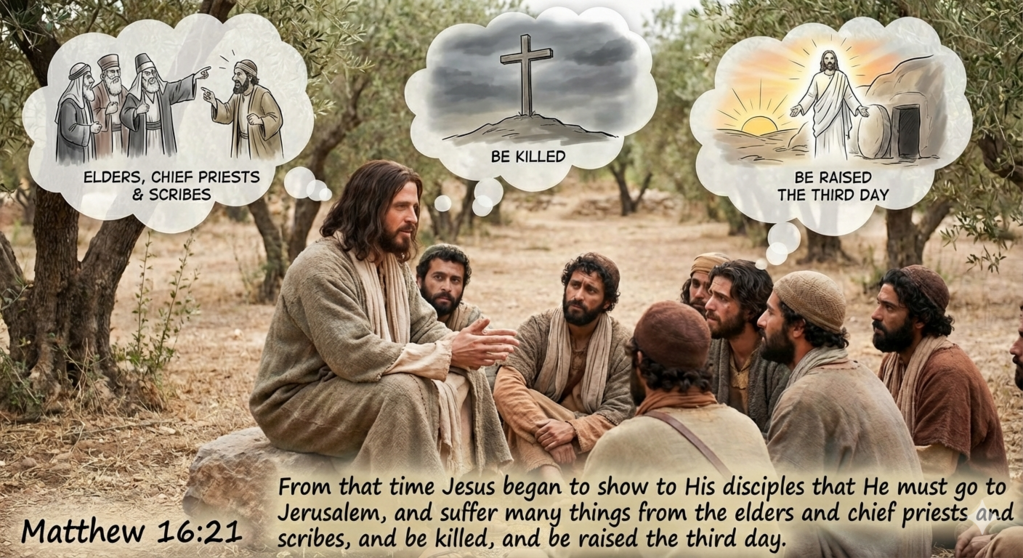
From that time Jesus began to show to His disciples that He must go to Jerusalem, and suffer many things from the elders and chief priests and scribes, and be killed, and be raised the third day. Matthew 16:21
Note: You can listen to today’s commentary courtesy of our friends at the “Bible in Ten” podcast. (Click Here to listen).
You can also read this commentary, scrolling with music, courtesy of our friends at “Discern the Bible” on YouTube. (Click Here to listen), or at Rumble (Click Here to listen).
“From then He began, Jesus, to show His disciples that it necessitates Him to depart to Jerusalem and to suffer many from the elders and chief priests and scribes, and be killed, and the third day be roused” (CG).
In the previous verse, Matthew said that Jesus enjoined the disciples that they should tell no one He was the Christ. Matthew continues with, “From then He began, Jesus…”
Some manuscripts add the word “Christ” after Jesus. This seems forced and unnatural, but it is included because of the proclamation that was just made. If it said, “Jesus the Christ,” it would seem more natural. It would also be a suitable contrast for what will be said in the next verse by Peter. But almost all translations, despite using that text for their work, omit the word.
There is an obvious change in the tone of the words. “From then” and “began” signify that something new is introduced and ongoing henceforth. A point in the ministry had been reached that necessitated this new direction. Understanding this, Matthew continues with “to show His disciples that it necessitates.”
A new word, dei, what must happen, is introduced. It is a form of deó, to bind. Thus, there is a binding effect on the matter that cannot be avoided. In this case, because it is a matter of Jesus’ destiny as the Messiah, it will be necessitated as part of fulfilling His divinely set purpose for coming. Specifically, it was first for “Him to depart to Jerusalem.”
Jerusalem is the place appointed for the events He necessarily needed to go through or accomplish to occur. If one has read the Bible through several times, a short exchange that realizes this thought, and which gives a sense of foreboding, is –
“On that very day some Pharisees came, saying to Him, ‘Get out and depart from here, for Herod wants to kill You.’
32 And He said to them, ‘Go, tell that fox, “Behold, I cast out demons and perform cures today and tomorrow, and the third day I shall be perfected.” 33 Nevertheless I must journey today, tomorrow, and the day following; for it cannot be that a prophet should perish outside of Jerusalem.’” Luke 13:31-33
Matthew next records, “and to suffer many.”
Another new word is seen, paschó, to feel heavy emotion, especially suffering. Thayer’s says, “the feeling of the mind, emotion, passion.” This is an alternate form of pathos, the etymological root of our modern word pathos, a word that gives the sense of suffering, experience, and/or strong emotion. Matthew next notes this would be “from the elders and chief priests and scribes.”
To this point, Jesus has been somewhat hounded by these people as they verbally challenged Him. Matthew 12:14 even indicated the thought that they went out and plotted against Him about how they might destroy Him.
Despite this, there has not been any physical attack against Him at this point. Things were to change, however, when He and the disciples began to minister in Jerusalem. Matthew continues to note what Jesus said, “and be killed.”
The word “killed” is plain enough. It is the Greek word apokteinó, first used in Matthew 10:28. It is an intensified form of kteino, to kill. Because of Jesus’ use of this word, one would think the apostles would have understood His death as being a part of what should be expected, because it was told them far in advance.
Peter’s words in the next verse point to his dissatisfaction with what Jesus says. But it includes more than just killing, meaning the suffering of many things. Therefore, it could be that they thought Jesus was speaking in hyperbole or metaphorically. The word is used this way two other times –
“For sin, taking occasion by the commandment, deceived me, and by it killed [apokteinó] me.” Romans 7:11
“For He Himself is our peace, who has made both one, and has broken down the middle wall of separation, 15 having abolished in His flesh the enmity, that is, the law of commandments contained in ordinances, so as to create in Himself one new man from the two, thus making peace, 16 and that He might reconcile them both to God in one body through the cross, thereby putting to death [apokteinó] the enmity.” Ephesians 2:14-16
As such, Matthew’s next words, though understood by us because we know the outcome of the story, may also have been completely misunderstood by the disciples. He records, “and the third day be roused.”
The word signifies to awaken or rouse. Strong’s says, “literally, from sleep, from sitting or lying, from disease, from death; or figuratively, from obscurity, inactivity, ruins, nonexistence.” With such a broad use of meanings, the confusion of the disciples is completely understandable. Of Jesus’ words here, Vincent’s Word Studies notes –
“This first announcement mentions his passion and death generally; the second (Matthew 17:22, Matthew 17:23), adds his betrayal into the hands of sinners; the third (Matthew 20:17-19), at length expresses his stripes, cross, etc.”
Life application: Jesus has acknowledged that He is the Messiah. He has noted that the basis of Peter’s proclamation, meaning that He is the Christ, would be that upon which He would build His out-calling. As such, it is completely understandable that the disciples would think His words were not really literal. How could someone who was dead do any building of a group of people?
It is easy for us to think of how dull they were, but we hear things like this all the time and don’t take them seriously. A football team may be on its way to an important game without three key members. They got thrown into jail for partying too much and have left the team vulnerable.
The head coach attends a press conference where he says that all will be great. They are the “Messiahs of madness” and would prevail. And yet, in the next two minutes, not knowing his mic is still on, he says to his offensive coordinator, “We are going to get killed down there.” It becomes a sensational story. And more, the Chiefs got totally slaughtered by the Eagles.
Nobody took them at their word, and other than getting proverbially slaughtered, all the players returned home. In tears, yes, but still very much alive.
Be sure to give an ounce of grace to the disciples. We were not there and cannot know all that was on their minds as the days of the life of Jesus and His ministry continued to unfold before their eyes.
Lord God, help us to have a clear perspective of what is going on in Your word. There are things that seem so obvious, and yet, we cannot grasp why they occur. In such instances, give us the wisdom to think through what is said and try to understand it from other perspectives so that we can come to the right conclusion about it. Thank You for being with us in our study of Your superior word. Amen.