
Tuesday, 3 February 2026
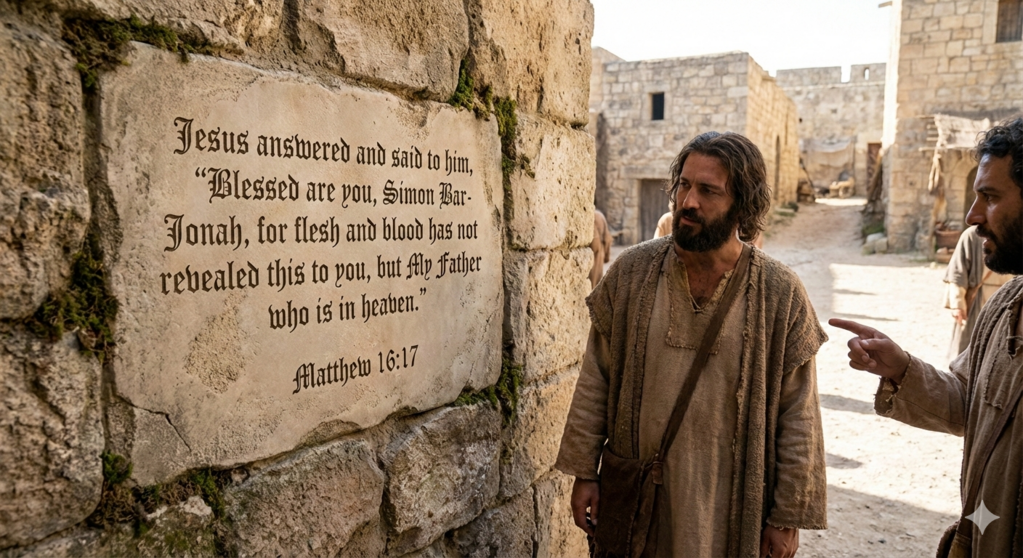
Jesus answered and said to him, “Blessed are you, Simon Bar-Jonah, for flesh and blood has not revealed this to you, but My Father who is in heaven. Matthew 16:17
Note: You can listen to today’s commentary courtesy of our friends at the “Bible in Ten” podcast. (Click Here to listen).
You can also read this commentary, scrolling with music, courtesy of our friends at “Discern the Bible” on YouTube. (Click Here to listen), or at Rumble (Click Here to listen).
“And Jesus, answering, He said to him, ‘Blessed you are, Simon, Bar-Jonah, for flesh and blood not it revealed to you, but My Father, the ‘in the heavens’” (CG).
In the previous verse, Peter said to Jesus that He was the Christ, the Son of the living God. Matthew next records, “And Jesus, answering, He said to him, ‘Blessed you are.’”
This is the first time that Jesus has said such a thing directly to a person. So far, His blessing statements have been general in nature, such as –
“Blessed – the pure of heart,
For they – God they will see.” Matthew 5:8
His words, then, bear a special highlight that is explained as the verse continues. As for who is blessed, Jesus says, “Simon, Bar-Jonah.”
The name Bar-Jonah means “Son of Jonah,” bar being the Aramaic equivalent of the Hebrew ben. Both mean “son.” The name Jonah is derived from the Hebrew yonah, a dove.
It is the same name as the prophet Jonah. Some translations say, “son of John” instead of “son of Jonah.” The names are interchangeable from the Greek transliteration. But it is likely Jonah is correct for several reasons, including Old Testament typology, of which the Book of Jonah fits nicely in with events from the life of Peter.
Using the father’s name instead of his given name is common in the Bible. Saying a person’s first name signifies general talk. Using the father’s name can be as an honorific, a term of joking familiarity, a term of indifference, a term of contempt, etc.
The context determines which. But it is a way of highlighting the person when speaking to or about him. Jesus continues, “for flesh and blood not it revealed to you.”
The word haima, blood, is introduced here. The word’s origin isn’t certain, but it signifies blood both literally, as in that of people or animals, and figuratively, as in juice, such as grapes. It can be used substantially when referring to Jesus’ atoning blood. Thus, it refers to His bloodshed and, thus, His death.
The meaning of Jesus’ words is that Peter didn’t just hear this from someone or when people were speaking. Nor was it something that was derived from earthly facts that he could put together to conclude that Jesus is the Christ of God. Rather, his deduction was one based on God the Father working through Jesus. That is seen in the next words, “but My Father, the ‘in the heavens’”
In other words, there have been lots of people who have been proclaimed the Messiah throughout the years, but those have all been regular people with no basis for the claim. The Person of Jesus is on an order of magnitude so much greater than any other supposed Messiah. Observing Him and seeing His works, Peter saw and understood that He was revealing God in Christ, nothing less.
Having said that, this doesn’t mean that Peter was under divine inspiration or that he understood that Jesus is God. At this point, his limited view of Jesus was that God was working in Him. That is not contradictory. Jesus had to explicitly say it to him and the other disciples later in His ministry –
“Philip said to Him, ‘Lord, show us the Father, and it is sufficient for us.’
Jesus said to him, ‘Have I been with you so long, and yet you have not known Me, Philip? He who has seen Me has seen the Father; so how can you say, “Show us the Father”? 10 Do you not believe that I am in the Father, and the Father in Me? The words that I speak to you I do not speak on My own authority; but the Father who dwells in Me does the works. 11 Believe Me that I am in the Father and the Father in Me, or else believe Me for the sake of the works themselves.’” John 14:8-11
Despite this clear presentation of Himself, these men still did not understand. Only after the resurrection did the muddied waters of their thinking begin to clear.
Peter has gone as far as his mind could take him at this point concerning who Jesus is. But what he has contemplated is of divine origin as God has revealed Himself through Jesus, whom he and the other disciples have so closely interacted with.
Life application: A noted pastor was speaking on the blood of Jesus. He essentially said, “It isn’t the blood, the substance, that was special but what it signified.” Oh boy, was he barbecued and called a heretic. The know-it-all community pulled out their blood samples from Jesus’ cross and proved that he was wrong.
Obviously, that didn’t happen. Nobody knows what Jesus’ blood is like. The speculation about it could go on and on, but without evidence, we are left with what then must be what is on God’s mind, which is exactly what the preacher was trying to communicate.
In the Bible, blood and life, and thus blood and death, are taken synonymously. One of many such examples is found in Leviticus 17 –
“And whatever man of the house of Israel, or of the strangers who dwell among you, who eats any blood, I will set My face against that person who eats blood, and will cut him off from among his people. 11 For the life of the flesh is in the blood, and I have given it to you upon the altar to make atonement for your souls; for it is the blood that makes atonement for the soul.” Leviticus 17:10, 11
To pour out an animal’s blood was to pour out its life. When Jesus died, He is said to have poured out His soul (Isaiah 53:12), meaning the lifeblood. Thus, it is a direct analogy to death. This is explicit from Deuteronomy 12:23, where the soul is said to be the blood –
“Only you must seize to failure of eating the blood. For the blood, it the soul, and not you will eat the soul with the meat” (CG).
Be sure that the preacher was not teaching heresy. He was making a point about what the blood signifies. Don’t get caught up in every “heresy” accusation that is flung around by people. Think such issues through, and be ready to defend proper theology when someone is in the right.
Glorious God, we thank You for the precious shed blood of Jesus Christ. In His death, we have life everlasting, if we will just accept it as our atonement. We have sinned, and do we ever need a Savior! He has come! Thank You for Jesus Christ our Lord. Amen.