
Friday, 30 January 2026
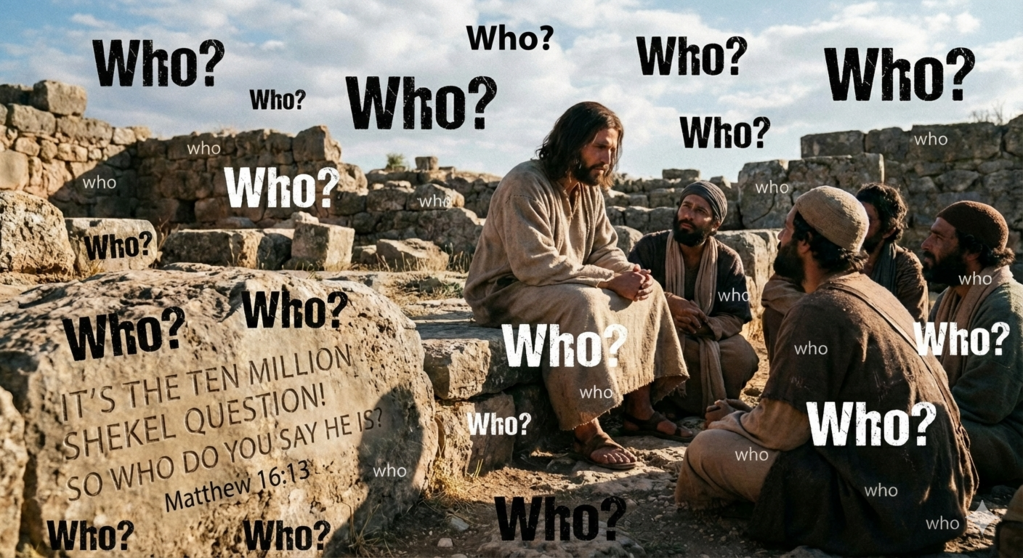
When Jesus came into the region of Caesarea Philippi, He asked His disciples, saying, “Who do men say that I, the Son of Man, am?” Matthew 16:13
Note: You can listen to today’s commentary courtesy of our friends at the “Bible in Ten” podcast. (Click Here to listen)
You can also read this commentary, scrolling with music, courtesy of our friends at “Discern the Bible” on YouTube. (Click Here to listen), or at Rumble (Click Here to listen).
“And Jesus, having come to the allotments – Caesarea, the Phillipi, He entreated His disciples, saying, ‘Whom they say, the men, Me to be, the Son of Man?’” (CG).
In the previous verse, the disciples finally clued in to what Jesus was trying to teach them. His words about the leaven of the Pharisees and Sadducees were speaking of their evil doctrine. Matthew now continues the narrative of their time after arriving on the eastern shore of the Sea of Galilee, saying, “And Jesus, having come to the allotments – Caesarea, the Phillipi.”
A new word, Kaisareia, Caesarea, is introduced. It is derived from Kaisar, Caesar, a Latin word referring to the title of the Roman Emperor. Caesarea refers to two places in the area of Israel. The first is this location, Caesarea Philippi. Of this location, Albert Barnes says –
“There were two cities in Judea called Caesarea. One was situated on the borders of the Mediterranean (See the notes at Acts 8:40), and the other was the one mentioned here. This city was greatly enlarged and ornamented by Philip the tetrarch, son of Herod, and called Caesarea in honor of the Roman emperor, Tiberius Caesar. To distinguish it from the other Caesarea the name of Philip was added to it, and it was called Caesarea Philippi, or Caesarea of Philippi. It was situated in the boundaries of the tribe of Naphtali, at the foot of Mount Hermon.”
Having come to this general area, “He entreated His disciples, saying, ‘Whom they say, the men, Me to be, the Son of Man?’” Translations consider His words in one of two ways. One is “Whom do men say that I am? The Son of Man?”, or “Whom do men say that I, the Son of Man, am?”
The latter is correct. Jesus has referred to Himself as the Son of Man nine times already, making this the tenth. Peter’s answer will also show that He is not asking if people say He is the Son of Man. Rather, He is asking what He, the Son of Man, is called by others. He is preparing them for a great pronouncement by asking this probing question first.
Life application: Jesus came to His own country in Matthew 13:53-58. He was rejected by them. In Matthew 14:1-12, the account of the beheading of John the Baptist was given. That was followed by the feeding of the five thousand in Matthew 14:13-21.
Jesus then walked on the sea, as is recorded in Matthew 14:22-33. From there, they came to the area of Gennesaret, at which time He fully saved all who simply touched Him. In Matthew 15:1-20, it then noted the traditions of the Jews which Jesus condemned, explaining that what comes out of a man is what defiles, not what enters into him.
That was then followed by His journey to the allotments of Tyre and Sidon, where the faith of the Canaanite woman was noted, and her daughter was saved. After that, Jesus went around the Sea of Galilee to the eastern side of it. There, He healed many and eventually fed four thousand. After feeding them, they crossed the Galilee, coming to the region of Magdala.
While there, He was accosted by the Pharisees and Sadducees who looked for a sign from heaven. He told them no sign would be given but the sign of Jonah. Once that was complete, they once again crossed the Sea of Galilee to the eastern side, being instructed on the leaven of the Pharisees and Sadducees. Now in the account, they have remained on this eastern side and gone north to the area of Caesarea Philippi.
This crisscrossing of the land and the Sea of Galilee all has a purpose. Jesus’ movements are being used as a walking instructional tool in what God is doing in redemptive history. It is good to stop and reconsider where He has gone and where He is at any given time. By considering these things, we can follow what God is doing in reconciling the world to Himself through Jesus.
Each area visited, each topographical marker that is mentioned, and each thing Jesus does is being woven into a marvelous tapestry for us to ponder and learn from. Keep paying attention to the details, both from a micro and macro viewpoint. God is telling us a story of humanity’s long trek back to Him, and it is all centered on Jesus.
Lord God, it would make no sense for You to send Your Son into the world unless there was something to be gained from it. His life of trials and burdens, culminating in His cross and resurrection, tells us that there is a great plan that has been put in place to bring Your people to a place we cannot even imagine at this time. We are grateful to be on this journey because of Jesus! Thank You for the sure hope we possess. Amen.