
Wednesday, 28 January 2026
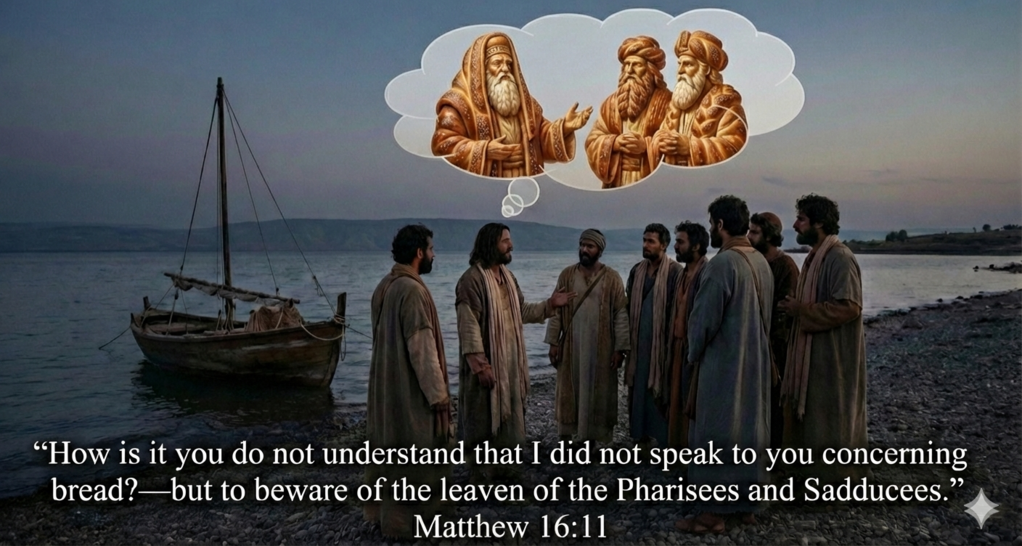
How is it you do not understand that I did not speak to you concerning bread?—but to beware of the leaven of the Pharisees and Sadducees.” Matthew 16:11
Note: You can listen to today’s commentary courtesy of our friends at the “Bible in Ten” podcast. (Click Here to listen)
You can also read this commentary, scrolling with music, courtesy of our friends at “Discern the Bible” on YouTube. (Click Here to listen), or at Rumble (Click Here to listen).
“How not you recollect that I spoke not concerning bread to you! Caution from the leaven of the Pharisees and Sadducees” (CG).
In the previous verse, Jesus continued His reminders to the disciples concerning His miracles, specifically the giving of the bread to four thousand, which was followed by collecting seven large hampers of leftovers. Because of this, He incredulously asks, “How not you recollect that I spoke not concerning bread to you!”
He had multiplied bread to feed many thousands on two separate occasions. And more, there was enough bread left over that people could have grabbed a snack for the journey on the way. So why would He care about the disciples not bringing bread? He wouldn’t. Something entirely different was on His mind. That is stated with the words, “Caution from the leaven of the Pharisees and Sadducees.”
There are two small changes in some of the texts –
How not you recollect that I spoke not concerning bread to you, but to caution from the leaven of the Pharisees and Sadducees.
How not you recollect that I spoke not concerning bread to you! Caution from the leaven of the Pharisees and Sadducees.
Either way, the sense is understood. In the second example, there seems to be a bit of impatience implied in the response, something that would be completely understandable. Jesus’ words in verse 6 said, “You behold, and you caution from the leaven of the Pharisees and Sadducees.”
Not getting the metaphorical nature of His words, they had assumed He was upset that they hadn’t brought bread. But now, after reminding them that He could multiply bread at will, He restates what He had originally said to them, if not a bit more impatiently. He wants them to contemplate the metaphor without His having to explicitly explain it.
Life application: What Jesus is doing is instructional. Instead of just outright telling the disciples what He means, He gives them a chance to think through the words. Teachers may do this in class.
Instead of saying what the answer to a problem is, they may restate it as a question. In doing this, it forces the students to think through what the teacher intends to say. Otherwise, the students may hear the information in one ear, and it will go right out the other.
However, when confronted with the chance to appear smart or refrain from looking uninformed, the question will cause each person to pay attention and contemplate what is on the teacher’s mind.
An even more subtle approach is what Jesus did. He didn’t ask a question. Instead, He said something intending for a metaphor to be considered, but knowing that probably wouldn’t be understood at first.
Then, after seeing the frustration of the disciples, He takes time to explain why their thinking is askew, and then He restates the original question, implying a demand for them to think again about what they had originally considered.
Suppose a person who owns a bell factory is getting married. He walks into the company and says, “I hear bells ringing soon.” The employees may say, “We are working on the whole new line. They should be ready soon!”
But the owner repeats his original statement, “I hear bells ringing SOON.” By repeating the same thing, he is letting them know he didn’t mean what they thought he meant. By adding stress, he asks them to reconsider the entire paradigm. Searching the recent past, they remember that the boss has been doting on Polly Pretty a lot lately.
Suddenly, the bells in their own minds ring clearly. The boss is talking about getting married. The metaphor is not only understood, but it has also been highlighted for them to joke about and reconsider in the years ahead. Jesus has used such a tool. That has now been reiterated to us in millions and millions of copies of the Bible for the past two thousand years.
We have learned, explicitly, what leaven is to be equated to when we read the Bible.
Lord God, we love how Your word instructs us. Again and again, teaching techniques are used that are intended to help us perfect our doctrine and also remember lessons that may otherwise escape our memories. But because of the way the word is laid out, we will remember many details as clearly as the ringing of a bell. Thank You for this. Amen.