Numbers 19:1-10
The Red Heifer
For the past ten or fifteen years, it has become common for news articles, videos, and discussion boards to claim that the main Jewish religious figures in Israel have finally found the perfect red heifer for once again conducting the temple rites in Jerusalem. It is claimed that without this, temple worship can’t begin again.
This, however, is flawed thinking. The red heifer is noted only now in Numbers. It is completely uncertain when this passage was written, but the fact that it is in Numbers, and the tabernacle was set up at the end of Exodus, clues us into the fact that the red heifer is not necessary for beginning the temple rites.
This is then seen after the first exile when the returnees built the altar of the God of Israel in Ezra 3 in order to offer burnt offerings on it. The red heifer is never mentioned there. They simply built the altar and offered offerings. The other aspects of the law would have been adhered to according to established need.
One can see from the passage that the red heifer is simply used for purification from sin, but the actual sin it purifies from will not be specified until next week’s sermon. For now, it is only described how to get to that which is needed for the purification.
But this passage is only symbolic of what is coming in Christ. It could not actually accomplish what it was given for…
Text Verse: “For if the blood of bulls and goats and the ashes of a heifer, sprinkling the unclean, sanctifies for the purifying of the flesh, 14 how much more shall the blood of Christ, who through the eternal Spirit offered Himself without spot to God, cleanse your conscience from dead works to serve the living God? 15 And for this reason He is the Mediator of the new covenant, by means of death, for the redemption of the transgressions under the first covenant, that those who are called may receive the promise of the eternal inheritance.” Hebrews 9:13-15
The author of Hebrews says that what we are looking at today simply sanctified for the purifying of the flesh. Beyond that, it could do nothing to truly restore a person to God. The flesh is at war with God as is perfectly evident from the rest of Scripture.
Only in the coming of Christ is the promise of the eternal inheritance realized. This is what is such a huge shame about Christians who openly applaud, and even financially support, the process of building a new temple, identifying a supposedly perfect red heifer, and joining in with the rites and rituals that are being conducted each year in anticipation of the coming temple.
To them, it is as if this is what God wants, and that we should somehow support it. If that was so, then we would not have the book of Hebrews to cite. Nor would we have any of the other New Testament books to read and celebrate in. The four gospels, Acts, and all of the New Testament letters are given for the purpose of showing that Christ fulfilled these types and shadows, and in His final act in fulfillment of them, He died. At the same time, He initiated a New Covenant which replaces the Old.
It is true that it is exciting that another temple is coming. It is amazing to see the implements being constructed and the rituals being practiced, but instead of rejoicing with Israel over these things, we should mourn for them. In their coming, there is nothing more than a continued rejection of what they only anticipated.
This will, once again, like so many times before, be evident from an evaluation of this passage which is found in His superior word. And so let’s turn to that precious word once again and… May God speak to us through His word today and may His glorious name ever be praised.
The Red Heifer
Now the Lord spoke to Moses and Aaron, saying,
Once again, as has been seen a few times, the usual address of the Lord speaking only to Moses is departed from in this verse by including Aaron. This has happened from time to time when there is a need for Aaron to be involved in whatever is occurring. Such is the case now.
The passage before us speaks of purification, specifically that of purification from defilement which comes from being physically near death. As death is the final result of sin, it is defiling to touch a dead person, or even be in the immediate presence of one who dies. Purification from this must be accomplished to maintain holiness.
It is not sure when this passage was received, but some speculate that it was actually at the time that the tabernacle was originally erected in Exodus 40. That occurred on the first day of the second month of the second year. In that same month, Numbers 9 says –
“Now there were certain men who were defiled by a human corpse, so that they could not keep the Passover on that day; and they came before Moses and Aaron that day. 7 And those men said to him, ‘We became defiled by a human corpse. Why are we kept from presenting the offering of the Lord at its appointed time among the children of Israel?’” Numbers 9:6, 7
Because they were defiled by a corpse, it is assumed by some that this law, now presented in Numbers 19, was already received. That may be so, but it may more likely be that this is a new thought entirely, coming on the heels of the final words of Numbers 17 –
“So the children of Israel spoke to Moses, saying, ‘Surely we die, we perish, we all perish! 13 Whoever even comes near the tabernacle of the Lord must die. Shall we all utterly die?’” Numbers 17:12, 13
The people had rebelled several times, and many had died during these rebellions. Finally, at the time of Aaron’s rod which budded, the people realized that death was the inevitable result of their sinning against the Lord, and they were destined to die in the wilderness because of this.
In this, they had been promised that all, twenty and above would die in the wilderness until the generation of the disobedient were consumed. The number of deaths which could be expected on any given day would then be in the hundreds. It was already understood, even from Genesis 2, that death is the result of sin, and that purification from sin was necessary, or further defilement and death would be the natural result.
And so we have a logical progression of thought. There was a challenge to Aaron’s priesthood. That challenge was handled by the Lord in the destruction of the rebels as seen in Chapter 16. From there, Aaron’s authority was definitively established through the budding of his rod in Chapter 17.
After that, the care of the Levitical priesthood through the system of tithes and offerings was detailed in Chapter 18. There, the possibility of death was mentioned four times in various ways. For example, only the priests could perform the duties in the tent of meeting. Anyone else would die. The Lord is instructing the people in holiness, His holiness, and what that means, including death for infractions against it.
Now, in response to terrified cries of the people that whoever comes near the tabernacle must die, the Lord is providing this passage concerning the cleansing of the people from the stain of sin related to death. They could, in fact, approach the sanctuary, but not the tabernacle. The boundaries had been set, but even those who came near the sanctuary to offer an offering must be pure.
Because the tabernacle of the Lord extends logically to cover the entire congregation, the people needed to maintain a state of purification from death. This then is the reason for the placement of the passage here. In Chapter 17, in the cries of the people’s words, “Whoever even comes near the tabernacle of the Lord must die,” a response is given now. In verse 13 of this chapter, we will read –
“Whoever touches the body of anyone who has died, and does not purify himself, defiles the tabernacle of the Lord.”
In both, the rare term, mishkan Yehovah, or “tabernacle of the Lord,” is used. To be an Israelite, dwelling in the Lord’s presence, and to not be purified from the stain of death, would defile the mishkan Yehovah. The problem of that is thus dealt with now…
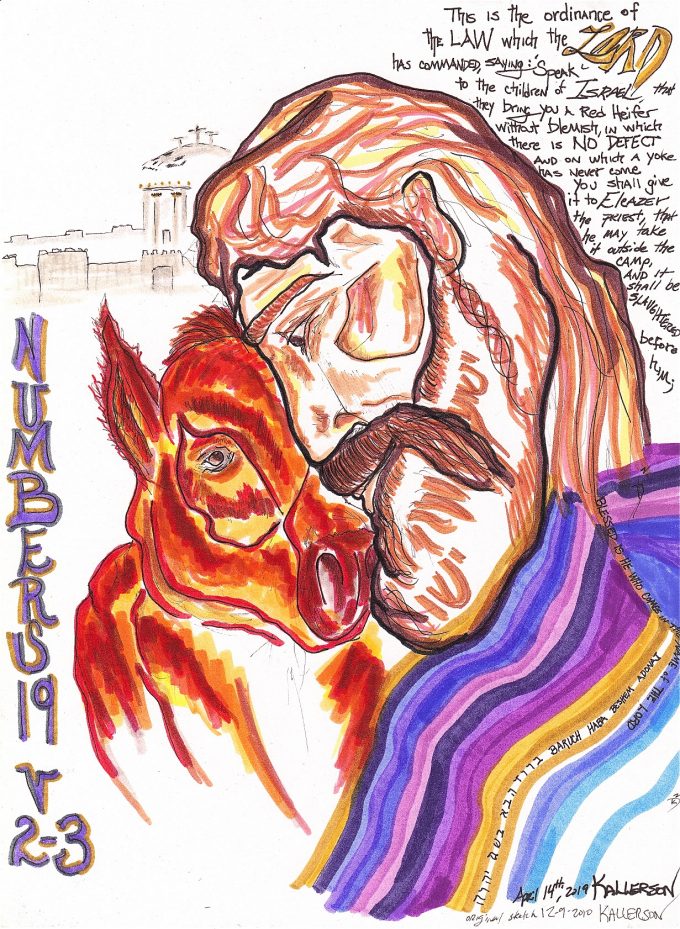
2 “This is the ordinance of the law
zot khuqat ha’torah – “this, enactment the law.” It is a very rare phrase which combines two common words – khuqat, or “statute,” and torah, meaning “law,” or “instruction.” The two words together in this manner are only seen here and in Numbers 31:21 where purification is again the subject, including the type of purification mentioned in this passage. For this combined form, John Lange provides a general meaning –
“We would read: an ordinance for securing the Torah. Without this expedient, for instance, the law of purification would have occasioned endless offences on the right hand and on the left.” John Lange
In other words, the word torah, or “law,” here is an all-encompassing statement concerning not any given law, but the Law of Moses itself. In order to secure the Law and keep it free from constant defilement in the people, this statute is now being enacted.
2 (con’t) which the Lord has commanded, saying:
Now the khuqat ha’torah, or “enactment of the law,” is said to be, tsivah, or commanded, by the Lord. There is a definite importance being ascribed to what will be presented. It is binding on all people because it is a part of the mutually agreed-to covenant between the Lord and His people. The Lord, speaking to Moses and Aaron concerning this guidance commanded by the Lord, tells them to…
2 (con’t) ‘Speak to the children of Israel,
This is then surely in direct response to what they had said to Moses which included Aaron as the recognized high priest –
“So the children of Israel spoke to Moses, saying, “Surely we die, we perish, we all perish!” Numbers 17:12
The children of Israel spoke to Moses in terror. The Lord will now speak to the children of Israel, through Moses and Aaron, concerning instruction on how to avoid that terror.
2 (con’t) that they bring you
The word “you,” is second person, singular. It thus explains the inclusion of Aaron more fully. What is to be brought is probably not to be brought to Moses. He is the lawgiver, and that job is a one-time position which will not be repeated during the period of the law. Rather, it is to be brought to the high priest, whoever he is, that fills the position. Aaron is representative of the position.
2 (con’t) a red heifer without blemish,
parah adumah temimah – “heifer red without blemish.” The obvious questions which arise from this are 1) Why a heifer? 2) Why red? And 3) Does “without blemish” qualify the color red, meaning “entirely red,” or is “without blemish” expanded upon by the coming words concerning no defect? The Hebrew could go either way.
Some scholars look to this as a symbolic rejection of the rites and rituals of Egypt. The heifer was sacred to the Egyptians, and so only bulls were sacrificed. Specifically, they sacrificed red bulls to their demon god Typhon. Thus, in using a red heifer, they were rejecting the rites and practices of Egypt. This is not sound. The Lord isn’t asking His people to look back on and reject Egypt. He is – as always – giving types and pictures of Christ to come.
The specificity of the red color is the only time such a requirement is made in the sacrificial system. At all other times, the type and sex of the animal are specified, but never the color.
The color adom, or red, is given as a direct tie to Adam, or humanity. The name Adam, and the word “man,” or adam, come from the word adom – both the verb and noun signify “red.” It is either the state of being red, or the action of making red. Esau was called Edom because of the adom, or red, soup. That was the only time the noun has been used, until now. Remembering what that story pictured, connects us to this requirement now.
The verb form was used in the construction of the tabernacle with the “rams skins dyed red.” It is seen ten times, and it comes from the idea of being made red, or to show blood in the face. The use of those ram skins dyed red pictured Christ’s covering of our sins. That is then explained by the use of the verb adom in Isaiah –
“‘Come now, and let us reason together,’
Says the Lord,
‘Though your sins are like scarlet,
They shall be as white as snow;
Though they are red like crimson,
They shall be as wool.’” Isaiah 1:18
After this, Paul explains how this points to Christ in his second letter to the Corinthians –
“For He made Him who knew no sin to be sin for us, that we might become the righteousness of God in Him.” 2 Corinthians 5:21
The red looks to Christ the Man, formed out of the earth, and thus it made possible His sacrificial work on our behalf. As for it being a heifer, meaning a female, The word parah, or heifer, is the feminine of par, a young bull or steer. That is associated with parar, meaning to break forth or frustrate, and thus to break, such as in a covenant, or to annul it.
As this is for the purification from sin, the idea of destroying its effect is an obvious connection to that. That it is a female looks to the initial cause of sin in man, not his actual sin, but what precipitated it –
“So when the woman saw that the tree was good for food, that it was pleasant to the eyes, and a tree desirable to make one wise, she took of its fruit and ate. She also gave to her husband with her, and he ate.” Genesis 3:6
That is then explained by Paul –
“And Adam was not deceived, but the woman being deceived, fell into transgression.” 1 Timothy 2:14
It is the woman who was deceived through her weak nature. Christ came born of a woman and bore the same weak nature that all humans possess. That is explained by the author of Hebrews –
“For every high priest taken from among men is appointed for men in things pertaining to God, that he may offer both gifts and sacrifices for sins. 2 He can have compassion on those who are ignorant and going astray, since he himself is also subject to weakness.” Hebrews 5:1, 2
That it is a heifer looks to Christ the Man who came subject to weakness, and His sacrificial work on our behalf.
Earlier, it was questioned concerning the word, temimah, or without blemish. Does the word qualify “red,” or is it qualified by “no defect?” In other words, does the word best translate as “without blemish,” meaning pure red, or does it best translate as “perfect,” meaning without defect?
First, all traditions hold that it qualifies “red,” and there is no obvious reason to go against that. Further, that there is no other sacrifice where the specific color is designated would certainly argue for the word qualifying “red.” Not only is it to be red, but wholly red. However, the word mum, or defect, in the next clause is used to qualify and explain the word tamim, or without blemish, elsewhere, such as in Leviticus 22:1 –
“And whoever offers a sacrifice of a peace offering to the Lord, to fulfill his vow, or a freewill offering from the cattle or the sheep, it must be perfect (tamim) to be accepted; there shall be no defect (mum) in it.”
Without being dogmatic, because we are speaking of a heifer and not a dog, I would – after talking it over with Sergio – go with the latter. Red is specified, without any other word which could very easily have been translated as “wholly,” thus indicating totally red. The picture of Christ’s humanity is sufficiently described with the single word, adom, or red. It is not His humanity that takes away our sins, but rather His perfect humanity which does.
Because of the specificity of the perfection of the peace offering, and that it should be without defect as well, is sufficient for us to consider the same here. And that is then actually revealed as what is necessary to picture Christ in the New Testament –
“…knowing that you were not redeemed with corruptible things, like silver or gold, from your aimless conduct received by tradition from your fathers, 19 but with the precious blood of Christ, as of a lamb without blemish and without spot.” 1 Peter 1:18, 19
It is not any man that can take away sin, but a Man without blemish, meaning perfect, and without spot, and without defect or defilement. The huge number of traditions which have been heaped up by the Jews concerning single white or black hairs of this red heifer making it unacceptable as a sacrifice have not highlighted the obvious pictures of the coming Christ, but rather they have only diminished them. That it is without blemish looks to Christ the sinless Man, and His sacrificial work on our behalf.
2 (con’t) in which there is no defect
ain bah mum – “not there is defect.” As we just saw, this certainly qualifies and further explains the words “without blemish.” Christ came in perfection, He lived in perfection, and He died… in perfection. That the red heifer had no defect looks to Christ the perfect Man, and His sacrificial work on our behalf.
2 (con’t) and on which a yoke has never come.
lo alah aleha ol – “not which has gone up on a yoke.” The ol, or yoke, is a picture of bondage. It comes from a root meaning, “to affect thoroughly.” This perfect red heifer, without defect, was also to have never been yoked. The idea of a yoke on an animal is subjection. On a person, it then conveys the idea of degradation.
It would be unbefitting of the purpose of the rites, for which this heifer was to be used, for it to have been placed under a yoke. But more, this looks to Christ who, though born under the yoke of the law was born sinless under that yoke. In other words, the law is a yoke because of sin. For one who is sinless, and who remains sinless, there is no yoke of bondage; there is no subjugation to sin. Thus, what will happen with this heifer for the people will look to what Christ does for His people –
“Come to Me, all you who labor and are heavy laden, and I will give you rest. 29 Take My yoke upon you and learn from Me, for I am gentle and lowly in heart, and you will find rest for your souls. 30 For My yoke is easy and My burden is light.” Matthew 11:28-30
In addition to His state under the law, this not being yoked is certainly explained in Christ’s voluntary service before the Lord. As a yoke implies bondage and forced labor, an animal that has never been yoked has lived free from such constraints. Such was true with Christ, as the author of Hebrews explains it –
Previously saying, “Sacrifice and offering, burnt offerings, and offerings for sin You did not desire, nor had pleasure in them” (which are offered according to the law), 9 then He said, “Behold, I have come to do Your will, O God.” He takes away the first that He may establish the second. 10 By that will we have been sanctified through the offering of the body of Jesus Christ once for all. Hebrews 10:8-10
Christ voluntarily came to do God’s will, and He voluntarily placed himself under the law. His sacrifice replaced these very sacrifices which are mentioned under the law, because His covenant replaced the covenant through which they came. What could never actually bring God pleasure is replaced by that which pleased God the most.
That this red heifer was never yoked looks to Christ the sinless Man, and His sacrificial work on our behalf.
3 You shall give it to Eleazar the priest,
The name Eleazar essentially means “Whom God helps.” He is the third son of Aaron, but the oldest remaining son. The very use of His name looks to the work of Christ. Whom God helps, He helps through Christ.
The son, not Aaron, goes because there will be a resulting defilement from the performance of these duties as will be seen in verse 7. As Aaron was to never allow himself to become defiled in this manner, the rite is transferred to the son. It is again reflective of Christ as is recorded by Paul –
“For He made Him who knew no sin to be sin for us, that we might become the righteousness of God in Him.” 2 Corinthians 5:21
The son became unclean through the rite; God’s Son took on our uncleanness through His work. For now in Numbers, it is this son who is to receive the heifer…
3 (con’t) that he may take it outside the camp,
Outside of the camp is where defilement is. It is where those who are unclean are sent. It is where the world at large is. As this was to be for the cleansing from defilement caused by death, and as death is the result of sin, the animal and its death were not taken to the altar for sacrifice, but outside the camp – away from the presence of the Lord. The connection to Christ is obvious –
“For the bodies of those animals, whose blood is brought into the sanctuary by the high priest for sin, are burned outside the camp. 12 Therefore Jesus also, that He might sanctify the people with His own blood, suffered outside the gate.” Hebrews 13:11, 12
The sanctification of the people was accomplished by the Lord as He hung outside the gate of Jerusalem. Every word so far has shouted out the magnificent wonder of what Jesus Christ did for His beloved people.
3 (con’t) and it shall be slaughtered before him;
The subject in the clauses is indefinite, “that may take it outside,” and “shall be slaughtered.” This is because it was not the priest who slaughtered the animal, but rather, it was someone unspecified. The reason for this is that though man led Christ outside of the city, and though man crucified Christ, it was God who ordained that it should be so.
The picture of Abraham, leading his son to be sacrificed on Mount Moriah, as being typical of God the Father and God the Son, once again comes to light here. But, the animal is slaughtered before the priest who then testifies to the death. This is seen in Matthew 27 where it is noted that the chief priests stood and witnessed the crucifixion of Christ.
4 and Eleazar the priest shall take some of its blood with his finger, and sprinkle some of its blood seven times directly in front of the tabernacle of meeting.
With the sacrifice of the animal complete, Eleazar was to take some of the blood of the heifer, and nazah, or sprinkle, it seven times directly toward the face of the Tent of Meeting. He actually would do this from the place outside the camp, not in the sanctuary. As he is considered unclean, so he remains defiled until evening.
With this act, the blood of the heifer, meaning the death of the heifer, becomes an actual sacrificial offering to the Lord. Thus, Eleazar, or Whom God Helps, is representative of Christ who is equated to the Finger of God in Luke 11:20.
The word finger, or etsbah, comes from another word, tsebah, which indicates dyed material, and thus one gets the idea of grasping something. Therefore, the finger is that which accomplishes a task. The creation is said to be the work of the Lord’s fingers in the 8th Psalm. But the Bible also records that the creation is accomplished through Christ.
Thus, in this verse, the shed blood is Christ the innocent Substitute and Sacrifice. Eleazar is Christ the Priest. The finger is Christ who accomplishes the work of purification. The seven sprinklings are the perfection of Christ’s blood presented before God as an acceptable purification from sin resulting from touching that which is dead.
5 Then the heifer shall be burned in his sight: its hide, its flesh, its blood, and its offal shall be burned.
This is the same thing that was to be done to the sin offerings of the anointed priest, the sin offering for the entire congregation, the sin offering for the ordination of Aaron and his sons, and the sin offering on the Day of Atonement. This is not a picture of Christ’s sufferings. The animal is already dead. This reflects something entirely different. Further, this is the only time that blood is said to be burnt as a part of the sacrifice.
The word used here for “burn” here is saraph. It is the word used, for example, when burning a leprous garment. It is never used in the sense of an offering. Rather, it more reflects the rejection of a thing, and a divine purification through incineration. It is a picture of the consequences of sin, the Lake of Fire. The body of Christ became an unclean thing before God in order to purify man from the stain of death. And so even this verse completely and wholly pictures Christ and His sacrifice for us. Next…
6 And the priest shall take cedar wood
Now the priest is instructed to take certain things. It is similar to that which was seen in a particular ritual in Leviticus 14. The first item is ets eretz, or wood cedar. The word eretz is derived from a root which means to be firm, or strong. It is the same word used to describe the cedars of Lebanon and even the cedars of God in Psalm 80. Thus they are large, magnificent, firmly fixed trees.
This part of the rite indicates permanence. It carries the strength of the process. It is symbolic of Christ who is the strength of God for salvation. As Paul says in Romans 5 –
“For when we were still without strength, in due time Christ died for the ungodly.” Romans 5:6
6 (con’t) and hyssop
v’ezov, or “and hyssop,” is taken as well. The word hyssop that we use today comes from the Hebrew through the Greek. In Greek, it is hussopos, a transliteration from the Hebrew ezov. You can hear the similarity ezov/hyssopos/hyssop. It is an herb native to the Middle East and elsewhere. It has antiseptic, cough-relieving, and expectorant properties.
Because of this, it is used as an aromatic herb and for medicine. It is a brightly colored shrub with dark green leaves. During the summer, it produces bunches of pink, blue, or, more rarely, white fragrant flowers. It is contrasted to the cedar in 1 Kings 4, showing its diminutive size –
“He spoke three thousand proverbs, and his songs were one thousand and five. 33 Also he spoke of trees, from the cedar tree of Lebanon even to the hyssop that springs out of the wall; he spoke also of animals, of birds, of creeping things, and of fish.” 1 Kings 4:32, 33
Whereas the cedar denoted firmness and strength, the hyssop denotes humility. Other than the one instance given by Solomon, it is always used in the Bible in conjunction with purification. Paul shows us how this humble plant, used in purification, looks forward to Christ –
“Let this mind be in you which was also in Christ Jesus, 6 who, being in the form of God, did not consider it robbery to be equal with God, 7 but made Himself of no reputation, taking the form of a bondservant, and coming in the likeness of men. 8 And being found in appearance as a man, He humbled Himself and became obedient to the point of death, even the death of the cross.” Philippians 2:5-8
6 (con’t) and scarlet,
u-sh’ni tolaat, or “and scarlet (of the) crimson grub worm,” is to be brought. The implication is scarlet yarn. Two words here are used to describe the color. The first is shani, which means “scarlet.” The second is tola. This is actually a worm known as the crimson-grub. However, it is used only in this manner concerning the color from it, and cloths dyed with it.
Taken together, they are translated as “scarlet,” but implying the scarlet which comes from the tola or grub worm. The scarlet, or red, in the Bible pictures and symbolizes war, blood, and/or judgment. In this case, it is judgment, as in judgment on sin. Thus, the sh’ni tolaat, or scarlet of the crimson grub worm, pictures Christ who is described by the same word, tola, in the 22nd Psalm, a psalm about the cross of Christ –
“But I am a worm, and no man;
A reproach of men, and despised by the people.” Psalm 22:6
The judgment is what happened at the cross of Christ, and this is what the scarlet signifies here. As repeated from an earlier sermon a description of this crimson dye, which is obtained from the tola is given to us by Henry Morris –
“When the female of the scarlet worm species was ready to give birth to her young, she would attach her body to the trunk of a tree, fixing herself so firmly and permanently that she would never leave again. The eggs deposited beneath her body were thus protected until the larvae were hatched and able to enter their own life cycle. As the mother died, the crimson fluid stained her body and the surrounding wood. From the dead bodies of such female scarlet worms, the commercial scarlet dyes of antiquity were extracted. What a picture this gives of Christ, dying on the tree, shedding his precious blood that he might ‘bring many sons unto glory.’ He died for us, that we might live through him!” Henry Morris
After this, the priest is instructed…
6 (con’t) and cast them into the midst of the fire burning the heifer.
The body of the unblemished, and defect-free red heifer has all of these things, representing the attributes of Christ, cast into the fire with it. Think of it! The perfect, sinless Man, who died in weakness, is described by what these articles imply. The casting of them into the fire with the body is signifying exactly that.
His perfections are what are being consumed with His body so that purification for any who have come into contact with death may be purified from that. As all have sinned, all have come into contact with death. But the purification of Christ is sufficient to cleanse any and all who will receive what He accomplished for them.
7 Then the priest shall wash his clothes, he shall bathe in water, and afterward he shall come into the camp; the priest shall be unclean until evening.
This is now another note of uncleanness in the process. There was the taking of the animal outside the camp. There was the death of the animal, meaning its state in death. There was the burning of the animal in its entirety. Through these unclean things, the priest is made unclean.
Think of it, the process which is given to cleanse the people from the sin of death, in turn, makes the attending priest unclean, implying that touching the blood used in the rite of sprinkling, meaning the proof of death, has made him unclean. How can it be that purity can come out of that which is unclean?
Because of this, he was required to accomplish certain rites of purification already laid out in Leviticus. The washing of the garments, the bathing in water, and waiting until evening were all required.
The reason for the uncleanness lasting until evening is because the evening is the start of a new day. Thus, a picture of the work of Christ is made. Through the death of Christ, man enters into a new Day where all things are made new. It doesn’t matter if a person is made unclean 20 minutes after evening, meaning he is unclean for 23 hours and 40 minutes, or if he is made unclean 15 minutes before evening. In Christ, one is cleansed for the new Day.
8 And the one who burns it shall wash his clothes in water, bathe in water, and shall be unclean until evening.
As the priest is made unclean through the rite, so is the one who burns the heifer made unclean. He too must wash his garments, bathe in water, and remain unclean until evening.
Think of it. The process which is given to cleanse the people from the sin of death, in turn makes the one who conducts the burning of the animal unclean. Implying that the burning of the animal causes uncleanliness. How can it be that purity can come out of that which is unclean?
9 Then a man who is clean shall gather up the ashes of the heifer,
Now a clean man is specifically called in to gather up the ashes of the heifer. The implication is that the other people who are unclean cannot conduct this part of the rite without somehow defiling the ashes. This is only the second time that epher, or ash, has been mentioned in the Bible. As normal in the Hebrew, the word is singular, ash. IT is what remains of a thing, and thus it reflects the whole thing.
Ash carries a couple of ideas. First, it reflects judgment, as when Abraham said, I am but dust and ashes. He was indicating that he was created from the dust, and all he deserved was being reduced to ashes in judgment. It also carries the idea of mourning, as when one puts ashes on the head to reflect the state in which they feel they exist. Thus, a clean person was to come and collect the ashes.
9 (con’t) and store them outside the camp in a clean place;
The ashes, which were collected by a clean person, are to be stored outside the camp, not inside the camp. However, they were to be in a clean place outside the camp. This implies that they would defile the camp if they were brought in. How can it be that purity can come out of that which is unclean?
9 (con’t) and they shall be kept for the congregation of the children of Israel for the water of purification;
Here the term is l’me niddah, or “for water of impurity.” It signifies water by which impurity is removed. The ashes would be taken and mixed with water and then used to purify. This process will be described in the verses ahead. It is then further described as…
9 (con’t) it is for purifying from sin.
khathat hi, or “sin, it.” Here the word “sin” signifies the offering for the sin. It is what takes the place of the sin, and thus it is called “sin.” It is reflective, then, of Christ who became sin so that we could become the righteousness of God in Him.
10 And the one who gathers the ashes of the heifer shall wash his clothes, and be unclean until evening.
Like the attending priest, and like the one who burned the heifer, this person who was clean, and who then gathered up the ashes for cleansing of those who are defiled by the state of death, has become unclean, and will remain that way until evening.
Think of it, collecting the ashes of the heifer which is given to cleanse the people from the sin of death, in turn, makes the one who collects them unclean. Implying that the ashes carry uncleanliness. How can it be that purity can come out of that which is unclean?
*10 (fin) It shall be a statute forever to the children of Israel and to the stranger who dwells among them.
Here, it is acknowledged that this rite of purification applied to both the children of Israel, and to the stranger, meaning the foreigner, who dwelt among them. And it applied for the entire time of the Mosaic law. As long as the law existed, and until it was replaced by the New Covenant in Christ, it remained in effect. As the typology points to Christ, it indicates – even from the Mosaic Law – that cleansing from such impurity was intended for both Jew and Gentile.
The question has been asked several times. “How can something that defiles bring about cleansing?” Again and again, being physically in contact with each part of the rite brought about a state of uncleanness. And yet, it is the very substance produced in this process of death which then is given as the only thing to purify from contact with the dead. How is this possible?
The answer is, of course, found in Christ. In Christ’s death, He took upon Himself all of the sin of the world, becoming – as we have already heard twice – sin. His body became the very thing that could cleanse us of our sin. But because His body was dead, literally and truly, it was considered unclean under the Law of Moses.
Anyone who touched it would be rendered unclean, and yet, in the completion of His work, meaning being found sinless before the Father, He was raised to eternal life. In this, our sin which was imputed to Him was washed away, and His body, which had died and was deemed unclean, became the only true way of cleansing humanity from the defilement caused by death. As John Lange says, “…death was to be put to death by this death of the most perfect blooming life.”
As all humans have been born with sin, all have had contact with death, and therefore, only Christ can purify us from what this red heifer anticipated. Everything under the law was external and shadowy. It could not actually cleanse from sin, nor could these things actually bring the unclean to a state of purity. They looked ahead to Him, and in Him is found the fulfillment of the many types, shadows, and pictures found in today’s beautiful passage.
Closing Verse: “Then they took the body of Jesus, and bound it in strips of linen with the spices, as the custom of the Jews is to bury. 41 Now in the place where He was crucified there was a garden, and in the garden a new tomb in which no one had yet been laid. 42 So there they laid Jesus, because of the Jews’ Preparation Day, for the tomb was nearby.” John 19:40-42
Next Week: John 16:19-22 God has something incredible planned. Hoo yeah and oh boy! (Your Sorrow Will Be Turned Into Joy) (Resurrection Day sermon)
The Lord has you exactly where He wants you. He has a good plan and purpose for you. It may seem at times as if you are lost in a desert, wandering aimlessly. But the Lord is there, carefully leading you to the Land of Promise. So follow Him and trust Him and He will do marvelous things for you and through you.
The Red Heifer
Now the Lord spoke to Moses and Aaron, saying
These are the words He was to them then relaying
“This is the ordinance of the law as I am relaying
Which the Lord has commanded, saying:
‘Speak to the children of Israel
That they bring you a red heifer without blemish
———-whether one or some
In which there is no defect
And on which a yoke has never come
You shall give it to Eleazar the priest
But this is just a prelim
That he may take it outside the camp
And it shall be slaughtered before him
And Eleazar the priest shall
Take some of its blood with his finger
———-I know there is no need for repeating
And sprinkle some of its blood seven times
Directly in front of the tabernacle of meeting
Then the heifer shall be burned in his sight
———-as you have now learned
Its hide, its flesh, its blood, and its offal shall be burned
And the priest shall take cedar wood
And hyssop and scarlet too
And cast them into the midst
Of the fire burning the heifer
———-so he shall do
Then the priest shall wash his clothes
He shall bathe in water as well
And afterward he shall come into the camp
The priest shall be unclean until evening
———-as to you I now tell
And the one who burns it shall
Wash his clothes in water, so he shall do
Bathe in water also
And shall be unclean until evening too
Then a man who is clean shall gather up the ashes of the heifer
And store them outside the camp in a clean place
And they shall be kept for the congregation
———-of the children of Israel
For the water of purification; it is for purifying from sin
———-so that of sin there will be no trace
And the one who gathers the ashes of the heifer
Shall wash his clothes, and be unclean until evening too
It shall be a statute forever to the children of Israel
And to the stranger who dwells among them
———-as I am instructing you
Lord God, we are even now in a wilderness
And we are wanting to be led by You
Without You to direct, our lives would be a mess
And so be our guide, O God; You who are faithful and true
We long for the water in this barren land
May it flow forth from the Rock, our souls to satisfy
Give us this refreshing, spiritual hand
And may we take it, and to our lives daily it apply
And we shall be content and satisfied in You alone
We will follow You as we sing our songs of praise
Hallelujah to You; to us Your path You have shown
Hallelujah we shall sing to you for all of our days
Hallelujah and Amen…