
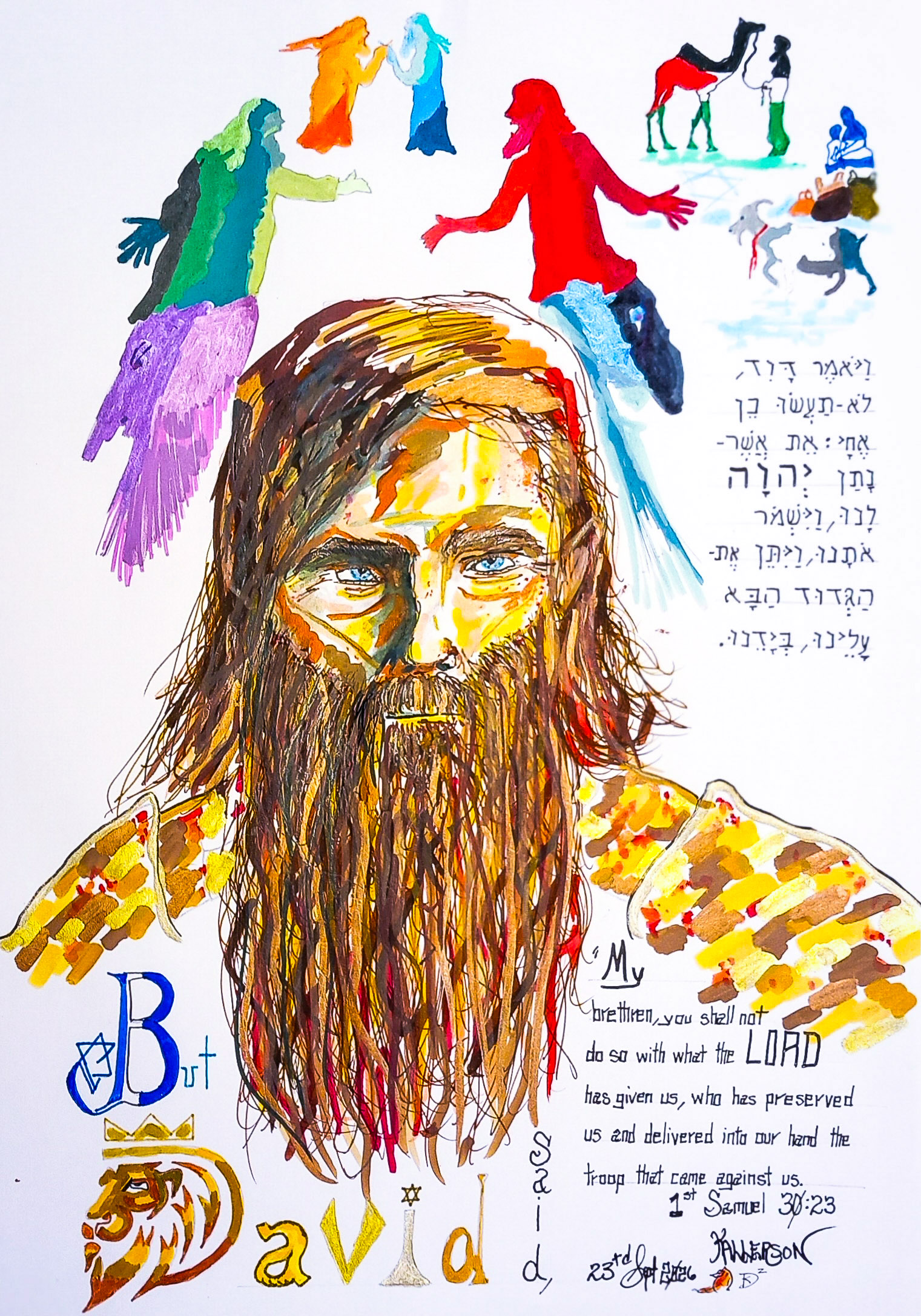
Artwork by Douglas Kallerson
1 Samuel 30:21-31
Wadi, the Besor, Part III
(Typed 1 June 2026) In Matthew 20, Jesus gives what is known as the Parable of the Workers in the Vineyard. That parable has interesting parallels to what is typologically revealed in this Chapter of 1 Samuel.
The Superior Word commentary on this parable was published in late May and early June, at the same time I typed this sermon. It wasn’t planned. It just worked out that way. The parable says –
“For the kingdom of heaven is like a landowner who went out early in the morning to hire laborers for his vineyard. 2 Now when he had agreed with the laborers for a denarius a day, he sent them into his vineyard. 3 And he went out about the third hour and saw others standing idle in the marketplace, 4 and said to them, ‘You also go into the vineyard, and whatever is right I will give you.’ So they went. 5 Again he went out about the sixth and the ninth hour, and did likewise. 6 And about the eleventh hour he went out and found others standing idle, and said to them, ‘Why have you been standing here idle all day?’ 7 They said to him, ‘Because no one hired us.’ He said to them, ‘You also go into the vineyard, and whatever is right you will receive.’
8 “So when evening had come, the owner of the vineyard said to his steward, ‘Call the laborers and give them their wages, beginning with the last to the first.’ 9 And when those came who were hired about the eleventh hour, they each received a denarius. 10 But when the first came, they supposed that they would receive more; and they likewise received each a denarius. 11 And when they had received it, they complained against the landowner, 12 saying, ‘These last men have worked only one hour, and you made them equal to us who have borne the burden and the heat of the day.’ 13 But he answered one of them and said, ‘Friend, I am doing you no wrong. Did you not agree with me for a denarius? 14 Take what is yours and go your way. I wish to give to this last man the same as to you. 15 Is it not lawful for me to do what I wish with my own things? Or is your eye evil because I am good?’ 16 So the last will be first, and the first last. For many are called, but few chosen.”
Text Verse: “And he said, ‘Listen, all you of Judah and you inhabitants of Jerusalem, and you, King Jehoshaphat! Thus says the Lord to you: ‘Do not be afraid nor dismayed because of this great multitude, for the battle is not yours, but God’s.’” 2 Chronicles 20:15
In the battle that David led against Amalek, David said essentially the same thing about the battle being the Lord’s –
“But David said, ‘My brethren, you shall not do so with what the Lord has given us, who has preserved us and delivered into our hand the troop that came against us.’” 1 Samuel 30:23
How does that tie in with Jesus’ teaching about the workers in the vineyard? It all comes down to the marvelous five-letter word: GRACE.
We can’t earn it, and we shouldn’t be upset when others receive it. Rather, we should accept it humbly and be glad when others receive it as well.
It is a certain truth that is found in His superior word. And so, let us turn to that precious word once again, and… May God speak to us through His word today, and may His glorious name ever be praised.
I. Unitedly, They Will Apportion (verses 21-31)
21 Now David came to the two hundred men who had been so weary that they could not follow David,
vayavo David el matayim ha’anashim asher pigeru milekheth akhare David – “And he came, David, unto ‘two hundreds, the mortals’ who they death-spent from walking after David.” These men were mentioned in verse 10 –
“And he pursued, David, he and four hundreds man. And they stood, two hundreds man whom they ‘death-spent’ from traversing ‘Wadi, the Besor’.” 1 Samuel 30:10 (CG)
The men had been going constantly since they left the Philistines who were preparing for battle. They returned to Ziklag and found their families and possessions plundered. They wailed in anguish until they couldn’t weep anymore. Then they picked up their arms and went in pursuit of the plunderers.
By the time they got to Wadi, the Besor, they were spent. Therefore, they stayed at the wadi while the rest of the soldiers pressed on after the raiders.
David means Beloved. He has pictured accepting the doctrines of Christ. Two hundred is the number of insufficiency.
21 (con’t) whom they also had made to stay at the Brook Besor.
vayoshivum benakhal ha’besor – “and they caused to ‘sit’ them in ‘Wadi, the Besor’.” Because David is referred to in verse 10 and this verse, many manuscripts say, “and he caused to ‘sit’ them in ‘Wadi, the Besor’.” It is more likely the text would be changed from the more difficult “they” to the seemingly more understandable “he.”
However, the next verse gives a good reason why the word “they” is correct. Either way, it was understood these men were more of a liability than a help.
Besor is from basar, to be fresh and thus full. That word was introduced in 1 Samuel 4:17, where it described the person “announcing” what occurred in the battle.
It gives the sense of announcing good news. As such, Strong defines the name of Besor as Cheerful. Abarim sees the root as possibly basar, flesh. Thus, they provide an option of Place of Flesh or Place of Glad Tidings. Jones and Young go with an Arabic nuance, saying Cold or Cool Brook.
The word translated as wadi, nakhal, signifies a winter torrent where the waters rush through it after the rains. During the times of no rain, it remains an empty bed. It is derived from the verb nakhal, to inherit. The connection is that the waters “inherit” the land where they flow.
These depleted men were left at the wadi while the rest continued the pursuit…
21 (con’t) So they went out to meet David and to meet the people who were with him.
vayetseu liqrath David veliqrath ha’am asher ito – “And they went out to encounter David, and to encounter the people who ‘with him’.” The size of the band returning from plundering the raiders was immense. There would be a seemingly endless line of animals followed by all of the captives who were retrieved, along with a great amount of plunder.
As such, the two hundred at the wadi would have seen them coming from a great distance. Realizing it was David and his men, they went out to meet them…
21 (con’t) And when David came near the people, he greeted them.
vayigash David eth ha’am vayishal lahem leshalom – “And he neared, David, the people, and he asked to them to peace.” David’s first concern is their situation. Were they faring well? Was their health restored? There was no sense of bragging or lording it over those who were left behind. Rather, David shared concern about them. Some of the others, however, weren’t so forgiving…
22 Then all the wicked and worthless men of those who went with David
vayaan kal ish ra u-veliyaal mehaanashim asher halekhu im David – “And he answered, all ‘man evil, and worthlessness’ from the mortals who they walked with David.” As has been seen before, the singular, he, refers to a collective. They are lumped into a single unit termed ra, evil, and beliyaal, worthlessness.
They may have been outstanding warriors, tireless and able to continue while others couldn’t, but they lacked the ability to empathize with those others. Because of their strength and endurance, they saw the others as unworthy of receiving recompense. They…
22 (con’t) answered and said, “Because they did not go with us, we will not give them any of the spoil that we have recovered,
vayomeru yaan asher lo halekhu imi lo niten lahem meha’shalal asher hitsalnu – “and they said, ‘Because which not they walked with me, not we will give to them from the booty which we caused to snatch.” The collective “me” is used, followed by the plural “we.” They have cumulatively pitted themselves against the whole, including David, to strengthen their position.
This would be like one guy coming forward and saying, “I went out to the battle while these guys stayed behind. Therefore, none of us will give them anything.” These men, speaking unitedly, are probing to see what David will do by speaking for everyone who engaged in the battle.
To me, this discourse bolsters the argument that “they” is the correct translation in verse 21, “and they caused to ‘sit’ them in ‘Wadi, the Besor’.” These worthless fellows agreed that the worn-out men should stay behind, plotting that when they came back with the spoil, they would not share any of it.
In other words, they were already planning on keeping the booty from the men at the wadi while encouraging them to stay behind and rest. It explains why they are so evil and worthless. They wanted nothing to be given to the others…
22 (con’t) except for every man’s wife and children, that they may lead them away and depart.”
The words are direct and curt: ki im ish eth ishto veeth banav veyinhagu veyelekhu – “for if man his wife and his sons. And they will drive, and they will walk.’” It is equivalent to, “Let them take their wives and their sons and beat it.” They had agreed to let these men stay at the wadi and protect the supplies. However, with the battle behind them, their lying sympathies of the previous days have become arrogant vociferations…
23 But David said, “My brethren, you shall not do so with what the Lord has given us,
vayomer David lo thaasu khen ekhai eth asher nathan Yehovah lanu – “And he said, David, ‘Not you will do thus, my brothers, with what He gave, Yehovah, to us.” David brilliantly introduces the Lord’s role in the matter, while at the same time calling them “brothers.” His determination is tempered with the affection of a soldier toward his comrades.
The side of the evil, worthless men is pitted against the Lord. Once Yehovah was mentioned, they could not claim the victory was theirs without losing all credibility in the eyes of the people.
The victory was a gift. A gift is an act of grace. If they received grace, then those who stayed with the supplies deserve the same grace. To bolster the scope of what occurred, David continues…
23 (con’t) who has preserved us and delivered into our hand the troop that came against us.
vayishmor othanu vayithen eth ha’gedud haba alenu beyadenu – “and He guarded us, and He gave the cohort, the ‘coming upon us,’ in our hand.” None of the men were at Ziklag when the attack took place. If they had been, they may have been overwhelmed in the attack.
When they returned to Ziklag, David consulted the ephod, and they were assured of finding the attackers and of victory over them. Just what the Lord said would occur is what transpired.
During the battle, as many lads as there were in David’s entire army escaped on camels, meaning the number they defeated was enormous. Only the Lord could effect such a magnificent victory. Therefore, any claims to the contrary would have to be weighed against what was predetermined by the Lord. In being weighed, they would be found wanting.
24 For who will heed you in this matter?
umi yishma lakhem ladavar ha’zeh – “And who, he will hear to you to the word, the this?” David uses this same type of speech elsewhere. The men pitted their view against David. In turn, David pits his view against them. However, as seen, he has done so only in conjunction with invoking the name of the Lord.
His argument could fail only if the men he challenged denied the Lord, something that would not happen. Therefore…
24 (con’t) But as his part is who goes down to the battle, so shall his part be who stays by the supplies; they shall share alike.”
ki kekheleq ha’yored bamilkhamah u-kekhehleq ha’yoshev al ha’kelim yakhdav yakhaloqu – “For according to portion the ‘descending in the battle,’ and according to portion the ‘sitting upon the vessels’, unitedly, they will apportion.” An army is a unit. Its various parts all work together to form a whole. To reject the effort of one part is to damage the whole. This is seen by Paul in 1 Corinthians 12.
There he refers to the various parts of the body which form a whole, a metaphor for the body of Christ. He says –
“But God composed the body, having given greater honor to that part which lacks it, 25 that there should be no schism in the body, but that the members should have the same care for one another. 26 And if one member suffers, all the members suffer with it; or if one member is honored, all the members rejoice with it.” 1 Corinthians 12:24-26
David wisely used this same logic concerning the army under his command…
25 So it was, from that day forward;
vayhi mehayom ha’hu vamaelah – “And it was, from the day, the it, and upward.” The word maal, upward, is used for the first time in this manner. It was misunderstood by the Jewish sage Rashi (as cited by Gill) to mean “back to the time of Abraham, after the battle where Lot was rescued.” That is a wholly inept conclusion.
Rather, this is the first time in the Bible that this upward language is used as a temporal formula concerning an event. Consider the ruling beginning at that point and ascending onward from there. Future events are treated as higher than present events because they accumulate from that day forward.
This is a vertical way of saying that from that point onward, the statute continued. It is also used to indicate age, such as “twenty years old and upward.”
This does not mean that time goes upward or downward. Rather, Hebrew more commonly views time through before/after language, where the ancient or former are “before,” and what follows comes “after.”
The point of the text is that David’s ruling rose from that day onward as a standing ordinance in Israel. That is seen in the next words…
25 (con’t) he made it a statute and an ordinance for Israel to this day.
vaysimekha lekhoq u-lemishpat leyisrael ad ha’yom ha’zeh – “And he put it to enactment and to verdict to Israel until the day, the this.” This is where the thought of ascension takes place. Each new instance is piled upon the previous one, forming a mountain of fulfilled verdicts concerning David’s first precedent-setting decision. The narrative continues…
26 Now when David came to Ziklag, he sent some of the spoil to the elders of Judah,
vayavo David el tsiqlag vayshalakh mehashalal leziqne Yehudah – “And he came, David, unto Ziklag, and he sent from the booty to ‘aged, Judah’.” This is the ‘booty, David’ referred to in verse 20. All of the livestock that was captured in the battle, except for what belonged to the men and was previously plundered from them, was given to David.
This was his personal portion of the spoil. Instead of retiring and settling down as a rancher, he had other designs for the animals. It is his way of making or solidifying alliances with groups, some of whom were probably plundered by Amalek.
Ziklag is derived first from tsuq, to pour out or melt, or to oppress or distress, such as to put pressure on someone to give up information or to lay siege to a city. The second part is from log, a small amount poured into a hollow, like the hand. Thus, it signifies Measure of Pressure or Measure of Pouring.
Judah is from yadah, to use the hand. In the case of Judah, it signifies raising the hands as a means of praise. Hence, it is rendered Praise.
26 (con’t) to his friends, saying, “Here is a present for you from the spoil of the enemies of the Lord”—
Rather: lereehu lemor hineh lakhem berakhah mishelal oyeve Yehovah – “to his associate, to say, ‘Behold! To you benediction from booty, ‘hatings, Yehovah’.’” Despite every translation I checked, the word associate is singular. This either means that David sent the spoil to one friend who was instructed to parcel the present out to the elders, or the word “associate” is being used collectively. As he is in Ziklag, the former seems likely. Next, he gives…
27 to those who were in Bethel, those who were in Ramoth of the South, those who were in Jattir,
laasher bevieth el velaasher veramoth negev velaasher beyatir – “To whom in Bethel, and to whom in ‘Ramoth, Parchedland’, and to whom in Jattir.” The Bethel mentioned here is unlikely to be the Bethel seen in so many other passages. Rather, it is probably the location called Bethul in Joshua 19:4 and Kesil mentioned in Joshua 15:30.
Bethel means House of God. Ramoth means Heights or High Places. Jattir is from yatar, to jut over or exceed. Thus, it is defined as Redundant, Superfluity (CG), Preeminence, or Lofty.
28 those who were in Aroer, those who were in Siphmoth, those who were in Eshtemoa,
velaasher baaroer velaasher besiphmoth velaasher beeshtemoa – “And to whom in Aroer, and to whom in Siphmoth, and to whom in Eshtemoa.” Aroer means Stripped, Bare, or Naked. Siphmoth is found only here in the Bible. Its root is debated. Abarim says it means Fence Keepers. Strong has it coming from saphah, to abrade, and thus bare. As such, it would mean Bare Spots. Eshtemoa comes from shama, to hear. It means Hearing but in the sense of Obedience.
29 those who were in Rachal, those who were in the cities of the Jerahmeelites, those who were in the cities of the Kenites,
velaasher berakhal velaasher beare hayerakhmeeli velaasher beare ha’qeni – “And to whom in Rachal, and to whom in ‘cities, the Jerahmeelite’, and to whom in ‘cities, the Kenite.’” Rachal is also found only here. It is from rakhal, to travel for trading, as in a spice merchant. Thus it would mean Traders or Place of Traffic.
The Jerahmeelite was mentioned in Chapter 27. The name means He Will Obtain Mercy of God. Kenite means Acquire.
30 those who were in Hormah, those who were in Chorashan, those who were in Athach,
velaasher bekharemah velaasher bevor-ashan velaasher baatakh – “And to whom in Hormah, and to whom in Bor-ashan, and to whom in Athach.” Hormah means Anathema. Bor-ashan is seen only here in the Bible as well. The problem with the name is that the letters beth and kaph are similar-looking. As such, depending on the translation, it is either a b or c (with a k sound).
The word ashan signifies smoke. If it is preceded by bor, it would be Pit of Smoke (Smoking Pit). If by kor, it would be Furnace of Smoke (Smoking Furnace). Athach is also only found here. Strong has it coming from an unused root meaning to sojourn. Thus, it would be Sojourn or Sojourning. Young says Lodging or Inn.
*31 (fin) those who were in Hebron, and to all the places where David himself and his men were accustomed to rove.
velaasher bekhevron u-lekhal hameqomoth asher hithhalekh sham David hu vaanashav – “And to whom in Hebron, and to all the places which he walked himself there, David, he and his mortals.” The NKJV gives the sense. In each place David walked, he sent his benediction. Hebron means Alliance.
The chapter ends without any fanfare. The list is provided to reveal how David made his early alliances, preparing his support base for when he would rule over Judah. Depending on when the battle between Saul and the Philistines took place, Saul may already be dead when these gifts were sent out.
Amalek has been attacking all along
Taking plunder wherever they go
Their way of life and actions have been wrong
Many have been taken, as we know
But none that belonged to the Lord will be lost
While the ages have unfolded before us
Each dispensation has revealed the cost
That has been paid for them by Jesus
In the end, the Lord will recover all
It is a truth found in His word
All who upon the Lord did call
Can be certain that He has heard
He will deliver them to eternal life
In a land free from Amalekite strife
II. All Will Be Recovered
In verse 1, David, accepting the doctrines of Christ, came to Ziklag, Measure of Pressure on the third day. Ziklag indicates the time of the tribulation, described in the New Testament with the Greek word thlipsis, pressure.
The number three signifies that which is solid, real, substantial, complete, and entire. In essence, it refers to divine perfection. Expanding on that, Bullinger says –
“The number three, therefore, must be taken as the number of Divine fulness. It signifies and represents the Holy Spirit as taking of the things of Christ and making them real and solid in our experience. It is only by the Spirit that we realise spiritual things. Without Him and His gracious operation, all is surface work: all is what a plane figure is to a solid (John 3:6).”
The tribulation will be the time of divine fullness concerning the redemptive plans of those who hold to the doctrines of Christ. Arriving at Ziklag, they found that the Amalekites, the People Who Wring Off, had invaded the parchedland as far as Ziklag, burning it with fire. The Amalekites are those who are disconnected from the body and who strive to disconnect the body.
The Amalekites have been wringing people off the body, those who hold to the doctrines of Christ, from the earliest times that the gospel was preached, all the way through until the tribulation (pictured by Ziklag, Measure of Pressure).
In verse 2, it said they took all the women in the city, and they did not kill any man. Instead, they were all driven away in subjugation. In verses 3 and 4, when the men arrived in Ziklag and found all their families gone, they wept until they had no more strength to continue.
Verse 5 specifically mentioned that David’s wives Ahinoam (Kindred to Sweetness), the Jezreelitess (God Sows), and Abigail (Father of Joy, meaning the source of Joy), the wife of Nabal (Dolt) the Carmelite (Vineyard of God) were taken.
In Chapter 25, they represented those of the church who missed the rapture (married to a Dolt), and those of Israel who entered the tribulation, but will come to a saving knowledge of Christ. Together, they will form the whole of those whom God calls during the tribulation.
Because their families were taken (verse 6), the men spoke of stoning David because they grieved “man upon his son, and upon his daughters.” The singular, son, highlights the matter. It was as if following the doctrines of Christ had caused their continuance to be cut short, something that would be expected during the tribulation.
Despite that, David, accepting the doctrines of Christ, seized himself in Yehovah his God. There is total trust that the Lord will get them through this ordeal. After reestablishing himself, David had Abiathar the priest (Father of Superfluity), the son of Ahimelech, bring the ephod near (verse 7).
It was previously seen that Abiathar’s name comes from a word that signifies an excess, but not as unwanted or without a purpose. It is that which goes beyond the needs of the original thing. He represents the law, which, despite being obsolete, still serves a purpose, even to this day.
He was noted as the son of Ahimelech, My Brother Is King, signifying the law anticipating Christ. Christ came, fulfilling the law. It is annulled and done (Ahimelech’s death), but it still serves a purpose in its issue (Abiathar). It is used as a tutor to lead people to Christ.
This is just what can be expected from the tribulation, where the temple is restored in contradiction to Israel calling on Jesus. And yet, because of the temple and all the trouble it will bring on Israel, it will be the necessary tutor to finally lead them to Him.
In verse 8, David inquired of the Lord if he should pursue the troop, asking if he would reach them. The Lord responded that he would reach the Amalekites, and he and his men would recover all that was lost.
Verse 9 noted that David and six hundred men went after them. It is the number of man, fallen man, in a cycle where nothing is wanting and the whole cycle is complete.
Still in verse 9, they came to Wadi, the Besor. The wadi signifies an inheritance. Besor, coming from basar, means to be fresh and thus full. In 1 Samuel 4:17, it was used to describe the person “announcing” what occurred in the battle. It is a word used throughout the Old Testament in announcing good news –
“How beautiful upon the mountains
Are the feet of him who brings good news,
Who proclaims peace,
Who brings glad tidings [mebaser: announcing] of good things,
Who proclaims salvation,
Who says to Zion,
‘Your God reigns!’” Isaiah 52:7
Abarim defines the Besor as the Place of Glad Tidings. Stated more simply (as in the 1 Samuel 4 sermons), it indicates the Gospel. Hence, wadi ha’besor would indicate Inheritance of the Gospel. A portion of them was left behind (‘being remained’), too death-spent to engage the battle.
Despite that (verse 10), David and four hundred men continued the pursuit. Four hundred is a derivative of four, the number of creation and the world (and city) number, and ten, which signifies “Completeness of order, marking the entire round of anything. … It implies that nothing is wanting; that the number and order are perfect; that the whole cycle is complete.”
It is also a derivative of forty and ten. Bullinger says of forty –
“It is the product of 5 and 8, and points to the action of grace (5), leading to and ending in revival and renewal (8). This is certainly the case where forty relates to a period of evident probation. But where it relates to enlarged dominion, or to renewed or extended rule, then it does so in virtue of its factors 4 and 10, and in harmony with their signification.”
The number two hundred signifies insufficiency. These two hundred were described by a word found only in this chapter, pagar, “death-spent.” The word comes from peger, a carcass.
One can see that during the tribulation, a spiritual battle takes place that leads to revival and renewal, while at the same time, there are those who will die during the tribulation because of their faith in the gospel, having no opportunity to engage in the battle.
Of note is that the same numbers as seen in 1 Samuel 25 are seen here. Two hundred remain with the supplies and four hundred go out for battle. The difference is that in Chapter 25, it was not the will of the Lord. In this chapter, the Lord was consulted and said they would prevail.
In verse 11, it mentioned that David’s men found an Egyptian (Double Trouble) man in the field. Man is born in sin, and he cannot redeem himself. Thus, he is in double trouble (Egypt). The field represents the world. He was of no value to the Amalekites, those who attempt to sever the head from the body, so they discarded him.
They gave this guy bread, water, a slice of fig-cake, and two raisin-cakes. Together, these speak of God’s provision for restoring and sustaining a person. Despite having no sustenance for three days, the period of divine fullness, he still revived. As it said, “it returned, his spirit, unto him.”
This means that even those who never knew about God, unlike those in the church who were left behind and the Jews who pursued Him incorrectly, can also be saved at any time during the tribulation. This Egyptian represents those mentioned in Revelation 7 –
“After these things I looked, and behold, a great multitude which no one could number, of all nations, tribes, peoples, and tongues, standing before the throne and before the Lamb, clothed with white robes, with palm branches in their hands, 10 and crying out with a loud voice, saying, ‘Salvation belongs to our God who sits on the throne, and to the Lamb!’” Revelation 7:9, 10
Verse 13 was the Egyptian’s detailed explanation of himself, carefully distancing himself from Amalek, despite being a servant of one of them.
In verse 14, the Egyptian explained where they had stripped the land. First was in the parchedland of the Cherethite. The name indicates cutting. I defined it as the Cutter. It points to those of Israel before Christ’s coming with whom the Lord cut the Mosaic Covenant.
They next stripped Judah. That would be Israel after the exile of the ten tribes. They then stripped the parchedland of Caleb. Caleb has consistently pictured the Gentiles. Thus, this represents those in the Gentile-led church but who missed the rapture because they never really believed.
Last, they stripped Ziklag, Measure of Pressure, meaning the tribulation, which was burned with fire. Peter speaks of that as occurring during the tribulation –
“But the day of the Lord will come as a thief in the night, in which the heavens will pass away with a great noise, and the elements will melt with fervent heat; both the earth and the works that are in it will be burned up. 11 Therefore, since all these things will be dissolved, what manner of persons ought you to be in holy conduct and godliness, 12 looking for and hastening the coming of the day of God, because of which the heavens will be dissolved, being on fire, and the elements will melt with fervent heat?” 2 Peter 3:10-12
Thus, it speaks of the impact of Amalek throughout all time, from the calling of Israel, throughout the church age, right through the tribulation.
In verse 15, David instructed the Egyptian to take him down to Amalek’s location. The Egyptian agreed as long as David swore not to kill him or hand him over to his lord.
In verse 16, David found the Amalekites having a giant party with all of the booty they had taken “from ‘land, Philistines’, and from ‘land, Judah’.” That revealed that the Cherethite, the Cutter, was located in Philistine territory.
This makes complete sense when considering that those of the Law of Moses were always hemmed in by Weakeners. It is like their default position.
In verse 17, David attacked Amalek from “the breeze and until the evening to their morrow.” It means the entire duration of the lighted day. The day is when man works and goes about his business, as noted by Jesus in John 9:4 and 11:9.
In the battle, it said none escaped except four hundred lads who rode upon camels and fled. The symbolism of the camel is to treat fully or adequately deal with a matter. Thus, these escapees represent that in the world (four) nothing is wanting, the whole cycle is complete (ten), and the matter has been adequately dealt with (camel).
Verse 18 noted that David, accepting the doctrines of Christ, recovered all that the Amalekites had carried away, including rescuing his two wives. These two represent those of the church who missed calling on Jesus, and those of Israel who together enter the tribulation and then call on Jesus.
Verse 19 reiterated that nothing was lacking and that everything had been recovered. In verse 20, it noted that all the tson, flock, and baqar, cattle, became David’s booty.
The two speak of migrating through the word, checking out what it says, and seeking out and inquiring as to what is in it. All of those they represent became David’s booty, leading the way before the rest of the entourage.
In verse 21, David came to the two hundred who were death-spent and had stayed at Wadi, the Besor (Inheritance of the Gospel). David greeted them and asked about their peace.
In verse 22, the wicked and worthless who went into the battle with David said that because the two hundred didn’t go with them, they should not get any of the spoil, and they should only be allowed to keep what was theirs. After that, they should beat it.
In verse 23, David explained that the entire scenario was a gift of grace and protection by the Lord. Even if the two hundred had engaged in the battle and the other four hundred hadn’t, those not fighting were entitled to an equal portion.
David proclaimed that all who descended to the battle would get the same portion as those who stayed with the vessels. With that stated, verse 25 noted that this became a statute from that day forward. As seen, the word maal was used in a new way.
It was as if the edict caused the results to accumulate in an ascending pile from that point on. After that, verse 26 began a list of names of those with whom David shared his spoil when he got to Ziklag.
If Ziklag, Measure of Pressure, represents the tribulation, and if the battle is complete, then this is the benediction of that period, meaning at the end of the tribulation.
The first share was to the aged of Judah, Praise. There it said “to his associate” in the singular. One can see that Judah, the land where Jesus came from, is cumulatively considered an associate in accepting the doctrines of Christ.
Along with that, thirteen other names are mentioned: Bethel, Ramoth of the Parchedland, Jattir, Aroer, Siphmoth, Eshtemoa, Racal, the cities of the Jerahmeelite, the cities of the Kenite, Hormah, Borashan, Athach, and Hebron. Along with them, it said, “and to all the places he walked himself there, David, he and his mortals.”
I attempted to discern a pattern or meaning from these places, but was unable to do so. What we have seen here is a real battle that pictures the spiritual battle that began all the way back at the Exodus and which continues through the tribulation.
It noticeably skips over the saved of the church. Amalek, those who attempt to sever the head from the body, have been at war with those who hold to the doctrines of Christ since Israel was brought out of Egypt.
That is because the gospel was preached to Abraham, as seen in Galatians 3:8. Since that time, people have trusted the promises of the Lord. The Amalekites have steadily worked against this doctrine through law observance and other means, attempting to sever the head from the body.
However, the story today tells us that none of them, throughout all of those ages, will be lost, as summed up in the words of verse 19 –
“And not it was arranged to them from the diminutive and until the great, and until sons, and daughters, and booty, and until all which they took to them. The ‘all’, he caused to return, David.”
At the end of the tribulation, all the faithful souls of this era will be brought out of the bondage of death, including those who die during the tribulation. The verses that explain this are –
“And many of those who sleep in the dust of the earth shall awake,
Some to everlasting life,
Some to shame and everlasting contempt.
3 Those who are wise shall shine
Like the brightness of the firmament,
And those who turn many to righteousness
Like the stars forever and ever.” Daniel 12:2, 3
&
“And I saw thrones, and they sat on them, and judgment was committed to them. Then I saw the souls of those who had been beheaded for their witness to Jesus and for the word of God, who had not worshiped the beast or his image, and had not received his mark on their foreheads or on their hands. And they lived and reigned with Christ for a thousand years. 5 But the rest of the dead did not live again until the thousand years were finished. This is the first resurrection.” Revelation 20:4, 5
The church is not seen in this chapter. That is because the church is dealt with separately at the rapture. It is a sweet nudge to the doctrine of the rapture, and a confirmation of a pre-tribulation rapture, something highlighted in an earlier 1 Samuel sermon.
The matter of the four hundred soldiers as opposed to the two hundred who stayed behind at the wadi is an exact parallel to Jesus’ parable of the workers in the vineyard from Matthew 20. The same portion that belongs to those who do the main laboring is given to those who do nothing but guard the supplies. The meaning is that one cannot merit the Lord’s grace.
David set forth the precept in 1 Samuel 30, and it continues to ascend on the pile of God’s salvation benefits. The overarching message of this passage is that all who hold to the doctrines of Christ, regardless of when (with the exception of the church age, which will be dealt with in a separate way), will be saved. None will be lost.
A good example of this precept is found in Luke 21 –
“Therefore settle it in your hearts not to meditate beforehand on what you will answer; 15 for I will give you a mouth and wisdom which all your adversaries will not be able to contradict or resist. 16 You will be betrayed even by parents and brothers, relatives and friends; and they will put some of you to death. 17 And you will be hated by all for My name’s sake. 18 But not a hair of your head shall be lost. 19 By your patience possess your souls.” Luke 21:14-19
Jesus says that some in the future will be put to death, and yet not a hair of their heads will be lost. Jesus will recover all that belong to Him. The chapter is a necessary portion of the doctrine that has been presented since 1 Samuel 17.
It is intended to solidify several key doctrines, such as the church not replacing Israel, that there will be a rapture, and that it will be pretribulation. That all of the saints who held to the doctrines of Christ will be raised by the Lord after the tribulation, and that none of them will be lost.
It is a marvelous section of the doctrinal journey that began in 1 Samuel 17. In the next chapter, Saul and his household will die, and more information conveying details of the ongoing biblical narrative will take place.
God has meticulously described what will happen while Sheol reigns over those who have placed their faith in the doctrines of Christ. In 2 Samuel, even after Saul’s death, his dynasty will continue for a while. Eventually, David will rule over all Israel. Exciting stories and insights into God’s redemptive plans and purposes will be seen as the life of David continues.
Closing Verse: “So when evening had come, the owner of the vineyard said to his steward, ‘Call the laborers and give them their wages, beginning with the last to the first.’ 9 And when those came who were hired about the eleventh hour, they each received a denarius.” Matthew 20:8, 9
Next Week: 1 Samuel 31:1-13 It’s his final stride, then that’s all… (And He Died, Saul) (65th and final 1 Samuel Sermon)
The Lord has you exactly where He wants you. He has a good plan and purpose for you. He is the One who abases the haughty and exalts the humble. He regards the lowly, and the proud, He knows from afar. So yield yourself to Him, trust Him, and believe His word. In this, He will do great things for you and through you.
1 Samuel 30:21-31 (CG)
21And he came, David, unto ‘two hundred, the mortals’ who they ‘death-spent’ from walking after David, and they caused to sit them in ‘Wadi, the Besor’. And they went out to encounter David, and to encounter the people who ‘with him’. And he neared, David, the people, and he asked to them to peace. 22And he answered all ‘man, evil and worthlessness’ from the mortals who they walked with David, and they said, “Because which not they walked with me, not we will give to them from the booty which we caused to snatch, for if man his wife and his sons. And they will drive, and they will walk.”
23And he said, David, “Not you will do thus, my brothers, with what He gave, Yehovah, to us, and He guarded us, and He gave the cohort, the ‘coming upon us,’ in our hand.” 24And who, he will hear to you to the word, the this? For according to portion the ‘descending in the battle’, and according to portion the ‘sitting upon the vessels’, unitedly, they will apportion. 25And it was from the day, the it, and upward. And he put it to enactment and to verdict to Israel until the day, the this.
26And he came, David, unto Ziklag, and he sent from the booty to ‘aged, Judah’, to his associate, to say, “Behold! To you benediction from booty, ‘hatings, Yehovah’.” 27To whom in Bethel, and to whom in ‘’Ramoth, Parchedland, and to whom in Jattir, 28and to whom in Aroer, and to whom in Siphmoth, and to whom in Eshtemoa, 29and to whom in Rachal, and to whom in ‘cities, the Jerahmeelite’, and to whom in ‘cities, the Kenite’, 30and to whom in Hormah, and to whom in Bor-ashan, and to whom in Athach, 31and to whom in Hebron, and to all the places which he walked himself there, David, he and his mortals.
1 Samuel 30:21-31 (NKJV)
21 Now David came to the two hundred men who had been so weary that they could not follow David, whom they also had made to stay at the Brook Besor. So they went out to meet David and to meet the people who were with him. And when David came near the people, he greeted them. 22 Then all the wicked and worthless men of those who went with David answered and said, “Because they did not go with us, we will not give them any of the spoil that we have recovered, except for every man’s wife and children, that they may lead them away and depart.”
23 But David said, “My brethren, you shall not do so with what the Lord has given us, who has preserved us and delivered into our hand the troop that came against us. 24 For who will heed you in this matter? But as his part is who goes down to the battle, so shall his part be who stays by the supplies; they shall share alike.” 25 So it was, from that day forward; he made it a statute and an ordinance for Israel to this day.
26 Now when David came to Ziklag, he sent some of the spoil to the elders of Judah, to his friends, saying, “Here is a present for you from the spoil of the enemies of the Lord”— 27 to those who were in Bethel, those who were in Ramoth of the South, those who were in Jattir, 28 those who were in Aroer, those who were in Siphmoth, those who were in Eshtemoa, 29 those who were in Rachal, those who were in the cities of the Jerahmeelites, those who were in the cities of the Kenites, 30 those who were in Hormah, those who were in Chorashan, those who were in Athach, 31 those who were in Hebron, and to all the places where David himself and his men were accustomed to rove.