
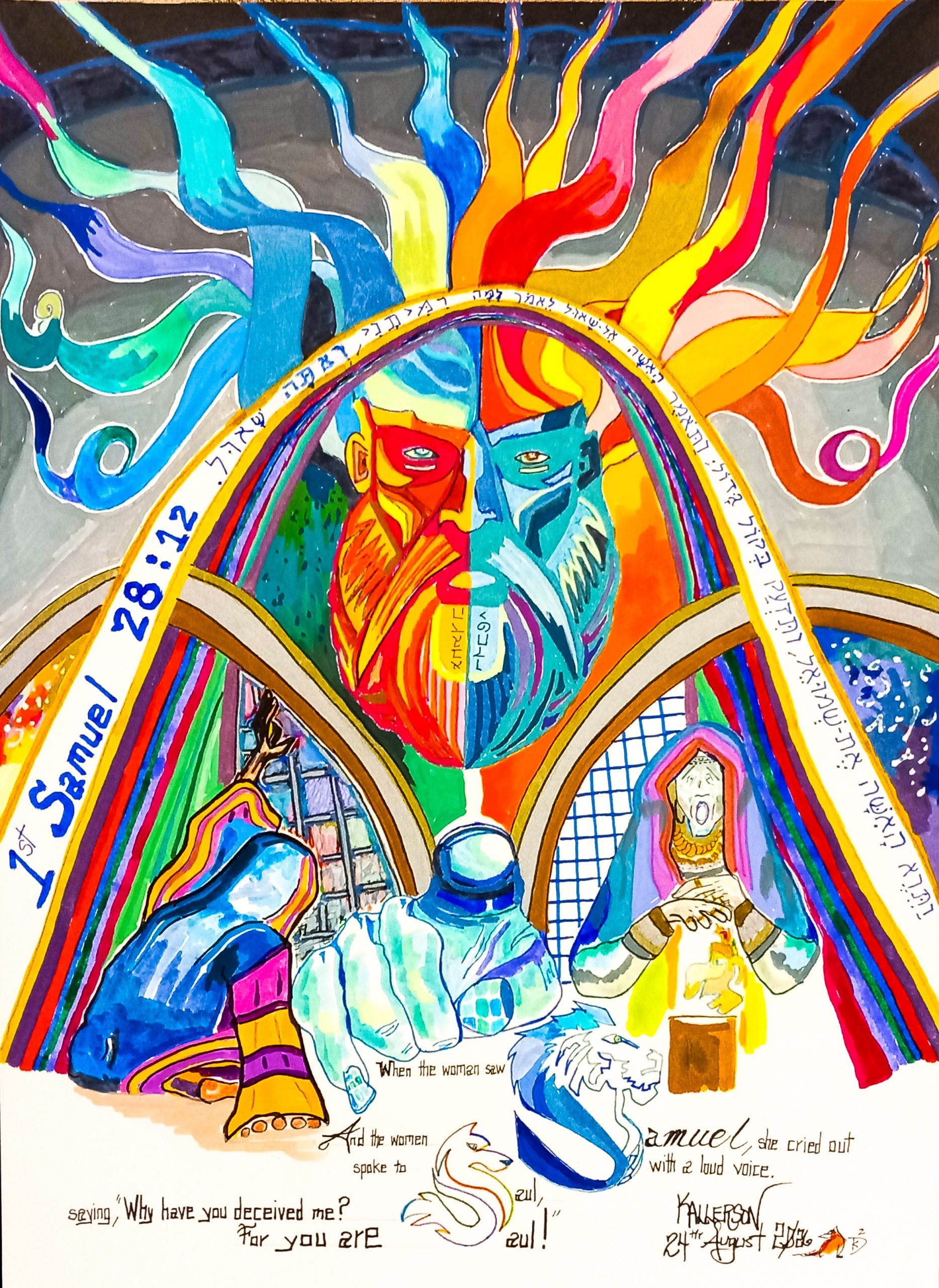
Artwork by Douglas Kallerson
1 Samuel 28:1-17
‘Mistress, ov’
The Witch of En Dor, Part I
(Typed 27 April 2026) When we were young, my brothers and I watched a TV show called Bewitched. We would gather around the TV, which had twelve channels, but only three of which would actually come in at any given time. Each week we anxiously waited to see if we would get reception.
If so, we awaited what cool thing would happen. With a twinkle of her nose, Samantha (Elizabeth Montgomery) could make the impossible happen. We were amazed. From time to time, her terrible mother Endora (Agnes Moorehead) would show up and take over the show.
I did not like that lady. To this day, when I read 1 Samuel 28, Endora comes to mind. Her name is based on the location where the witch in this chapter is from, En-dor. As we grew up, my brothers and I realized that witches can’t do what TV shows say they can.
Even witches know this is true. The witch of En Dor could not call up the dead, as is evident from the details of the story. But it is fun to preach on this chapter after growing up with a TV show that has a connection to it.
Text Verse: “And the person who turns to mediums and familiar spirits, to prostitute himself with them, I will set My face against that person and cut him off from his people.” Leviticus 20:6
Saul doesn’t actually die in this chapter, but his approaching death is certain because the Lord revealed that it would be so. Over the years, many people have asked me about verses found here, specifically those relating to Samuel’s spirit being raised.
Jehovah’s Witnesses deny it was Samuel. But guess what, so do many scholars. Some say it was the devil lying through the witch. Some say it is the witch using ventriloquism. Others find various reasons why the text doesn’t say what it says.
We will evaluate that as we go. But my advice in all such matters is to accept what the Bible says, taking it at face value. What it proclaims is historically true, prophetically without fault, and reliable in every detail.
When it says that God made man on the sixth day of creation, we should accept that, taking the words as written. God is telling us His story. It is a story that includes us. How He deals with us is based on how we relate to His word.
Let us be sure to accept it as absolutely sure and reliable. Great and sure truths are to be found in His superior word. And so, let us turn to that precious word once again, and… May God speak to us through His word today, and may His glorious name ever be praised.
I. And They Were Assembled, Philistines (verses 1-6)
Now it happened in those days that the Philistines gathered their armies together for war, to fight with Israel.
vayhi bayamim ha’hem vayiqbetsu phelishtim eth makhanehem latsava lehilakhem beyisrael – “And it was, in the days, the those, and they amassed, Philistines, their camps to the host to be battled in Israel.” The words, “the days, the those” refer to the events of Chapter 27. David had fled to the land of the Philistines.
While there, he had gained Achish’s favor by telling him that he had been raiding Israel and its allies when he had instead been raiding tribes unfriendly to Israel. During those days, the Philistines had gathered for war.
This force is more than mere raiding parties performing minor incursions into the land. It includes all of the Philistine leaders, and thus all of the soldiers of the five Philistine enclaves. Of this coming battle, Adam Clarke records –
“The Philistines gathered their armies together – Sir Isaac Newton conjectures that the Philistines had got a great increase to their armies by vast numbers of men which Amasis had driven out of Egypt. This, with Samuel’s death, and David’s disgrace, were no inconsiderable motives to a new war, front which the Philistines had now every thing to hope.”
Everything being presented is given to typologically reveal spiritual events coming in later redemptive history.
Philistine means Weakener. They are those who work to weaken the faith of others, particularly through law observance. The recorded war anticipates battle in the spiritual realm. Israel means He Strives with God. The name is a double entendre. It can be positive (on God’s side) or negative (against God).
Because David had gained the confidence of Achish, king of Gath, as seen in Chapter 27…
1 (con’t) And Achish said to David, “You assuredly know that you will go out with me to battle, you and your men.”
Rather: vayomer akhish el David yadoa teda ki iti tetse vamakhaneh atah vaanashekha – “And he said, Achish, unto David, ‘Knowing, you know, for with me you will go out in the camps, you and your mortals.’” It says “camps”, not “battle.”
This indicates that more than one Philistine enclave was going out on an independent excursion. Being in the camps implies being in the battle. When there is a battle, there are camps where the warriors of each enclave stay, just as in Chapter 17 in the account of David and Goliath.
David was a well-known warrior. He had fled from Saul and taken up residence in the land of the Philistines. While there, he convinced Achish that he was fighting against Judah and the allies of Israel, so Achish believed he could never return to Israel again. And more, he believed that in a larger engagement, David could be trusted to fight valiantly with the Philistines against Israel.
The meaning of Achish’s name is too dubious to pin down with certainty. David means Beloved. He pictures “accepting the doctrines of Christ.” Because of Achish’s confidence…
2 So David said to Achish, “Surely you know what your servant can do.”
David’s words are emphatic: vayomer David el akhish lakhen atah teda eth asher yaaseh avdekha – “And he said, David, unto Achish, ‘To thus, you, you will know what he will do, your servant.’” Achish used the verb yada, to know – yadoa teda: “knowing, you will know.” David repeats it back to him – lakhen atah teda: “to thus, you, you will know.”
This essentially means, “Oh yeah, you will surely know what I can do.” The thought is ambiguous. Achish takes it as a mark of valor towards him, especially because David calls himself “your servant.” However, servants have been known to turn against those they serve.
We can speculate on the tone of the response and David’s true intentions, but because he has not attacked Israel over the past many months, there is no reason to assume he would actually do so at this point. Achish takes him to mean that he will fight alongside him. Therefore…
2 (con’t) And Achish said to David, “Therefore I will make you one of my chief guardians forever.”
The NKJV misses the intent of the word rosh, head: vayomer akhish el David lakhen shomer leroshi asimekha kal ha’yamim – “And he said, Achish, unto David, ‘To thus, ‘guarder to my head’ I will put you all the days.’” Achish repeats David’s affirmation –
“To thus, you, you will know what he will do, your servant.”
“To thus, guarder to my head I will put you all the days.”
The NKJV uses the word rosh, head, in the wrong way, as if David will be a “chief” guarder (one of many). Rather, Achish is saying that David will be the guarder to his “head” meaning his right-hand man and personal protector.
3 Now Samuel had died, and all Israel had lamented for him and buried him in Ramah, in his own city.
The words of verse 3 are parenthetical: u-shemuel meth vayispedu lo kal Yisrael vayiqberuhu varamah u-veiro – “(And Samuel, he died, and they lamented to him, all Israel. And they interred him in the Ramah, and in his city.” The reason for including this lies ahead in the narrative, but the words serve as a backdrop to that. What is said was already noted in 1 Samuel 25
25:1 – “And he died, Samuel, and they were assembled, all Israel, and they lamented to him, and they interred him in his house in the Ramah.”
28:3 – “And Samuel, he died, and they lamented to him, all Israel. And they interred him in the Ramah, and in his city.”
Saying “and in his city” is probably because there are at least two places called Ramah. This specifically identifies which Ramah he was buried in. Samuel means Asked from God. The Ramah means The Lofty Place. Still in the parenthesis, it says…
3 (con’t) And Saul had put the mediums and the spiritists out of the land.
veshaul hesir ha’ovoth veeth hayideonim meha’arets – “(And Saul, he caused to veer the necromancers and the conjurors from the land.)” Samuel is dead. Saul had removed all of the necromancers and the conjurors. He had also killed Ahimelech and the priests at Nob.
He had few options to communicate with God or gods. There were other priests and the school of the prophets, but the main priest and the main prophet were both gone. By this point, he may have installed another high priest. This appears likely. We will see that as we continue.
This appears to be the reason for mentioning Samuel’s death again, along with the note about the necromancers and conjurers. It sets up the narrative going forward.
As for the ov, necromancer, it is a word signifying “to mumble.” It also signifies a water skin because when you blow into a skin, like into a soda bottle, you get the hollow oooooohhhh sound. Also noted is the yiddeoni, conjuror. That is derived from yada, to know. As such, it refers to one who has knowledge like a wizard.
With this introductory parenthetical thought complete, the narrative diverts from David with Achish until the end of the chapter, inserting a story about what happens with Saul…
4 Then the Philistines gathered together, and came and encamped at Shunem.
vayiqavetsu phelishtim vayavou vayakhanu veshunem – “And they were amassed, Philistines, and they came, and they inclined in Shunem.” As noted earlier, this is an assembling of the axles, meaning the five lords of the Philistines. As such, it would be a great amassing of people.
And more, Shunem is located in the tribe of Issachar, in northern Israel in the Jezreel Valley. The Philistines, therefore, have marched up through the land to this wide valley, taking up their position on the north and west of where Saul will be.
Scholars do not agree where the name Shunem is derived from. Strong says it is from the name Shuni, to rest or be quiet. Others, based on various root words, say Uneven, Two Resting Places, Silences, or Teeth. As for Israel…
4 (con’t) So Saul gathered all Israel together, and they encamped at Gilboa.
vayiqbots shaul eth kal Yisrael vayakhanu bagilboa – “And he assembled, Saul, all Israel. And they inclined in the Gilboa.” Due to the size of the Philistine force, Saul made a general call for all capable military men of Israel to amass for war. The location he chose is across the Jezreel Valley to the south and east of the Philistines.
Gilboa is from gal, something rolled and thus a heap, and baah, to gush over and thus to swell. As such, it is The Rolling Fountain, The Fountain of Bubbling, The Bubbling Fountain, The Boiling Fountains, etc.
5 When Saul saw the army of the Philistines, he was afraid, and his heart trembled greatly.
vayar shaul eth makhaneh phelishtim vayira vayekherad libo meod – “And he saw, Saul, ‘camp, Philistines’, and he feared. And it shuddered, his heart, vehemently.” The size and layout of the Philistine camp made Saul extremely fearful. This would not be a small battle with one side quickly overcoming another. It would be a bloody, brutal match of armies where many would be slaughtered.
And more, he knew God had turned from him and that the kingdom would eventually be taken from him. He may have thought this was the time when he would lose it. He had lost David, and he might have known David was with the Philistines. If so, adding him and his men to the Philistine forces would add to the slaughter. Added to that is more bad news…
6 And when Saul inquired of the Lord, the Lord did not answer him, either by dreams or by Urim or by the prophets.
vayishal shaul beYehovah velo anahu Yehovah gam baholomoth gam baurim gam baneviim – “And he asked, Saul, in Yehovah. And not he answered him, Yehovah, also in the dreams, also in the Urim, also in the prophets.” A pun is made here. Saul’s name means Asked. Thus, it says, “And he asked, Asked, in Yehovah.”
Saul asked for a divine response, but it did not come in any of the usual ways. The threefold repetition of gam, also, is intended to highlight the situation. No response to Saul’s asking, in any form, was given. Therefore, he is left without any guidance that he could rely on.
There are a few things about this verse that cause difficulties. The first is that in 1 Chronicles 10, it says –
“So Saul died for his unfaithfulness which he had committed against the Lord, because he did not keep the word of the Lord, and also because he consulted a medium for guidance. 14 But he did not inquire of the Lord; therefore He killed him, and turned the kingdom over to David the son of Jesse.” 1 Chronicles 10:13, 14
This is seen by some scholars as a contradiction. Saul asked “in the Lord” in 1 Samuel, but translations of 1 Chronicles say he didn’t. This thought disappears when the Hebrew is checked. In 1 Chronicles, it says of him –
“…to ask (shaal) in the necromancer to inquire (darash), and not he inquired (darash) in Yehovah.”
All Saul did was “ask” in Yehovah. The implication is that he went so far and then gave up. On the other hand, he “asked” in the necromancer to go further for him and inquire. He put trust in the necromancer above trusting and seeking in the Lord.
The difference is not so much “who” is being consulted but “how” they are being consulted. The “who” issue is bad enough, but adding in the “how” makes his actions a combined slap in the face of the Lord.
This verse is where it appears Saul appointed his own high priest, Zadok. Thus, saying he inquired by the Urim was probably something done by Zadok on Saul’s behalf. In 2 Samuel 8, two high priests are noted –
“And Zadok, ‘son, Ahitub’, and Ahimelech, ‘son, Abiathar’ – priests. And Seraiah – tallier.” 2 Samuel 8:17 (CG).
As Saul found no success in asking in Yehovah, exactly as 1 Chronicles says, Saul did…
Can a witch summon the dead?
Is it possible for the turn of a card to direct me?
Can I tell the future when my palm is read?
Into the other realm, I want to see
Can knocking on wood really bring me luck?
Or will stepping on a crack really break my back?
Maybe it could if I tripped… unlucky duck
Down I would go, and my head would quack
Wait! I can see the future if I want to
The Bible tells us what’s coming in the latter days
No need to turn a card or two
Turning the Bible’s pages will reveal God’s ways
II. Whom Will I Cause to Ascend to You? (verses 7-17)
7 Then Saul said to his servants, “Find me a woman who is a medium, that I may go to her and inquire of her.”
vayomer shaul laavadav baqeshu li esheth baalath ov veelekhah eleha veedreshah bah – “And he said, Saul, to his servants, ‘You must seek to me – woman, ‘mistress, ov’. And let me walk unto her, and let me inquire in her.’” A new word, baalah, a mistress, is used here. It is the feminine form of baal, master.
Saul asks for a woman who is a mistress of an ov (a familiar spirit). This is the word elsewhere rendered “necromancer,” but here Saul uses it relationally—one who possesses such a spirit, a kind of “mumbler,” as if channeling a spirit.
Saul’s wording reflects a belief that the spirit is in a working relationship with the woman. The ov is not merely consulted, but one must ask the woman to inquire of the ov. Understanding these nuances, notice the difference in what is said –
1 Samuel 28: 6 – “And he asked (shaal), Saul, in Yehovah.”
1 Chronicles 10:13, 14 – “…to ask (shaal) in the necromancer to inquire (darash), and not he inquired (darash) in Yehovah.”
1 Samuel 28:7 – And let me walk unto her, and let me inquire (darash) in her.’”
Saul’s relationship with the Lord lacks faith, but he was willing to place his trust in a ‘mistress, ov’. In other words, he did not truly seek Yehovah, but he was willing to rely on the medium for a response. That goes with the earlier citation of 1 Chronicles 10:13 exactingly, “because he did not keep the word of the Lord.”
Keeping the word of the Lord is considered an act of faith (belief) as noted in Hebrews 3:18. This resolves the supposed contradiction between this account and 1 Chronicles 10. It further explains Saul’s failed relationship with Yehovah.
7 (con’t) And his servants said to him, “In fact, there is a woman who is a medium at En Dor.”
vayomeru avadav elav hineh esheth baalath ov beein dor – “And they said, his servants, unto him, ‘Behold! Woman, ‘mistress, ov’ in En Dor.’” It isn’t stated how his servants knew she was there, which raises all kinds of questions, but they were aware of her presence.
En Dor is a bit north and about seven or eight miles over difficult ground from where they were in the Gilboa. And more, they would have to go around the camp of the Philistines to get to her. Saul is going to a great deal of trouble to continue his disobedience to the Lord.
En Dor is from ein, spring (literally, eye) and either dor, a revolution of time, as in an age or generation, or one of several other roots. Therefore, it is translated as Spring of a Generation, Spring of Habitation, Spring of Dwelling, Where the Eye Lingers, etc.
8 So Saul disguised himself and put on other clothes, and he went, and two men with him; and they came to the woman by night.
vayitkhapes shaul vayilbash begadim akherim vayelekh hu u-shene anashim imo vayavou el ha’ishah layelah – “And he searched himself, Saul. And he clothed ‘garments, others’. And he walked, he and two mortals with him, and he came unto the woman – night.” The meaning of “searched himself” is that he looked himself over to determine what about himself needed to be hidden.
From there, he changed from his royal garments into garments that would conceal his identity. Everything about this is reflection of his state. He takes a dangerous path, emblematic of his hardened heart. He goes at night, a reflection of his darkened soul. He conceals who he is, reflecting his unkingly actions. And he goes to a necromancer, reflecting his rejection of Yehoah.
8 (con’t) And he said, “Please conduct a séance for me, and bring up for me the one I shall name to you.”
vayomer qasomi li baov vehaali li eth asher omar elayikh – “And he said, ‘You must distribute [k.] to me in the ov, and you must cause to ascend to me whom I will say unto you.’” The scribes change the text from Saul’s blunt and direct words to a softer tone –
Written: “You must distribute to me.”
Oral: “You must distribute to me, I pray.”
The change makes it sound more polite and idiomatically standard for a request of this nature. That seems like a ridiculous reason to change the text. Despite that, most translations go with the oral. The word is qasam, to distribute. It signifies to determine by lot or magical scroll. Thus, it gives the sense of divining.
Therefore, when Saul says, “distribute to me in the ov,” he is asking for the ability of the ov to be portioned out to him. The portioning he specifically wants is for someone to be brought up from the dead. She has hesitations though…
9 Then the woman said to him, “Look, you know what Saul has done, how he has cut off the mediums and the spiritists from the land.
vatomer ha’ishah elav hineh atah yadata eth asher asah shaul asher hikhrith eth ha’ovoth veeth hayideoni min ha’arets – “And she said, the woman unto him, ‘Behold! You, you knew what he did, Saul, which he caused to cut the necromancers and the conjurors from the land.’” At an earlier time in Saul’s kingship, he took action to uphold the law. In Leviticus 20, it says –
“A man or a woman who is a medium, or who has familiar spirits, shall surely be put to death; they shall stone them with stones. Their blood shall be upon them.” Leviticus 20:27
The irony of Saul now coming to such a person is evident, but she doesn’t yet know it is Saul. However, she suspects these men are working on his behalf…
9 (con’t) Why then do you lay a snare for my life, to cause me to die?”
velamah atah mitnaqesh benaphshi lahamitheni – “And to why you ‘entrapping oneself’ in my soul to cause to kill me?” Her words are evidence that the written text of the previous verse is the most likely translation. Someone looking for divination would make a request politely, reassuring the diviner that he wasn’t a foe. But with Saul’s curt demand, she immediately suspected that this was a setup to trap her into revealing her skills.
Saul must next remove the proverbial wall he put up between them before they can proceed…
10 And Saul swore to her by the Lord, saying, “As the Lord lives, no punishment shall come upon you for this thing.”
vayishava lah shaul beYehovah lemor khai Yehovah im yiqerekh avon badavar hazeh – “And he was sevened to her, Saul, in Yehovah, to say, ‘Alive Yehovah, if it will encounter you, perversity, in the word, the this.’” The incredible hardening of Saul’s heart is seen in his words. He swears an oath in the name of Yehovah, who wouldn’t answer his lackluster questions through dreams, the Urim, or prophets.
It is mind-numbing to see him do this, and yet, it is just like people anywhere who will gladly swear an oath by God, even when they deny Him, ignore Him, or have no meaningful relationship with Him. As for the oath, instead of telling her that word will never get back to Saul, he swears that nothing will be done to her.
11 Then the woman said, “Whom shall I bring up for you?”
vatomer ha’ishah eth mi aaleh lakh – “And she said, the woman, ‘Whom I will cause to ascend to you?’” Her question is simple and direct. It is the kind of response you will get from any tarot card reader, palm reader, or person who conducts seances, etc.
They claim they have complete authority over their area of the spiritual realm. They do it in a casual manner, as if it is no more difficult than bagging groceries. Saul accepts her confidence…
11 (con’t) And he said, “Bring up Samuel for me.”
vayomer eth shemuel haali li – “And he said, ‘Samuel, you must cause to ascend to me.’” It is another irony. Samuel means Asked from God. Saul asks a necromancer, a person at enmity with God, to bring up Asked from God. In turn, instead of asking from God, her request will be made to an ov. Everything about the account is completely twisted around and ungodly.
Despite that, her petition comes back with a positive response…
12 When the woman saw Samuel, she cried out with a loud voice.
vatere ha’ishah eth shemuel vatizaq beqol gadol – “And she saw, the woman, Samuel. And she shrieked in ‘voice, great’.” It is certain from her reaction that she never expected someone to come up from the dead, despite spending her life deluding others and herself that she had such powers.
Samuel did certainly, in fact, rise. This was not a result of her sorcery. Rather, it is an explicit rebuke from the Lord who allowed it. The reason we know Samuel arose is because the Bible says, “And she saw, the woman, Samuel.”
That is all we need to know to understand the matter. This isn’t an explanation from the woman. Rather, it is an explanation from God in His word. What is a little puzzling are her next words…
12 (con’t) And the woman spoke to Saul, saying, “Why have you deceived me? For you are Saul!”
vatomer ha’ishah el shaul lemor lamah rimitani veatah shaul – “And she said, the woman, unto Saul, to say, ‘To why you hurled me? And you – Saul!’” No reason for how she realized this is given. And yet, some of the goofiest commentaries found among scholars are provided to explain the matter. Pages and pages of speculation are given over her response.
Because the Bible doesn’t explain it, all we can do is guess. For all we know, Samuel came forth annoyed and said, “What do you want now, Saul?” Or maybe, she finally noticed his height and realized who he was.
It may also be that because this is the first time she has ever actually seen a real spirit, she realized it had to be Saul calling for Samuel who anointed him. Here I am speculating like everyone else 😲.
Regardless, her knowledge is for the sake of Saul, not her. Because she has deduced it is Saul without having known before, it is a confirmation to him that what will transpire is true…
13 And the king said to her, “Do not be afraid. What did you see?”
vayomer lah ha’melekh al tirei ki mah raith – “And he said to her, the king, ‘Not you will fear. For what you saw?’” His reassurance was necessary. He had vowed, and with his words to confirm he was no harm, she continues…
13 (con’t) And the woman said to Saul, “I saw a spirit ascending out of the earth.”
vatomer ha’ishah el shaul elohim raiti olim min ha’arets – “And she said, the woman, unto Saul, ‘Gods, I saw, ascending from the earth.’” The word she uses, elohim, means God, god, or gods. It can refer to the true God, false gods, people in certain positions of power, etc. To understand, regardless of who is being referred to, one should think of “over there.”
If it is the true God, he is “over there” in relation to humans. If it is a false god, it is what humans think they are in relation to them, such as, “Oh, these are my gods that I pray to. They help me from their realm over there.” If it is a human, as in Psalm 82:6, it means men who are “over there” in relation to other humans, be it as a judge, a leader, etc.
She sees apparitions and calls them elohim. They are “over there,” and yet, they are also now here in some manner, just as when God intervenes in our lives. He is “over there,” and yet He is also here. The reason for translating it in the plural, “gods,” is because the verb ascending is plural.
John Lange notes that to match the noun form, the plural verb is given. But that doesn’t make sense. She could have used the verb in the singular. However, Saul now switches to the singular, which she continues with…
14 So he said to her, “What is his form?”
And she said, “An old man is coming up, and he is covered with a mantle.”
vayomer lah mah taoro vatomer ish zaqen oleh vehu oteh meil – “And he said to her, ‘What its form?’ And she said, “‘Man, aged’, ascending, and he clothed – robe.’” Saul wouldn’t know this was a man. Thus “its form” is more likely what he said than “his form.” That is confirmed by her stating that the form was a man.
He didn’t know it was a man until she told him. Thus, the pronoun has gone from the indefinite, its, to the definite, he. Saying he is clothed in a robe signifies dignity, even in death, while in Sheol.
As for the appearance, the Bible leaves no doubt that she sees Samuel. It is telling us what happened. If she were making this up, the Bible would say so.
It is inexcusable, like not accepting a literal six-day creation, to dismiss the clearly stated words. Her description is enough to convince Saul that it is Samuel…
14 (con’t) And Saul perceived that it was Samuel, and he stooped with his face to the ground and bowed down.
vayeda shaul ki shemuel hu vayiqod apayim artsah vayishtakhu – “And he knew, Saul, for Samuel, he. And he hunched, nostrils earthward, and he prostrated himself.” Once he saw that Samuel had arisen, you can almost hear the next event – kerplunk. Saul’s face went downward, first hunching over towards the earth and then he went to his knees…
15 Now Samuel said to Saul, “Why have you disturbed me by bringing me up?”
vayomer shemuel el shaul lamah hirgaztani lehaaloth othi – “And he said, Samuel, unto Saul, ‘To why you caused to quiver me to cause to ascend me?’” Again, the Bible is what attests to the fact that it is Samuel speaking.
Further, it does not say Samuel spoke through the woman. Even if he did, it is still conveyed in the Bible that Samuel spoke to Saul. There is no need to assume anything else.
His words “caused to quiver me” show that he was at ease, as in a state of rest. The Bible does not tell us if it was the prodding of the witch or the prodding of God by which he was quivered. Ultimately, however, the latter is true either way. As for Samuel’s words, they are directed to Saul.
Either God allowed the woman to do that which she had never done before, or He bypassed her and directly answered Saul’s request for Samuel to be brought forth.
15 (con’t) And Saul answered, “I am deeply distressed; for the Philistines make war against me, and God has departed from me and does not answer me anymore, neither by prophets nor by dreams.
vayomer shaul tsar li meod u-phelistim nilkhamim bi velohim sar mealay velo anani od gam beyad haneviim gam bakhalomoth – “And he said, Saul, ‘It cramped to me, vehemently. And Philistines being battled in me. And God, He veered from upon me. And not He answered me again, also in hand the prophets, also in the dreams.”
Saul goes through his laundry list of reasons for why he felt disobeying the law was ok, as if he can make his actions acceptable. But even while moaning about it, he acknowledges that God left him. Saul’s thinking is confused and erratic.
In his excuse, he never mentioned the Urim. Some speculate that might be because he massacred the priests of Nob. That could be the case, or it could be that, as noted above, he had appointed a new high priest. That would only add to the pickle he was in if he mentioned that to Samuel. Regardless…
15 (con’t) Therefore I have called you, that you may reveal to me what I should do.”
vaeqraeh lekha lehodieni mah eeseh – “And I (surely) called to you to cause me to know what I will do.’” Samuel has been in Sheol. He is either transmitting from there or, when the conversation is over, he will return there. Either way, for Samuel to give Saul advice, he would have to petition God for it.
Why would Saul expect an answer from God through Samuel if God didn’t answer him any other way? If he thinks Samuel can give him advice apart from God, that demonstrates even less clarity of mind.
Everything about Saul’s actions and reasoning is completely out of touch with reality. Samuel confirms this…
16 Then Samuel said: “So why do you ask me, seeing the Lord has departed from you and has become your enemy?
vayomer shemuel velamah tishaleni veYehovah sar mealekha vayhi arekha – “And he said, Samuel, ‘And to why you will ask me? And Yehovah, He veered from upon you, and He became your foe!’” A new and rare word, ar, foe, is seen here. It is from ur, awake. Thus, it is a foe, as one watches out for mischief, something you would do when you are awake.
Samuel’s words mean, “When I spoke, it was always what the Lord determined for me to speak. That hasn’t changed. The Lord has left you and has actively become your enemy. So why would you come to me for advice?”
Whatever Saul was thinking when he headed to En Dor, his hopes for help from Samuel would not be forthcoming. And more…
17 And the Lord has done for Himself as He spoke by me.
The words confuse scholar and translator alike: vayaas Yehovah lo kaasher diber beyadi – “And He did, Yehovah, to Him according to which He spoke in my hand.” About half the translations I checked say this is Samuel speaking about Saul in the third person.
That is incorrect. The NKJV has rendered it correctly. Yehovah did for Himself (to Him) just what He spoke through Samuel. This goes back to 1 Samuel 15 when Saul disobeyed the Lord’s word concerning anathematizing Amalek. Saul failed to do as he was instructed, and the Lord promised him, through Samuel, that this day would come…
*17 (fin) For the Lord has torn the kingdom out of your hand and given it to your neighbor, David.
vayiqra Yehovah eth ha’mamlakhah miyadekha vayitenah lereakha ledavid – “And He rent, Yehovah, the kingdom from your hand, and He gave it to your associate, to David.’” This is just what the Lord said through Samuel. The only addition, which is the final confirmation of Saul’s continuous suspicions, is that David would succeed him as king –
“And he turned, Samuel, to walk, and he caused to seize in ‘extremity, his robe’, and it was rent. 28And he said unto him, Samuel, ‘He rent, Yehovah, ‘kingdom, Israel’ from upon you the day. And he gave her to your associate – the good from you. 29And also ‘Refulgency*, Israel’, not He will cheat, and not He will be sighed. For not human, He, to be sighed.’” 1 Samuel 15:27-29
Saul’s kingdom is set to end. Samuel doesn’t need to consult the Lord about it. He gave the prophecy, and it would be fulfilled. But this is not where Samuel’s words end. He will give Saul a full accounting, in advance, of what the Lord showed him concerning Saul’s situation.
And guess what? The Lord has given mankind the same thing. He has given us a full accounting of what He is doing in human history, from beginning to end.
The little details aren’t included. Samuel won’t tell Saul if he will have breakfast in the morning or how long it will take him to march to the battle. But he will give Saul a full understanding of what is important in the overall picture.
This is what God has done for us. We don’t need a full itinerary of what we should do for a vacation, whom we should marry, or whether we should start a new business.
Those things are not what we need to know from God. We are to pray about them and act according to our desire. But the greater matters of our place in redemptive history have been revealed in the word.
We know what God has done, we know what He is doing, and we know what He will do right through to the consummation of all things. All of it is recorded in the word. And like Saul, we can be certain that those things will come about.
The Lord has spoken through His word. He tells us that He really created the universe in 6 days. He caused a donkey to open its mouth and speak. He brought Samuel back from Sheol to speak to Saul. He sent Jesus to die for our sins.
These things have occurred. It is our job to take the word at face value, even if it seems incredible at times. God does the incredible. So trust Him by trusting His word. In this, you will be pleasing to Him for trusting what He says is true.
Closing Verse: “For if the word spoken through angels proved steadfast, and every transgression and disobedience received a just reward, 3 how shall we escape if we neglect so great a salvation, which at the first began to be spoken by the Lord, and was confirmed to us by those who heard Him.” Hebrews 2:2, 3
Next Week: 1 Samuel 28:18-25 Better than picking fresh oranges in a grove, that’s for shore, and yes – it’s true… (‘Mistress, ov’, the Witch of En Dor, Part II) (60th 1 Samuel Sermon)
The Lord has you exactly where He wants you. He has a good plan and purpose for you. He is the One who abases the haughty and exalts the humble. He regards the lowly, and the proud, He knows from afar. So yield yourself to Him, trust Him, and believe His word. In this, He will do great things for you and through you.
What were the ashes of the red heifer used for? For the water purification.
1 Samuel 28:1-17 (CG)
1 And it was, in the days, the those, and they amassed, Philistines, their camps to the host to be battled in Israel. And he said, Achish, unto David, “Knowing, you must know, that with me, you will go out in the camp, you and your mortals.”
2And he said, David, unto Achish, “To thus, you, you will know what he will do, your servant.”
And he said, Achish, unto David, “To thus, ‘guarder to my head’ I will put you all the days.”
(3And Samuel, he died, and they lamented to him, all Israel. And they interred him in the Ramah, and in his city. And Saul, he caused to veer the necromancers and the conjurors from the land.)
4And they were amassed, Philistines, and they came, and they inclined in Shunem. And he assembled, Saul, all Israel. And they inclined in the Gilboa. 5And he saw, Saul, ‘camp, Philistines’, and he feared. And it shuddered, his heart, vehemently. 6And he asked, Saul, in Yehovah. And not He answered him, Yehovah, also in the dreams, also in the Urim, also in the prophets.
7And he said, Saul, to his servants, “You must seek to me – woman, ‘mistress*, ov*’. And let me walk unto her, and let me inquire in her.”
And they said, his servants, unto him, “Behold! Woman, ‘mistress, ov’ in En Dor.”
8And he searched himself, Saul. And he donned ‘garments, others’. And he walked, he and two mortals with him, and they came unto the woman – night. And he said, “You must distribute [k.] to me in the ov, and you must cause to ascend to me whom I will say unto you.”
9And she said, the woman, unto him, “Behold! You, you knew what he did, Saul, which he caused to cut the necromancers and the conjurors from the land. And to why you ‘entrapping oneself’ in my soul to cause to kill me?”
10And he was sevened to her, Saul, in Yehovah, to say, “Alive Yehovah, if it will encounter you, perversity, in the word, the this.”
11And she said, the woman, “Whom I will cause to ascend to you?”
And he said, “Samuel, you must cause to ascend to me.”
12And she saw, the woman, Samuel. And she shrieked in ‘voice, great’. And she said, the woman, unto Saul, to say, “To why you hurled me? And you – Saul!”
13And he said to her, the king, “Not you will fear. For what, you saw?”
And she said, the woman, unto Saul, “Gods*, I saw, ascending from the earth.”
14And he said to her, “What its form?”
And she said, “’Man, aged’, ascending, and he wrapped – robe.” And he knew, Saul, for Samuel, he. And he stooped, nostrils earthward, and he prostrated himself.
15And he said, Samuel, unto Saul, “To why you caused to quiver me to cause to ascend me?”
And he said, Saul, “It cramped to me, vehemently. And Philistines being battled in me. And God, He veered from upon me. And not He answered me again, also, in hand the prophets, also, in the dreams. And I (surely) called to you to cause me to know what I will do.”
16And he said, Samuel, “And to why you will ask me? And Yehovah, He veered from upon you, and He became your foe! 17And He did, Yehovah, to Him according to which He spoke in my hand. And He rent, Yehovah, the kingdom from your hand, and He gave it to your associate, to David.”
1 Samuel 28:1-17 (NKJV)
1 Now it happened in those days that the Philistines gathered their armies together for war, to fight with Israel. And Achish said to David, “You assuredly know that you will go out with me to battle, you and your men.”
2 So David said to Achish, “Surely you know what your servant can do.”
And Achish said to David, “Therefore I will make you one of my chief guardians forever.”
3 Now Samuel had died, and all Israel had lamented for him and buried him in Ramah, in his own city. And Saul had put the mediums and the spiritists out of the land.
4 Then the Philistines gathered together, and came and encamped at Shunem. So Saul gathered all Israel together, and they encamped at Gilboa. 5 When Saul saw the army of the Philistines, he was afraid, and his heart trembled greatly. 6 And when Saul inquired of the Lord, the Lord did not answer him, either by dreams or by Urim or by the prophets.
7 Then Saul said to his servants, “Find me a woman who is a medium, that I may go to her and inquire of her.”
And his servants said to him, “In fact, there is a woman who is a medium at En Dor.”
8 So Saul disguised himself and put on other clothes, and he went, and two men with him; and they came to the woman by night. And he said, “Please conduct a séance for me, and bring up for me the one I shall name to you.”
9 Then the woman said to him, “Look, you know what Saul has done, how he has cut off the mediums and the spiritists from the land. Why then do you lay a snare for my life, to cause me to die?”
10 And Saul swore to her by the Lord, saying, “As the Lord lives, no punishment shall come upon you for this thing.”
11 Then the woman said, “Whom shall I bring up for you?”
And he said, “Bring up Samuel for me.”
12 When the woman saw Samuel, she cried out with a loud voice. And the woman spoke to Saul, saying, “Why have you deceived me? For you are Saul!”
13 And the king said to her, “Do not be afraid. What did you see?”
And the woman said to Saul, “I saw a spirit ascending out of the earth.”
14 So he said to her, “What is his form?”
And she said, “An old man is coming up, and he is covered with a mantle.” And Saul perceived that it was Samuel, and he stooped with his face to the ground and bowed down.
15 Now Samuel said to Saul, “Why have you disturbed me by bringing me up?”
And Saul answered, “I am deeply distressed; for the Philistines make war against me, and God has departed from me and does not answer me anymore, neither by prophets nor by dreams. Therefore I have called you, that you may reveal to me what I should do.”
16 Then Samuel said: “So why do you ask me, seeing the Lord has departed from you and has become your enemy? 17 And the Lord has done for Himself as He spoke by me. For the Lord has torn the kingdom out of your hand and given it to your neighbor, David.