
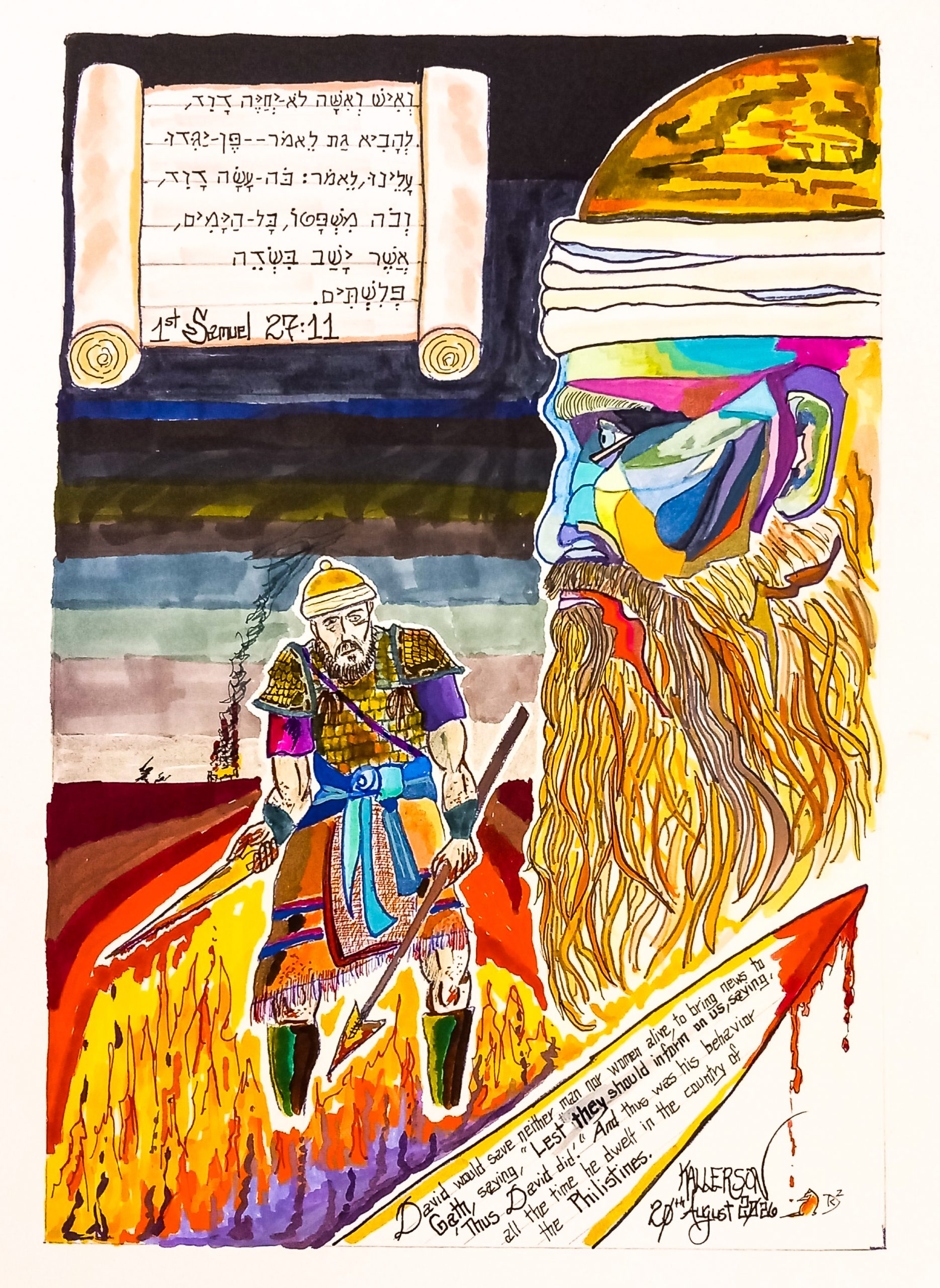
Artwork by Douglas Kallerson
1 Samuel 27:1-12
He Sat in ‘Field, Philistines’
(Typed 20 April 2026) David gets a big thumbs-down from some scholars for his actions in this passage. True, it seems like a lot of things he does are contrary to what we would expect of him and his relationship with God.
He seems to lack faith, refrains from interacting with the Lord, departs from his land, lies, murders, etc. Because of his conduct, Adam Clarke turns up the gas to barbecue him –
“There is not one circumstance in this transaction that is not blameable. David joins the enemies of his God and of his country, acts a most inhuman part against the Geshurites and Amalekites, without even the pretense of a Divine authority; tells a most deliberate falsehood to Achish, his protector, relative to the people against whom he had perpetrated this cruel act; giving him to understand that he had been destroying the Israelites, his enemies. I undertake no defense of this conduct of David; it is all bad, all defenceless; God vindicates him not. The inspired penman tells what he did, but passes no eulogium upon his conduct; and it is false to say that, because these things are recorded, therefore they are approved. In all these transactions David was in no sense a man after God’s own heart. Chandler attempts to vindicate all this conduct: those who can receive his saying, let them receive it.” Adam Clarke
We can agree that “it is false to say that, because these things are recorded, therefore they are approved.” Too often people wrongly draw conclusions when evaluating the Bible.
Just because something is recorded, even about a notable person, that doesn’t mean that it is either approved or disapproved. At times, facts are conveyed regardless of whether they are right or wrong.
Text Verse: “To the ‘orchestrating’. Upon the Gittite: Melody to David.
‘Yehovah our Lords,
How majestic – Your name in all the earth!
Which You must (surely) give Your grandeur upon the heavens.’” Psalm 8:1 (CG)
The text verse has less to do with sermon content and more to do with the overall life of David.
As for Adam Clarke’s comments, he fails to take into consideration that what David did may have included things the Lord told him to do. In other words, just because something isn’t recorded in the Bible, it does not mean it didn’t happen.
Thus, we cannot conclude that David went to the land of the Philistines without the Lord’s approval. The text says what it says. We are to evaluate it based on its content. There might be valid reasons for not recording such a directive from the Lord.
What we are to do is evaluate what the Lord has recorded in His word. In doing this, we will more likely find out what we are supposed to find out in this passage and, indeed, in all of this wonderful book.
Great treasures are to be found in His superior word. And so, let us turn to that precious word once again, and… May God speak to us through His word today, and may His glorious name ever be praised.
I. Let Me Sit There (verses 1-6)
And David said in his heart,
Rather: vayomer David el libo – “And he said, David, unto his heart.” It is as if David is having a conversation with his seat of reasoning rather than with the Lord. In fact, the Lord is not mentioned in this chapter.
David means Beloved. Thus far, he has pictured accepting the doctrines of Christ. As for his internal discussion, he says…
1 (con’t) “Now I shall perish someday by the hand of Saul.
atah esapheh yom ekhad beyad shaul – “Now I will be scraped, day one, in hand Saul.” David has thus far been protected and led by the Lord. He has consistently prevailed over Saul’s attempts to destroy him. And yet, he appears convinced that Saul will prevail at some point. And this, despite being anointed by Samuel to be king.
Because Saul continuously hounded him, David assumes Saul’s attitude will not truly change, even though David just spared his life once again.
Saul means Asked. He has pictured Sheol calling out for the souls of men. In non-pointed Hebrew, Saul and Sheol are identical in spelling. As for David’s reasoning, it tells him…
1 (con’t) There is nothing better for me than that I should speedily escape to the land of the Philistines;
ein li tov ki himalet imalet el erets pelishtim – “Naught to me good, for being eluded, I will be eluded unto ‘land, Philistines’.” David reasons that everything is against him (Naught to me good). Thus, he is once again set to flee from the land of Israel.
He had gone to Moab in Chapter 22. While there, the prophet Gad told him to return to Judah. Nothing here is said of a prophet giving him advice. Further, nothing is said about him asking advice through the ephod as in Chapter 23.
It appears he is having an internal pity party, and his reasoning has failed to recall all that the Lord has thus far done for him.
Philistines means Weakeners. They have consistently pictured those who attempt to weaken the faith of others. As for David, he continues his pity party, saying…
1 (con’t) and Saul will despair of me, to seek me anymore in any part of Israel. So I shall escape out of his hand.”
venoash mimeni shaul levaqesheni od bekhal gevul Yisrael veminlateti miyado – “And he was desisted from me, Saul, to seek me yet in all ‘border, Israel’. And I was eluded from his hand.” A new word is seen, yaash, to desist, but with the figurative sense of desponding or hopeless effort.
David’s thinks that by going to the land of the Philistines, a move that Saul would not expect, he would be free from Saul’s pursuits. Unless a report of David returning to Israel was given, Saul would stay home and leave off pursuing David.
Israel means He Strives with God.
David hopes to be permanently safe from Saul. Therefore…
2 Then David arose and went over with the six hundred men who were with him
vayaqam David vayaavor hu veshesh meoth ish asher imo – “And he arose, David, and he traversed, he, and six hundreds man who with him.” With his internal discussion complete, the traversal from Judah to the land of the Philistines takes place.
His force, six hundred, is a multiple of six and tens. Bullinger says –
“Six is either 4 plus 2, i.e., man’s world (4) with man’s enmity to God (2) brought in: or it is 5 plus 1, the grace of God made of none effect by man’s addition to it, or perversion, or corruption of it: or it is 7 minus 1, i.e., man’s coming short of spiritual perfection. In any case, therefore, it has to do with man; it is the number of imperfection; the human number; the number of MAN as destitute of God, without God, without Christ.” In short, it speaks of fallen man.
Ten: “Completeness of order, marking the entire round of anything, is, therefore, the ever-present signification of the number ten. It implies that nothing is wanting; that the number and order are perfect; that the whole cycle is complete.”
This sizeable force went…
2 (con’t) to Achish the son of Maoch, king of Gath.
el akhish ben maokh melekh gath – “unto Achish ‘son, Maoch, king, Gath’.” As seen in Chapter 21, the meaning of Achish is uncertain, having an unclear etymology. Young says Serpent Charmer. Others defer to Persian, Egyptian, Greek, or Arabic roots. Some suggestions are He Was Afraid, Majestic, Angry, or Gift of God.
Maoch is from maak, to press or squeeze. Thus, his name means Pressed, Oppressed, Oppression, or maybe Bruised. Gath means Winepress. Despite being six hundred men, there would have been many more in number with them…
3 So David dwelt with Achish at Gath, he and his men, each man with his household,
vayeshev David im akhish begath hu vaanashav ish u-veitho – “And he sat, David, with Achish in Gath, he, and his mortals, man and his house.” This may at first seem unusual. How could such a large contingent of the enemies of the Philistines show up and begin dwelling with Achish in Gath?
However, if each of these people brought their households, meaning wives, children, and any flocks and herds, it would be apparent that they were coming as refugees. No sane person would go into the enemy territory with his children unless this was the case.
Such a large group would be an asset rather than a threat. If every man had a wife and perhaps others dependent on him, the total group could be in the thousands.
In Chapter 21, David fled there alone, which could be seen as suspicious. But with all these people looking for a new home, such was not the case. Even David came with his house…
3 (con’t) and David with his two wives, Ahinoam the Jezreelitess, and Abigail the Carmelitess, Nabal’s widow.
David u-shete nashav akhinoam hayizreelith vaavigayil esheth naval hakarmelith – “David and ‘two, his wives’, Ahinoam the Jezreelitess and Abigail, ‘wife, Nabal’, the Carmelitess.” David’s wives are mentioned as Ahinoam and then Abigail. As seen at the end of Chapter 26, Abigail was likely his second wife.
Ahinoam means Kindred to Sweetness. Jezreel comes from zara, to scatter seed or sow, and el, God. Thus, it means God Sows. Jones says He Will Be Sown of God, explaining that as “i.e. have a numerous progeny.”
Abigail is derived from av, father, and giyl, joy or exultation. That is derived from gil, to spin around, which gives the sense of rejoicing. Her name means Father of Joy, she being the source of the joy. Nabal means Dolt. Carmel means Vineyard of God.
4 And it was told Saul that David had fled to Gath; so he sought him no more.
vayugad leshaul ki barah David gath velo yosaph [k.] od levaqesho – “And it was caused to declare to Saul, for he bolted, David – Gath. And not he caused to add [k.] again to seek
Just what David had hoped for is realized. If David was accepted in Gath as a refugee, Saul would have to battle the Philistines to get him. That would not be a safe venture. Therefore, as long as no report of David’s return came to Saul’s ears, David would remain safe in his new dwelling.
As an interesting side note, this time dwelling in Gath may have been the impetus for either David’s style of music, or for an instrument called Gittith, which is found in the introduction to Psalms 8, 81, and 84. Gittith is from Gitti (a Gittite), which is a patrial from Gath. A Gittith was seen, for example, in our text verse.
5 Then David said to Achish, “If I have now found favor in your eyes,
vayomer David el akhish im na matsathi khen beenekha – “And he said, David, unto Achish, ‘If, pray, I found graciousness in your eyes.” David was received by Achish and allowed to dwell in Gath. Without stating how long they had been there at this point, whether days, weeks, or even months, it was long enough that David was considered accepted.
Because of that, he sees an opportunity to use his new alliance to his benefit. Therefore, he proposes a change in his situation to Achish…
5 (con’t) let them give me a place in some town in the country, that I may dwell there.
yitenu li maqom beakhath are ha’sadeh veeshevah sham – “they will give to me place in one – ‘cities, the field’, and let me sit there.” The plural, they, is probably referring to the five axles of the Philistines. This would be a matter that needed to be resolved among the five rather than by Achish only.
That is speculation, but if Achish could make this decision on his own, then David would have said “you.” David is looking for a break from dwelling in Gath. Several benefits would result. His own people would not get too friendly and aligned with the residents of Gath.
They would be free from the non-Israelite culture and lifestyle of the Philistines, including the idolatry of worshipping Dagon and any other Philistine gods. David could also war against non-Philistine groups situated within and along the border of Judah’s territorial grant.
Despite these benefits, David makes his request based on supposed humility towards Achish…
5 (con’t) For why should your servant dwell in the royal city with you?”
velamah yeshev avdekha beir ha’mamlakhah imakh – “And to why he will sit, your servant, in ‘city, the kingdom’ with you?’” It is a way of saying, “We are a large group and a burden on you. If we are in the outlying territory, we won’t trouble you, but you can benefit from our presence through taxation or other levies.”
But there is one more benefit in moving to an outlying area: David can make his attacks against others appear as if he is attacking Saul’s kingdom. Thus, Achish will believe that David is truly and forever aligned with him…
6 So Achish gave him Ziklag that day.
vayiten lo akhish bayom ha’hu eth tsiqlag – “And he gave to him, Achish, in the day, the it, Ziklag.” Ziklag was a part of the original inheritance given to Judah in Joshua 15:31. Later, it was granted to Simeon who dwelt in Judah’s territory in Joshua 19:5.
The Philistines either lived there, and Judah never moved into it, or it was overrun by the Philistines when given to Simeon and remained in their control until this time.
The name Tsiq’lag is a bit of a brain teaser. It appears to be derived first from tsuq, to pour out or melt, or to oppress or distress, such as to put pressure on someone to give up information or to lay siege to a city. It is used in Job 29 –
“When my steps were bathed with cream,
And the rock poured [tsuq] out rivers of oil for me!” Job 29:6
The second part is from log, a small amount poured into a hollow, like the hand. Thus, it could signify Measure of Pressure or Measure of Pouring. Jones’ says Outflowing of a Fountain. Abarim says A Pint of Liquid Metal.
6 (con’t) Therefore Ziklag has belonged to the kings of Judah to this day.
lakhen hayethah tsiqlag lemalkhe Yehudah ad hayom ha’zeh – “To thus, it was, Ziklag, to kings Judah until the day, the this.” Once the city fell under the control of David, it remained under Israel’s rule until some point after the rule of Solomon’s son Rehoboam.
The reason we know this is that the term “kings of Judah” implies that there are two dynasties in Israel, the southern kingdom and the northern kingdom.
Thus, sometime between the reign of Rehoboam and the exile to Babylon, the book was compiled. Ziklag is also referred to in Nehemiah, after the return of the exiles from Babylon.
Sheol wants me, but he won’t win
If I flee to Gath, he won’t follow me there
For the time being, I will have to elude him
And I can get things done while I am there
So, off we go to ‘field, Philistines’
Not knowing exactly what lies ahead
But all will be well, so it seems
Because for me, Christ’s blood was shed
I am taking the doctrines of Christ with me
To ‘field, Philistines’, here we go
I know I will dwell in security
Because the Lord is with me, this I know
II. Causing to Reek, He Caused to Reek (Verses 7-12)
7 Now the time that David dwelt in the country of the Philistines was one full year and four months.
vayhi mispar hayamim asher yashav David bisdeh phelishtim yamim vearbaah khodashim – “And it was, number the days which he sat, David, in ‘field, Philistines’, ‘days, and four renewals’.” In this case, the word “days” implies a year. That is understood by the phrase “and four renewals,” meaning four renewals of the moon, or four months.
This provides historical proof concerning the life and times of David, which was known and documented by whoever compiled the narrative.
8 And David and his men went up and raided the Geshurites, the Girzites, and the Amalekites.
vayaal David vaanashav vayiphshetu el ha’geshuri veha’girzi [k.] veha’amaleqi – “And he ascended, David, and his mortals, and they stripped unto the Geshurite, and the Girzite [k.], and the Amalekite.” The oral Hebrew changes the word Girzite to read Gizrite.
Various suggestions have been put forth concerning the word change, but it is unknown which is correct, as this is the only time the Girzites are mentioned in Scripture.
As for what is going on, with David in his own city, which is quite removed from Gath, he goes about raiding other cities, gaining wealth and removing those who would otherwise trouble Judah.
Young and Strong say Geshur comes from an unused root meaning to join, as in a bridge. Jones’ says it means Expulsion. Gezer is defined by Young as Precipice. Strong identifies them with Gerizim which is derived from garaz, to cut off. As such, he says, “cut up” and thus Rocky. Jones says Place Cut Off or Precipice.
The Amalekites have been seen before. The name is derived from am, people, and malaq, to nip or wring off the head of a bird with or without severing it from the body. They are The People Who Wring Off. They are those who are disconnected from the body and who strive to disconnect the body.
8 (con’t) For those nations were the inhabitants of the land from of old, as you go to Shur, even as far as the land of Egypt.
ki henah yoshevoth ha’arets asher meolam boakha shurah vead erets mitsrayim – “For these ‘sitting the land which from vanishment’, you going Shur-ward and until ‘land, Egypt’.” The meaning is that these people had been dwelling there since time unknown, filling all of the area toward Shur as far as Egypt.
Shur is from shur, wall. That is from the verb shur, to travel about. Thus, it signifies Wall, Bull, Fort, or Fortification. Egypt means Double Trouble.
David’s raiding methods were brutal…
9 Whenever David attacked the land, he left neither man nor woman alive,
vehikah David eth ha’arets velo yekhayeh ish veishah – “And he will cause to strike, David, the land. And not he will ‘live’, man and woman.” Every person in whatever area he raided was killed. Without saying it, this would have included the children as well. The reason will be explained, but it was a brutal business to engage in.
These people were part of the original mandate given to Israel to be removed from the land. Therefore, David cannot be charged with wrongdoing in this matter. This is especially so with the Amalekites, whom the Lord promised to war against from generation to generation.
It is unlikely even the littlest children were spared because of the original mandate from the Lord. If they had been spared, something unknown, they could have been brought into David’s city. As for what lived…
9 (con’t) but took away the sheep, the oxen, the donkeys, the camels, and the apparel, and returned and came to Achish.
velaqakh tson u-vaqar vahamorim u-gemalim u-vegadim vayashav vayavo el akhish – “And he will take flock, and cattle, and jacks, and camels, and garments. And he returned, and he came unto Achish.” This tells us that David openly brought whatever booty he plundered to Achish. The implication is that being king, Achish would get a portion as a tribute.
The named animals are the tson, flock, coming from a root signifying to migrate. Next are the baqar, cattle, from a root signifying to plough or break forth. Figuratively, it means to seek out or inquire.
After that is the khamor, jack, a male donkey. That is from khamar, to be red or khamar, to boil up. The sense is redness from the glowing of the pot which causes the boiling.
The gamal, camel, comes from gamal, to treat a person well or ill. Thus, to adequately deal with. The beged, garment, is from bagad, to cover. Figuratively, it signifies to act covertly. Upon presenting the spoil to Achish, it says…
10 Then Achish would say, “Where have you made a raid today?”
vayomer akhish al peshatetem ha’yom – “And he said, Achish, ‘Not you stripped, the day?’” Seeing David with all the plunder, Achish understood that David had been out raiding. He asks a question, but it is more like an exclamation. “Well, well! Haven’t you done some raiding today!” The implication then is, “Where did you raid to get all this stuff?”
10 (con’t) And David would say, “Against the southern area of Judah, or against the southern area of the Jerahmeelites, or against the southern area of the Kenites.”
vayomer David al negev Yehudah veal negev hayarkhemeeli veel negev haqeni – “And he said, David, ‘Upon ‘parchedland, Judah’, and upon ‘parchedland, the Jerahmeelite’, and unto ‘parchedland, the Kenite’.’” David lies, supposedly demonstrating to Achish that he had fully turned against Israel by raiding in Judah, Praise, and others who they were not at war with.
The Jerahmeelite is the descendant of Hezron, a son of Perez, son of Judah, as recorded in 1 Chronicles. His descendants were a larger family in Judah, having their own clan. Jerahmeel means May God Have Compassion or He Will Obtain Mercy of God.
The Kenite refers to the clan of Moses’ father-in-law who accompanied Israel to the land during the Exodus and wilderness wanderings. They remained friendly to Israel throughout the years. Kenite is a patronym derived from Qayin. That is derived from qanah, to acquire. It means Acquire.
Achish would revel in David’s news, thinking that he had terrorized the nation he left. As for David’s actions concerning those he really raided…
11 David would save neither man nor woman alive, to bring news to Gath, saying, “Lest they should inform on us, saying, ‘Thus David did.’”
veish veishah lo yekhayeh David lehavi gath lemor pen yagidu alenu lemor koh asah David – “And man, and woman, not he will ‘live’ – David, to cause to go – Gath, to say, ‘Lest they will cause to declare upon us, to say, “Thus, he did, David.””’ David’s purpose was self-protection. If anyone was left alive, word could eventually make its way to Gath. If so, it would have been revealed where he raided and destroyed.
Even if someone didn’t know who did the raiding, it would not be hard for Achish to deduce that it was David. Therefore, it was imperative that David kill all those living in whatever area he plundered.
11 (con’t) And thus was his behavior all the time he dwelt in the country of the Philistines.
vekhoh mishpato kal ha’yamim asher yashav bisdeh phelishtim – “And thus, his verdict all the days which he sat in ‘field, Philistines’.” This was David’s standard practice and rule of conduct for his engagements. He was determined not to allow it to be exposed that his true targets were not Judah or those aligned with him. The field, in typology, represents the world.
12 So Achish believed David, saying, “He has made his people Israel utterly abhor him;
vayaamen akhish bedavid lemor havesh hivish beamo beyisrael – “And he will cause to establish, Achish, in David, to say, ‘Causing to reek, he caused to reek in his people, in Israel.’” The NKJV word “believed” somewhat gets the point across. Achish didn’t just believe David. Rather, he trusted him and agreed with his methods.
He was certain that David had made himself a stench in the nostrils of Israel. Therefore, Achish was happy to continue to receive plunder that came from David’s hand indefinitely…
*12 (fin) therefore he will be my servant forever.”
vehayah li leeved olam – “And he will be to me to ‘servant, vanishment’.” The word olam signifies the vanishing point. If you are standing on train tracks and look to the point where they unite and disappear, that is the vanishment. As far as Achish could see into the future, he saw no chance of David reconciling with Israel. Because of this, he would continue to reap the benefits of David’s skills as a plunderer.
Out raiding the enemy, isn’t it fun!
Taking them out when nobody knows
Yes, we are taking out every single one
And with each victory, our flock grows
And yet, the world thinks I agree with them
As if Christ wasn’t my hope
But that ain’t the case, no haw or hem
Not following Jesus would make me a dope
Out raiding the enemy, what a joy it is
Doing it in the open, and yet nobody knows
This is better than a Philly with Cheez Whiz
And with each victory, our flock grows
III. When the Whole World Is Against You
In verse 1, David (accepting the doctrines of Christ) spoke unto his heart, his seat of reasoning, noting that one day he would be scraped, like hair on a face that gets shaved off, by Saul (Sheol calling out for the souls of men).
As such, he determined his best option was to be eluded to the land of the Philistines (Weakeners). He was certain Saul would desist from pursuing him there, giving up hope that he could be caught.
How does one elude Sheol’s call during the tribulation? It is the subject of this chapter. The chapter deals with holding to the doctrines of Christ while the surrounding world is filled with those who are there to weaken the faith of others.
The church is gone, hence, David is in “field, Philistines’ (as noted in verse 11). The field represents the world. After the rapture, there will still be those who hold to the doctrines of Christ.
Because of this, in verse 2, it said that David arose along with six hundred men. It is the number of man, fallen man, in a cycle where nothing is wanting and the whole cycle is complete. These went to Achish, son of Maoch, king of Gath. Those alive must make it to the end of the tribulation. That is represented by the number 600.
The meaning of the name Achish is too dubious to try to pin down. Robert Young’s definition, Serpent Charmer, is intriguing and would fit, but I have no idea how he derived the name. Maoch comes from a word signifying to press or squeeze, which fits well with Gath, winepress. The winepress symbolizes the place of judgment on sin, which is expected during the tribulation.
David is specifically noted as being accompanied by his two wives, Ahinoam (Kindred to Sweetness) from Jezreel (God Sows), and Abigail (Father of Joy, meaning the source of Joy). In Chapter 25, they represent those of the church who missed the rapture (married to Dolt) and those of Israel who, together, will form the whole of who God calls during the tribulation.
In verse 4, Saul was informed that David was in Gath, and so he sought him no more. If one who accepts the doctrines of Christ goes back to the law, he is no threat. Sheol doesn’t have to fear that guy. That is reflected in Hebrews, a book written to the end times Jews –
“For it is impossible for those who were once enlightened, and have tasted the heavenly gift, and have become partakers of the Holy Spirit, 5 and have tasted the good word of God and the powers of the age to come, 6 if they fall away, to renew them again to repentance, since they crucify again for themselves the Son of God, and put Him to an open shame.” Hebrew 6:4-6
Those verses are greatly misunderstood. They are not talking about a loss of salvation, but that apart from Christ, there is no suitable sacrifice for sin. Saul/Sheol sees that accepting the doctrines of Christ has gone to the Weakeners and assumes he has fit the type spoken of in Hebrews.
In verse 5, David is established in Gath. He requested from Achish a city in the field rather than residing in the city of the kingdom of Achish. As noted, the field represents the world in typology.
David is looking to do his own thing while supposedly being aligned with the Philistines. In verse 5, it said that Achish gave him Ziklag, Measure of Pressure. That would indicate the time of the tribulation, described in the New Testament by the Greek word thlipsis, pressure.
That was supplemented with the note that Ziklag henceforth belonged to the kings of Judah. Verse 7 gave the time that David dwelt in the field of the Philistines, days and four renewals, meaning a year and four months.
As the word “year” was not used, the focus is on the number four, the number of material creation, material completeness, and the world number. Thus, it appears to be a reference to the extent of the tribulation, being global.
Verse 8 revealed who David was raiding: the Geshurites (Expulsion), the Girzites (coming from garaz, to cut off), and the Amalekites (People Who Wring Off).
David (accepting the doctrines of Christ) is in the land of the Philistines, the Weakeners, and yet, he takes advantage of coming against these foes, each with a name that shows enmity with the truth through expulsion (Geshurite), cutting it off (Girzite), and wringing off the head from the body (Amalekite).
These enemies were nations that had always been in that area in “your going Shur-ward and until ‘land, Egypt’.” The meaning was seen in Chapter 15 where a somewhat similar statement was given. David’s raiding is against these foes who attempt to destroy faith in others.
The locations signify that there is the end of the argument (Shur/Wall), which faces the place where man is in sin, without God. He is born in sin, and he cannot redeem himself. Thus, he is in double trouble (Egypt). It speaks of those who have rejected the truth and who will be destroyed.
In verse 9, it said that when David attacked, killing all, both men and women. However, he took the tson, flock, coming from a root signifying to migrate. It speaks of migrating through the word, checking out what it says.
He also took the baqar, cattle. It is from a root signifying to plough or break forth. Figuratively, it means to seek out or inquire, as if one is seeking out what is in the word.
Also noted was the khamor, jack. A male donkey. That pictures Christ in His humanity as has been seen many times before. Along with that, there was the gamal, camel, which signifies to adequately deal with. Lastly, the beged, garment, is from bagad, to cover.
David (accepting the doctrines of Christ) rescued all who were willing to examine the word, migrating through it, seeking it out, finding Jesus, covering their exposed state with His righteousness.
In verse 10, Achish noted the plunder with a statement that implied a question, as in “Where did all this plunder come from?” David responded that it was from the arid regions (parchedland) of Judah (Praise), the Jerahmeelite (He Will Obtain Mercy of God), and the Kenite (Acquire).
However, the opposite of what he said was true. Those are the ones who are the praise of God, who will obtain His mercy, and acquire salvation through Christ.
In verse 11, it noted that David killed all the men and women to avoid the word getting back to Gath (Winepress). This was his regular “verdict” all the time he sat in the field of the Philistines.
During the tribulation, there will be a spiritual war between those who accept the doctrines of Christ and those who reject them. Those who accept them will have to use subterfuge to stay alive and evangelize during this period, and it will work.
In verse 12, it was noted that Achish trusted David, agreeing with his methods, which were different in reality. As such, he felt confident that David would be his servant forever. When those who hold to law observance think they are in control, it will be seen that they are not.
David’s time in the Philistine enclave is not through, but before it ends, Chapter 28 will convey the details of Saul’s final hours before his end. In Chapter 31, his end will then come about.
Each story is building upon the next, revealing doctrine that has taken place since Christ’s cross, which was particularly highlighted in Chapter 17 with the account of David and Goliath.
Will people from the church who missed the rapture still have the opportunity to be saved? Many teach that they will not. That is refuted in these ancient stories from the early life of David. From the cross to the millennium, doctrine for each dispensation is prominently on display.
There is always hope for those you love who are currently not paying attention to having a relationship with Christ. Until our final breath, we have the chance to call out to Jesus and be saved.
But why delay? It is far better to yield to Him now, accepting the simple gospel and being taken home to glory at the rapture.
Closing Verse: “But he who endures to the end shall be saved. 14 And this gospel of the kingdom will be preached in all the world as a witness to all the nations, and then the end will come.” Matthew 24:13, 14
Next Week: 1 Samuel 28:1-17 It’s a treasure trove, and definitely not a bore. Rather, it will be fun… (‘Mistress, ov’, the Witch of En Dor Part I) (59th 1 Samuel Sermon)
The Lord has you exactly where He wants you. He has a good plan and purpose for you. He is the One who abases the haughty and exalts the humble. He regards the lowly, and the proud, He knows from afar. So yield yourself to Him, trust Him, and believe His word. In this, He will do great things for you and through you.
1 Samuel 27:1-12 (CG)
27 And he said, David, unto his heart, “Now I will be scraped, day, one, in ‘hand, Saul’. Naught to me good, for being eluded, I will be eluded unto ‘land, Philistines’. And he was desisted* from me, Saul, to seek me yet in all ‘border, Israel’. And I was eluded from his hand.” 2And he arose, David, and he traversed, he, and six hundreds man who with him, unto Achish, ‘son, Maoch, king, Gath’. 3And he sat, David, with Achish in Gath, he and his mortals, man and his house, David and ‘two, his wives’, Ahinoam the Jezreelitess and Abigail, ‘wife, Nabal’, the Carmelitess. 4And it was caused to declare to Saul, for he bolted, David – Gath. And not he caused to add [k.] again to seek him.
5And he said, David, unto Achish, “If, pray, I found graciousness in your eyes, they will give to me place in one – ‘cities, the field’, and let me sit there. And to why he will sit, your servant, in ‘city, the kingdom’ with you?” 6And he gave to him, Achish, in the day, the it, Ziklag. To thus, it was, Ziklag, to ‘kings, Judah’ until the day, the this. 7And it was, ‘number, the days’ which he sat, David, in ‘field, Philistines’, ‘days, and four renewals’*.
8And he ascended, David, and his mortals, and they stripped unto the Geshurite, and the Girzite [k.], and the Amalekite. For those ‘sitters the land which from vanishment’, you going Shur-ward and until ‘land, Egypt’. 9And he will cause to strike, David, the land. And not he will ‘live’, man and woman. And he will take flock, and cattle, and jacks, and camels, and garments. And he returned, and he came unto Achish. 10And he said, Achish, “Not you stripped, the day?” And he said, David, “Upon ‘parchedland, Judah’, and upon ‘parchedland, the Jerahmeelite’, and unto ‘parchedland, the Kenite’.” 11And man, and woman, not he will ‘live’ – David, to cause to go – Gath, to say, “‘Lest they will cause to declare upon us, to say, ‘Thus, he did, David.’” And thus, his verdict all the days which he sat in ‘field, Philistines’. 12And he will cause to establish, Achish, in David, to say, “Causing to reek, he caused to reek in his people, in Israel. And he will be, to me, to ‘servant, vanishment’.”
*Verse 1 – Hebrew: yaash. To desist, but with the figurative sense of desponding or hopeless effort.
Verse 4 – Qeri: he added.
*Verse 7 – 1 year and 4 months.
*Verse 8 – Qeri: the Gizrite.
1 Samuel 27:1-12 (NKJV)
And David said in his heart, “Now I shall perish someday by the hand of Saul. There is nothing better for me than that I should speedily escape to the land of the Philistines; and Saul will despair of me, to seek me anymore in any part of Israel. So I shall escape out of his hand.” 2 Then David arose and went over with the six hundred men who were with him to Achish the son of Maoch, king of Gath. 3 So David dwelt with Achish at Gath, he and his men, each man with his household, and David with his two wives, Ahinoam the Jezreelitess, and Abigail the Carmelitess, Nabal’s widow. 4 And it was told Saul that David had fled to Gath; so he sought him no more.
5 Then David said to Achish, “If I have now found favor in your eyes, let them give me a place in some town in the country, that I may dwell there. For why should your servant dwell in the royal city with you?” 6 So Achish gave him Ziklag that day. Therefore Ziklag has belonged to the kings of Judah to this day. 7 Now the time that David dwelt in the country of the Philistines was one full year and four months.
8 And David and his men went up and raided the Geshurites, the Girzites, and the Amalekites. For those nations were the inhabitants of the land from of old, as you go to Shur, even as far as the land of Egypt. 9 Whenever David attacked the land, he left neither man nor woman alive, but took away the sheep, the oxen, the donkeys, the camels, and the apparel, and returned and came to Achish. 10 Then Achish would say, “Where have you made a raid today?” And David would say, “Against the southern area of Judah, or against the southern area of the Jerahmeelites, or against the southern area of the Kenites.” 11 David would save neither man nor woman alive, to bring news to Gath, saying, “Lest they should inform on us, saying, ‘Thus David did.’” And thus was his behavior all the time he dwelt in the country of the Philistines. 12 So Achish believed David, saying, “He has made his people Israel utterly abhor him; therefore he will be my servant forever.”