
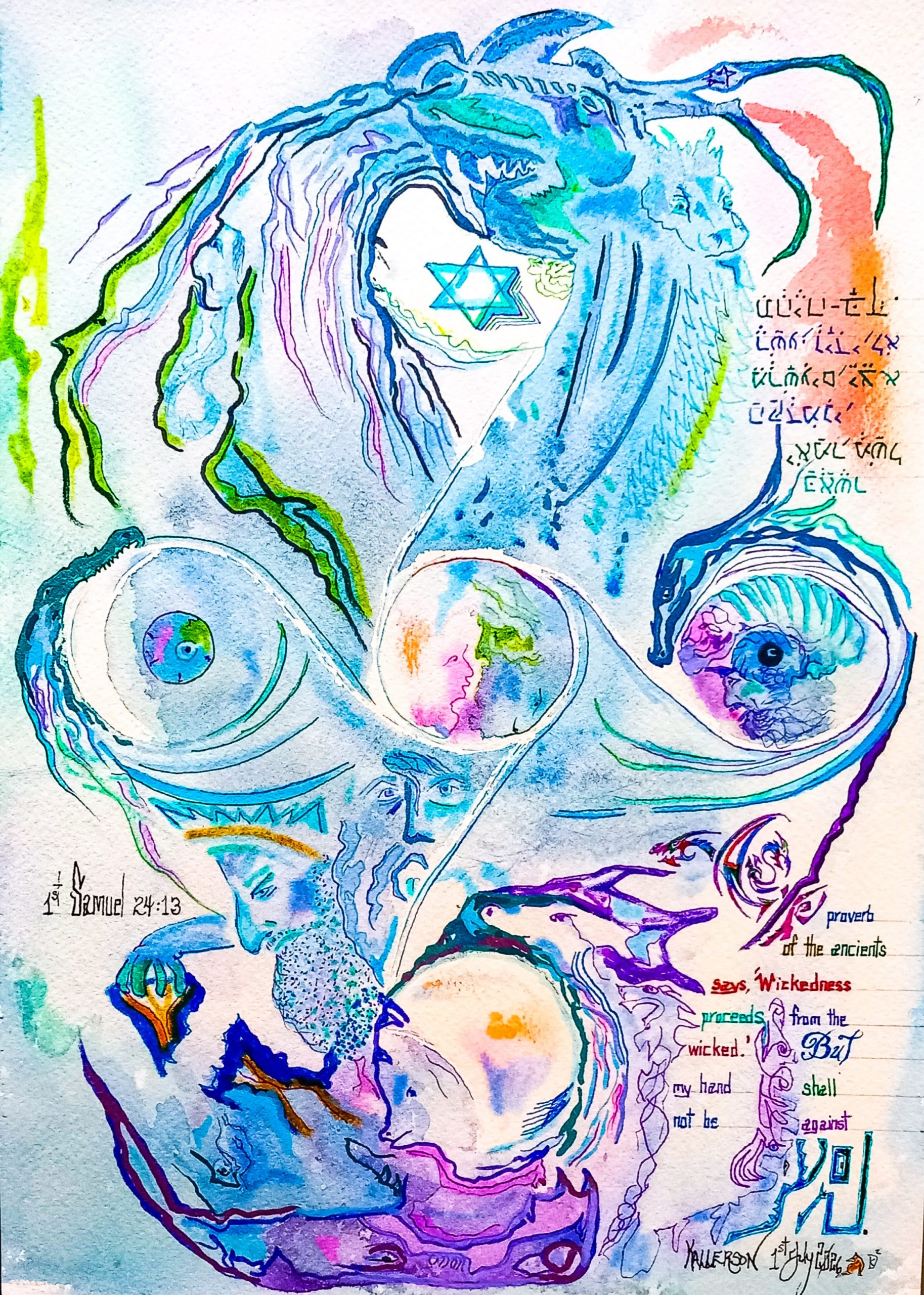
Artwork by Douglas Kallerson
1 Samuel 24:1-13
For Reigning, You Will Reign, Part I
(Typed 23 February 2026) There are parallels between Psalm 7 and this passage from 1 Samuel 24. Other psalms of David have similar thoughts, too.
It was a difficult time in his life as he waited to be the king. He had been anointed, and yet, he waited on the Lord as Saul hunted him ruthlessly without a cause.
Despite the trials, David never let his trust in the Lord or in His covenant promises waver. He also actively petitioned the Lord for deliverance and praised the Lord for His righteousness.
That is a trait we can all learn from. Things happen in our lives that are unfair, painful, emotionally overwhelming, and so forth. And yet, if we follow David’s example, we will talk to the Lord about those things, petition Him for deliverance, and praise Him regardless of the outcome.
Text Verse: “Meandering to David, which he sang to Yehovah upon ‘words, Cush, son, Right’.” (Introduction to Psalm 7) (CG)
Cush is not mentioned anywhere else in Scripture, but because he is so predominantly mentioned in Psalm 7, it is likely that he is one of the people David alludes to in 1 Samuel 24.
Maybe there is someone hounding you in one way or another. Maybe they are spreading lies about you, cheating you, or harming you in some way. What did David do about Cush? He wrote a psalm.
Now, we have the psalms to read. When we come across one that is pertinent to a situation in our own lives, we can mentally insert that foe into the words of the psalm as we read it. If words fail us, the word of the Lord won’t. He inspired it, and He has given it to us to guide our walk.
Use it accordingly. The world is filled with foes. Let the word itself help you speak to the Lord about them. One thing is for certain: you can’t be doing wrong because the word gives the pattern for living. That helps take the pressure off me when I’d like to sock some politician in the nose.
Instead of doing that, I can use the Lord’s words to let Him know how I feel about that guy. So come happily unto meeting every rong-doer with a petition to the Lord from the pages of this wonderful word.
Yes, let this word guide you, and you will be blessed. This is a marvelous truth found in His superior word. And so, let us turn to that precious word once again, and… May God speak to us through His word today, and may His glorious name ever be praised.
I. Extremity, the Robe (verses 1-6)
Now it happened, when Saul had returned from following the Philistines,
vayhi kaasher shav shaul meakhare pelishtim – “And it was, according to which he returned, Saul, from ‘after Philistines’.” The account is a continuation of the events that ended Chapter 23. As that chapter ended, it said –
“And messenger, he came unto Saul, to say, ‘You must (surely) hurry, and you must (surely) walk. For they overspread, the Philistines, upon the land.’ 28And he returned, Saul, from pursuing after David. And he walked to encounter Philistines. Upon thus, they called to the place, the it, Crag the Divisions. 29And he ascended, David, from there. And he sat in strongholds En Gedi.” 1 Samuel 23:27-29 (CG)
The first clue that this chronologically follows those events is the note concerning Saul’s return from pursuing the Philistines. This is something he did for much of his life. But taken in conjunction with the next words, this is after the events of the previous chapter…
1 (con’t) that it was told him, saying, “Take note! David is in the Wilderness of En Gedi.”
vayagidu lo lemor hineh David bemidbar ein gedi – “And they caused to declare to him, to say, ‘Behold! David in ‘Wilderness, En Gedi’.’” Other than being listed as a city of Judah in Joshua 15:33, En Gedi has not been mentioned before.
These two references in 1 Samuel are the only times it is mentioned until 2 Chronicles 20:2. As such, we can confidently assert that these events are chronological.
En Gedi is on the western shore of the Dead Sea. At this spot, freshwater flows from springs, producing a natural oasis. Two Israeli adventurers, Sergio and Rhoda in Israel, have a YouTube video well worth watching of this remarkable spot.
Saul means Asked, but its spelling is identical to Sheol, the place of the dead. Philistines means Weakeners. David means Beloved. En Gedi means Fountain of a Kid (a young goat). A fountain is a permanent source of fresh water. The kid, gedi, is from gadah, to cut off.
In the Bible, the wilderness is a place of God’s grace and closeness to Him, but it is also a place of testing. For some, such as Israel, the testing results in disobedience. For others, such as Christ when He was tested, it is a place of fellowship through obedience.
The wilderness and the law are closely connected because testing is accomplished through law. This is seen in the word itself, midbar. It is derived from the verb davar, to speak, and the noun davar, meaning word. The Lord spoke the Ten Commandments (words/devarim) in the desert (midbar) of Sinai.
Having been presented the intel on David, Saul prepares for more warfare…
2 Then Saul took three thousand chosen men from all Israel,
vayiqakh shaul sheloshet alaphim ish bakhur mikal Yisrael – “And he took, Saul, three thousands man, selected from all Israel.” David’s force of six hundred men was mentioned in 1 Samuel 23:13. Thus, Saul has a force five times as large.
Three thousand is derived from the numbers three and ten. Bullinger notes that three “stands for that which is solid, real, substantial, complete, and entire.” As such, it represents Divine Perfection.
He says the number 10 means “Completeness of order, marking the entire round of anything, is, therefore, the ever-present signification of the number ten. It implies that nothing is wanting; that the number and order are perfect; that the whole cycle is complete.” It represents Ordinal Perfection.
Israel means He Strives with God.
2 (con’t) and went to seek David and his men on the Rocks of the Wild Goats.
vayelekh levaqesh eth David vaanashav al pene tsure hayeelim – “and he walked to seek David and his mortals upon faces ‘Cliffs, the Ibexes’.” Saul’s pursuit took him to this area by the Dead Sea. Having water, it would be a good place to hide, but Saul’s spies identified where David was.
The location may be a description, the cliffs of the ibexes, or it may be a proper name, Cliffs, the Ibexes. The word cliff is derived from tsur, to bind or confine. Therefore, it is a cliff or sharp rock, as if it has been compressed.
The yael, ibex, is introduced to Scripture here. It is derived from yaal, to ascend. That is normally used figuratively, such as indicating to profit, when one ascends in wealth. The yael, ibex, is derived from this because it is an animal that climbs on the cliff faces. Concerning Saul coming to this area…
3 So he came to the sheepfolds by the road,
vayavo el gidroth hatson al ha’derekh – “And he went unto ‘enclosures, the flock’ upon the road.” The gederah, enclosure, is from the noun gader, a circumvallation. Therefore, this is a place where the flocks are completely isolated for protection. The tson, flock, comes from a root signifying to migrate. As such, these are migrators that are currently unable to do so.
The derek, road, is from darak, to tread. That is both literally and figuratively applied, such as in the walk of one’s life. At this location, it next says…
3 (con’t) where there was a cave;
vesham mearah – “And there, cave.” This explains the enclosure. In The Land and the Book by William Thomson, he notes that the enclosures are made by piling up stones at the mouth of caves, forming a circular wall. That is covered by thorns. It keeps the flocks in and predators out. These are used in times of inclement weather and for protection at night. Thomson notes –
“These caverns are as dark as midnight, and the keenest eye cannot see four paces inward; but one who has been long within, and looking outward toward the entrance, can observe with perfect distinctness all that takes place in that direction. David, therefore, could watch Saul as he came in . . . but Saul could see nothing but impenetrable darkness.”
As for the mearah, cave, it is from ur, to make naked. Thus, it signifies what is exposed or bare. Which is kind of ironic, based on the next words…
3 (con’t) and Saul went in to attend to his needs.”
The verb is causative: vayavo shaul lehasekh eth raglav – “And he went, Saul, to cause to cover his feet.” The words can be taken in one of two ways. The first is that he went in and used the cave as his john (no flushing necessary). Usually, the bare or sandaled feet are uncovered, and the rest of the body is covered, but at this time, the opposite is true.
The second, a later interpretation, is that he went in there to sleep. One lies down and covers his feet when sleeping. Hence, when Ruth went to Boaz at the threshing floor, she uncovered his feet. In that account, the verb is not causative.
Commentators have it in their mind which is correct and assert why they think it is one option or the other. Ellicott says, “The meaning of this disputed passage is quite simple.” He then wrote a lengthy paragraph, inserting a dozen points not even hinted at in the account.
The likely reason that it refers to using the john is that if Saul fell asleep, more information would likely be supplied, as in the account in Chapter 24, where it twice notes that Saul was sleeping.
Nothing like that is mentioned here. Second, what would be the point of using a euphemism instead of just saying, “Saul went in to sleep.”? The causative verb indicates more than lying down and sleeping. In other words, he is causing to cover his feet so that he can then perform another action.
The only other time this expression is used is in Judges 3, where it is almost certainly referring to Eglon using the john. If this meant sleep, one would assume that the term would be used frequently to indicate that, but apart from these two accounts, it is not seen.
Either way, however, someone else is there with Saul…
3 (con’t) (David and his men were staying in the recesses of the cave.)
vedavid vaanashav beyarkete ha’mearah yoshevim – “And David, and his mortals, in ‘flank, the cave’, sitting.” In the wilderness, one can see others coming from a long distance. David probably saw Saul and his men marching and decided to retreat into the furthest part of the cave to hide.
This seems to be the reason why the sheepfold was mentioned. There were probably sheep in there at the time. Therefore, it would be noisy from bleating, flapping their ears, wandering around greeting their sheep buddies, chewing the cud, etc. Yes, I watched a video of sheep in a fold to see what they do.
If there were sheep in the fold, Saul would know it was safe to go in there alone, never expecting armed men to be in there. This also explains how the men could talk without being heard. Normally, a whisper would be detectable in a cave. But with sheep bleating, any voices would be completely obscured…
4 Then the men of David said to him, “This is the day of which the Lord said to you,
vayomeru anshe David elav hineh hayom asher amar Yehovah elekha – “And they said, ‘mortals, David’, unto him, ‘Behold! The day which He said, Yehovah, unto you.” There is nothing recorded concerning what they will next say. However and whenever the words were spoken, it was something the men were aware of…
4 (con’t) ‘Behold, I will deliver your enemy into your hand,
hineh anokhi noten eth oyevekha beyadekha – “Behold! I Myself ‘giving your enemies [k.] in your hand’.” The written and the oral Hebrew are different. The written is plural, your enemies. The oral is singular, your enemy.” Despite this, some textual traditions say it is exactly the opposite. However, the seven other uses of the oral are all singular, so those traditions are incorrect. The written plural is correct.
The reason the scribes changed it to the singular is that only Saul is in the cave. Thus, it seems like there is a conflict in the quote of the Lord. The fix for this is so simple, I’m not sure why translations don’t get it. That is seen in the next words…
4 (con’t) that you may do to him as it seems good to you.’”
veasita lo kaasher yitav beenekha – “and you did to him according to which it will wellify in your eyes.”’ The NKJV, and all other translations that I read, makes this a continuation of the Lord’s quote. However, the quote ends as I have shown, not the other way –
“This is the day of which the Lord said to you, ‘Behold, I will deliver your enemy into your hand, that you may do to him as it seems good to you.’”
“Behold! The day which He said, Yehovah, unto you, ‘Behold! I giving your enemies [k.] in your hand.’ And you did to him according to which it will be good in your eyes.”
The supposed second clause of the quote isn’t a part of it at all. Rather, it is an affirmation by those who spoke to David. The Lord said that He would give David’s enemies into his hand. The men then prompt David to do what he wishes.
This is important because if David takes their advice, it will call into question the value of his own anointing. If someone can arbitrarily kill Saul, the Lord’s anointed, then David, who is also the Lord’s anointed, could be justifiably targeted at some future point, his killing of Saul being an example of this.
Maybe David hasn’t yet thought this through to its logical conclusion, or maybe he has, and he wants Saul to know it. Either way, David moves forward at their prompting…
4 (con’t) And David arose and secretly cut off a corner of Saul’s robe.
vayaqam David vayikhroth eth kenaph ha’meil asher leshaul balat – “And he arose, David, and he cut ‘extremity, the robe’, which to Saul, in the secret.” David crept up to where Saul’s robe was. It was probably set off to the side while Saul was reading the morning paper, or whatever he was doing.
To prove that he was within a foot or two of Saul, David cut off the kanaph, extremity, of the robe. At times, this is called the wing of the robe because the same word is used when describing a bird’s wings. In this case, the extremity of the robe is specifically intended for a particular purpose –
“Again the Lord spoke to Moses, saying, 38 ‘Speak to the children of Israel: Tell them to make tassels on the corners [kanaph] of their garments throughout their generations, and to put a blue thread in the tassels of the corners [kanaph]. 39 And you shall have the tassel, that you may look upon it and remember all the commandments of the Lord and do them, and that you may not follow the harlotry to which your own heart and your own eyes are inclined, 40 and that you may remember and do all My commandments, and be holy for your God. 41 I am the Lord your God, who brought you out of the land of Egypt, to be your God: I am the Lord your God.’” Numbers 15:37-41
To cut this tassel off is to essentially cut away Saul’s reminder of the commandments of the covenant. But more, because Saul is the king, and because David has cut the king’s robe with this personal tassel, it is like cutting away the kingship from Saul because the king’s authority stems from the Lord’s commandments. Because of this…
5 Now it happened afterward that David’s heart troubled him
vayhi akhare khen vayakh lev David otho – “And it was, after thus, and it caused to strike, ‘heart, David’, him.” By the time David crept up to Saul, he knew that he should not kill the king. But he wanted Saul to know that he had the opportunity to do so. Therefore, he did what came to mind to prove that he was there.
However, probably after thinking through the significance of the tassel in his hand, he realized with horror what it meant within the context of the society…
5 (con’t) because he had cut Saul’s robe.
al asher karath eth kanaph asher leshaul – “upon which he cut ‘extremity which to Saul’.” David knew how he would feel if someone did this to him. This was like killing Saul without actually killing him. The only difference is that, unlike murder, restoration could be made.
Despite that, the significance of the act in David’s mind was sufficient to condemn his heart, and to teach his men concerning the gravity of the matter…
6 And he said to his men, “The Lord forbid that I should do this thing to my master,
vayomer laanashav khalilah li meYehovah im eeseh eth ha’davar ha’zeh ladoni – “And he said to his mortals, ‘(Surely) Profane to me from Yehovah if I will do the word, the this, to my lord.’” The words ish, man, and enosh, mortal, are almost synonymous.
The word ish refers to a man in his course of life, whereas enosh is from anash, to be feeble, frail, etc. Thus, it refers to man’s mortality. The subtle difference reminds the reader that the state in which man exists is perilous.
David, probably still clutching the tassel, feels the weight of Saul’s mortality. Thus, it applies to them all. Even something as seemingly innocuous as cutting the tassel was too much to bear for David. He had symbolically taken a mortal action against his lord, meaning…
6 (con’t) the Lord’s anointed,
limshiakh Yehovah – “to ‘anointed, Yehovah’.” Saul is the Lord’s messiah. He bears the holy anointing oil, and despite being rejected by the Lord, he was still alive. Only the Lord had the right to take the life of His messiah or come against him…
6 (con’t) to stretch out my hand against him, seeing he is the anointed of the Lord.”
lishloakh yadi bo ki meshiakh Yehovah hu – “to send my hand in him, for ‘anointed, Yehovah’, he.” The only way that David could bring his hand against Saul would be if the Lord personally directed him. That had not occurred, despite the promptings of his men. Thus, David felt the guilt of what he had done.
Your enemy is in your hand
Do what you will, and we are with you
We will all understand
When you do to him what you should do
He has wronged you all along
Like an animal, he has hounded you
Let today be your retribution song
When you do to him what you should do
*
It would be wrong for me to harm him
Even though he has done me wrong
My fate, not his, would be ever so grim
If I were to do the Lord’s anointed wrong
II. He Will Judge, Yehovah (verses 7-13)
7 So David restrained his servants with these words,
vayshasa David eth anashav badevarim – “And he split, David, his mortals, in the words.” The word shasa, to split, is seen for the last of nine times. The other uses indicate either a state, as in the split hoof of an animal, or in an act of tearing an animal. The men intended for Saul to die, but David split that thought from them.
The unusual use of the word reveals David’s wholehearted opposition to his men entertaining such a thought…
7 (con’t) and did not allow them to rise against Saul.
velo netanam laqum el shaul – “And not he gave them to rise unto Saul.” This is based on Saul being the Lord’s anointed. Even David, who is Yehovah’s anointed, would not think to raise his hand against Saul. The men were restrained because of this…
7 (con’t) And Saul got up from the cave and went on his way.
veshaul qam mehamearah vayelekh badarekh – “And Saul, he arose from the cave, and he walked in the road.” Completely unsuspecting and no worse for the ordeal, Saul exited the cave through the sheep enclosure and went on his way. But he would not get far…
8 David also arose afterward, went out of the cave,
vayaqam David akhare khen vayetse min ha’mearah – “And he arose, David, after thus, and he went out from the cave [k].” The written and oral Hebrew vary here, but the translation doesn’t change. Instead, the scribes adjusted two words to become one without changing the meaning. However, the intent does change.
This change in intent is like “out from ‘the-cave” to “out ‘from-the-cave’.” Understanding the variation is complicated enough that Sergio had to go to a Hebrew discussion board to obtain the difference in intent. The separate word min is “generally used for emphasis, elevated or literary style, or when the following word is not definite.” Thus, David went out FROM ‘the cave’ after Saul arose ‘from the cave’.
David needed to ensure that Saul understood what took place. David’s intent is to demonstrate to Saul that he is aligned with the king and bears no enmity towards him…
8 (con’t) and called out to Saul, saying, “My lord the king!”
vayiqra akhare shaul lemor adoni ha’melekh – “And he called after Saul, to say, ‘My lord the king!’” David begins by acknowledging that Saul is above him, saying, adoni, “My lord.” He then extends that to acknowledge that it is Saul, not he, who is the reigning authority with the words “the king.”
The words are carefully selected to begin on the proper footing for everything that will follow. Next…
8 (con’t) And when Saul looked behind him,
vayabet shaul akharav – “And he caused to scan, Saul, after him.” Upon hearing the voice, Saul had to purposefully scan the area, looking for where it came from. Once his eyes alighted on David…
8 (con’t) David stooped with his face to the earth, and bowed down.
vayiqod David apayim artsah vayishtakhu – “And he stooped, David, nostrils earth-ward, and he prostrated himself.” The word qadad signifies to shrivel up. David either hunched over or stooped. This would be an honorific, like when a subordinate averts his eyes from a superior, or when one bows to honor another as greater than himself.
After doing this, he completely flattened himself to the earth. In this position, he has left himself fully exposed and vulnerable to Saul if Saul advances against him. In this position, he begins his words…
9 And David said to Saul: “Why do you listen to the words of men
vayomer David leshaul lamah tishmah eth divre adam – “And he said, David, to Saul, ‘To why you will hear ‘words, human’.” The meaning of saying adam, human, is obvious. Saul was the king. If he had a problem with David and wanted to know if his thoughts about him were correct, all he needed to do was consult the Lord.
Saul was listening to human voices and not divine speech. As the king, he could consult a prophet or priest to receive a divine word concerning the things spoken to him. The human words David refers to are…
9 (con’t) who say, ‘Indeed David seeks your harm’?
lemor hineh David mevaqesh raathekha – “to say, ‘Behold, David seeking your evil!’?” Several of the statements during this conversation closely match words found in Psalm 7. Our text verse, which is the introduction to that Psalm, says, “Meandering to David, which He sang to Yehovah upon ‘words, Cush, son, Right’.”
Therefore, it is probable that Cush is at least one of the people feeding Saul bad information. In that introduction, David calls Cush, ben yemini, son Right. This is probably a pun cast upon the “Son right who has done him wrong.”
It is the same term applied to Gera in 2 Samuel 19, who cursed David as he fled from his son Absalom. Each time the term is used, it is a play on words, either positively or negatively.
David had other enemies allied against him as well, such as Doeg and the Ziphites. Saul was listening to such people instead of checking with the Lord. And speaking of the Lord…
10 Look, this day your eyes have seen that the Lord delivered you today into my hand in the cave,
hineh hayom hazeh rau enekha eth asher nethanekha Yehovah hayom beyadi bamearah – “Behold, the day, the this! They saw, your eyes, which He gave you, Yehovah, the day, in my hand in the cave.” Although Saul doesn’t know the full magnitude of the situation yet, he would have immediately seized on the fact that David was there in the cave.
Therefore, as Saul was in no condition to defend himself with his shorts wrapped around his feet, he was fully delivered into David’s hands. David ascribes this to Yehovah. Divine providence had allowed the events to occur, and Saul couldn’t argue against that. And more…
10 (con’t) and someone urged me to kill you.
Rather: veamar laharagakha – “And He will say to slay you.” Most translations provide an unfortunate rendering. In fact, I don’t know one that gets it right, though some say, “And I thought to kill you.” The verb is 3rd person masculine singular, and the Lord is the nearest antecedent. Saul knew exactly what David meant.
David asked why Saul was listening to human words, prompting him to kill David. He then said that Yehovah delivered Saul into his hands. But Saul is still alive. Therefore, despite saying that He, Yehovah, told David to kill Saul, it means that Yehovah didn’t “tell” David to kill Saul. Rather, human voices urged him to do so.
Though the translations may carry the intent, they lose all of the significance of what David is saying. And more, it is not a translation if the words are not translated.
We are given this incredible gift of the Bible from God to read and learn from, and without being properly schooled on what is said, we can never understand the overarching message of what He is telling us. David continues…
10 (con’t) But my eye spared you,
vatakhas alekha – “And it compassionated upon you.” David uses an ellipsis. Saul would have gotten the meaning, which is “… my eye compassionated upon you,” or “my soul compassionated upon you.” The likely reading is eye, though –
“They saw, your eyes, which He gave you, Yehovah, the day, in my hand…”
“And it [my eye] compassionated upon you…”
Saul’s literal eyes are seeing what David’s metaphorical eye did.
10 (con’t) and I said, ‘I will not stretch out my hand against my lord,
David’s fourfold repetition of the first person provides its own emphasis: vaomar lo eshlakh yadi badoni – “And I said, ‘Not I will send my hand in my lord.’” The first two instances show David’s determined purpose. The second two again reveal him subjugating himself to Saul’s authority…
10 (con’t) for he is the Lord’s anointed.’
ki meshiakh Yehovah hu – “For ‘anointed, Yehovah’, he.” David’s claim isn’t being Saul’s friend, son-in-law, military officer, or subject of his kingdom as his reason for withholding his hand. Rather, he appeals to the highest state in which Saul exists, his anointing from the Lord.
As Yehovah’s messiah, David could do no less than honor Yehovah by sparing Saul. Only with that understood, does he next bring in another aspect of Saul…
11 Moreover, my father, see!
veavi reeh – “And, my father, you must see!” David is not appealing to Saul as his father-in-law when he says, “my father.” Rather, it is an appeal to Saul’s humanity while he maintains a subordinate posture. He probably held up the tassel, maybe even shaking it a little to attract Saul’s attention toward it. He then repeats himself for effect…
11 (con’t) Yes, see the corner of your robe in my hand!
gam reeh eth kenaph meilekha beyadi – “Also, you must see, ‘extremity, your robe’ in my hand.” This is the moment Saul probably came apart inside. He was within feet, or even inches, of death. If David had his tassel, he also had a knife to cut off his tassel. And yet, Saul was alive to hear David’s words, which confirmed what his eyes saw and his mind grasped…
11 (con’t) For in that I cut off the corner of your robe, and did not kill you,
ki bekharethi eth kenaph meilekha velo haragtikha – “For I cut ‘extremity, your robe’, and not I slayed you.” No enemy would spare his life. Instead, Saul would have been lying in a pool of his own blood. And yet, he remained alive, hopefully reasoning through what David had to tell him…
11 (con’t) know and see that there is neither evil nor rebellion in my hand, and I have not sinned against you.
da ureeh ki ein beyadi raah vapesha velo khatathi lakh – “You must know, and you must see! For naught in my hand evilness and revolt. And not I sinned to you.” David lays out his case concerning his innocence, all the while dangling the tzitzit. It is the necessary proof that he is sincere.
He did nothing wrong, conspiratorial, or maligning against Saul. Despite that…
11 (con’t) Yet you hunt my life to take it.
veatah tsodeh eth naphshi leqakhtah – “And you, chasing my soul to take it.” He reminds Saul of the past as well as the present. David was hounded by Saul again and again. As such, the participle is used to remind Saul of this and to petition him to let this be the last chase. If not…
12 Let the Lord judge between you and me,
yishpot Yehovah beni uvenekha – “He will judge, Yehovah, between me and between you.” The future tense is an appeal for Saul to let go of the pursuit that has driven Saul and hounded David for too long. If Saul continues chasing David, the Lord will judge him for it…
12 (con’t) and let the Lord avenge me on you.
uneqamani Yehovah mimekha – “And He will avenge me, Yehovah, from you.” It will be a done deal if Saul continues. Yehovah will judge, and in judging, He will find Saul guilty. In other words, David is saying that he has done no wrong, he is doing no wrong, and he will not do wrong towards Saul.
That is the truth of the matter. In Yehovah’s eyes, the matter is as good as judged. Therefore, Saul needs to relent and no longer pursue David. But even if he does…
12 (con’t) But my hand shall not be against you.
veyadi lo tihyeh bakh – “And my hand not it will be in you.” Regardless of whether Saul pursues David or gives up the pursuit, David will never raise his hand against Saul. To confirm this, David cites a proverb that he lives by because it is committed to memory…
13 As the proverb of the ancients says, ‘Wickedness proceeds from the wicked.’
kaasher yomar meshal haqadmoni mereshaim yetse resha – “According to which it will say, ‘proverb, the olden’, ‘From wrongful, it will come wrongfulness.’” A new adjective is seen, qadmoni, literally: frontward.
The words qedem, qadom, qadam, etc., refer to what is in front or preceding. This is in relation to the situation of the tabernacle, which opens to the east, and the Lord sits in the holy of holies to the west. Thus, past time is east, the future is west. Man seeking God is, therefore, always heading into the future.
As such, the frontward means east in space or the past (stretching to eternity) in time. Therefore, the intent is that the proverb comes from olden times. If someone is a wrongful person, he will do wrongful things. David is, therefore, not referring to Saul, but to himself, claiming he is not wrongful and will not do wrongfully.
The “but” used by the NKJV can lead to a wrong conclusion, as if he is speaking of Saul, which he is not. That is confirmed in the repetition from the previous verse…
*13 (fin) But my hand shall not be against you.
veyadi lo tiyeh bakh – “And my hand, not it will be in you.” Because he is not a wrongful person, wrongfulness will not proceed from him. Rather, he will do right. This includes not harming Saul, regardless of whether Saul pursues him or ceases from doing so.
David refrained from doing wrong, even when it would have resulted in a quick resolution to his troubles. He knew that the Lord would deal with Saul in His own time and in His own way. Because Saul had the anointing oil on him, it would be an implicit attack against the Lord for David to attack Saul.
Therefore, he was willing to leave room for the Lord to act. In Romans 12, another Saul, also known as Paul, implores us to follow this principle. If that is so with all people, then how much more should we strive to have this attitude towards those on whom the Lord’s anointing rests?
Both Paul and John refer to the anointing that rests upon believers (2 Corinthians 1:21 and 1 John 2:20 & 27). If other believers are the Lord’s anointed, then we should do our utmost to give them grace and allow the Lord to handle them.
When we have issues with other believers, the epistles tell us how to deal with them. That’s why it’s important to stay in the word and to know what it says. It is a treasure trove of useful lessons for us as we walk in the presence of God.
Next week, we will finish this chapter, the Lord willing, and see how things turn out. For now, be sure to love the Lord and seek Him daily. And be good to those around you, as Paul says, “if possible.” The Lord is evaluating us. Remember that. He will judge us fairly when we act in accord with His will.
Closing Verse: “Beloved, do not avenge yourselves, but rather give place to wrath; for it is written, ‘Vengeance is Mine, I will repay,’ says the Lord. 20 Therefore
‘If your enemy is hungry, feed him;
If he is thirsty, give him a drink;
For in so doing you will heap coals of fire on his head.’
21 Do not be overcome by evil, but overcome evil with good.” Romans 12:19-21
Next Week: 1 Samuel 24:14-22 David is certain to become king, it is true… (For Reigning, You Will Reign, Part II) (52nd 1 Samuel sermon)
The Lord has you exactly where He wants you. He has a good plan and purpose for you. He is the One who abases the haughty and exalts the humble. He regards the lowly, and the proud, He knows from afar. So yield yourself to Him, trust Him, and believe His word. In this, He will do great things for you and through you.
1 Samuel 24:1-13 (CG)
And it was, according to which he returned, Saul, from ‘after Philistines’, and they caused to declare to him, to say, “Behold! David in ‘Wilderness, En Gedi’.” 2And he took, Saul, three thousands man, selected from all Israel, and he walked to seek David and his mortals upon faces ‘Cliffs, the Ibexes’. 3And he went unto ‘enclosures, the flock’ upon the road. And there, cave. And he went, Saul, to cause to cover his feet. And David, and his men, in ‘flank, the cave’, sitting. 4And they said, ‘mortals, David’, unto him, “Behold! The day which He said, Yehovah, unto you, ‘Behold! I Myself ‘giving your enemies [k.] in your hand’,’ and you did to him according to which it will welify in your eyes.” And he arose, David, and he cut ‘extremity, the robe’, which to Saul, in the secret. 5And it was, after thus, and it caused to strike, ‘heart, David’, him, upon which he cut ‘extremity which to Saul’. 6And he said to his mortals, “(Surely) Profane to me from Yehovah if I will do the word, the this, to my lord, to ‘anointed, Yehovah’, to send my hand in him, for ‘anointed, Yehovah’, he.” 7And he split, David, his mortals, in the words. And not he gave them to rise unto Saul. And Saul, he arose from the cave, and he walked in the road.
8And he arose, David, after thus, and he went out from the cave [k.]. And he called after Saul, to say, “My lord the king!” And he caused to scan, Saul, after him. And he stooped, David, nostrils earthward, and he prostrated himself. 9And he said, David, to Saul, “To why you will hear ‘words, human’, to say, ‘Behold, David seeking your evil!’? 10Behold, the day, the this! They saw, your eyes, which He gave you, Yehovah, the day, in my hand in the cave. And He will say to slay you. And it* compassionated upon you. And I said, ‘Not I will send my hand in my lord. For ‘anointed, Yehovah’, he.’ 11And, my father, you must see! Also, you must see, ‘extremity, your robe’ in my hand. For I cut ‘extremity, your robe’, and not I slayed you. You must know, and you must see! For naught in my hand evilness and revolt. And not I sinned to you. And you, chasing my soul to take it. 12He will judge, Yehovah, between me and between you. And He will avenge me, Yehovah, from you. And my hand, not it will be in you. 13According to which it will say, ‘proverb, the olden’, ‘From wrongful it will come wrongfulness.’ And my hand, not it will be in you.
Verse 4 – Qeri: “your enemy.”
Verse 8 – Kethiv/qeri meaning is the same. The change is like “from ‘the-cave’,” to “‘from-the-cave’.”
*Verse 10. The words are elliptical. The verb is feminine. Thus, either David’s soul or his eye had compassion on Saul – “And it [my eye] had compassion…”
1 Samuel 24:1-13 (NKJV)
Now it happened, when Saul had returned from following the Philistines, that it was told him, saying, “Take note! David is in the Wilderness of En Gedi.” 2 Then Saul took three thousand chosen men from all Israel, and went to seek David and his men on the Rocks of the Wild Goats. 3 So he came to the sheepfolds by the road, where there was a cave; and Saul went in to attend to his needs. (David and his men were staying in the recesses of the cave.) 4 Then the men of David said to him, “This is the day of which the Lord said to you, ‘Behold, I will deliver your enemy into your hand, that you may do to him as it seems good to you.’ ” And David arose and secretly cut off a corner of Saul’s robe. 5 Now it happened afterward that David’s heart troubled him because he had cut Saul’s robe. 6 And he said to his men, “The Lord forbid that I should do this thing to my master, the Lord’s anointed, to stretch out my hand against him, seeing he is the anointed of the Lord.” 7 So David restrained his servants with these words, and did not allow them to rise against Saul. And Saul got up from the cave and went on his way.
8 David also arose afterward, went out of the cave, and called out to Saul, saying, “My lord the king!” And when Saul looked behind him, David stooped with his face to the earth, and bowed down. 9 And David said to Saul: “Why do you listen to the words of men who say, ‘Indeed David seeks your harm’? 10 Look, this day your eyes have seen that the Lord delivered you today into my hand in the cave, and someone urged me to kill you. But my eye spared you, and I said, ‘I will not stretch out my hand against my lord, for he is the Lord’s anointed.’ 11 Moreover, my father, see! Yes, see the corner of your robe in my hand! For in that I cut off the corner of your robe, and did not kill you, know and see that there is neither evil nor rebellion in my hand, and I have not sinned against you. Yet you hunt my life to take it. 12 Let the Lord judge between you and me, and let the Lord avenge me on you. But my hand shall not be against you. 13 As the proverb of the ancients says, ‘Wickedness proceeds from the wicked.’ But my hand shall not be against you.