
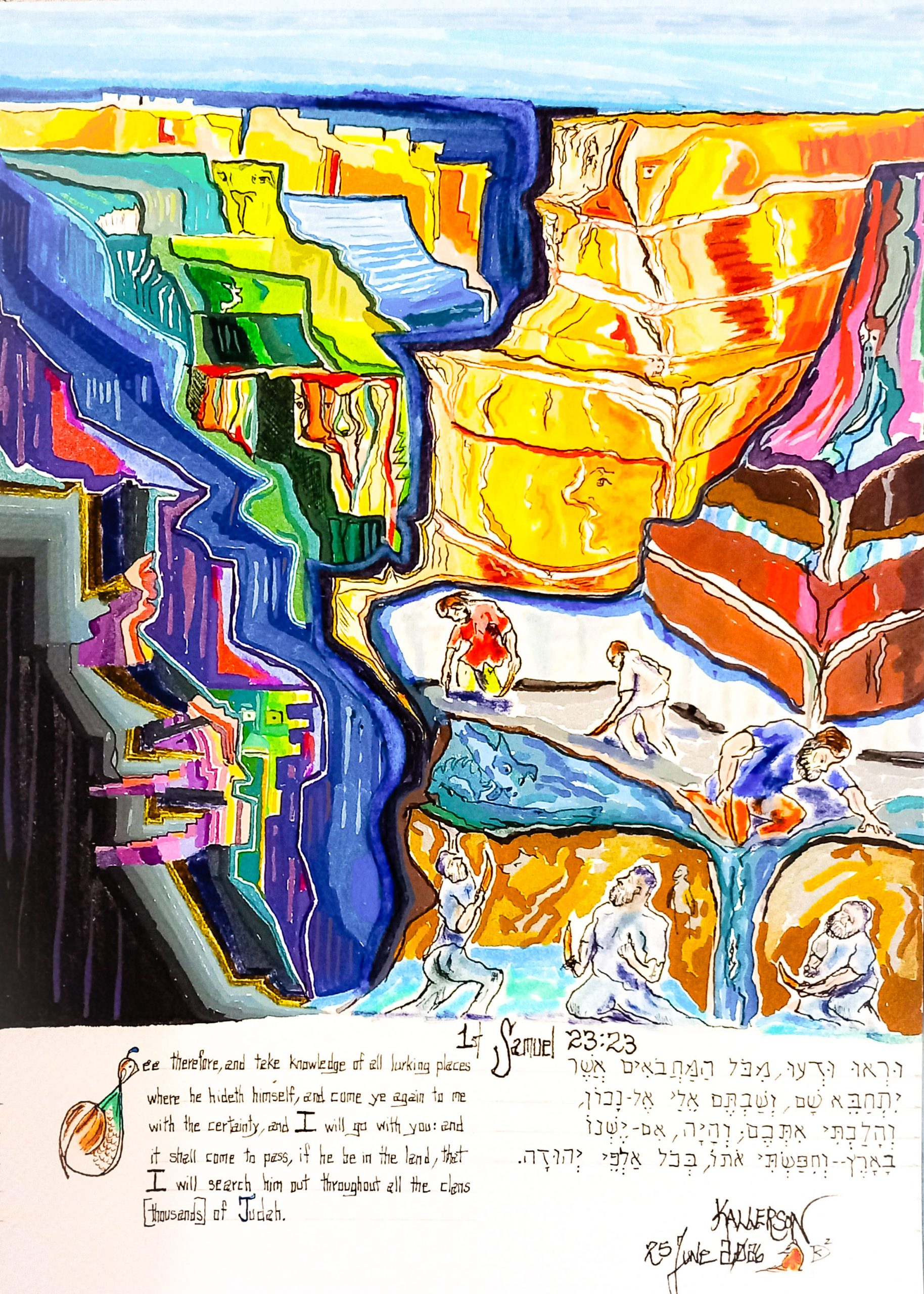
1 Samuel 23:16-29
You Will Reign Upon Israel, Part II
(Typed 16 & 17 February 2026) In 1993, the US had a bit of a spat with the Somalis. Throughout much of the year, there was military conflict, which culminated in the October 1993 battle of Mogadishu, a battle made famous in the movie Blackhawk Down.
During the year, Mohamed Farrah Aidid, often called General Aidid, remained elusive to the US government intelligence agencies. And yet, the press was there interviewing him time and again. How could the entire US intelligence apparatus not find someone that a bunch of left-wing newsies could? Something never made sense about that.
In the passage today, Saul relentlessly pursues David, and yet, he never gets him. Despite this, his son Jonathan has no problem finding David and spending time with him.
It’s hard to understand how these things occur, but the account is detailed, and Jonathan was able to do what Saul and his army failed to.
Text Verse: “To the Chief Musician. A Psalm of David the servant of the Lord, who spoke to the Lord the words of this song on the day that the Lord delivered him from the hand of all his enemies and from the hand of Saul.” Introduction to the 18th Psalm
David was betrayed by the people of Keilah, whom he saved from the hand of the Philistines. Later, while in the area of the Ziphites, a city belonging to his own tribe of Judah, he was betrayed by some of them.
With Saul constantly pressing hard after him, it seemed like he couldn’t catch a break. He had a true and trusted friend in Jonathan. His men were loyal to him as well. But above all that, because of his trust in the Lord, the Lord was with him.
This was evidenced throughout his life. Just when he needed delivery, the Lord was there to provide it. We, too, have such great assurances. Because of Jesus, the Lord will always deliver us in the way that He deems is appropriate. We can trust in that.
Such great truths as this are to be found in His superior word. And so, let us turn to that precious word once again, and… May God speak to us through His word today, and may His glorious name ever be praised.
I. To All Longing Your Soul (verses 16-20)
16 Then Jonathan, Saul’s son, arose
vayaqam yehonathan ben shaul – “And he arose, Jehonathan, ‘son, Saul’.” Jonathan is reintroduced into the narrative. He has not been seen since verse 20:42, when he and David agreed that there would be peace between them and between their households forever.
As seen in several accounts, his name is spelled differently here. Instead of Jonathan, the Hebrew has an additional letter, hey, elongating the name. It is the fifth letter of the aleph-bet and means look, reveal, and breath –
יוֹנָתָ֗ן
יְהוֹנָתָ֜ן
Jonathan will be mentioned only here in the chapter. The next time he will be mentioned is in Chapter 31, where it notes his death in battle. Jehonathan has the same meaning as Jonathan, Yah Has Given.
16 (con’t) and went to David in the woods
vayelekh el David khoreshah – “and he walked unto David Horesh-ward.” Somehow, Jonathan learned of David’s location and went to visit him. As with the previous verses, the name Horesh contains an additional hey at the end.
This hey ending is dismissed by Hebrew grammarians as a fossilized ending that has no bearing on the meaning of the name, but that seems like an excuse to dismiss what is not understood. I have retained the meaning of this ending and translated it with the standard locational meaning of such a suffix as Horesh-ward.
The word either is the name of a location, Horesh, or it is the word khoresh, which means forest. Either way, the result is the same for typology. David means Beloved.
16 (con’t) and strengthened his hand in God.
vayakhazeq eth yado belohim – “And he seized his hand in God.” This conveys the idea that David needed strength, he reached out for it in God, God was grasped, and David was thus strengthened in the power and reliability of God. The strengthening is an encouragement in David’s time of distress and difficulty as he hid from Saul, who relentlessly pursued him.
17 And he said to him, “Do not fear, for the hand of Saul my father shall not find you.
vayomer elav al tira ki lo thimtsaakha yad shaul avi – “And he said unto him, ‘Not you will fear, for not it will find you, ‘hand, Saul’, my father.’” The imagery is that Saul’s hand blindly searches for David, swinging about trying to strike him.
Jonathan knows that David is under the divine protection of God. Saul may doggedly pursue David, reaching with his hand to impinge in David, but David will remain unharmed. Saul means Asked. His name is identical in spelling to Sheol. Jonathan understands more than just God’s divine protection of David, though…
17 (con’t) You shall be king over Israel,
veatah timlokh al yisrael – “And you, you will reign upon Israel.” Jonathan understands that Saul will not reign as king forever. But he goes further, clearly understanding that it is David, not he, who will rule over the nation.
Israel means He Strives With God.
Without saying it explicitly, Jonathan indicates that he is giving up any right to ruling in place of his father…
17 (con’t) and I shall be next to you.
veanokhi ehyeh lekha lemishneh – “And I myself, I will be to you to double.” The meaning is most likely that Jonathan expects to be appointed as David’s right-hand man. He would be like Joseph was to Pharaoh, leading the people under the hand of David. Such an underling’s primary job was to ensure the rule and authority of the king was always upheld and never challenged.
17 (con’t) Even my father Saul knows that.”
vegam shaul avi yodea ken – “And also, Saul, my father, knowing thus.” This cannot be taken to mean that Saul knew for certain that Jonathan would rule with David or that Saul was sure David would rule. Rather, it means that Saul felt it was a logical outcome based on how things were working out.
The reason it cannot be a certainty is that Jonathan will not survive to be David’s second in command. Thus, there was no prophetic word given to Saul. Jonathan knew Saul had just figured that this was how things would work out.
18 So the two of them made a covenant before the Lord.
vayikrethu shenehem berith lipne Yehovah – “And they cut, they two, covenant to ‘faces, Yehovah’.” Jewish scholars say that they renewed the covenant that had been made before. Christian scholars agree with that. But it doesn’t say that at all. It says they cut a covenant.
It is not a renewal but a new covenant. Jonathan has yielded his authority and right to the kingdom to David. David has accepted Jonathan’s offer and agreed that he will be his right-hand man. Time and circumstance will preclude this from happening, but the covenant was made, should the opportunity arise.
18 (con’t) And David stayed in the woods, and Jonathan went to his own house.
vayeshev David bakhoreshah vihonathan halakh leveitho – “And he sat, David, in the Horesh-ward. And Jehonathan, he walked to his house.” Unless another encounter which Scripture does not record occurred, this was the last time they would see one another alive.
19 Then the Ziphites came up to Saul at Gibeah, saying, “Is David not hiding with us in strongholds
vayaalu ziphim el shaul ha’givathah lemor halo David mistater imanu vametsadoth – “And they ascended, Ziphites, unto Saul the Gibeah-ward, to say, ‘(Indeed) not David hiding himself with us in the strongholds.’” The area is the Wilderness of Ziph. Thus, those dwelling there are known as Ziphites. The somewhat lengthy explanation of the name was detailed in verse 14.
As there is no article before Ziphites, it indicates some of the people of Ziph in general, not the people as a whole. Their allegiance to Saul, or their fear of him, has led them to betray David’s location to the king.
It may also be that they thought David would claim the area as his own, leaving them without what they currently possessed.
Gibeah means Hill. It is etymologically connected to Gabbatha.
Regardless of their reason, Ziphites came and disclosed the information to Saul, saying David was…
19 (con’t) in the woods, in the hill of Hachilah, which is on the south of Jeshimon?
bakhoreshah begivath ha’khakhilah asher mimin hayshimon – “in the Horesh-ward in ‘Hill, the Hachilah’ which from ‘right, the wasteland’?’” They provided specific detail so that Saul would not waste time scouring an entire area.
According to Strong, Hachilah is from khaklili, a word “By reduplication from an unused root apparently meaning to be dark; darkly flashing (only of the eyes); in a good sense, brilliant (as stimulated by wine) — red.”
That word is found only once in Scripture –
“Crimson – eyes from wine,
And white – teeth from milk.” Genesis 49:12 (CG).
The word “from” means the words are being used as a comparative. As the second clause is compared to white, meaning whiter, I would assume this means darker red from the redness of wine. As such, I say Crimson. Others say Dark, Gloomy, or Dusky.
The wasteland, yeshimon, comes from yasham, to lie waste. Being prefixed by the definite article, it signifies the wasteland. Having given the necessary information to Saul…
20 Now therefore, O king, come down according to all the desire of your soul to come down;
The words are lively and show the full support of these men towards Saul: veatah lekhal avath napshekha ha’melekh laredeth red – “And now to all longing your soul, the king, to descend you must descend.” We could paraphrase this as “We know you really want this deep down inside, and as the king, you should descend and fulfill your desire.” When he does his part…
20 (con’t) and our part shall be to deliver him into the king’s hand.”
velanu hasgiro beyad ha’melekh – “And to us – cause to shut him in ‘hand, the king’.” If the king acts according to their offer, they will do their part and shut David in. Then the king can grab him, shutting him in his own hand. Because of their full support…
Do not fear, for the Lord is by Your side
Trouble may pursue, but it will not find You
The Lord is faithful – tested and tried
Yes, the Lord is there, faithful and true
You shall reign as King over Israel
So continue on despite the trials you face
Satan doesn’t stand a chance, he will be chucked into hell
When all is finished, that will be his place
Do not fear or be dismayed
The troubles will soon pass away
All the trials and sorrow will fade
Eternal glory is set for You on that glorious day!
II. Crag, the Divisions (verses 21-29)
21 And Saul said, “Blessed are you of the Lord, for you have compassion on me.
vayomer shaul berukhim atem leYehovah ki khamaltem alay – “And he said, Saul, ‘Blessed you to Yehovah, for you commiserated upon me.’” Saul conveys that David is the one who had it out for him. As the king, he should be safe from attempts on his life by his underlings. But David was a bully trying to harm him.
On the other hand, these Ziphites felt sorry for Saul and his plight and were willing to help him. Because of this, he blessed them in the name of Yehovah.
22 Please go and find out for sure,
The whole verse is put together willy nilly, as if Saul is trying to speak intelligibly, but he can’t quite do it: lekhu na hakhinu od – “You must walk, pray, you will cause to establish yet.” The meaning is, “Go back to your area, please, and be sure to once again carefully get a fix on where David is.” As the NKJV says, “find out for sure.”
He next somewhat repeats the same thought…
22 (con’t) and see the place where his hideout is, and who has seen him there.
udeu ureu eth meqomo asher tihyeh raglo mi raahu sham – “And you must know, and you must see his place where it will be his foot – who he saw him there.” The imperatives are like saying, “Be certain! Be sure to locate exactly where his foot is standing. Make sure it is an eyewitness account and get the exact details.
It is like his mind is racing, and he is in panic mode to know with complete certainty the exacting details. This is because…
22 (con’t) For I am told he is very crafty.
His words about David are emphatic: ki amar elay arom yarim hu – “For it said unto me conceiving, he will cause to conceive, he.” It is a new word in Scripture, arom, to be or make bare. But it is only used in its derivative sense, what being made bare leads to. It is seen just five times in Scripture.
In analyzing each use of the word, conceive, to form or devise a plan in the mind seems to be the best fit. One sees or considers what is going on, and his mind exposes or makes bare a solution by conceiving what to do.
Saul essentially says, “Be one hundred percent sure. Identify exactly where he is because he has probably already devised a plan to make it look like he is in one place when he is really in another. He, David, is such a crafty dude.”
23 See therefore, and take knowledge of all the lurking places where he hides;
ureu udeu mikol hamakhavoim asher yithkhabe sham – “And you must see, and you must know from all the hideouts where he will ‘secrete himself’ there.” Saul uses another new word, makhave, a hideaway. It is derived from khava, to secrete or hide. It is only seen here and in Isaiah 32:2.
Saul wants them to reconnoiter, monitoring David’s movements, locating each place he goes. That way, if he eludes Saul, he will know where David fled.
23 (con’t) and come back to me with certainty, and I will go with you.
veshavtem elay el nakhon vehalakhti itekhem – “And you will return unto me unto ‘being established,’ and I will walk with you.” Once his words have been acted on and it has been established with certainty what he has asked for, he will then go with the Ziphites to pursue David.
23 (con’t) And it shall be, if he is in the land, that I will search for him throughout all the clans of Judah.”
vehayah im yeshno vaarets vehipasti otho bekhol alphe Yehudah – “And it will be, if he exists in the land, and I will ‘search’ him in all ‘thousands, Judah’.” The meaning is clear. No matter where David might be hiding among all of the various clans, signified by a division of a thousand, Saul would be there to get him.
24 So they arose and went to Ziph before Saul.
vayaqumu vayelekhu zipha liphne shaul – “And they arose, and they walked Ziph-ward to ‘faces, Saul’.” The Ziphites received their instructions, turned around, and headed back towards Ziph. At the same time…
24 (con’t) But David and his men were in the Wilderness of Maon, in the plain on the south of Jeshimon.
vedavid vaanashav bemidbar maon baaravah el yemin hayshimon – “And David, and his mortals, in ‘Wilderness, Maon’, in the wasteplain, unto ‘right, the wasteland’.” Maon was first mentioned in Joshua 15. It was next mentioned in Judges 10:12. It means Abode or Habitation.
As seen in verse 14, the wilderness is a place of God’s grace and closeness to Him, but it is also a place of testing. For some, such as Israel, the testing results in disobedience. For others, such as Christ when He was tested, it is a place of fellowship through obedience.
The wilderness and the law are closely connected because testing is accomplished through law. This is seen in the word itself, midbar. It is derived from the verb davar, to speak, and the noun davar, meaning word. The Lord spoke the Ten Commandments (words/devarim) in the desert (midbar) of Sinai.
25 When Saul and his men went to seek him,
vayelekh shaul vaanashav levaqesh – “And he walked, Saul, and his mortals to seek.” Without saying it, the meaning is that the Ziphites got a report to Saul as requested. With that in hand, Saul and his men headed out after David. However…
25 (con’t) they told David. Therefore he went down to the rock, and stayed in the Wilderness of Maon.
vayagidu ledavid vayered ha’sela vayeshev bemidbar maon – “And they caused to declare to David, and he descended – the crag, and he sat in ‘Wilderness’ Maon’.” The meaning is unclear without knowing the landscape. Was David on the crag and descended from it, or was he somewhere else and he descended to the crag (he descended – the crag)? If the former, then it means he went to Maon. If the latter, it means the crag is in Maon.
As he was already in the wilderness of Maon, it means he went to a crag that would provide a natural barrier. Once down from the crag, he waited in the general area to see what Saul would do.
The Pulpit Commentary includes a quote from Claude Condor’s 1878 book, Tent Work in Palestine: A Record of Discovery and Adventure, which says –
“Between the ridge of El Kolah (the ancient hill of Hachilah) and the neighbourhood of Maon there is a great gorge called ‘the Valley of Rocks,’ a narrow but deep chasm, impassable except by a detour of many miles, so that Saul might have stood within sight of David, yet quite unable to overtake his enemy; and to this ‘cliff of division.’”
25 (con’t) And when Saul heard that, he pursued David in the Wilderness of Maon.
vayishma shaul vayirdoph akhare David midbar maon – “And he heard, Saul, and he pursued after David – ‘Wilderness, Maon’.” There are obviously spies watching on both sides. David heard about Saul coming, and Saul heard about David’s descent. The better or more recent the intel, the more likely one side will prevail over the other.
Eventually, the matter became as intense as the climax of a Mission Impossible movie…
26 Then Saul went on one side of the mountain, and David and his men on the other side of the mountain.
vayelekh shaul mitsad ha’har mizeh vedavid vaanashav mitsad ha’har mizeh – “And he walked, Saul, from ‘side, the mount’, from this, and David and his mortals from ‘side, the mount’, from this.” The topography of the mountain being referred to include the crag that divided them. David waited for Saul to move. Once he did, David did as well, just on the opposite side of the mountain…
26 (con’t) So David made haste to get away from Saul, for Saul and his men were encircling David and his men to take them.
vayhi David nekhpaz lalekheth mipene shaul veshaul vaanashav oterim el David veel anashav lethaphesam – “And he was, David, being hastened to walk from ‘faces, Saul’. And Saul, and his mortals, encircling unto David and unto his mortals, to manipulate them.”
A new word is seen, atar, to encircle. It is used when crowning someone. In Psalm 65, the sense is used in beautiful metaphor –
“You encircled year – your good,
And your circulars, they will (surely) drip – fat.” Psalm 65:11 (CG)
The sense is that the Lord blesses the entire year with His goodness, and as each year returns upon itself, the land is blessed with abundance.
Understanding this, we see that Saul has men going in both directions around the mount so that eventually, one division or another will meet up with David and his men. In this impossible-to-escape-without-a-battle scenario set, the impossible (with all of its little dashes) is brushed away by more pressing matters…
27 But a messenger came to Saul, saying, “Hurry and come, for the Philistines have invaded the land!”
u-malakh ba el shaul lemor maharah velekhah ki phashetu phelishtim al ha’arets – “And messenger, he came unto Saul, to say, ‘You must (surely) hurry, and you must (surely) walk. For they overspread, the Philistines, upon the land.’” Saul had his enemy in sight. He had his men encircling them so that they could “manipulate” them.
Everything was set for Saul to overcome David when, out of the blue, a runner with a message told him of a much greater need. Because Saul and the army were distracted, the Philistines could wreak havoc on the people of Israel. The frustration level in Saul’s mind must have been enough to give him a stroke at that point. However…
28 Therefore Saul returned from pursuing David, and went against the Philistines;
vayashav shaul mirdoph akhare David vayelekh liqrath pelishtim – “And he returned, Saul, from pursuing after David. And he walked to encounter – Philistines.” As the king, he had his battles to choose. If he continued to pursue David, it would have been his head to lose. He knew this, broke off the pursuit he so desperately desired to finish, and returned to tend to the invading Philistines. Therefore…
28 (con’t) so they called that place the Rock of Escape.
al ken qareu lamaqom ha’hu sela ha’makhleqoth – “Upon thus, they called to the place, the it, ‘Crag, the Divisions.’” The Pulpit Commentary continues to explain the layout and what transpired –
David “went to it as being an impassable barrier between him and his pursuers. But ‘he hasted anxiously to get away’ (ver. 26), because Saul would divide his army into two parts, and so David would only have the advantage of the few miles of detour which Saul must make. … The ordinary notion that David and his men were concealed from the sight of Saul by an intervening mountain is disproved, not only by no such mountain existing, but also by the clause, ‘Saul and his men were surrounding David and his men’ (ver. 28). They had them in sight, and were forming in two divisions, so as to pass the gorge at the two ends and close upon the flanks of David’s small band of followers.”
It is called sela ha’makhleqoth because it is a crag that divided David and Saul and by which they were permanently divided as far as this battle goes. Hence, the plural, Divisions.
The name is a double entendre. The crag was the physical divider, and it stands as a witness to their division by the fortunes of time and event as set forth by God. With that exciting event behind them…
*29 (fin) Then David went up from there and dwelt in strongholds at En Gedi.
vayaal David misham vayeshev bimtsadoth ein gedi – “And he ascended, David, from there. And he sat in ‘strongholds, En Gedi’.” The location is on the western shore of the Dead Sea. 2 Chronicles 20:2 tells us it is the same location known as Hazezon-Tamar, seen in Genesis 14:7, which is identified by the palms that grow there.
The name En Gedi, however, identifies it by the ayin, literally an eye, but figuratively a spring of water, and the animal, gedi, a young goat. The implication is that young goats frequented the area. Thus, its name means Fountain of a Kid.
The word gedi is from gadah, to cut off. Typologically, the goat is what finishes a matter.
The Crag of Divisions is a glorious place
When one side is saved by the Lord’s protective hand
They will look up and see His face
And those who see it will understand
The other side will have to face their own trials
Troubles await them that they must face
It won’t be joy, and there will be no smiles
For them, the Crag of Divisions is not a happy place
The Lord is the judge, and He does what is right
Protecting His own in the trials they face
For them, there is a future, shining and bright
On the day when they will see His face
III. Explaining the Typology
This passage deals with several truths seen during the church age. The first one is the state of the nation of Israel during this dispensation.
In verse 1, David, accepting the doctrines of Christ, was told that the Philistines, the Weakeners, were fighting against Keilah, Out-slung.
They represent those cast out by the Lord, picturing Israel in their exile. There are many verses to explain this, but Jeremiah 10:18 is perfect because it uses the root of Keilah to demonstrate what the Lord will do to Judah. There, it says –
“For thus He said, Yehovah:
‘You behold! I slinging [qala]
‘Inhabiting the land’ in the beat, the this,
And I caused to cramp to them
To end purpose, they will find.” Jeremiah 10:18 (CG)
The Weakeners were plundering the threshing floors of Keilah. That is the place of separation and judgment where the chaff is separated from the kernel. There are Jews, called a remnant by Paul, throughout the church age. They have the same problem with Weakeners as anyone else.
We can think of those who accept what Christ teaches (represented by David), going to save the Jews from the Weakeners, those trying to weaken the faith of others by inserting the law into their beliefs. It is something false Christians have been doing with the Jews forever, telling them that it is ok to observe the law. Think of John Hagee or the doctrine of the Roman Catholic Church.
Those who accept the doctrines of Christ must act in such instances.
In verse 2, David asked the Lord if he should go and attack the Philistines. The Lord said yes. However, in verse 3, his men feared. They said, “Behold! We here in Judah – frightened.” It is typical of those who have been saved but are unwilling to engage against the Weakeners on behalf of the Jews. They are in Judah, Praise, and yet they are afraid.
David went to the Lord in verse 4 and again asked if he should engage. The Lord told him to do so, “You must arise! You must descend – Keilah. For I – delivering Philistines in your hand.” The imperatives tell us that it is our job to evangelize the Jews. We should not coddle or shy away from those who teach them falsities about the law.
In verse 5, David attacked the Philistines, and he was victorious, taking their livestock. The word miqneh comes from qanah. It gives the sense of one’s possessions. Those who accept the doctrines of Christ will always defeat such weak opponents and take what they possess, meaning their false teachings.
The parentheses about Abiathar bolting from Saul to David came in verse 6. It is logically placed here as a statement of fact to explain how David had an ephod available.
Abiathar’s name comes from a word that signifies an excess, but not as unwanted or without a purpose. It is that which goes beyond the needs of the original thing. He represents the law, which, despite being dead, still serves a purpose, even to this day.
He was noted as the son of Ahimelech, My Brother Is King, signifying the law anticipating Christ. Christ came, the law was annulled and done (Ahimelech’s death). But it still serves a purpose in its issue (Abiathar). It is used as a tutor to lead people to Christ.
In verse 7, Saul, signifying Sheol calling out for the souls of men, heard that David had gone to Keilah. Those who accept the doctrines of Christ were among the exiles from Judah. Saul figured he would win this battle. Why would anyone go among the non-believing Jews except to share in their apostate lifestyle?
Saul noted that David had shut himself inside a city with doors and bars. Once again, he has misunderstood the call of the Lord on David’s life, and so he prepared to go to battle against Keilah to besiege David and his men.
David, however (verse 9), learned of Saul’s evil plans. Therefore, David called Abiathar to bring the ephod. David, accepting the doctrines of Christ, is going to use the law itself to determine if Saul will come against him.
David asked two questions, “They will cause to shut me, masters Keilah, in his hand?” and “He will descend, Saul, according to which he heard, Your servant?” The Lord answered the second that Saul would come against him. Therefore, David repeated his first question, adding a note of handing him and his men in Saul’s hand.
The Lord answered that they would do so. The law itself prophesies that the Jews as a nation will not accept Christ until the end of this dispensation. That can be understood without referring to the New Testament. Passages such as Ezekiel 4 and Daniel 9, among many others, assures us.
David was aware of his own state before the Lord, but he was unwilling to risk his men. Therefore, in verse 13, it said that David and about six hundred men arose. The number in both Judges 18 and Judges 20 was seen to represent the duration of the church age.
This means that during the church age, the Jews may not be on the side of the Philistines, but they are not on the side of those who accept the doctrines of Christ either. They are, as seen elsewhere, A People who are not God’s people at this time.
Saul doesn’t need to wage war against them because they will be joining him in Sheol without Christ to get them out. Saul halted his expedition because David wasn’t there.
In verse 14, it said “And he sat, David, in the wilderness, in the strongholds, and he sat in the mount in ‘wilderness, Ziph’. And he sought him, Saul, all the days, and not He gave him, God, in his hand.”
A wilderness is a place of testing and closeness with God. The stronghold signifies a place of hunting. A mountain typologically signifies a large but centralized group of people. Ziph signifies an outflowing, as in pitch melting.
The whole verse points to the effects of the church age, where the church is flowing out, hunting for souls to save, while living in this land of testing and yet closeness to God.
Verse 14 speaks of an indeterminate time at which this takes place, and at no time did God give David into Saul’s hand. It reflects eternal security.
Verse 15 said David was in the wilderness of Ziph “in the Horesh-ward.” The word is used four times in the chapter, always with the locative h ending. The root of the word is karash, to scratch. That has many significations. The main idea of it, however, is that of opening something up, as in plowing, etching, or even conceiving in one’s mind.
Because of the complicated nature of the word, I would guess that it refers to those who hold to the doctrines of Christ. They seek out the word, plowing it to unearth mysteries, searching out Christ. That would perfectly explain why David was “in the Horesh-ward.”
The seemingly contradictory thought is explained by those who accept the doctrines of Christ always being in the word, seeking to uncover more. And for thousands of years, new insights continue to come out of the word, practically daily.
Understanding this, it noted in verse 16 that Jehonathan, the saved believer granted salvation by grace through faith, came to David the Horesh-ward. It is what believers are to do. There it said, “he seized his hand in God.” Again, this is just what believers are to do: strengthen those who accept the doctrines of Christ.
In verse 17, Jonathan said that his father would not find David and that David would be king over Israel, He Strives With God. That is exactly what was set to happen. However, he also said he would be second to David, something that will not happen. Saved believers during this dispensation will be taken out at the rapture.
Verse 18 noted the covenant that David and Jonathan cut. After that, David stayed in the Horesh-ward while Jehonathan returned to his house. There had to be a literal parting of the two recorded at some point. This is when it took place.
In verse 19, Ziphites ascended unto Saul the Gibeah-ward. It doesn’t say “the Ziphites.” Thus, it means some Ziphites. Heading toward Gibeah signifies those who have not arrived at Gibeah. They reflect those in the church who have not accepted the doctrines of Christ.
The location they gave concerning David is “in the Horesh-ward in ‘hill, the Hachilah’, which from ‘right, the wasteland’.” This speaks of pursuing Christ. The givah, hill, is the same meaning as Gibeah, with the same connection to Gabbatha.
The Hill the Hachilah, or Hill the Crimson, speaks of the judgment rendered at Gabbatha, the cross of Christ. Being from ‘right, the wasteland’ signifies Christ’s power over the desolation of sin and its consequences.
These Ziphites tell Saul to come down, and they will shut David in their hand for him. Considering where David is, that is an impossibility. But they are a bit dull concerning the matter.
Verses 21-24 were Saul’s directives and their compliance with them. Then the narrative went directly to a note concerning David being in the Wilderness of Maon to the right of the wasteland. In other words, David is in the Habitation of Christ’s power over the desolation of sin and its consequences.
The final section of this chapter deals with the Lord’s continuous care for those who hold to the doctrines of Christ.
Verse 25 noted Saul seeking David. David heard about it and descended to the crag in Wilderness Maon. The sela, rock, is used again and again to picture the Lord as the Provider, Protector, and Defender of His people.
In verse 26, Saul was on one side of the mount while David was on the other. Remember, a mountain, har, is synonymous with a large but centralized group of people. Being on opposite sides of the mount, it means they are on opposite sides of the belief system of the group of people with whom they are identified.
Saul represents man destined for Sheol. However, there are those who will remain in Sheol and those who are destined to be removed from there. The dividing line is faith in Jesus Christ.
While David was retreating from Saul, it noted that Saul was encircling him. At that decisive moment in verse 27, a messenger came to tell Saul about the Weakeners overspreading the land. This caused Saul to give up pursuing David.
What will happen after the rapture? The Weakeners will truly overspread the land on a global scale. With those of the true church gone, this is exactly what can be expected.
Because of this, the crag was called Crag, the Divisions. A division existed between Saul and David as a physical divider. That pictures the spiritual divide between those who hold to the doctrines of Christ, contrasted to the power of Sheol.
The division serving as a witness points to Sheol having no ability to keep those it receives who hold to the doctrines of Christ.
The final verse said that David ascended and sat in the strongholds of En Gedi, the Fountain of a Kid. A fountain is a permanent source of fresh water. As noted, the gedi, is from gadah, to cut off. It is what finishes a matter. It speaks of living in the presence of God with the eternal flow of His Spirit. Thus, sin and death have been permanently dealt with.
These things are what can be expected during the church age, culminating in its end. The chapter has been given to reveal it. We don’t have to fear Sheol. Even if we die before the coming of Christ, there is a division set between God’s people and the power of Sheol. He is that Division, and we can confidently trust Him.
The passage is another in a list of typologically presented passages intended to help us understand what is doctrinally right and proper. In seeing what God has tucked away in these lessons, we can refine our own thinking about what God is telling us in other passages that may be disputed in the New Testament.
Pay heed to the details! God is giving us this information for our benefit if we will just search it out. Above all, He is meticulously telling us that Jesus is the key to it all. Let us be diligent to tell others about Him as well. The world needs Jesus. Without him, there will be hell to pay.
Closing Verse: “As for God, His way is perfect;
The word of the Lord is proven;
He is a shield to all who trust in Him.” Psalm 18:30
Next Week: 1 Samuel 24.1-13 I’ll say it, and I’ll say it a-gain, even till it’s done… (For Reigning, You Will Reign, Part I) (51st 1 Samuel sermon)
The Lord has you exactly where He wants you. He has a good plan and purpose for you. He is the One who abases the haughty and exalts the humble. He regards the lowly, and the proud, He knows from afar. So yield yourself to Him, trust Him, and believe His word. In this, He will do great things for you and through you.
1 Samuel 23:16-29 (CG)
19And they ascended, Ziphites, unto Saul the Gibeah-ward, to say, “(Indeed) not David hiding himself with us in the strongholds in the Horesh-ward in ‘Hill, the Hachilah’ which from ‘right, the wasteland’?” 20And now to all longing your soul, the king, to descend, you must descend. And to us – cause to shut him in hand the king.
21And he said, Saul, “Blessed you to Yehovah, for you commiserated upon me.” 22You must walk, pray, you will cause to establish yet. And you must know, and you must see his place where it will be his foot – who he saw him there. For it said unto me conceiving, he will cause to conceive, he. 23And you must see, and you must know from all the hideouts where he will ‘secrete himself’ there. And you will retun unto me unto ‘being established’, and I will walk with you. And it will be, if he exists in the land, and I will ‘search’ him in all ‘thousands, Judah’.”
24And they arose, and they walked Ziph-ward to ‘faces, Saul’. And David, and his mortals, in ‘Wilderness, Maon’, in the wasteplain, unto ‘right, the wasteland’. 25And he walked, Saul, and his mortals to seek. And they caused to declare to David, and he descended – the crag. And he sat in ‘Wilderness, Maon’. And he heard, Saul, and he pursued after David – ‘Wilderness, Maon’. 26And he walked, Saul, from side, the mount, from this, and David and his mortals from side, the mount, from this. And he was, David, being hastened to walk from ‘faces, Saul’. And Saul, and his mortals, encircling unto David and unto his mortals, to manipulate them.
27And messenger, he came unto Saul, to say, “You must (surely) hurry, and you must (surely) walk. For they overspread, the Philistines, upon the land.” 28And he returned, Saul, from pursuing after David. And he walked to encounter – Philistines. Upon thus, they called to the place, the it, ‘Crag, the Divisions’. 29And he ascended, David, from there. And he sat in ‘strongholds, En Gedi’.
Verse 23 – Qeri: “and his mortals.”
1 Samuel 23:16-29 (NKJV)
16 Then Jonathan, Saul’s son, arose and went to David in the woods and strengthened his hand in God. 17 And he said to him, “Do not fear, for the hand of Saul my father shall not find you. You shall be king over Israel, and I shall be next to you. Even my father Saul knows that.” 18 So the two of them made a covenant before the Lord. And David stayed in the woods, and Jonathan went to his own house. 19 Then the Ziphites came up to Saul at Gibeah, saying, “Is David not hiding with us in strongholds in the woods, in the hill of Hachilah, which is on the south of Jeshimon? 20 Now therefore, O king, come down according to all the desire of your soul to come down; and our part shall be to deliver him into the king’s hand.”
21 And Saul said, “Blessed are you of the Lord, for you have compassion on me. 22 Please go and find out for sure, and see the place where his hideout is, and who has seen him there. For I am told he is very crafty. 23 See therefore, and take knowledge of all the lurking places where he hides; and come back to me with certainty, and I will go with you. And it shall be, if he is in the land, that I will search for him throughout all the clans of Judah.”
24 So they arose and went to Ziph before Saul. But David and his men were in the Wilderness of Maon, in the plain on the south of Jeshimon. 25 When Saul and his men went to seek him, they told David. Therefore he went down to the rock, and stayed in the Wilderness of Maon. And when Saul heard that, he pursued David in the Wilderness of Maon. 26 Then Saul went on one side of the mountain, and David and his men on the other side of the mountain. So David made haste to get away from Saul, for Saul and his men were encircling David and his men to take them.
27 But a messenger came to Saul, saying, “Hurry and come, for the Philistines have invaded the land!” 28 Therefore Saul returned from pursuing David, and went against the Philistines; so they called that place the Rock of Escape. 29 Then David went up from there and dwelt in strongholds at En Gedi.