
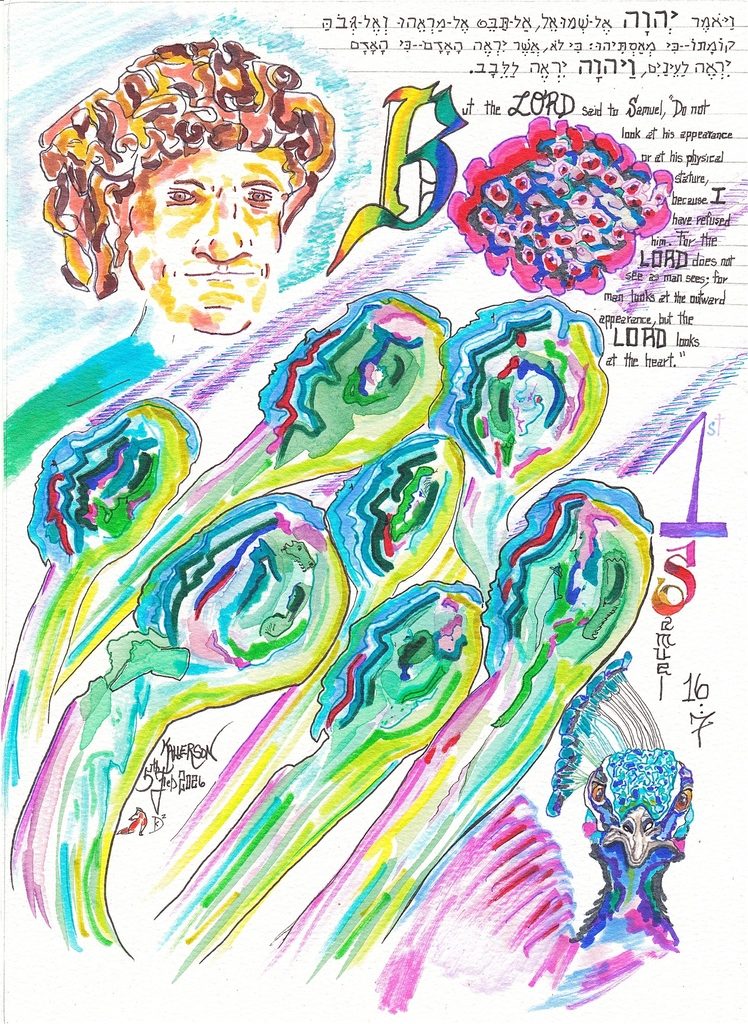
Cool stuff. Artwork by Douglas Kallerson.
1 Samuel 16:1-13
Arise! Anoint Him! Part I
(Typed 3 November 2025) As we know, first impressions can be completely out of whack with the reality of who a person really is. This is especially true if we are willing to accept people with whom we think we could never agree.
It’s also true with inanimate things. We may see a place, a restaurant, a little town, etc., and think, “What a dive.” And yet, we may find the restaurant has the best food in the universe and that the little town has more charm than Grace Kelly.
People come to this church, and their first impression is, “It’s a strip mall! I bet this won’t be a great place to attend.” Most of us have heard a story from someone who thought the Superior Word would be Loserville.
And yet, the compliments after attending have been many. Some even give assurances that the next time they are in town, they will come again. Many times, I have heard people exclaim how wonderful the congregation is. Someday, maybe they will give the same compliment about the preacher… someday, maybe. J
Samuel is going to meet David in this chapter. Before he does, he will go through a process of evaluating his brothers. His first impression will not be right, and the Lord will correct his thinking.
Text Verse: “So God created man in His own image; in the image of God He created him; male and female He created them.” Genesis 1:27
We are all prone to basing our opinions about people and things based on first impressions. Goliath did that, and it cost him the whole shootin’ match. One of the fundamental truths in Christianity is that all people bear God’s image.
Because of this, when we look down on someone else without knowing him, it is a failure to see the image of God in him. This shouldn’t be. James 3:9 says this explicitly, basing his statement on Genesis 1:27.
How we judge people later on, when we get to know them, will be based on their character. Normally, we should reserve making such judgments until we have an idea about who they are and what they are like.
It is true that some people’s actions allow us to know a great deal about them. But even then, we may find that they are acting out in an attempt to hide pain, trials, feelings of worthlessness, and so forth.
So let us reserve judgment as best we can when it is possible to do so. We may find surprising things by withholding what we might first think. Who knows, you may even find the storefront church you decided to attend turned out to be a place full of great folks, like those at the Superior Word.
Being careful to view others as God’s image bearers who need to be evaluated prudently is an important tenet found in His superior word. And so, let us turn to that precious word once again, and… May God speak to us through His word today, and may His glorious name ever be praised.
I. He Will See to the Heart (verses 1-7)
Now the Lord said to Samuel, “How long will you mourn for Saul, seeing I have rejected him from reigning over Israel?
vayomer Yehovah el shemuel ad mathay atah mitabel el shaul vaani meastiv mimelokh al yisrael – “And he said, Yehovah, unto Samuel, ‘Until when you mourning yourself unto Saul, and I, I spurned him from reigning upon Israel?’” This takes the reader back to the final words of the previous chapter –
“And not he added, Samuel, to see Saul until day his death. For he bewailed himself, Samuel, unto Saul. And Yehovah, He was sighed for He caused to reign, Saul, upon Israel.” 1 Samuel 15:35 (CG)
Despite Saul’s disobedience, Samuel had grown in affection for Saul. The entire situation deeply pained him, probably to the point where he returned home and moped around the place. Therefore, the Lord has to wake him out of his slumberous state. The Lord had rejected Saul, and that was that.
Samuel means Asked from God. Saul means Asked, but the spelling of his name is identical to Sheol.
1 (con’t) Fill your horn with oil, and go;
male qarnekha shemen velekh – “You must fill your horn – oil, and you must walk.” To Samuel, the meaning would be obvious. It was time to anoint a new king over Israel. The imperative verbs are intended to spur Samuel to action. He was lollygagging around while the Lord was initiating a new direction in the redemptive narrative.
In Scripture, the qeren, horn, is a symbol of prominence and power. By extension, having oil in it for anointing indicates the presence of the power of the Holy Spirit which is then specially highlighted in a particular place. This leads to the thought of dignity and honor.
Notice the difference between the two:
(And Yehovah, he denuded ear Samuel, day one to faces coming Saul, to say, 16 “According to the time, tomorrow, I will send unto you man from land Benjamin. And you anointed him to commander upon My people, Israel. And he caused to save My people from hand Philistines. For I saw My people. For it came, his shriek, unto Me.”) … And he took, Samuel, flask the oil, and he poured upon his head, and he kissed him and he said, “Not for He anointed you, Yehovah, upon His inheritance to commander? 1 Samuel 9:16 & 10:1 (CG)
And he said, Yehovah unto Samuel, “Until when you mourning yourself unto Saul, and I, I spurned him from reigning upon Israel? You must fill your horn – oil, and you must walk. I will send you unto Jesse – House the ‘My Bread.’ For I saw in his sons: to Me – king.” 1 Samuel 16:1 (CG)
A flask is made by a man. A horn comes from an animal created by God, even if prepared by man. The pakah, flask, is only seen again in the anointing of Jehu as king over Israel. Like Saul, he was anointed for a particular task but not as the ruler of the dynasty leading to the Messiah. However, this instance is different…
1 (con’t) I am sending you to Jesse the Bethlehemite.
No translation I know of gets the meaning: eshlakhakha el Yishai beith ha’lakhmi – “I will send you unto Jesse – House the ‘My Bread.’” The definite article placed after beith, house, demands such a rendering. The words are broken down as –
beith – house
ha – the definite article
lakhmi – my bread, eater, warrior, bread-ite (as in House the ‘Bread-ite’)
The final word without the vowel points is identical to “my bread,” found 8 times in Scripture. It is also identical to the name Lakhmi found in 1 Chronicles 20:5. That name signifies either Warrior or Eater. Both are derived from lekhem, bread.
Lekhem is derived from lakham, to feed on. By implication, it signifies to battle, as if a warrior is feeding on the souls of his enemy as he strikes them with the mouth of his sword.
Therefore, the name in this verse, which is found only four times in Scripture, all in 1 Samuel, means either House the Eater, House the Warrior, House the Bread-ite, or House, the ‘My Bread.’ Being the ancestor of Jesus, who is the Bread of Life (John 6:35), the meaning is clear. All four of these merge into one thought: God’s Messiah.
Three of the names are simple enough to understand in their relationship to Christ Jesus. However, the name House the Eater may be confusing since we haven’t been in Leviticus for a while. From the sermon on Leviticus 10:8-20 entitled Absolute Zero given on 9 July 2017, which is 8 years, 6 months, and 30 days (or 3136 days) ago as of 8 February 2026, this is what was said concerning verse 10:17 –
“In the eating of the sin offering, they [the priest] actually bore the guilt of the congregation, thus making atonement for them.
The blood was never taken into the holy place. If that had happened, then the animal would have been handled in a different way. But the blood had merely been cast out upon the altar of burnt-offering. In the eating of the flesh, they therefore actually took the sin of the congregation upon themselves for the purpose of canceling it, or making expiation for it.”
One can see the role of Christ as the “Eater” of our sin, devouring it and eliminating it once and for all. It highlights the doctrine of eternal salvation, right in the book of Leviticus.
Jesse means Yehovah Exists. But it also means My Husband. As such, the name Jesse contains the weighty notion that human marriage reflects divine revelation.
Notice that the Lord only gives the name of the father of the family. It would have saved effort to name the son of Jesse who would be selected, but that would leave out critical information that would reveal more of God’s redemptive plans. As such…
1 (con’t) For I have provided Myself a king among his sons.”
ki raiti bevanav li melekh – “For I saw in his sons: to Me – king.” Without a moment’s hesitation, one can see the dual meaning of these words. God is selecting a king to replace Saul, but He is also selecting a king for a kingdom that will rule Israel forever. Two excellently stated points on this clause are –
“The language is remarkable, and intimates a difference between this and the former king. Saul was the people’s choice, the fruit of their wayward and sinful desires for their own honor and aggrandizement. The next was to be a king who would consult the divine glory, and selected from that tribe to which the pre-eminence had been early promised (Ge 49:10).” JFB Commentary
“…the one was given in wrath, and the other in love; the one was to the rejection of God as King, the other to the rejection of Saul by the will of God.” John Gill
Both are spot on concerning the contrast between the two anointings. The Lord gave the people Saul when they rejected Him as their king. Next, He gives them what He wants through appointing the Davidic line leading to Jesus to (😝tee hee 😝) once again rule them as the King! The thought is breathtakingly astonishing.
Considering that Saul’s name in Hebrew is identical to Sheol, it is as if the Lord is handing them a choice concerning life or death. Speaking of Saul…
2 And Samuel said, “How can I go? If Saul hears it, he will kill me.”
vayomer shemuel ekh elekh veshama shaul vaharagani – “And he said, Samuel, ‘How I will walk? And he heard, Saul, and he killed me!’” Samuel anointed Saul as king. Despite his authority as the prophet and judge of the Lord, the king had the military ability to strike anyone. This is seen later in the history of the kings when a prophet came to correct King Amaziah –
“Therefore the anger of the Lord was aroused against Amaziah, and He sent him a prophet who said to him, ‘Why have you sought the gods of the people, which could not rescue their own people from your hand?’
16 So it was, as he talked with him, that the king said to him, ‘Have we made you the king’s counselor? Cease! Why should you be killed?’
Then the prophet ceased, and said, ‘I know that God has determined to destroy you, because you have done this and have not heeded my advice.’” 1 Chronicles 25:15, 16
Soldiers are normally dedicated to their leaders. If Saul killed Samuel, they would be hesitant to stand against him. Samuel’s fear, even at this early stage, is justified. Therefore…
2 (con’t) But the Lord said, “Take a heifer with you, and say, ‘I have come to sacrifice to the Lord.’
vayomer Yehovah eglath baqar tiqakh beyadekha veamarta lizboakh leYehovah bathi – “And He said, Yehovah, ‘Heifer, herd, you will take in your hand, and you said, “To sacrifice to Yehovah I came.”’” This is not a lie. If the Lord told him to take the heifer to sacrifice, and he does, then the word of the Lord is fulfilled. Even if there is another reason for going, that doesn’t negate the truth of this directive.
Like concealing of Saul’s anointing from the people of Israel, David’s anointing is to be kept from Saul, the leader of Israel.
The type of animal is an eglath baqar, heifer of the herd. The word eglah is a female calf, coming from egel, a male calf. They are derived from the same root as agol, circular, due to their frisking around. The word baqar, herd, is from a root signifying to plough or break forth. Figuratively, it means to seek out or inquire.
Using the sacrifice as a ruse to conceal the main purpose tells us that Samuel probably did this at other times in various locations. As such, it would be a common event that would not raise suspicion. Along with a general sacrifice, three things are to occur…
3 Then invite Jesse to the sacrifice,
veqaratha leyishai bazavahk – “And you called to Jesse to the sacrifice.” The first directive. The sacrifice is a zabakh, a slaughter. However, it signifies doing so for a sacrifice, which is then followed by a feast of the animal. Unlike the burnt offering, for example, which is wholly burnt to the Lord, it is a word used for all sacrifices eaten at a feast.
Being a feast offering, the animal belongs to Samuel, and he has the right to invite anyone he desires. Jesse is to be invited.
3 (con’t) and I will show you what you shall do;
veanokhi odiakha eth asher taaseh – “and I will cause to know, you, what you will do.” The second directive. The Lord will give the instructions at the time He determines. Next…
3 (con’t) you shall anoint for Me the one I name to you.”
u-mashakhta li eth asher omar elekha – “and you anointed to Me whom I will say unto you.” The third directive. The choice will be made by Yehovah. Samuel is not to act until the Lord speaks.
4 So Samuel did what the Lord said, and went to Bethlehem.
vayaas shemuel eth asher diber Yehovah vayavo beith lakhem – “And he did, Samuel, what He said, Yehovah, and he went – Bethlehem.” In obedience, Samuel got his horn, filled it with oil, obtained a heifer of the herd, and headed to Bethlehem, House of Bread, but with a secondary meaning of House of Battle (War).
4 (con’t) And the elders of the town trembled at his coming,
vayekherdu ziqne ha’ir liqrato – “(And they shuddered, aged the city, to encounter him.)” In contrast to all other translations, I have set this clause off as parenthetical. It is a statement of fact, but unless apart, it complicates the ongoing narrative. The reason they shudder is that Bethlehem was not on the normal rounds of Samuel –
“And he judged, Samuel, Israel all days his livings. 16 And he walked from day year in year, and he revolved – Bethel and the Gilgal and the Mizpah. And he judged Israel all the spots, the these. 17 And his recurrence the Ramah-ward. For there his house. And there, he judged Israel. And he built there altar to Yehovah.” 1 Samuel 7:15-17
If there was a need to meet Samuel, one would normally go to him, not the other way around. Therefore, there must be a pressing, and quite possibly distressing, reason for Samuel to come. If the people knew about the rift between him and Saul, they might suppose it to be the cause of worse tidings.
4 (con’t) and said, “Do you come peaceably?”
The addressee is in the singular: vayomer shalom boekha – “And he said, ‘Peace, you come?’” The elders were mentioned in the previous clause. As such, one would think it would be “And they said, ‘Peace, you come?’” This is unless one spoke for the whole. That is not unprecedented. But if the narrative continues with the previous clause as parenthetical, Jesse is the subject –
And you called to Jesse to the sacrifice, and I cause to know you what you will do. And you anointed to Me whom I will say unto you.” 4 And he did, Samuel, what He said, Yehovah, and he went – Bethlehem. … And he said, “Peace, you come?” 5 And he said, “Peace. To sacrifice to Yehovah I came. You must sanctify yourselves and come with me in the sacrifice.” And he consecrated, Jesse and his sons. And he called to them to the sacrifice.
5 And he said, “Peaceably; I have come to sacrifice to the Lord.
vayomer shalom lizboakh leYehovah bathi– “And he said, ‘Peace. To sacrifice to Yehovah I came.’” Samuel’s response is to Jesse’s question. “I have come in peace for the purpose of offering a feast sacrifice.” Therefore…
5 (con’t) Sanctify yourselves, and come with me to the sacrifice.”
hitqadeshu uvathem iti bazavakh – “You must consecrate yourselves, and you came with me in the sacrifice.” Not only has Samuel come to conduct a sacrifice, but he has done so with the intent of having Jesse participate in it…
5 (con’t) Then he consecrated Jesse and his sons,
vayqadesh eth Yishai veeth banav– “And he consecrated, Jesse and his sons.” This explains the previous clause. Samuel told them they must consecrate themselves, a statement of fact. Samuel is the one to direct, oversee, and/or perform this function. With that completed…
5 (con’t) and invited them to the sacrifice.
vayiqra lahem lazavakh – “And he called to them to the sacrifice.” Whatever the process for consecration, once it was complete, Jesse and his sons were then called to participate in the sacrifice, an idea implied in “to the sacrifice.” Upon their arrival…
6 So it was, when they came, that he looked at Eliab
vayhi bevoam vayar eth Eliav – “And it was, in their coming, and he saw Eliab.” Eliab is noted as the firstborn in 1 Samuel 17:13. His name means God is Father, or My God is Father. Jesse probably invites them to attend in birth order so that he can introduce them as they sit. Samuel notes Eliab excitedly…
6 (con’t) and said, “Surely the Lord’s anointed is before Him!”
vayomer akh neged Yehovah meshikho – “and he said, ‘Surely, afront Yehovah His anointed.’” Samuel thought this was the guy. It can be inferred that Saul was the firstborn of Kish (maybe his only son) from 1 Chronicles.
Eliab, being introduced first, would alert Samuel that he was the firstborn. The assumption, along with his appearance and height (which is implied in the next verse), would have supposedly made him a prime candidate. Such thinking, however, was erroneous…
7 But the Lord said to Samuel, “Do not look at his appearance or at his physical stature, because I have refused him.
vayomer Yehovah el shemuel al tabet el marehu veel gevoakh qomatho ki meastihu – “And He said, Yehovah, unto Samuel, ‘Not may you cause to gaze unto his appearance and unto elevation his height. For I spurned him.’” This is the error in thinking that Samuel and the people made previously –
“And they ran, and they took him from there. And he stood himself in midst the people. And he soared from all the people, from his neck and upward. 24 And he said, Samuel, unto all the people, ‘You saw whom He selected in Him, Yehovah. For naught according to him in all the people.’
And they caused to shout, all the people, and they said, ‘May he live, the king!’” 1 Samuel 10:23, 24
The assumption was, like Arnold Schwarzenegger’s biceps, that bigger is better. Saul was the tallest, so he must be a great guy. It is what is known as a source, or genetic, fallacy. However, the Lord’s thinking is never fallacious.
This tells us that His selection of Saul was one intended to teach the people a lesson and fulfill any necessary typology or relevant patterns the Bible deals with. However, it was not a selection of who best met the ideal of a sound king for His people…
7 For the Lord does not see as man sees; for man looks at the outward appearance, but the Lord looks at the heart.”
The clause is elliptical, rightly indicated by the NKJV: ki lo asher yireh ha’adam ke ha’adam yireh laenayim veYehovah yireh lalevav – “For not which he will see, the man. For the man, he will see to the eyes, and Yehovah, He will see to the heart.” God created man. He is aware of every aspect of every human. Our outward appearance is irrelevant to Him.
People take offense at the words of Leviticus, as if the Lord looks positively or negatively at people based on such considerations –
“Speak to Aaron, saying: ‘No man of your descendants in succeeding generations, who has any defect, may approach to offer the bread of his God. 18 For any man who has a defect shall not approach: a man blind or lame, who has a marred face or any limb too long, 19 a man who has a broken foot or broken hand, 20 or is a hunchback or a dwarf, or a man who has a defect in his eye, or eczema or scab, or is a eunuch.” Leviticus 21:17-20
This has nothing to do with the externals as indicated in 1 Samuel. Rather, two things were being taught to Israel. The first was the holiness of God in relation to sin, of which such defects are manifest in humanity. Second, it was that these men were types of Christ in His priestly duties.
Externals, such as those being dealt with in 1 Samuel, have no bearing on how the Lord looks at people. That is seen throughout the Old Testament, such as in Isaiah 56, when referring to the eunuch whose heart was obedient to the Lord.
“Do not let the son of the foreigner
Who has joined himself to the Lord
Speak, saying,
“The Lord has utterly separated me from His people”;
Nor let the eunuch say,
“Here I am, a dry tree.”
4 For thus says the Lord:
“To the eunuchs who keep My Sabbaths,
And choose what pleases Me,
And hold fast My covenant,
5 Even to them I will give in My house
And within My walls a place and a name
Better than that of sons and daughters;
I will give them an everlasting name
That shall not be cut off.” Isaiah 56:3-5
A King is coming to shepherd My flock
He will be humble and true of heart
In honoring Me, He will always take stock
And from My laws, He will not depart
Israel will not know Him at first
They will reject Him, thus turning from Me
But for His people, He will thirst
Waiting for them to receive Him, patiently
A shepherd King will rule Israel
And will bring many more into His flock
“He has done all things well”
And Israel will, in Him, finally take stock
II. He Anointed Him (verses 8-13)
8 So Jesse called Abinadab, and made him pass before Samuel.
vayiqra Yishai el avinadav vayaavirehu liphne shemuel – “And he called, Jesse, unto Abinadab. And he caused to traverse him to faces Samuel.” The wording gives the sense of a fashion show. To traverse means to cross. As such, he is coming into Samuel’s presence, crossing before him, and then passing to the other side.
Abinadab comes from av, father, and nadav, willing, as in “willing to share,” generous, etc. As such, it means Father of Liberality. As for Abinadab, well, he didn’t make the cut…
8 (con’t) And he said, “Neither has the Lord chosen this one.”
vayomer gam bazeh lo bakhar Yehovah – “And he said, ‘Also in this, not He selected, Yehovah.’” The communication to Samuel is immediate and completely understandable. However it came about, it was as clear as if it were audible. Like Eliab, Abinadab is rejected. Therefore…
9 Then Jesse made Shammah pass by. And he said, “Neither has the Lord chosen this one.”
vayaaver Yishai shamah vayomer gam bazeh lo bakhar Yehovah – “And he caused to traverse, Jesse, Shammah. And he said, ‘Also in this, not He selected, Yehovah.’” Shammah also doesn’t measure up. Jesse’s curiosity meter must have been set to max by this point.
Shammah is derived from shamem, desolate, stupefy (in a negative sense), make amazed, etc. That is from a primitive root signifying to stun. It means something like Desolation, Astonishment, or Horror. Abarim says, Appalling Desolation.
Having turned down these three, Jesse still has a quiver full to go. Therefore, they continue…
10 Thus Jesse made seven of his sons pass before Samuel.
vayaaver Yishai shivat banav liphne shemuel – “And he caused to traverse, Jesse, seven his sons to faces Samuel.” 1 Chronicles 2:13-15 lists only seven sons of Jesse, including David. This likely means that one died, although there are other explanations for this, such as one being the son of a concubine.
Regardless, seven have been noted at this time. Seven is the number of spiritual perfection. All seven were evaluated. However…
10 (con’t) And Samuel said to Jesse, “The Lord has not chosen these.”
vayomer shemuel el Yishai lo bakhar Yehovah baeleh – “And he said, Samuel, unto Jesse, Not He selected, Yehovah, in these.’” It is not known how much Samuel revealed to Jesse. Whether he told him the reason for the anticipated selection or that he said the Lord was looking for a particular person without regard to the reason is debated.
Either way, Samuel tells Jesse that none of these sons is the one selected. Therefore, he asks an obvious question…
11 And Samuel said to Jesse, “Are all the young men here?”
vayomer shemuel el Yishai khathamu ha’nearim – “And he said, Samuel, unto Jesse, ‘They completed, the lads?’” Samuel had to be wondering what was going on. He had asked for Jesse’s sons to pass before him as instructed by the Lord. And yet, the Lord kept turning each down, one after another.
Knowing that the Lord cannot be wrong leads Samuel to the one avenue not yet taken. For whatever reason, one of Jesse’s sons had not been brought before Samuel. The ball is again in Jesse’s court…
11 (con’t) Then he said, “There remains yet the youngest,
vayomer od shaar haqatan – “And he said, ‘Yet he left, the diminutive.’” The eighth son is like an afterthought to Jesse. “Oh yeah, I have one more. He’s the youngest of the lot. I… kind of forgot about him. My bad.”
11 (con’t) and there he is, keeping the sheep.”
vehineh roeh batson – “And behold! Pasturing in the flock.” The “behold” isn’t a place indicator as the NKJV implies. Rather, it is being used as a diminutive about David. “Not only is he the little guy, but he’s just a keeper of the flock. No need to concern yourself with that guy!”
The tson, flock, comes from an unused root meaning to migrate.
Despite Jesse’s dismissive attitude, Samuel disagrees…
11 (con’t) And Samuel said to Jesse, “Send and bring him.
vayomer shemuel el Yishai shilakhah veqakhenu – “And he said, Samuel, unto Jesse, ‘You must send-ward, and you must take him.” Samuel now knows that not all the sons have been presented. He also knows that the Lord had not chosen any of the first seven.
Therefore, the little guy out with the sheep must be called before the process can be considered complete…
11 (con’t) For we will not sit down till he comes here.”
Rather: ki lo nasov ad boo poh – “For not we will revolve until his coming here.” In other words, they will all sit around (savav) the table for the sacrificial meal. Once they sat, plates of food would revolve (savav) through the hands of those seated there. Therefore…
12 So he sent and brought him in.
vayishlakh vayviehu – “And he sent, and he caused to bring him.” Nothing is said of David being consecrated, but this isn’t a problem. Either he was consecrated before being brought in, or he didn’t eat the sacrificial meal. It doesn’t say he did, so that is a possibility. Either way, we can’t conclude that he wasn’t consecrated, only that he was brought in.
12 (con’t) Now he was ruddy, with bright eyes, and good-looking.
vehu admoni im yepheh enayim vetov roi – “And he, red, with beautiful eyes and good visage.” Other than being red, I’m really close on this one…
The first word used to describe David, admoni, is the same as that used of Esau in Genesis 25:25. The word comes from the same root as the verb adom, to be red. It can speak of the hair or the complexion.
Either way, the connection to Esau and what he typologically signified shouldn’t be missed. To understand why, take a break later and watch the sermons on Esau and Jacob from Genesis 25 and 27.
Next, David’s eyes are noted as yapheh, beautiful. This is from the verb yaphah, to be bright. Thus, to be beautiful. In the Bible, the eye is used to indicate one’s spiritual state, focus, and understanding.
It is used in reference to seeing spiritual truths or being blind toward them. This leads to the moral character or intentions of a person, such as referring to a good eye or a bad eye to indicate one’s level of generosity.
Lastly, his visage is considered good, as in pleasing.
12 (con’t) And the Lord said, “Arise, anoint him; for this is the one!”
The abruptness of each clause provides its own emphasis: vayomer Yehovah qum meshakehu ki zeh hu – “And He said, Yehovah, ‘You must arise! You must anoint him! For this he!’”
One can see the response to the three directives of verse 3 –
1And you called to Jesse to the sacrifice, 2and I cause to know you what you will do, 3and you anointed to Me whom I will say unto you.
1Arise! 2Anoint him! 3For this he!
Think about what has happened. Saul is rejected, while David is accepted. Saul was the tallest, soaring above the others, but from the littlest tribe. David is the diminutive one of Jesse, but from the biggest tribe. Saul was the firstborn, while David was the youngest. Saul was out looking for his father’s jennies, unclean animals. David was tending his father’s sheep, clean animals. And more…
13 Then Samuel took the horn of oil and anointed him in the midst of his brothers;
vayiqakh shemuel eth qeren ha’shemen vayimshakh otho beqerev ekhav – “And he took, Samuel, horn the oil, and he anointed him in midst his brothers.” It is clear that the family knows there is a purpose for David, whether Samuel told them what it was or not. Despite the view of some scholars, it seems unlikely that Samuel would have withheld this knowledge and yet anointed him in front of them.
Another contrast to Saul is seen in this clause. Saul was alone with Samuel when he was anointed. David is openly anointed before his brothers. When this took place…
13 (con’t) and the Spirit of the Lord came upon David from that day forward.
vatishlakh ruakh Yehovah el David mehayom ha’hu vamaelah – “And it surged, Spirit Yehovah, unto David from the day, the it, and upward.” Again, another difference between the two is seen. Saul was given three signs before he received the Spirit. Here, the Spirit surges unto David from that day, meaning at the moment of his anointing. With that accomplished…
*13 (fin) So Samuel arose and went to Ramah.
vayaqam shemuel vayelekh haramathah – “And he arose, Samuel, and he walked the Ramah-ward.” Samuel’s job is complete as regards anointing the new king. As such, he returned homeward to Ramah, Lofty Place.
There are contrasts between Saul and David, but the truth is that Saul was selected by the Lord, accomplished the Lord’s will in some regard, and pictured Jesus in a limited way.
Also, it was the Lord’s intention that there would be a king before David in order to continue the pattern of the second replacing the first, which is predominantly displayed in Scripture.
A new direction will be seen as the focus of 1 Samuel transitions from Saul to David, highlighting the latter from this point forward. The way God has structured Scripture is intended to get us to consider each story from many angles.
One of the commentaries I read while studying for this sermon noted –
“Wordsworth curiously considers these three successive unctions of David figurative of the successive unctions of Christ: conceived by the Holy Ghost in the Virgin’s womb; then anointed publicly at his baptism; and finally, set at God’s right hand as King of the Universal Church in the heavenly Jerusalem.” Charles Ellicott
Although I am not sold on that analysis and will have to consider it as the narrative continues, I never would have thought of it, not in a million billion thousand years. Wordsworth may be right. If not, we can be sure there is still a reason.
In all such things, we should challenge our minds as to why they are recorded. Make notes! Reread things as they come to mind. Be sure to ask the Lord to help you in your study and consideration of the word.
When you do, you will be rewarded. The Lord wants His word to be understood. Make a study of the word your daily habit. Start today! As for 1 Samuel 16, we’ll be back next week, the Lord willing, to finish up the chapter and see what all the detail is pointing to.
Until then, be blessed in all you do. Include the Lord in each thing that comes your way, and you will find a blessing in it. And be sure not to make rash judgments about those you encounter based on first impressions.
Let your first impressions of others be filled with grace. You may find that those you encounter will surprise you.
Closing Verse: “I have found My servant David;
With My holy oil I have anointed him,
21 With whom My hand shall be established;
Also My arm shall strengthen him.” Psalm 89:20, 21
Next Week: 1 Samuel 16:14-23 What a surprise! Nothing grim, it’s true… (Arise! Anoint Him! Part II) (34th 1 Samuel Sermon)
The Lord has you exactly where He wants you. He has a good plan and purpose for you. He is the One who abases the haughty and exalts the humble. He regards the lowly, and the proud, He knows from afar. So yield yourself to Him, trust Him, and believe His word. In this, He will do great things for you and through you.
1 Samuel 16:1-13 (CG)
And he said, Yehovah, unto Samuel, “Until when you mourning yourself unto Saul, and I, I spurned him from reigning upon Israel? You must fill your horn – oil, and you must walk. I will send you unto Jesse – House the ‘My Bread.’ For I saw in his sons: to Me – king.”
2And he said, Samuel, “How I will walk? And he heard, Saul, and he killed me!”
And He said, Yehovah, “Heifer, herd, you will take in your hand, and you said, ‘To sacrifice to Yehovah I came.’ 3And you called to Jesse to the sacrifice, and I will cause to know, you, what you will do, and you anointed to Me whom I will say unto you.”
4And he did, Samuel, what He said, Yehovah, and he went – Bethlehem. (And they shuddered, aged the city, to encounter him.) And he said, “Peace, you come?”
5 And he said, “Peace. To sacrifice to Yehovah I came. You must consecrate yourselves, and you came with me in the sacrifice.” And he consecrated, Jesse and his sons. And he called to them to the sacrifice.
6And it was, in their coming, and he saw Eliab, and he said, “Surely, afront Yehovah His anointed.”
7And He said, Yehovah, unto Samuel, “Not may you cause to gaze unto his appearance and unto elevation his height. For I spurned him. For not which he will see, the man. For the man, he will see to the eyes, and Yehovah, He will see to the heart.”
8And he called, Jesse, unto Abinadab. And he caused to traverse him to faces Samuel. And he said, “Also in this, not He selected, Yehovah.” 9And he caused to traverse, Jesse, Shammah. And he said, “Also in this, not He selected, Yehovah.” 10And he caused to traverse, Jesse, seven his sons to faces Samuel. And he said, Samuel, unto Jesse, “Not He selected, Yehovah, in these.” 11And he said, Samuel, unto Jesse, “They completed, the lads?” And he said, “Yet he left, the diminutive. And behold! Pasturing in the flock.”
And he said, Samuel, unto Jesse, “You must send-ward, and you must take him. For not we will revolve until his coming here.” 12And he sent, and he caused to bring him. And he, red, with beautiful eyes and good visage. And He said, Yehovah, “You must arise! You must anoint him! For this he!” 13And he took, Samuel, horn the oil, and he anointed him in midst his brothers. And it surged, Spirit Yehovah, unto David from the day, the it, and upward. And he arose, Samuel, and he walked the Ramah-ward.
1 Samuel 16:1-13 (NKJV)
Now the Lord said to Samuel, “How long will you mourn for Saul, seeing I have rejected him from reigning over Israel? Fill your horn with oil, and go; I am sending you to Jesse the Bethlehemite. For I have provided Myself a king among his sons.”
2 And Samuel said, “How can I go? If Saul hears it, he will kill me.”
But the Lord said, “Take a heifer with you, and say, ‘I have come to sacrifice to the Lord.’ 3 Then invite Jesse to the sacrifice, and I will show you what you shall do; you shall anoint for Me the one I name to you.”
4 So Samuel did what the Lord said, and went to Bethlehem. And the elders of the town trembled at his coming, and said, “Do you come peaceably?”
5 And he said, “Peaceably; I have come to sacrifice to the Lord. Sanctify yourselves, and come with me to the sacrifice.” Then he consecrated Jesse and his sons, and invited them to the sacrifice.
6 So it was, when they came, that he looked at Eliab and said, “Surely the Lord’s anointed is before Him!”
7 But the Lord said to Samuel, “Do not look at his appearance or at his physical stature, because I have refused him. For the Lord does not see as man sees; for man looks at the outward appearance, but the Lord looks at the heart.”
8 So Jesse called Abinadab, and made him pass before Samuel. And he said, “Neither has the Lord chosen this one.” 9 Then Jesse made Shammah pass by. And he said, “Neither has the Lord chosen this one.” 10 Thus Jesse made seven of his sons pass before Samuel. And Samuel said to Jesse, “The Lord has not chosen these.” 11 And Samuel said to Jesse, “Are all the young men here?” Then he said, “There remains yet the youngest, and there he is, keeping the sheep.”
And Samuel said to Jesse, “Send and bring him. For we will not sit down till he comes here.” 12 So he sent and brought him in. Now he was ruddy, with bright eyes, and good-looking. And the Lord said, “Arise, anoint him; for this is the one!” 13 Then Samuel took the horn of oil and anointed him in the midst of his brothers; and the Spirit of the Lord came upon David from that day forward. So Samuel arose and went to Ramah.