Friday, 23 October 2026
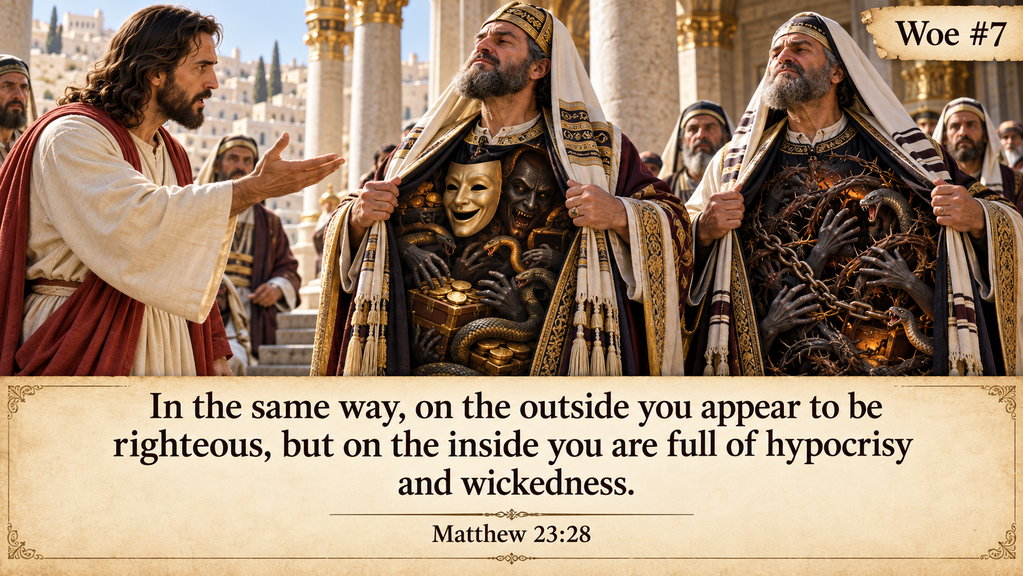
Even so you also outwardly appear righteous to men, but inside you are full of hypocrisy and lawlessness. Matthew 23:28
Note: You can listen to today’s commentary courtesy of our friends at the “Bible in Ten” podcast. (Click Here to listen)
You can also read this commentary, scrolling with music, courtesy of our friends at “Discern the Bible” on YouTube. (Click Here to listen), or at Rumble (Click Here to listen).
“Thus, also, you outwardly – indeed – you appear to the men righteous. Inwardly, also, you are replete – hypocrisy and lawlessness.” (CG)
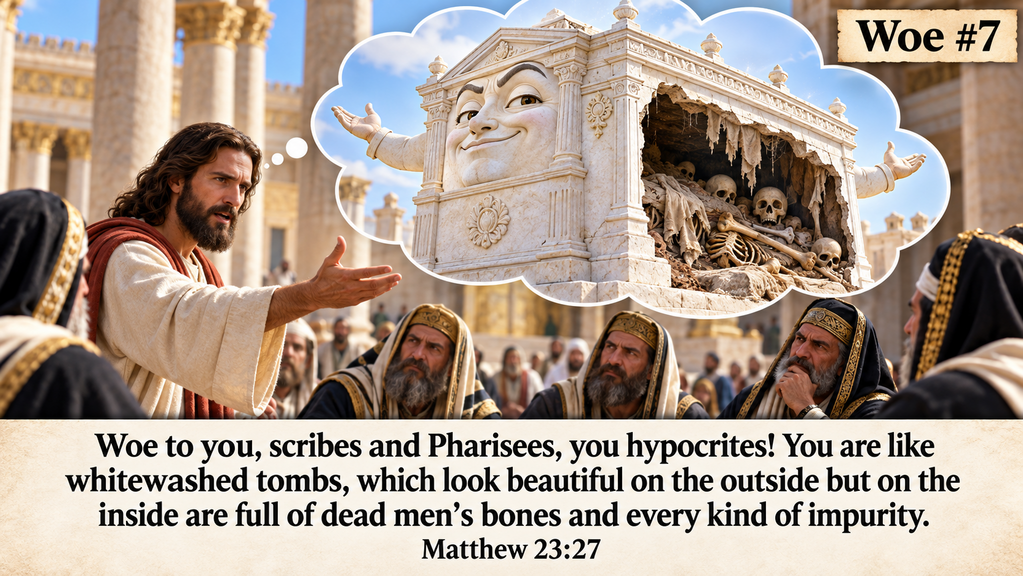
In the previous verse, Jesus began His seventh woe directed at the scribes and Pharisees, noting that they were like whitewashed tombs that look beautiful on the outside but are full of dead men’s bones and all uncleanness inside. He continues His words, saying, “Thus, also, you outwardly – indeed – you appear to the men righteous.”
Just as a whitewashed tomb seems innocuous enough, maybe even cheerful if adorned with flowers, the Pharisees had an outward appearance that seemed righteous. People are easily misdirected by externals.
They see meticulously lived lives, formal garments of pious religion, an unwillingness to touch anything unclean, etc., and they assume that the person is the same on the inside. But as often as not, it is just the opposite. As Jesus says, “Inwardly, also, you are replete – hypocrisy and lawlessness.”
A new word is seen here: mestos, replete. It can be literal or figurative. In the case of the Pharisees, they were replete with being double-faced. This included being hypocrites about the law that they were supposed to represent and uphold.
Jesus saw right through them and their wickedness, clearly pointing it out for others to understand as well.
Life application: Religious processions draw a lot of attention. The pope will have lines of people dressed in fancy garb carrying crosses while chants are heard from the choir. This puts on a great show, and it immediately fills people’s minds with a sense of true religion. How could God not be pleased with such a show of piety?
This follows through in lesser denominations. For example, the Episcopal church is big on these externals. They wear special flowing garments that shine like silk. Sewn into them are crosses and other “holy” symbols. They come to the altar with carefully selected tunes playing on an organ as they carry shiny crosses on wooden staves.
Once they are at the altar, arms are raised, and pious benedictions are spoken out over the people. It all seems so God-honoring in appearance. And yet, hanging outside on the same pole as the Christian flag, sometimes above that flag, are gay and trans flags. Their homilies lean toward a communist message, manipulating the Bible for extreme left-wing purposes.
Like the pope in the Vatican, they talk about ecumenism, something that immediately puts the way of man above the word of God. Though not politically established, their choice of wording leaves no doubt that they side with globalism, left-wing causes, and a one-world government hierarchy.
They preach tolerance, and yet, they are intolerant of those who disagree with their warped ideas and world outlook. It is not the externals that have any value. In fact, they only distract from what is truly good.
But this is not limited to mainstream denominations. One can look at how people conduct themselves on a stage in front of thousands of people in a mega church and see that this rings true as well.
There must be a standard by which God either approves of a church or not. And there is. That standard is set on how Jesus Christ is proclaimed and how the word of God is handled. Anything else is just show without substance. Be sure to know the Bible well enough to know when you are being led down a false path.
Lord God, help us to be wise in who we listen to and what we accept. There are many ways to present Your word, but what is said must conform to what it says. Help us to be prudent and responsible as we pursue You through our Lord Jesus Christ. Amen.