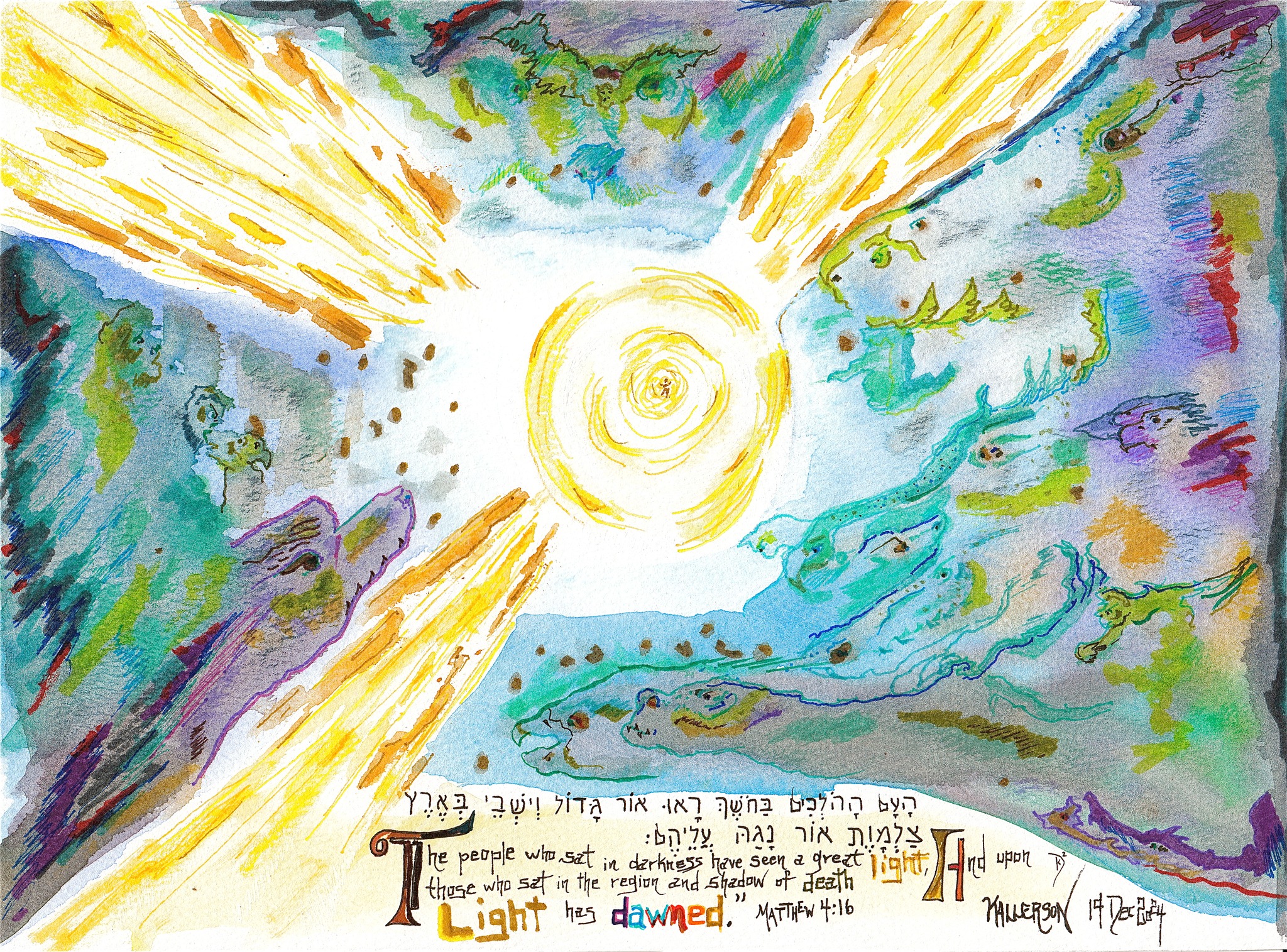
John 10:30 (I and the Father, We Are One) – 2025 Christmas Sermon

Artwork by Douglas Kallerson

John 10:30
(I and the Father, We Are One)

Who, He is, ‘image the God, the invisible,’ Firstborn – all creation. 16 Because in Him, it was created, these all, the ‘in the heavens’ and the ‘upon the earth,’ the visible, and the invisible, whether thrones, whether lordships, whether rulers, whether authorities. These all, through Him and unto Him, it has been created. 17 And He, He is before all, and the ‘all,’ in Him, it has been co-established. 18 And He, He is the Head, ‘the body, the out-calling,’ whom He is the beginning – Firstborn from dead, so that He might be, in all, He preeminencing.” Colossians 1:15-18 (CG).

(Typed 24 November 2025) At Christmas, people get excited for various reasons. In Japan, at least when I lived there forty years ago, people would get excited about the holiday. A week before Christmas, lights would go up everywhere. The stores were filled with special presents for the holiday while Christmas music filled the aisles of the stores. And you would be remiss if you didn’t buy a kurisimasu kaiki to celebrate.

At midnight, while everyone was digesting their kurisimasu kaiki as they slept, the lights were being taken down. By morning, you would never have known it was Christmas. In the US, it is no less vulgar. It just goes on a bit longer. Landfills overflow with shredded wrapping paper and less-than-ideal toys.

Some people get excited, even angry, about the day. Atheists sue, Muslims target, and legalistic, better-than-everyone-else Christians condemn those who would dare to celebrate a “pagan” holiday.

The timing of Christ’s birth wasn’t December! They quibble over the dating, hate their neighbor as they do, and miss the whole point of what the day signifies. If they checked the Feasts of the Lord recorded in the books of Moses, they would find that several of them coincide with pagan holidays. Add in the Feast of Dedication recorded in John 10:22, and they would see that it does too.

So there must be a reason why there is a closeness between the dating of God’s redemptive calendar and the general dating of other calendars.

Text Verse: “I and the Father, We are One.” John 10:30 (CG)

For clarity, Jesus was born on the Feast of Acclamation, recorded in Leviticus 23:23-25. That would have been the September-October timeframe. This means He was conceived right around the time of the Feast of Dedication, which corresponds to the Christmas timeframe on modern calendars.

So the day we are celebrating, though lost through time and because of a lack of understanding of what the Bible conveys, is not the birth of Jesus from the womb. Rather, it is the day Jesus was conceived in the womb, the very moment of the incarnation.

However, regardless of the day, and apart from how any saved Christian celebrates the day, meaning with understanding or ignorance about the details, we come together like those in Japan, to have a moment of celebration, a deviation from the routine, and to enjoy family and friends in a, hopefully, closer bond for a span.

The job of the preacher, my job, is to instruct you on how to more appropriately celebrate the day, or at least how to more fully understand what the day signifies. That way, even if you have traditions of various sorts that have nothing to do with the Bible, which is perfectly fine by the way, you will be directing your hearts and minds to the One who is ultimately the reason behind Christmas.

By carefully and contemplatively considering the words of Colossians 1 in relation to Jesus, it is incredible to ponder the magnificence of the moment of conception, followed by His life, as recorded in the Bible.

God had a plan. It was one set in His mind before a single thing beyond Himself existed. Before Creation, He was, just as He is today, and just as He will be forever and ever. In His state, there is perfect fellowship in Himself that was the impetus for going beyond Himself.

Knowing that He could share Himself with a creation of His design, while also knowing there would be a time of chaotic existence that would inevitably result from creating a cognitive, sentient being, He saw that the final result would be worth the intermediate stages of disorder, disharmony, and downright evil that would be realized in the process.

With this final goal in mind, and allowing for the interim chaos that had to be, He spoke the universe into existence. He then fashioned it to be filled with order and precision. From our perspective, there is harmony, grace, and a demonstration of love in how all creation works and in how the various parts interact with one another.

And yet, there are also chaotic events that constantly terrify us, swirling, erupting, and shaking our home planet. These tragedies, however, aren’t something unexpected to God, nor do they mean things are out of control, a common sentiment among those who deny God’s existence, leading them to their faulty conclusions concerning the matter.

What seems to be unmanageable and chaotic from one perspective may be perfectly proper from another. The old saying, “You have to break a few eggs to make an omelet,” means that the chaotic breaking of an egg can lead to a good (well, a yummy) end.

It is true that people die in accidents, wars, natural disasters, and from old age, but it is also true that if these things weren’t taking place, there would be no people from whom God could build a church.

It may seem cold and crass that a comparison between eggs and people has been put forth, but the Bible goes further, comparing people to clay jars, fashioned according to God’s will and to be used or disposed of according to that will.

We use things, be it eggs, clay jars, wood, hay, and straw, to provide examples of how things may be treated. These concepts give us understanding in other things. But more relevant to the matter is that we, as humans, tend to overvalue our importance in the grand scheme of things.

We are cognitive beings who understand things from our perspective. We are physical beings who have needs and desires. Therefore, when we interact with the world around us, things are perceived from our own limited perspectives and in relation to our hopes, needs, wants, desires, and so forth.

This naturally makes us self-centered. We look at the world and think, “I am me. I am important.” We also do this with those we are close to. “This is MY child, how dare God give him cancer!”, as if God owes us or our children health and ease.

We often also place high value on our pets, our houses, and our bank accounts, as if they have great importance. At the same time, however, we may hear of 250,000 people being swept away in an Indonesian tsunami and not think a thing of it.

When we see people dying in war, we will evaluate those deaths based on who we are rooting for. The soldiers who die on the other side “got what they deserved.” Can’t you see how limited we are in our thinking!

The soldier who was killed at 10:42 am had just left his family a few days earlier. He had hopes and dreams. He had a girlfriend and a good job with many friends. He had a special pet puppy, and he never hurt a thing. But he “got what he deserved,” according to the other “good” side of the conflict.

But he also had something else. He had Jesus. Unlike most of those around him, and most of those on the other side of the conflict, he had Jesus. The others, all with their own families and lives, had sin. Now, who is “getting what he deserves?”

According to the Bible, we all deserve death and eternal separation from God. Depending on how we live our lives, we deserve varying levels of punishment as well. We really overestimate our own value as human beings. To God, and apart from Jesus Christ, we have none.

But we also have the potential for great, even eternal value. The difference between the two is Jesus. Without Him in the mix, the creation of the universe, the formation of man, and the breath of life being breathed into his lungs is an exercise in futility, even vanity.

God could have remained in perfect fellowship with Himself and spared all the effort of setting things in motion. However, despite all of the things that from our perspective are bad, evil, wicked, painful, horrifying, and so forth, everything that is happening is intended to meet a good purpose –

“But as for you, you meant evil against me; but God meant it for good, in order to bring it about as it is this day, to save many people alive.” Genesis 50:20

While eggs are being broken, an omelet like we cannot even imagine is being made. And the entire process, from beginning to end, is centered on God Himself and His plan of making it come about. Colossians 1:15, speaking of Jesus Christ, says, “He is the image of the invisible God, the firstborn over all creation.”

Words have meaning, and those words cannot be disassociated from the context of what is being said in Colossians 1 without destroying the intent of the author.

Paul’s words there, and in the verses that follow, are precise. They are intended to cut through heresies that were already being introduced concerning Christ Jesus at that early date. In order for those at Colossae, and all believers in all ages since then, to understand proper Christological doctrine, he penned those words about Jesus Christ.

Paul says of Jesus, “Who, He is, ‘image the God, the invisible.’” The Greek word translated as image “assumes a prototype, of which it not merely resembles, but from which it is drawn.” It is then “More than a ‘shadow,’ rather it is a replication” (HELPS Word Studies).

This replication reflects what it is replicating for us to understand. There is a stress on the words, “image the God, the invisible,” to lead us to grasp that Jesus Christ is revealing that which would otherwise be unknown. This is the purpose of the incarnation.

God, who is love and who created with intent and purpose for fellowship beyond Himself, essentially replicated His being through the incarnation. It is more complicated and precise than that, but this is stated as a way of conveying the truth of God in Christ by Paul.

God’s perfections and His very Being are seen in Christ, being completely and accurately displayed in Him. This is explained in several different ways in the Bible. A few examples are –

“No one has seen God at any time. The only begotten Son, who is in the bosom of the Father, He has declared Him.” John 1:18

“He who has seen Me has seen the Father.” John 14:9

“I and the Father, We are One.” John 10:30 (CG)

What is being conveyed to us is that God is, but we cannot see Him. In order for us to understand Him in an intimate and personal way, He united with His creation in the womb of Mary, coming as Christ Jesus.

Therefore, He is the image, or replication, of what we could otherwise not see. He explains the Father to us because He is one with the Father, having come from the Father. The choice of wording Paul gives, and the many references elsewhere in Scripture, call out for us to believe that Jesus Christ is God, nothing less.

When referring to God, Hebrews 1:3 calls the Son “the brightness of His glory and the express image of His person.” Paul repeats that sentiment in 2 Corinthians 4:4. God is, and Jesus is God.

Jesus is also described as “Firstborn – all creation.” It is an interesting Greek word, prototokos, being derived from prótos, “first” or “preeminent,” and tiktó, “bring forth.” The German scholar Bengel says of this word, “Time is an accident of the creature. Therefore, the origin of the Son of God precedes all time.”

In other words, Paul is not saying that Jesus is the Firstborn of all that is created, but He is the Firstborn prior to all that is created. He is eternal, having issued from the Father and having preceded time itself.

Vincent’s Word Studies says of this word, “As image points to revelation, so first-born points to eternal preexistence.” This is logically supported by the words to come. If this were not true, then Paul could not continue with his presentation the way he does, and yet he will.

Moreover, the pattern used here in Colossians 1 is repeated in Hebrews 1 and John 1, showing that it is not a mistake by Paul, but it is rather logical and proper.

There is Christ, and then there is creation, which follows. Logically, Christ then is God, issuing from the Father prior to the creation of time itself, and having been in eternal fellowship with Him.

Understanding this inescapable truth, Paul next writes in verse 16, “Because in Him, it was created, these all, the ‘in the heavens’ and the ‘upon the earth,’ the visible, and the invisible, whether thrones, whether lordships, whether rulers, whether authorities. These all through Him and unto Him, it has been created.”

Saying “because” is given as an explanation of the previous verse, which refers to Jesus as “image the God, the invisible.” Verse 16 is given to explain and expand upon that. It is not that Jesus Christ is merely a knock-off copy of God. Rather, He is God, wholly and completely. Paul substantiates that by saying, “Because in Him, it was created, these all.”

We have read about God creating elsewhere, haven’t we? In Genesis 1:1, it says, “In the beginning God created the heavens and the earth.” The term “the heavens and the earth” is meant to be taken as an all-encompassing statement. Elohim created all things.

Elohim is the Creator; Jesus is the Creator. It is not hard to figure out what Paul is telling us. And more! The words “these all” (ta panta), being plural, provide a collective sense. This then signifies the entire universe, which includes all things.

From the atoms to the galaxies, all things were created by Him. Without the article in Greek, it would mean all things individually, but the article shows that it is all things collectively. He created, and all things came to be.

It is the same message written by John at the very beginning of his gospel, “In beginning, He exists, the Word. And the Word exists with God. And God, He exists – the Word” John 1:1 (CG).

It is the same message that is repeated in various ways and by various writers in both Testaments of the Bible. Logically, there can be only one Creator. Anything created by Him is then a contingent being, a created and dependent being that cannot create anything.

And yet, man has done everything possible to deny the deity of Jesus Christ in order to separate Him from what is said about Him. They have even added words into this verse in order to change the meaning of it, hoping to obscure what God has done in and through Jesus Christ.

As for Paul’s words of Colossians 1:16, in the words “was created,” the aorist tense denotes a specific, definite event which occurred in history. It wasn’t that there was a creation, and then a re-creation. Nor were there some things created, and then other things created later. Instead, all things were created, and they remain as the creation to this day.

As Paul continues, and as if his words were as yet insufficient to describe Jesus, he says, “the ‘in the heavens’ and the ‘upon the earth.’” Again, this is an all-encompassing statement concerning the totality of creation.

His words again return to Genesis 1:1, showing that everything created by Elohim was created by Jesus. Elohim is God, and yet, Jesus is God. It is not hard to figure out what Paul is conveying to us. But to ensure that even the dull of mind can figure it out, he continues, “the visible, and the invisible.”

We understand that “these all, the ‘in the heavens’ and the ‘upon the earth,’” includes things which cannot be seen, such as spirits. Everything in the material world, and everything in the spiritual world, is included in Jesus’ creative efforts. No angel exists apart from His work of creation.

And more, Paul continues with, “whether thrones, whether lordships, whether rulers, whether authorities.” Within both the spiritual and the earthly realms, there are levels of authority that govern the affairs of sentient beings. These were created by Christ Jesus. None exists apart from His authority in creation.

All things, and all levels of authority, are subordinate to Christ Jesus. As a qualifier to this, however, Paul elsewhere says –

“For ‘He has put all things under His feet.’ But when He says, ‘all things are put under Him,it is evident that He who put all things under Him is excepted. 28 Now when all things are made subject to Him, then the Son Himself will also be subject to Him who put all things under Him, that God may be all in all.” 1 Corinthians 15:27, 28

Jesus Christ is not above the Godhead. Rather, He is a member of it.

Paul finishes verse 16, saying, “These all, through Him and unto Him, it has been created.” He repeats the words ta panta, these all, in order to recapitulate what he had just said. The words, again being collective, speak of everything.

Nothing is left undone, and His creative efforts are all-inclusive. The scholar Lightfoot says, “The latter describes the definite, historical act of creation; the former the continuous and present relations of creation to the Creator.”

Paul’s words of this verse are so clear, so meticulously presented, and so obvious as to what they are relaying that even a dolt, nay – a sub-dolt – should be able to figure out what he is saying.

Paul is not merely implying that Jesus is God. Rather, his words make the claim explicit. But this doesn’t fit with the theology of heretics, and so they will actually change the word of God in order to deny what Paul is saying.

Think about that in relation to what was said earlier. Man, apart from Jesus Christ, has no value because man has sin. God understood that even what He has provided to instruct us on who He is and what He has done, meaning His word, would be manipulated by man to deny who He is.

And yet, we think we are the center of everything while denying the Creator of all things. Could a more poignant example of man’s true worth apart from Christ be seen?

As for Paul’s words, they continue in verse 1:17, saying, “And He, He is before all, and the ‘all,’ in Him, it has been co-established.” The words, again, are intended to highlight the deity of Christ.

The first clause is stated emphatically, And He, He is before all.” It is an unequivocal declaration that His existence precedes any and all creation. He, in the absolute sense, is the Creator because nothing precedes Him. Nothing. This includes space, time, and matter. It includes anything that may be apart from those things that we are wholly unaware of.

As only God existed before all things, then Jesus Christ is God. He is the One who spoke to Moses, saying, ehyeh asher ehyeh, “I will be that I will be” (CG). In other words, He is because He is. He is uncreated and exists necessarily, because there is existence. But it is not because there is existence, meaning the universe, that He exists.

Jesus Christ, Yehovah incarnate, is self-existent and dependent on no other thing. His claim in John 8:58 is more fully understood because of this –

“Amen, amen, I say to you, before Abraham was, I, I Am.” (CG)

Colossians 1:17 confirms the words of the previous verse, “These all, through Him and unto Him, it has been created.” If He alone is before all things, then He must be the Creator of all things. Only He is a necessary Being. All other things are contingent, dependent on Him for their existence and continuation.

But because only God is a Necessary Being, then Jesus must be God. This is further realized in the words, “in Him, it has been co-established.” In other words, everything was placed together, and everything continues to be held together by Jesus Christ.

The sentiment is restated by the author of Hebrews using the words, “and bearing these all, the utterance, the power through Himself” Hebrews 1:3 (CG). The universe (these all) was created by Him. Being contingent, it is also dependent on Him at all times for its continued existence.

This shows us that He is God, who alone is absolutely necessary. He cannot not exist. All other things could simply not be. But God alone must exist. This is the Being who Paul says Jesus Christ is.

As the Bible teaches that God is also Father and Holy Spirit, we are being instructed in the doctrine of the Trinity. It helps explain why God created. He is capable of fellowship. He created in order to extend that fellowship beyond that which exists in Himself. It is an inescapable result of accepting the words of Scripture when taken at face value.

As for Paul’s words, they continue, breaking from the creation model and stating something beyond the wildest imaginations of man. And yet, the words are fully in line with the preplanned purposes of God, which existed before He spoke a single thing into existence. Paul writes, “And He, He is the Head, ‘the body, the out-calling,’ whom He is the beginning – Firstborn from dead, so that He might be, in all, He preeminencing.” Colossians 1:18

Jesus was presented in relation to the creation. He existed before it and above it. He created it, and He has sustained it since its creation. The words refer to Him being preeminent in all ways in relation to creation.

In verse 1:18, He is presented in relation to the church, a body which came forth out of the creation, and which is formulated from what He has done in creation. Paul emphatically says that “And He, He is the Head, ‘the body, the out-calling.’” (CG).

The emphatic “He” is given as a parallel to His being the image of God. The One who is the image of God is He who is the Head of this newly derived body. There is parallelism running between the two thoughts, which will be built on by Paul.

The people of the world are all a part of the creation, but because of the fall and because of free will within man, not all of those in creation have acknowledged God. However, within the stream of humanity, God has called out a group who acknowledge Him. Those in this group have become members of His body.

Paul deals with this in the book of Ephesians, where a stress is placed upon the unity of the body. Now he places the stress on the preeminent position of Christ within the body. Jesus Christ is the Head of this group, the out-calling, meaning the church.

While speaking of Him, Paul says, “whom He is the beginning.” As He is the One who created all things, so He is the beginning of the new thing which God has done within the creation. In this body, which is called out of the world, Christ is the beginning of it, being “Firstborn from dead.”

This is where the parallelism finds its true anchor. It is between Christ’s position in relation to creation and His position in relation to the church. He is “Firstborn – all creation” as was seen in verse 15, and He is “Firstborn from dead.” The two thoughts place Christ Jesus in the preeminent position in all things.

However, there is a point that must be considered. Though Christ is the firstborn of both, His status in relation to the church differs from His status in relation to creation. He is the Firstborn from the dead, having been One who was… dead, just as those who come after Him also die. However, though He is the Firstborn over all creation, He is not a part of the creation.

In other words, it shows the magnitude of what Christ, the Creator, was willing to do in order to identify with those He has called. He was willing to participate in the most humiliating aspect of all in order to fellowship with us.

Death is the result of sin. He was willing to take our sin upon Himself and die. Having no sin of His own, He had to resurrect. It is impossible that it could be otherwise. Peter exclaimed in Acts 2:24 that it was not possible that Jesus should be held by death.

In His resurrection, He carried our sin away through His death, leaving it in death so that we might follow Him in life. He is the Firstfruits from the dead. He is the Pattern for all who will afterwards arise from the dead.

But this refers to the resurrection, not merely a reanimation. Others have been reanimated to life. It happened to Lazarus. It has happened in hospitals throughout the world as well. Those people died or will die again.

On the other hand, what happened to Jesus is of another order entirely. His was a resurrection. It is a permanent restoration of life because of a spiritual connection with God. The power is that of an indestructible life. When Lazarus was raised, this wasn’t the case. His life was and remained destructible because his sin debt had not been dealt with. As such, there was no spiritual connection with God.

Jesus died. His death was a destructible death, but it was not destructible for Him. He had and always retained the spiritual connection to God. Jesus’ death was a substitutionary death. He vicariously died for our sins.

In His dying for our sins, sin no longer has mastery over us. Therefore, anyone who comes to Jesus by faith has the spiritual connection with God restored. Because of this, our death is not a destructible death, except for the physical body that our souls bear.

Jesus is the First of the resurrection, coming forth to eternal life. For those who come to Him, death, meaning spiritual death, is conquered in Him. Therefore, all who are in Him are spiritually alive in God.

Whether in relation to creation, or in relation to the church, Christ is first so “that He might be, in all, He preeminencing.” As Vincent’s Word Studies states, “He became head of the Church through His incarnation and passion, as He is head of the universe in virtue of His absolute and eternal being.”

In all things and in all ways, Jesus Christ is the first. He holds the position of absolute preeminence. But this also teaches us a truth about ourselves. Jesus is the Head of the body, the out-calling of God. A body is something united. It is a whole that has many parts, but it is a whole.

This is why Paul uses the term “in Christ” again and again in his writings. He is making a point concerning us. Paul repeatedly says, “God in Christ.” However, he also says, we are “in Christ.” In other words, Christ, the Messiah, is the tie that binds between the two.

God has united Himself with His creation, not only in the incarnation of Jesus, but He has also done so with us through Jesus. Jesus is the One who stood in our place in death. As such, He is the One who has restored us to life. In this, God has sealed us, in Christ, with the sealing of the Holy Spirit.

What does this have to do with Christmas? It means that the fellowship of family, something we celebrate at Christmas, is brought to an entirely different level because of what Christmas signifies.

God united with His creation on this celebratory day. It was with the intent of forming a family to fellowship with. He considered what the act of creation meant, including trials, sadnesses, disasters, and death, and He knew that it would be worth all of what we consider “evil” to proceed.

Joseph said to his brothers, “…you meant evil against me; but God meant it for good, in order to bring it about as it is this day, to save many people alive.” God knew what the devil would do. He intended evil against God, but God meant it for good.

A purpose for all the bad in the world is being served. Every time someone responds to the good news of God in Christ by responding to the gospel, God’s ultimate plan of a forever family is being realized.

God is not unconcerned about the trials and sadnesses of humanity. But they are a reality that must exist in order for His plan to come about. For those not in Christ, there are almost an infinite number of reasons why it is so.

The time, location, conditions, and attitudes of our existence all bear on whether we will be in Christ or not. A person who was born at an inopportune time will never have the chance of hearing or responding to the gospel.

A person born in an area that is not evangelized because money, access, and resources made it impossible for it to take place will never have the opportunity as well.

It may be that the conditions in a country, such as North Korea, make it impossible for the gospel to be shared. This isn’t God’s fault. Rather, it is how things happen. Why would we blame God if we got in a car and had an accident?

We choose to own cars. We voluntarily get into them knowing the conveniences and the risks. Would we be happy if God said, “You cannot have cars?” Likewise, we appoint leaders. It is the way the world is set up. North Korea has its leader because that is the way it is. God is not to blame.

Likewise, people have their own attitudes and dispositions. There are 8.5 million people in New York City. The vast majority of them have heard of Jesus. Many of them have in-depth knowledge of Him. And yet, only a small portion of them have accepted His offer of peace with God.

Is God to be blamed for that? None of these things shows either an incompetent or an uncaring aspect of God. The fact that He sent Jesus, with the specific purpose of dying for sin, indicates that He cares about sinful human beings.

Don’t overestimate your value in God’s eyes. But don’t dismiss it either. The potential in you, because of Christ, is what matters. You have a choice this Christmas. Accept the offer of God’s Son, given for You in the Person of Jesus Christ.

If you do, you will be the pearl of great price that Jesus was willing to sell all for. It is your faith in Jesus that will make it so. The world is filled with flawed, useless pearls that God will not deal with. But there is one, the people who have faith in Jesus, for whom He was willing to sell everything.

This is the kingdom of the heavens that Jesus speaks of, and you can be a part of it because of the Christmas Child that God gave for the sins of the world. Be sure to receive what He has done today.

Closing Verse: “Now there were in the same country shepherds living out in the fields, keeping watch over their flock by night. And behold, an angel of the Lord stood before them, and the glory of the Lord shone around them, and they were greatly afraid. 10 Then the angel said to them, ‘Do not be afraid, for behold, I bring you good tidings of great joy which will be to all people. 11 For there is born to you this day in the city of David a Savior, who is Christ the Lord. 12 And this will be the sign to you: You will find a Babe wrapped in swaddling cloths, lying in a manger.’
13 And suddenly there was with the angel a multitude of the heavenly host praising God and saying:
14 ‘Glory to God in the highest,
And on earth peace, goodwill toward men!’” Luke 2:8-14

Next Week: 1 Samuel 14:15-30 Pretty yearny, like skies so sunny… (A Journey – the Honey) (27th 1 Samuel Sermon)

The Zeal of the Lord of Hosts

Unto us a Child is born
A time to rejoice and not to mourn

Unto us a Son is given
The One to lead us from death to a’livin’

And the government will be upon His shoulder
Every eye will see Him; every soul will be His beholder

Upon the throne of David and over His kingdom’s realm
To order it and establish it with judgment and justice
From that time forward, even forever – He at the helm
The zeal of the Lord of hosts will perform this

And His name will be called Wonderful
The Counselor and Mighty God is He
Everlasting Father, Prince of Peace, pure and white as wool
Of the increase of His government and peace, no end shall we see

Do not be afraid, for behold
I bring you good tidings of great joy
Which will be to all people, forever told
The wondrous story, the birth of a Boy

For there is born to you this day
In the city of David, a Savior, it is He
Christ the Lord, whom heaven’s hosts obey
The Messiah has come, and now you may go and see

And this will be the sign to you:
You will find a Babe wrapped in swaddling clothes
Lying in a manger, a glorious view
The Christmas Child whom our Heavenly Father bestows

A Child like no other has come to dwell among us
He shall lead us in paths of righteousness for His name’s sake
And His name is called out, His name is JESUS
Come, and of the Heavenly Child partake

He is God’s gift and heaven’s treasure
He is Immanuel – God with us
And He bestows upon us grace without measure
The Christmas Child, our glorious Lord – JESUS!

Hallelujah and Amen…
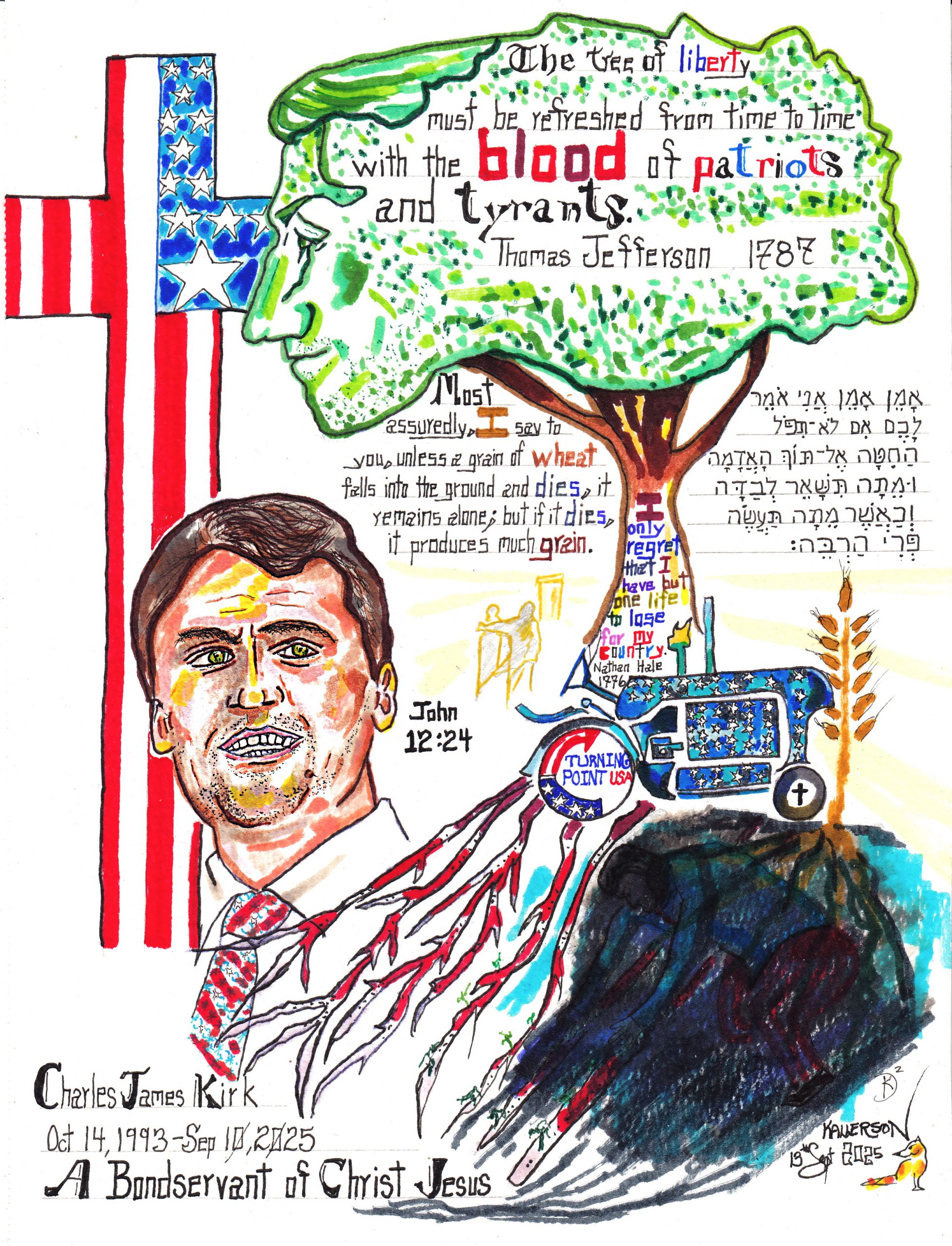
 

Freedom in the Balance – Charlie Kirk’s Life and Sacrifice

Artwork by Douglas Kallerson

Freedom in the Balance – Charlie Kirk’s Life and Sacrifice

As sad as what happened on Wednesday is for those who love freedom in its many areas of our lives: religion, political leanings, public discourse, employment choices, etc., it would be a mistake to assume that what took place in the assassination of Charlie Kirk was the silencing of a voice.

Rather, his voice will be multiplied through the event in many ways. His proclamation of Christian principles, combined with reasonable, moral, political conservatism, will come, once again, to the forefront of the American public. How the public embraces it is the big question.

We tend to become fickle rather quickly. In World War II, we used our intelligence and resources to develop a weapon that was capable of ending the war and saving, what is believed to be, millions of lives.

In a short span of time, those who second-guess every choice or who disapproved of the way the action was taken infiltrated the media, condemning the nation while continuing to enjoy the benefits that are derived from it.

After the attack on 11 September 2001, the nation flew flags everywhere. Wherever you were, little flags adorned cars in the streets, and people stood in unity against what happened. No sooner had we as a nation met the enemy, engaging those who attacked us, than the usual voices were raised about how terrible we were for doing so.

After the horror of 911, Pat Tillman of the Arizona Cardinals was impelled to leave his beloved and lucrative game to join the US Army. He served honorably in Iraq and Afghanistan, but was killed by friendly fire in 2004. Morally deficient voices on the left openly applauded his death as if he were the enemy.

Just 24 years after the Islamic attack, New York City is facing its greatest crisis ever with the prospect of electing a communist as its mayor. He openly rejects the core principles of our nation, arrogantly rejects the law set in place to protect its citizens, and ludicrously denies that he is one of the privileged he claims to be opposed to.

How quickly we forget the efforts of those who brought us to where we are at any given time! Instead, we accept the lies of those who intend real harm to our society, assuming that because they are in positions of power or influence, they should be trusted.

Rather, they eloquently project their own wickedness on others in an effort to hide who they really are. We need clarity of thought to see through what they are doing, something lacking in the masses who are busily engaged in work, family, and living their daily lives.

Charlie Kirk possessed this clarity and, without malicious words or demeaning conduct, he clearly stated what is right, moral, and proper. This cost him his life, but it will cause others to speak out more boldly, offering an alternative to the unbelievably vile hatred and evil-speak of those on the left.

Of those rabid voices, thousands upon thousands of gleeful social media posts rejoicing in Charlie’s assassination have filled the internet. The democrats in the US Congress actively booed the call for, and then tried to kill, a moment of silence to remember Kirk’s life and death.

The legacy media openly reveled in his execution on numerous occasions, claiming that Charlie’s “violent rhetoric” brought about his murder – just desserts for spewing so-called “hatred.”

Two of hundreds of vile news articles will give you a sense of this, and who is behind it in this nation:

Survey Finds ONE IN THREE College Students Think Some Level of Violence is Acceptable to Stop Campus Speech They Don’t Like

Young Woman Who Witnessed Charlie Kirk’s Assassination Says Liberals in the Crowd Were CHEERING After He Was Shot

How did we come to the point in this nation where this type of vile conduct has come about? Each year or so, for many years, I have revisited the words of Florida US Congressman Syd Herlong’s extension of remarks read into the proceedings of the US House of Representatives on 10 January 1963 entitled Current Communist Goals.

In his remarks, he cited 45 points by which the communists planned to overthrow the government of the United States. Rather than a shooting war they could not win, they understood the vacillating nature of the American public and set forth a long-term agenda to obliterate the fundamental underpinnings of our nation.

A majority of those goals have been realized. Several of them were overcome by events on the world stage. Rather than reading the list, a mere four of them will explain to you what the impetus behind Charlie Kirk’s assassination was –

  1. Get control of the schools. Use them as transmission belts for socialism and current Communist propaganda. Soften the curriculum. Get control of teachers’ associations. Put the party line in textbooks.


  1. Present homosexuality, degeneracy and promiscuity as “normal, natural, and healthy.”


  1. Infiltrate the churches and replace revealed religion with “social’ religion. Discredit the Bible and emphasize the need for intellectual maturity which does not need a “religious crutch.”


  1. Eliminate prayer or any phase of religious expression in the schools on the ground that it violates the principle of “separation of church and state.”


A fifth point was steadily pursued, and it was successfully realized in the past 20 years, becoming a major part of this political assassination –


  1. Capture one or both of the political parties in the United States.


Charlie Kirk was first and foremost a Christian. However, if he were just sitting in the pews on Sunday morning, no attention would have been focused on him. Sunday morning Christians are not the problem, and they can be dealt with easily enough when full communism has taken over the nation.

Directives to kneel, followed by an inexpensive bullet to the back of the head, will take care of such people if they refuse to recant. This has occurred millions of times in communist countries. Anyone who thinks this won’t happen here does not understand the nature of the spiritual and political battle being waged.

Along with being a Christian, Charlie Kirk was as much of an educator as he was anything else. He may not have been in a classroom teaching, but he was actively engaged in debating the religious, moral, and civil conduct of the people of this nation.

Innumerable times during the previous democrat administrations, conservative personalities who were scheduled to speak at colleges and universities have been shouted down, riots have taken place, sit-in protests have been held – all to keep these conservatives from being able to engage in public discourse.

The democrat party applauded the “bravery” of these miscreants while the wholly-infiltrated administrations, the DoJ, and the FBI did nothing to stop these violations of the rights of those conservative speakers. With a new administration completely set against this communist agenda in place, and with high fines and penalties for such conduct, universities have been forced to allow these voices to speak.

Unfortunately, the educational system has so brainwashed the youth of this nation, that they now feel their only remaining recourse is to climb on top of a building, point a gun at the head of the lover of freedom, honor, morality, and dignity, and pull the trigger, thus silencing the voice who simply wants to debate the moral ramifications of people’s decisions.

Charlie Kirk’s educational aspect focuses on just that, meaning the morality and civil dignity of humans. But standing against “homosexuality, degeneracy, and promiscuity as ‘normal, natural, and healthy’” cannot be tolerated in a society racing towards a supposed communist utopia.

Those who think this way don’t realize that right after the Christians, it is those who practice homosexuality, degeneracy, and promiscuity who will be the next ordered to kneel as the brave new society spends another five cents on each bullet used to eliminate them. Useful idiots, as Vladimir Lenin called them.

These communist points for taking over the nation were exactly what Charlie Kirk spoke against. And yet, being 31 years old, he probably wasn’t even aware of Syd Herlong’s extension of remarks. He probably died without realizing the magnitude of the forces set against what he stood for.

Of all of Syd’s points, the most important of them was number 27, “Infiltrate the churches and replace revealed religion with ‘social’ religion. Discredit the Bible and emphasize the need for intellectual maturity, which does not need a ‘religious crutch.’”

This is something Alexis de Tocqueville carefully warned America about in his study Democracy in America. He stated that religion “should be considered the first” of the nation’s “political institutions,” urging the necessity for Americans to “maintain Christianity…at all cost.”

Whether Charlie Kirk knew of Tocqueville’s writings or not, he understood this as an absolute necessity for the nation to survive. Unfortunately, “religion” under the umbrella of Christianity does not necessarily mean moral, biblical, God-honoring religion.

This is what the communists understood. And so they have taken full advantage of infiltrating first the seminaries and then the churches of the nation. During the sixties, the infection of this agenda slowly crept into America’s schools. By the time of the Vietnam War, the left had so taken over the minds of many young people that they were unwilling to identify with the nation at all.

Many headed north to avoid the draft. But many of them found a way of avoiding the draft while still benefiting from life in the United States. By entering the seminary, they were exempt from the draft. And so, an entire generation of ideologically perverse people was being led by professors who never cared at all about the cause of Jesus Christ.

What does one do when he graduates from seminary? He becomes a pastor, preacher, or priest. The churches who pay well belong to the larger denominations. Free housing, congregants who idolize their spiritual leader, susceptible sheep willing to listen without checking, and a steady paycheck. The recipe for disaster was set.

Since the 1970s, all large denominations have been partly or completely overtaken by these moral minuscules. Many denominations are Christian in name only. Their message is one of presenting “homosexuality, degeneracy and promiscuity as ‘normal, natural, and healthy.’”

If you don’t believe it, drive by any church in the modern “mainstream denominations. The chances are high that along with an American flag (well, often not even that) there will be a “pride” flag, a trans flag, BLM flags, etc.

Every un-American, anti-God value that can be snuck into Sunday’s sermon is introduced. Adherence to biblical values is non-existent, and the name of Jesus Christ is blasphemed as the person in the pulpit, wholly unqualified to be there, by the way, preaches “tolerance” as if it is an all-inclusive virtue. Charlie Kirk’s assassination, and ten thousand other abominations against faithful Christians, say otherwise.

Jesus, citing Isaiah, said of the foes of rightness at His time –

“These people draw near to Me with their mouth,
And honor Me with their lips,
But their heart is far from Me.” Mark 15:8

This is what we see in modern, mainstream, denominations. In undermining the Bible, Christianity itself is undermined. The worship of Jesus Christ is no longer the preeminent factor of going to church. Rather, social justice and progressive liberalism have replaced that. Their day of judgment will not be pleasant. Again, as Isaiah said –

“Woe to those who call evil good, and good evil;
Who put darkness for light, and light for darkness;
Who put bitter for sweet, and sweet for bitter!” Isaiah 5:20

A disastrous day lies ahead for these people.

Though it is unlikely that those on the left will ever cede an inch, it does not mean that faithful Christians should give up. It is our responsibility to continue to press forward. And more, it is a sacred obligation.

Jesus didn’t get to Calvary and call down twelve legions of angels to save Himself. The eternal destiny of all of humanity was on the line. That truth has not changed to this day. Though the act is accomplished, the path is clear, and access is available, unless it is proclaimed, no change will take place in the human heart.

Christians cannot sit idly by and remain silent. Having said that, there are others who will peevishly stand down from speaking out. It is sad but true. The opportunists of the world will be vocal until the time of persecution comes. When it does, they will fade into the background, never having really believed in, or maybe cherished, what they espoused.

For such, their supposedly deep moral convictions come down to safety, a reasonable stream of income, a position of power or influence, or a combination of any or all of these. Remove the true inspiration for their “moral stand,” and they will quickly bolt from it.

In politics, Dick Cheney is a great example. He was supposedly a sound, moral, Republican who would never have tolerated what the left pushed on the American public… well, until his younger daughter came out as a lesbian. Then his true moral soundness began to be revealed.

When his older daughter participated in one of the greatest attempts at overthrowing our government in the history of this nation, he fully revealed where he stood in his moral thinking. Is allegiance to family members where our morals are derived from?

Congress is elected for a reason. We vote for our representatives and senators based on what they say. Unfortunately for those on the right, what they have said and what they then did have almost always been completely at odds.

This is obviously true with most presidential candidates as well. They move to the center, lie as much as possible concerning what type of a president they will be, and they then immediately begin to reveal their true colors when they enter into office.

The greatest deceiver of them all was the one who, though untruthful in everything he said, mostly just avoided talking about his agenda. The things he said on the campaign trail were platitudes intended to lull the public into thinking he was the right guy for the job.

In fact, if you listen to his speeches, yes he lied, but he did it in a way that could be excused as typical political jargon. But this Satan of the political realm was elected, taking his oath of office (and I gag at even saying that) on 20 January 2009.

The son of a dyed-in-the-wool communist, and one who spent his life pursuing the communist agenda, took care of the things that were partially accomplished or wholly left undone as detailed in Syd Herlong’s list. He pursued them with reckless abandon.

Probably never in the history of the world, to include Sodom and Gomorrah or ancient Greece, were the forces of perversion and moral turpitude opened up in a society as they were under him. The power of the presidency was brought to bear against the foundational principles of the nation he swore to defend.

To him, the constitution was a “living organism” that meant whatever he decided. It was at this time that the true character of the democrat party began to be seen. A political party had, in fact, been captured – communism had taken it over. Unfortunately for them, the American public had had enough and chose a different path in 2016.

However, because of the pen of Barack Obama, the government itself had become so infested with those who swore allegiance to the cause he espoused, that it was not difficult to completely hamper the progress of the then-sitting president, Donald Trump.

An entire agenda of fabricating evidence against him was enacted from the Obama White House before he departed. The highest form of treason our nation could experience was realized. From that steppingstone, the power of the democrat-led Congress continuously stymied President Trump’s ability to enact any meaningful change in this nation.

In just four years, and with the ability to sway the next election through deception on a scale never before imagined, Obama would, once again, be in power. With the ability of big tech, and a CDC so sold out to the democrat party that its employees openly wept the day Donald Trump was elected, a plan was devised.

I need not tell you what it was. We all lived through it. Billions of people were utterly deceived over an event that changed the course of world politics and defined just how far governments could go to restrict the rights of their citizens. A global test case on how to control the masses.

The inevitable loss of the presidency for Donald Trump followed, and the lawfare began. Any other person in history would have signed the document, surrendered to the golf course, and kept his mouth shut until he died. But Donald Trump is not a normal person.

He is sold out to the American dream. All you need to do is go back and watch the innumerable videos of his younger years, and you will understand the man. He has his piece of the pie, but he wants it for everyone in this nation.

And so, while Barack Obama was enjoying his third term as president, presiding over a person that Donald Trump called braindead during the 2020 elections (so obvious it was even then), Trump was fighting off the power of the entire US government that was directed against him.

In case after case, he was vindicated. During this period, the left was certain of two things: 1) Joe Biden could not last a second term, nor could he win a second term, and 2) Kamala Harris was as sold out to the Obama agenda as anyone on the planet.

The gamble was made, the cards were laid down, and Joe Biden put his pen to a few of the only pardons that bore his actual signature out of the 4,245 that bear his name. He then submitted his removal from the ballot and frittered away his final days in office while Barack Obama prepared for his fourth term in office.

Donald Trump, however, spurred the masses on, telling them that they needed to come out in such numbers that even cheating couldn’t win. And he did. He won. The left underestimated his ability to stir the people, and they way overestimated the abilities of the wholly inept Kamala Harris.

When Obama walked into the Capitol Rotunda on Inauguration Day 2025, he whispered words to George W. Bush that were supposedly secret, but … well, there are lip readers at every such event. He said to Bush, “How do we stop this?” Bush laughed and knew that things were going to change. If you doubt this, go watch the video.

And there is a change in how President Trump has dealt with his second term, isn’t there? With a Republican House and Senate, the left can do pretty much zero to stop the tide of good news that has spread across our government for these past nine months.

And, as I noted before, congress is elected for a reason. Many on the right have frittered away the years, getting rich while squandering our heritage. They would be doing that right now, but the overwhelming tide of President Trump’s abilities have forced them to finally align with the values of those who voted for them.

At the same time, those on the left – every single one of them with the surprising exception of John Fetterman – have proven several things. There is not a single stand that they hold to –, moral, judicial, civil, or political – that is in line with the founding principles of this nation. They have fully revealed what they believe, what they want, and what is necessary to attain their goals.

Stopping here for a moment, one might say, “What is a pastor doing giving a political speech from the pulpit while discussing the assassination of the chief executive officer of Turning Point USA? If you think this is a political speech, you have not been paying attention.

Christianity is a religion, the one true religion, BTW. It stems from God, who ordained Jesus Christ to go to the cross before the foundation of the world. From there, the message has gone throughout the world. But the world is divided by people groups, cultures, and nations.

These were ordained by God, and they exist by His will. Daniel 2:21 says that God removes kings and raises up kings. God has ordained that we live in a world of this design. We as people cannot disassociate our religion from our existence within a society, which includes civil, judicial, and moral precepts.

Alexis de Tocqueville understood this. Many past presidents understood this. And Charlie Kirk understood this. He was fully aware of the fact that he was a target for assassination. It was made known to him again and again. But he knew that his voice in speaking out was more important than whatever would happen to him. In his life, he was the Lord’s. In his death, he is the Lord’s.

As for President Trump, I personally question if he is truly saved or not. Recent comments tell me that if he is, he is theologically confused about his state of salvation. That is easy enough to correct if someone would just sit down with him for fifteen minutes with the intent of smoothing that issue out for him.

Regardless of his personal state, he fully understands that the Christian message is the binding tie between the nation and its citizens. In nine months, he has done more to restore the Christian message and the Christian faith within the government than anyone in generations, maybe since our founding as a nation.

Our ability to freely exercise our faith was under such heavy attack since the inauguration of Barack Obama that, were it not for the Supreme Court of the United States, preaching from the full counsel of Scripture would no longer be tolerated in this nation.

Hence, there has been a continuous call over the past four years, even within the administration, to either dismantle or pack the Supreme Court. That was a step that the left realized may lead to their own termination at the rising up of Christians, and so it didn’t happen. But we are one election away from facing exactly that.

How does God raise up kings and establish nations? He does it through people. That was clearly evidenced in the writing of Thomas Jefferson and signed by a group of men on August 2, 1776, at the Pennsylvania State House, now known as Independence Hall.

Brave men, mostly led by Christians, either from the pulpit or from soap boxes, have spurred the nation to act time and again during periods of war or national crisis. Today, we are in a national crisis, but the forces of evil are not found attacking from without. They are attacking from within.

Donald Trump understands this. Charlie Kirk understood it, and his stand cost him his life. His wife will not see him again this side of glory, and his children have been bereft of their father because he understood and acted.

And he understood it exactly as I just explained it. We as Christians cannot separate our faith from the environment in which we live. When that happens, the results are evident from a mountain of past nations that have done just that.

The people either hide from the inevitable persecution they will face, give up on their faith because there is no one willing to stand and defend it, or they nobly and resolutely get on their knees and await their execution, something that has happened hundreds of thousands of times in Africa in recent years.

It has happened throughout the world, in fact. The great purge of Christians among peoples and nations, and even within the church itself, is a testament to our need to never give up in the face of iniquity. Just minutes before he was shot, Charlie Kirk was handing out MAGA hats.

As much of a political movement as it is, MAGA in the United States today is the only thing that has spared Christianity from the machinations of Barack Hussein Obama and those allied with him. Their idea of democracy is to remove the rights of those they disagree with so that their idea of democracy can exist.

If you don’t believe this, you haven’t been reading the quotes of people on the left, including politicians and media personnel, over the past four days. The execution of Charlie Kirk has been a cry for more. What was Rolling Stone’s Response to this? People Are Losing Their Jobs for Criticizing Slain ‘Free Speech’ Advocate Charlie Kirk.

The only people losing their jobs are those who either don’t have the right to say what they say while in their particular job, such as members of the US military, or those who work for people who will not tolerate threats against other human beings, finding them incompatible with the values of whatever entity the individual works for.

Charlie Kirk had nothing to do with this. Their own inability to realize that what they are peddling is not acceptable is what caused those people to lose their jobs. This is evident from the subtitle to their article, “Journalists, publicists, and college faculty have been fired after calling the right-wing influencer a divisive figure and making light of his assassination.”

A company, news media, or school cannot promote such speech without paying dearly for it. But this is how the left thinks because they have been steeped in communist ideology for over sixty years now.

Whether you agree with my words today or not, Charlie Kirk died because he believed in the agenda of Donald Trump. And the reason he believed in it is because Donald Trump is the only man to have the intestinal fortitude to do what he has done.

If you are to believe Scripture, then you must avow that God raised up Donald Trump for a time such as this. Charlie Kirk understood, he accepted God’s hand in the process, and he joined it to secure a safer, more promising future for Christians in this nation.

His death may have exactly the opposite effect. Only time will tell how the left will respond to the momentum of President Trump’s push to restore our nation. And it may be that the US House or both bodies will be lost in the next election.

If so, the nation will come to a screeching halt as innumerable, bogus counts for impeachment are brought to bear against the president once again. No wonder he is working feverishly to control and restore the electoral process that has been so stunningly manipulated by the left, even since the time of John Kennedy’s win over Richard Nixon.

Chicago’s dead were raised to vote democrat in that election. That has increased to a nationwide phenomenon, which was multiplied to an astonishing number in 2020, something not repeatable in 2024 because the receipts were in. But unless the voter rolls are secured, it will inevitably happen again.

In 1 Timothy 1, Paul says –

“But we know that the law is good if one uses it lawfully, knowing this: that the law is not made for a righteous person, but for the lawless and insubordinate, for the ungodly and for sinners, for the unholy and profane, for murderers of fathers and murderers of mothers, for manslayers, 10 for fornicators, for sodomites, for kidnappers, for liars, for perjurers, and if there is any other thing that is contrary to sound doctrine.” 1 Timothy 1:8-10

Think about what Paul says. The law is not made for a righteous person. The law, any law, is given to secure the unrighteous, ungodly, profane, murderers, and so forth. This is just why the left has been so blatant in ignoring the laws of the United States over the past four years and why they continue to do so today.

What Joe Biden did concerning immigration was unlawful. What the sanctuary cities have done and are doing is unlawful. What DAs and prosecutors are doing in liberal cities is unlawful. What schools are doing with our own children in these same cities is unlawful.

These things are not just ignoring what is commonly held as good or moral. They are violations of existing laws. In ignoring the laws, they are attempting to absolve themselves of the responsibility for their murders, thefts, ungodliness, and so forth.

However, this is the reason for government. It is intended to enforce the laws that exist. Donald Trump is not violating anyone’s rights by rounding up illegal aliens. Rather, he is enforcing the law. It is the same law that was broken by the previous administration, and which nobody on the left even thought about condemning.

Why? Because in agreeing with the agenda, they solidify power, prepare to assume total control, and then rid themselves of those who disagree with them. One five-cent solution at a time until they have cast off their foe. And in casting them off, they no longer have the accusing finger of the Creator pointing at them from the pulpit each Sunday.

Well, at least the pulpits that are willing to steel themselves against the onslaught of wickedness, perversion, and assassination coming against them. Charlie Kirk was a man of principle. His principle was in conformity with the morally proper ideology of Donald Trump in relation to the running of this nation.

If you want to know why Charlie Kirk died, it is because they missed twice with President Trump. Charlie Kirk had the freedom to engage in public discourse because decisions to change the moral direction of this nation came down from the top of our government. By now, the left would have eliminated Charlie’s ability to meet as he did this past week.

And the top of our government, whether you like it or not, was directed by God in accord with His sovereign rule over the nations. On July 13, 2024, President Donald Trump survived an assassination attempt while speaking at an open-air campaign rally near Butler, Pennsylvania.

We can certainly glean two things from that event. First, that God wanted him alive for His purposes. Second, every time Donald Trump looks in the mirror or scratches his right ear, he is reminded of that fact. Charlie Kirk’s time is over. But his memory will be long in being forgotten.

Donald Trump’s time continues, and with the resolve of the sacrifice of Charlie Kirk to bolster him, he will continue to press on in securing the freedoms we possess as Christians and as citizens of this nation. May God protect and bless him, and may God bless and protect this nation according to how we honor Him.

That is a scary petition when we were so close to having lost our right to do so because of those who hate Him, despise His word, and revile the name of His Son, the name which is above every name, and the name to which all knees will bow – Jesus Christ our Lord.

Amen.


Revelation 5 (Worthy Is the Lamb Who Was Slain)

Artwork by Douglas Kallerson.

Revelation 5:12
Worthy Is the Lamb Who Was Slain

Read Revelation 5
(Typed 24 March 2025) Religious pluralism is defined as “the acceptance and coexistence of multiple religious beliefs and practices within a society, emphasizing that various religions can provide meaningful paths to spiritual fulfillment and fostering tolerance and understanding among diverse faiths” (AI Overview).

In a nutshell, religious pluralism teaches that different, even contradictory, religions are equally valid and provide their own suitable and acceptable path to restoration with God.

Religious syncretism is defined as “the blending of different religious belief systems or the incorporation of beliefs from one tradition into another, often resulting in a new or modified religious practice or belief system” (AI Overview).

Religious syncretism is a pick-and-choose approach to religion – “This aspect of this religion is appealing, and so I will add it to my approach to religious expression.” For example, the Roman Catholic Church has adopted this path throughout the centuries.

Such expressions include Santeria, Haitian Voodoo, Kongo Syncretism, etc. Indigenous festivals are observed, various local confessions and approaches to healings are maintained, and native sacred objects are incorporated into the faith.

A stunning example of this was seen in 2019 when the Pope held the Amazon Synod at the Vatican. At that gathering, the Andean fertility goddess Pachamama was revered and adherents were welcomed to bow before the carvings in reverence, prayer, and petition.

The Pope himself acknowledged the deity and held his own observances of it in the Vatican Gardens.

Text Verse: “So shall He sprinkle many nations.
Kings shall shut their mouths at Him;
For what had not been told them they shall see,
And what they had not heard they shall consider.” Isaiah 52:15

Such practices by the Pope and others are not unique to Roman Catholicism. They are more pronounced, however, because of the size, scope, and authority of the denomination in the world.

Because of its worldwide presence, the world views Roman Catholicism as the leader of the Christian faith, and they see the Pope as the ultimate representative of it. Therefore, his acceptance of pluralistic and syncretistic doctrines allows people to more readily accept such teachings.

There are a variety of reasons why pluralism and syncretism are accepted within religions and societies. One is an attempt to provide harmony between otherwise warring factions. Religious battles have led to the deaths of innumerable people over the millennia.

Other reasons include control, power, accumulation of wealth, naivete, a refusal to acknowledge that God has the right to judge according to a set plan that is exclusive of personal merit, etc.

The list could go on and on because, for every person who wants to do his own thing, there must then be an allowance for that new thing if pluralism is to remain valid.

But there is a problem within this greater framework of hoped-for global kumbaya. That problem is the truth that various religious expressions do not allow the practice of other religions. They make exclusive claims that are at odds with the idea of pluralism.

This is certainly true with Islam, for example. However, one of the allowable tenets of Islam is that it is acceptable for adherents to lie in order to further the goals of the faith. Therefore, as Islam enters into societies, unless it simply takes over by the sword and subdues its foes, adherents can make claims that are untrue in order to meet their ultimate goals.

For this reason, among others, Islam is given a pass in societies and is gathered into the fold of naïve pluralistic societies that desire peace and security while demonstrating their tolerance for those who are “less fortunate,” “oppressed,” etc.

The real stickler for the world, therefore, is not the slow and carefully plotted overtaking of the world by Islam or even communism, which is its own sort of religious expression. Rather, the stickler is found in adherents to Scripture as is recorded in the Holy Bible. They are those who refuse to bow their knee to the concept that “all paths lead to God.”

This is intolerable to a society and a world that is supposedly marching toward a state of complete tolerance. Unfortunately, when there is something intolerable blocking such a goal, it must be eradicated. The book of Revelation details what will happen to those who refuse to bend their knee to this “tolerant” society that is yet future to us now.

Reading Revelation 5, one can see how incompatible the true Christian faith, meaning accepting Jesus as Lord and Savior, is to religious pluralism. This has not gone unrecognized in Christian societies.

Over the years, those who refuse to accept Christ, who are unqualified to minister, or who just don’t care about proper theology have entered into the ministry, causing Christianity to degrade.

Some have entered with the set goal of destroying sound churches from within. It has been a constant battle in all Christian-centered Western societies.

As soon as the reformation got its foothold in one area or another, someone would begin the march toward weakening the faith of the various denominations and churches. In America, the freedom of religious expression allowed Christianity to bloom in an amazing way, seemingly securing it from any such decline.

But the very mechanism that has allowed freedom of religion has helped bring the faith to a state of complete confusion. For example, Joseph Smith had the same book in his hand that Dwight Moody held. Mormonism is Christian in name only, but that name allows it to be considered under the Christian umbrella.

Even churches that started out doctrinally sound but later want to deviate from biblical precepts are slowly allowed to do so without a great deal of controversy, except by those who hold to a proper evaluation of Scripture in its intended context.

For example, the first woman to be ordained as a Protestant minister in the US, Antoinette Brown Blackwell, set a precedent that is unbiblical. However, the event became the first of an unstoppable tide of apostasy from what is biblically acceptable. Despite that, someone had to ordain her, and so the corruption was already in place before the day of her ordination.

Since then, churches and denominations have continued to degrade from adherence to Scripture to the point where many are, like Mormonism, Christian in name only.

Their rites and rituals gather together people who have never experienced the saving message of grace that is found in Jesus Christ. Instead, they are led astray into what Paul would call the “doctrines of demons.”

Pluralism, syncretism, and the loosening of doctrines within the church for the sake of accommodation have brought the Christian faith to a state of high confusion and moral degradation that can only be corrected through a return to the acceptance of and adherence to Scripture alone for the conduct and faith practice of adherents.

That is not expected to take place before the Lord comes for His church. Rather, that is just a note of how it could come about for those who care enough to depart from the false religious expressions they have been following.

Because of the high level of biblical illiteracy in our nation, people looking for a church here in Sarasota, for example, may decide on Sunday morning to go to a Mormon church or a Kingdom Hall of Jehovah’s Witnesses because it is close and convenient.

Without knowing anything about the Bible or what it proclaims, they may enter the doors of such a church, think it represents the Christian faith, and spend the rest of their lives never coming to know Jesus Christ for who He is and what He has done to redeem man.

When considered in its intended light, Revelation 5 reveals a truth that is undeniable. This truth spans all nations, cultures, societies, and people. It also spans all ages since the first man walked on earth. Verse 3 said that no one in heaven or on the earth was able to open the scroll or look at it.

Buddha could not do so. Confucius could not do so. Muhammed could not do so. No pope, priest, or preacher could do so. No king, prime minister, or president could do so. Nobody could.

The words signify total unworthiness. No person within any religious or societal structure that has ever existed was found worthy. Not only could none take it in his hand or loose its seals, but all were deemed unworthy to even take a momentary glance at the scroll.

The state of either positional or moral unworthiness of all beings in creation excluded such a glance. Angels, for example, may be morally qualified, but their position as spirits excludes them.

Humans may be positionally qualified, being of the seed of Adam, but their moral state as fallen beings who have inherited original sin excludes them. None are found worthy. The list includes these categories:

  • No one in heaven – No human being who has ever lived and who is currently in the heavenly realms is qualified. Enoch, the seventh man from Adam, was translated directly to heaven because he “walked with God” – unworthy. Elijah, the great prophet of Israel, also went directly to heaven in a chariot of fire – unworthy. No angel in heaven as well. Due to their state in creation – unworthy.
  • No one on the earth – Think of the people on the earth today whom you may admire. A great evangelist – unworthy. The US president – unworthy. Some other noted pastor or politician – unworthy. You – unworthy. Me – unworthy. Repeat this for the other 7 or 8 billion people on earth – all unworthy.
  • No one under the earth – Every human who has ever existed since the creation of Adam and who is now resting in the dust from which they came. Just think about it! Great men of God, great world leaders, missionaries, evangelists, heroes of the Bible – all unworthy.

And not only are we all unable to open the scroll, but we also aren’t even worthy to look at it.

All humans have inherited Adam’s sin directly in three ways: Legally – we are legally in Adam because He is our federal head. Potentially – the very fact that we could exist as human beings brings us into direct contact with Adam. Seminally – all humans who actually exist (from the very moment of conception) are stained with Adam’s sin, having inherited it as a result of the fall. Death, which is the wages of sin, proves this. Even infant babies aren’t excluded.

As an important note, this verse disproves the immaculate conception of Mary. If Mary were born and had remained in a sinless state, then she would be… worthy. But no one, including Mary the mother of Jesus, is found worthy according to Revelation 5.

This frightening passage should leave all of us humbled. We have no claim to boast before God because we are unworthy. No wonder it says that John wept bitterly. He literally burst into tears. As the NKJV renders it, “So I wept much.”

In the Greek, the pronoun is emphatic, while the verb is in the imperfect tense. One might say, “And I, even I, just kept weeping exceedingly.” When he realized the state of man before the holiness of God, he understood the eternal disconnect that stood between the two.

What seems like an easy walk in the presence of God while on earth is found to be a catastrophic, unhealable wound when standing before Him in heaven. John wept uncontrollably “because no one was found worthy to open and read the scroll.”

The contents of the scroll remain securely closed from the eyes of all men. The inheritance lost by Adam is left unattainable. The words here have a sense of finality, like those of Leviticus 18:5 –

“You shall therefore keep My statutes and My judgments, which if a man does, he shall live by them: I am the Lord.”

The promise was made. Men born under the law came and went, year after year. There were prophets, kings, priests, and holy men who lived under this law, and yet they all died. The grave received them and held them firmly in its grasp.

Because of the lack of worthiness in humanity, only life in a fallen world, followed by death and separation from God, is the result. The contents of the scroll are to remain forever out of the reach of the fallen sons of Adam. The infection of sin has precluded life from continuing either under the law or apart from it. Woe is the state of man without the intervention of God’s Christ!

What Revelation 5 has implicitly referred to is the doctrine of original sin. The effects of sin have permeated every person who was ever born. Only a sinless being would be qualified to replace the failings of Adam. But where would such a person come from?

Humans come from humanity. Humanity is stained with Adam’s sin. The equation seems to rule out any possible remedy. John’s pained tears continue to flood the minds of people to this day because they are recorded in God’s word.

We can look back on an ocean of tears that have flowed around the entire globe as new translations are prepared for people to read and consider their complete unworthiness before God. However, in hearing the gospel and understanding its message, hope is restored for those who understand what God has done for them.

This is because the message to John concerning his tears was, “Do not weep.” If the unworthiness to open the scroll of those in creation is what brought John to his current state, then the words “Do not weep” must provide a remedy to that state.

Without stopping to allow John to question why, the elder continued his words, saying, “Behold, the Lion.” In Scripture, the lion signifies various things depending on the type of lion and how it interacts with the surrounding context.

However, John’s mind probably would have immediately scanned his knowledge of the Hebrew writings and focused on one particular reference. This is because the elder continued with the words “of the tribe of Judah.”

This wasn’t an actual lion then, but a metaphor for a Man, one who would come through, Judah, the fourth son of Israel. Every Jew who attended the synagogue would be familiar with the prophecy –

“Judah is a lion’s whelp;
From the prey, my son, you have gone up.
He bows down, he lies down as a lion;
And as a lion, who shall rouse him?
10 The scepter shall not depart from Judah,
Nor a lawgiver from between his feet,
Until Shiloh comes;
And to Him shall be the obedience of the people.” Genesis 49:9, 10

The elder’s words clearly identify the One being spoken of as the fulfillment of the prophecy from Genesis 49. John is being reminded of Scripture. In remembering the word of God, the downtrodden soul can refocus on what is good, right, and hope-filled.

This reminder may have then reminded John of other messianic prophecies seen in the Hebrew Scriptures, such as the promise of an everlasting throne being bestowed upon the line of David in 2 Samuel 7. It is to Judah that these great promises were made. Thus, this Lion of the Tribe of Judah is the fulfillment of those prophecies.

As a confirmation of this, the elder further describes this Lion as “the Root of David.” As a note, this term is often wrongly applied by scholars to say that Christ is a root that springs out of David. This is incorrect.

A root is the basis for what springs out of it. A seed first goes down into the soil to find anchoring and moisture. From there, the roots are established, and the plant then proceeds upward.

Elsewhere, the Messiah is called a Branch, signifying One who would come from a plant, extending out. This would be a descendant. In this case, however, the Root refers to One who comes before.

Thus, not only does this One descend from Judah (and obviously from David who was given the kingly promises), but He is the Source of David – the Root. This is confirmed later in Revelation 22 where Christ says He is both “the Root and the Offspring of David.” It is what is referred to in Matthew 22 –

While the Pharisees were gathered together, Jesus asked them, 42 saying, “What do you think about the Christ? Whose Son is He?”
They said to Him, “The Son of David.”
43 He said to them, “How then does David in the Spirit call Him ‘Lord,’ saying:
44 ‘The Lord said to my Lord,
“Sit at My right hand,
Till I make Your enemies Your footstool”’?
45 If David then calls Him ‘Lord,’ how is He his Son?” 46 And no one was able to answer Him a word, nor from that day on did anyone dare question Him anymore.
-Matthew 22:41-46

In His words, Jesus was showing that not only was the Christ to come from David, but He is also the Creator of David. It is of this One that the elder next calls out, saying that He “has prevailed to open the scroll and to loose its seven seals.”

The Greek word translated as “prevailed” signifies to overcome, overpower, or stand victorious. It is a word that implies the fighting of a battle. This One has been in a battle, and He has prevailed. In His prevailing, He has earned the right “to open the scroll and to loose its seven seals.”

That which was sealed and inaccessible could now be made manifest. The Lion of the tribe of Judah, the Root of David, has been found worthy! John, cease your tears. Let your heart rejoice, and in your rejoicing, multitudes will rejoice with you. There is hope!

What appeared to be a loss for humanity has become a victory, but only because of the intervention of God. The incarnation of Jesus Christ was the only hope for man because all men are conceived in sin through Adam, receiving his fallen nature.

All of the other beings in creation – be they spirit or animal – are in a different category, and they are unworthy to accomplish for man what man had to do. And so, Jesus came through a woman (He is fully Man) and by the Holy Spirit (He is fully God).

In this, He did not inherit Adam’s sin. He was qualified to accomplish the task set before Him. From there, the gospel shows that He was also capable of doing so. He was born sinless, and He lived without ever sinning.

In this, He prevailed. He is the great King, the Lion of the tribe of Judah. He is JESUS! And He has come to claim what is rightfully His. And yet, when He is to receive His scroll, the heavenly scene suddenly changes.

There, in the midst of the throne, it says there is “a Lamb as though it had been slain.” The words are paradoxical. How can a Lamb be standing despite being as if it had been slain?

The word translated as “Lamb” is the diminutive form of a sheep, thus it is a little lamb. There are two aspects to this then. The first is innocence. In the sacrificial system of Israel, this was what was required for the Passover lamb –

“Your lamb shall be without blemish, a male of the first year.” Exodus 12:5

Further, the same thing is said of the twice-daily offering at the tabernacle/temple –

“Now this is what you shall offer on the altar: two lambs of the first year, day by day continually. 39 One lamb you shall offer in the morning, and the other lamb you shall offer at twilight.” Exodus 29:38, 39

A first-year lamb conveys the idea of innocence. It is weak, cannot protect itself, and would normally follow its mother along, needing her to direct its every step. This one, however, is “as though it had been slain,” using the word sphazó. It signifies butchery for food or sacrifice.

Being in the midst of the throne, the focus of both the heavenly government and the earthly witness of God’s dealings with man is directed to this Lamb that was as if it had been sacrificed. And of this Lamb, John says it is “having seven horns and seven eyes.”

In the Old Testament, the horn comes from the word qeren. That is from the verb qaran, signifying “to send out rays,” meaning “to shine.” This then conveys the idea of prominence, exaltation, and strength. And this is how the horn is used in 2 Samuel (and elsewhere) –

“The Lord is my rock and my fortress and my deliverer;
The God of my strength, in whom I will trust;
My shield and the horn of my salvation,
My stronghold and my refuge;
My Savior, You save me from violence.” 2 Samuel 22:2, 3

The eye, or in Hebrew ayin, is that which is outflowing, and thus that which gives an appearance. For example, a spring or fountain is called “an eye” because it is where water issues forth from.

Using this idea of appearance, the eye is used along with many descriptors – “an evil eye,” “a bountiful eye,” “the lust of the eyes,” “eyes full of adultery,” and so on. However, in this case, the appearance of the Lamb is that of innocence and substitutionary death, which is radiated out in power and exaltation.

Concerning the number, seven, it is the number of spiritual perfection (completeness). John takes these two things together, horns and eyes, and says that they “are the seven Spirits of God.”

These seven spirits of God reflect His perfect power, exaltation, and appearance. In other words, this Lamb reflects those attributes of God perfectly. In His being a Lamb (innocent), and in His being slain (substitutionary death), these attributes of God are perfectly revealed.

One can see a reflection of what the Lord said to Paul in 2 Corinthians 12, “My grace is sufficient for you, for My strength is made perfect in weakness.”

Just as Christ’s strength is made perfect in weakness,” through the apostle, the perfection of God’s strength is displayed in the humility of Christ, the Lamb. It is this depiction of Christ by which the seven Spirits of God are “sent out into all the earth.”

It is the innocence (sinlessness) and death of Christ by which God has most purposefully revealed Himself. Despite all of the power, wonder, and majesty of the created order, the highest and most glorious expression of Himself, in all of time and in all of His handiwork, is in the innocent crucified Christ.

As for the scroll which is to be opened, it is a will or title deed. In Hebrews 9:16, it says, “…where there is a testament, there must also of necessity be the death of the testator.” Jesus Christ gave up His perfect life to establish the New Covenant and to regain the title deed to fallen humanity.

The scroll that is to be opened will contain judgments upon the world, and the One who opens it will be the executor of those judgments. When they come, the people of the world will not be able to ask why the executor isn’t also participating in these judgments.

The record of His crucifixion testifies that He already has. He already took the judgments of God upon Himself so that the world could be saved. The rightful judgment and punishment we deserve were meted out to Him on behalf of those who will accept His payment.

Jesus Christ came in sinless perfection and lived without sin under the Law of Moses, a law that promises life to the man who can do the things of the law. Jesus performed under the law perfectly, and He gave His life in fulfillment of that law. Being sinless, He resurrected.

And because He was also made a substitutionary offering for the rest of humanity, those who come to Him through faith in what He has done will likewise be given eternal life. Those who don’t will receive what they deserve for rejecting His gracious offer.

And those who have never heard the gospel message will have to stand on their own merits before God at the judgment. But it has already been seen that none are worthy. Inherited sin means that only the expectation and anticipation for us is that of being found guilty and then being eternally separated from God.

The concept of religious pluralism is completely dismissed when one understands what God in Christ has done. The idea of religious syncretism is found to be utterly repulsive when considered in the light of the cross of Jesus Christ.

Only Jesus is worthy because only Jesus is the God/Man. And as the Lord says in His word –

“I am the Lord, that is My name;
And My glory I will not give to another” Isaiah 42:8

Because of His worthiness, both in accomplishment and in glory, the slain Lamb came and took the scroll out of the right hand of Him who sat on the throne.

In the Greek, there is a change in the tenses of the verbs, which is skipped by most translations, and yet it makes the entire scene much more graphic. The Greek goes from the aorist to the perfect tense –

“And He came, and He has taken the scroll out of the right hand of Him who is sitting on the throne.”

One can imagine anyone approved to do so coming before the throne, just as is seen in any royal setting. For example, Esther was granted permission to stand before King Ahasuerus in the book of Esther –

“Now Esther spoke again to the king, fell down at his feet, and implored him with tears to counteract the evil of Haman the Agagite, and the scheme which he had devised against the Jews. And the king held out the golden scepter toward Esther. So Esther arose and stood before the king.” Esther 8:3, 4

In this heavenly scene of Revelation 5, the Lamb came before the One on the throne. He has been granted this royal privilege. But there is a specific reason for His approach. In His coming, it says, “and He has taken the scroll.”

One can see the definitive nature of the act. Not only did the Lamb come forward, but when He came, His worthiness was highlighted. The completed and definitive act of receiving the scroll, as indicated in the words “has taken,” demonstrates that it occurred and is fully accomplished. Worthy is the Lamb!

The metaphors are marvelous to consider. Christ is as a Lion. He is as a Lamb. He is the One on the throne. He possesses the scroll, and He passes it to Himself upon the completion of His earthly ministry.

God is revealing Himself through His Christ, but the account uses apocalyptic symbolism to convey aspects of Him. The lamb speaks of innocence. A slain lamb speaks of sacrifice. The innocence and the sacrifice are what have made His coming forward and taking the scroll possible.

In coming forward, this innocent One who was sacrificed (but who is obviously alive), is said to take the scroll “out of the right hand.” The right hand is the position of power and authority. Again, as cited before, this looks back to Jesus’ own words at the end of the book of Matthew –

“And Jesus came and spoke to them, saying, ‘All authority has been given to Me in heaven and on earth. 19 Go therefore and make disciples of all the nations, baptizing them in the name of the Father and of the Son and of the Holy Spirit, 20 teaching them to observe all things that I have commanded you; and lo, I am with you always, even to the end of the age.’ Amen.” Matthew 28:18-20

God has returned this title deed to Himself through the incarnation of Jesus Christ. He is the One on the throne, He is the Lamb that was slain, He is the Lion who has prevailed. The incarnation of Jesus Christ is in full view in this heavenly scene.

What is presented in Revelation 5 is a similar expression to what was already presented to Israel in Daniel 7 –

“I was watching in the night visions,
And behold, One like the Son of Man,
Coming with the clouds of heaven!
He came to the Ancient of Days,
And they brought Him near before Him.
14 Then to Him was given dominion and glory and a kingdom,
That all peoples, nations, and languages should serve Him.
His dominion is an everlasting dominion,
Which shall not pass away,
And His kingdom the one
Which shall not be destroyed.” Daniel 7:13, 14

The right to receive and open the scroll has been given to the Lion of the tribe of Judah, who is the King of kings. This right has been given to the Lamb of God who fulfilled the law on behalf of fallen man, paying the penalty for their sins at the Cross of Calvary.

His blood was shed as a substitution for those who are willing to accept Him. The guilt is transferred, and the sins are removed. As such, the righteousness is then transferred from God to man.

Think of it! The infinite righteousness of God that is needed for man to again be in the presence of the infinitely righteous God is transferred to us through the sacrificial death of Jesus Christ. Of what value is religious pluralism? Such a thought only expresses death leading to death.

But Jesus has won the victory and gained the right to the title deed. He alone has paid the price for those who call on Him. He offers mercy based on His paying this price, and He has provided the grace by exalting all who accept the call.

The choice is made and now the scroll can be opened. When it is, the entire earth will be affected by the result. Big events are on the horizon. The Lion has prevailed, and the Lamb has been found worthy. He is great, and He is glorious. He is JESUS!

As for the description of the slain lamb that came forward, saying that he has “seven horns and seven eyes,” these were explained as being “the seven Spirits of God sent out into all the earth.”

In Revelation 4:5, it said, “Seven lamps of fire were burning before the throne, which are the seven Spirits of God.” In other words, these “seven Spirits of God” that burned before the throne – illuminating the splendor of God – have now become the active agents of the Lamb that will go forth in judgment.

The eyes see every hidden thing and the horns will execute the judgment upon the unrepentant world. This Lamb will no longer be the meek and mild suffering Servant. He will become the One who comes to bring destruction to all who have rejected Him. He is the Lion and the Lamb. He is Jesus.

The cure and the remedy to our fallen state is found in God’s giving of His Son to pay the sin debt we as humans owe. The portrayal of the wrath of God, which is so often found in the Bible, does not mean that God’s nature is wrathful.

Rather, it means that our sin brings about a state of enmity between the perfectly loving God and ourselves. Wrath, as we perceive it from Scripture, is the natural outcropping of sin not being dealt with. God’s perfection necessarily demands our perfection.

Because God’s perfection can only be realized in us through the eradication of imperfection, there must be a means by which this can be realized. This is the process that the Bible speaks of and reveals.

When man was created, he was in a state of perfection. However, he was also in a state of lack, something that is not an imperfection. To lack nothing would mean we were God. Lack is a state of existence we all possess.

One thing man lacked was the knowledge of good and evil. Without this knowledge, man cannot appreciate God in a manner that provides reciprocal love and respect. God saw that the correcting of this lack was worth the trouble that would naturally accompany its acquisition.

And so, God gave man a law. In disobeying that law, which God knew would take place, man “missed the mark” of perfection. In other words, sin entered the world. It is this state of imperfection that requires the process of reacquiring perfection.

The giving of more law, meaning the Law of Moses, didn’t help the situation for Israel. Rather, it only exacerbated it. But it was a necessary step. In fulfilling the law, Christ Jesus was able to bring us back to the state of perfection that God requires.

This is because Jesus is God. Therefore, those in Christ are now included in His perfect righteousness, the righteousness of God. There is no more “missing the mark” because there is no more law by which that can take place.

This is why no other religious expression can restore us to God. They fail to deal with the state of sin in man. They may address the issue, but they fall short of the necessary requirements of God, which can only stem from Himself.

What God in Christ has done is not something arbitrary or random, as if it can also come about in some other way. Rather, it is pinpointed, targeted, and mutually exclusive of any other path or attempt at reconciliation.

Any other avenue, by default, includes the work of others because it does not rely solely on God. This is why the Bible says –

“For by grace you have been saved through faith, and that not of yourselves; it is the gift of God, not of works, lest anyone should boast.” Ephesians 2:8, 9

When you think about religion in your life, think logically, soberly, and carefully. In so doing, you will desire what God has done through Christ Jesus. It is the necessary process that will lead you to the necessary perfection that will restore you to God. This is because it is accomplished through our Savior. And our Savior is JESUS!

This past week remembered the Passion of Jesus. Friday remembered His crucifixion. Today, we remember His resurrection. Each of these demonstrates to us that we have value in the sight of God.

I wonder how that can be possible when I think of my own fallen and sin-stained life before Him. And yet, even though I question why God would save me, I do not question that He did. He went through the entire process of redemption, culminating in Jesus’ cross and resurrection. As this is so, I know with every fiber of my being that I have been saved.

May you carry this reassurance with you always as you live in the presence of God, sealed with His Holy Spirit because you trusted – by faith – in the full, finished, final, and forever-sufficient work of our Lord. He is JESUS!

Closing Verse: Let this mind be in you which was also in Christ Jesus, who, being in the form of God, did not consider it robbery to be equal with God, but made Himself of no reputation, taking the form of a bondservant, and coming in the likeness of men. And being found in appearance as a man, He humbled Himself and became obedient to the point of death, even the death of the cross. Therefore God also has highly exalted Him and given Him the name which is above every name, 10 that at the name of Jesus every knee should bow, of those in heaven, and of those on earth, and of those under the earth, 11 and that every tongue should confess that Jesus Christ is Lord, to the glory of God the Father.” Philippines 2:5-11

Next Week: Song of Songs 5:1-8 Pretty great stuff, fer sher… (My Hands Dripped Myrrh) (12th Song of Songs sermon)

The Lord has you exactly where He wants you. He has a good plan and purpose for you. It is He who has defeated the enemy and who now offers His people rest. So, follow Him and trust Him and He will do marvelous things for you and through you.

A Celebration of the Resurrection of Jesus Christ

This is the gospel which was preached to you
It is also the one you received and on which you stand
It is the gospel of salvation, providing life that’s new
And which will carry you to the promised Holy Land

What is delivered to you is what was before received
That Christ died for our sins according to God’s word
He was buried and He rose, and so we have believed
And many witnesses testify to this message you have heard

Now, if Christ is preached that He is risen from the dead
How can some among you say the resurrection isn’t true?
If there is no resurrection after Christ was crucified and bled
Then our faith as well as yours is certainly askew

And if so, we are found false witnesses of God
Because we have wrongly testified of this mighty deed
And our faith is futile, no heavenly streets we’ll trod
And we are still dead in our sins; fallen Adam’s seed

Even more, those who have fallen asleep in the Lord are gone
And we are the most pitiable creatures the world could ever look upon

But indeed, Christ is risen from the dead
He is the Firstfruits of those who have fallen asleep
And as death came through one man, Adam, our federal head
So Christ will make all alive; our souls He will keep

There is an order to the Resurrection call
Christ was first, the pattern for the rest when He comes
When He does, He will make a shout out to us all
And we will rise as if to the sound of heavenly battle drums

Then comes the time, when He delivers the kingdom to the Father
When all rule, authority, and power have come to an end
The last enemy to be destroyed is death, never more to bother
Then the Son will to the Father eternal rule extend

But you ask, “What will we be like after our time of sleep?
After we have been buried in corruption’s pit so deep?”

Our body is sown in dishonor, but it will be raised in glory
It is sown in weakness, but raised in power – the resurrection story

The first man Adam became a living being, it is true
The last Adam became a life-giving Spirit, life to me and you

And as was the man of dust, created so long ago
So are those likened unto him, also made of dust
And as is the Man, the Lord from heaven, you know
That we shall bear His image for eternity just as we’ve discussed

Flesh and blood cannot inherit the kingdom of God
Nor can corruption inherit that which is incorrupt
Be we shall all be changed, and so, heavenly streets we’ll trod
In the twinkling of an eye, the change will be abrupt

When the last trumpet sounds, we will be taken to glory
We shall all be changed, completion of the gospel story

Where O Death, O where is your sting?
When Christ our Savior, us to Himself does He bring

Where O Hades, O where is your victory?
When Christ translates His children to eternal glory

The sting of death is sin, and the strength of sin the law
But thanks be to God who gives us victory through our Lord
My beloved brethren be steadfast in all you’ve heard and saw
And cling confidently to God’s eternal word

Know for certain that your labor is not in vain
Be of good cheer, Christ is coming again

Hallelujah and Amen…


Matthew 4:12-16 (A Great Light)

Artwork by Douglas Kallerson

Matthew 4:12-16
A Great Light

Now when Jesus heard that John had been put in prison, He departed to Galilee. 13 And leaving Nazareth, He came and dwelt in Capernaum, which is by the sea, in the regions of Zebulun and Naphtali, 14 that it might be fulfilled which was spoken by Isaiah the prophet, saying:
15 “The land of Zebulun and the land of Naphtali,
By the way of the sea, beyond the Jordan,
Galilee of the Gentiles:
16 The people who sat in darkness have seen a great light,
And upon those who sat in the region and shadow of death
Light has dawned.”

(Typed 2 December 2024) The sermon text seems to have little to do with the birth of Jesus. We’ll discover that it does later. But even the surface text is comprised of words that wonderfully express the contrast between what the Bible considers good and bad.

The clauses in verse 16 compare darkness to the shadow of death. Both clauses provide light as a contrast. Elsewhere in the Bible, darkness is seen to be a metaphor for a spiritually dead state because of sin. Light, however, is given as a state of perfection, holiness, moral purity, and life.

At times, when someone doesn’t have the truth, he is said to be without light. To have light shine is to reveal the truth. The Apostle Paul lacked the truth, but then suddenly, light shone around him from heaven in such dazzling brightness that it blinded him.

His sin-stained life was literally stunned by the overwhelming brightness of the perfection of God in Christ, the risen Jesus. The contrast between the two highlights how far away from the truth Paul was.

With his conversion, Paul saw the true Light for who He is. He became the apostle to the Gentiles to lead them from the same state of spiritual darkness that he suffered under. Simeon beheld the Child Jesus and he prophesied this would take place…

Text Verse: “Lord, now You are letting Your servant depart in peace,
According to Your word;
30 For my eyes have seen Your salvation
31 Which You have prepared before the face of all peoples,
32 A light to bring revelation to the Gentiles,
And the glory of Your people Israel.” Luke 2:29-32

Simeon’s words reflect the tenor of Isaiah 49:6 where Isaiah spoke of the restoration of Israel and the light of the Messiah being provided to the Gentiles. As for the law, it is not considered a light, except as it is included in the greater body of writings which comprise the Lord’s word.

If the law itself was a sufficient light, there would have been no need for a Messiah. That should clue people into the purpose of the law, but it escapes many. Thus, they become mired in the same darkness in which Paul found himself.

Rather, the word of God in both testaments refers to the Lord as Light or being the Source of light. For example, Psalm 36:9 says of the Lord, “in Your light we see light.” It is a way of saying that life, something associated with light, is found in the light of the Lord.

As we contemplate the significance of Christmas, we should consider more than a Baby lying in a manger, but what that Baby signifies. Light is just one aspect of His superlative greatness. It is the aspect that we will consider today concerning the Lord Jesus, the Child of Christmas. He is the great Light who has come to illuminate the world with the splendor of God.

This truth is carefully and exactingly highlighted in His superior word. And so, let us turn to that precious word once again, and… May God speak to us through His word today, and may His glorious name ever be praised.

~~~~~~~

The incarnation of Jesus Christ came about at this time of year, right around the time known in John 10:22 as the Feast of Dedication. This can be deduced from an exacting timeline given in the Bible, but it must be elicited from passages in both Testaments.

This timeline shows us that Jesus was born in the September/October timeframe, corresponding to the Feast of Acclamation recorded in Leviticus 23:23-25. Backing up from this time, the number of days for human gestation brings one to the end of December in our modern calendar.

Thus, Jesus’ incarnation was at this time of the year, corresponding to the Feast of Dedication, also known as the Festival of Lights. The Light of the World entered into the darkness, preparing to illuminate the way for man.

This pattern is seen time and again in Scripture. The Bible says in 1 John 1:5, “that God is light and in Him is no darkness at all.” In Genesis, on the first day of creation, it says –

“The earth was without form, and void; and darkness was on the face of the deep. And the Spirit of God was hovering over the face of the waters.
Then God said, ‘Let there be light’; and there was light.” Genesis 1:2, 3

There was darkness, and then there was light. But if God is light, then that means He purposefully created with darkness so that afterward, the light could be revealed. He was setting a pattern for us to understand what would come later, meaning things coming from outside to accomplish something inside, as well as light overcoming darkness.

Adam was created outside of Eden and was only afterward placed in the Garden. Adam is never equated to light, but through his misdeeds came the pall of spiritual darkness.

Abraham was called, and only then did he enter into the land of Canaan. Paul says –

“And the Scripture, foreseeing that God would justify the Gentiles by faith, preached the gospel to Abraham beforehand, saying, ‘In you all the nations shall be blessed.’ So then those who are of faith are blessed with believing Abraham.” Galatians 3:8, 9

In Canaan, Abraham received the gospel, meaning the doctrine of salvation by grace through faith. And what does Paul equate the gospel to? The answer is found in 2 Corinthians 4:4, where he refers to “the light of the gospel of the glory of Christ.” Light had come into Cannan.

Jacob was called into Canaan from Padan Aram, being renamed Israel as he entered the land. Israel was to be the bearer of light, meaning the hope of God in Christ.

From there, Israel, the nation, was birthed in Egypt (see Exodus 4:22), and only then were they brought into Canaan. The land of spiritual darkness was being prepared, through Israel’s time of darkness under the law, to receive that light, a light that would be emitted to the whole world –

“And you, child, will be called the prophet of the Highest;
For you will go before the face of the Lord to prepare His ways,
77 To give knowledge of salvation to His people
By the remission of their sins,
78 Through the tender mercy of our God,
With which the Dayspring from on high has visited us;
79 To give light to those who sit in darkness and the shadow of death,
To guide our feet into the way of peace.” Luke 1:76-79

The Light of God in Christ, Jesus, came from outside of this darkened earthly realm and entered into it. The patterns of the past were given to show what God would do. From that springboard, a new direction is given, but following the same pattern.

Believers are called outside of the New Jerusalem in anticipation of being brought in. But Paul says that we are as lights in the world in Philippians 2:15, meaning we were lights brought forth in the darkness. The light of God in Christ continues through His people as they bring the light of the gospel to this world darkened from sin.

Understanding these things, we can more fully appreciate the verses of our sermon text…

12 Now when Jesus heard that John had been put in prison, He departed to Galilee.

Akousas de ho Iēsous hoti Iōannēs paredothē anechōrēsen eis tēn Galilaian – “And Jesus, having heard that John – he was surrendered, He withdrew into the Galilee.” These words follow directly after Jesus was tempted by Satan in the wilderness. Unlike Adam, who had failed and succumbed to the devil’s testing, Jesus had prevailed over it. With these temptations behind Him, it next says, “And Jesus.”

Some manuscripts, and thus some translations, do not include the name Jesus here. For example, the Berean Literal Bible says, “And having heard that John had been arrested, He withdrew into Galilee.”

As always, there are those who claim one text or another is correct, but the context is completely understandable either way. Jesus is the Subject of the words. Of Him, it next says, “having heard that John – he was surrendered.”

The word is paradidómi. It gives the sense of giving or turning over. Thus, it can be putting someone in prison, entrusting someone with goods, betraying someone, etc. The word simply means to surrender.

John was arrested or surrendered to the prison. This event is not necessarily chronological. Matthew presents things in more of a categorical manner. Of this, Charles Ellicott notes the following –

“Between the 11th and 12th verses there is a great break, and it is well to remember what passed in the interval: (1) the return to the Baptist, and the call of the six disciples (John 1:29-51); (2) the marriage at Cana, and the visit to Capernaum (John 2:1-12); (3) the cleansing of the Temple; the interview with Nicodemus, and the last testimony of the Baptist (John 2:13 to John 3:36). At this stage comes in the imprisonment of John (mentioned here, but not narrated till 14:3-5) and the consequent journey through Samaria to Galilee (John 4:1-42). The verse now before us may be noted as implying a ministry in Judæa, which for some reason the writer does not narrate.” Charles Ellicott

Jesus continued His ministry. Eventually, He heard of John’s imprisonment, and so it says, “He withdrew.”

The word is anachóreó. Strong notes that the “underlying idea perhaps is of taking refuge from danger or of going into retirement.” In other words, Jesus is withdrawing to the Galilee. This would keep His ministry from overexposure in Judea until the right time for His ministry to come to its completion. It next says, “into the Galilee.”

Most translations do not include the article. Rather, they simply say Galilee. But even in the Hebrew, the location is normally preceded by the definite article. It is a region, the Galilee, first noted in Joshua 20:7. It signifies a circle or circuit. In 1 Kings 9:11, it included twenty cities that were given to Hiram, king of Tyre, by Solomon.

Because it designates an area, “the Circle,” inclusion of the article more appropriately defines the area when it is included in the Greek text.

Of this verse, the Expositor’s Greek Testament says, “In a few rapid strokes the evangelist describes the opening of the Messianic work of Jesus in Galilee. He has in view the great Sermon on the Mount, and the group of wonderful deeds he means thereafter to report, and he gives first a summary description of Christ’s varied activities by way of introduction.”

This statement is somewhat misleading. As noted above in Ellicott’s commentary, Jesus carried out His ministry for some amount of time in the area of Judea. However, Matthew’s focus is more categorical than chronological. It is good to remember this when evaluating the gospels in order to avoid theological misunderstandings.

At times, the actual chronology of when Jesus said things can be difficult to determine because of how the gospels present their narratives. Therefore, it is better to have a side-by-side comparison of the content of the gospels before jumping to erroneous conclusions.

With such a side-by-side comparison, the events of Jesus’ life make a much fuller and more understandable picture from a chronological perspective. Such comparisons can be found right online, so when you are trying to sort things out, do a search, and you can explore things in that manner. With that noted, Matthew continues with…

13 And leaving Nazareth, He came and dwelt in Capernaum, which is by the sea, in the regions of Zebulun and Naphtali,

kai katalipōn tēn Nazara elthōn katōkēsen eis Kapernaoum tēn parathalassian en horiois Zaboulōn kai Nephthalim – “And having disregarded Nazareth, having come, He dwelt in Capernaum, the seaside, in borders Zebulun and Naphtali.” After Jesus heard that John was arrested, He withdrew to the Galilee. The narrative continues with, “And having disregarded Nazareth.”

The Greek spelling of Nazareth here is Nazara. It is only spelled this way here and in Luke 4:16 when the people of the town heard Him speak, were offended by His words, and tried to cast Him off a cliff, rejecting Him and His ministry.

Matthew speaks of a visit to Nazareth in Matthew 13, which seems to parallel Luke’s account. This identical spelling between the two is a clue that the two accounts are, in fact, referring to the same event.

The meaning of the name Nazareth is highly debated. Most Lexicons and Concordances admit its origin is unknown. Scholars think it is likely the origin comes from the Hebrew word netser, a branch, or nazar, to consecrate oneself.

From there, Old Testament references to these words are used to force meaning into the text to explain Matthew’s words that say, “that [hoti] a Nazarene He will be called” (Matthew 2:23). However, this is unnecessary.

Matthew wasn’t quoting Scripture as translations imply by using quotation marks, rather, he was making a point about the writings of Old Testament prophets, such as Isaiah 9:2. Isaiah is saying the light is Christ, and being called a Nazarene is a fulfillment of this prophecy.

For example, if a prophecy noted someone would be a famous surfer in Sarasota, and he was actually living on Siesta Key, they may say, “He will be called a Siesta Surfer.” As Siesta Key is a part of Sarasota, the prophecy would make complete sense to those who understood it.

This explains why hoti, that, is included in Matthew’s words. If he was citing a prophecy, the word would not be needed. But it is an explanatory pronoun. If Joseph had moved to Tiberius instead of Nazareth, the words of Matthew would still speak of the fulfillment of the words of the prophets. For example –

“…that it should be fulfilled having been spoken through the prophets, that a Tiberian He will be called.”

With this understanding, and with no need to force meaning into the name Nazareth, Abarim derives it from a verbal form of zara, to scatter. This form is used several times in the Old Testament, such as in Numbers 5, where it says v’nizr’ah zara – “And scattered seed.” Thus, they translate Nazareth as Scattered or Sown.

As for Jesus’ movement as recorded in this verse, some people think there were two visits to Nazareth, allowing Him to now leave the city. Others think the visit recorded in Luke 4, Mark 6, and Matthew 13 each refer to the same visit.

As noted, Matthew is not necessarily presenting a chronological narrative, so it is likely all of the visits are the same. Despite this, pretty much every translation of Matthew 4:12 says “left,” “leaving,” “having left,” etc., as if He was there and then departed from Nazareth.

The word, however, is kataleipó. The word means “to leave down.” Thus, it signifies to abandon, forsake, neglect, leave, etc. Here in Matthew 4, it probably means “passed by.”

In other words, Jesus was in Nazareth, as recorded in Matthew 2:23. It is where He grew up. Matthew 3:13 notes that Jesus came from the Galilee to John. One would assume that means He left Nazareth, which is in the Galilee, and went to John to begin His ministry.

Now that He is returning to the Galilee (4:12), one would expect Him to return to Nazareth. Instead, He passes by, or disregards, Nazareth, forsaking it as His base and dwells in Capernaum instead. The word is used this way in Acts 21:3 –

“And having sighted Cyprus, and having disregarded it on the left, we sailed to Syria and landed at Tyre. For there the ship was to be unloading the cargo” (CG).

Properly translating the word in this manner resolves the difficulty presented by all translations. Understanding this, it next says, “having come, He dwelt in Capernaum.”

The name is derived from the Hebrew word kaphar, a village, and Nakhum, the Hebrew name of the prophet Nahum. His name comes from nakham, to sigh, meaning to breathe strongly. As such, it is a word signifying to console, comfort, reconsider, etc. Each case is determined by the context.

Thus, his name means something like Compassion, Comfort, or Consolation. Hence, the name of the location is Village of Compassion or something similar. As the base for Jesus’ ministry, it is a beautiful parallel to Him and His work. Of the location, it next says, “the seaside.”

The word is found only here in Scripture, parathalassios. It is derived from para, beside or by the side of, and thalassa, sea. Thus, “seaside” is a literal translation. Of this location, Wikipedia says –

“…a fishing village established during the time of the Hasmoneans, located on the northern shore of the Sea of Galilee. It had a population of about 1,500 in the 1st century AD. Archaeological excavations have revealed two ancient synagogues built one over the other. A house turned into a church by the Byzantines is held by Christian tradition to have been the home of Saint Peter.

The village was inhabited continuously from the 2nd century BC to the 11th century AD, when it was abandoned sometime before the First Crusade. This includes the re-establishment of the village northeast of the earlier location in c. 700, during the Early Islamic period.”

It was rediscovered in 1838 but not identified as the same location until later. Of this location, it next says, “in borders Zebulun and Naphtali.”

Zebulun means Glorious Dwelling Place. Naphtali means My Twistings or My Wrestlings. As will be seen, this move to Capernaum in this particular area of inheritance within the tribes of Israel is made by Jesus to fulfill prophecy.

Before going on, it should be noted that because of the way translations are made, it becomes almost a herd mentality to continue to translate things the same as everyone else. Otherwise, a variation by one translation may seem completely out of place and might even be a source of derision.

But if Jesus only made one trip to Nazareth, there must be an explanation as to why He didn’t actually go to Nazareth and then depart from there in Matthew 4. The word used to explain this, when properly translated, provides that explanation.

It is best not to get stuck in the herd mentality but to go where the narrative actually leads. In Matthew 19:5, the same word as used here in Matthew 4:13 is used when citing Genesis 2:24. A man will depart, kataleipó, from his father and mother and be united to his wife.

This does not mean that he has to physically depart from them. In fact, throughout history, such has not been the case. Rather, a man is to depart from them in the sense of them being his top priority. His primary allegiance to them is disregarded for the sake of his wife. His duties to her become the main priority.

As a life lesson, never stop considering what the word is telling you. Don’t reject anything off hand when it may be correct, but also don’t be duped by those who claim to have new or secret knowledge that nobody else has.

Rather, take everything with a grain of salt until you have personally checked things out. This is wise. It is the prudent way of avoiding many pitfalls in your theology and in your walk with the Lord.

14 that it might be fulfilled which was spoken by Isaiah the prophet, saying:

hina plērōthē to rhēthen dia Ēsaiou tou prophētou legontos – “That it might be fulfilled, the ‘having been spoken’ through Isaiah the prophet, saying…” Matthew next begins with, “That it might be fulfilled.”

In other words, the movement of Jesus to Capernaum in the regions of these two tribes of Israel was actually a fulfillment of prophecy in Scripture. Concerning where the prophecy is, Matthew tells us with the words, “the ‘having been spoken’ through Isaiah the prophet, saying.”

Some say Nazareth is a town located within Naphtali. However, some place it in the tribe of Zebulun. The ancient borders are not completely known. Either way, it is rather certain that Capernaum was located in the territorial allotment of Naphtali. Between the two places He lived, the fulfillment of Isaiah’s words, as will next be described, is certainly realized in Jesus’ life and ministry.

There are many literary styles in Scripture, including prophecy. Matthew claimed that Isaiah prophesied these things. One proof that God’s hand is behind the word is prophecy.

Things are stated by Him, and then they come to pass. Many prophecies have been fulfilled. Others are in an ongoing process of being fulfilled (such as God’s promises to keep Israel as a people). And others are yet future to us today.

Because of the innumerable prophecies that have already been fulfilled, we can be sure of several things:

The word is reliable. God has spoken, and what He says faithfully comes to pass. Thus, it proves that He is fully in charge of the future as it unfolds.

Jesus is the Messiah. God promised a Messiah. He has given prophecies in His word that tell when He would come, what would be the situation with Israel at His coming (and afterward), what family He would descend from, what His birth would be like, the things the Messiah would do, etc. Only Jesus qualifies concerning the fulfillment of these prophecies. Also, no person can ever fulfill them in the future based on the way God has arranged things.

Past performance assures us of future results. Because the word is trustworthy in the fulfillment of prophecy, we can be certain that those things which have not yet been fulfilled will be as well. And this isn’t just true with exacting prophecies but also with general and specific promises.

In the word, we are told that there will be a rapture. We can rest in that promise, being assured that it will come to pass. We are told that those in Christ who have died before us will be raised to eternal life. We should not worry one iota that it might not happen. God has promised us eternal life in a state we cannot yet understand. One without pain, fear, or death.

God’s past performance is a reliable testimony that His promises about the future for His people will be realized.

Do not fret, fear, or be uneasy about where life is taking you. Rest in the truth that God’s word will stand. Jesus has prevailed, and we will, too. Hold fast to this as the world around us continues to spin out of control. It really isn’t out of control at all.

God is allowing man to take the course he chooses until the time when He will set things straight. With those things to reassure us, we continue with Matthew’s words which cite the prophecy of Isaiah…

15 “The land of Zebulun and the land of Naphtali,
By the way of the sea, beyond the Jordan,
Galilee of the Gentiles:

Gē Zaboulōn kai gē Nephthalim hodon thalassēs peran tou Iordanou Galilaia tōn ethnōn

“Land Zebulun and land Naphtali,
Way of the sea, beyond the Jordan –
Galilee of the Gentiles.”

These words are the specific words of prophecy by Isaiah, which begin with, “Land Zebulun and land Naphtali.”

The words come from Isaiah 9, the first seven verses of which are filled with descriptions of the coming Messiah. Matthew’s citation is not directly from the Hebrew or the Greek. Rather, it appears that he was writing from memory and giving the substance of the idea.

Isaiah’s words are directed to the area of two tribes that sat north in the land of Israel. Naphtali extended to the northern border of Canaan. Its eastern border rested along the Jordan and the Sea of Galilee. Zebulun’s border ran next to Naphtali in approximately its southwest area. Isaiah’s words are addressed to this particular area, next noting, “Way of the sea.”

The sea is speaking of the Sea of Galilee. There is a route that leads to these areas by going around the sea, but so close to the sea that it is considered a sea highway. The next words of Isaiah, “beyond the Jordan,” are usually ignored or completely misunderstood.

The word is peran. It means over, on the other side, beyond, etc. It answers to the Hebrew noun ever, the region across or beyond. Both give the sense of a location that is opposite to the point of reference. However, Naphtali and Zebulun are within the borders of Canaan. Therefore, it seems like the thought is erroneous.

Why would a prophecy about these two tribal inheritances be given as if from across the Jordan when Isaiah was in Jerusalem on the west side of the Jordan?

Because of this, the words are ignored at times. Some say that they are speaking of the two areas as a base for Jesus’ evangelism on the other side of the Jordan (something not indicated by the words of Isaiah). Others will note it means something like what Albert Barnes says –

“This does not mean to the east of Jordan, as the phrase sometimes denotes, but rather in the vicinity of the Jordan, or perhaps in the vicinity of the sources of the Jordan.” Albert Barnes

Such a notion is incorrect. The word means the other side, beyond, etc., and it is used here as if from the area east of the Jordan. It does not mean “in the vicinity of.” The answer comes from looking at the fuller words of Isaiah in the surrounding context. Isaiah 8:1-10 refers to the invasion of Assyria. For example –

“Then I went to the prophetess, and she conceived and bore a son. Then the Lord said to me, ‘Call his name Maher-Shalal-Hash-Baz; for before the child shall have knowledge to cry “My father” and “My mother,” the riches of Damascus and the spoil of Samaria will be taken away before the king of Assyria.’” Isaiah 8:3, 4

The rest of Isaiah 8 will first describe this invasion, and then it will describe the state of the people within the land, ending with the words, “Then they will look to the earth, and see trouble and darkness, gloom of anguish; and they will be driven into darkness.” It is from this springboard that the majestic words of hope come forth in Isaiah 9.

Therefore, the words “beyond the Jordan” refer to the area of the land of Israel’s northern kingdom, which included Zebulun and Naphtali, but they are spoken from the perspective of Assyria, which is east of the Jordan. It is in this area that hundreds of years later, the Messiah would bring hope to a land that had been through so much anguish and darkness at the time of Isaiah.

It is a land that still languished spiritually at the time of the coming of Christ Jesus. Understanding the reference to Isaiah’s words clears up the otherwise seemingly incomprehensible words. From this springboard, Matthew continues with, “Galilee of the Gentiles.”

This area contained land given to the Gentile king of Tyre, Hiram, as recorded in 1 Kings 9. It was later invaded by Assyria, and the people of the northern kingdom were taken into exile. From there, the Assyrians took Gentile people and moved them into this area, as noted in 2 Kings 17:24, 25.

Because of problems within the land, one of the priests of Israel was sent back to instruct these new inhabitants on how to live there properly (1 Kings 17:27, 28). The account next says –

“However every nation continued to make gods of its own, and put them in the shrines on the high places which the Samaritans had made, every nation in the cities where they dwelt. 30 The men of Babylon made Succoth Benoth, the men of Cuth made Nergal, the men of Hamath made Ashima, 31 and the Avites made Nibhaz and Tartak; and the Sepharvites burned their children in fire to Adrammelech and Anammelech, the gods of Sepharvaim. 32 So they feared the Lord, and from every class they appointed for themselves priests of the high places, who sacrificed for them in the shrines of the high places. 33 They feared the Lord, yet served their own gods—according to the rituals of the nations from among whom they were carried away.” 1 Kings 17:29-33

The pagan practices never departed from the area, and it always remained a place without the light of the Lord. This is why the Jews of Jesus’ time who lived in the north, and who would travel to Jerusalem, would avoid Samaria.

It was a place that developed its own worship of the Lord with its own modified version of the writings of Moses, known as the Samaritan Pentateuch. It is to this land of spiritual gloom that Isaiah’s prophecy is directed…

*16 (fin) The people who sat in darkness have seen a great light,
And upon those who sat in the region and shadow of death
Light has dawned.”

ho laos ho kathēmenos en skōtei eide phōs mega kai tois kathēmenois en khōra kai skia thanatou phōs aneteilan autois

“The people sitting in darkness, it saw Light – great,
And sitting in a country and death-shadow,
Light – it arose upon them.”

The words begin with “The people sitting in darkness,” and they explain the situation described in the previous verse.

The Assyrians came in and conquered the land, removing the northern ten tribes for their faithless conduct before the Lord. In place of them, pagans from around the Assyrian empire were brought in. They worshiped all the gods of their homelands, bringing great spiritual darkness when they did.

Many of these false religions were intermingled with the customs and religion of the Jews, as it said –

“They feared the Lord, yet served their own gods—according to the rituals of the nations from among whom they were carried away.” 2 Kings 17:33

This lack of properly worshiping the Lord continued throughout the years. This verse uses a present participle, sitting. Translations that render it as “sat” do a disservice to the intent. They were sitting and continued to sit.

The light of the worship of the Lord under the law did not permeate the darkness in which they sat. Something greater was needed to pull them out of the state of darkness in which they were stuck. But when Christ came, this area of darkness, “it saw Light – great.”

It is referring to Jesus and His ministry. This area was His main focus for an extended period. And it wasn’t just to the Jews, even though that was the primary calling. An example of Jesus bringing light to others is found in John 4, where He was presented as the Messiah to the Samaritans in Sychar.

Throughout the region, there was only darkness, and this included the religion of the Jews in the synagogues. They had been taken over by the religious leaders who misdirected the people with their false, self-centered teachings. These received the greatest rebukes from Jesus. As He said to them –

“Woe to you, scribes and Pharisees, hypocrites! For you travel land and sea to win one proselyte, and when he is won, you make him twice as much a son of hell as yourselves.” Matthew 23:15

Thus, the words of Isaiah continue, referring to the masses of this region, “and sitting in a country.” The people were sitting in darkness, and the darkness is here equated to the country. The area is within the original borders of the land of Israel, and yet there was only darkness.

Something greater than the law was needed to move them into a right relationship with the Lord, as the words of the prophecy next note, “and death-shadow.”

The Greek is two separate nouns: skia, a shadow, and thanatos, death. Taken together, they translate the single word found in the Hebrew of Isaiah, tsalmaveth – “death-shadow.” The death referred to carries a double connotation. It is the spiritual death that results in the physical death of humanity.

In other words, without the spiritual life of Christ, man is destined to die. This is what Jesus came to change. He came to give light and life to His people, bringing them out of the spiritual death in which they lived and from the physical death that all suffer because of it.

The words of the prophecy say of His coming, “Light – it arose upon them.” The words are beautifully explained by John as he opened his gospel narrative –

“In Him was life, and the life was the light of men. And the light shines in the darkness, and the darkness did not comprehend it.
There was a man sent from God, whose name was John. This man came for a witness, to bear witness of the Light, that all through him might believe. He was not that Light, but was sent to bear witness of that Light. That was the true Light which gives light to every man coming into the world.” John 1:4-9

In Jesus’ appearing, the words of Isaiah are fulfilled. He is the Great Light that came into the world and who appeared in the spiritually dark lands noted by Isaiah. In John 7, it says –

“Then the Pharisees answered them, ‘Are you also deceived? 48 Have any of the rulers or the Pharisees believed in Him? 49 But this crowd that does not know the law is accursed.’
50 Nicodemus (he who came to Jesus by night, being one of them) said to them, 51 ‘Does our law judge a man before it hears him and knows what he is doing?’
52 They answered and said to him, ‘Are you also from Galilee? Search and look, for no prophet has arisen out of Galilee.’” John 7:47-52

These religious leaders had the words of Isaiah right before them, and yet they refused to accept what he had written because it did not fit their presuppositions about the Messiah.

This is still the case today. Why are there some who follow the doctrines of Calvinism and some who completely reject Calvin’s main points? Why are there people who accept that you can lose your salvation, while others teach salvation is eternal?

Many believe in a rapture, while others reject the notion as silly. And even among those who accept the premise of a rapture, there are disagreements on the timing of the event.

This is a teeny portion of various disagreements within Christianity over doctrine. In fact, it is an infinitesimally small portion of them. Why is this?

There are several reasons. One is that people are arguing from different viewpoints about the source of what they believe. Some hold to Scripture alone, but they may hold to a single source text of the Hebrew or Greek or to a single English translation.

Some think that the church has been given ongoing authority to set doctrine, while others accept that the Bible is the sole source of doctrine for believers. But this still leads back to “which source text or translation.”

Even if a standard is agreed on, if one fails to take the Bible in its proper context, there can be no agreement on how doctrine is presented. If Jesus speaking to Israel under the law is used to make a doctrinal point in the church, and if that conflicts with what Paul says in his epistles, then there will be a disagreement on a particular doctrine.

And, of course, there are those who simply pull doctrines out of thin air and teach them as if they are biblically correct. These may be based on emotions, sensational events, or desires for power or money. In using those as the basis for instructing others who are uneducated in proper theology, people are captivated and brought into often disastrous situations.

We must each decide what standard we will accept as authoritative. As God has said His word is authoritative, that is the safest place to find the truth. From there, each step of the way, we should consider our next step carefully while fixing our eyes on Jesus, whom the Bible says is “the author and finisher of our faith” (Hebrews 12:2).

If we do this, our priorities should be right as we continue our walk before God. Let us do this above all else as we seek His face in the Great Light of the face of Jesus Christ our Lord, as Paul notes in 2 Corinthians 4:6.

This light had to start somewhere. Reading these words of Matthew, who cites earlier words of Isaiah, tells us a story that is deeper than the surface text. By taking the names and details of verses 12-16, we are given a picture of this.

And Jesus (Salvation), having heard that John (Yehovah Has Been Gracious – the final witness to Israel) – he was surrendered, He withdrew into the Galilee (the Liberty – signifying freedom from the law). 13 And having disregarded Nazareth (Sown – the nation of Israel), having come, He dwelt in Capernaum (Village of Compassion), the seaside, in borders Zebulun (Glorious Dwelling Place – the heavenly promise) and Naphtali (My Wrestlings – the completed work of Christ). 14 That it might be fulfilled, the ‘having been spoken’ through Isaiah the prophet, saying,

15 “Land Zebulun and land Naphtali,
Way of the sea, beyond the Jordan (the Descender – Christ’s
incarnation) –
Galilee (Liberty) of the Gentiles.
16 The people sitting in darkness, it saw Light – great,
And sitting in a country and death-shadow,
Light – it arose upon them.”

The Lord, the Descender, came from heaven, united with human flesh, fulfilling all that was necessary to bring us back to a state of perfection that is acceptable to God. But to descend means from somewhere, meaning from God.

Just as in the Genesis 1 account, the Light that existed in God entered into the darkness of His creation. He did this in the form of a human being. But the Light came at the Feast of Dedication, the Festival of Lights, the time that we celebrate Christmas.

The Light that shone in Israel and that dawned upon the Gentiles is the Lord God. When we celebrate Christmas on the 25th, we are not really celebrating the birth of a baby born in Bethlehem. Rather, we are acknowledging the most incredible moment in all of human history: the uniting of the eternal Creator with His creation in the womb of a woman.

What Israel missed, for the most part, is what the Gentiles have come to understand intimately. Someday, Israel will understand too, but that day is yet ahead. For now, we can and should rejoice in the wonderful workings of God where He saw fit to join with us in this struggle against darkness and to prevail for us so that we can join Him in perfect fellowship for all eternity.

Thank God for the Child of Christmas and for the Light of the world, our Lord and Savior, Jesus Christ.

Closing Verse: “The Holy Spirit will come upon you, and the power of the Highest will overshadow you; therefore, also, that Holy One who is to be born will be called the Son of God.” Luke 1:35

Next Week: *Malachi 3:5, 6 It is a truth that cannot be refuted… (For I, Yehovah! Not Transmuted) (7th Malachi Sermon)

The Lord has you exactly where He wants you. He has a good plan and purpose for you. He sent His own Son into the world to reconcile you to Himself. Remember the enormity of what that means each day of your life. And then, follow Him and trust Him as He continues to do marvelous things for you and through you.

The Zeal of the Lord of Hosts

Unto us a Child is born
A time to rejoice and not to mourn

Unto us a Son is given
The One to lead us from death to a’livin’

And the government will be upon His shoulder
Every eye will see Him; every soul will be His beholder

Upon the throne of David and over His kingdom’s realm
To order it and establish it with judgment and justice
From that time forward, even forever – He at the helm
The zeal of the Lord of hosts will perform this

And His name will be called Wonderful
The Counselor and Mighty God is He
Everlasting Father, Prince of Peace, pure and white as wool
Of the increase of His government and peace, no end shall we see

Do not be afraid, for behold
I bring you good tidings of great joy
Which will be to all people, forever told
The wondrous story, the birth of a Boy

For there is born to you this day
In the city of David, a Savior, it is He
Christ the Lord whom heaven’s hosts obey
The Messiah has come; and now you may go and see

And this will be the sign to you:
You will find a Babe wrapped in swaddling clothes
Lying in a manger, a glorious view
The Christmas Child whom our Heavenly Father bestows

A Child like no other has come to dwell among us
He shall lead us in paths of righteousness for His name’s sake
And His name is called out, His name is JESUS
Come, and of the Heavenly Child partake

He is God’s gift and heaven’s treasure
He is Immanuel – God with us
And He bestows upon us grace without measure
The Christmas Child, our glorious Lord – JESUS!

Hallelujah and Amen…
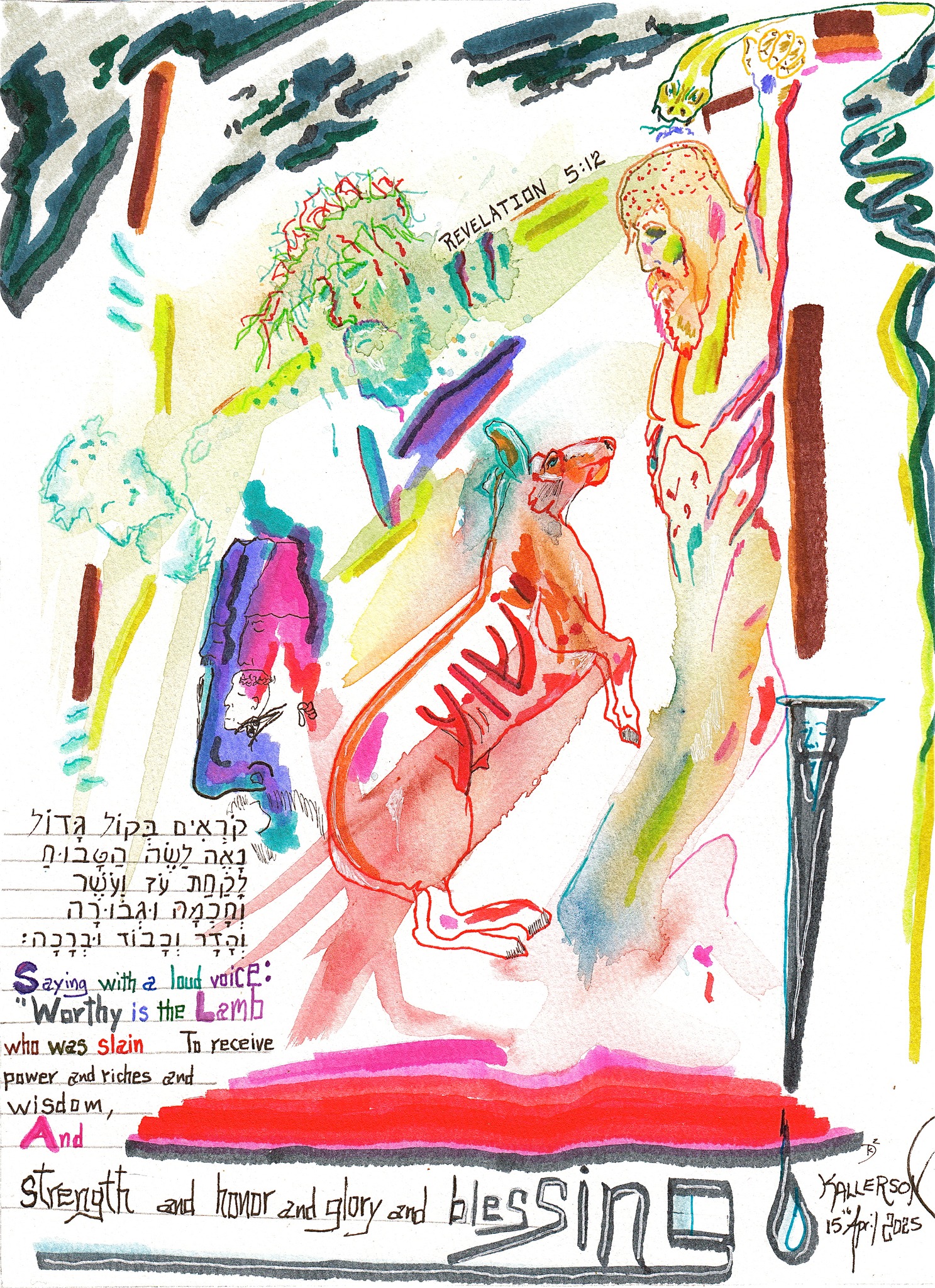


Psalm 42:5 (For I Shall Yet Praise Him)

Artwork by Douglas Kallerson.

Psalm 42:5
For I Shall Yet Praise Him

Now there was a day when his sons and daughters were eating and drinking wine in their oldest brother’s house; 14 and a messenger came to Job and said, “The oxen were plowing and the donkeys feeding beside them, 15 when the Sabeans raided them and took them away—indeed they have killed the servants with the edge of the sword; and I alone have escaped to tell you!”
16 While he was still speaking, another also came and said, “The fire of God fell from heaven and burned up the sheep and the servants, and consumed them; and I alone have escaped to tell you!”
17 While he was still speaking, another also came and said, “The Chaldeans formed three bands, raided the camels and took them away, yes, and killed the servants with the edge of the sword; and I alone have escaped to tell you!”
18 While he was still speaking, another also came and said, “Your sons and daughters were eating and drinking wine in their oldest brother’s house, 19 and suddenly a great wind came from across the wilderness and struck the four corners of the house, and it fell on the young people, and they are dead; and I alone have escaped to tell you!”
20 Then Job arose, tore his robe, and shaved his head; and he fell to the ground and worshiped. 21 And he said:
“Naked I came from my mother’s womb,
And naked shall I return there.
The Lord gave, and the Lord has taken away;
Blessed be the name of the Lord.”
22 In all this Job did not sin nor charge God with wrong. -Job 1:13-22

In 1776, and under a completely different context, Thomas Paine wrote a pamphlet called The American Crisis. It was a call to stir up the American army, which had faced defeats as they faced the British during the Revolutionary War. In his words, Paine wrote, “These are the times that try men’s souls.” It was such a poignant and stirring line that it has remained embedded in the American psyche ever since. It was also a key impetus for inspiring the army to cross the Delaware and attack the Hessian Army stationed at Trenton, New Jersey, becoming the American’s first significant victory of the war.

Job faced the times that tried his soul, and he prevailed over the battle that Satan brought against him by remaining steadfast in his faithful devotion to God, despite the inordinate amount of loss he faced.

But Satan was not through with him as Chapter 1 closed out. Rather, he continued to incite Job to sin against the Lord by attacking his physical body, covering him with painful boils from the sole of his foot to the crown of his head. All he was left with was potsherds to scrape his miserable, festering skin, pain from each swipe of a boil, and a nagging wife who implored him to “Curse God and die.” The latter being the greatest punishment of all. And yet, his words back to this treacherous woman vindicated his faith that God was just –

“But he said to her, ‘You speak as one of the foolish women speaks. Shall we indeed accept good from God, and shall we not accept adversity?’ In all this Job did not sin with his lips.” Job 2:10

In 1979, Steve Martin starred in the movie The Jerk. He was a white boy born as a poor black child, lacking any skills or abilities that could elevate him out of a life of mediocrity. And yet, through a series of events, he became extremely wealthy. But as such things go, it was all lost just as quickly as it appeared. When their downfall came about, he said to his wife, played by Bernadette Peters, that it was just money, and they could make more of that. Her response was, “I don’t care about losing all the money. It’s losing all the stuff.”

Is that what our life is to be remembered for? Stuff?

For me, it is Monday, 7 October. It is 4:30 am, and I have walked the dogs, read the Bible (over two cups of coffee), and quickly surveyed a property that has been our home since 1993 and the home of my father for another fifteen or so years beyond that.

In the previous ten days, we have gone through the most significant flooding of our lives. Dad moved onto the island in 1948. There have been storms, and there have been times of green grass and then high tides, but there was never a time where the high tides overflowed the island and completely swept away the green grass as it retreated… until late September of this year. And yet, within just a few days of that ending, we are set to face another hurricane, most likely as a direct or near-direct hit. Monday morning at 2 am, the forecast places the storm upon arrival as a category 3 with a significant storm surge.

The only question is whether it will veer a bit south, a bit north, or come directly at us. Each has positives and negatives concerning winds and tides, but none appear appealing at this point. And more, this storm will not just affect the coastal homes of the west coast of Florida as Helene did. Rather, every person in this church – even Ron and Shannon, who live many miles north and far inland will be on my mind because of the track once landfall is made.

Every person in this church is a burden upon my mind as I sit in the dark and type. Along with them are family and friends throughout the area. But what else does this day represent? A storm lies ahead, but 365 days ago, on this day, a storm of a different kind swept through parts of Israel when they were brutally attacked by a terrorist force bent on killing the people of Israel.

The Islamic forces of Hamas murdered, raped, and tortured the people they encountered. We have time to at least prepare for the next few days and decide what we will do as the storm approaches. Those people, like Job, simply faced the satanic onslaught as it came about, and they had to face the consequences of it once it had passed by. Many in Israel found out what was truly important at that time. And the nation as a whole had to decide what to do about what transpired. Their response, and the battles they continue to face, are a part of the unfolding drama of the prophetic scenario known to God all along.

As for those of us in the path of Hurricane Milton, time will tell what the result of its passing will be. As for Helene, we – meaning my father, Hideko, and I – have gone through that. It was a truly trying ordeal. As we watched the house fill with water, we heard appliances – one after another – fail. The washer-dryer unit, which wasn’t even running, came on and started to churn. Within a couple of minutes, it burned up. A freezer in the garage sparked and died.

The waters rose more and came into the house. Suddenly, there was a heavy smell of ozone, and the refrigerator gave off some scary rattling noises and died. What could we do? I got Dad to come from his house to ours, we all retreated upstairs, and we waited to see what the outcome would be.

Throughout the night, something kept happening that I will never forget. I called it “the sound of car death.” Different houses have been built on different levels of dirt brought in from the mainland in hopes of beating such an event, but for most, it wasn’t enough.

As the minutes turned to hours, again and again, there would be the steady beeping noise of a car alarm as the waters began to reach the electronics. The beeping would continue for a while and then become erratic, like a child who wasn’t getting his way over the toy he wanted Mommy to give him. And then, within a few minutes, the whining would stop… the car had died.

The next morning, and for the next days afterward, we saw Porches, Lamborghinis, Maserati’s, and other cars worth more than our house towed away to be made into other useful things, like razor blades and tin cans. One could almost hear the repetition of the words of Bernadette Peters… “It’s losing all the stuff.”

Along with the cars, tons and tons (and tons) of household goods were carried out to the roadside and heaped unceremoniously in piles that I eventually called “the walls of sorrow.” Scrappers came through each day, taking whatever their eyes alighted on. That reduced the level of junk a bit. But the walls of sorrow continued to grow for the next week as people came into town to survey the damages in these, their winter homes.

As a side note to highlight our own situation, and something you might find comical, as we watched the things stored up for a lifetime slowly being destroyed by the waters, I remember seeing a brand-new pack of Bounty paper towels bobbing around in the garage. Hideko had bought them just a couple of days before, and they were unopened when the storm hit. The ruin of those paper towels affected me more than almost anything else. We had used the washer/dryer for a year (it was Hideko’s retirement present).

We had used the refrigerator for eons. It was set to go anyway. The sofa had been slept on innumerable times, and every dog we had with us for thirty years probably threw up on it a dozen times in order to stake its rightful claim over it. But those Bounty towels were never opened. It was like taking $20.00 and just lighting it on fire. The waste seemed so… so… so pointless. Surely, these are the times that try men’s souls. The loss of the HMS Bounty didn’t seem as important to me as the loss of those paper towels call Bounty.

We have to consider each event as it comes, process it in whatever way it affects us, and then live with what happened. This is true for something as insignificant as a big pack of Bounty towels that wound up on the side of Midnight Pass Road without ever having served the purpose for which they were made.

As I sit here on Monday morning, I wonder if the coming storm will lift up those towels and the tons and tons of other things sitting out there, as yet uncollected, and deposit them, once again, all over our property.

And what about the people in the church? The storm is coming, and each one of them will probably face it to some extent. Will these, my family in Christ, be ok? All I can do is type, pray, and place my hope in the Lord’s hands for each of them.

The psalmist gave us words to consider in such times –

1 As the deer pants for the water brooks,
So pants my soul for You, O God.
My soul thirsts for God, for the living God.
When shall I come and appear before God?
My tears have been my food day and night,
While they continually say to me,
“Where is your God?”
When I remember these things,
I pour out my soul within me.
For I used to go with the multitude;
I went with them to the house of God,
With the voice of joy and praise,
With a multitude that kept a pilgrim feast.
Why are you cast down, O my soul?
And why are you disquieted within me?
Hope in God, for I shall yet praise Him
For the help of His countenance.
O my God, my soul is cast down within me;
Therefore I will remember You from the land of the Jordan,
And from the heights of Hermon,
From the Hill Mizar.
Deep calls unto deep at the noise of Your waterfalls;
All Your waves and billows have gone over me.
The Lord will command His lovingkindness in the daytime,
And in the night His song shall be with me—
A prayer to the God of my life.
I will say to God my Rock,
“Why have You forgotten me?
Why do I go mourning because of the oppression of the enemy?”
10 As with a breaking of my bones,
My enemies reproach me,
While they say to me all day long,
“Where is your God?”
11 Why are you cast down, O my soul?
And why are you disquieted within me?
Hope in God;
For I shall yet praise Him,
The help of my countenance and my God. Psalm 42

The rest of the week, like our very next moment of existence of each moment we live, is unknown to me. And so, shall I fret as we await the coming storm? Shall I call out and curse God if things don’t go well? Shall I throw a temper tantrum at the God who created all things and who temporarily gives them to us to enjoy?

Rather, I have determined now that in whatever comes, I shall yet praise Him. He alone is worthy of that. He alone determines the end from the beginning. When Sunday morning arrives, if it arrives for us as individuals and for us as a church gathering, I would hope that regardless of what transpires, each of you will say, “The Lord is my Rock. He is my Fortress, my Defense, my Hope, and my Hiding Place. Through the days of my life, I shall yet praise Him.”

What is stuff? For the most part, it is a distraction from our relationship with God. If we are wise, we can incorporate the things of our lives into that relationship. When a large and delicious meal is set before us, we can thank Him for it. Should we be in a foxhole with C-rations, we can thank Him for that. And if the week ahead finds any of us eating a meal provided by Samaritans Purse as we sit under a tent, having lost everything, we can thank Him for that as well.

Life, the spark of life that impels us forward, is not about stuff. Our lives will be judged based on our response to the things that occur around us and the situations in which we interact throughout our days, not on the amount of stuff we collected and idolized. If our responses and interactions acknowledge the goodness of the Lord while we are in the land of the living, He will justly and adequately reward us according to His goodness in relation to our faith. It is Monday morning for me as I type.

I am already trying to process the week ahead in ten thousand possible permutations of what could be. I am already mourning with those who are mourning. I am already burdened with those facing loss. I am already grateful for the storm that… that didn’t happen (oh! To pray and dream!).

To pass this week, as with each day of our lives as they occur, I am looking forward to it with the Lord as a part of it. Cursed God and die? It shall never be! You speak as one of the foolish women speaks!

In the Revolutionary War, many men gave everything to secure a land and a freedom for those who followed. On October 7th, 2023, many of Israel saw the futility of life without God as loved ones were taken from them.

When Hurricane Helene pushed north in late September, lives were uprooted, towns and villages were swept away, and many lives were lost. Some were faithful Christians, while others rejected that path. Eternal destinies were set as lives were extinguished through raging floodwaters.

In Butler, Pennsylvania, a president was spared while Corey Comperatore lost his life protecting his family. Corey was a saved believer in Christ, no one is really sure about President Trump. Which is in the better position right now? Life is about choices.

Now, another storm is just ahead. And if this sermon is given on Sunday, the 13th of October, it will be just behind. It has been my main goal and purpose in life these past years to prepare people for just such an event, actually, for the choices that should be made before such an event. Why do bad things happen to “good” people? First and foremost, the question is flawed. Jesus Himself told us this –

“Now behold, one came and said to Him, ‘Good Teacher, what good thing shall I do that I may have eternal life?’
17 So He said to him, ‘Why do you call Me good? No one is good but One, that is, God. But if you want to enter into life, keep the commandments.’” Matthew 19:16,17

The words of Jesus speak of an ultimate standard of goodness. The same word, translated as good, is used to speak of people elsewhere in a comparative sense. Jesus says in Matthew 12 that a good man, out of the good treasure of his heart, brings forth good things. Barnabas is called a good man in Acts 11:24.

These and numerous other examples are given as comparative uses of the word good. But in the eyes of God, apart from His Son, there are none truly good. The defect of sin remains in us, and we are prone to being anything but good.

However, if we go by the comparative sense of the word, we can and do ask why God allows the good to suffer. We question how God can be just when evil things happen to us. But consider the premise! Where do we live? Some of us chose to live in Florida. Now that… that is good.

We enjoy the benefits of the land we have chosen to live in. And. yet, there is not a person with a modicum of reason in his head who doesn’t know that Florida is prone to hurricanes. Should we move here and suddenly expect to be exempt from such an ordeal now that we have graced this land with our presence? What about those in Asheville, North Carolina? They moved in, and all was good. They lived their lives with God or apart from God as they so choose. Their choice of home was “good,” and they were “good” in whatever comparative sense filled their heads.

But is it reasonable to expect God to send the floodwaters upon Asheville and exempt the “goodest of the good” while sweeping away the less “good” because they weren’t quite as good as those gooder than them?

When a person goes water skiing, there is a chance that he will –

Have a heart attack.
Get bit by a shark and bleed out.
Get run over by the boat that is supposed to pull him along for a day of fun.
Hit a rock or a dock and come to a sudden end.
Etc.

Are these things God’s fault? Is God expected to bubble-wrap humanity so that they are free from such things? If God said, “No, I don’t want you water skiing. It’s just too dangerous,” you would shake your fist in His face and tell Him to mind His own business.

You probably did it with your own parents a time or two when they told you “No” over something not so intelligent that you were planning to do. But when your boyfriend slams into a dock and dies from sudden trauma, there is always God to blame… to question… to be angry at for allowing such a thing to happen. “I hate God. He took my wife from me.” I have personally heard this. Maybe you have, too. It is always God’s fault when tragedy arises, but it is almost never to His credit when the good things of life come about. “I achieved!” “I won!” “I earned!” “I built!”

How rare and wonderful it is to the ears of the Lord when someone gets his “I’s” corrected, and he finally sees things properly and as they should be. Why do bad things happen to good people? They don’t. Good things happen to us despite our lack of any true goodness.

Only in Christ, and only by the power of His goodness, can we even be looked at by God with the slightest hint of favor. If you don’t believe that, try reading Genesis 6. In fact, let’s see about all those comparatively “good” people and what God thought of them at that time –

“Then the Lord saw that the wickedness of man was great in the earth, and that every intent of the thoughts of his heart was only evil continually. And the Lord was sorry that He had made man on the earth, and He was grieved in His heart. So the Lord said, ‘I will destroy man whom I have created from the face of the earth, both man and beast, creeping thing and birds of the air, for I am sorry that I have made them.’ But Noah found grace in the eyes of the Lord.” Genesis 6:5-8

After only fifteen hundred years of man on earth, he had so corrupted his ways that there was no remedy left but to destroy him. And so, in the year 1656 Anno Mundi, the rains fell, the great storehouses of the deep, filled with the wrath of God, exploded forth, and the world went into a cataclysmic period of complete destruction.

All of the “good” people, comparatively speaking, on the planet didn’t measure up. Today, there are “good” people in Tel Aviv. Mom says, “He’s a good boy, and I am so proud of him and his husband.” In Los Angeles, there is a “good” District Attorney, respected by his colleagues and by every criminal he fails to prosecute. His walls are lined with awards and accolades, he wields power and authority, and he is a “good” man, comparatively speaking. In North Korea, there is a “good” leader, worshipped by his people as a living god and who wields complete authority over his “good” people.

Kamala Harris is a “good” person who will defeat evil Trump, who has come to destroy the “good” way of life introduced by those on the left. Donald Trump is a “good” person who wants to protect the “good” values of Americanism and democracy.

Each person before the flood was “good” on some unknown curve that was established within his own mind or within the minds of those around him. Each person on the planet today thinks he is “good” in some comparative way.

Why do bad things happen to “good” people? Ask those of the pre-flood world. Ask those who were in the seats of United Airlines Flight 175 that flew into the South Tower of the World Trade Center on September 11th, 2001, at 9:03 am. Or better yet, ask those who flew that plane into the tower.

Why did some of us suffer loss this past week? Why are my father and Doctor Bridges 91 years old while others have died at 87 or… 21, or… 3? Where does our standard of “good” come from? If it isn’t from God, then we have a faulty impression of goodness. And when we carry this impression around, of course, we will blame God when our favorite animal dies. “O God is so cruel.”

We have spent the entire life of that dog, from the moment it was a newborn puppy until the last moment of its life thinking about how great it is that we have this dog, never considering thanking the God (the God we don’t believe in) for allowing us to enjoy it while it is alive.

But the moment the dog dies, we blame God, tell Him that we hate Him (even though we don’t believe in Him!), and angrily and sadly bury it in the back yard. And then we go in and have a big steak for dinner, never considering that the cow on our plate was just as much a unique animal as the dog we just buried.

Last year my “good” wife (the best in fact ☺️) got cancer. Should we have blamed God for interrupting our “good” life? Last year, our house plumbing – all of it, water and sewer – exploded. Our “good” lives were upheaved. Should we have blamed God?

Twice in three weeks, we are facing possible complete annihilation of our home. Should we just give up, raise our fists to the heavens, and blame God? We are “good” people. Why doesn’t God give us a break? What about the “bad” guy down the road? Should God put up a wall to protect us and wash him away?

Why do bad things happen to “good” people? Because we make choices in a world of uncertainty. We choose to live in Florida. We choose to live in Sarasota. We choose to live on Siesta Key. We choose to continue to stay in a house that was built 76 years ago with substandard building materials. We choose the cars we drive, the workplace we go to each day, the route we take to get there, the store we shop at, and so much more. Life is a stream of choices in a world that is preset for certain events to occur at certain times to direct the course of history as it marches toward an inevitable conclusion that is already recorded in the pages of God’s word.

We have the overall blueprint, but we lack the details. And so, we make choices… “good” people (well, comparatively) in a fallen world. Many chose not to come to church today, or any Sunday in fact, and worship the Lord who created them.

Some choose to rob, murder, rape, and so forth. And yet, there is someone out there who will say, “He is a good person. He didn’t mean it.” They will rationalize away the crimes based on their past lives, the unfairness of the skin color they were born with, or for a thousand other reasons, and they will appeal to society that they are “good” people.

What happened to you this past week? Did you suffer loss? Praise the Lord for what you had. Thank Him it wasn’t worse. Did someone you know die? Thank the Lord that you were blessed to know that person. Did you come out unscathed completely? Praise Him for the blessing and pity those who were dealt a different hand.

It’s Monday morning. I’m sermon typing. I was just sent photos from a friend in Israel. Twice this week, he had to go into a bomb shelter while missiles flew in from the north. He sent pictures of bomb craters, a bombed-out car, pieces of shrapnel, windows pelleted with holes, etc.

In the next message, he said, “So I hear that the hurricane that’s coming tomorrow will push 18 feet of water from the shore line and 2-3 feet up beyond sea level. Are you guys evacuating?” He’s being bombed from the skies at random times and from random angles, and he is concerned about us in Florida. Does this “good” guy deserve the hatred leveled against him simply because he exists as a Jew (a Jesus-believing Jew, BTW) in the land of Israel? Is his concern for us in Florida rational while he actually faces greater uncertainty from moment to moment than we will in the days ahead? One thing is for sure: if we are alive and able, on our respective days of worship, that is where we will be – Yosi and me, on other sides of the ocean, praising the same Lord who has granted us the time and places of our lives in His presence.

We will be worshiping, praising, and serving the Lord who gave us this temporary, uncertain life. It is a life filled with loss – floating Bounty paper towels, if you will – that is completely uncontrollable. But it is a life worth living in the presence of God no matter how bad it gets, and no matter how good it can be.

We will praise Him in the storm, and we will thank Him for the abundance. He is the Creator and we are the created. The pot has no right to complain against the potter, “Why did you form me like this?” He formed us. We must live within the parameters of existence for which we are formed.

These may be the times that try men’s souls, but these are the days of our lives. We have to live them. And so, let us live them in a way that honors God. We have every right to mourn. Jesus wept. He surely wept over the madness of rejecting Him for the things of this world. He has come to show us the very heart of God the Father. Instead, we blame God the Father… for everything bad. And we ignore Him during the times when all is good.

Jesus wept. We, too, can mourn. Abraham mourned for the loss of Sarah. David mourned over the loss of Absalom. Why? Everyone else thought he was a loser, and indeed he was. He usurped his father’s throne, came after him to kill him, and wound up dead himself. And in his dying, David mourned –

“O my son Absalom—my son, my son Absalom—if only I had died in your place! O Absalom my son, my son!” 2 Samuel 18:33

What prompted David to so tenderly love such an unlovable person? What force, what thought, what eternal love impelled God to send His Son to die for such unlovable, unworthy, unholy creatures as us? What kind of love impelled the God who destroyed the entire world by the flood to send Jesus to die for billions and billions of Absaloms?

The love of God is greater far
Than tongue or pen can ever tell.
It goes beyond the highest star
And reaches to the lowest hell.
The guilty pair, bowed down with care,
God gave His Son to win;
His erring child He reconciled
And pardoned from his sin.

O love of God, how rich and pure!
How measureless and strong!
It shall forevermore endure—
The saints’ and angels’ song.

When hoary time shall pass away,
And earthly thrones and kingdoms fall;
When men who here refuse to pray,
On rocks and hills and mountains call;
God’s love, so sure, shall still endure,
All measureless and strong;
Redeeming grace to Adam’s race—
The saints’ and angels’ song.

Could we with ink the ocean fill,
And were the skies of parchment made;
Were every stalk on earth a quill,
And every man a scribe by trade;
To write the love of God above
Would drain the ocean dry;
Nor could the scroll contain the whole,
Though stretched from sky to sky.
-Frederick M. Lehman

For some, these indeed are the times that try men’s souls. But is our life about a bunch of stuff? Is it about petting puppies while having steak? Is our life about the house we live in, the refrigerator we possess, or the car we drive?

And why do bad things happen to good people? It’s because God has allowed it to be so. Though He slay me, yet I will trust Him. He is God, I am the work of His hands, and so I will trust Him. May this be your state as well? Today and every day, let us entrust our souls to God, who formed and fashioned us for His purposes.

And may He be glorified on our lips, in our actions, and throughout our days. May it be so. We have a meeting with Him in due time. May that day be one of joy and rejoicing because of the simple faith that pleases Him more than anything else.

Jesus! Jesus! Jesus! Thank God for Jesus, who truly makes us “good” in the sight of God. Because of Him, we can forever plumb the mysteries of why things are the way they are, knowing that all things meet a plan and a purpose that extends far beyond our current days of uncertainty, sadness, and loss.

Closing Verse: And we know that all things work together for good to those who love God, to those who are the called according to His purpose. 29 For whom He foreknew, He also predestined to be conformed to the image of His Son, that He might be the firstborn among many brethren. 30 Moreover whom He predestined, these He also called; whom He called, these He also justified; and whom He justified, these He also glorified.  -Romans 8:28-30

Next Week: Judges 20:36-48 An amazing story to tell, line by line… (No King in Israel, Part IX) (56th Judges Sermon)

The Lord has you exactly where He wants you. He has a good plan and purpose for you. It is He who judges His people according to their deeds. So, follow Him, live for Him, and trust Him, and He will do marvelous things for you and through you.

Hallelujah and Amen…