Revelation 1:4

Sunday, 16 August 2020

John, to the seven churches which are in Asia:
Grace to you and peace from Him who is and who was and who is to come, and from the seven Spirits who are before His throne,
Revelation 1:4

With the introductory verses complete, the greeting now opens with the author simply stating his name, “John.” Nothing else is given, such as title, father’s name, etc. Because of the lack of any of these, it is obvious that the author is widely recognized. It adds a high note of surety that this is the apostle John – the author of the gospel and three epistles ascribed to him as well.

His address is “to the seven churches.” The number seven, throughout Scripture, is of great significance. EW Bullinger defines it as the number of spiritual perfection. These are not the only seven churches that are found in the area being addressed, and so the number seven defines not “all” the churches but rather “these select” churches.

The reason for selecting these particular churches will become evident as the letter proceeds. In short, it is because each typifies any given church at any given time. Some churches will face this issue, while others may face another issue. However, all can be categorized by either the strengths or the failings that are mentioned by the Lord here in Revelation. Therefore, the seven churches represent the fullness of the one true church founded on Jesus Christ. It is these seven churches “which are in Asia.”

The term “Asia” does not carry the same significance today that it once did. Rather, it speaks of the Roman proconsular province known as Asia. It is in the western area of Asia Minor and is a part of the country of Turkey today. It is referred to throughout the book of Acts, and both Paul and Peter refer to it in their letters, such as in 1 Corinthians 16:19.

These are Gentile churches in Gentile areas. It is important to understand this, lest the intent of the letters to the churches get twisted in order to justify the heretical doctrine of hyperdispensationalism (which will be addressed as we continue through the verses). Christ Jesus gave a beautiful picture of this in the feeding of the multitudes during His ministry.

The two relevant passages are found in the gospels, where He fed five thousand and where he fed four thousand. After feeding them, the pieces were gathered up, and the exact amount gathered was recorded –

But Jesus, being aware of it, said to them, “Why do you reason because you have no bread? Do you not yet perceive nor understand? Is your heart still hardened? 18 Having eyes, do you not see? And having ears, do you not hear? And do you not remember? 19 When I broke the five loaves for the five thousand, how many baskets full of fragments did you take up?”
They said to Him, “Twelve.”
20 “Also, when I broke the seven for the four thousand, how many large baskets full of fragments did you take up?”
And they said, “Seven.” Mark 8:17-20

The words translated as “baskets” and “large basket” are entirely different. One is a kophinos, or small handbasket. The other is a spuris, or large plaited basket. So large was one spuris that it was used in Acts 9:25 to lower Paul down from the wall of the city to allow him to escape. A point was being made by mentioning the baskets and the number of them that would only be realized later.

There were twelve small baskets representing the twelve tribes of Israel, from whom would come a small harvest – a remnant (Romans 11:5, for example). There were seven large baskets representing the seven churches from whom would come a large harvest, a harvest which has continued on for two thousand years. These seven churches of Asia are given to represent the one church. To them, John next says, “Grace to you and peace.”

Grace (charis in Greek) is unmerited favor; it cannot be earned. This is the common greeting among the Greek people. Peace however is the common greeting among the Hebrew people. In their language, the word is shalom. This is more than a greeting for calm or quiet. Rather, it is a state of wholeness and completion in all ways. John unites the two terms just as the church is united between Jew and Gentile. This grace precedes the peace because only after receiving the grace of God can a person experience the peace of God. That is extended, as it says, “from Him who is and who was and who is to come.”

In this greeting, there is a veiled and yet sure reference to the Trinity. The words “from Him who is and who was and who is to come” are a united thought in one clause. It is, at this time, referring to God the Father. This is certain because verse 5 will continue by saying, “and from Jesus Christ.” However, the term “who is and who was and who is to come” will also be used to refer to Jesus in verse 8.

The term will also be used in Revelation 4:8 and 11:17, and will be discussed at that time. Therefore, John is setting up a theological tower that supports the notion that Jesus Christ is fully God. This is perfectly evident in how he is structuring his words. Next, John says, “and from the seven Spirits who are before His throne.”

This is a reference to the Holy Spirit who manifests the character and nature of God in a sevenfold manner. This is seen in veiled ways in the Old Testament, such as in Isaiah 11 where both the Son and the Spirit are referred to –

“There shall come forth a Rod from the stem of Jesse,
And a Branch shall grow out of his roots.
The Spirit of the Lord shall rest upon Him,
The Spirit of wisdom and understanding,
The Spirit of counsel and might,
The Spirit of knowledge and of the fear of the Lord.” Isaiah 11:2

Upon the Son rests the “sevenfold Spirit” – The Spirit of the (1) Lord, meaning Yehovah; the Spirit of (2) wisdom and (3) understanding; the Spirit of (4) counsel and (5) might; the Spirit of (6) knowledge and of (7) the fear of the Lord.

To more get a fuller understanding of John’s use of his words here, Vincent’s Word Studies provides more insight –

The Father is Him which isand which wasand which is to come. This is a paraphrase of the unspeakable name of God (Exodus 3:14), the absolute and unchangeable. Ὁ ὢν, the One who is, is the Septuagint translation of Exodus 3:14, “I am the ὁ ὢν (I am ):” “ ὁ ὢν (I am ), hath sent me unto you.” The One who was ( ὁ ἦν ). The Greek has no imperfect participle, so that the finite verb is used. Which is and which was form one clause, to be balanced against which is to come. Compare Revelation 11:17Revelation 16:5; and “was ( ἦν ) in the beginning with God” (John 1:2). Which is to come ( ὁ ἐρχόμενος ). Lit., the One who is coming. This is not equivalent to who shall be; i.e., the author is not intending to describe the abstract existence of God as covering the future no less than the past and the present. If this had been his meaning, he would have written ὁ ἐσόμενος , which shall be. The phrase which is to come would not express the future eternity of the Divine Being. The dominant conception in the title is rather that of immutability. Further, the name does not emphasize so much God’s abstract existence, as it does His permanent covenant relation to His people. Hence the phrase which is to come, is to be explained in accordance with the key-note of the book, which is the second coming of the Son (Revelation 1:7Revelation 22:20).

Life application: The seven churches fanned out about 50 miles from Ephesus, but (as noted) they are not the only seven churches in that area. Rather, they were carefully chosen because they had specific problems that needed to be addressed and which represent the same situations that have crept up in churches since that time. In other words, they are emblematic of the entire Church Age – from Pentecost to the Rapture.

Also, the specific wording here in Revelation provides a clear and unambiguous indication of the eternality of Jesus. He is not a created being. Rather, He is the eternal God. As the thought concerning God the Father in this verse is later in verse 8 applied to Jesus, it shows that Christ is fully God. The wording here, taken together with the coming verses, demonstrate this. It is a similar analogy to Hebrews 13:8 – “Jesus Christ is the same yesterday, today, and forever.”

This is a main purpose of the book of Revelation. It is to provide a full understanding that Jesus is God, and that humanity is accountable to God by how we receive this truth. We cannot call on a “Jesus” meaning “another Jesus” (see 2 Corinthians 11:4) who is a created being and expect to be saved. Such a teaching is heretical. Jesus Christ is the central focus of the biblical message. He is the incarnation of the Lord (Yehovah) of the Old Testament. He is God.

Oh God! We proclaim that Jesus is Lord. We acknowledge that He is the One to whom our hearts, our love, our devotion, and our allegiance belongs. He is the One who reveals Your heart to us, and it is through faith in Him that we receive the blessed and precious Holy Spirit. Thank You for Jesus Christ our Lord who makes reconciliation to You possible! Hallelujah and Amen.




Revelation 1:3

Saturday, 15 August 2020

Blessed is he who reads and those who hear the words of this prophecy, and keep those things which are written in it; for the time is near. Revelation 1:3

Here we have a description of how the church was initially set up to transmit and receive the word of God. It is something that is all but lost to the church today, with very few following the model laid out here. The verse begins with, “Blessed is he who reads.”

In the church, there was a Reader of the word. Someone would take the scroll or book, and he would read out loud to the congregation. At the time that Revelation was received, and even until very recent times in relation to the overall church age, owning a copy of the Bible, or even of a single book of the Bible, was a rare thing. They were expensive, time-consuming to make copies, and thus not widely available.

For most of this age, there may have been one copy in a town or village. This is where the term “chained to the pulpit” comes from. Bibles were so precious that they were carefully guarded. Unfortunately, this led to its own problems concerning doctrine and the like. However, for those churches who had a copy of the Bible, or even just copies of various books of the Bible, they were read aloud. Here we are told that the one who read the word was blessed.

John continues with, “and those who hear.” This is the congregation. The implication is that there is an open and public reading of the word. Those who have gathered to hear the word read are also promised a blessing. Of the words thus far, Vincent’s Word Studies makes the following comment –

“The passage is of some weight in determining the date of this book. The stated reading of the Apostolical writings did not exist as a received form before the destruction of Jerusalem, a.d. 70.”

As this is so, then the idea of the prophecies of Revelation being fulfilled in the destruction of the temple in Jerusalem is incorrect. In this, the preterist view of eschatology is found incorrect. Preterism is a flawed system which is not at all supported by the overall content of Scripture.

With this understanding, John continues with, “the words of this prophecy.” Here we are shown the main content of the book of Revelation. It is a book of prophecy. However, some of the prophecies are tied in with events that are written about in the present tense. This is particularly true concerning the seven letters to the seven churches that will be conveyed early in the book.

What is said in those verses details things that are actually occurring in individual churches at the time John recorded them. However, they are also events which continue to occur throughout the entire church age. Thus, the warnings given to those seven churches continue to apply to those in the church at all times – prophetically anticipating that the same problems will arise until the Lord comes for His church. This is why John continues with, “and keep.”

These words are directed to both the reader and the hearer. Just because someone is a reader, it does not give him a position where he can ignore what is read. In this, to hear implies not only the physical act of hearing, but of attentively listening and assimilating what is heard.

To “keep” is to then observe what has been assimilated. The idea of “keeping” goes back to the Hebrew word shamar. It signifies to be circumspect, keep, observe, and so on. It comes from a primitive root signifying to hedge about (as with thorns) and thus to guard. Moses uses the word when speaking to Israel, telling them to both hear and keep what he presented to them.

As an active example concerning this, when one keeps the sheep, he observes, guards, protects, and so on. The idea is beautifully expressed in the 121st Psalm when referring to the Lord –

“He will not allow your foot to be moved;
He who keeps you will not slumber.
Behold, He who keeps Israel
Shall neither slumber nor sleep.” Psalm 121:3, 4

Just as the Lord attentively keeps Israel, so we are to not only “hear” the word, but we are to “keep” the word. Further, the verb is given as a present participle, active voice – “keeping.” When hearing the word, we are then to constantly keep, from moment to moment. The active voice says that we are to apply our keeping as the agent of the action.

With this understanding, the word “blessed” can be explained. In its most basic sense, it means “happy.” From that, one can think of fortunate, or well off. One should simply consider that in reading and keeping the words of Revelation, they will remain happy even in a world that is troubling, filled with terrifying events, and so on. The final pages of the book show what life will be like for the Lord’s redeemed in the eternal state. In “keeping” that in one’s heart, one can be happy through the most difficult of all human trials.

John then says what is to be kept with the words, “those things which are written in it.” The verb translated as “which are written” is a perfect participle. They have been written, nothing more will be coming, and the word stands as such. What has been received is all that will be coming.

Because Revelation is the last book of the Christian canon, it shows us that no further prophetic word is to be expected. Anyone who claims prophetic revelation is to be ignored. God’s word is complete and no “prophecy,” or “word from the Lord” is to be expected after the reception of this final book. It is a simple note which should, if understood and accepted as such, keep those in the church free from being duped by people who claim visions and prophecies. Unfortunately, this precept is widely ignored, and many are led down unhealthy avenues of deceit.

Lastly, John gives an explicit reason for hearing and keeping. He says, “for the time is near.” The word translated as “time” is kairos. It signifies “the opportune time.” It is a particular moment, rather than an ongoing chronology of time. The word signifying “near” means at hand, or ready. Thus, in the sense of time, it speaks of that which is imminent. However, it does not necessarily mean that it is expected to happen and be fulfilled within any given timeframe.

The words to the seven churches are spoken as of “right now.” And yet, those types which are given can be reapplied at any time and to any church. Therefore, the time of such events is always near. As this is so, then what can be anticipated for those things after the church is removed can be (and so far, have been) thousands of years later. Christians are always expected to watch for events that will usher in the anticipated next age.

Life application: As noted, there is a blessing promised to those who (in context of the time this was written):

  1. Read – the one who recites the words of the book of prophecy aloud to others.
  2. Hear – those who listen to the reader as it is read aloud.

Both of these categories will receive their blessing if they keep what they have heard. In other words, we can refer to the words of James 1:22-25 –

“But be doers of the word, and not hearers only, deceiving yourselves. 23 For if anyone is a hearer of the word and not a doer, he is like a man observing his natural face in a mirror; 24 for he observes himself, goes away, and immediately forgets what kind of man he was. 25 But he who looks into the perfect law of liberty and continues in it, and is not a forgetful hearer but a doer of the work, this one will be blessed in what he does.”

Anyone can sit and read the Bible or listen to it being read and then go on with their life, completely unaffected by its message. But it takes a discerning soul to hear the words, believe them, and apply them to their lives. This then is where the blessing comes from.

As far as the church age, it is of indeterminate length. Just because John wrote this almost 2000 years ago, that has no bearing on the nearness of the moment from God’s perspective. It is a mistake in thinking that because the amount of time has been lengthy from our perspective that the admonition here is somehow faulty. We don’t know the times and seasons which are at God’s authority. We are to live our lives as if Jesus’ return could come at any time.

Lord God, as the words of the Bible unfold before us as we hear it read, or read it ourselves, help us to take them to heart and apply them to our lives. May we be changed by the words, renewing our hearts and minds, and growing more like You every day. May this be so, and may it be to Your glory. Amen.


Revelation 1:2

Friday, 14 August 2020

…who bore witness to the word of God, and to the testimony of Jesus Christ, to all things that he saw. Revelation 1:2

The words, “who bore witness,” refer to John from the previous verse. The word translated as “bore witness” is martureó. It signifies giving evidence, making a testimony, and so on. Here, it is in the aorist tense – he “bore witness.” He is stating that he saw and he has testified to what he had seen. And, as he says, he “bore witness to the word of God.”

It is generally agreed that this is not speaking of the personal “Word of God,” meaning Jesus Christ. Rather, it refers to either the doctrine which explains who God is, or that which God speaks out – the recorded word of God. Assuming the latter view, meaning John is stating that he has been a faithful witness to what God had revealed as His word, it can then be debated whether this is speaking of the Gospel of John or the words which are now being presented as the revelation, or unveiling, of Jesus Christ.

John could even be referring to his oral defense of the gospel of Jesus Christ, meaning everything he had presented throughout his life. He was a faithful witness of the deposit entrusted to him over the years.

The aorist tense of the verb may be a marker to signify that it is an all-encompassing thought concerning John. He “bore witness” throughout his life – in his gospel proclamations, and in his writings (inclusive of the gospel, epistles, and now Revelation) – and in any other way that was needed when the time arose (meaning in deed and action in order to bring others to a proper understanding of who Jesus Christ is).

This seems quite likely because he next says, “and to the testimony of Jesus Christ.” John will later give examples of both a general testimony, which resulted in his exile to Patmos, and of the specific testimony of recording the events of the book of Revelation –

“I, John, both your brother and companion in the tribulation and kingdom and patience of Jesus Christ, was on the island that is called Patmos for the word of God and for the testimony of Jesus Christ.” Revelation 1:9

“I, Jesus, have sent My angel to testify to you these things in the churches. I am the Root and the Offspring of David, the Bright and Morning Star.” Revelation 22:16

Therefore, John’s having borne witness, referred to now, appears to his having lived an all-encompassing life of faithful service to that to which he had been called – he “bore witness … to all things that he saw.”

Here, there is a difference in source texts. Some include the word “and.” Thus it would say, “and as many things as he saw.” Thus, it would signify an additional category to the word of God and the testimony of Jesus Christ. Without the article, or even with the article, but using it in apposition with “the word of God and the testimony of Jesus Christ” – meaning – “even as many things as he saw” – it would then define the first two categories as one thought. This is the most likely idea here. It is not a separate category, but an explanation of his having seen and witnessed to the first two.

No matter what, the main focus here is on the faithful testimony of John. We can be sure that what he has seen, said, done, and recorded is from a person who was willing to devote his life to the service of God and to the gospel of Jesus Christ. The idea here is complementary to that of John 21:24 –

“This is the disciple who testifies of these things, and wrote these things; and we know that his testimony is true.”

Life application: Jesus’ beloved disciple, John, is the one who bears witness “to the word of God.” This would then be a definitive claim by John that what is recorded here is Scripture. For this reason, liberal scholars will attempt to deny this was actually received and then penned by John.

If, in fact, he received it, then they would have to admit it is inspired of God. If it is inspired by God, then it is God’s word. If it is God’s word, then it is authoritative in all it contains and proclaims. However, much of Revelation concerns judgment and woe. If one wants to live out a “social gospel” or a “prosperity gospel,” then Revelation becomes an immense problem because both of these approaches to the gospel are proven false. Therefore, for them, it is easier to dismiss Revelation than to heed its warnings.

The book itself is centered on Jesus Christ. If this is so, then it is authoritative for the Christian on all matters it proclaims. Jesus Christ is the Word of God and the second member of the eternal Godhead. One cannot disassociate Revelation and all that it proclaims without diminishing the very structure and authority of the Bible.

Taking all this into consideration, it is at one’s own peril that he dismisses the authority of the book of Revelation. Further, it is at one’s own loss to not read it, study it, and heed it just like the rest of Scripture. It is for these reasons that John, under inspiration of the Holy Spirit, penned the words in this verse.

God is competent, God is in control of His word, and God has provided us with this book for our warning and for our blessing. Let us look with anticipation at the marvels ahead of us in this wonderful study!

Heavenly Father, we thank You for the beautiful lessons that have been recorded in Your word. Yes, there are parts that are difficult for us to read, and many of them are considered unpalatable in our modern society, but they are Your words. Please help us to understand them and to take them in the context which You intended. May we be faithful stewards of Your word at all times. Thank You for Your precious word, O God! Amen.


Revelation 1:1

Thursday, 13 August 2020

The Revelation of Jesus Christ, which God gave Him to show His servants—things which must shortly take place. And He sent and signified it by His angel to His servant John, Revelation 1:1

The book of Revelation opens with the words, “The Revelation of Jesus Christ.” The word “Revelation” is translated from the Greek word apokalupsis. That is derived from apó, meaning “away from,” and kalýptō, meaning “to cover.” Thus, it signifies to uncover, or to reveal what is hidden. It makes plain that which was previously obscured.

Here, then, we see that what will be presented is the “unveiling of Jesus Christ.” It is an unveiling that He makes. However, it is also what needs to be unveiled concerning who He is and what His purposes are for the world within the unfolding plan of redemption. In other words, the world fell into sin, but God in Christ – even from the very beginning – presented the initiation of His plan. That was found explicitly stated for the first time in Genesis 3:15 –

“And I will put enmity
Between you and the woman,
And between your seed and her Seed;
He shall bruise your head,
And you shall bruise His heel.”

From that point on, the redemptive narrative was carefully recorded. However, there are veiled hints of the work of God in Christ even from Genesis 1:1. These continue, carefully hidden within the recorded narrative, to reveal what God was doing in typological pictures of Jesus. To understand these types and pictures, one can start with the Genesis 1:1 sermon from the Superior Word and continue on through until every sermon has been seen. They carefully evaluate the passage presented, revealing these truths.

However, the Jewish people as a whole rejected Christ when He came. Their eyes have been blinded to the truth of who He is. The book of Revelation, leaning heavily on Old Testament writings, will tie those writings into a panorama of events that have and will come upon the world, demonstrating to them that Jesus is the Christ and that they missed Him on His first advent.

However, the church itself has been woefully blinded in its own theology concerning God’s covenant promises to Israel. The church has claimed that it has replaced Israel in the redemptive narrative. Because of this, Revelation is given, when properly understood, to steer believers away from this aberrant theology as well.

The book begins with an address to the church which lasts for three chapters, instructing them that they are the main focus of God’s attention within the unfolding redemptive narrative. However, in verse 4:2, a dramatic shift will take place, with the intent of unveiling Jesus Christ to the nation of Israel. The church will not be mentioned again until Chapter 19. During all of the intervening chapters, the events focus on Israel. This is to bring them to an understanding of who Christ is, and that what is said of Him in both the Old and New Testaments is the true and reliable word of God.

This unveiling, then, is intended to go in both directions – opening the eyes of the church to God’s faithfulness to Israel, and also to opening the eyes of Israel to the Messiah they had missed for the many years of their exile and punishment. It is this body of literature that John writes out concerning Jesus “which God gave Him to show His servants.”

Jesus Christ is the Mediator between God and man. Being fully God and fully man, He is the means of transmitting the events of redemptive history to the world – especially to “His servants,” meaning His redeemed people. Each member of the Godhead has its own role within the Godhead, revealing the unified purpose that they share. This is seen in Jesus’ words of John 16 concerning the Holy Spirit –

“I still have many things to say to you, but you cannot bear them now. 13 However, when He, the Spirit of truth, has come, He will guide you into all truth; for He will not speak on His own authority, but whatever He hears He will speak; and He will tell you things to come. 14 He will glorify Me, for He will take of what is Mine and declare it to you. 15 All things that the Father has are Mine. Therefore I said that He will take of Mine and declare it to you.” John 16:12-15

Jesus is the one who draws out from the Father the will of God. The Holy Spirit declares what is drawn out. The process of this is what forms the word of God, and it is what then allows man to understand more fully what God is doing within the stream of time. Of this, the Pulpit Commentary rightly states –

“Christ is both the Mystery and the Revealer of it. He comes to reveal himself, and in himself the Father, whose Image he is. Thus in its opening words the book takes us beyond itself. What is revealed is not secrets about the future, but a Person. And the Revealer is not man, but God; not John, but the Divine Son, commissioned by the Father. For even the unincarnate Word receives from the Father that which he reveals.”

Understanding that it is Jesus who is the focus of the unveiling will help keep the reader free from the error of using the book of Revelation as some type of tool to predict future events. Countless readers of the book have, unfortunately, used it this way. Predictions about the date of the rapture, who the Antichrist is, and a host of other such things are dogmatically argued over, and they are always found to be incorrect. The reason for this is that they are attempting to use the book of Revelation in the wrong, self-centered, way.

Avoiding such error will keep the contents of the book in their proper perspective. Of those things God gave Christ Jesus to show to His servants, John next says that they are “things which must shortly take place.”

The Greek words translated as “shortly” is tachos. It signifies swiftness or in a brief space of time. It can mean with quickness, speed, haste, or immediately. Those, such as preterists, will understand the word to mean “quickly” as in “soon after John penned the letter.” In other words, they hold to the view that all is fulfilled millennia ago.

Others will consider the word to mean that when the events are set to come about, they will come about rapidly. Thus, a gap of two thousand years is not a violation of the intent of the word. The church age will end at the rapture, and then the events of Revelation which follow will come about rapidly. As God’s faithfulness to unfaithful Israel is not to be questioned, and as His covenant promises to them must come to pass, the latter view is correct. Replacement theology and the preterist view are both false doctrines which fail to account for what is otherwise obvious concerning Israel.

John next writes, “And He sent and signified it by His angel to His servant John.” The word “signified” comes from a Greek word meaning “to indicate” or “give a sign.” It was used in John 21:19 to convey to Peter how he would die, saying, “This He spoke, signifying by what death he would glorify God.” Jesus has sent His angel to signify what would occur.

The angel, or messenger, doesn’t come into the focus of the narrative until Revelation 17:1. But it is he who conveys the message to John. However, at times – and, in particular, the first three chapters of the book – Jesus speaks out His words directly to John. Therefore, the angel is there to communicate a variety of events that Jesus has specifically determined to be transmitted indirectly from Him.

In both occasions – whether from Christ directly, or through His angel – it is John who receives the word in order to record it for the servants of the Lord to read and understand. Again, it should be stressed that Revelation is not a tool for people to predict future events in a dogmatic fashion or timeframe. Rather, it is a general panorama of events which are to be fully understood after they occur, not before.

Life application: The entire Bible, from Genesis 1:1 to Revelation 22:21, is about Jesus Christ. However, much of the Old Testament is veiled and requires looking back from the clear focus of the Cross of Calvary to understand the types and pictures that were “shadowed” in the time prior to the incarnation.

The four Gospel accounts present a full picture of the Lord that was evident, but veiled, such as during the theophany seen by Ezekiel – “As for the likeness of their faces, each had the face of a man; each of the four had the face of a lion on the right side, each of the four had the face of an ox on the left side, and each of the four had the face of an eagle” (Ezekiel 1:10).

This theophany of the Lord (Yehovah) describes the four faces of Jesus presented in the Gospels – Matthew presents Jesus as the King (represented by a lion); Mark presents Jesus as the Servant (the ox); Luke presents Jesus as the Son of Man (the man); and John presents Jesus as the Son of God (the eagle).

Revelation is more fully unveiling Jesus for His beloved church to understand that they have an assignment in holding to doctrinal purity and maintaining His church in the manner prescribed in the New Testament. It also has a second assignment which is to understand that He is not finished with His people, Israel.

The fulfillment of His promises to Israel, as is evidenced by His prophets – such as Daniel – is realized in the coming pages and it is a duty of all Christians to understand this. Christians are to accept that God has not rejected Israel, even during their time of “spiritual blindness” (as is indicated by Paul in Romans 11:25).

The Church Age will end at the rapture, and the time of tribulation (the time of Jacob’s Trouble) will follow. Jesus is coming again, first for His church at the rapture, and then to His people Israel, as He declared with His own mouth to Jerusalem, the seat of power in Israel –

“O Jerusalem, Jerusalem, the one who kills the prophets and stones those who are sent to her! How often I wanted to gather your children together, as a hen gathers her chicks under her wings, but you were not willing! 38 See! Your house is left to you desolate; 39 for I say to you, you shall see Me no more till you say, ‘Blessed is He who comes in the name of the Lord!’”  Matthew 23:37-39

Lord, it is with eager anticipation that we begin each day in Your precious word. What other way can we start it with such comfort and joy! Please open our eyes to its truths. May our doctrine be pure, and may our hearts be receptive to the glorious love and mercy that it reveals to the people of the world. We pray this in Jesus’ name. Amen.


The Book of Revelation; an Introduction

Wednesday, 12 August 2020

The Book of Revelation; an Introduction

The book of Revelation is the 66th and final book of the Bible. It is comprised of 22 chapters of 404 verses. A verse-per-day evaluation of Revelation will take a tad less than 1.11 years to complete.

The name of the book comes from Latin translation of the first Greek word of it. The Greek word is apokalupsis, and it means an uncovering or an unveiling. It is the basis of our modern word apocalypse. The Latin translation, revelatio, gives the root of our modern word revelation.

In the ultimate sense, the author of the book is Jesus Christ, as directed by His angel (messenger) (see Revelation 1:1 and 22:6). Just as Paul is noted as the author of Romans even though he had a scribe to write what he spoke (see Romans 16:22), so Revelation comes from the Lord through His messenger. Thus, John is more of a scribe who is directed to write what he sees and to then send it to seven named churches (Revelation 1:11).

However, it is the apostle John who records what he sees. Further, he will write much of the letter from a first-person perspective. Therefore, the book is called by some, “The Revelation of John.” This is not an acceptable title though. It is rather, “The Revelation of Jesus Christ.” The unveiling is of Him and His workings in redemptive history.

The evidences for the book being written by the apostle John – meaning the son of Zebedee, the author of the Gospel of John, and the author of the three epistles that bear his name – are many. For a list of these, one can refer to the Bible.org introductory comments to the book.

The dating of the book is highly disputed, and – surprisingly – scholars and commentators will actually do their best to fix the dating based on their presuppositions about what the contents of the book are conveying. An earlier date (late AD60s) would justify one view, whereas a later dating will justify another view. For those who believe all of the events of Revelation have been fulfilled, the earlier view is held to. This is also true for those who believe the church has replaced Israel.

On the other hand, for those who see a fulfillment long after the book was written (meaning at the end of the church age), a later dating is considered correct. Either way, the dating of the book goes from somewhere around late AD60s to AD95).

The authenticity of the book was questioned early on, but it was also widely accepted as an inspired as well. It was accepted by such early Church Fathers as Justin Martyr, Origen, Irenaeus, Clement of Alexander, and Hippolytus, among others.

The book of Revelation relies heavily on the Old Testament, referencing it over five hundred times. Dr. Arnold Fruchtenbaum complied an exhaustive list of these which can be viewed at this link – http://rebel13.nl/revelation.pdf. Therefore, in understanding what is conveyed in Revelation, the student of the Bible should be fully versed in the Old Testament as well.

The letter is specifically addressed to “the seven churches which are in Asia.” However, these seven churches are then analyzed by scholars based on their own presuppositions in order to form a basis for their doctrine concerning the entire book. For example, the heresy known as hyperdispensationalism claims that the churches are Jewish churches, basing this on the high amount of references to the Old Testament “Jewish” symbolism.

Others view the seven churches as actual New Testament churches, but they are being specifically chosen in order to reveal a pattern which may apply to any given church at any time during the church age.

The location of the writing of the book is Patmos, a remote island off the coast of Asia Minor. It was a Roman penal colony at the time of the writing, and John was there “for the word of God and for the testimony of Jesus Christ,” meaning that he was incarcerated there for his testimony of these things (see Revelation 1:9).

Regarding the interpretation of the book, there are numerous schools of thought concerning what is being conveyed. For the scholar who is writing a commentary on Revelation, it is nearly impossible to not evaluate these views without presuppositions. One does not normally write a commentary on something without being convinced already of what he believes. As this is true with me, my evaluations are given based on what I already believe.

Due to the immense number of views, a commentary on all of them would be innumerable pages in length, and it is totally unnecessary to discuss every one of them. Rather, a short breakdown of four main views, to give an overall sense of how the book can be perceived are –

1) Preterist View – This view claims that the events of Revelation are already fulfilled: preter meaning “before.” The preterist view was developed in large part by Alcazar, a 17th century Jesuit scholar. The belief in this view is that the destruction of the temple in AD70 was the time of the book’s fulfillment. Some preterists believe Christ returned at that time (a heresy known as hyper-preterism), and others believe this is still future but the rest of the book is already fulfilled. Preterism is incorrect and this study will disregard it completely, except to occasionally note claims of preterists during the study, if applicable.

2) Historicist View – This view sees Revelation as on-going and being fulfilled throughout history. Revelation’s prophecies then are believed to be fulfilled in major events of human history and are recognizable as such. Historicism as an overall approach to Revelation is incorrect, but this doesn’t negate the fact that many patterns and parallels have occurred within history that match the events of the book. The Church Age has many exciting parallels to the time of the Law and the Temple in Jerusalem which overlap in amazing ways as well. As Ecclesiastes 1:9 states – “That which has been is what will be, that which is done is what will be done, and there is nothing new under the sun.” Therefore, it is no surprise to see major events in Revelation fitting into the overall Church Age in recognizable patterns. But Historicism overlooks the important fact that Revelation 4-19 is dealing not with the church, but with the nation of Israel.

3) Idealist View – This view looks at the book as a spiritual conflict of the overall principles of good versus evil, and which encompass non-historical elements. This view discounts the fact that the letters are written to seven churches about their actual state, and that it specifically says that the events detailed throughout the book “must shortly take place” (see Revelation 1:1 and 22:6). Thus, there is the sense of the literal nature of the events, even if they are clothed in apocalyptic apparel.

4) The Futurist View – This view holds that the events recorded by John are future to the time he is writing. This is obvious based on the words “must shortly take place.” But what “shortly” means must be considered from the perspective of the Bible. It can encompass an extended period of time (meaning the past two millennia are included in this view).

Of the futurist view, there are countless subdivisions. Again, it is unnecessary to discuss every one of them. Rather, a short breakdown of the view I hold to is all that is necessary for the reader to decide if he wishes to continue the study or not. At times, the incorrect views of others may be discussed during the verse by verse evaluation of the book, but the view which I hold to is the Dispensationalist View.

This view looks at the Bible as occurring in “dispensations.” There are seven of them – Innocence, Conscience, Government, Promise, Law, Grace, and Millennial Kingdom. The Tribulation period detailed in the book of Revelation is not a separate dispensation. Rather it is the final seven years of the Dispensation of the Law which is given to Israel alone to finally come to a realization of the fact that Jesus Christ is the Messiah, and that they missed Him when He came.

One must read and understand Daniel 9:24-27 to be able to fully grasp what is occurring in the book of Revelation. In those verses, God gave Daniel an outline of the history of the nation of Israel; a prophetic timetable comprising a 490-year timeframe. The fulfillment of the first 483 years came to an end on 6 April AD 32 when Jesus rode into Jerusalem on Palm Sunday, five days before His crucifixion. The prophetic calendar for those 490 years stopped at that time for the nation of Israel.

The Church Age began approximately 2 months later on the day of Pentecost and has continued since then. When the Church Age ends at the rapture of the church (coming soon to a trumpet blast near you…), the nation of Israel will again be the focus of God’s attention on earth. The seven years detailed in the book of Revelation (from Revelation 4:2 until Revelation 19:10) are the final seven years of Daniel’s “70 7’s” or 490 years.

The main theme of the book of Revelation is “The consummation of all things in Christ.” Thus, the main purpose of the book is twofold. 1) To provide hope for the persecuted church and encourage them to persevere, and 2) To motivate Christians to godly and wise living. The main presentation of Jesus Christ in the book is “Jesus Christ, King of kings and Lord of lords.”

A short review of the book includes the following –

Revelation
Author – The Apostle John
Date – mid 90s
Theme – The consummation of all things in Christ.
                The 7-year tribulation and national Israel’s coming into the New Covenant as a prerequisite for Christ’s second coming.
Purpose – (1) To provide hope for the persecuted church and encourage them to persevere.
                 (2) To motivate Christians to godly and wise living.
Presentation of Christ – King of kings and Lord of lords

Rather than a long breakdown of the book into an overall and all-encompassing outline which you can find on many dispensationalist websites, a brief synopsis of what is ahead would be –

Chapters 1-3 are directed to the church. The seven letters to the seven churches are symbolic of the seven types of churches which characterize the Church Age.

Chapters 4-19 concern the nation of Israel and describe the seven years of Daniel’s 70th week.

Chapter 19 details the return of Christ to Israel as prophesied in the Old Testament and confirmed by Jesus’ own words. The church will return with Jesus at this time.

Chapter 20 describes the Millennial Kingdom (a literal 1000-year reign of Christ on earth, from Jerusalem) which was prophesied in the Old Testament and confirmed by Jesus’ words. After this period is the Great White Throne judgment of humanity.

Chapter 21 describes the completion of God’s plan for humanity when He creates a “new heaven and a new earth” which will be the eternal state of the believers. What was lost will be restored, but it will be far better because in the dispensation of innocence there was no possession of the knowledge of good and evil. What is coming will be with the possession of this knowledge and thus the redeemed of the ages will be able to appreciate the greatness of what God has done for His redeemed creatures.

Chapter 22 finishes the book and the Bible with an admonition, a blessing, and a warning along with other details.

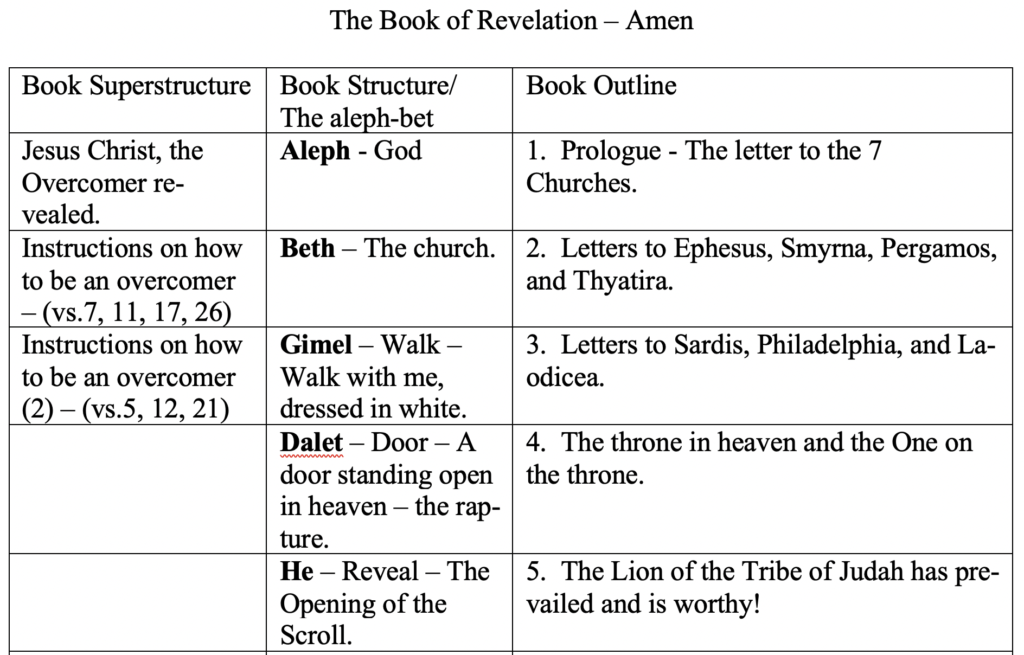
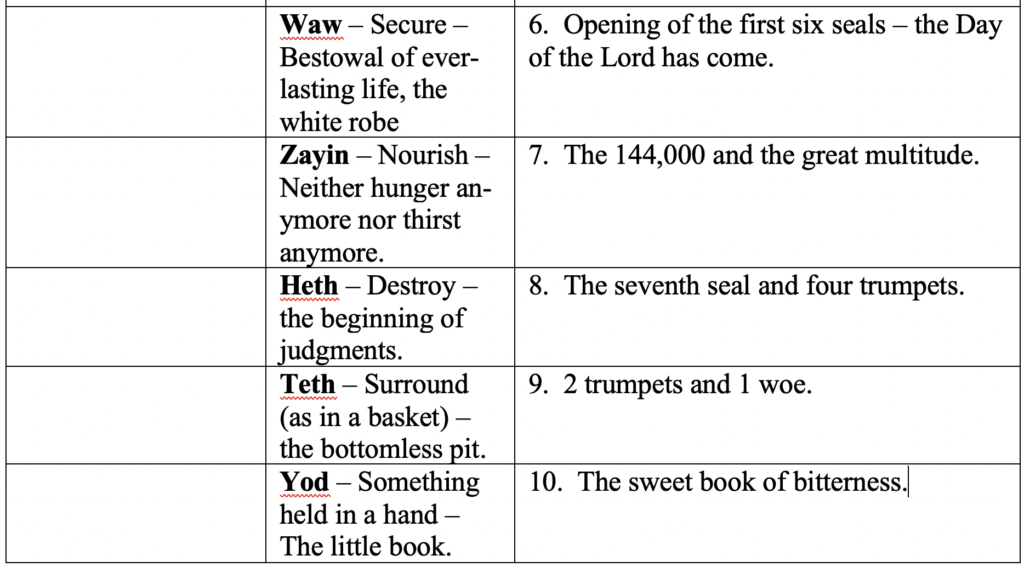
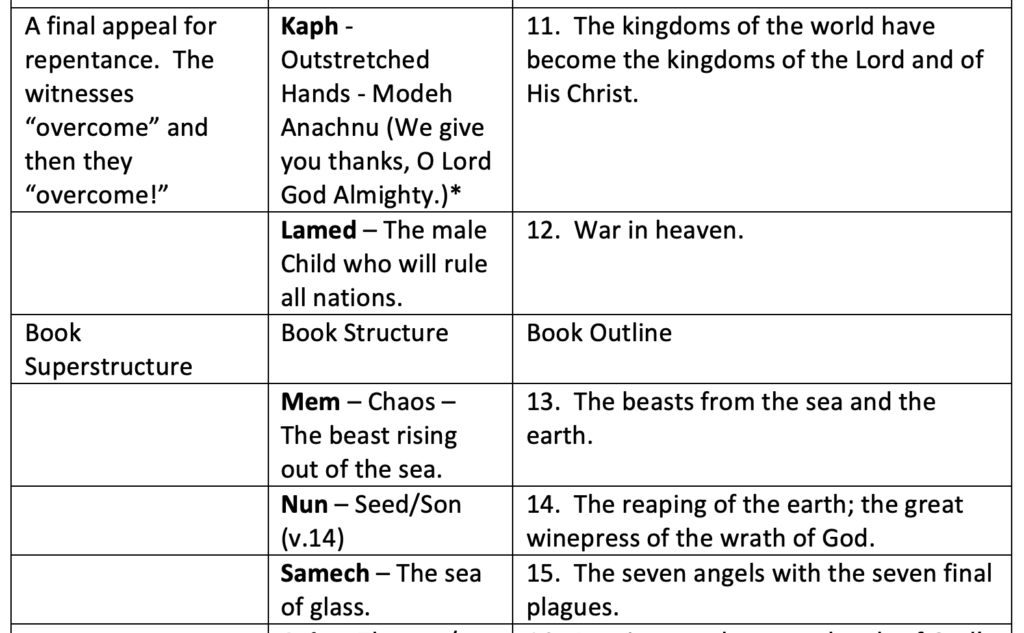
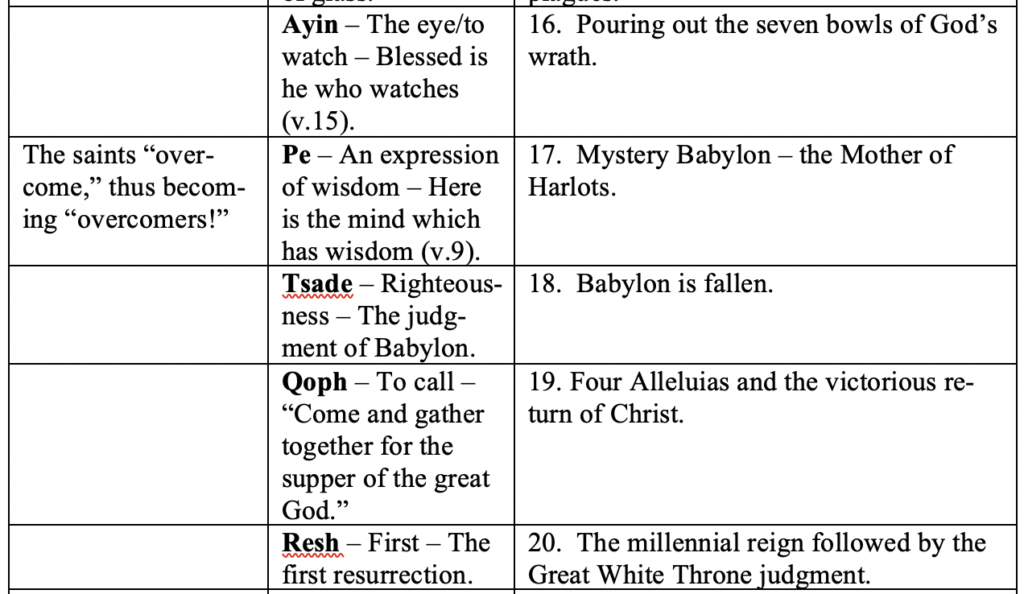
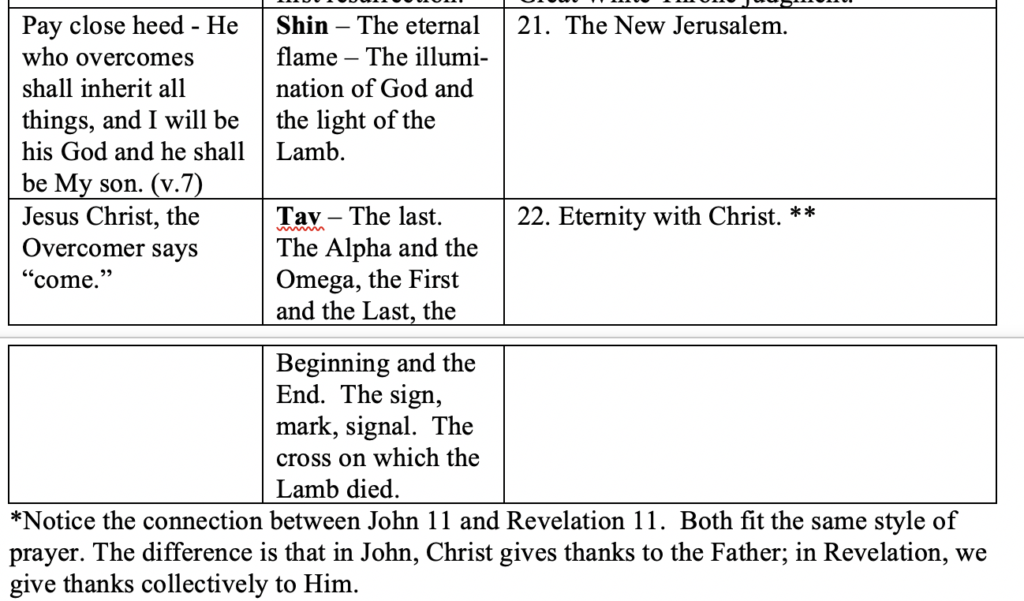
Finally, as an enticement for you to want to look for hidden patterns in Scripture, the following chart concerning the 22 chapters of Revelation and the corresponding 22 letters of the Hebrew aleph-beth is provided for you. Each letter of the aleph-beth has its own meaning. The structure of the book of Revelation, in its 22 chapters, corresponds beautifully to these 22 letters. Interestingly, the 21 chapters of the gospel of John follow this same pattern, and thus they, at times, are a corresponding nature to the book of Revelation –

**Revelation ends with 22:21 and not 22:22 – very interesting!

Life application: In the next 404, days we will see the culmination of God’s great plan of redemption as detailed by the Apostle John. This book has been interpreted in many ways, and the book marks a large dividing line between denominations and sects within Christianity. Many heretical views have arisen from an evaluation of the book or are used in an incorrect evaluation of it.

Because there are many ways to approach Revelation, and because of these many opinions on the book’s meaning and fulfillment, it is often ignored, often misused, and often maligned. In the end though, it is a book of absolute truth because it is a part of God’s word. Therefore, we mishandle it or misinterpret it at our own peril – just like all of Scripture.

One of the main dividing lines over the contents of Revelation comes down to one word – Israel. Do you believe that the church has replaced Israel? Does Israel have a future purpose in redemptive history? If one believes that God has rejected Israel, it means that God’s promises and covenant faithfulness cannot be trusted. Is salvation eternal, or can it be lost? National Israel is a template of individual salvation. If God has rejected them, He may also reject you. Is that what God has come to do? Has He come to provide eternal insecurity to His redeemed?

Revelation, and indeed all of the Bible, would say, “No.” What will be presented to you in these next 404 days is based on this idea. Have surety in your salvation. God is faithful, even when you are unfaithful.

Are you ready? Let’s discover the fulfillment of the ages as we explore Revelation!

“He who testifies to these things says, ‘Surely I am coming quickly.’
Amen. Even so, come, Lord Jesus!  The grace of our Lord Jesus Christ be with you all. Amen.” Revelation 22:20, 21

Lord God, open our hearts to Your word. Speak to us as we pursue a knowledge of You in it each time we open it. And Lord, convict us that it is right, proper, and necessary to be in it day and night. Help us to put Your word first in our lives because it tells us of Jesus, and because Jesus reveals You to us. May it be so, all the days of our lives. Amen.