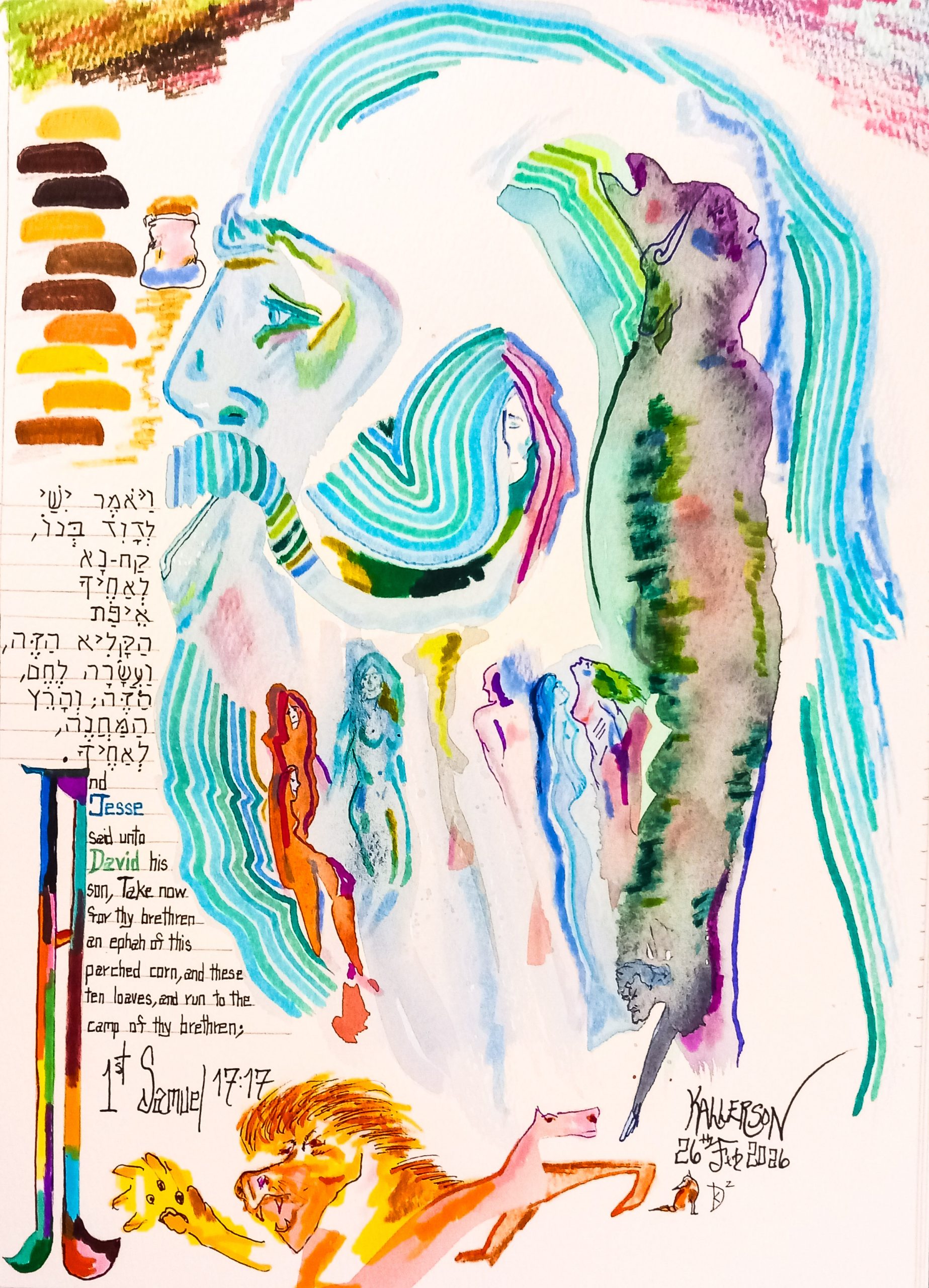
1 Samuel 16:1-13 (Arise! Anoint Him! Part I)

Cool stuff. Artwork by Douglas Kallerson.

1 Samuel 16:1-13
Arise! Anoint Him! Part I

(Typed 3 November 2025) As we know, first impressions can be completely out of whack with the reality of who a person really is. This is especially true if we are willing to accept people with whom we think we could never agree.

It’s also true with inanimate things. We may see a place, a restaurant, a little town, etc., and think, “What a dive.” And yet, we may find the restaurant has the best food in the universe and that the little town has more charm than Grace Kelly.

People come to this church, and their first impression is, “It’s a strip mall! I bet this won’t be a great place to attend.” Most of us have heard a story from someone who thought the Superior Word would be Loserville.

And yet, the compliments after attending have been many. Some even give assurances that the next time they are in town, they will come again. Many times, I have heard people exclaim how wonderful the congregation is. Someday, maybe they will give the same compliment about the preacher… someday, maybe. J

Samuel is going to meet David in this chapter. Before he does, he will go through a process of evaluating his brothers. His first impression will not be right, and the Lord will correct his thinking.

Text Verse: “So God created man in His own image; in the image of God He created him; male and female He created them.” Genesis 1:27

We are all prone to basing our opinions about people and things based on first impressions. Goliath did that, and it cost him the whole shootin’ match. One of the fundamental truths in Christianity is that all people bear God’s image.

Because of this, when we look down on someone else without knowing him, it is a failure to see the image of God in him. This shouldn’t be. James 3:9 says this explicitly, basing his statement on Genesis 1:27.

How we judge people later on, when we get to know them, will be based on their character. Normally, we should reserve making such judgments until we have an idea about who they are and what they are like.

It is true that some people’s actions allow us to know a great deal about them. But even then, we may find that they are acting out in an attempt to hide pain, trials, feelings of worthlessness, and so forth.

So let us reserve judgment as best we can when it is possible to do so. We may find surprising things by withholding what we might first think. Who knows, you may even find the storefront church you decided to attend turned out to be a place full of great folks, like those at the Superior Word.

Being careful to view others as God’s image bearers who need to be evaluated prudently is an important tenet found in His superior word. And so, let us turn to that precious word once again, and… May God speak to us through His word today, and may His glorious name ever be praised.

I. He Will See to the Heart (verses 1-7)

Now the Lord said to Samuel, “How long will you mourn for Saul, seeing I have rejected him from reigning over Israel?

vayomer Yehovah el shemuel ad mathay atah mitabel el shaul vaani meastiv mimelokh al yisrael – “And he said, Yehovah, unto Samuel, ‘Until when you mourning yourself unto Saul, and I, I spurned him from reigning upon Israel?’” This takes the reader back to the final words of the previous chapter –

“And not he added, Samuel, to see Saul until day his death. For he bewailed himself, Samuel, unto Saul. And Yehovah, He was sighed for He caused to reign, Saul, upon Israel.” 1 Samuel 15:35 (CG)

Despite Saul’s disobedience, Samuel had grown in affection for Saul. The entire situation deeply pained him, probably to the point where he returned home and moped around the place. Therefore, the Lord has to wake him out of his slumberous state. The Lord had rejected Saul, and that was that.

Samuel means Asked from God. Saul means Asked, but the spelling of his name is identical to Sheol.

1 (con’t) Fill your horn with oil, and go;

male qarnekha shemen velekh – “You must fill your horn – oil, and you must walk.” To Samuel, the meaning would be obvious. It was time to anoint a new king over Israel. The imperative verbs are intended to spur Samuel to action. He was lollygagging around while the Lord was initiating a new direction in the redemptive narrative.

In Scripture, the qeren, horn, is a symbol of prominence and power. By extension, having oil in it for anointing indicates the presence of the power of the Holy Spirit which is then specially highlighted in a particular place. This leads to the thought of dignity and honor.

Notice the difference between the two:

(And Yehovah, he denuded ear Samuel, day one to faces coming Saul, to say, 16 “According to the time, tomorrow, I will send unto you man from land Benjamin. And you anointed him to commander upon My people, Israel. And he caused to save My people from hand Philistines. For I saw My people. For it came, his shriek, unto Me.”) … And he took, Samuel, flask the oil, and he poured upon his head, and he kissed him and he said, “Not for He anointed you, Yehovah, upon His inheritance to commander? 1 Samuel 9:16 & 10:1 (CG)

And he said, Yehovah unto Samuel, “Until when you mourning yourself unto Saul, and I, I spurned him from reigning upon Israel? You must fill your horn – oil, and you must walk. I will send you unto Jesse – House the ‘My Bread.’ For I saw in his sons: to Me – king.” 1 Samuel 16:1 (CG)

A flask is made by a man. A horn comes from an animal created by God, even if prepared by man. The pakah, flask, is only seen again in the anointing of Jehu as king over Israel. Like Saul, he was anointed for a particular task but not as the ruler of the dynasty leading to the Messiah. However, this instance is different…

1 (con’t) I am sending you to Jesse the Bethlehemite.

No translation I know of gets the meaning: eshlakhakha el Yishai beith ha’lakhmi – “I will send you unto Jesse – House the ‘My Bread.’” The definite article placed after beith, house, demands such a rendering. The words are broken down as –

beith – house
ha – the definite article
lakhmi – my bread, eater, warrior, bread-ite (as in House the ‘Bread-ite’)

The final word without the vowel points is identical to “my bread,” found 8 times in Scripture. It is also identical to the name Lakhmi found in 1 Chronicles 20:5. That name signifies either Warrior or Eater. Both are derived from lekhem, bread.

Lekhem is derived from lakham, to feed on. By implication, it signifies to battle, as if a warrior is feeding on the souls of his enemy as he strikes them with the mouth of his sword.

Therefore, the name in this verse, which is found only four times in Scripture, all in 1 Samuel, means either House the Eater, House the Warrior, House the Bread-ite, or House, the ‘My Bread.’ Being the ancestor of Jesus, who is the Bread of Life (John 6:35), the meaning is clear. All four of these merge into one thought: God’s Messiah.

Three of the names are simple enough to understand in their relationship to Christ Jesus. However, the name House the Eater may be confusing since we haven’t been in Leviticus for a while. From the sermon on Leviticus 10:8-20 entitled Absolute Zero given on 9 July 2017, which is 8 years, 6 months, and 30 days (or 3136 days) ago as of 8 February 2026, this is what was said concerning verse 10:17 –

“In the eating of the sin offering, they [the priest] actually bore the guilt of the congregation, thus making atonement for them.

The blood was never taken into the holy place. If that had happened, then the animal would have been handled in a different way. But the blood had merely been cast out upon the altar of burnt-offering. In the eating of the flesh, they therefore actually took the sin of the congregation upon themselves for the purpose of canceling it, or making expiation for it.”

One can see the role of Christ as the “Eater” of our sin, devouring it and eliminating it once and for all. It highlights the doctrine of eternal salvation, right in the book of Leviticus.

Jesse means Yehovah Exists. But it also means My Husband. As such, the name Jesse contains the weighty notion that human marriage reflects divine revelation.

Notice that the Lord only gives the name of the father of the family. It would have saved effort to name the son of Jesse who would be selected, but that would leave out critical information that would reveal more of God’s redemptive plans. As such…

1 (con’t) For I have provided Myself a king among his sons.”

ki raiti bevanav li melekh – “For I saw in his sons: to Me – king.” Without a moment’s hesitation, one can see the dual meaning of these words. God is selecting a king to replace Saul, but He is also selecting a king for a kingdom that will rule Israel forever. Two excellently stated points on this clause are –

“The language is remarkable, and intimates a difference between this and the former king. Saul was the people’s choice, the fruit of their wayward and sinful desires for their own honor and aggrandizement. The next was to be a king who would consult the divine glory, and selected from that tribe to which the pre-eminence had been early promised (Ge 49:10).” JFB Commentary

“…the one was given in wrath, and the other in love; the one was to the rejection of God as King, the other to the rejection of Saul by the will of God.” John Gill

Both are spot on concerning the contrast between the two anointings. The Lord gave the people Saul when they rejected Him as their king.  Next, He gives them what He wants through appointing the Davidic line leading to Jesus to (😝tee hee 😝) once again rule them as the King! The thought is breathtakingly astonishing.

Considering that Saul’s name in Hebrew is identical to Sheol, it is as if the Lord is handing them a choice concerning life or death. Speaking of Saul…

And Samuel said, “How can I go? If Saul hears it, he will kill me.”

vayomer shemuel ekh elekh veshama shaul vaharagani – “And he said, Samuel, ‘How I will walk? And he heard, Saul, and he killed me!’” Samuel anointed Saul as king. Despite his authority as the prophet and judge of the Lord, the king had the military ability to strike anyone. This is seen later in the history of the kings when a prophet came to correct King Amaziah –

“Therefore the anger of the Lord was aroused against Amaziah, and He sent him a prophet who said to him, ‘Why have you sought the gods of the people, which could not rescue their own people from your hand?’
16 So it was, as he talked with him, that the king said to him, ‘Have we made you the king’s counselor? Cease! Why should you be killed?’
Then the prophet ceased, and said, ‘I know that God has determined to destroy you, because you have done this and have not heeded my advice.’” 1 Chronicles 25:15, 16

Soldiers are normally dedicated to their leaders. If Saul killed Samuel, they would be hesitant to stand against him. Samuel’s fear, even at this early stage, is justified. Therefore…

2 (con’t) But the Lord said, “Take a heifer with you, and say, ‘I have come to sacrifice to the Lord.’

vayomer Yehovah eglath baqar tiqakh beyadekha veamarta lizboakh leYehovah bathi – “And He said, Yehovah, ‘Heifer, herd, you will take in your hand, and you said, “To sacrifice to Yehovah I came.”’” This is not a lie. If the Lord told him to take the heifer to sacrifice, and he does, then the word of the Lord is fulfilled. Even if there is another reason for going, that doesn’t negate the truth of this directive.

Like concealing of Saul’s anointing from the people of Israel, David’s anointing is to be kept from Saul, the leader of Israel.

The type of animal is an eglath baqar, heifer of the herd. The word eglah is a female calf, coming from egel, a male calf. They are derived from the same root as agol, circular, due to their frisking around. The word baqar, herd, is from a root signifying to plough or break forth. Figuratively, it means to seek out or inquire.

Using the sacrifice as a ruse to conceal the main purpose tells us that Samuel probably did this at other times in various locations. As such, it would be a common event that would not raise suspicion. Along with a general sacrifice, three things are to occur…

Then invite Jesse to the sacrifice,

veqaratha leyishai bazavahk – “And you called to Jesse to the sacrifice.” The first directive. The sacrifice is a zabakh, a slaughter. However, it signifies doing so for a sacrifice, which is then followed by a feast of the animal. Unlike the burnt offering, for example, which is wholly burnt to the Lord, it is a word used for all sacrifices eaten at a feast.

Being a feast offering, the animal belongs to Samuel, and he has the right to invite anyone he desires. Jesse is to be invited.

3 (con’t) and I will show you what you shall do;

veanokhi odiakha eth asher taaseh – “and I will cause to know, you, what you will do.” The second directive. The Lord will give the instructions at the time He determines. Next…

3 (con’t) you shall anoint for Me the one I name to you.”

u-mashakhta li eth asher omar elekha – “and you anointed to Me whom I will say unto you.” The third directive. The choice will be made by Yehovah. Samuel is not to act until the Lord speaks.

So Samuel did what the Lord said, and went to Bethlehem.

vayaas shemuel eth asher diber Yehovah vayavo beith lakhem – “And he did, Samuel, what He said, Yehovah, and he went – Bethlehem.” In obedience, Samuel got his horn, filled it with oil, obtained a heifer of the herd, and headed to Bethlehem, House of Bread, but with a secondary meaning of House of Battle (War).

4 (con’t) And the elders of the town trembled at his coming,

vayekherdu ziqne ha’ir liqrato – “(And they shuddered, aged the city, to encounter him.)” In contrast to all other translations, I have set this clause off as parenthetical. It is a statement of fact, but unless apart, it complicates the ongoing narrative. The reason they shudder is that Bethlehem was not on the normal rounds of Samuel –

“And he judged, Samuel, Israel all days his livings. 16 And he walked from day year in year, and he revolved – Bethel and the Gilgal and the Mizpah. And he judged Israel all the spots, the these. 17 And his recurrence the Ramah-ward. For there his house. And there, he judged Israel. And he built there altar to Yehovah.” 1 Samuel 7:15-17

If there was a need to meet Samuel, one would normally go to him, not the other way around. Therefore, there must be a pressing, and quite possibly distressing, reason for Samuel to come. If the people knew about the rift between him and Saul, they might suppose it to be the cause of worse tidings.

4 (con’t) and said, “Do you come peaceably?”

The addressee is in the singular: vayomer shalom boekha – “And he said, ‘Peace, you come?’” The elders were mentioned in the previous clause. As such, one would think it would be “And they said, ‘Peace, you come?’” This is unless one spoke for the whole. That is not unprecedented. But if the narrative continues with the previous clause as parenthetical, Jesse is the subject –

And you called to Jesse to the sacrifice, and I cause to know you what you will do. And you anointed to Me whom I will say unto you.” 4 And he did, Samuel, what He said, Yehovah, and he went – Bethlehem. … And he said, “Peace, you come?” 5 And he said, “Peace. To sacrifice to Yehovah I came. You must sanctify yourselves and come with me in the sacrifice.” And he consecrated, Jesse and his sons. And he called to them to the sacrifice.

And he said, “Peaceably; I have come to sacrifice to the Lord.

vayomer shalom lizboakh leYehovah bathi– “And he said, ‘Peace. To sacrifice to Yehovah I came.’” Samuel’s response is to Jesse’s question. “I have come in peace for the purpose of offering a feast sacrifice.” Therefore…

5 (con’t) Sanctify yourselves, and come with me to the sacrifice.”

hitqadeshu uvathem iti bazavakh – “You must consecrate yourselves, and you came with me in the sacrifice.” Not only has Samuel come to conduct a sacrifice, but he has done so with the intent of having Jesse participate in it…

5 (con’t) Then he consecrated Jesse and his sons,

vayqadesh eth Yishai veeth banav– “And he consecrated, Jesse and his sons.” This explains the previous clause. Samuel told them they must consecrate themselves, a statement of fact. Samuel is the one to direct, oversee, and/or perform this function. With that completed…

5 (con’t) and invited them to the sacrifice.

vayiqra lahem lazavakh – “And he called to them to the sacrifice.” Whatever the process for consecration, once it was complete, Jesse and his sons were then called to participate in the sacrifice, an idea implied in “to the sacrifice.” Upon their arrival…

So it was, when they came, that he looked at Eliab

vayhi bevoam vayar eth Eliav – “And it was, in their coming, and he saw Eliab.” Eliab is noted as the firstborn in 1 Samuel 17:13. His name means God is Father, or My God is Father. Jesse probably invites them to attend in birth order so that he can introduce them as they sit. Samuel notes Eliab excitedly…

6 (con’t) and said, “Surely the Lord’s anointed is before Him!”

vayomer akh neged Yehovah meshikho – “and he said, ‘Surely, afront Yehovah His anointed.’” Samuel thought this was the guy. It can be inferred that Saul was the firstborn of Kish (maybe his only son) from 1 Chronicles.

Eliab, being introduced first, would alert Samuel that he was the firstborn. The assumption, along with his appearance and height (which is implied in the next verse), would have supposedly made him a prime candidate. Such thinking, however, was erroneous…

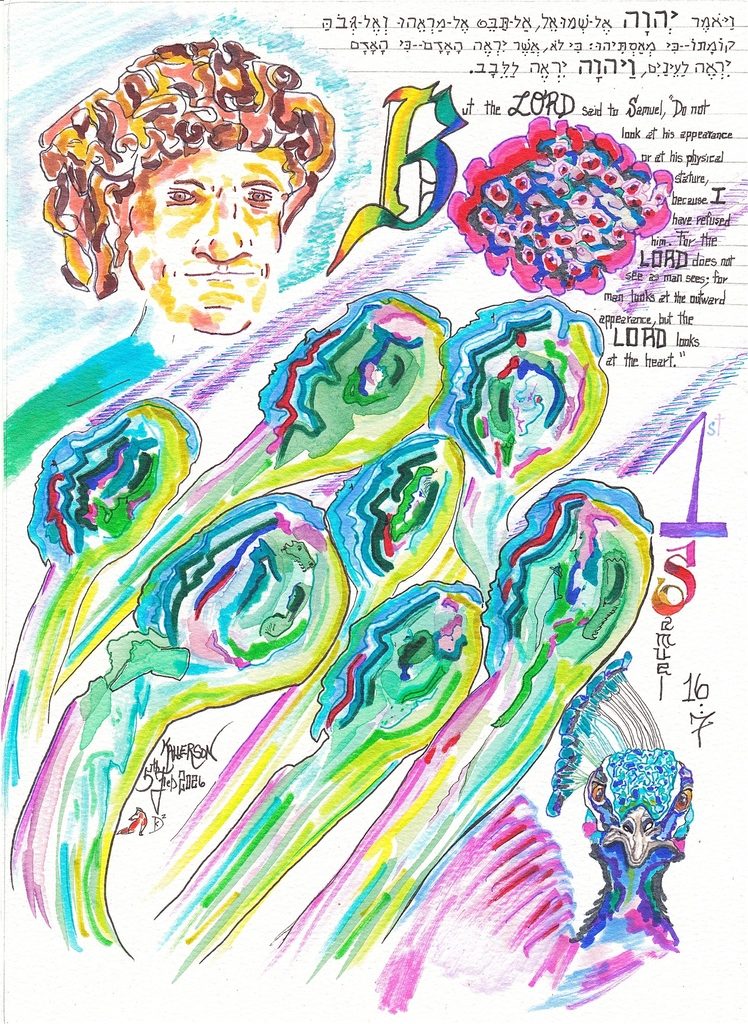
But the Lord said to Samuel, “Do not look at his appearance or at his physical stature, because I have refused him.

vayomer Yehovah el shemuel al tabet el marehu veel gevoakh qomatho ki meastihu – “And He said, Yehovah, unto Samuel, ‘Not may you cause to gaze unto his appearance and unto elevation his height. For I spurned him.’” This is the error in thinking that Samuel and the people made previously –

“And they ran, and they took him from there. And he stood himself in midst the people. And he soared from all the people, from his neck and upward. 24 And he said, Samuel, unto all the people, ‘You saw whom He selected in Him, Yehovah. For naught according to him in all the people.’
And they caused to shout, all the people, and they said, ‘May he live, the king!’” 1 Samuel 10:23, 24

The assumption was, like Arnold Schwarzenegger’s biceps, that bigger is better. Saul was the tallest, so he must be a great guy. It is what is known as a source, or genetic, fallacy. However, the Lord’s thinking is never fallacious.

This tells us that His selection of Saul was one intended to teach the people a lesson and fulfill any necessary typology or relevant patterns the Bible deals with. However, it was not a selection of who best met the ideal of a sound king for His people…

For the Lord does not see as man sees; for man looks at the outward appearance, but the Lord looks at the heart.”

The clause is elliptical, rightly indicated by the NKJV: ki lo asher yireh ha’adam ke ha’adam yireh laenayim veYehovah yireh lalevav – “For not which he will see, the man. For the man, he will see to the eyes, and Yehovah, He will see to the heart.” God created man. He is aware of every aspect of every human. Our outward appearance is irrelevant to Him.

People take offense at the words of Leviticus, as if the Lord looks positively or negatively at people based on such considerations –

“Speak to Aaron, saying: ‘No man of your descendants in succeeding generations, who has any defect, may approach to offer the bread of his God. 18 For any man who has a defect shall not approach: a man blind or lame, who has a marred face or any limb too long, 19 a man who has a broken foot or broken hand, 20 or is a hunchback or a dwarf, or a man who has a defect in his eye, or eczema or scab, or is a eunuch.” Leviticus 21:17-20

This has nothing to do with the externals as indicated in 1 Samuel. Rather, two things were being taught to Israel. The first was the holiness of God in relation to sin, of which such defects are manifest in humanity. Second, it was that these men were types of Christ in His priestly duties.

Externals, such as those being dealt with in 1 Samuel, have no bearing on how the Lord looks at people. That is seen throughout the Old Testament, such as in Isaiah 56, when referring to the eunuch whose heart was obedient to the Lord.

“Do not let the son of the foreigner
Who has joined himself to the Lord
Speak, saying,
“The Lord has utterly separated me from His people”;
Nor let the eunuch say,
“Here I am, a dry tree.”
For thus says the Lord:
“To the eunuchs who keep My Sabbaths,
And choose what pleases Me,
And hold fast My covenant,
Even to them I will give in My house
And within My walls a place and a name
Better than that of sons and daughters;
I will give them an everlasting name
That shall not be cut off.” Isaiah 56:3-5

A King is coming to shepherd My flock
He will be humble and true of heart
In honoring Me, He will always take stock
And from My laws, He will not depart

Israel will not know Him at first
They will reject Him, thus turning from Me
But for His people, He will thirst
Waiting for them to receive Him, patiently

A shepherd King will rule Israel
And will bring many more into His flock
“He has done all things well”
And Israel will, in Him, finally take stock

II. He Anointed Him (verses 8-13)

So Jesse called Abinadab, and made him pass before Samuel.

vayiqra Yishai el avinadav vayaavirehu liphne shemuel – “And he called, Jesse, unto Abinadab. And he caused to traverse him to faces Samuel.” The wording gives the sense of a fashion show. To traverse means to cross. As such, he is coming into Samuel’s presence, crossing before him, and then passing to the other side.

Abinadab comes from av, father, and nadav, willing, as in “willing to share,” generous, etc. As such, it means Father of Liberality. As for Abinadab, well, he didn’t make the cut…

8 (con’t) And he said, “Neither has the Lord chosen this one.”

vayomer gam bazeh lo bakhar Yehovah – “And he said, ‘Also in this, not He selected, Yehovah.’” The communication to Samuel is immediate and completely understandable. However it came about, it was as clear as if it were audible. Like Eliab, Abinadab is rejected. Therefore…

Then Jesse made Shammah pass by. And he said, “Neither has the Lord chosen this one.”

vayaaver Yishai shamah vayomer gam bazeh lo bakhar Yehovah – “And he caused to traverse, Jesse, Shammah. And he said, ‘Also in this, not He selected, Yehovah.’” Shammah also doesn’t measure up. Jesse’s curiosity meter must have been set to max by this point.

Shammah is derived from shamem, desolate, stupefy (in a negative sense), make amazed, etc. That is from a primitive root signifying to stun. It means something like Desolation, Astonishment, or Horror. Abarim says, Appalling Desolation.

Having turned down these three, Jesse still has a quiver full to go. Therefore, they continue…

10 Thus Jesse made seven of his sons pass before Samuel.

vayaaver Yishai shivat banav liphne shemuel – “And he caused to traverse, Jesse, seven his sons to faces Samuel.” 1 Chronicles 2:13-15 lists only seven sons of Jesse, including David. This likely means that one died, although there are other explanations for this, such as one being the son of a concubine.

Regardless, seven have been noted at this time. Seven is the number of spiritual perfection. All seven were evaluated. However…

10 (con’t) And Samuel said to Jesse, “The Lord has not chosen these.”

vayomer shemuel el Yishai lo bakhar Yehovah baeleh – “And he said, Samuel, unto Jesse, Not He selected, Yehovah, in these.’” It is not known how much Samuel revealed to Jesse. Whether he told him the reason for the anticipated selection or that he said the Lord was looking for a particular person without regard to the reason is debated.

Either way, Samuel tells Jesse that none of these sons is the one selected. Therefore, he asks an obvious question…

11 And Samuel said to Jesse, “Are all the young men here?”

vayomer shemuel el Yishai khathamu ha’nearim – “And he said, Samuel, unto Jesse, ‘They completed, the lads?’” Samuel had to be wondering what was going on. He had asked for Jesse’s sons to pass before him as instructed by the Lord. And yet, the Lord kept turning each down, one after another.

Knowing that the Lord cannot be wrong leads Samuel to the one avenue not yet taken. For whatever reason, one of Jesse’s sons had not been brought before Samuel. The ball is again in Jesse’s court…

11 (con’t) Then he said, “There remains yet the youngest,

vayomer od shaar haqatan – “And he said, ‘Yet he left, the diminutive.’” The eighth son is like an afterthought to Jesse. “Oh yeah, I have one more. He’s the youngest of the lot. I… kind of forgot about him. My bad.”

11 (con’t) and there he is, keeping the sheep.”

vehineh roeh batson – “And behold! Pasturing in the flock.” The “behold” isn’t a place indicator as the NKJV implies. Rather, it is being used as a diminutive about David. “Not only is he the little guy, but he’s just a keeper of the flock. No need to concern yourself with that guy!”

The tson, flock, comes from an unused root meaning to migrate.

Despite Jesse’s dismissive attitude, Samuel disagrees…

11 (con’t) And Samuel said to Jesse, “Send and bring him.

vayomer shemuel el Yishai shilakhah veqakhenu – “And he said, Samuel, unto Jesse, ‘You must send-ward, and you must take him.” Samuel now knows that not all the sons have been presented. He also knows that the Lord had not chosen any of the first seven.

Therefore, the little guy out with the sheep must be called before the process can be considered complete…

11 (con’t) For we will not sit down till he comes here.”

Rather: ki lo nasov ad boo poh – “For not we will revolve until his coming here.” In other words, they will all sit around (savav) the table for the sacrificial meal. Once they sat, plates of food would revolve (savav) through the hands of those seated there. Therefore…

12 So he sent and brought him in.

vayishlakh vayviehu – “And he sent, and he caused to bring him.” Nothing is said of David being consecrated, but this isn’t a problem. Either he was consecrated before being brought in, or he didn’t eat the sacrificial meal. It doesn’t say he did, so that is a possibility. Either way, we can’t conclude that he wasn’t consecrated, only that he was brought in.

12 (con’t) Now he was ruddy, with bright eyes, and good-looking.

vehu admoni im yepheh enayim vetov roi – “And he, red, with beautiful eyes and good visage.” Other than being red, I’m really close on this one…

The first word used to describe David, admoni, is the same as that used of Esau in Genesis 25:25. The word comes from the same root as the verb adom, to be red. It can speak of the hair or the complexion.

Either way, the connection to Esau and what he typologically signified shouldn’t be missed. To understand why, take a break later and watch the sermons on Esau and Jacob from Genesis 25 and 27.

Next, David’s eyes are noted as yapheh, beautiful. This is from the verb yaphah, to be bright. Thus, to be beautiful. In the Bible, the eye is used to indicate one’s spiritual state, focus, and understanding.

It is used in reference to seeing spiritual truths or being blind toward them. This leads to the moral character or intentions of a person, such as referring to a good eye or a bad eye to indicate one’s level of generosity.

Lastly, his visage is considered good, as in pleasing.

12 (con’t) And the Lord said, “Arise, anoint him; for this is the one!”

The abruptness of each clause provides its own emphasis: vayomer Yehovah qum meshakehu ki zeh hu – “And He said, Yehovah, ‘You must arise! You must anoint him! For this he!’”

One can see the response to the three directives of verse 3 –

1And you called to Jesse to the sacrifice, 2and I cause to know you what you will do, 3and you anointed to Me whom I will say unto you.

1Arise! 2Anoint him! 3For this he!

Think about what has happened. Saul is rejected, while David is accepted. Saul was the tallest, soaring above the others, but from the littlest tribe. David is the diminutive one of Jesse, but from the biggest tribe. Saul was the firstborn, while David was the youngest. Saul was out looking for his father’s jennies, unclean animals. David was tending his father’s sheep, clean animals. And more…

13 Then Samuel took the horn of oil and anointed him in the midst of his brothers;

vayiqakh shemuel eth qeren ha’shemen vayimshakh otho beqerev ekhav – “And he took, Samuel, horn the oil, and he anointed him in midst his brothers.” It is clear that the family knows there is a purpose for David, whether Samuel told them what it was or not. Despite the view of some scholars, it seems unlikely that Samuel would have withheld this knowledge and yet anointed him in front of them.

Another contrast to Saul is seen in this clause. Saul was alone with Samuel when he was anointed. David is openly anointed before his brothers. When this took place…

13 (con’t) and the Spirit of the Lord came upon David from that day forward.

vatishlakh ruakh Yehovah el David mehayom ha’hu vamaelah – “And it surged, Spirit Yehovah, unto David from the day, the it, and upward.” Again, another difference between the two is seen. Saul was given three signs before he received the Spirit. Here, the Spirit surges unto David from that day, meaning at the moment of his anointing. With that accomplished…

*13 (fin) So Samuel arose and went to Ramah.

vayaqam shemuel vayelekh haramathah – “And he arose, Samuel, and he walked the Ramah-ward.” Samuel’s job is complete as regards anointing the new king. As such, he returned homeward to Ramah, Lofty Place.

There are contrasts between Saul and David, but the truth is that Saul was selected by the Lord, accomplished the Lord’s will in some regard, and pictured Jesus in a limited way.

Also, it was the Lord’s intention that there would be a king before David in order to continue the pattern of the second replacing the first, which is predominantly displayed in Scripture.

A new direction will be seen as the focus of 1 Samuel transitions from Saul to David, highlighting the latter from this point forward. The way God has structured Scripture is intended to get us to consider each story from many angles.

One of the commentaries I read while studying for this sermon noted –

“Wordsworth curiously considers these three successive unctions of David figurative of the successive unctions of Christ: conceived by the Holy Ghost in the Virgin’s womb; then anointed publicly at his baptism; and finally, set at God’s right hand as King of the Universal Church in the heavenly Jerusalem.” Charles Ellicott

Although I am not sold on that analysis and will have to consider it as the narrative continues, I never would have thought of it, not in a million billion thousand years. Wordsworth may be right. If not, we can be sure there is still a reason.

In all such things, we should challenge our minds as to why they are recorded. Make notes! Reread things as they come to mind. Be sure to ask the Lord to help you in your study and consideration of the word.

When you do, you will be rewarded. The Lord wants His word to be understood. Make a study of the word your daily habit. Start today! As for 1 Samuel 16, we’ll be back next week, the Lord willing, to finish up the chapter and see what all the detail is pointing to.

Until then, be blessed in all you do. Include the Lord in each thing that comes your way, and you will find a blessing in it. And be sure not to make rash judgments about those you encounter based on first impressions.

Let your first impressions of others be filled with grace. You may find that those you encounter will surprise you.

Closing Verse: “I have found My servant David;
With My holy oil I have anointed him,
21 With whom My hand shall be established;
Also My arm shall strengthen him.” Psalm 89:20, 21

Next Week: 1 Samuel 16:14-23 What a surprise! Nothing grim, it’s true… (Arise! Anoint Him! Part II) (34th 1 Samuel Sermon)

The Lord has you exactly where He wants you. He has a good plan and purpose for you. He is the One who abases the haughty and exalts the humble. He regards the lowly, and the proud, He knows from afar. So yield yourself to Him, trust Him, and believe His word. In this, He will do great things for you and through you.

1 Samuel 16:1-13 (CG)

And he said, Yehovah, unto Samuel, “Until when you mourning yourself unto Saul, and I, I spurned him from reigning upon Israel? You must fill your horn – oil, and you must walk. I will send you unto Jesse – House the ‘My Bread.’ For I saw in his sons: to Me – king.”

2And he said, Samuel, “How I will walk? And he heard, Saul, and he killed me!”

And He said, Yehovah, “Heifer, herd, you will take in your hand, and you said, ‘To sacrifice to Yehovah I came.’ 3And you called to Jesse to the sacrifice, and I will cause to know, you, what you will do, and you anointed to Me whom I will say unto you.”

4And he did, Samuel, what He said, Yehovah, and he went – Bethlehem. (And they shuddered, aged the city, to encounter him.) And he said, “Peace, you come?”

5 And he said, “Peace. To sacrifice to Yehovah I came. You must consecrate yourselves, and you came with me in the sacrifice.” And he consecrated, Jesse and his sons. And he called to them to the sacrifice.

6And it was, in their coming, and he saw Eliab, and he said, “Surely, afront Yehovah His anointed.”

7And He said, Yehovah, unto Samuel, “Not may you cause to gaze unto his appearance and unto elevation his height. For I spurned him. For not which he will see, the man. For the man, he will see to the eyes, and Yehovah, He will see to the heart.”

8And he called, Jesse, unto Abinadab. And he caused to traverse him to faces Samuel. And he said, “Also in this, not He selected, Yehovah.” 9And he caused to traverse, Jesse, Shammah. And he said, “Also in this, not He selected, Yehovah.” 10And he caused to traverse, Jesse, seven his sons to faces Samuel. And he said, Samuel, unto Jesse, “Not He selected, Yehovah, in these.” 11And he said, Samuel, unto Jesse, “They completed, the lads?” And he said, “Yet he left, the diminutive. And behold! Pasturing in the flock.”

And he said, Samuel, unto Jesse, “You must send-ward, and you must take him. For not we will revolve until his coming here.” 12And he sent, and he caused to bring him. And he, red, with beautiful eyes and good visage. And He said, Yehovah, “You must arise! You must anoint him! For this he!” 13And he took, Samuel, horn the oil, and he anointed him in midst his brothers. And it surged, Spirit Yehovah, unto David from the day, the it, and upward. And he arose, Samuel, and he walked the Ramah-ward.


1 Samuel 16:1-13 (NKJV)

Now the Lord said to Samuel, “How long will you mourn for Saul, seeing I have rejected him from reigning over Israel? Fill your horn with oil, and go; I am sending you to Jesse the Bethlehemite. For I have provided Myself a king among his sons.”

And Samuel said, “How can I go? If Saul hears it, he will kill me.”

But the Lord said, “Take a heifer with you, and say, ‘I have come to sacrifice to the Lord.’ Then invite Jesse to the sacrifice, and I will show you what you shall do; you shall anoint for Me the one I name to you.”

So Samuel did what the Lord said, and went to Bethlehem. And the elders of the town trembled at his coming, and said, “Do you come peaceably?”

And he said, “Peaceably; I have come to sacrifice to the Lord. Sanctify yourselves, and come with me to the sacrifice.” Then he consecrated Jesse and his sons, and invited them to the sacrifice.

So it was, when they came, that he looked at Eliab and said, “Surely the Lord’s anointed is before Him!”

But the Lord said to Samuel, “Do not look at his appearance or at his physical stature, because I have refused him. For the Lord does not see as man sees; for man looks at the outward appearance, but the Lord looks at the heart.”

So Jesse called Abinadab, and made him pass before Samuel. And he said, “Neither has the Lord chosen this one.” Then Jesse made Shammah pass by. And he said, “Neither has the Lord chosen this one.” 10 Thus Jesse made seven of his sons pass before Samuel. And Samuel said to Jesse, “The Lord has not chosen these.” 11 And Samuel said to Jesse, “Are all the young men here?” Then he said, “There remains yet the youngest, and there he is, keeping the sheep.”

And Samuel said to Jesse, “Send and bring him. For we will not sit down till he comes here.” 12 So he sent and brought him in. Now he was ruddy, with bright eyes, and good-looking. And the Lord said, “Arise, anoint him; for this is the one!” 13 Then Samuel took the horn of oil and anointed him in the midst of his brothers; and the Spirit of the Lord came upon David from that day forward. So Samuel arose and went to Ramah.


1 Samuel 15:27-35 (Anathematize the Sinners, Part III)

1 Samuel 15:27-35
Anathematize the Sinners – Amalek, Part III

In 1 Samuel, the Hebrew word nakham, to sigh, is found four times. All four of those uses are in Chapter 15. The first was in verse 11 where I argued against the standard translation of most versions, which use the verbs relent, repent, regret, etc.

Those give a bit of the sense, but the meaning is fuller than that. In fact, other uses of the word convey a completely different meaning, such as comfort, appease, consolation, etc. Those are so disparate that it is hard to see any connection.

However, if every instance of the 108 uses of nakham in Scripture is translated as sigh, the underlying meaning will be more understandable in each case.

As noted in the comments on 1 Samuel 15:11, the Lord doesn’t actually regret His decisions. They are made in accordance with His foreknowledge and predetermined plan. However, the verses in the passage today give us seemingly contradictory thoughts –

v.29 – And also Refulgency Israel, not He will cheat, and not He will be sighed. For not man, He, to be sighed.

v.35 – And Yehovah, He was sighed for He caused to reign, Saul, upon Israel.

What do we do when such thoughts appear contradictory? Why would the Bible say one thing about the Lord and then just a few verses later say exactly the opposite? It would be foolish to think that the Bible would have a contradiction within just six verses. So, how would you handle what is presented?

Text Verse: “And He sent, the God, Messenger to Jerusalem to cause to ruin her, and according to causing to ruin, He looked, Yehovah, and he was sighed [nakham] upon the evil. And He said to the Messenger, the ‘causing to ruin,’ ‘Abundant! Now, you must cause to slacken your hand. And Messenger Yehovah standing with threshing floor Ornan the Jebusite.” 1 Chronicles 21:15

So how can it be that the Lord will “not be sighed” and yet the Lord is sighed? The answer lies in our relationship with Him. When Samuel said the Lord will not be sighed, he was stating a truth which in ancient Greek was known as theopropeō, meaning in a manner befitting God. We would say theomorphically.

When we read that God sighed, that is known as anthrōpopathōs, after the manner of human passion. The word we commonly use today is “anthropomorphic.” The Bible assigns to God human attributes. God does not change. He is. However, we change in relation to Him.

When we see a change in the events occurring in the redemptive narrative, such as Saul losing the kingship, it is because God knew Saul would change in relation to Him. In order to explain the change in events so that we can readily understand what has happened, the change is ascribed to God.

If you keep this in mind as you read Scripture, you will have a better sense of what God’s word is conveying to you. There are no contradictions. Rather, the word contains verbal accommodations to help us process what is going on.

Great things such as anthropomorphism are to be found in His superior word. And so, let us turn to that precious word once again, and… May God speak to us through His word today, and may His glorious name ever be praised.

I. Now You Must Enweigh Me (verses 27-35)

The final verses of the previous passage said –

“And he said, Saul unto Samuel, ‘I sinned. For I traversed mouth Yehovah and your words. For I feared the people, and I heard in their voice. 25 And now, you must lift, I pray, my sin. And you must return with me. And I prostrated myself to Yehovah.’

26 And he said, Samuel unto Saul, ‘Not I will return with you. For you spurned word Yehovah, and He spurned you, Yehovah, from being king upon Israel.’” 1 Samuel 15:24-26

Having completed his words to Saul…

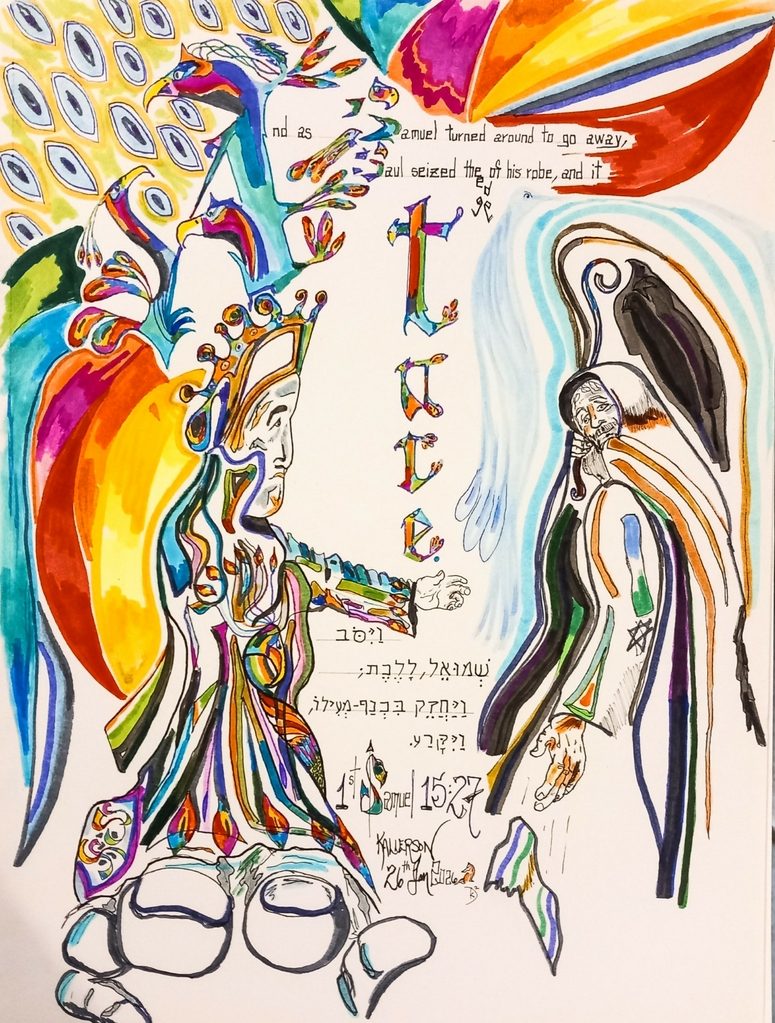
27 And as Samuel turned around to go away, Saul seized the edge of his robe, and it tore.

Rather: vayisov shemuel lalekheth vayakhazeq bikhnaph meilo vayiqara – “And he turned, Samuel, to walk, and he caused to seize in extremity his robe, and it was rent.” Inserting the name Saul does an injustice to the account. It is a quick and convenient addition, but it misses the point.

Who is the nearest antecedent? Samuel. He finished speaking to Saul, turned, and as he was turning, Samuel seized the extremity of Saul’s robe. The causative verb indicates that the action is not accidental but purposeful. He is giving Saul an object lesson to remember.

This would likely have been the tzitzith mandated in Numbers 15:38. In Deuteronomy 22, speaking of these tassels, Moses uses the term gedilim. Both indicate what is carefully described in Numbers 15 –

“Again the Lord spoke to Moses, saying, 38 ‘Speak to the children of Israel: Tell them to make tassels on the corners of their garments throughout their generations, and to put a blue thread in the tassels of the corners. 39 And you shall have the tassel, that you may look upon it and remember all the commandments of the Lord and do them, and that you may not follow the harlotry to which your own heart and your own eyes are inclined, 40 and that you may remember and do all My commandments, and be holy for your God. 41 am the Lord your God, who brought you out of the land of Egypt, to be your God: I am the Lord your God.’” Numbers 15:37-41

Samuel is conveying that Saul’s actions failed to honor the Lord. Instead, he did what his own heart and eyes were inclined to do. Tearing Saul’s robe is a symbolic act that would leave him no doubt that Samuel, and by extension, the Lord, was through with him.

Something similar occurs in 1 Kings 11 –

“Now it happened at that time, when Jeroboam went out of Jerusalem, that the prophet Ahijah the Shilonite met him on the way; and he had clothed himself with a new garment, and the two were alone in the field. 30 Then Ahijah took hold of the new garment that was on him, and tore it into twelve pieces. 31 And he said to Jeroboam, ‘Take for yourself ten pieces, for thus says the Lord, the God of Israel: ‘Behold, I will tear the kingdom out of the hand of Solomon and will give ten tribes to you…” 1 Kings 11:29-31

It is the prophet in both cases who performs the symbolic action that points to a truth already decided in God’s plans. But just in case Saul has become too dull to understand…

28 So Samuel said to him, “The Lord has torn the kingdom of Israel from you today,

vayomer elav shemuel qara Yehovah eth mamlekhuth Yisrael mealekha ha’yom – “And he said unto him, Samuel, ‘He rent, Yehovah, kingdom Israel from upon you the day.’” The action of Samuel tearing Saul’s rob adds poignancy and potency to the words. It is an intentional, not accidental, act. The Lord has decided and this is what will come to pass. And more…

28 (con’t) and has given it to a neighbor of yours, who is better than you.

u-nethanah lereakha ha’tov mimekha – “And he gave her to your associate – the good from you.” Like a city, a kingdom is a feminine entity. Saying “it” is fine, but using the feminine conveys the sense more appropriately. It is the people who form a kingdom under a king. Saul has lost his right to rule God’s people.

Therefore, someone else will be selected to whom the kingdom will be given. As noted in a previous sermon, this was not by chance or something unexpected that had to be reworked into God’s plans now that Saul had failed.

Instead, it was already known that the rule would go to Judah. Because in Genesis 49, it was to Judah that the promise of Shiloh’s coming was made. Along with that explicit note, innumerable typological hints of this have been provided.

God knew in advance that Saul’s kingdom would not continue. However, it was a necessary step in the process of His redemptive plans. The decision for his rule to end and another to assume the kingdom has now been openly displayed to Saul in the tearing of his robe. As a confirmation of this, Samuel continues…

29 And also the Strength of Israel

vegam netsakh Yisrael – “And also Refulgency Israel.” A new noun, ascribed as a name of the Lord, is used, netsakh, a goal. Strong’s describes it as “The bright object at a distance travelled towards.” This is the only time it is directly applied to the Lord in this manner. However, the word is used elsewhere to describe what belongs to Him –

“Yours, O Lord, is the greatness,
The power and the glory,
The victory and the majesty [netsakh];
For all that is in heaven and in earth is Yours;
Yours is the kingdom, O Lord,
And You are exalted as head over all.” 1 Chronicles 29:11

The word “strength” doesn’t convey this idea at all. Some translations say “glory,” but there is a word for that. Other translations include Refuge, Preeminence, Triumpher, Eternal One, Glorious One, Excellency, Hope, Majestic God, etc.

The word netsakh is often translated as “forever,” but to say “goal” more correctly satisfies the intent. A goal can include the sense of forever, but that is the state in which the goal may exist, such as when pursuing God. In the case of the deity of God in Christ, Paul says –

“…who alone has immortality, dwelling in unapproachable light, whom no man has seen or can see, to whom be honor and everlasting power. Amen.” 1 Timothy 6:16

Therefore, to maintain the idea of the goal, which is described by the unapproachable light, I selected the word refulgency, the quality of being bright and sending out rays. Next, Samuel says that He…

29 (con’t) will not lie nor relent.

lo yeshaqer velo yinakhem – “not He will cheat, and not He will be sighed.” The word shaqar includes lying, but it contains a fuller sense. It can indicate dealing falsely in action as well as word. The Lord will do neither. His words will always be truthful, and His actions will be in line with His words.

Also, He will never sigh, meaning breathe strongly over a matter, be it from frustration, sorrow, consternation, etc. Such an expression can be applied to Him so we understand such a situation, but it does not actually apply to Him…

29 (con’t) For He is not a man, that He should relent.”

ki lo adam hu lehinakhem – “For not man, He, to be sighed.” Various words are translated as man in the Hebrew canon. In this case, Samuel uses the word adam, coming from adom, to be red. The use of adam speaks of humanity having been created by God. Unlike man, God is uncreated.

Therefore, His being is perfect and unchanging. In contrast, humanity is temporal and has potential to change. Where man waffles in his convictions, God remains steadfast. Therefore, His will in a matter will not change, even if He allows man to change in relation to Him, thereby seemingly to indicate a change in Him.

Saul finally gets it and concedes the point. Despite that, he continues to only think of himself…

30 Then he said, “I have sinned;

vayomer khatathi – “And he said, ‘I sinned.’” It is a single Hebrew word. Thus, we can take the expression as an admission in state only, but not in remorse. In other words, “Yeah, yeah, so I sinned…” Saul is simply not getting the scope of his transgression or the weight of the matter that has been presented to him. Therefore, he continues seeking self-aggrandizement…

30 (con’t) yet honor me now, please, before the elders of my people and before Israel,

atah kabedeni na neged ziqne ami veneged Yisrael – “Now you must enweigh me, I pray, afront elders my people, and afront Israel.” Losing the kingdom doesn’t necessarily mean losing the kingship. His kingdom will not continue after him, but he remains the anointed king during his life.

As such, to maintain that state, he seeks to be honored by Samuel in the presence of the people. Otherwise, they may sense the rift between them and bring his kingship to an end. How much more if they saw that the tzitzith of Saul’s garment had been torn off.

Saul’s use of an imperative verb appears to be based on fear of the outcome if Samuel doesn’t come with him. The use of imperative continues, saying…

30 (con’t) and return with me, that I may worship the Lord your God.”

veshuv imi vehishtakhavethi leYehovah elohekha – “And you must return with me, and I prostrated myself to Yehovah your God.” Saul has done a changeup switcheroo in his terminology from verse 25 –

v.25 – “And now, you must lift, I pray, my sin. And you must return with me. And I prostrated myself to Yehovah.”
v.30 – “And you must return with me, and I prostrated myself to Yehovah your God.”

He no longer asks for his sin to be lifted, and instead of saying Yehovah, he says, “Yehovah your God.” He understands that the Lord’s decision is final, but he can still appeal to the humanity in Samuel. His appeal is understood and acknowledged…

31 So Samuel turned back after Saul, and Saul worshiped the Lord.

vayashav shemuel akhare shaul vayishtakhu shaul leYehovah – “And he returned, Samuel after Saul. And he prostrated himself, Saul, to Yehovah.” Despite Saul’s petition being selfish, it is one that Samuel could hardly neglect. He had anointed Saul. To reject Saul at this time would indicate a rejection of the anointing that still rested on him.

That may seem trivial, but what would his anointing of the next king matter in the eyes of the people if Samuel could walk away from his anointed king at this time? The validity of the Lord’s anointed king would be called into question.

Thus, the people could brazenly appoint their own king and assume their chosen potentate was as worthy as whoever Samuel had anointed. They had already rejected the Lord as a king to rule them. The next step of rejecting the Lord’s anointed would be simple after that.

Despite this, there was also a failure of Saul to attend to in order for the kherem that was demanded by the Lord to be fulfilled. The people failed in regard to the animals, but Samuel will not tolerate it in regard to Amalek personally…

32 Then Samuel said, “Bring Agag king of the Amalekites here to me.”

vayomer shemuel hagishu elay eth agag melekh amaleq – “And he said, Samuel, ‘You must cause to near unto me Agag, king Amalek.’” It’s hard to know what was on Agag’s mind when the summons was made. He was spared by Saul, and now he is told that the Lord’s prophet wanted to see him.

It is unlikely he was worried about death. One would think that was a matter for Saul. Therefore, the request may have even emboldened Agag to think he had some value to Samuel since he was kept alive. Therefore…

32 (con’t) So Agag came to him cautiously.

Rather: vayelekh elav agag maadanoth – “And he walked unto him, Agag, delightedly.” The word maadanoth, a delight or delicacy, is rare in the Bible, this being the second of only four uses. It is derived from adan, to be soft or pleasant. The only use of that word is in Nehemiah 9:25, where it is used reflexively to indicate delighting oneself.

This, rather than cautiously, is the intent. The word is used adverbially to indicate that Agag is delightedly going to see the prophet. This meaning is seen in Proverbs –

“You must chastise your son,
And he will cause to rest you,
And he will give delights to your soul.” Proverbs 29:17 (CG)

Agag’s soul is delighted, and so he walks to Samuel delightedly. The reason for this is…

32 (con’t) And Agag said, “Surely the bitterness of death is past.”

vayomer agag akhen sar mar ha’maveth – “And he said, Agag, ‘Surely, it veered, bitter – the death.’” The NKJV gives a good sense, but the Hebrew is stronger, “the death.” Thus it personifies death. It is as if Agag was walking along the road heading to death (because of the battle), but then the bitterness of death took a turn off that path, leading to delight in its place.

However, in his arrogant stride, he failed to realize he never left the original path he was on…

33 But Samuel said, “As your sword has made women childless, so shall your mother be childless among women.”

Rather: vayomer shemuel kaasher shikelah nashim kharbekha ken tishkal minashim imekha – “And he said, Samuel, ‘According to which it miscarried women, your sword, thus it will miscarry, from women, your mother.’” The certain meaning, lost in all translations, is as I have rendered it. Only a few ancient Jewish commentaries got the intent.

The verb form is known as a qal. Its aspect is imperfect. There are two possible paradigms in this aspect –

It will miscarry…
She will be miscarried…

Notice the difference –

According to which it miscarried women, your sword, thus it will miscarry, from women, your mother.
According to which it miscarried women, your sword, thus she will be miscarried, from women, your mother.

The word sword is feminine. So the subject of the second clause could refer either to the sword or to the mother. There are two reasons why it is sword. The first is that it is the main subject and also the appropriate antecedent. The word from is being used as a comparative between the miscarrying of women and the mother.

Agag’s mother is being caused to metaphorically miscarry because of Agag’s pending death. The second option allows this, but then it loses the parallelism to the first clause.

The second reason is because of what is about to happen to Agag…

33 (con’t) And Samuel hacked Agag in pieces before the Lord in Gilgal.

vayshaseph shemuel eth agag lipne Yehovah bagilgal – “And he hewed, Samuel, Agag to faces Yehovah in the Gilgal.” A unique word, one that would have been loved by Gomer Pyle, is found here: shasaph. It signifies to hew to pieces. The implication is that Saul used Agag’s own sword to hew him.

Because of the use of this word, it seems that Samuel not only struck and killed him, but sacrificially parted him in some undescribed manner. And thus ended the life of Agag…

34 Then Samuel went to Ramah, and Saul went up to his house at Gibeah of Saul.

vayelekh shemuel ha’ramatah veshaul alah el beitho givath shaul – “And he walked, Samuel, the Ramah-ward. And Saul, he ascended unto his house – Gibeah Saul.” Once the meeting was complete, the two parted ways, each heading homeward. Ramah signifies Lofty Place. Gibeah means Hill.

35 And Samuel went no more to see Saul until the day of his death.

velo yasaph shemuel liroth eth shaul ad yom motho – “And not he added, Samuel, to see Saul until day his death.” There was a complete parting of the two. In 1 Samuel 19, Saul will go to where Samuel is in Naioth. However, there is no indication they met, and there was no conversing between them.

Saul went there to kill David. However, the Spirit of God came upon him in the presence of Samuel, causing him to strip and lie before Samuel, prophesying. No actual meeting between the two took place.

35 (con’t) Nevertheless Samuel mourned for Saul,

ki hithabel shemuel el shaul – “For he bewailed himself, Samuel, unto Saul.” Samuel had developed a close bond with Saul. The affection he felt for him is reflected in these few words. Despite this, because of the Lord’s decision and because of his obedience to the will of the Lord, the separation between the two was permanently maintained by Samuel.

*35 (fin) and the Lord regretted that He had made Saul king over Israel.

veYehovah nikham ki himlikh eth shaul al Yisrael – “And Yehovah, He was sighed for He caused to reign, Saul, upon Israel.” As noted in the introduction, these words are anthropomorphically ascribed to the Lord for us to understand and empathize with the events that have taken place.

The Lord tolerated the selection of Saul as an object lesson to Israel that the tallest and seemingly most prime of the people was not the only consideration in selecting a king. Rather, a deep love for the Lord and a desire, even if failingly, to follow His ways is what is of prime consideration to Him.

You saved me, and yet I sin
It’s troubling that it is this way
I keep failing… think I’m done in
The Lord will drop me for sure… maybe today

 Sometimes I even do wrong intentionally
It’s like the Imp of the Perverse deep down inside
There he is, poking and prodding at me
For sure, I’m a goner, the Lord can’t abide

*

Yes, you have a streak that is wrong
Just like My people, Israel
But I have kept them all along
And because of Jesus, you are safe from hell

II. The Lord’s Patience and Eternal Salvation

Chapter 15 is given to reveal the difference between merely seeking the Lord and obeying Him. As noted in verse 1, “There is no hint of time, as the word ‘also’ [NKJV] implies.” It is a narrative that is selected from the lives of Samuel and Saul as they interact with one another before the Lord.

Saul, Asked, pictures those seeking the truth, even to the point of being saved. Saul’s typological salvation has already been seen previously.

But is that enough to be pleasing to the Lord from that point on? Or does the Lord suffer us in our salvation when we are disobedient? Seeing the nation of Israel for its 3500-year history should answer the question. But it still needs to be addressed for those who are in Christ.

In verse 1, Samuel, Asked from God, picturing the seed of Grace (Jesus and those in Him), says to Saul that the Lord sent him to anoint him as king over His people. Having reminded him of that, the imperative words that he must hear Yehovah’s voice, meaning being obedient to them, are required.

Verse 2 lets Saul know that the Lord considered the ways of Amalek (those who are disconnected from the body and strive to disconnect people from the body) when they attacked Israel as they ascended from Egypt. Egypt signifies Double Trouble. That is indicative of life bound by sin and without God. Man is born in sin, and he cannot redeem himself. Thus, he is in double trouble.

Saul’s job is to eliminate this foe, Amalek, totally anathematizing them and all they had. Samuel’s listed items left no room for anything but total anathematization. A comparable note from Paul is given concerning those – any and all – who deviate from the gospel –

“I marvel that you are turning away so soon from Him who called you in the grace of Christ, to a different gospel, which is not another; but there are some who trouble you and want to pervert the gospel of Christ. But even if we, or an angel from heaven, preach any other gospel to you than what we have preached to you, let him be accursed. As we have said before, so now I say again, if anyone preaches any other gospel to you than what you have received, let him be accursed.” Galatians 1:6-9

Verse 4 noted the men were numbered in the Telaim, the spotted lambs. The word is ultimately derived from tala, to cover with pieces, as in patching. In Genesis, it was used to picture the acceptance of the doctrine of the grace of Christ outlined in Paul’s epistles.

The number of those selected was two hundred thousand and ten thousand from Judah. These reflect those who have entered the New Covenant from Israel and Judah, as noted in Jeremiah 31:31. The numbers, however, are the main issue. Two is the number of division or difference (Israel and Judah), twenty is expectancy, two hundred is insufficiency.

Bullinger notes that ten, a multiple of both numbers given, signifies completeness of order where nothing is wanting, the number and order are perfect, and the whole cycle is complete. Being “footed” signifies their guidance and moral walk (Topical Lexicon).

Summed up, their guidance and moral walk, though adhering initially to the doctrines of grace in Christ, were insufficient throughout this entire cycle of redemption. That is what is explained in the chapter concerning their actions.

When they came to Amalek City (verse 5), it said that “he caused to grapple, riv, in the valley, nakhal, valley.” The word valley is derived from the verb nakhal, which means to inherit. This means that they contended with the word of the Lord in their inheritance, their state of salvation. This begins the explanation of what occurred.

Verse 6 noted the Kenite, Acquire. It speaks of those who have Acquired (Kenite) salvation through Christ’s fulfillment of the Law of Moses. They are united to Him by affinity through His imputed righteousness. These are to be spared.

The destruction is to be on the Amalekites. They are The People Who Wring Off. They are those who are disconnected from the body and strive to disconnect the body. The Lord wants them excised from among the people.

The clause that says they were struck by Saul from Havilah to Shur which is facing Egypt escapes me. My best guess is that it speaks of completely destroying the Amalekites, meaning those they picture, in their doctrine with evidence presented to them from throughout Scripture (Havilah to Shur). That, however, is total speculation, even if it matches the typological purpose of the battle.

I conclude this from the likely meaning of Havilah and Shur, and the known meaning of Egypt: Circle, Wall, and Double Trouble. There is Scripture, there is the end of the argument, and that faces the place where man is in sin, without God.

Despite Israel’s success in battle, they sadly took Agag, Rooftop, alive. Abarim notes, “since a society was a ‘house,’ its ‘rooftop’ referred to that society’s governing council.”

As such, Agag pictures the apex of those who come against God’s people, attempting to sever them from the body. In other words, he symbolizes the prime false doctrine of what Amalek, those who wring off the head, signifies.

He was taken alive while the rest were anathematized with the mouth of the sword. In other words, the law, which they supposedly held to, was found to condemn them because it is what points to Christ. It is not an end in itself.

Along with Agag, the people also kept the best of the animals, but the author used different words to describe them than those initially used.

It is a note of disobedience in adhering to the word. It is what people do all the time when they misuse Scripture for their own purposes, pulling verses out of context in order to form a pretext. It said that Saul was unwilling to anathematize them.

It is exactly what Paul rebuked Peter for in Galatians. Paul said that those who present a false gospel were to be anathema. An example of this disobedience is given concerning what Peter did in Galatians 2:11-21.

Because of this, the Lord said in verse 11, “I was sighed, for I caused to reign, Saul, to king.” It is not those who are merely saved that are pleasing to God, but those who are obedient in their salvation.

God covenanted with all who are saved, and they will remain saved. However, He finds no pleasure in those who fail to live in faithful obedience. That is the continued warning and admonition to the seven churches in Revelation 2 and 3.

For this reason, it said, “And it burned to Samuel, and he shrieked unto Yehovah all the night.” How many of you have been so upset about the state of believers’ lives that you shout out to the Lord about it? Hopefully, all of us would have such an attitude.

Verse 12 noted that Saul went Carmel-ward and erected a monument to himself. Carmel, Vineyard of God, is explained by Paul, saying, “you are God’s field” (1 Corinthians 3:9). It doesn’t say he went to Carmel, just toward it.

The meaning appears to be that those who are like Saul want to erect a name for themselves among God’s people, but they are unwilling to go all the way in obedience.

After Saul built his monument, he revolved, traversed, and went to the Gilgal, the Liberty. This means that he went there to honor himself as king, despite being disobedient to the word. It is something people like this are famous for.

In verse 13, Saul proclaimed to Samuel that he had done what the Lord commanded. Samuel, however, noted to Saul the voice of the flock, tson, to migrate, and cattle, baqar, to seek. The doctrines of Amalek, migrating through the word and searching it out in an inappropriate way, were not eliminated.

Rather, they were assimilated as if they were acceptable offerings to the Lord. In verse 16, Samuel told Saul that he was to slacken up and let him speak. Saul answered with a plural response, we, for him to speak. The people wanted to hear what the issue was. However, Samuel redirected his words solely towards Saul.

The Lord’s words through Samuel reminded Saul that even when he was little in his own eyes, he was appointed the head of Israel’s tribes. In other words, those seeking the truth, meaning those of faith, are set in the preeminent position in Israel.

They were given the word and expected to obey it, destroying all that Amalek stands for. Instead, they failed. Think of Peter in Galatians 2. This is the theme being presented. There is one gospel, one truth, and the focus is to be on that. There can be no accommodation of another gospel. All false doctrines must be eliminated.

Samuel continued speaking to Saul, asking why he didn’t obey the word of the Lord. Instead, he swooped down on the booty of the enemy. If this doesn’t sound like much of the church in the world, it would be hard to say what did.

False doctrines are mixed in, accommodations are made, and leaders, even if saved, swoop down on these things in order to ingratiate themselves. Despite this, Saul protested, “Which I heard in voice Yehovah!”

He couldn’t even state a complete thought to defend himself. It is like multitudes of people who have no idea what the word of the Lord says, or they misrepresent the word of the Lord, attempting to defend themselves based on… the word of the Lord!

Saul even boasted of his disobedience while trying to defend himself, saying that he brought Agag when he anathematized Amalek. If Agag is an Amalekite, then he didn’t anathematize Amalek.

It is like the Catholic Church. They subdue their enemies and then incorporate the main doctrine of those same enemies into their doctrines. Think of it as, “I conquered the Lord’s enemies by assimilating what made them enemies into our doctrine!” The thinking is erratic, confused, and unholy.

The greatest example of this is found in those who came to Christ, who triumphed over the law, but who then place that same enemy, meaning the law, as the pinnacle of their doctrine. This is exactly what Saul is doing by sparing Agag and the best of the animals.

In verse 22, Samuel rebuked him for his supposed great acts –

  1. Behold! *Hearing – from +sacrifice, good!
  2. To @‘causing to hearken’ – from #fat rams!


  1. For +sin divination – *bitterness.
  2. And #nothingness and teraphim – @causing to peck.

Saul’s actions are completely unacceptable. As noted at that time, “Israel failed to hear the word of faith. They were cut off and exiled. Those in the church who fail to heed the word of faith will likewise be cut off (if not saved) or lose all rewards (if they were saved and then turned to false doctrines).”

Verse 23 conveyed the words that Saul was spurned from being king. Because of that (verse 24), Saul admitted his transgression, blaming his attitude on the people, exactly like Peter when he feared “those who were of the circumcision.”

In verse 26, Samuel refused to budge and noted a second time that Saul had been spurned from being king. Verse 27 said that Samuel turned to walk, and when he did, he seized the extremity of Saul’s robe, rending it.

Those who are the seed of grace will not be led by the weak and peevish who cannot properly uphold the doctrines of the Lord. Rather, as verse 28 points out, those who will lead the people are those who are better than that.

What is being seen here is a contrast between Saul and the one who will replace him. These are types, not concrete ones, but examples. This is why verse 1 was given without regard to time. There has to be a time when David will take the lead role in the redemptive narrative.

When he does, he will be used as an example of the kind of believer the Lord favors. This chapter anticipates the coming switch from Saul to David. This is why verse 29 noted that the Lord will not cheat or be sighed. It is because he is not a man that such could happen.

The Lord determined from the beginning that Saul would be the first king, and that he would then be followed by David. In using the lives of these two men, He is showing us what pleases Him, even when both categories may be saved.

Saul, after hearing the words of finality concerning his kingship, still asked selfishly for Samuel to honor him. Samuel did so. However, he also directed that Agag be brought to him.

The idea here is still honoring those who are saved, but it ensures that their wrong beliefs are eradicated. This is a recurring theme in Paul’s letters.

Next, Agag came to Samuel in a delighted fashion. Think of a saved, right-thinking believer going to a church that has incorporated false doctrine, like law observance, and destroying that doctrine. This is the intent. It is what Paul did in Antioch when Peter was there playing the hypocrite, and it is what we are called to do.

At that time, Samuel said to Agag, “According to which it miscarried women your sword, thus it will miscarry from women, your mother.” In other words, Samuel is using the law (kherev, sword, which is identical to Horeb, the mountain of the law), to destroy the very doctrine of the offender, symbolized by Agag.

It is what we do every week at the Superior Word. We analyze the law, from Moses through Malachi, to defeat the false doctrines of those who refuse to come to Christ alone for salvation. The typology, if nothing else, confirms the translation in contrast to all others, which makes the miscarried woman the subject instead of the sword.

It is the sword itself, the law, which is used to destroy the enemies of God’s people who are supposedly trusting in the law. The picture has been seen many times, and it will continue to be seen repeatedly.

Therefore, it said, “And he hewed, Samuel, Agag to faces Yehovah in the Gilgal.” Agag, Rooftop, the prime false doctrine of what Amalek signifies, is hewn before the Lord in “the Liberty.” The doctrine of law observance cannot live in the presence of the gospel of grace.

In verse 34, it noted that Samuel went Ramah-ward. He is heading to the Lofty Place where those who hold to grace alone, even after salvation, will be exalted. They are anticipating what they possess, but what they have not yet actually attained.

Saul went to his house in Gibeah of Saul. Gibeah is etymologically connected to Gabbatha. This is a note of Saul’s salvation, despite his disobedience.

To understand that, take time to read 1 Corinthians 3:9-15 and 2 Corinthians 5:9-11. Verse 35 completed the chapter by saying that Saul and Samuel were separated henceforth, but that Samuel mourned for Saul. Along with that, the Lord sighed that He caused to reign, Saul, upon Israel.

It is a note that those who are saved and hold to proper doctrine are not to fellowship with those who hold to improper doctrine. It is a stern but sad admonition. We may mourn over their decision to cling to false doctrine and try to correct them, but there can be no harmony between the two.

Further, the Lord has saved and will continue to save them, but they are a disappointment to Him as they reject the grace they once so gladly received.

The chapter is clear and obvious in what it proclaims. It has continuously been the main focus of 1 Samuel. What is it that pleases God? It is not adherence to the law that Jesus fulfilled. That is a disgrace and a disappointment to the Lord for those who have at one time believed the gospel.

For those who never believed, the implication is obvious. There is no room in God’s economy for them. They will be anathematized and destroyed. Just think of the hacking Agag got! What a sad, mournful thought. Jesus is right there in Scripture, waiting for people to simply trust Him, and then to continue to trust Him apart from their own merits.

Let us learn that lesson and hold fast to it. Is it worth tolerating that which God will not tolerate and fellowshipping with those whose lives and actions are abhorrent to Him? Do we desire to give up on all of heaven’s riches to accommodate that which God finds deplorable?

Look at how Paul addressed Peter, calling him back to sound and reasonable doctrine after his gross violation of the grace he had been bestowed. Think on these things, apply the lesson to your lives, and honor God through holding fast to the doctrine of grace found when He gave Christ for our restoration. Amen.

Closing Verse: “And I testify again to every man who becomes circumcised that he is a debtor to keep the whole law. You have become estranged from Christ, you who attempt to be justified by law; you have fallen from grace. For we through the Spirit eagerly wait for the hope of righteousness by faith.” Galatians 5:3-

Next Week: 1 Samuel 16:1-13 The choice is wise, not just a whim – that’s how it’s done… (Arise! Anoint Him! Part I) (33rd 1 Samuel Sermon)

The Lord has you exactly where He wants you. He has a good plan and purpose for you. He is the One who abases the haughty and exalts the humble. He regards the lowly, and the proud, He knows from afar. So yield yourself to Him, trust Him, and believe His word. In this, He will do great things for you and through you.

1 Samuel 15:27-35 (CG)

27 And he turned, Samuel, to walk, and he caused to seize in extremity his robe, and it was rent. 28 And he said unto him, Samuel, “He rent, Yehovah, kingdom Israel from upon you the day. And he gave her to your associate – the good from you. 29 And also Refulgency Israel, not He will cheat, and not He will be sighed. For not man, He, to be sighed.”

30 And he said, “I sinned. Now you must enweigh me, I pray, afront elders my people, and afront Israel. And you must return with me, and I prostrated myself to Yehovah your God.” 31 And he returned, Samuel after Saul. And he prostrated himself, Saul, to Yehovah.

32 And he said, Samuel, “You must cause to near unto me Agag, king Amalek.” And he walked unto him, Agag, delightedly.

And he said, Agag, “Surely, it veered, bitter – the death.”

33 And he said, Samuel, “According to which it miscarried women, your sword, thus it will miscarry, from women, your mother.” And he hewed, Samuel, Agag to faces Yehovah in the Gilgal.

34 And he walked, Samuel, the Ramah-ward. And Saul, he ascended unto his house – Gibeah Saul. 35 And not he added, Samuel, to see Saul until day his death. For he bewailed himself, Samuel, unto Saul. And Yehovah, He was sighed for He caused to reign, Saul, upon Israel.


1 Samuel 15:27-35 (NKJV)

27 And as Samuel turned around to go away, Saul seized the edge of his robe, and it tore. 28 So Samuel said to him, “The Lord has torn the kingdom of Israel from you today, and has given it to a neighbor of yours, who is better than you. 29 And also the Strength of Israel will not lie nor relent. For He is not a man, that He should relent.”

30 Then he said, “I have sinned; yet honor me now, please, before the elders of my people and before Israel, and return with me, that I may worship the Lord your God.” 31 So Samuel turned back after Saul, and Saul worshiped the Lord.

32 Then Samuel said, “Bring Agag king of the Amalekites here to me.” So Agag came to him cautiously.

And Agag said, “Surely the bitterness of death is past.”

33 But Samuel said, “As your sword has made women childless, so shall your mother be childless among women.” And Samuel hacked Agag in pieces before the Lord in Gilgal.

34 Then Samuel went to Ramah, and Saul went up to his house at Gibeah of Saul. 35 And Samuel went no more to see Saul until the day of his death. Nevertheless Samuel mourned for Saul, and the Lord regretted that He had made Saul king over Israel.


1 Samuel 15:13-26 (Anathematize the Sinners – Amalek, Part II)

Artwork by Douglas Kallerson.

1 Samuel 15:13-26
Anathematize the Sinners – Amalek, Part II

(Typed 20 October 2025) Most of us know the old idiom, “You got caught with your hand in the cookie jar.” It became popular around WWII when it became common for people to keep their money in a cookie jar.

If someone took some of the money without the owner’s approval, he might get caught. Hence, the “getting caught” part. Today, the idiom extends to children who literally get caught with their hands in the jar, or to people who get caught taking anything they have no right to.

With the advent of cheap home security, office, warehouse, etc., cameras, there is a lot more getting caught going on in the world today. Despite getting caught, some people, even with chocolate chip goo all over their faces, will still deny what they did.

And even with the evidence presented directly to them, such as a video, some will continue to work around the situation, denying what they did was as it seems. In 1 Samuel 15, Saul will get caught with his hand in the cookie jar. He will deny any wrongdoing. And when presented with the evidence of his misdeeds, he will attempt to justify his actions.

Imagine having your face all smeared in cookie goo and then having it recorded in God’s word for everyone to read. Would we act differently if we thought our own misdeeds were going to be exposed to the whole world?

Text Verse: “Against You, You only, have I sinned,
And done this evil in Your sight—
That You may be found just when You speak,
And blameless when You judge.” Psalm 51:4

When David became king, he got caught with his hand in the proverbial cookie jar as well. When confronted with what he did, he didn’t try to hide it. Rather, he immediately said, “I have sinned against the Lord.” Along with that, he took the time to confess his wrongdoing to the Lord in a psalm.

His error and how he handled it is on prominent display in the same book that Saul’s is. The world has access to both stories because what they did is recorded. But what a difference in how the two men handled their sin, and how they are perceived by God’s people to this day.

Not only did David not hide what he did, but there is no hint of him justifying his wrongdoing, either to Nathan the prophet or to the Lord in the psalm. If we are honest with ourselves and others, we will admit that each of us is prone to wrongdoing. The effects of sin run deeply in even the greatest saint.

How we respond to our wrongdoings is important. This is a lesson that is on prominent display in His superior word. And so, let us turn to that precious word once again, and… May God speak to us through His word today, and may His glorious name ever be praised.

I. You Swooped Unto the Booty (verses 13-19)

13 Then Samuel went to Saul,

vayavo shemuel el shaul – “And he went, Samuel, unto Saul.” Samuel was probably in his hometown of Ramah. When he arose in the morning, he was told that Saul had first gone to Carmel and then to Gilgal. As Gilgal is close to the Jordan, it would be about fifteen miles from Ramah to Gilgal. This would be about a five-hour walk.

Samuel means Asked from God. Saul means Asked. However, Saul is identical in spelling to Sheol, the pit. It is a point to remember. As he approaches, meeting Saul…

13 (con’t) and Saul said to him, “Blessed are you of the Lord! I have performed the commandment of the Lord.”

vayomer lo shaul barukh atah leYehovah haqimothi eth devar Yehovah – “and he said to him, Saul, ‘Blessed you to Yehovah. I caused to arise word Yehovah.’” The proclamation itself shouts out that his words are a lie. It is a guilty person who greets another and immediately proclaims his innocence.

Saul doesn’t ask why Samuel has come, although it could be assumed that Samuel would come according to the instruction given in 1 Samuel 10:8. Saul had gathered at Gilgal according to the words of that verse. However, the last time they gathered the people in this manner, it said –

“And it was according to his finish to cause to ascend the burnt offering, and behold, Samuel, coming, and he went, Saul, to meet him to bless him.

11 And he said, Samuel, ‘What you done?’ And he said, Saul, ‘For I saw for dispersed, the people, from upon me, and you, not you came to appointment the days, and Philistines being gathered Michmash.’ 12 And I said, ‘Now they will descend, Philistines, upon me the Gilgal, and faces Yehovah not I rubbed, and I contained myself, and I caused to ascend the burnt offering.’

13 And he said, Samuel, unto Saul, ‘You were silly. Not you guarded command Yehovah your God which He enjoined you. For now – He caused to establish, Yehovah, your kingdom upon Israel until vanishment. 14 And now – your kingdom, not it will rise. He searched, Yehovah, to Him man according to His heart, and He enjoined him, Yehovah, to commander upon His people, for not you guarded which He enjoined you, Yehovah.’” 1 Samuel 13:10-14

Saul had not carefully guarded the Lord’s command. Samuel immediately called him out for it. This time, Saul preempted Samuel, calling out a blessing, as if that would stop any negative comments in their tracks.

Without being prompted, Saul then claimed that he had “cause to arise word Yehovah.” In other words, establish the word as if it stood firm. Unfortunately, little voices were calling out, highlighting Saul’s deceit…

14 But Samuel said, “What then is this bleating of the sheep in my ears, and the lowing of the oxen which I hear?”

vayomer shemuel u-meh qol ha’tson ha’zeh beazenay veqol ha’baqar asher anokhi shomea – “And he said, Samuel, ‘And what voice the flock, the this, in my ears, and voice the cattle which I hearing?’” Samuel’s words highlight Saul’s disobedience. The word of the Lord was to anathematize all living things. Nothing was to be excepted.

The animals of Amalek, bleating and lowing, proclaimed the ironic truth. They could not have highlighted the truth of Saul’s misdeeds more poignantly than the donkey of Balaam when it rebuked him for beating her.

The two types of animals mentioned here are the tson, flock, a word coming from a root meaning to migrate, and the baqar, cattle, which comes from the verb baqar, to seek or search out. Despite their barnyard rebukes to his transgressions, Saul gets his shovel and digs himself a bit deeper in the manure pile…

15 And Saul said, “They have brought them from the Amalekites; for the people spared the best of the sheep and the oxen,

vayomer shaul meamaleqi hevium asher khamal ha’am al metav ha’tson veha’baqar – “And he said, Saul, ‘From Amalekite they caused to bring them which he commiserated, the people, upon best the flock and the cattle.’” It is the same word Samuel spoke to Saul, khamal, to commiserate –

“And not you will commiserate upon him. And you will cause to die from man until woman, from suckling and until being suckled, from ox and until sheep, from camel and until donkey.” 1 Samuel 15:3

The rest of the words explained what “commiserate upon him” meant. Exactly what Saul was told not to do, he did. However, instead of acknowledging that as the leader, he was responsible for the actions of his people, he punted the blame to them, saying “he commiserated, the people.”

These are not the words of a strong leader but of a peevish simp, unwilling to lead and direct those under him in accord with the word of the Lord.

As for the name Amalek, it is derived from the word am, people, and malaq, to nip or wring off the head of a bird with or without severing it from the body. They are The People Who Wring Off. They are those who are disconnected from the body and who strive to disconnect the body.

Saul blamed his own people for what happened between them and Amalek. And worse, he next attempts to take their evil actions, of which he implicitly approved by allowing them to be done, and says it was intended for a holy purpose…

15 (con’t) to sacrifice to the Lord your God;

lemaan zevoakh leYehovah elohekha – “to end purpose sacrifice to Yehovah your God.” The ludicrous nature of Saul’s words is evident in what happened to peace (thank) offerings. When they were presented to the Lord, it says, “The flesh of the sacrifice of his peace offering for thanksgiving shall be eaten the same day it is offered” (Leviticus 7:15).

In other words, there are parts of the animal that were reserved for holy purposes. The rest of the animal was returned to the offeror for him to eat. The people had taken the best of the flock and herd to have a giant party, roasting and dining on the plundered animals of Amalek, exactly what the Lord had forbidden. Saul pretends this is ok, though, saying…

15 (con’t) and the rest we have utterly destroyed.”

veeth hayother hekheramnu – “and the remaining, we caused to anathematize.” In other words, “We kept all the good stuff to sacrifice to Yehovah (well, and to party with), and everything else (the not so good stuff), we dedicated to the Lord by anathematizing it.”

The entire thought is revolting and unholy. The false-hearted actions of Ananias and Sapphira could not excel Saul’s deceitfulness and disdain for the word of the Lord. But like Peter, who called them out for what they did, Samuel has words for Saul…

16 Then Samuel said to Saul, “Be quiet! And I will tell you what the Lord said to me last night.”

vayomer shemuel el shaul khereph veagidah lekha eth asher diber Yehovah elay ha’layelah – “And he said, Samuel unto Saul, ‘You must cause to slacken, and let me cause to declare to you what He spoke, Yehovah, unto me the night.’” The word khereph, to slacken, gives the sense of idleness, desisting, fainting, etc.

Saul is excitedly defending the indefensible. Samuel tells him to let it go, slacken his stand and pay heed to his words, words which are, in turn, the word of the Lord…

16 (con’t) And he said to him, “Speak on.”

The written and the oral Hebrew are not the same: vayomeru lo daber – “And they said [k.] to him, ‘You must speak.’” The written is plural, “And they said.” The oral is singular, “And he said.” Of this discord, Keil, et. al., say, the written “is evidently a copyist’s error.” It takes more to assume that than it takes to assume the text is correct.

A first read through such an error would be caught by the copyist. Rather, the oral fails to understand the context. Saul is standing there with his troops, not alone. In verse 15, Saul said, “And the remaining, we caused to anathematize.”

Samuel addresses Saul, the one speaking for the whole. However, they all want to know what is being conveyed. It is a common reaction when a group is presented with a matter relevant to all. Even though Samuel is addressing Saul, the issue pertains to those with him…

17 So Samuel said, “When you were little in your own eyes, were you not head of the tribes of Israel?

The words are highly emphatic: vayomer shemuel halo im qaton atah beenekha rosh shivte Yisrael atah – “And he said, Samuel, ‘Not if, diminutive, you, in your eyes – head scepters Israel, you?’” The emphasis tells us that, despite more than just Saul asking him to speak on, Samuel redirects the conversation back to Saul alone.

We don’t know the tone of Samuel’s voice, but he is repeating the word of the Lord. For all we know, the Lord could be excoriating him with sarcasm –

“Well, well, well! Wasn’t it… surely it was! You were so small in your own eyes. You didn’t see yourself as worthy to lead Israel’s leaders – yes you!”

It is a reminder of the day of his calling –

“And he answered, Saul, and he said, ‘Not son right, I? From least scepters Israel? And my family the little from all families, scepters Benjamin? And why you spoke according to word, the this?’” 1 Samuel 9:21

The thought, based on the Lord’s words, would then be, “And you were right! You proved yourself this day to be as unworthy as you thought you were! You are a “son right” and what you have done is completely wrong!”

17 (con’t) And did not the Lord anoint you king over Israel?

This is not a question but a firm proclamation: vayimshakhakha Yehovah lemelekh al Yisrael – “And He anointed you, Yehovah, to king upon Israel!” Despite Saul’s feeling of unworthiness, the Lord gave him the chance to excel and become more than he thought of himself. The opportunity and the offering were his.

What he did with it was also his to decide. And what Saul did proved that he was not a suitable king to rule the Lord’s people. To validate that, the evidence is laid before him…

18 Now the Lord sent you on a mission, and said, ‘Go, and utterly destroy the sinners, the Amalekites,

vayishlakhakha Yehovah bedarekh vayomer lekh vehakharamtah eth ha’khataim eth amaleq – “And He sent you, Yehovah, in road, and He said, ‘You must walk, and you caused to anathematize the sinners – Amalek.” The word kherem, anathematize, can mean only one thing. Saul failed to follow through with the Lord’s intent. He was to engage Amalek and destroy them.

The specific reason for this is that they are “the sinners.” Saying it this way is rather rare. It is a way of saying their sin is preeminent in the eyes of the Lord –

“And men Sodom wicked, and sinners to Yehovah, vehemently.” Genesis 13:13 (CG)

The terminology used was intended to highlight the necessity for following through with the command…

18 (con’t) and fight against them until they are consumed.’

venilkhamta vo ad kalotham otham – “And you were fought in them until they finish them.” Saul wasn’t just to fight Amalek and destroy their ability to wage war again. Nor was he to merely fight them and chase them out of Israel. Rather, he was to destroy them until there was not an Amalekite left breathing. But this didn’t take place…

19 Why then did you not obey the voice of the Lord?

velamah lo shamata beqol Yehovah – “And to why not you heard in voice Yehovah?” The NKJV is correct. To hear means more than to simply listen. It means to hearken by acting upon what was heard. Saul failed to do this. And more, the lack of acting was an intentional act of disobedience…

19 (con’t) Why did you swoop down on the spoil, and do evil in the sight of the Lord?”

vatat el hashalal vataas ha’ra beene Yehovah – “And you swooped unto the booty, and you did the evil in eyes Yehovah.” A new and rare word is seen, iyt, to swoop down on as a raptor might do to a mouse. It will only be seen here and in 1 Samuel 25:14.

Saul is being equated to a bird of prey, an unclean bird, that swoops down on its spoil. Such a bird fixes its eyes on the goal before it to the exclusion of all else. This is how Saul conducted himself, taking his eyes off the Lord, closing his ears to the word of the Lord, and fixating on nothing but the prey he intended to tear apart and devour.

Despite that, Saul shovels out more of what he is standing in, proving himself even more foolish…

What is it about that five-letter word?
What is so difficult that we can’t get it right?
Do we not trust the word we have heard?
Anything but GRACE… and so we put up a fight

We fight against God, not trusting His offer
We ignore what is so clearly stated in His word
Our own deeds are what we try to proffer
Ignoring the message of GRACE that we heard

Somehow, we have to insert ourselves into it
That place where we do not belong
We fight against the cross, failing to commit
By GRACE through faith alone… No!
Works shall be our song

I. He Spurned You (verses 20-26)

20 And Saul said to Samuel, “But I have obeyed the voice of the Lord,

The response is unusual. Saul uses a relative pronoun to begin his defense: vayomer shaul el shemuel asher shamati beqol Yehovah – “And he said, Saul unto Samuel, ‘Which I heard in voice Yehovah!’” It seems that his words form an ellipsis, such as, “I have done that ‘which I heard in voice Yehovah!’”

Without knowing the intonation, facial expression, and so forth, it is hard to tell if he is being coy, confused, shocked, smarmy, angry, or something else. As such, we can’t dogmatically read into the narrative anything about what is being conveyed. Whatever his intent, he continues with his protestation…

20 (con’t) and gone on the mission on which the Lord sent me, and brought back Agag king of Amalek; I have utterly destroyed the Amalekites.

veelekh baderekh asher shelakhani Yehovah vaavi eth agag melekh amaleq veeth amaleq hekheramti – “And I walked in the road which He sent me, Yehovah. And I caused to bring Agag, king Amalek, and Amalek I caused to anathematize.” An obvious point that either eludes Saul or that he is purposefully ignoring, is that Agag, king of Amalek is also an Amalekite.

If he were to anathematize Amalek, as he himself admits, then he could not have done so by leaving Agag alive.

Agag is from either agag, a verb meaning to violently blaze, or it is connected to gag, a rooftop. Various suggestions are Flaming, High, Very Sublime, Rooftop, or Apex.

Saul next continues with his illogical or obdurate words. Based on verse 24, I would go with the latter…

21 But the people took of the plunder, sheep and oxen, the best of the things which should have been utterly destroyed, to sacrifice to the Lord your God in Gilgal.”

vayiqakh ha’am mehashalel tson u-baqar reshith ha’kherem lizboakh leYehovah elohekha bagilgal – “And he took, the people, from the booty: flock and cattle, first, the devoted to sacrifice to Yehovah your God in the Gilgal.” Saul goes from the first person to the third, pinning the responsibility for what happened on the people. Notice how the pronouns cunningly change –

“Which I heard in voice Yehovah. And I walked in the road which He sent me, Yehovah. And I caused to bring Agag, king Amalek, and Amalek I caused to anathematize. 21 And he took, the people, from the booty: flock and cattle, first, the devoted to sacrifice to Yehovah your God in the Gilgal.”

The problem is that Agag should have been killed, so blaming the people for keeping the flocks makes little difference. And that, despite the fact that he is their king. Blaming them for taking from the booty doesn’t absolve him of wrongdoing.

Further, saying “the Lord your God,” to Samuel seems to imply that Saul is supposedly trying to rectify his past wrong, “I have done this so that you can offer the sacrifices to the Lord which I incorrectly did in the past. You are the Lord’s representative, and these sacrifices are for you to offer to Him accordingly.”

If this is his intent, it is a pathetic one by feigning obedience to the command he once violated (1 Samuel 13), as if it justifies his actions in this engagement against Amalek. But two rongs don’t make a rite. The animals were kherem, anathematized. As such, they belonged to the Lord through kherem. They could not be offered because they did not belong to the people.

The Gilgal signifies The Rolling, but the intended meaning is derived from the account of Joshua 5:9, where the Lord “rolled away the reproach of Egypt.” Thus, it means The Liberty.

So far, Saul’s words demonstrate weakness mixed with futile deflection. Samuel understands this and redirects the conversation back to the main point…

22 So Samuel said:
“Has the Lord as great delight in burnt offerings and sacrifices,
As in obeying the voice of the Lord?

vayomer shemuel ha’khephets leYehovah beoloth uzevakhim kishmoa beqol Yehovah – “And he said, Samuel, ‘The pleasure, to Yehovah, in burnt offerings and sacrifices according to hearing in voice Yehovah?’” It is a rhetorical question. Whether or not Saul is sincere in his words, he has failed to consider what most pleases the Lord. The nature of the question is to alert him to what is misdirected in his actions.

The answer to the question should be evaluated by each of us. What is it that pleases the Lord and which, when accomplished, places a person in right standing with Him?

The question’s importance is based on the same deficiency in thinking that Paul spends an inordinate amount of time in his epistles attempting to correct.

Burnt offerings and sacrifices were mandates of the law. Does the Lord find more pleasure in people who do deeds of the law, or in those who hear and obey his voice? The thought will be considered after hearing Samuel’s response to his own question…

22 (con’t) Behold, to obey is better than sacrifice,
And to heed than the fat of rams.

hineh shemoa mizevakh tov lehaqshiv mekhelev elim – “Behold! Hearing – from sacrifice, good! To ‘causing to hearken’ – from fat rams!” The word from is being used as a comparative, indicating a superlative followed by a diminutive.

Hearing (meaning obeying) is more important than sacrifice and, actively “causing to hearken,” meaning hearing and acting, is above the fat of rams, meaning the sacrificial part of the ram offered to the Lord as indicated in the law –

“Then he shall offer from the sacrifice of the peace offering an offering made by fire to the Lord. The fat that covers the entrails and all the fat that is on the entrails, the two kidneys and the fat that is on them by the flanks, and the fatty lobe attached to the liver above the kidneys, he shall remove; and Aaron’s sons shall burn it on the altar upon the burnt sacrifice, which is on the wood that is on the fire, as an offering made by fire, a sweet aroma to the Lord.” Leviticus 3:3-5

Saul could argue all day long that he acted in accord with the law, but the divine response would come back every time that his sacrifices and offerings were contemptible because they weren’t made in accordance with obeying through hearing and acting.

The word in both clauses is shama, to hear, but indicating obedience. This was seen, for example, in Numbers 14, the account which caused Israel to remain in the wilderness for forty years, and which typologically anticipated their second (the Roman) exile –

“Then the Lord said: ‘I have pardoned, according to your word; 21 but truly, as I live, all the earth shall be filled with the glory of the Lord— 22 because all these men who have seen My glory and the signs which I did in Egypt and in the wilderness, and have put Me to the test now these ten times, and have not heeded [shama] My voice, 23 they certainly shall not see the land of which I swore to their fathers, nor shall any of those who rejected Me see it.’” Numbers 14:20-23

That failure to obey (the act of hearing) is from the exact same account that the author of Hebrews uses to correct the thinking of the Hebrew people today –

“For who, having heard, rebelled? Indeed, was it not all who came out of Egypt, led by Moses? 17 Now with whom was He angry forty years? Was it not with those who sinned, whose corpses fell in the wilderness? 18 And to whom did He swear that they would not enter His rest, but to those who did not obey19 So we see that they could not enter in because of unbelief.” Hebrews 3:16-19

The author of Hebrews does exactly what the Lord did in Numbers. He equates hearing with obedience and not hearing with unbelief. It is the sin that Saul has committed, and it is the sin that those in the church commit every time they reinsert the law into their New Covenant theology.

Israel failed to hear the word of faith. They were cut off and exiled. Today, those in the church who fail to heed the word of faith will likewise be cut off (if not saved) or lose all rewards (if they are saved but turn to false doctrines). This is the lesson being taught in this passage about Saul and his faithless reaction to the word of the Lord. This is because…

23 For rebellion is as the sin of witchcraft,
And stubbornness is as iniquity and idolatry.

ki khatath qesem meri veaven u-teraphim haphtsar – “For sin divination – bitterness. And nothingness and teraphim – causing to peck.” Samuel’s use of ki, for, signifies parallelism, but his words are actually inverse parallelism –

“Behold! Hearing – from sacrifice, good! To ‘causing to hearken’ – from fat rams!”

  1. Behold! *Hearing – from +sacrifice, good!
  2. To @‘causing to hearken’ – from #fat rams!


  1. For +sin divination – *bitterness.
  2. And #nothingness and teraphim – @causing to peck.

The word meri, means bitterness. Figuratively, it signifies rebellion, but translating as bitterness is more precise. It is as if one takes the word of the Lord and, instead of assimilating it and acting on it, he finds it bitter. As such, it is something to be spit out. Because of this, the sacrifice is equated to the sin of divination.

In the second clause, causing to hearken is contrasted to causing to peck (urging until annoyance), while the fat of rams is equated to nothingness and teraphim. The words are brilliantly structured to get the point across that what Saul has done is completely unacceptable. Therefore…

23 (con’t) Because you have rejected the word of the Lord,
He also has rejected you from being king.”

yaan maasta eth devar Yehovah vayimasekha mimelekh – “Because you spurned word Yehovah, and He spurned you from king.” The word yaan signifies to heed, but it is used adverbially to indicate a reason or cause for something.

Spurning Yehovah’s words is the reason why He spurns Saul in his kingship. As such, the word maas, spurn, is set in contrast to shama, hear –

*Behold! Hearing – from sacrifice! And to ‘causing to hearken’ – from fat rams! [shama]

*Because you spurned word Yehovah, and He spurned you from king. [maas]

Everything about the word of the Lord through Samuel is precisely stated, getting to the very heart of what the Lord expects from His people and what the result of rejecting that expectation means.

24 Then Saul said to Samuel, “I have sinned, for I have transgressed the commandment of the Lord and your words,

vayomer shaul el shemuel khatathi ki avarti eth pi Yehovah veeth devarekha – “And he said, Saul unto Samuel, ‘I sinned. For I traversed mouth Yehovah and your words.’” To traverse means to go to the other side. When one hears the word of the Lord, he acts upon it, remaining in accord with the will of the Lord. When he traverses the word, he positionally moves out of the will of the Lord.

Saul acknowledges this is what he has done. After finally coming to this point of resigned acceptance, he explains why he did what he did, thus acknowledging that he knew all along that it was wrong. The problem was that his lack of faith in the word of the Lord was less than his desire to please men…

24 (con’t) because I feared the people and obeyed their voice.

ki yarethi eth ha’am vaeshma beqolam – “For I feared the people, and I heard in their voice.” Saul was afraid of those he was supposed to lead. Instead of having faith in the word of the Lord, he acted in order to please them over Him. This is exactly what Paul refers to when writing the Galatians –

“I marvel that you are turning away so soon from Him who called you in the grace of Christ, to a different gospel, which is not another; but there are some who trouble you and want to pervert the gospel of Christ. But even if we, or an angel from heaven, preach any other gospel to you than what we have preached to you, let him be accursed. As we have said before, so now I say again, if anyone preaches any other gospel to you than what you have received, let him be accursed.
10 For do I now persuade men, or God? Or do I seek to please men? For if I still pleased men, I would not be a bondservant of Christ.” Galatians 1:6-10

To show that this is exactly what Paul refers to, he then speaks in Galatians 2 of Peter doing exactly what Saul did –

“Now when Peter had come to Antioch, I withstood him to his face, because he was to be blamed; 12 for before certain men came from James, he would eat with the Gentiles; but when they came, he withdrew and separated himself, fearing those who were of the circumcision. 13 And the rest of the Jews also played the hypocrite with him, so that even Barnabas was carried away with their hypocrisy.” Galatians 2:11-13

Both men, Saul and Peter, traversed the word of the Lord and had to be called out for their lack of faith. As for Saul…

25 Now therefore, please pardon my sin,

Rather: veatah sa na eth khatathi – “And now, you must lift, I pray, my sin.” Samuel cannot pardon [shalakh: to send] sin. Saul is asking him to lift it, meaning the consequences of it, from him. In other words, “I know that I have sinned and that you are miffed with me. You probably want nothing to do with me, but don’t have that attitude. Instead…”

25 (con’t) and return with me, that I may worship the Lord.”

veshuv imi veeshatkhaveh Yehovah – “And you must return with me. And let me prostrate myself to Yehovah.” Saul is looking for Samuel to overlook his sin so that he can prostrate himself before the Lord. Samuel would thus be the intercessor on Saul’s behalf. But even this request has an ulterior motive, which will be revealed in verse 30. Samuel, however, is determined to ignore the plea…

26 But Samuel said to Saul, “I will not return with you, for you have rejected the word of the Lord,

vayomer shemuel el shaul lo ashuv imakh ki maastah eth devar Yehovah – “And he said, Samuel unto Saul, ‘Not I will return with you. For you spurned word Yehovah.’” The words are similar to verse 23, but there is a subtle difference –

Because (yaan) you spurned word Yehovah
For (ki) you spurned word Yehovah

The first one speaks of consequences of an action: “Because you did this, He will do that.” The second one refers to principles for an action: “I will not go for this reason.”

Samuel will not agree to Saul’s request because Saul treated the word of the Lord with contempt. It would be inappropriate for him to accompany Saul. His presence would be an implicit sign to the people that what Saul did was acceptable. To continue the ethical reason for not going, he says…

*26 (fin) and the Lord has rejected you from being king over Israel.”

vayimasekha Yehovah mihyoth melekh al Yisrael – “and He spurned you, Yehovah, from being king upon Israel.” Continuing his thought from the first clause, Samuel is not referring to consequences, but principles –

…and He spurned you from king
…and He spurned you, Yehovah, from being king upon Israel.

If you are aware of the account of David’s transgression, you might question why there are differences in the outcome of each of them. Albert Barnes rightly explains the matter –

“How was it that these repeated confessions were unavailing to obtain forgiveness, when David’s was? Because Saul only shrank from the punishment of his sin. David shrank in abhorrence from the sin itself Psalm 51:4.” Albert Barnes

Barnes is right. It explains why the Lord continued to love David, despite the horrifying things he did. God understands our weaknesses. It is how we respond to them when they overtake us that explains who we really are.

Peter denied the Lord three times, but he was restored. He then implicitly did it again in Antioch when Paul had to call him out for his actions as recorded in Galatians. But we know that the Lord understood the deep-seated remorse Peter surely felt for his conduct because he continued to minister as an apostle.

The word repent is used to describe what we are supposed to do when we do wrong. Unfortunately, the modern sense of the word has been so manipulated over the years that it does not have the same meaning it once did.

When someone says, “You need to repent of your sins” in order to be saved, people think they have to completely stop sinning before they are saved. This, unfortunately, is the intent of most people who say it, and it is certainly implied by those who hear it.

But such a thought makes our salvation up to us. This is not the gospel. Thus, it is why I never hand out a tract that has the word repent in it. It is not because the word in its original meaning is wrong. Rather, it is how the word is perceived in modern thought.

The Greek word metanoeó signifies to think differently or afterwards. In other words, to reconsider. It is not the act that is changing but the mind. David’s mind was harmed by the knowledge of what he did. He reconsidered what he had done, acknowledging his transgression.

Saul has not reconsidered his wrongdoing. Instead, he regretted the fact that he got caught and that there were consequences for what he did. As an example, a person might get caught stealing jewels. His reaction might be to get upset that he must now go to jail, interrupting his exciting life.

On the other hand, he might hear about the place he robbed going out of business and the family losing their home in the process. In this, his heart is broken and he mourns over what he did, deciding he will do his utmost to never harm someone like that again. There is a world of difference between the two reactions.

As I said, God knows our weaknesses. He empathizes with us when our heart is rightly directed toward him. Saul’s heart has failed to measure up to this standard, and the Lord, who reads the hearts and minds of man, knows it.

As we go through life failing the Lord and others, we should reconsider our actions and determine that we will do our utmost to live for Him. If we fail, the Lord reads our hearts, and He is keenly aware of our struggle.

Our salvation is not up to us to procure through what we do. Rather, Jesus took care of that at the cross. We procure salvation by faith in what He did. Be sure to get this right. It will save you a lifetime of neurosis as you live in His presence, cleansed by His precious blood once and forever.

Thank God for His tender mercies toward those whose hearts are receptive to what He has done for us. Thank God for Jesus. Amen.

Closing Verse: “For we do not have a High Priest who cannot sympathize with our weaknesses, but was in all points tempted as we are, yet without sin.” Hebrews 4:15

Next Week: 1 Samuel 15:27-35 Better than 50 chicken dinners… with no check! Just you wait and see… (Anathematize the Sinners – Amalek, Part III) (32nd 1 Samuel Sermon)

The Lord has you exactly where He wants you. He has a good plan and purpose for you. He is the One who abases the haughty and exalts the humble. He regards the lowly, and the proud, He knows from afar. So yield yourself to Him, trust Him, and believe His word. In this, He will do great things for you and through you.

1 Samuel 15:13-26 (CG)

13 And he went, Samuel, unto Saul, and he said to him, Saul, “Blessed you to Yehovah. I caused to arise word Yehovah.”

14 And he said, Samuel, “And what voice the flock, the this, in my ears, and voice the cattle which I hearing?”

15 And he said, Saul, “From Amalekite they caused to bring them which he commiserated, the people, upon best the flock and the cattle to end purpose – sacrifice to Yehovah your God. And the remaining, we caused to anathematize.”

16 And he said, Samuel unto Saul, “You must cause to slacken, and let me cause to declare to you what He spoke, Yehovah, unto me the night.”

And they said [k.] to him, “You must speak.”

17 And he said, Samuel, “Not if, diminutive, you, in your eyes –head scepters Israel, you? And He anointed you, Yehovah, to king upon Israel! 18 And He sent you, Yehovah, in road, and He said, ‘You must walk, and you caused to anathematize the sinners – Amalek. And you were fought in them until they finish them.’ 19 And why not you heard in voice Yehovah? And you swooped unto the booty, and you did the evil in eyes Yehovah.”

20 And he said, Saul unto Samuel, “Which I heard in voice Yehovah! And I walked in the road which He sent me, Yehovah. And I caused to bring Agag, king Amalek, and Amalek I caused to anathematize. 21 And he took, the people, from the booty: flock and cattle, first, the devoted to sacrifice to Yehovah your God in the Gilgal.”

22 And he said, Samuel, “The pleasure, to Yehovah, in burnt offerings and sacrifices according to hearing in voice Yehovah? Behold! Hearing – from sacrifice, good! To ‘causing to hearken’ – from fat rams! 23 For sin divination – bitterness. And nothingness and teraphim – causing to peck. Because you spurned word Yehovah, and He spurned you from king.”

24 And he said, Saul unto Samuel, “I sinned. For I traversed mouth Yehovah and your words. For I feared the people, and I heard in their voice. 25 And now, you must lift, I pray, my sin. And you must return with me. And let me prostrate myself to Yehovah.”

26 And he said, Samuel unto Saul, “Not I will return with you. For you spurned word Yehovah, and He spurned you, Yehovah, from being king upon Israel.”


1 Samuel 15:13-26 (NKJV)

13 Then Samuel went to Saul, and Saul said to him, “Blessed are you of the Lord! I have performed the commandment of the Lord.”

14 But Samuel said, “What then is this bleating of the sheep in my ears, and the lowing of the oxen which I hear?”

15 And Saul said, “They have brought them from the Amalekites; for the people spared the best of the sheep and the oxen, to sacrifice to the Lord your God; and the rest we have utterly destroyed.”

16 Then Samuel said to Saul, “Be quiet! And I will tell you what the Lord said to me last night.”

And he said to him, “Speak on.”

17 So Samuel said, “When you were little in your own eyes, were you not head of the tribes of Israel? And did not the Lord anoint you king over Israel? 18 Now the Lord sent you on a mission, and said, ‘Go, and utterly destroy the sinners, the Amalekites, and fight against them until they are consumed.’ 19 Why then did you not obey the voice of the Lord? Why did you swoop down on the spoil, and do evil in the sight of the Lord?”

20 And Saul said to Samuel, “But I have obeyed the voice of the Lord, and gone on the mission on which the Lord sent me, and brought back Agag king of Amalek; I have utterly destroyed the Amalekites. 21 But the people took of the plunder, sheep and oxen, the best of the things which should have been utterly destroyed, to sacrifice to the Lord your God in Gilgal.”

22 So Samuel said:

“Has the Lord as great delight in burnt offerings and sacrifices,
As in obeying the voice of the Lord?
Behold, to obey is better than sacrifice,
And to heed than the fat of rams.
23 For rebellion is as the sin of witchcraft,
And stubbornness is as iniquity and idolatry.
Because you have rejected the word of the Lord,
He also has rejected you from being king.”

24 Then Saul said to Samuel, “I have sinned, for I have transgressed the commandment of the Lord and your words, because I feared the people and obeyed their voice. 25 Now therefore, please pardon my sin, and return with me, that I may worship the Lord.”

26 But Samuel said to Saul, “I will not return with you, for you have rejected the word of the Lord, and the Lord has rejected you from being king over Israel.”


1 Samuel 15:1-12 (Anathematize the Sinners – Amalek, Part I)

Artwork by Douglas Kallerson.

1 Samuel 15:1-12
Anathematize the Sinners – Amalek, Part I

(Typed 13 October 2025) In March 1783, things were not going well for the American forces under George Washington as they battled the mighty British army. Things had spiraled out of control, necessitating Washington to gather his troops for a personal meeting in Newburgh, New York.

His speech was carefully laid out in the manner expected of such a great military leader. He was firm and yet humble, appealing indirectly to Scripture by loosely citing it with words any church-attending person would mentally connect with the Bible.

The National Constitution Center provides the following summary of his address –

“George Washington’s Newburgh Address was one of the most important speeches in his military career. The soldiers who gathered in Newburgh, New York, were tired, bloody, homesick, and unpaid.  They were also on the brink of mutiny.  Prior to Washington’s speech, the soldiers had circulated petitions criticizing the Continental Congress and contemplating widespread insubordination. When Washington heard of these mutinous rumblings, he was horrified. A large-scale mutiny by American soldiers would shatter the public’s confidence in the military, vindicate Great Britain’s skepticism about the American experiment, and tarnish the young nation in the eyes of the world. Explaining his decision to address the soldiers in Newburgh to Alexander Hamilton, Washington wrote, ‘I was obliged . . . to rescue them from plunging themselves into a gulf of civil horror from which there might be no receding.’ On March 15, 1783, Washington delivered this address to the senior officers of the Continental Army. In his speech, Washington emphasized many themes that he returned to throughout his career, including the importance of public duty, honor, civilian control of the military, and civic republican virtue. At a key moment in the speech, Washington reached into his pocket and revealed for the first time that he had begun wearing glasses, saying: ‘Gentlemen, you will permit me to put on my spectacles, for, I have grown not only gray, but almost blind in the service of my country.’ Many soldiers were moved to tears.”

Text Verse: “Oh, love the Lord, all you His saints!
For the Lord preserves the faithful,
And fully repays the proud person.” Psalm 31:23

As we go through the verses today, think about the difference between Washington’s words and the actions of Saul. Despite all of the pressures of a thus-far failing campaign, Washington stood firm in his resolve. After the war, he turned down any notion of leading the nation as a military or kingly figure, only accepting when a president was called for.

On the other hand, Saul was unwilling to do what he was commanded to do, shunning the precise orders he was given. After the battle, instead of humility and honoring others above himself, he immediately set out to memorialize himself.

The words of the psalmist in our text verse ring true. Washington was preserved, eventually becoming the first president of our nation. Saul, however, was repaid for his pride. Let us remember how the Lord deals with us when we interact with Him. We, too, are being evaluated.

It is a truth that is on prominent display in His superior word. And so, let us turn to that precious word once again, and… May God speak to us through His word today, and may His glorious name ever be praised.

I. Anathematize Them (verses 1-5)

Samuel also said to Saul,

Rather: vayomer shemuel el shaul – “And he said, Samuel, unto Saul.” There is no hint of time, as the word “also” implies. It is a narrative selected from the lives of Samuel and Saul as they interact with one another before the Lord. But it is not just any narrative.

This is a defining moment in the history of Saul’s life and thus in the history of all Israel and for the rest of redemptive history for all of God’s people. This is because the consequences of this account bear directly on the coming of the Messiah.

Samuel means Asked from God. Saul means Asked.

1 (con’t) “The Lord sent me to anoint you king over His people, over Israel.

The position of the pronoun is emphatic: oti shalakh Yehovah limshakhokha lemelekh al amo al Yisrael – “‘Me, He sent, Yehovah, to anoint you, to king upon His people – upon Israel.” The emphasis sets the stage for the narrative. Saul did not earn the kingship through mighty exploits, nor was he born into it, thus inheriting the right to rule.

Rather, Yehovah initiated the process, accomplished it through his prophet and judge Samuel, who complied with the Lord’s directive to anoint Saul as king –

“And Yehovah, he denuded ear Samuel, day one to faces coming Saul, to say, 16 “According to the time, tomorrow, I will send unto you man from land Benjamin. And you anointed him to commander upon My people, Israel. And he caused to save My people from hand Philistines. For I saw My people. For it came, his shriek, unto Me.” 1 Samuel 9:15, 16

Because the process was initiated by Yehovah, and because Samuel was the means by which it took place, the implied meaning for Saul is to heed what will be said, fully complying with every word as an unalterable directive…

1 (con’t) Now therefore, heed the voice of the words of the Lord.

The verb is imperative: veatah shema leqol divre Yehovah – “And now, you must hear to voice words Yehovah.’” The imperative does not mean, “I have a job for you that must get done,” even if that is true. Rather, it says Saul must hearken to the words of the voice speaking.

As an example, the president may say to a general through his messenger, “You must have victory in this battle.” In such a command, despite it being from the president, the imperative is directed to the victory. The urgency may be “this is our last chance,” “if you don’t, we will be out of supplies,” or some other point that necessitates victory.

On the other hand, if the president says, “You must heed my exact commands as you engage this battle. You need to win, but you must also prioritize not destroying the ancient archaeological site at all costs,” the imperative is on his command.

Winning the battle may be a desired outcome, but it is not the primary focus. Rather, complete obedience lies with the president’s words and how they are to be complied with. This is what is being dealt with here. The “voice words Yehovah” is of paramount importance. Therefore…

Thus says the Lord of hosts: ‘I will punish Amalek for what he did to Israel, 

koh amar Yehovah tsevaoth paqadti eth asher asah amaleq leyisral – “Thus, He said, Yehovah Sabaoth, ‘I visited which He did, Amalek, to Israel.’” Samuel uses the term Yehovah Tsevaoth, Yehovah of Hosts. It is given to remind Saul to know that even if he is the king and military leader of the people, he is ultimately under the rule and authority of the Lord, the true Leader of Israel’s hosts.

And this leadership extends to all times in their history. The verb paqad means to visit. However, that has a variety of significations. In this case, Yehovah is going back in time, visiting the events in Israel’s history as if reading pages of a book.

He gets to the account of Amalek and what he did to Israel, and He says, “I need to fulfill what I said at that time!” This is similar to what happened in the book of Esther –

“That night the king could not sleep. So one was commanded to bring the book of the records of the chronicles; and they were read before the king. And it was found written that Mordecai had told of Bigthana and Teresh, two of the king’s eunuchs, the doorkeepers who had sought to lay hands on King Ahasuerus. Then the king said, ‘What honor or dignity has been bestowed on Mordecai for this?’” Esther 6:1-3

Amalek is derived from the word am, people, and malaq, to nip or wring off the head of a bird with or without severing it from the body. They are The People Who Wring Off. They are those disconnected from the body and who strive to disconnect the body.

The Lord visited the events of Amalek’s interactions with Israel and decided that the time to act is now. In explanation of that…

2 (con’t) how he ambushed him on the way when he came up from Egypt.

asher sam lo baderekh baaloto mimitsrayim – “which he put to him in the way, in his ascent from Egypt.” The battle against Amalek is described in Exodus 17. In that account, it says that Amalek came and fought with Israel in Rephidim. That doesn’t fully explain the matter. Later, in Deuteronomy, Moses said –

“Remember what Amalek did to you on the way as you were coming out of Egypt, 18 how he met you on the way and attacked your rear ranks, all the stragglers at your rear, when you were tired and weary; and he did not fear God. 19 Therefore it shall be, when the Lord your God has given you rest from your enemies all around, in the land which the Lord your God is giving you to possess as an inheritance, that you will blot out the remembrance of Amalek from under heaven. You shall not forget.” Deuteronomy 25:17-19

This is the reason for the longstanding enmity between the nations. The Lord has chosen this moment in history to right the wrongs committed against Israel by Amalek.

Egypt means Double Trouble.

Saul is instructed to be the instrument by which Amalek is punished. As such…

Now go and attack Amalek, and utterly destroy all that they have,

atah lekh vehikithah eth amaleq vehakhramtem eth kal asher lo – “Now, you must go, and you cause to strike Amalek, and you cause to anathematize them, all which to him.” The instruction is to engage in battle (cause to strike), understanding that every person and everything belonging to Amalek is to be consecrated to Yehovah.

The word kharam means to seclude. In other words, all associated with Amalek is to be separated for destruction as an offering to the Lord for the offense they brought against the Lord and against the people bearing His name. Thus, it is an act of anathematization.

The word is used seven times in the books of Samuel, all of which are in this chapter about Amalek. These words are the basis for the imperative of verse 1. It isn’t just that Israel is to engage Amalek in battle, but the voice of the Lord wants their anathematization to be the defining outcome of the battle. Therefore…

3 (con’t) and do not spare them.

velo takhmol alav – “And not you will commiserate upon him.” The word khamal, to commiserate, has only been seen twice so far. The first time was when Pharaoh’s daughter found Moses in the basket on the Nile and pitied him. The second was in Deuteronomy 13 when referring to someone enticing others to worship other gods. Even if it was the closest family member, they were not to be pitied. Instead, they were to be killed.

Saying he was to anathematize Amalek should have been enough to get the point across. However, to ensure that His words are understood and obeyed, to the last letter, Saul is instructed to show no pity at all. Rather…

3 (con’t) But kill both man and woman, infant and nursing child, ox and sheep, camel and donkey.’”

vehematah meish ad ishah meolel vead yoneq mishor vead seh migamal vead khamor – “And you will cause to die from man until woman, from suckling and until being suckled, from ox and until sheep, from camel and until donkey.” The list is all-inclusive. Nothing with breath, even the smallest baby, was to be excepted. Rather it was to be devoted to the Lord.

People claim they find fault with the Lord for this, as if He has no right to dispense with His creation as He sees fit. However, many people who think this way would not bat an eye at aborting a child in the womb. Such illogical thinking belies their supposed moral superiority.

This is the Lord’s world. All humanity is subject to His will. What He determines is totally up to Him without regard to our morally tainted perspective of the world around us.

In this clause, a new word is seen, olel, a suckling. It is derived from ul, to suckle, the root from which the high priest Eli’s name stems.

The animals mentioned are first the shor, ox, coming from shur, to turn, and thus to travel about. Next is the seh, sheep, coming from a word signifying to rush, and thus to devastate. Third is the gamal, camel, coming from gamal, to treat a person well or ill. Thus, to adequately deal with. Last is the khamor, a male donkey. That is from khamar, to be red or khamar, to boil up, but the sense is redness from the glowing of the pot which causes the boiling.

The list as given is an abbreviated way of describing every person and every animal without exception.

So Saul gathered the people together

The phrase is unusual: vayshama shaul eth ha’am – “And he heard, Saul, the people.” The meaning is that Saul had the people hear the call to prepare for battle. The strange form of expression, which the context demands is causative, even though the verb itself is not in a causative form, is only found one more time, in 1 Samuel 23:8. Of this gathering of the troops…

4 (con’t) and numbered them in Telaim,

Not another translation follows the Hebrew: vayiphqedem batelaim – “And he visited them in the spotted lambs.” There is an article before telaim, “in the telaim.” The word is used nowhere else, and it is unlikely that it is the same as Telem mentioned in Joshua 15:24. That location probably has a completely different meaning.

Rather than being a name preceded by the article, it is probably a designation. If it is a name, it still should be preceded by the article, “in the Telaim.” If so, then it begs for a translation.

The word telaim is the plural of tela, a spotted lamb, meaning a young lamb that is spotted as a form of protection. That is from tala, to cover with pieces like patches. It is a word found eight times. Six are in the account of Jacob having spotted animals, which are contrasted to Laban’s flocks.

Once it is seen in Joshua 9 concerning patched sandals, which made those who wore them look like they had traveled a long time, when in fact they were from just down the road. The last use is in Ezekiel 16, where the people took fine garments given to them by the Lord and mottled them on high places, playing the harlot with other gods.

The Douay-Rheims says Saul “numbered them as lambs.” Other than lacking the article, that is a reasonable possibility concerning the intent.

If the word is being used as a descriptor, the word telaim could signify “two spotted lambs,” the plural being used as a reduplication of tela from one to two. If so, that would then be explained with the next words…

4 (con’t) two hundred thousand foot soldiers and ten thousand men of Judah.

matayim eleph ragli vaasereth alaphim eth ish Yehudah – “two hundred thousand footed, and ten thousands man Judah.” In other words, the “two spotted lambs” may be equated to the two categories. These various suggestions are speculation based on what is recorded.

As for the numbers, two is the number of division or difference. It leads to twenty, the number of expectancy. That leads to two hundred, expectancy multiplied, and thus insufficiency.

The multiple ten, along with the number ten thousand, which is multiples of ten, signify, according to Bullinger, completeness of order where nothing is wanting, the number and order are perfect, and the whole cycle is complete.

And Saul came to a city of Amalek,

vayavo shaul ad ir amaleq – “And he came, Saul, until city Amalek.” The words ir amaleq either mean Amalek City, a city known by the name of the people, or it is a city of Amalek. The former seems likely, as the people are otherwise seen to move around in groups of plunderers.

5 (con’t) and lay in wait in the valley.

The words are probably anticipatory: vayarev banakhal – “And he caused to grapple in the valley.” The word riv signifies to contend, wrangle, grapple, strive, etc. If this is the meaning, the clause may look forward to the spot where the battle will commence.

Others think the word used here is a contracted form of a verb signifying to lie in wait. As that is convenient, most translations follow suit, thus eliminating the seemingly disconnected meaning of the clause.

It could be that the grappling is with the subject of the next verse, the Kenite. Although the recorded words are amicable, it may be that the Kenite took this as an affront before realizing that Saul intended them good, not harm.

What seems likely is that the grappling is akin to Israel noted in Exodus 17 or Moses and Aaron in Numbers 20, where they grappled, riv, with the Lord. In other words, the words are anticipatory concerning the actions of the people.

Whatever the meaning, the type of valley, nakhal, is a stream or winter torrent. It is derived from the verb nakhal, to inherit, as a stream inherits the riverbed as it flows. Prior to engaging Amalek, Saul spares the ancient people who had been continuously in the land since Israel had entered it hundreds of years earlier…

Anathematize the Amalekites! Get it done
They are out there, waiting to strike
When they do, it is never fun
They come after all, stealthy and catlike

When they attack, they will nip off the head
From the body, they disconnect those unaware
Bleeding them out until they are dead
Doing it without a care

This is your job: leave none alive
Anathematize them! Get it done
If you don’t, man alive…
They will keep on coming, and it won’t be fun

II. I Was Sighed (verses 6-12)

Then Saul said to the Kenites, “Go, depart, get down from among the Amalekites,

vayomer shaul el ha’qeni lekhu suru redu mitokh amaleqi – “And he said, Saul, unto the Kenite, ‘You must walk, and you must veer, and you must descend from midst Amalekite.’” The Kenites were a nomadic people who came out of the wilderness with Israel at the time of Moses. They were related to Moses by marriage.

The name Kenite is a patronym derived from Qayin or Kain. That name is derived from qanah, to acquire. However, it is also etymologically connected to qayin, spear. To further complicate things, Jones’ Dictionary takes the meaning from Numbers 24:21, tying it to the word qen, nest. Thus, various meanings can be considered: Acquire, People of the Spear, Nestling, etc.

6 (con’t) lest I destroy you with them.

pen osiphkha imo – “lest I gather you with him.” The meaning is “to gather to the Lord.” The same form of the verb is used when the Lord says, “I will gather you unto your fathers” in 2 Kings 22:20. The Kenites would fully grasp the meaning.

The reason for sparing them also goes back to the time of the exodus. Instead of waging war against Israel, the Kenites took a different approach…

6 (con’t) For you showed kindness to all the children of Israel when they came up out of Egypt.”

The words are emphatic, thus showing the distinction between the Amalekites and the Kenite: veatah asitah khesed im kal bene Yisrael baalotam mimitsrayim – “And you, you did kindness with all sons Israel in their ascent from Egypt.” This has to be inferred from the words of Judges 1:16 –

“Now the children of the Kenite, Moses’ father-in-law, went up from the City of Palms with the children of Judah into the Wilderness of Judah, which lies in the South near Arad; and they went and dwelt among the people.” Judges 1:16

Moses’ father-in-law was the one in Exodus 18, after the account of war with Amalek, to advise Moses on how to relieve the burden he bore by judging all the people. The two accounts are set in stark contrast as they are remembered here.

Later, in Numbers 10, Moses petitioned his father-in-law to be with them and be their eyes as they traveled to Canaan, promising to treat him with the same goodness the Lord would treat them.

Because of this longstanding, amicable relationship, Saul gives them a chance to depart before the attack begins…

6 (con’t) So the Kenites departed from among the Amalekites.

vayasar qeni mitokh amaleq – “And he veered, Kenite, from midst Amalek.” Understanding the situation, the Kenite pulled up stakes and veered out of the path that would otherwise see them consumed along with Amalek. With that effected…

And Saul attacked the Amalekites, from Havilah all the way to Shur, which is east of Egypt.

vayakh shaul eth amaleq mekhavilah boakha shur asher al pene mitsrayim – “And he struck, Saul, Amalek, from Havilah – you go Shur, which upon faces Egypt.” Saul immediately prevailed over Amalek City, causing them to retreat. He pressed the attack as they retreated, cutting them down as he went.

The root of Havilah is debated. Strong’s says it is derived from khul, to twist or whirl, as in a circular pattern. He defines it as Circular. The same root could also produce Circle or Whirling.

Jones’ derives it from khavah, to gather into a symbiosis, and says Bringing Forth or Trembling. Abarim associates it with laha, to languish or faint, and defines it as Languishing Village or Exhausted Revelation.

Shur is from shur, wall. That is from the verb shur, to travel about. Thus, it signifies Wall, Bull, Fort, or Fortification. In this destructive engagement, Saul makes his first major error against the “voice words Yehovah…”

He also took Agag king of the Amalekites alive,

vayitpos eth agag melekh amaleq khai – “And he manipulated Agag, king Amalek, alive.” The word of the Lord was to anathematize every living thing. This included Agag. Rather, it appears he spared Agag as a sign of his greatness, boasting over his victory by displaying the king of their great enemy alive.

Agag is from either agag, a verb meaning to violently blaze, or it is connected to gag, a rooftop. Various suggestions are Flaming, High, Very Sublime, Rooftop, or Apex. As for the rest…

8 (con’t) and utterly destroyed all the people with the edge of the sword.

veeth kal ha’am hekharim lepi kharev – “And all the people, he caused to anathematize to mouth sword.” Although this is in obedience to the word of the Lord, it is stated after the fact that Agag was spared.

As for the words lepi kharev, to mouth sword, remember that the word kharev is identical in spelling to Horeb, the mountain where the law was given – חרב. Thus, the sword is typologically used to represent the law. To anathematize to the “mouth sword” equates to destruction according to the command of the law, something Saul has failed because he didn’t heed the word of the Lord…

But Saul and the people spared Agag

vayakhmol shaul veha’am al agag – “And he commiserated, Saul, and the people, upon Agag.” Saul didn’t spare Agag to kill him later, as Joshua did with the king of Ai in Joshua 8, or the five kings of the Amorites in Joshua 10. Those kings were saved to later publicly hang as a lesson for the soldiers concerning the battles of the Lord.

Rather, the same word, khamal, just used in verse 3 and translated as commiserate, is used again here, “And not you will commiserate upon him…” Saul openly disobeyed the word of the Lord in doing what he did. And more, the transgression is increased with the next words. He commiserated upon Agag, and also…

9 (con’t) and the best of the sheep, the oxen, the fatlings, the lambs, and all that was good,

veal metav ha’tson veha’baqar veha’mishnim veal ha’karim veal kal ha’tov – “and upon best the flock, and the cattle, and the doubles, and upon the lambs, and upon all the good.” The words here are not the same as those above –

shor / seh / gamal / khamor
tson / baqar / mishneh / kar

It is as if the author is intentionally poking at Saul. It isn’t that he actually thought what is probably being expressed. Rather, it is a humorous way of saying it –

“The Lord was clear, you were to kill everything!”
“No, I did just what He said. There are no shor, seh, gamal, or khamor here. Can’t you see that! Not one I tell you!”

Obviously, only a cunningly devious person would deny such a thing, but that seems to be the point. As for the animals, the tson, flock, comes from a root meaning to migrate. It is a collective word for a flock of sheep or goats. Thus, it would include the seh, sheep mentioned already. The baqar, cattle, comes from the verb baqar, to seek or search out. It would have included the ox noted above.

Scholars struggle over the next word, mishneh, double. It is from shanah, to fold or duplicate. Thus, it signifies a duplicate, copy, or a double. This is the only time it is used in this manner. Some say it refers to that which is second best or inferior. But that is contrary to the context.

Others say it refers to sheep old enough to cut, or shed, the two teeth. Thus, sheep in their prime. This isn’t what it says. It is referring to the sheep, not their teeth or what happens to their teeth. Taking the word with its plain meaning, it would signify a fatling, a double-sized animal raised for slaughter. This would be similar to the use of the word found in Isaiah 61 –

“Instead of your shame you shall have double [mishnehhonor,
And instead of confusion they shall rejoice in their portion.
Therefore in their land they shall possess double [mishneh];
Everlasting joy shall be theirs.” Isaiah 61:7

There is a reduplication of the thing. In the case of the animal, it would be in its size and value. Lastly, the kar, lamb, comes from a verb signifying to dance or twirl. Thus, it is an animal that is full-grown and fattened.

Each of these spared was a prime category.

9 (con’t) and were unwilling to utterly destroy them.

velo avu hakharimam – “and not he acquiesced – caused to anathematize them.” Saul was completely unwilling to acquiesce or yield to the word of the Lord. Instead, he turned his back on Him and took another path.

The reason Saul will give later is not only insufficient, but it will also exacerbate his guilt concerning the matter. For now, to highlight the contemptible nature of his misdeeds, the words continue with…

9 (con’t) But everything despised and worthless, that they utterly destroyed.

vekhal ha’melakha nemivzah venames otah hekherimu – “And all the deputyship – disesteemed and being wasted, it they caused to anathematize.” The word melakhah, deputyship, gives the sense of a subordinate worker. In other words, these are the prime animals that have been kept from being anathematized, and then there are all the others that didn’t make the grade.

1 Samuel 8:16 said that when Israel got a king, he would take the best of the people’s servants and maidservants and make them to his deputyship. The contrast was between the king and those under him. Saul has kept Agag the king and killed everyone else.

He has also taken the “kingly” animals, destroying everything else. The actions of Saul are highlighted as a vile display of his unworthy conduct as the chosen king of Israel.

10 Now the word of the Lord came to Samuel, saying,

vayhi devar Yehovah el shemuel lemor – “And it was, word Yehovah, unto Samuel, to say…” Because of the verse division, which came millennia later, cutting the verse off before what is said gives an ominous sense about what is coming.

Even without it, however, the fact that the Lord is speaking to Samuel immediately after the words concerning Saul, we know a cloud hangs in the air. Bad news concerning Saul is forthcoming…

11 “I greatly regret that I have set up Saul as king,

nikhamti ki himlakhti eth shaul lemelekh – “I was sighed, for I caused to reign, Saul, to king.” Translations generally say repent, regret, am sorry, etc. The word nakham means “to sigh.” It can have various connotations based on the context.

In this case, one can imagine the Lord going pbpbpbpbpbpbhhh or maybe hohhhhhh the way we do when we are exasperated. The Lord doesn’t actually regret His decisions. They are made in accordance with His foreknowledge and predetermined plan. But this doesn’t mean that He enjoys the process.

One can imagine Him saying, “Hohhhhh, I will be so glad when this is over. It was a necessary step, but this is brutal to endure.” Obviously, that is a lot of anthropomorphism tucked into the analysis, but it is a closer sense than translating it as repent or regret.

This sighing was caused by Saul’s conduct…

11 (con’t) for he has turned back from following Me, and has not performed My commandments.”

Rather: ki shav meakharay veeth devaray lo heqim – “For he returned from after Me, and My words not he caused to rise.’” The word qum means to rise. In other words, Saul failed to establish the word of the Lord. It is true he didn’t perform what was said, but that only goes part of the way. The instruction was to take the Lord’s word and cause it to come about. Because of this…

11 (con’t) And it grieved Samuel, and he cried out to the Lord all night.

vayikhar lishmuel vayizaq el Yehoval kal halayelah – “And it burned to Samuel, and he shrieked unto Yehovah all the night.” The word kharah signifies to burn, but it is always in connection with anger. This doesn’t say why Samuel was angry, meaning whether he was angry with the Lord or Saul, but he was in a state of anger.

It is similar to Jonah, where it said, “And it spoiled unto Jonah – bad whopping, and it burned to him” (Jonah 4:1). Interestingly, that was based on the sighing (nakham) of God concerning the destruction of Nineveh. In both cases, it appears that both prophets were angry with the entirety of what occurred.

Thus, there is the implicit anger at the Lord for initiating the process and for involving them in it, as well as the results of the unfolding process. In the case of Saul, his disobedience. In the case of Jonah, Nineveh’s change of mind.

12 So when Samuel rose early in the morning to meet Saul,

vayashkem shemuel liqrath shaul baboqer – “And he caused to rise early, Samuel, to encounter Saul in the morning.” One can almost imagine Samuel stewing in his anger all night. Like anyone in that condition, he gets up early, steaming as he heads out the door to find Saul. However, when he looks for him…

12 (con’t) it was told Samuel, saying, “Saul went to Carmel, and indeed, he set up a monument for himself;

vayugad lishemuel lemor ba shaul ha’karemelah vehineh matsiv lo yad – “And it was caused to declare to Samuel, to say, ‘He went, Saul, the Carmel-ward, and behold, causing to station to him hand.” Samuel encountered someone who knew about Saul’s affairs and who told him Saul headed towards Carmel for the purpose of erecting a hand, a monument, to himself.

We know this is what it means because the same wording is used in 2 Samuel 18:18 when Absalom erected a pillar “upon his name,” calling it yad avshalom, “Hand Absalom.” Whatever Saul erected, it was to signify his personal position and strength, the hand being a symbol of authority and power.

Carmel is from kerem, vineyard. Thus, it means Plantation, Orchard, or Fruitful Field (Plentiful Place). Clarke calls it Vineyard of God because the name is supplemented with the ending, el, God. Saul erected his monument…

*12 (fin) and he has gone on around, passed by, and gone down to Gilgal.”

vayisov vayaavor vayered ha’gilgal – “And he revolved, and he traversed, and he descended – the Gilgal.” With the monument set up, he then set his sights on where he was renewed as king –

“And he said, Samuel, unto the people, ‘You must walk, and we will walk the Gilgal, and let us renew there the kingdom.’ 15 And they walked, all the people, the Gilgal. And they caused to reign there, Saul, to faces Yehovah in the Gilgal. And they sacrificed there sacrifices repayments to Yehovah. And he brightened there, Saul, and all men Israel, until vehemently.” 1 Samuel 11:14, 15

It is clear that he is going to Gilgal with the intent of honoring himself as king, while including sacrifices to the Lord as had occurred before.

The Gilgal signifies The Rolling, but the intended meaning is derived from the account of Joshua 5:9, where the Lord “rolled away the reproach of Egypt.” Thus, it means The Liberty.

The verses so far are sad but not unexpected. Paul advises Timothy regarding the appointment of elders that a man is not to be a novice, “lest being puffed up with pride he fall into the same condemnation as the devil” (1 Timothy 3:6).

Regardless of how long Saul had been a king at this point, being the first king of Israel, he was essentially a novice, learning each aspect of the job as he went. He failed to keep himself and his authority in check. This led to the situation in which he and Samuel found themselves.

It is an unfortunate thing, but the Lord knew it would occur. Saul’s selection as king fit the ongoing plan of redemption exactly as it should. There are numerous reasons why it had to be so.

One of them is seen time and again in Scripture, where the first of something is replaced by a second. This type of occurrence is given for several reasons as well. For example, there is the law, and then there is grace. The two contrast, and yet they confirm the whole of God’s workings in that regard.

Likewise, the second replacing the first, like Jacob replacing Esau, is given to show us pictures of Christ, such as Him replacing Adam as man’s new federal Head.

Another reason there is to be a new king is the prophetic word. In Genesis 49, it was not to Benjamin, but to Judah, that the promise of Shiloh’s coming was made. Other hints, typologically and prophetically, have been given already concerning this as well.

God’s selection of Saul was not in error. Nor was it something He repented of. Instead, it was something that had to be endured in order for things to properly match His redemptive plans. God did not repent over sending Jesus to the cross. Rather, it is something that was set forth before the founding of the world in His mind.

It was something that had to be endured for the final redemption of man to be secured. As we read Scripture and as we live our lives, we should have this mind in us, never questioning God’s knowledge, ability, goodness, or purposes.

In His word, we should accept what is recorded there as appropriate, even if our limited mores and biased intellectual view of things conclude otherwise. And in our lives, we should accept that if we are in Christ, what happens to us, no matter how difficult and vexing it seems, is serving a good purpose and will be realized in a good result.

If we can keep this attitude, we will be grounded, faithful Christians whose moral compass is properly aligned with God and His will for us. May it be so as we continue our walk of life in His presence.

Closing Verse: “He who is of a proud heart stirs up strife,
But he who trusts in the Lord will be prospered.” Proverbs 28:25

Next Week: 1 Samuel 15:13-26 Because they are not life’s winners, this you must do… (Anathematize the Sinners – Amalek, Part II) ((31st 1 Samuel Sermon)

The Lord has you exactly where He wants you. He has a good plan and purpose for you. He is the One who abases the haughty and exalts the humble. He regards the lowly, and the proud, He knows from afar. So yield yourself to Him, trust Him, and believe His word. In this, He will do great things for you and through you.

1 Samuel 15:1-12 (CG)

1 And he said, Samuel, unto Saul, “Me, He sent, Yehovah, to anoint you, to king upon His people – upon Israel. And now, you must hear to voice words Yehovah.” 2 Thus, He said, Yehovah Sabaoth, “I visited which He did, Amalek, to Israel, which he put to him in the way, in his ascent from Egypt. 3 Now, you must go, and you cause to strike Amalek, and you cause to anathematize them, all which to him. And not you will commiserate upon him. And you will cause to die from man until woman, from suckling and until being suckled, from ox and until sheep, from camel and until donkey.”

4 And he heard, Saul, the people. And he visited them in the spotted lambs, two hundred thousand footed, and ten thousands man Judah. 5 And he came, Saul, until city Amalek. And he caused to grapple in the valley.

6 And he said, Saul, unto the Kenite, “You must walk, and you must veer, and you must descend from midst Amalekite, lest I gather you with him. And you, you did kindness with all sons Israel in their ascent from Egypt.” And he veered, Kenite, from midst Amalek. 7 And he struck, Saul, Amalek, from Havilah – you go Shur, which upon faces Egypt. 8 And he manipulated Agag, king Amalek, alive. And all the people, he caused to anathematize to mouth sword. 9 And he commiserated, Saul, and the people, upon Agag, and upon best the flock, and the cattle, and the doubles, and upon the lambs, and upon all the good, and not he acquiesced – caused to anathematize them. And all the deputyship – disesteemed and being wasted, it they caused to anathematize.

10 And it was, word Yehovah, unto Samuel, to say, 11 “I was sighed, for I caused to reign, Saul, to king. For he returned from after Me, and My words not he caused to rise.” And it burned to Samuel, and he shrieked unto Yehovah all the night. 12 And he caused to rise early, Samuel, to encounter Saul in the morning. And it was caused to declare to Samuel, to say, “He went, Saul, the Carmel-ward, and behold, causing to station to him hand.” And he revolved, and he traversed, and he descended – the Gilgal.


1 Samuel 15:1-12 (NKJV)

1 Samuel also said to Saul, “The Lord sent me to anoint you king over His people, over Israel. Now therefore, heed the voice of the words of the Lord. Thus says the Lord of hosts: ‘I will punish Amalek for what he did to Israel, how he ambushed him on the way when he came up from Egypt. Now go and attack Amalek, and utterly destroy all that they have, and do not spare them. But kill both man and woman, infant and nursing child, ox and sheep, camel and donkey.’ ”

So Saul gathered the people together and numbered them in Telaim, two hundred thousand foot soldiers and ten thousand men of Judah. And Saul came to a city of Amalek, and lay in wait in the valley.

Then Saul said to the Kenites, “Go, depart, get down from among the Amalekites, lest I destroy you with them. For you showed kindness to all the children of Israel when they came up out of Egypt.” So the Kenites departed from among the Amalekites. And Saul attacked the Amalekites, from Havilah all the way to Shur, which is east of Egypt. He also took Agag king of the Amalekites alive, and utterly destroyed all the people with the edge of the sword. But Saul and the people spared Agag and the best of the sheep, the oxen, the fatlings, the lambs, and all that was good, and were unwilling to utterly destroy them. But everything despised and worthless, that they utterly destroyed.

10 Now the word of the Lord came to Samuel, saying, 11 “I greatly regret that I have set up Saul as king, for he has turned back from following Me, and has not performed My commandments.” And it grieved Samuel, and he cried out to the Lord all night. 12 So when Samuel rose early in the morning to meet Saul, it was told Samuel, saying, “Saul went to Carmel, and indeed, he set up a monument for himself; and he has gone on around, passed by, and gone down to Gilgal.”


1 Samuel 14:46-52 (And Saul, He Caught the Kingdom, Part II)

Artwork by Douglas Kallerson.

1 Samuel 14:46-52
And Saul, He Caught the Kingdom, Part II

(Typed 6 October 2025) In these verses, Saul has to figure out why the Lord will not respond to the question he asked Him. He will have to go through a step-by-step process to find the cause. Fortunately, he only has to go through a few steps to discover his answer.

A few days before typing this sermon, I had a problem. It was compounded by another problem that I have had at the house for almost a year. However, nobody could figure out the resolution to that.

My internet is amazingly fast, with the exception of one site. Unfortunately, it is a site I use multiple times every day, the church website. A normal post will take 15 seconds to upload and process, maybe less. At the house, it takes two minutes or more. This happens on any device, mine or anyone else’s.

These devices, including my iPad that I use here at church, work normally. A Frontier specialist at the house couldn’t figure it out. He switched, in the middle of an upload, from my internet to his cell service, and it immediately changed to working normally.

After many more tests, he said that in 30 years, he had never encountered this. The specialists at Frontier have no idea. So now imagine the time it took to fix the next problem.

When I went to upload a sermon on Tuesday morning, the upload was blocked. This has happened before if malicious code is inserted. That requires going to the server and rebooting it. That didn’t fix it.

The reason it didn’t work was that the only thing being blocked was the sermon. Everything else could be uploaded. So, I uploaded half the sermon. No problem. Then I tried posting the other half. Blocked. So I posted the first half of the second half. No problem.

Then I posted the second half of it. Blocked. I kept doing this until I figured out it was my translation of 1 Samuel 9. I tried half of it. Blocked. I posted the second half, and it was OK. I then tried the first three verses. Blocked. The rest posted ok.

Then I tried to post it verse by verse. Verse 2 was blocked. I then posted each half. No problem. Oh my! So I sent the verse to Sergio. He figured there was a virus hidden in that verse. So I made a new post and typed it manually. Blocked. Not a virus.

We went to a site that evaluated such things and put the verse in. It came up with about eighty pages of code. He ran that through ChatGPT. It analyzed it and said –

“… Saul – select and good … From his shoulders. Many WAF rules (including Sucuri) look for the SQL pattern SELECT … FROM in a case-insensitive way and often ignore punctuation and line breaks. Your wording creates that exact sequence.”

The words Select and From are used to form a code that malicious viruses use to ruin other people’s stuff. It took me two hours to get this figured out.

Text Verse: “And to him, it was son, and his name Saul – select and good. And not man from sons Israel good from him. From his shoulders and upward higher from all the people.” 1 Samuel 9:2 (CG)

Someday, we won’t have to worry about hackers, coding, and slow internet. Until then, we have to live through these things. Saul wanted to figure out why the Lord wouldn’t respond to him. At times, we might think the Lord isn’t listening to us, but He is.

We don’t need to worry about that. If a response to a prayer seems overdue in coming, that’s just the way the Lord’s timing works sometimes. If God answered every prayer we made right when we made it, we, not He, would never get anything done.

The way things are is just how they should be. This is a truth that we can learn from His superior word. And so, let us turn to that precious word once again, and… May God speak to us through His word today, and may His glorious name ever be praised.

I. He Struck Amalek (verses 46-48)

In the previous verses, Saul’s rash vow that no man should eat until the evening brought Israel a considerable amount of loss in their battle against the Philistines. The army was weakened due to a lack of nourishment, fatigue set in, and the victory was not as pronounced as it could have been.

Along with that, Jonathan didn’t hear Saul’s adjuration and ate some honey. This brought Saul to the point of exclaiming that Jonathan should die for what he did. Were it not for the men of the army speaking up for Jonathan and redeeming him from death, Saul would have carried out his word.

Along with these events, without any word from the Lord to instruct him concerning continued battle, Saul had no choice but to remain at the camp, allowing the Philistines to continue their retreat without further engagement by Israel. Because of this…

46 Then Saul returned from pursuing the Philistines,

vayaal shaul meakhare pelishtim – “And he ascended, Saul, from after Philistines.” This means that not only did Saul cease the attack, but he would have turned and ascended to his previous location of Gibeah, noted in verse 2, forsaking any further battle at this time.

Saul means Asked. As a consequence of his actions…

46 (con’t) and the Philistines went to their own place.

u-phelishtim halekhu limqomam – “And Philistines, they walked to their place.” The Philistines did not suffer complete defeat. They were able to return to their five cities and would be able to rest, rearm, and eventually reengage in the battle.

Despite this, the victory for Israel was considered a resounding success. They had caused the complete retreat of the Philistines from Israelite territory. These words begin to close out the previous section. Next, the narrative turns to a parenthetical explanation of the state of Israel with Saul as its head. Then, the rest of the previous narrative will resume and complete the chapter…

47 So Saul established his sovereignty over Israel,

Rather: veshaul lakhad hamelukhah al Yisrael – (“And Saul, he caught the kingdom upon Israel.” The NKJV says “so,” implying that these words are a result of the previous thought. This is not the intent. Rather, that thought was complete. What is presented here through the end of the chapter is a summary of Saul’s kingship.

This can be deduced because a general listing of the various foes he faced will be detailed. Following this will be a listing of various family members. After that, there is a note that Saul battles against the Philistines all his days. As such, this verse begins this short summary of Saul’s kingship.

First is the word lakad. It signifies to catch or capture. It is generally used to indicate taking a city in battle. It is also used when someone is taken during the casting of the lots. In all of its uses, there is a sense of purposeful capturing that has taken place.

It was used in this latter way when Saul was taken in the lots, having been selected as the first king of Israel. It was also used in verses 41 & 42 when Saul and Jonathan were taken by lot, and then Jonathan was taken when the lot was cast between the two of them.

The sense, then, is the seizure of something. Saying that he established his sovereignty is correct to a point, but it was his selection by lot, which was followed by his military victories as leader of the army, that is being highlighted. The kingly power was caught, and the full authority that goes with it was solidified under him.

The use of this word is specifically designed to help us understand what is going on. Therefore, because he has caught the kingdom and solidified his power, the next thought is better understood…

47 (con’t) and fought

Still speaking of Saul: vayilakhem – “And he was fought.” Notice that it doesn’t say that Israel was fought. Though that is understood, Saul now stands as representative of the forces of Israel. One can see this thought expressed elsewhere –

“When it was told David, he gathered all Israel, crossed over the Jordan, and came to Helam. And the Syrians set themselves in battle array against David and fought with him. 18 Then the Syrians fled before Israel; and David killed seven hundred charioteers and forty thousand horsemen of the Syrians, and struck Shobach the commander of their army, who died there.” 2 Samuel 10:17, 18

Saul, as the leader of Israel’s armies was fought…

47 (con’t) against all his enemies on every side,

saviv bekhal oyevav – “around in all his hatings.” Saying that Saul was fought in this matter intensifies the state of Israel at that time. They were surrounded by those with whom they were at enmity. The kingdom began in a state of troubled vexation leading to constant battles…

47 (con’t) against Moab, against the people of Ammon, against Edom, against the kings of Zobah, and against the Philistines.

bemoav u-vivne amon u-veedom u-vemalkhe tsovah u-bapelishtim – “in Moab, and in sons Ammon, and in Edom, and in kings Zobah, and in the Philistines.” The foes mentioned almost encompass Israel. Moab is to the east of the Dead Sea, and Ammon is north of that, to the northeast corner of the Dead Sea. Edom is south of Moab, to the south and southeast of the Dead Sea.

The kings of Zobah were to the north and northeast of Israel. They extended far past Damascus, between the Euphrates and the Orontes. The Philistines held territory in the west of Canaan along the Mediterranean Sea.

Moab means From Father. Ammon signifies A People. Edom means Red or Ruddy, being etymologically connected to Adam. Zobah (Tsovah) is introduced here. Though probably not a Hebrew name, several Hebrew words that would be on the mind of a reader would give the possible sense of Engagement (as in interacting), Collective, or Beauty. Strong’s, however, defines it as Station. Philistines signifies Weakeners. With all these foes around…

47 (con’t) Wherever he turned, he harassed them.

u-vekhol asher yiphneh yarshia – “And in all which he will turn, he will cause to condemn.” The word rasha is used here. It signifies to do or declare wrong, thus, to condemn. For example –

“For any kind of trespass, whether it concerns an ox, a donkey, a sheep, or clothing, or for any kind of lost thing which another claims to be his, the cause of both parties shall come before the judges; and whomever the judges condemn [rasha] shall pay double to his neighbor.” Exodus 22:9

The use of this word in such an unusual context is striking and has caused a lot of debate as to the intent. Translations, not knowing what to do with it, are all over the place: inflicted punishment, vexed, distressed, disturbed, harassed, routed, struck down, was victorious, overcame, was successful, to the worse, conquering, caused havoc, troubled, discomfited, handled them as wicked, etc.

There is no need, however, to depart from the word’s intended meaning. What is being said is that “he was fought” by these nations, implying that they felt they had a right to his kingdom. However, in fighting back and prevailing, he condemned their actions. Next, Israel’s ancient foe is highlighted…

48 And he gathered an army

vayaas khayil – “And he made valor.” The noun khayil is widely rendered. It is derived from khul, to whirl or twist. Thus, it literally signifies a whirling, as in, “and he made a whirling.” That, however, gives the sense of a force. Something twisted is under tension. Something whirling is a force as it spins.

The word valor would be an aspect of such a force where courage and gallantry are highlighted, such as in combat. This is then reflected in the next words…

48 (con’t) and attacked the Amalekites,

vayak eth amaleq – “and he caused to strike Amalek.” Amalek is not mentioned in the previously listed nations because they generally comprised bands of marauding raiders, not being established in a particular location. The main battle against this foe is described in Chapter 15.

Amalek is derived from the word am, people, and malaq, to nip or wring off the head of a bird with or without severing it from the body. They are The People Who Wring Off. They are those who are disconnected from the body and strive to disconnect the body.

48 (con’t) and delivered Israel from the hands of those who plundered them.

vayatsel eth Yisrael miyad shosehu – “and he caused to snatch Israel from hand plundering him.” The meaning is derived from when Amalek would raid Israel when they were weak or unsuspecting. Samuel refers to the first instance as the reason for engaging them –

“Samuel also said to Saul, ‘The Lord sent me to anoint you king over His people, over Israel. Now therefore, heed the voice of the words of the Lord. Thus says the Lord of hosts: ‘I will punish Amalek for what he did to Israel, how he ambushed him on the way when he came up from Egypt.’” 1 Samuel 15:1, 2

With the military aspect of Saul’s kingdom noted, the next thought presented is that of his royal family…

Fighting the enemy on every side
But it’s no sweat when you know the Lord
It’s like going for a Sunday ride
When you stay grounded in His word

Yes, the enemies can be trying at times
They can seem overwhelming, but not for long
As soon as Bible reading hour chimes
Then comes the encouragement to make you strong

Then you get back in the fight, sure to win
Because you remember you are aligned with Jesus
The enemy won’t prevail. No, he’s done in
Because of the great thing God has done for us

II. Son of Valor (verses 49-52)

49 The sons of Saul were Jonathan, Jishui, and Malchishua.

vayihyu bene shaul Yonathan veyishvi u-malkishua – “And they were, sons Saul, Jonathan, and Ishvi, and Malchishua.” Jonathan means Yah Has Given. Ishvi either comes from “man” and a shortened form of Yehovah, and thus, Man of Yah, or it comes from shavah, to level, and thus Equal or Equalize. It is believed that he is the same person as Abinadab in 1 Samuel 31:2.

Malchishua is derived from melekh, king, along with one of several possible roots. And so, it means something like King of Salvation, King of Help, My King is Opulence, or King of Wealth.

One other son of Saul is mentioned elsewhere, Ishbosheth (aka Eshbaal). It is not known why he isn’t listed here.

49 (con’t) And the names of his two daughters were these: the name of the firstborn Merab, and the name of the younger Michal.

veshem shete venotav shem ha’bekhirah merav veshem ha’qethanah mikhal – “And name two his daughters: name the firstborn, Merab, and name the diminutive Michal.” Merab means Multiplication or Increase, coming from ravav, a verb signifying to multiply or increase.

Michal is identical to mikal, a rivulet. But it could also be a shortened form of Michael, derived from mi (who), k (according to), and el (God), and thus means Who Is Like God.

50 The name of Saul’s wife was Ahinoam the daughter of Ahimaaz.

veshem esheth shaul akhinoam bath akhimaats – “And name, wife Saul, Ahinoam – daughter Ahimaaz.” Ahinoam is derived from akh, brother, and the verb naem, to be pleasant. Therefore, various possibilities are Brother of Pleasantness, My Brother is Delight, Kindred to Sweetness, or Delightful Ally. The last two look at “brother” in the figurative sense.

Ahimaaz is derived from akh, brother, and the Arabic maats, enraged. Thus, it is believed to mean Brother of Anger or My Brother is Wrath. Strong’s defines it as coming from atsah, to fasten. If so, it may mean something like My Brother is Fastened, Brother of Closure, or something similar.

50 (con’t) And the name of the commander of his army was Abner the son of Ner, Saul’s uncle.

veshem sar tsevao aviner ben ner dod shaul – “And name, commander his host, Abiner son Ner, uncle – Saul.” The name is normally spelled Abner. Here, it is uniquely spelled Abiner. The name comes from av, father, and ner, lamp. Thus, it would mean Father of Light, Father Is a Lamp, etc. However, the inclusion of the i would make it possessive, My Father Is Light (a Lamp). Ner means Lamp.

51 Kish was the father of Saul, and Ner the father of Abner was the son of Abiel.

This ends the parenthesis that began in verse 47: veqish avi shaul vener avi avner ben aviel – “And Kish, father Saul, and Ner, father Abner, son Abiel.)” Kish was previously defined as Ensnared. The difficulty with the relationships between these men was discussed in 1 Samuel 9. Refer to the comments there if you need to. Abiel means God Is My Father. Next, the words of verse 46 resume to close out the chapter…

52 Now there was fierce war with the Philistines all the days of Saul.

vatehi ha’milkhamah khazaqah al pelishtim kol yeme shaul – “And it was the battle strong upon Philistines all days Saul.” One can see how the thought of verse 46 flows directly into these words –

“And he ascended, Saul, from after Philistines. And Philistines, they walked to their place. … 52 And it was the battle strong upon Philistines all days Saul. And he saw, Saul, all man powerful, and all son valor, and he gathered him unto him.”

Saul was not able to completely subdue the Philistines due to his rash vow, leading to a lack of response by the Lord, even after the troops were refreshed. This meant he had to face the enemy time and again throughout his reign.

In order to meet the demands of warfare against the Philistines and the other foes mentioned above, this final thought is presented…

*52 (fin) And when Saul saw any strong man or any valiant man, he took him for himself.

veraah shaul kal ish gibor vekhal ben khayil vayaasphehu elav – “And he saw, Saul, all man powerful, and all son valor, and he gathered unto him.” This statement seems a bit disconnected from a typical ending to the chapter. Some think it is an explanation of the previous sentence. That is true, but it is setting up the later narrative of David as well –

“Then one of the servants answered and said, ‘Look, I have seen a son of Jesse the Bethlehemite, who is skillful in playing, a mighty man of valor [khayil], a man of war, prudent in speech, and a handsome person; and the Lord is with him.’
19 Therefore Saul sent messengers to Jesse, and said, ‘Send me your son David, who is with the sheep.’” 1 Samuel 16:18, 19

Saul’s theocratic reign essentially ended in Chapter 13. The ending of his earthly reign and the need to anoint his successor begins in the next chapter. That will bring about the events that eventually lead to the death of Saul and his sons at the end of 1 Samuel. Thus, the words closing out this chapter anticipate David joining Saul’s army as a part of that process.

A list of names is found in His word
Without any reason given for it being there
But remember the lesson that you’ve heard
To find Jesus, just research the word with care

He is found in what God is telling us
He is the reason for the giving of the word
So be sure to think about how it all points to Jesus
Yes, remember this lesson that you’ve heard

The Lord wants us to see His Son in it
To search for Him, because He is there
It may take time and study – more than a bit
But you will be rewarded with Jesus everywhere

III. Christ in the Contents

There are two accounts to be evaluated. The first encompasses the contents of verses 31-46 and also includes verse 52. The second comprises verses 47-51.

The first began in verse 31 with the statement that Israel had driven back the Philistines from Michmash to Aijalon. It is saying that the Weakeners were driven from the Treasury to Place of Strength. Thus, it means that Israel held Aijalon (Place of Strength), and it is where the subsequent events take place.

Thus, the spiritual battle being described shows that the Weakeners will be beaten. They will no longer mishandle the Bible, and Israel will be in the place of strength when they are battling in faith. This is based on Jonathan’s leading the battle solely through faith in the Lord.

The next thing introduced in verse 32, which is never condemned elsewhere, is the unusual note that the people supposedly sinned to Yehovah by eating the blood. But what was their action based on? It was based on Jonathan’s act of faith, which eventually led to Saul’s rash oath that no one should eat.

Jonathan had eaten, and he was strengthened. The people followed Jonathan’s act of faith –

“Then Jesus said to them, ‘Most assuredly, I say to you, unless you eat the flesh of the Son of Man and drink His blood, you have no life in you. 54 Whoever eats My flesh and drinks My blood has eternal life, and I will raise him up at the last day. 55 For My flesh is food indeed, and My blood is drink indeed. 56 He who eats My flesh and drinks My blood abides in Me, and I in him. 57 As the living Father sent Me, and I live because of the Father, so he who feeds on Me will live because of Me. 58 This is the bread which came down from heaven—not as your fathers ate the manna, and are dead. He who eats this bread will live forever.’” John 6:53-58

The specific animals point to Christ as the plunder of the Philistines. The sheep, tson, comes from a root signifying to migrate. Think of the migration of people in search of Christ, just as they are in search of food. Of the tson, the Topical Lexicon rightly states, “The history of flock sacrifices informs present gratitude for the once-for-all sacrifice of Christ.”

The cattle, baqar, comes from a root signifying to inquire or seek, which is what those who want to find Christ will do. These cattle are the plunder of the Weakeners, meaning those who rob others of Christ. Slaughtering them “earthward” looks to the internment of Christ in the tomb. This was followed by the people eating the blood –

“Likewise He also took the cup after supper, saying, ‘This cup is the new covenant in My blood, which is shed for you.’” Luke 22:20

Saul, however, defaults to the law in verse 33 after being told that the people were sinning against Yehovah. But the blood is the life. As such, the blood of Christ is eternal life. Saul, however, sees this as a covert act and calls for a stone to be rolled unto him. This would be used to properly slaughter the animals.

In verse 34, Saul changes the names of the animals, calling for the people to bring their ox, shor, and seh, sheep. The roots give the sense of turning and making desolate. In this case, they are to be taken in a negative sense of the people turning from their faith, making it desolate.

Instead of honoring the Lord through faith as Jonathan had, Saul has a confused sense of what is right. He is seeking the truth, but he is theologically confused and can never seem to put his foot down in the right place, meaning trusting by faith.

Verse 35 noted, “And he built, Saul, altar to Yehovah. It, he caused to begin to build, altar to Yehovah.” Just after the Ten Commandments were given, the law of the altar was detailed. Saul took the stone that he used for the sacrifices and began to build an altar with it.

What was the altar described in Exodus 20 intended to anticipate? Jesus. Saul has missed the point of salvation by faith and is determined to build an altar to Yehovah, thus building his own anticipation of the Messiah instead of what God offered through faith. Despite battling the Weakeners, Saul can never seem to defeat them because his actions lack the faith necessary to traverse that gap, something Jonathan readily did.

The next thing mentioned was in verse 36. Saul desired to go down by night after the Philistines, the Weakeners, plundering them until the morning. But that is contrary to the message of Jesus. He notes in John 9:4 that the “night is coming when no one can work.”

The people, desiring to do Saul’s will, told him that he should do what was good in his eyes. However, that alerted the priest that they should first “near, here, unto ‘the God.’” It would be unfathomable to build an altar to Yehovah and then not ask God if He was with them in the venture they planned to set out on.

Understanding the priest’s words is necessary to understanding what is going on. The article before God is always used to express being in a right relationship with God or to contrast those who are not. In this case, the answer for Saul comes back right away, but it comes through the lack of any answer!

He asks his questions of the Lord in verse 37. The first is whether he should descend after the Philistines. The second is whether the Lord will deliver them into his hand. As noted, if only the first question had been asked, the Lord could have said yes but have handed Israel into the hands of the Philistines.

Such could be expected after the men had eaten the blood. However, neither question was answered that day. Saul completely misunderstood what was going on and called over the corners of the people in verse 38. They are defined by the word pinnah, a corner or cornerstone. It is the place of stability, strength, and support.

They represent the stability of people, a stability only found in Christ, the Chief Cornerstone of Psalm 118. In verse 39, Saul tells the people that if the sin he assumes is the cause for the Lord not responding is found, even in Jonathan, Yah Has Given, he would die. Jonathan represents those who are given their gift (faith) from the Lord.

These men never responded. Instead, they awaited the falling of the lot. As such, in verse 40, Saul divided himself and Jonathan from them, side against side. Again, as in verse 36, they emphatically told Saul ha’tov beenekha aseh, “the good in your eyes, you must do.”

Therefore, in verse 41, Saul said to the Lord God of Israel, “You must give-ward spotless.” In response from the Lord, Saul and Jonathan were taken. Therefore, in verse 42, Saul called for the lot to fall between himself and Jonathan. When it was cast, it said, “And he was caught, Jonathan.”

Saul assumed that this meant there was guilt in Jonathan. But Saul had said, “You must give-ward spotless.” The result was Jonathan being caught. Saul assumed the lot favored him, meaning he must be innocent. But that is not the case. Only Saul assumes the guilt is in others.

However, he is the one who has failed to understand Jonathan’s act of faith. Everyone else seemed to understand it except Saul. Saul next pressed Jonathan, asking what he did. Jonathan, now assuming he had done wrong because of Saul’s adamancy, admitted he tasted honey with the end of his branch.

This foreshadows going to the word and tasting Paul’s writings, finding in them grace through faith. Because Saul found error in that, Jonathan acknowledges he should die. Saul agreed with an emphatic statement (verse 44) that this is surely what would come about.

Saul was more concerned with saving face than acknowledging Jonathan’s proven ability. However, this was not the case with the people. In verse 45, they recognized what Saul had been unable or unwilling to acknowledge, exclaiming, “The ‘Yah Has Given’ will die?” Rather, it is the faith given to him by the Lord that brought about the salvation in Israel!

The intent of the words is obvious. Unless one uses the gift of the Lord, grace through faith, salvation will never come about. The contrast to Saul returning to the law for a sacrificial altar is highlighted in their words.

It is reflective of the words of Hebrews 10:26, “For if we sin willfully after we have received the knowledge of the truth, there no longer remains a sacrifice for sins.” Sacrifices after the coming of Christ are no longer acceptable. Only faith in what He has done is accredited to man for salvation.

The people’s words concerning Jonathan not being harmed acknowledge that it is he who is right with God, something the lot had already disclosed. Because of that, it said that the people redeemed Jonathan. In other words, the doctrine of salvation by grace through faith has been upheld.

Next, the narrative jumps to verse 52 as a closing thought, noting that the battle remained strong upon the Philistines all the days of Saul. The typological meaning is that during the days of asking for the truth, the spiritual battle will continue. Only when the truth is decided upon will it be complete.

During his rule, however, it noted that when Saul, Asked, saw powerful sons of valor, he gathered them unto him. The purpose of that statement will find its most important realization in Chapter 16 with the selection of David to serve him.

The reason why Saul did not fully defeat the Philistines, and the reason he will continue to fight them for the rest of his life, is that he cannot get himself to come down solely on the doctrine of salvation by grace through faith alone. He keeps inserting himself into the equation.

Understanding this, the second section, which comprises verses 47-51, was inserted as an explanation of the rule of Saul. The meaning can be seen in the names provided.

It essentially says, “And Asked caught the kingdom upon Israel. And he was fought around in all his hatings.” Those seeking the truth, represented by Saul, will lead Israel before the time of the millennial kingdom. This fight will be against several named enemies. The first is Moab, From Father, representing those who have rejected Christ –

“You are of your father the devil, and the desires of your father you want to do. He was a murderer from the beginning, and does not stand in the truth, because there is no truth in him. When he speaks a lie, he speaks from his own resources, for he is a liar and the father of it.” John 8:44

Next is Ammon, A People. They are the Jews who are “not My people,” meaning those who rejected Jesus, according to Hosea 1 and Romans 9.

That is followed by Edom, Red, representing those who have not transferred from the headship of Adam to that of Christ. They are still unregenerate and fallen.

Lastly, Zobah, was named. Of the various root words the name resembles, one gets the sense of it reflecting those who engage against the will of the Lord, taking their station against the Lord’s people. The words concerning Saul’s engagement with these foes were unusual but understandable: “And in all which he will turn, he will cause to condemn.”

In other words, these contrary spiritual groups come with their falsities, and each is shown to be false and condemned as such.

Verse 48 noted Saul making valor, meaning a strong force, and striking the ancient foe, Amalek. The Amalekites are not of the body, and they strive to disconnect the body, just as the Philistines and others do. The whole picture is that of law versus grace and those who strive from one side or the other.

With that short section complete, the naming of those in Saul’s family was provided. They form a marvelous picture of God in Christ. Saul’s sons are Yah Has Given, Man of Yah, and King of Salvation. It forms a picture of the incarnation and what Jesus would accomplish.

Saul’s daughters are Multiplication (Increase) and Who Is Like God. They describe the effect of Christ’s work in the people of the world. His people form a body that has multiplied and that bears the resemblance of Christ.

The wife of Saul is “Kindred to Sweetness, the daughter of Brother of Closure.” The verb translated as sweetness naem, was used in describing Solomon’s beloved, representing the church, in Song of Songs 7:6. It is those God cherishes and to whom He then provides eternal salvation. The names reflect the relationship of Christ to His people.

Next, Abiner was named. Understanding that the word dod, uncle, also means beloved, the words say, “And name commander his host, My Father Is Light, son Lamp, beloved – Asked.” The symbolism is explained in Revelation, where the Son is said to be the Lamp of God through which God radiates to His people.

One can see the Father/Son relationship that is expressed in light upon those who have asked for and received the truth in Christ.

The last words of verse 51 refer to those ensnared by the law and living without Christ (Kish), but who then lead to those who will seek the truth (Asked). They will find what they seek in Christ whose Father is God.

The family of Saul is given to provide these hints of Christ. They reveal His relationship within the Godhead and with the people of God. Like other such clusters of names, the word highlights these things while giving a real account concerning some of those we will interact with again as we continue through the coming chapters.

Like the words concerning Saul mentioned at the beginning of the sermon, Select and From, God is giving us coded information in His word. The way to retrieve it is like the process I went through to figure out what was wrong with our website.

We have to carefully, methodically, and meticulously search each word and its possible connection to what God is telling us elsewhere. Once that is determined, we can then take that coded information and lay it out to reveal what is being expressed.

The process is long and tiring at times, but it is worth the effort. Then we can see what is on the mind of God and adjust our lives to what is being expressed. Unfortunately, I know people who have been told about the problem with law and how it is opposed to grace, and yet they continue down the path of law observance.

It is as if their operating system is broken and they choose not to fix it. Regarding that translation, the easiest thing for me to do once I found out what was causing the uploading problem would have been to change the translation, tweaking it so that the problem would just go away. That is what ChatGPT suggested.

But that doesn’t solve the greater problem. The word is set, and it cannot be manipulated to suit our whims. Rather, we must find the “exemption code” and apply it to our walk with God. In the case of the church website, the translation remained unchanged, and I added my IP address to the exemption list.

By doing that, anything I publish for the website from my home IP address is overlooked, even if it is suspicious. In the case of our sin, we must have an exemption in place, or we will remain in our sin. The exemption comes by moving from law to grace. Without that, we will never be restored to God.

All people are born under law, be it the law Adam violated or the Law of Moses. None are exempt from law without receiving Christ’s perfect righteousness. Take to heart what is being expressed in these stories of 1 Samuel. The same theme keeps getting repeated again and again in various ways to instruct us on how to find the right path.

Let us look to Jesus in faith. In doing so, our steps will be in line with what God intends.

Closing Verse: “And we have stable the prophetic word which attending we do well, as a lamp shining in an obscure place until that day – it shall gleam through, and light bearing – it shall arise in your hearts.” 1 Peter 1:19 (CG)

Next Week: 1 Samuel 15:1-12 Funner than chicken dinners with no check, super fun… (Anathematize the Sinners – Amalek, Part I) (30th 1 Samuel Sermon)

The Lord has you exactly where He wants you. He has a good plan and purpose for you. He is the One who abases the haughty and exalts the humble. He regards the lowly, and the proud, He knows from afar. So yield yourself to Him, trust Him, and believe His word. In this, He will do great things for you and through you.

1 Samuel 14:46-52 (CG)

46 And he ascended, Saul, from after Philistines. And Philistines, they walked to their place.

47 And Saul, he caught the kingdom upon Israel. And he was fought around in all his hatings: in Moab, and in sons Ammon, and in Edom, and in kings Zobah, and in the Philistines. And in all which he will turn, he will cause to condemn. 48 And he made valor, and he caused to strike Amalek, and he caused to snatch Israel from hand plundering him.

49 And they were, sons Saul, Jonathan, and Ishvi, and Malchishua. And name two his daughters: name the firstborn, Merab, and name the diminutive Michal. 50 And name, wife Saul, Ahinoam – daughter Ahimaaz. And name, commander his host, Abiner son Ner, uncle – Saul. 51 And Kish, father Saul, and Ner, father Abner, son Abiel.

52 And it was the battle strong upon Philistines all days Saul. And he saw, Saul, all man powerful, son valor, and he gathered unto him.


1 Samuel 14:46-52 (NKJV)

46 Then Saul returned from pursuing the Philistines, and the Philistines went to their own place.

47 So Saul established his sovereignty over Israel, and fought against all his enemies on every side, against Moab, against the people of Ammon, against Edom, against the kings of Zobah, and against the Philistines. Wherever he turned, he harassed them. 48 And he gathered an army and attacked the Amalekites, and delivered Israel from the hands of those who plundered them.

49 The sons of Saul were Jonathan, Jishui, and Malchishua. And the names of his two daughters were these: the name of the firstborn Merab, and the name of the younger Michal. 50 The name of Saul’s wife was Ahinoam the daughter of Ahimaaz. And the name of the commander of his army was Abner the son of Ner, Saul’s uncle. 51 Kish was the father of Saul, and Ner the father of Abner was the son of Abiel.

52 Now there was fierce war with the Philistines all the days of Saul. And when Saul saw any strong man or any valiant man, he took him for himself.