Acts 16:22

50MT Nuke ready for launch.

Wednesday, 3 May 2023

Then the multitude rose up together against them; and the magistrates tore off their clothes and commanded them to be beaten with rods. Acts 16:22

Note: You can listen to today’s commentary courtesy of our friends at “Bible in Ten” podcast. (Click Here to listen)

You can also read this commentary, with music, courtesy of our friends at “Discern the Bible” on YouTube. (Click Here to listen), or at Rumble (Click Here to listen).

In the previous verse, the claim against Paul and Silas was that they taught customs that were not lawful for Romans to receive or observe. Now, Luke continues, saying, “Then the multitude rose up together.”

These words set the tone for what is about to happen. Luke uses a word found only here in the Bible, sunephistémi. It comes from two words signifying “together” and “to set upon.” Hence, we are being told that all who were there listening to the charges against them rose up as one.

Remembering that this is a Roman colony, the people would be zealous to uphold the law that had been broken by rushing to punish the offenders. That is seen in the next words, “against them.”

The entire crowd of Roman citizens came against these “Jews” who had come to bring their illegal influences upon their supposedly superior society. However, in the irony of the day, and much like mob thinking throughout history, they were proceeding to violate the law in their zeal to protect their law. This wasn’t just the common citizens, however. Instead, it next says, “and the magistrates.”

It is those mentioned in verse 16:20 to whom Paul and Silas were first brought to. It is these men who were bound by the law to protect those within their jurisdiction, until a proper trial had been held, who also joined in the moblike attack against Paul and Silas. Of these men, it says they “tore off their clothes.”

Rather, the use of a participle translates as “having torn off their clothes.” The action is taken and awaits the next action in the narrative which is “and commanded them to be beaten with rods.” Here, the verb is imperfect, “and were commanding to beat them with rods.” It wasn’t just one magistrate that called out for it, nor was it a single call.

Instead, the use of the plural verbs indicates that all the magistrates were complicit in the act of tearing off their garments and of calling repeatedly for the lictors to come and beat them. The word rhabdizó is introduced here. It signifies to beat with rods. It will only be seen again in 2 Corinthians 11:25. There, Paul is probably partially referring to this event here in Acts 16 –

“From the Jews five times I received forty stripes minus one. 25 Three times I was beaten with rods [rhabdizó]; once I was stoned; three times I was shipwrecked; a night and a day I have been in the deep; 26 in journeys often, in perils of waters, in perils of robbers, in perils of my own countrymen, in perils of the Gentiles, in perils in the city, in perils in the wilderness, in perils in the sea, in perils among false brethren; 27 in weariness and toil, in sleeplessness often, in hunger and thirst, in fastings often, in cold and nakedness— 28 besides the other things, what comes upon me daily: my deep concern for all the churches. 29 Who is weak, and I am not weak? Who is made to stumble, and I do not burn with indignation?” 2 Corinthians 11:24-29

Life application: It is often questioned why Paul did not appeal to his Roman citizenship to avoid being punished in this illegal manner. The words of the verse seem to explain the matter. They were brought before the magistrates and were accused as “Jews” (verse 19:20). Luke records the words of accusation and then he notes the onrush of the multitude against Paul and Silas.

The indication is that there was not even time to appeal to the magistrates before the subsequent events took place. They were attacked, had their clothes torn off them, and were beaten. In such an instance, there is little chance of any appeals of Paul and Silas either being heard or listened to. This is especially so with the illegal involvement of the magistrates.

This same type of thing will occur later in Acts while Paul is in Jerusalem. The difference will be that two groups of people will be present, the Jews who would not see reason (like the Romans now in Philippi), and the impartial Romans who were charged with controlling the crowds. As there is only one type of crowd without any impartial restraining force here, Paul and Silas fell to the unjust actions of the crowd.

This is a problem with having law. Unless there is an impartial and reasonable system to regulate it, things will inevitably get out of hand. If those who are charged with upholding the law fail to do so, mob rule will result. If those who are charged with upholding the law participate in violating the law, the rights of those under the law will be ignored.

Both have occurred in the recent past. In 2020, riots throughout the United States were allowed to continue without restraint, bringing destruction, loss, and death to its citizens. In early 2021, the government planted instigators within rallying citizens to foment an uprising. Those citizens, since then, have had no reasonable say in the events that have subsequently transpired.

The point of these examples is that when something curious occurs, like when Paul and Silas are illegally beaten, look to the surrounding text to get a sense of why this is so. Paul and Silas were identified within a Roman colony as “Jews.” In Acts 18:2, it will be noted that all the Jews were commanded to depart from Rome. Here in the Roman colony described, the same prevailing disdain for Jews would arise.

In this case, an entire multitude has arisen as one, the magistrates were there inciting the crowd by tearing off their clothes, and the lictors are being ordered to beat these men by those magistrates. If you wonder why Paul and Silas were beaten, or if you wonder how hundreds of US citizens who did nothing wrong are still sitting in government prisons awaiting trials on charges that came about by events instigated by the government, you will see that nothing changes in the human heart when law is involved.

Man is being taught a lesson in the pages of Scripture. The law, because it is administered by fallible humans, and because it is set forth to regulate fallible humans, is like an enemy to man. What humanity needs is the grace of God in Jesus Christ. Human systems, no matter how well-intentioned, will never produce a perfect society. Thus, we as Christians await our eternal home where righteousness will rule forever and ever. May that day be soon.

Lord God, the world is fallen and broken. Without Your intervention in our affairs, only chaos and death will be the eventual result. This is proven again and again in both Scripture and history. May the day be soon when Your glorious kingdom will rule forever and ever. Yes, may that day be soon. Amen.




Acts 16:21

I think it was the Pentagon I was trying to get a picture of. Nowadays, we call it Woke Warrior World.

Tuesday, 2 May 2023 

“and they teach customs which are not lawful for us, being Romans, to receive or observe.” Acts 16:21

Note: You can listen to today’s commentary courtesy of our friends at “Bible in Ten” podcast. (Click Here to listen)

You can also read this commentary, with music, courtesy of our friends at “Discern the Bible” on YouTube. (Click Here to listen), or at Rumble (Click Here to listen).

In the previous verse, Paul and Silas were taken to the magistrates and were accused of exceedingly troubling the city. Now, that continues, saying, “and they teach customs.” Rather, the word is kataggelló. It signifies to openly declare or proclaim.

The missionaries weren’t teaching yet but were proclaiming Christ in anticipation of converts. Hence, they were being charged with open incitement of the people. As for the word “customs,” it is ethos and signifies “an unwritten custom; behavior based on tradition (a habit) fixed by the religious social life of a nation” (Helps Word Studies).

The accusation is shrewdly made. Those who brought Paul and Silas forth did so because they had lost their source of revenue. They didn’t care diddly about what was being proclaimed. Rather, they were vindictively seeking to have the source of their loss punished. By making this accusation, they were making a claim that could be legally applied. With that, their words continue, saying, “which are not lawful for us.”

Again, the thought is mistranslated. The verb is singular. Rather than “are,” it reads, “which it is not lawful for us.” The thought, being presented in the singular, is tied to the next words, “being Romans.”

Being a Roman colony, the worship of the citizens was restricted. Rome normally did not interfere in the private religious practices of the people they subjugated, but they did regulate what Roman citizens could apply to their religious life. Albert Barnes, citing Cicero, says, “No person shall have any separate gods, or new ones; nor shall he privately worship any strange gods, unless they be publicly allowed.”

It is this charge, therefore, that is being levied against Paul and Silas. They were supposedly infecting citizens of Rome by proclaiming something unlawful for Romans “to receive or observe.”

The word “receive” gives the sense of welcoming with personal interest. The word “observe” signifies “to do.” The claim is that those things which could not be entertained by Roman citizens were being proclaimed to have them invited into their regular lives, making them a part of their religious practices.

Life application: The excuse used in this verse is still used constantly by those who reject the gospel. When evangelizing someone, you might be told, “My family would never accept this,” or “My culture is set, and we cannot accept such a teaching.” Such statements are as common as mangos in Malaysia. But they are normally just excuses intended to divert attention away from the main issue.

If the gospel is properly preached, it includes the idea that sin is the problem. When someone hears that Christ died for his sins, it 1) means that he is a sinner, and 2) that Jesus has solved the problem for him.

The first idea is often repugnant to some. “I’m not a sinner.” Some people simply don’t want to admit their state of imperfection. The second idea is often repugnant to others. “I can take care of my own issues so that God will like me.” They may admit having sin, but they also want to be their own savior. To yield oneself to another is to admit that the problem is bigger than the individual can handle.

Either way, the fallback is to ignore or misdirect from the main issue. To do this, the matter is obfuscated by introducing family, social, cultural, or national customs as a reason that they don’t want to continue the conversation. One must be ready to directly address this type of issue if a successful gospel presentation is to come about.

Keep bringing the matter back to the main issue. Until someone realizes that sin is the problem and that he cannot fix it on his own, the matter cannot be resolved. Jesus is the answer. Keep proclaiming Jesus.

Lord God, there is a need in all people for the cleansing power of Jesus’ blood. Without His death, our sin remains unatoned for. There is nothing we can do to make up for our state. When we try, we place ourselves as our own redeemers. That is a sad place to be. Help us to properly explain to people that without Jesus, there is no hope. But with Him, eternal peace in Your presence is to be found. Amen.


Acts 16:20

Washington Monument in the distance.

Monday, 1 May 2023

And they brought them to the magistrates, and said, “These men, being Jews, exceedingly trouble our city; Acts 16:20

Note: You can listen to today’s commentary courtesy of our friends at “Bible in Ten” podcast. (Click Here to listen).

You can also read this commentary, with music, courtesy of our friends at “Discern the Bible” on YouTube. (Click Here to listen), or at Rumble (Click Here to listen).

In the previous verse, Paul and Silas were dragged into the Agora where the authorities sat. With that, Luke next records, “And they brought them to the magistrates.”

Of the word translated as “magistrates,” Vincent’s Word Studies says –

“Their usual name was duumviri, answering to the consuls of Rome; but they took pride in calling themselves στρατηγοί [strategoi], or praetors, as being a more honorable title. This is the only place in the Acts where Luke applies the term to the rulers of a city.”

Luke’s careful recording of this shows his minute attention to detail. Philippi was a Roman colony. Therefore, it is likely that these were army officers who exercised both military and civil authority. Once brought before these men, they then stated their case, saying, “These men, being Jews.”

This was probably a special poke at them, and it may explain why Luke and Timothy were not nabbed. Though Timothy was circumcised by Paul because his mother was a Jew, he probably looked like any other Gentile in his conduct, dress, and demeanor. Luke was a Gentile. Hence, they would have been overlooked concerning what occurred. But Paul and Silas were Jews.

Around this time, the Jews had been banished from Rome by Emperor Claudius. No distinction between sects of Jews was made. Thus, even though they were followers of Christ, they fell under the greater umbrella of being Jews, as it is even today. As such, a more reliable case could be made against them than if Luke and Timothy were included in the matter. As for the accusation against Paul and Silas, the claim by their accuser is that they “exceedingly trouble our city.”

It is a word found only here in Scripture, ektarassó, coming from ek (out of) and tarassó (to agitate or stir up). Thus, it signifies to exceedingly trouble or agitate. The men are being accused of something leaning towards insurrection as if they wanted everyone agitated to the point where rioting or chaos would ensue. Although that is hardly the case according to the words of Luke, it would be a charge sufficient to get these men tossed into prison.

If Claudius found it acceptable to expel the Jews from Rome, and because this was a Roman colony, it would be simple and expedient to label these Jews as public agitators and have them punished for their perceived wrongdoing.

Life application: The believing Jews at this time were given grief in two directions at once. They received grief from their own countrymen in abundance. But they also received grief from those who found the Jewish people offensive for whatever reason.

Now, two thousand years later, this trend continues. Those Jews who have come to Jesus tend to get grief from their own countrymen at times. But there are many “Christians” who ridiculously reject their conversion as if God has abandoned Israel to the point where Jews are completely cast off from God’s grace.

Obviously, some Jewish converts have taken advantage of the situation by using their Jewishness to heavily profit from the broader Christian faith, claiming they are somehow specialists in Scripture simply because of their Jewish heritage. This becomes problematic for those who point out their faulty doctrine. Suddenly, it is they who are then attacked as if they are antisemites for daring to point out where these Jewish people are wrong.

To avoid such errors in thought, we all need to have at least a basic understanding of critical thinking. But mostly, we should be well-versed in Scripture. If so, we will not be duped by people who claim special insight into Scripture, but who are just opportunists trying to profit off the lack of biblical knowledge of others. At the same time, we can identify those teachers who are sound and stand behind them when they are erroneously accused of something simply because of their culture or heritage.

Lord God, please keep us from making incorrect judgments about people simply because of a particular trait they possess. Help us to evaluate all people based on how they present themselves in whatever subject they are being evaluated on, be it knowledge of Scripture or how they perform their jobs as a plumber or professor. Help us to always consider people fairly. Amen.


Acts 16:19

Spotsylvania County. “I vant to vash your clothes.”

Sunday, 30 April 2023

But when her masters saw that their hope of profit was gone, they seized Paul and Silas and dragged them into the marketplace to the authorities. Acts 16:19

Note: You can listen to today’s commentary courtesy of our friends at “Bible in Ten” podcast. (Click Here to listen).

You can also read this commentary, with music, courtesy of our friends at “Discern the Bible” on YouTube. (Click Here to listen), or at Rumble (Click Here to listen).

The previous verse told of Paul commanding in the name of the Lord for the spirit of Python to come out of the girl. That came about as commanded. Now, Luke next records, “But when her masters saw that their hope of profit was gone.”

The word translated as “profit” is ergasia. It is a singular noun meaning work, trade, craft, business, etc. As such, the word as used by Luke indicates the result of the work, thus the profit. This is another sure indication that the spirit really had hold of the girl. If she was just faking her words, she could continue to do that without any change having taken place in her. But she is now unable to do what she had previously done. Being a slave girl, her profit belonged to her owners. They were now deprived of that.

They looked at her ability as a source of income, just as they would a plumber or a chairmaker. She was no longer able to conduct her affairs as she previously had, and this meant they would have to look elsewhere to replace whatever money she brought in. As this was so, it became a legal issue for them. Therefore, “they seized Paul and Silas.”

These were obviously the two main perpetrators in their eyes. The others who accompanied them, such as Luke and Timothy, were not deemed responsible for what had occurred. Having laid their hands on these two, it next says, “and dragged them into the marketplace.”

The marketplace is called the Agora. It was not just a marketplace, but the center of social life as found in all Greek cities. Charles Ellicott notes –

“In Philippi, as a colonia, reproducing the arrangements of Rome, it would answer to the Forum, where the magistrates habitually sat. What had taken place would naturally cause excitement and attract a crowd.” It is to this location that they were dragged “to the authorities.”

Of this, the Pulpit Commentary next states –

“Philippi, being a colony, was governed by Roman magistrates called duumviri, corresponding to the two consuls at Rome. But we learn from Cicero that in his time the duuraviri in the colonies were beginning to be called praetors, a [title] previously used only at Rome (‘De Leg. Agrar.,’ 34), and to be preceded by lictors… Two inscriptions have been found in which the duumviri of Philippi are mentioned.”

Life application: Today in various countries, pastors and preachers are being arrested for disturbances as they go about spreading the gospel. Some of them are deserved. Other than bringing attention to self, there are those who stand in marketplaces and other areas and yell at people while telling them they are going to hell. Nothing of value is brought about by such actions. They set about to incite people and the conflicts that arise are sometimes of their own making.

Some go into areas that are privately owned and expect that they will be free from arrest when they pass out tracts. But privately owned malls and businesses are allowed to set policies for the conduct of those who come into their establishments.

However, there are those who go into the public square where freedom of speech has fewer restrictions, and they are not in violation of any codes or ordinances. And yet, they are treated as offenders and arrested. If the same treatment is not given to all others who are doing the same thing, then they have a legitimate case for redress against the authorities.

If you are planning on evangelizing in various areas, be sure to know what the laws of the area you are going to are. If you are arrested, it very well may be your own fault. If so, you should not be held as a martyr for the faith. Rather, you are just like any other miscreant who needs to be penalized for your actions. Be sure that what you do is not going to bring discredit upon the name of the Lord who you are supposedly trying to exalt.

Lord God, give us the wisdom to know when and where it is appropriate to share our faith in You. Help us not to work in a manner contrary to bringing You glory through the preaching of the gospel. Rather, may our actions be seen as faithful people who are willing to expend themselves to bring the good news to those who truly need it. Amen.


Acts 16:18

Saturday, 29 April 2023

And this she did for many days.
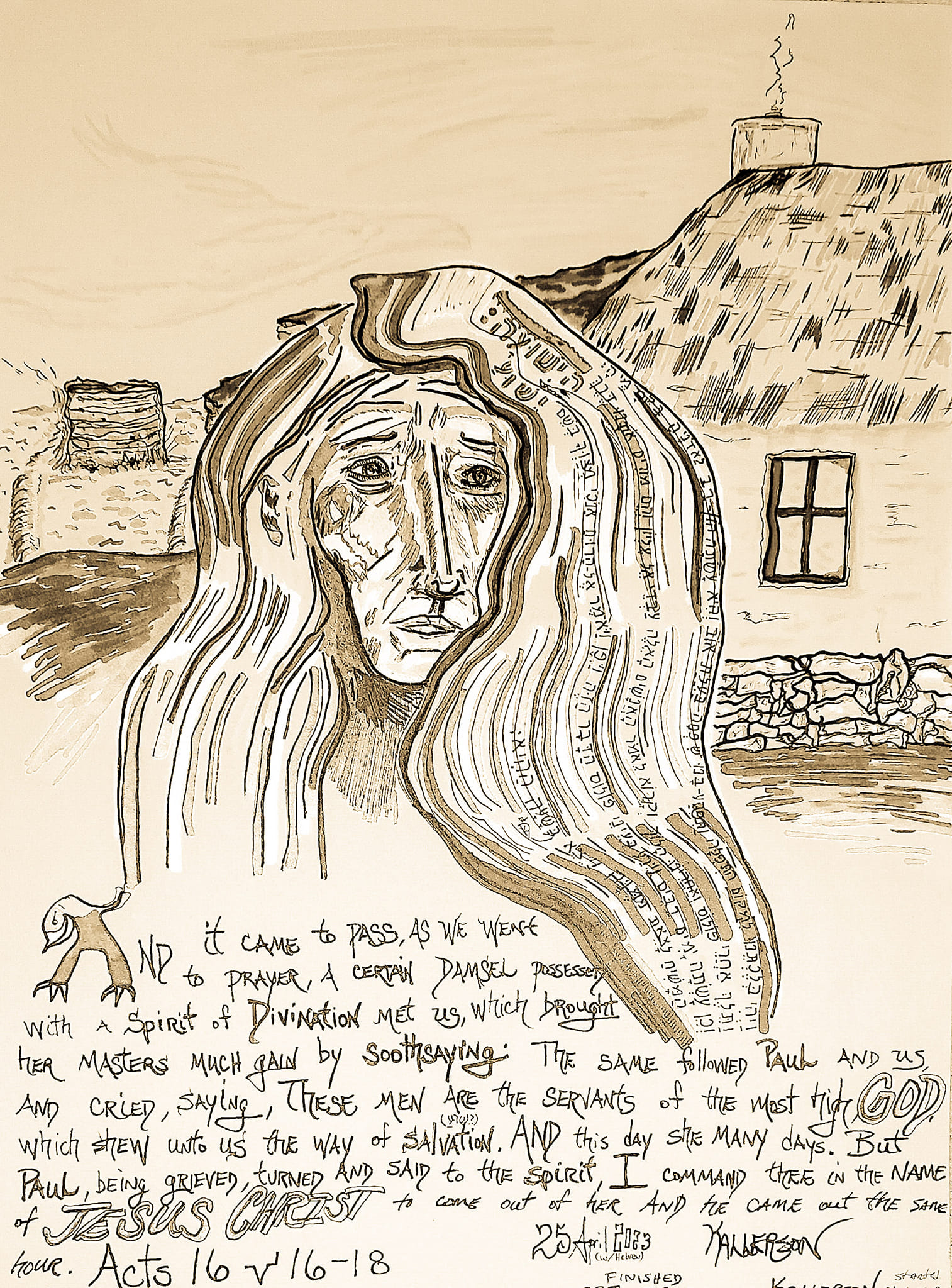
But Paul, greatly annoyed, turned and said to the spirit, “I command you in the name of Jesus Christ to come out of her.” And he came out that very hour. Acts 16:18

Note: You can listen to today’s commentary courtesy of our friends at “Bible in Ten” podcast. (Click Here to listen).

You can also read this commentary, with music, courtesy of our friends at “Discern the Bible” on YouTube. (Click Here to listen), or at Rumble (Click Here to listen).

Note: The verbs are completely off in the translation by the NKJV. They follow four of the five translational errors of the KJV. For this study, the BLB will be used: “And she continued this for many days. And Paul having been distressed and having turned, said to the spirit, ‘I command you in the name of Jesus Christ to come out from her.’ And it came out that hour.”

In the last verse, the slave girl with the spirit of Python had been following Paul and those with him, crying out that they were servants of the Most High God who were proclaiming the way of salvation. With that noted, Luke next records, “And she continued this for many days.”

The verb, being imperfect, is rightly translated as “continued.” She just followed along and annoyingly kept calling out the same thing. As noted in the previous verse, the emphasis in her voice may have been mocking, provoking, dismissive, or in some other manner that finally took its toll on the men. It seems to have really been bothersome to Paul though because Luke next records, “And Paul having been distressed and having turned, said to the spirit.”

The use of participles brings life and motion to the event. Luke brings us into the event as it has started, preparing our minds for what next is to transpire.

As for the words “having been distressed,” they come from the Greek word diaponeomai. This is its second and last use in the Bible. The first was found in Acts 4:2 where the priests, captain of the temple, and the Sadducees came upon Peter and John as they preached in the temple.

The word gives the sense of being thoroughly worn out, as if a piercing fatigue. Paul was just done with it, and so he decided it was high time to end her annoying proclamations. Therefore, he called out, “I command you in the name of Jesus Christ to come out from her.”

The words leave no other option than that the girl was, in fact, possessed. Paul could not have commanded a spirit to come out of her that did not exist. As an apostle, he was given this authority and he obviously knew that the power had been endowed upon him at this time to exercise it. And so, proclaiming that his authority was endowed by Jesus Christ, he commanded the spirit to come out from her. With that, Luke next records, “And it came out that hour.”

It is a way of saying, “right away.” There was no need to conduct a ceremony, wait till the next day to do a checkup and then certify compliance, or any such thing. At the spoken word of Paul, the spirit departed from the slave girl and the annoying proclamations ended.

Life application: Acts is a descriptive account of events that occurred as the church was being established. Nothing is prescribed in this account, and no precedent for future exorcisms has been established through Luke’s recording of the events. Paul was given apostolic authority to do certain things at certain times. However, the ability to do these things was not unlimited.

Paul could heal at times. At other times, he could not do so. Paul was able to restore a dead person at one point, but it does not mean he could do so at any point. Likewise, he was given the power to drive out this spirit of Python, but this does not mean he always had this power. And more, these abilities were apostolic in nature. Nothing is said that these powers were to continue after the apostles were dead.

With the word of God compiled, we have the written record of what occurred at the church’s establishment. We can either accept that the events recorded are true or we can dismiss them as fairy tales. But we should not expect that they can be repeated by us. There is no need for them. The witness of the word is sufficient to establish the power and authority of Jesus Christ. Let us accept it and know that even when we have trials and troubles, sicknesses and sadnesses, we can know that they are temporary and will someday be behind us.

Lord God, we have confidence in our walk before You because we have the written record of who You are, of what You are capable of, and what You have done to establish the church which has continued for two thousand years. These things give us the full assurance that the promises recorded in it will come to pass. We are secure in You. Thank You for this wonderful reassurance! Amen.