
Acts 17:17

Fancy lighting. Washington State Capitol.

Wednesday, 7 June 2023

Therefore he reasoned in the synagogue with the Jews and with the Gentile worshipers, and in the marketplace daily with those who happened to be there. Acts 17:17

Note: You can listen to today’s commentary courtesy of our friends at “Bible in Ten” podcast. (Click Here to listen).

You can also read this commentary, with music, courtesy of our friends at “Discern the Bible” on YouTube. (Click Here to listen), or at Rumble (Click Here to listen).

The NKJV, though cleaning up the KJV in some areas, is still not salvageable. For this commentary, the following will be used: “Therefore, indeed, he was reasoning in the synagogue with the Jews and those worshiping, and in the marketplace on each day with those meeting him” (CG).

In the previous verse, Paul’s spirit was provoked within him because the city of Athens was given over to idols. Because of this, it next says, “Therefore, indeed.”

The intensity of the matter is seen in this. Luke takes Paul’s situation and highlights it. He will then explain what Paul’s response to the idol-filled city was, beginning with, “he was reasoning in the synagogue.”

This is the same thought as that of verse 17:2, which said, “Then Paul, as his custom was, went in to them, and for three Sabbaths reasoned with them from the Scriptures.” The imperfect verb shows a continuing effort. He didn’t just go in, give his thoughts, and sit down. Rather, he continued to reason with those in the synagogue. In this, his reasoning was “with the Jews and those worshiping.”

This was his usual habit. He would reason with those who already knew Scripture about their need for Jesus. His reasoning there would be just as with those in Thessalonica and Berea. He would be “explaining and demonstrating that the Christ had to suffer and rise again from the dead, and saying, ‘This Jesus whom I preach to you is the Christ’” (Acts 17:3).

However, this was not his only time of discourse. The intensity of wording at the beginning of the verse is more fully realized in his efforts that went beyond the synagogue. That is seen in the next words, “and in the marketplace on each day.”

Paul took no time off but went into the agora [public center, market area]and spoke out against the idolatry that filled the city. His spirit was so moved within him, that he could not constrain himself to simply talk to those in the synagogue, waiting for them to be moved by (or rejecting of) his words. This speaking in the marketplace wasn’t just to Jews and proselytes, but “with those meeting him.”

Being the public meeting place, even if he was originally only speaking to those who came from the synagogue, others could hear. In hearing, if they were interested in listening, they could then engage in the conversation as well. This will be seen in the next verse.

Life application: It isn’t known who Paul initially spoke to in the marketplace, but it may have just been people he reasoned with on the Sabbath at first. In other words, “Meet me at the agora and we can have some tea and talk more about what you heard today.” By speaking to them in public, it would provide a chance for anyone to hear his words.

This is a good way of getting new people to listen to what you have to say. If it is a nice day and you have the opportunity to have a Bible study in a park, on the beach, or in some other public place, people will naturally slow down and listen as the teacher speaks. That may spark curiosity and a desire to know more.

Consider this avenue. It is non-confrontational like street preaching because anyone listening is leaning into a group meeting, and so the event is passive. Street preaching, on the other hand, is actively targeting people.

Despite the non-confrontational nature of such a meeting, there are some who will be offended by you exercising your rights in public. They may be the ones who get confrontational, so be prepared for that as well. Paul faced this, and you might, but it is still a great way of passively getting people interested in the Bible.

Lord God, the church isn’t just a building and a set time to meet. The church is comprised of people wherever they are and whenever they meet. Help us to be willing to teach, instruct, and lead others to You at any time and in any location. May the church grow because we are willing to put forth effort among those we encounter. Amen.



Acts 17:16

Swanky bronze doors. Washington State Capitol.

Tuesday, 6 June 2023

Now while Paul waited for them at Athens, his spirit was provoked within him when he saw that the city was given over to idols. Acts 17:16

Note: You can listen to today’s commentary courtesy of our friends at “Bible in Ten” podcast. (Click Here to listen).

You can also read this commentary, with music, courtesy of our friends at “Discern the Bible” on YouTube. (Click Here to listen), or at Rumble (Click Here to listen).

In the last verse, Paul was brought to Athens and then he had asked for Silas and Timothy to be sent to him. With that remembered, it now says, “Now while Paul waited for them at Athens.”

The verb is a present participle, “And Paul, waiting for them in Athens.” As for this time of waiting, nothing is said about how long he waited for Silas and Timothy. But nothing is said of them meeting him in Athens either. In Chapter 18, it will note Paul leaving from Athens and going to Corinth. Only while in Corinth does it then say that Silas and Timothy came from Macedonia. As for his time alone in Athens, it next says “his spirit was provoked within him.”

It is a new word in Scripture, paroxunó. It will only be seen again in 1 Corinthians 13:5. It comes from two words signifying “alongside” and “a sharp edge.” Hence, literally “to cut alongside.” Figuratively, it signifies to become emotionally provoked. As He was checking out the city, he was stirred up inside “when he saw that the city was given over to idols.”

Here is another new word, found only this once in Scripture, kateidólos. It gives the sense of “full of idols.” The word applies to the city itself, not the inhabitants. Of this state, G.S. Davies records the following –

“We learn from Pliny that at the time of Nero, Athens contained over three thousand public statues, besides a countless number of lesser images within the walls of private houses. Of this number the great majority were statues of gods, demi-gods, or heroes. In one street there stood before every house a square pillar carrying upon it a bust of the god Hermes. Another street, named the Street of the Tripods, was lined with tripods, dedicated by winners in the Greek national games, and carrying each one an inscription to a deity. Every gateway and porch carried its protecting god. Every street, every square, nay, every purlieu, had its sanctuaries, and a Roman poet bitterly remarked that it was easier in Athens to find gods than men” (G. S. Davies, St. Paul in Greece).

Life application: Paul was provoked in his very being by the idolatry he saw around him. As noted by G.S. Davies, these weren’t just idols of Greek gods, but there were idols of winners in the Greek games which were then marked with inscriptions to deity. Is it any different in our world today?

We have idols of sports figures, Hollywood movie stars, famous people like astronauts, politicians, etc. Anytime we allow our attention to be taken off of the Lord and affixed somewhere else, we are caught up in idolatry. This includes those in churches when they bow to statues of Mary and the saints. We can even make an idol out of the Bible, placing a version of it above our love for the Lord.

We need to be careful to never allow anything to take away our heartfelt allegiance to the Lord. If something is consuming too much of your time, distracting you from thinking about the Lord, step away from it and refocus your mind on Him. Talk to Him as you go out and as you come in. Think about Him as you look at the beauty of what He has created. Thank Him for the beautiful flowers and the favorable weather. Praise Him in the storms of life. Let your mind be always filled with the Lord.

Lord God, help us to remember to fix our eyes on Jesus. May our hearts be directed to You and may we be appreciative of the lives You have given us by speaking to You in our walk each day. Help us not to get distracted by the idols of this world, but to be always attentive to You and Your goodness. Amen.


Acts 17:15

On to Athens…

Monday, 5 June 2023

So those who conducted Paul brought him to Athens; and receiving a command for Silas and Timothy to come to him with all speed, they departed. Acts 17:15

Note: You can listen to today’s commentary courtesy of our friends at “Bible in Ten” podcast. (Click Here to listen)

You can also read this commentary, with music, courtesy of our friends at “Discern the Bible” on YouTube. (Click Here to listen), or at Rumble (Click Here to listen).

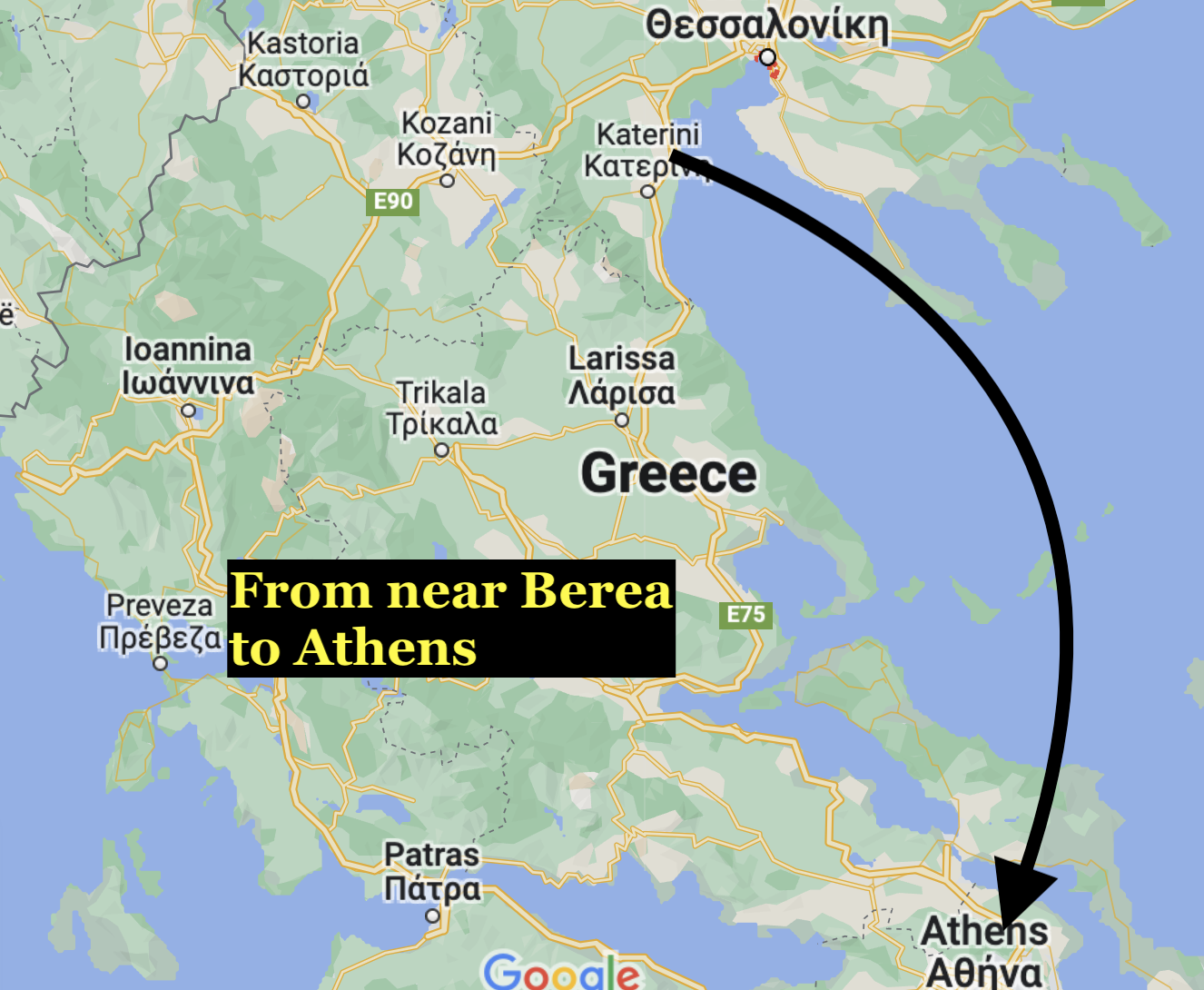
Paul was just conducted out of Berea either to the sea and then to Athens, or pretending to go to the sea and then to Athens by land. Either way, it now says, “So those who conducted Paul.”

Rather, the verb is a present participle, “So those conducting Paul.” Luke writes as if they are in the process of traveling to the next city. As for the word translated as “conducting,” it signifies to set in order or to appoint. It is as if they were given charge over Paul, seeing to his every need, including what it next says. They “brought him to Athens.”

Athens is considered the intellectual capital of Greece. The word is the plural of Athéné, or Athena, the Greek goddess of wisdom – who was reputed to have founded the city. Once Paul and those with him had arrived in Athens, it next says, “and receiving a command.”

Rather, it should be translated, “and having received a command.” Once they had arrived in Athens, they were then given new instructions which were “for Silas and Timothy to come to him.” With Paul safely in Athens, he wanted to set about evangelizing the city. At the same time, he probably wanted these two out of Berea for the time being as well.

This would allow things to settle down. Therefore, he sent back word with those who had conducted him for Silas and Timothy to now come to Athens as well. And more, he asked that it be done “with all speed.”

One can see the eagerness of Paul in these words. If he truly was in need of care, this would be one reason for their coming quickly to him. But even if it was merely his desire to have a team to evangelize, it is evident that he wanted it to come about quickly. With this note from him, his conductors who are now his messengers “departed.”

Life application: Who these men were who conducted Paul is left unstated in the narrative. However, we will have eternity to get to know them. All the redeemed of the Lord throughout all the ages will be joined together in the presence of God. We will know them in a way that we cannot even imagine now.

There will be time to learn about them and their lives and to share in the details of the things we did as well. When we are asked about our own lives by such people, will we be able to say, “I also helped conduct the message of the Bible along to others”?

We have this one life to live before we come before the Lord. May we not come before Him with empty hands. Instead, may our lives be presented to Him as faithful offerings of having told others about Jesus, having helped with missionary causes, having praised him with our lips and our actions, etc.

The Lord set us here for a reason, let us become useful vessels for His use while we remain.

Lord God, help us to use our time wisely. May our lives be spent in worthy pursuits, and may our actions be glorifying of You at all times. We shall stand before You someday. And so, may it not be with regret. Prompt us in our hearts and in our souls to be faithful servants while we have the time to do so. Amen.


Acts 17:14

Sunday, 4 June 2023 

Then immediately the brethren sent Paul away, to go to the sea; but both Silas and Timothy remained there. Acts 17:14

Note: You can listen to today’s commentary courtesy of our friends at “Bible in Ten” podcast. (Click Here to listen)

You can also read this commentary, with music, courtesy of our friends at “Discern the Bible” on YouTube. (Click Here to listen), or at Rumble (Click Here to listen).

In the previous verse, the Jews from Thessalonica came to Berea and stirred up the crowds there. With that remembered, it next says, “Then immediately the brethren sent Paul away.”

It is obviously Paul that the Jews had the problem with. Thus, in order to calm things down, the believers there knew it would be expedient to remove him from the area. His life, or at least his freedom, would be in jeopardy if he remained. And so, sending him out of the area was the proper avenue to take. This they did without any delay. However, they didn’t just walk him out of the city on a trek down the best Roman road. Rather, in conducting him, it was “to go to the sea.”

There is a slight variation in the reading of texts here. Some read heós (ἕως) while others read hós (ὡς). With this variation, the text will either read “as it were to the sea” or “as far as the sea.” In the first, it would be a feinting maneuver where they pretended to go to the sea but then conducted him on the road to Athens. If the latter, it would mean they took him all the way to the sea where they would sail to Athens.

However, even the first could read, “even to the sea.” This appears more likely as there is nothing said of any stops between Berea and Athens. But the distance between the two is so great that not mentioning such stops seems unlikely. Either way, however, these men conducted Paul either from Berea to the sea and then to Athens by ship, or they pretended to go to Athens by ship and then accompanied him all the way to Athens.

The important point of this is that they would be far enough away from the miscreant Jews to not have them hounding him from town to town. The distance between the two is somewhere around four hundred miles. With this having taken place, it next says, “but both Silas and Timothy remained there.”

This makes it obvious that Paul was the object of the Jews’ disfavor. These two men could stay and continue to teach those in Berea without the trouble that Paul brought. They would also be close to Thessalonica and could quickly travel there to check on the church.

As for Timothy, he has not been mentioned since Acts 16:1. However, it is obvious that he came with Paul as he traveled. This is certain at least as far as Philippi. However, it is likely that he went with Paul and Silas all the way, but he was not mentioned because Paul and Silas were the main focus of the narrative until this point. With Paul gone to Athens, Timothy is now mentioned in a prominent role along with Silas.

Life application: Although it is speculation, the words of this verse give us an indication that Paul required others to be with him. He speaks of an affliction that he had in 2 Corinthians 12. One speculation is that his eyes were poor. Whether this or something else, it is seen throughout Acts and even in his epistles that he is normally accompanied by others. In this verse, he is conducted by others out of the city and even to Athens.

Supposing it is true that he had an affliction that necessitated others to tend to him. Is that a cause of shame? To Paul, it obviously was not. His reliance on others allowed them to tend to him. Thus, both benefitted through the interactions that these people willingly participated in.

Quite often, we want to carry the heavy loads of life all by ourselves, but the Bible would teach us otherwise. Solomon speaks of this –

“Two are better than one,
Because they have a good reward for their labor.
10 For if they fall, one will lift up his companion.
But woe to him who is alone when he falls,
For he has no one to help him up.
11 Again, if two lie down together, they will keep warm;
But how can one be warm alone?
12 Though one may be overpowered by another, two can withstand him.
And a threefold cord is not quickly broken.” Ecclesiastes 4:9-12

Let us be willing to allow others the honor and privilege of helping us out when the need arises. At the same time, let us not be a burden on others by having them carry our loads unnecessarily. Taking advantage of others is never a good thing. So, let us have balance in our lives as we interact with others, blessing them according to our abilities and our limitations.

Lord God, thank You for those people who come into our lives and bless us with their presence, help, and encouragement. May we be prompted to reach out today and give them a word of thanks and blessing for their kindness toward us. Amen.


Acts 17:13

Big brass doors. Washington State Capitol.

Saturday, 3 June 2023

But when the Jews from Thessalonica learned that the word of God was preached by Paul at Berea, they came there also and stirred up the crowds. Acts 17:13

Note: You can listen to today’s commentary courtesy of our friends at “Bible in Ten” podcast. (Click Here to listen)

You can also read this commentary, with music, courtesy of our friends at “Discern the Bible” on YouTube. (Click Here to listen), or at Rumble (Click Here to listen).

In the previous verse, it said that many in Berea believed. Now the narrative continues, starting with, “But when the Jews from Thessalonica.” Berea is said to be 45 miles southwest of Thessalonica. Today, that would be a quick drive, but at the time of Acts, it would take a couple of days to travel the distance.

We are not told how the word got back to those at Thessalonica, but it is probable Paul and Silas stayed at Berea for some time once converts had been made. The word about the conversion of people would naturally be passed along and nothing sinister should be inferred. However, for the most part, the Jews in Thessalonica had rejected the gospel and caused the city to get stirred up. With this remembered, it next says they “learned that the word of God was preached by Paul at Berea.”

The NKJV skips over a necessary conjunction. It more rightly says, “learned that the word of God was preached by Paul also in Berea.” This would have gotten their dander up. They probably thought that with Paul and Silas having been run out of town, that would be the end of their preaching. However, not only were there believers in Thessalonica because of them, but they were also now making converts in Berea.

The Jews’ sphere of influence was dwindling because of the evangelism of these men. And so, with apparently nothing better to do than to cause trouble elsewhere, it next says that “they came there also and stirred up the crowds.” Rather, the verb is a present participle. The clause reads, “they came there also, stirring up the crowds.”

The word translated as stirring up, saleuó, is found in the Greek translation of the Old Testament where it refers to the stirring up of the oceans. This is what these people were like. They went among the multitudes and were stirring them up and causing trouble because of their jealousy concerning the success of the gospel.

The irony of the matter is that they were working against the Messiah whom they said they were waiting for. But a Messiah who came to die for the sins of the people meant that they were sinful people. In their arrogance, they rejected this premise. Their idea of a Messiah is one that would welcome them in their state of supposed superiority and elevate them above the world of Gentiles among whom they dwelt.

Life application: Today, it is easier to cause trouble for others than ever before. If someone proclaims a message that offends others, he can be hounded by those who don’t like what they hear.

For example, if you are a preacher in a church who has made such enemies, they can hack your church website and fill it with vile material. They can give poor ratings or reviews on various sites that provide evaluations of companies, products, churches, restaurants, etc. They can say harmful things on YouTube videos. The inventiveness of people to harm others is almost limitless. One must be prepared to take such things in stride and continue to proclaim the truth of the gospel with proper theology and sound doctrine.

There is often little you can do about such people, so you must be consistent and demonstrate that they are the miscreants by your continued proper proclamation of the word of God. It was not easy for Paul and Silas, it was not easy for those who spoke against the abuses of the church throughout the past millennia, and it is not easy today. These things must be expected. But press on as best you can. The Lord is building his church despite such agitators.

Lord God, be with Your people through the many trials that arise. When sound pastors and preachers are attacked because of their sound doctrine and proclamation of the gospel, reassure them in their hearts and lives. Bless the work of their hands because it is the work You have set forth for them to do. Be glorified in Your people, O God. Amen.