
Acts 17::27

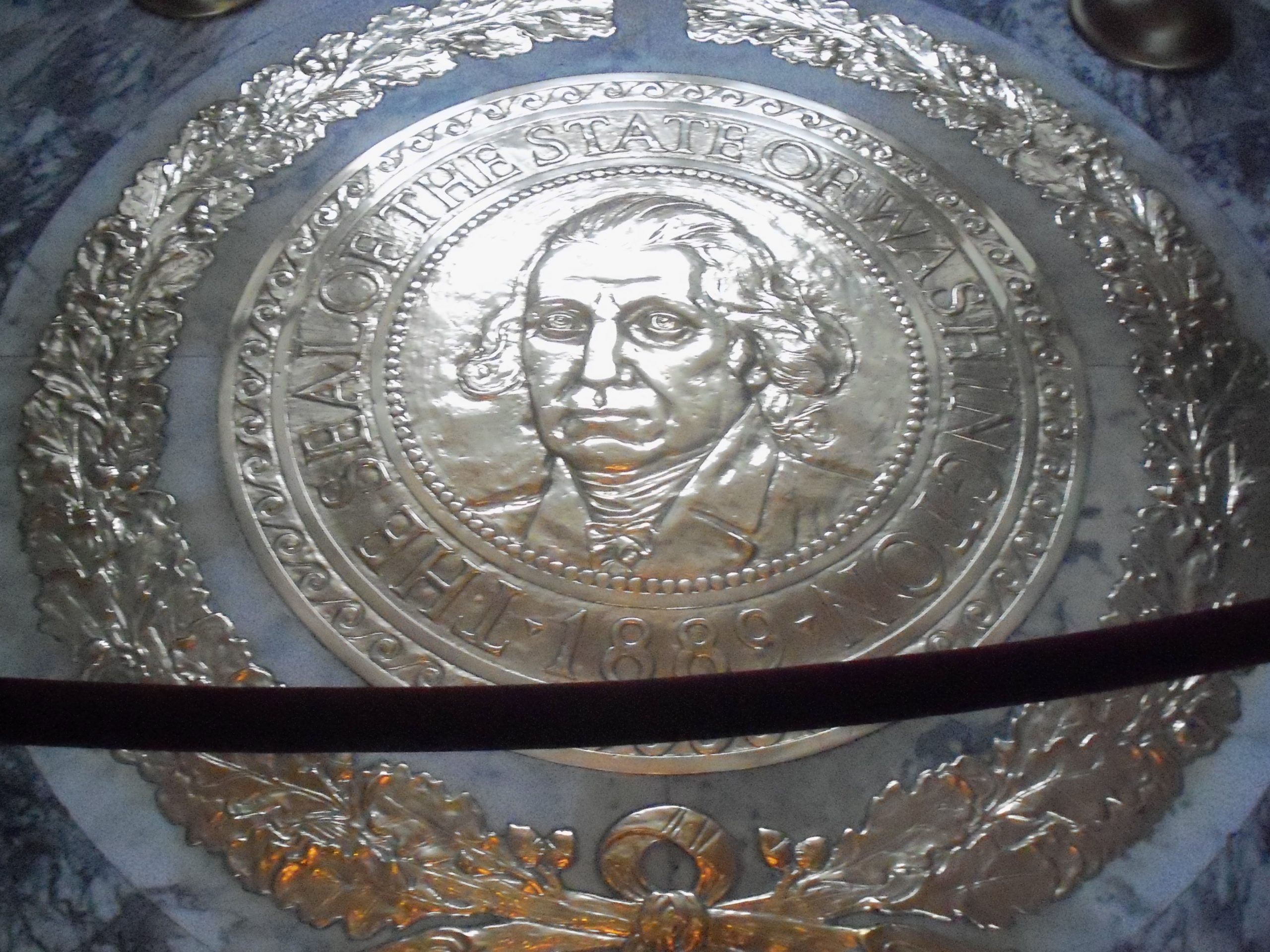
Floor medallion, Washington State Capitol.

Saturday, 17 June 2023

“so that they should seek the Lord, in the hope that they might grope for Him and find Him, though He is not far from each one of us; Acts 17:27

Note: You can listen to today’s commentary courtesy of our friends at “Bible in Ten” podcast. (Click Here to listen)

You can also read this commentary, with music, courtesy of our friends at “Discern the Bible” on YouTube. (Click Here to listen), or at Rumble (Click Here to listen).

More literally, the verse reads, “to seek the Lord, if perhaps, indeed, they might feel for Him and might find Him, although He is not far from each one of us (CG).”

In the previous verse, Paul spoke of the creation of man and that God has pre-appointed the times and boundaries of their dwellings. He now continues this thought, saying, “to seek the Lord.” The meaning is, as many Bibles paraphrase it, “so that they should seek the Lord.”

In other words, rather than seeking a united power against the Lord as during the time of the Tower of Babel, the peoples were divided by languages and these nations were established and dispersed so that they would seek out the Lord instead. It should be noted that many manuscripts say “God” here instead of “the Lord.”

Either way, because the Lord is God, the meaning is not substantially changed. The thought here is expressed in Romans 1:19, 20 –

“…because what may be known of God is manifest in them, for God has shown it to them. 20 For since the creation of the world His invisible attributes are clearly seen, being understood by the things that are made, even His eternal power and Godhead, so that they are without excuse.”

God has made Himself manifest in the created world. It is obvious that the universe did not simply explode itself into existence. Nor is it eternal, as if it had always existed. These things can be deduced without the Bible. And more, it is evident that God didn’t just create a bowl of soup which then evolved into the various types of life on the planet. This is evident without the Bible as well.

However, with man united as one, their greatest desire is to eliminate God from the picture. On the other hand, as nations develop, there is a chance of them being governed in a manner that will allow their people to think through matters concerning God and pursue Him. Job was such a person.

But more, he was not alone. It notes in Job 1:6, “Now there was a day when the sons of God came to present themselves before the Lord.” This is not speaking of angels. Rather, it is referring to those people among whom Job associated and who believed in the Lord as handed down to them from the time of Noah.

This would not have been the case if the nations remained united. The Lord knew this and dispersed them. In doing this, Paul next says, “if perhaps, indeed, they might feel for Him and might find Him.”

The meaning of the words is obvious. In seeking after the Lord, he may be found through His general revelation of Himself. Paul gives a sense of this in Romans 2 –

“…for when Gentiles, who do not have the law, by nature do the things in the law, these, although not having the law, are a law to themselves, 15 who show the work of the law written in their hearts, their conscience also bearing witness, and between themselves their thoughts accusing or else excusing them16 in the day when God will judge the secrets of men by Jesus Christ, according to my gospel.” Romans 2:14-16

The Mosaic Law is special revelation. But people know that it is wrong to steal. Even without the law being stated, they may willingly restrain themselves from stealing because of this. There is a moral conscience in man that tells him he should seek after God who has instilled this consciousness in him.

This is clearly evident because societies all over the world have laws against stealing. Only when a society has completely departed from the conscience instilled in them by God will it no longer enforce laws concerning stealing. Communism is designed to steal the people’s efforts away from them. Liberal governments allow looters and thugs to steal from stores that put forth the effort to gather and resell merchandise.

Even if man cannot be saved by general revelation, he can live a happy and content life, given to him by God, when he feels for Him and finds Him. Understanding this, Paul finishes with, “although He is not far from each one of us.”

Paul is surely tying this thought back to the abundant idolatry found in Athens, and indeed in the whole world. Instead of seeking God who is ever present with us and who has filled the universe with order and harmony so that it is evident it was done by a Designer, man makes up gods of his own. He bows down to them and worships them. These things, of man’s own imagination and production, become his gods.

What is near to us in what God has done, and which is so obviously created by Him, shows us that He is there.

Life application: Despite our knowing that God is right here with us, we want to bring our own gods closer, thus pushing the knowledge of Him out of our minds. Paul speaks of this in Romans 1 as well –

“…because, although they knew God, they did not glorify Him as God, nor were thankful, but became futile in their thoughts, and their foolish hearts were darkened. 22 Professing to be wise, they became fools, 23 and changed the glory of the incorruptible God into an image made like corruptible man—and birds and four-footed animals and creeping things.” Romans 1:21-23

Because of this, an obvious cycle of degradation in man takes place, especially leading to sexual sin, but also all other sorts of immoral and destructive behavior. Take time to read Romans 1:24-32 to see what Paul says concerning this. While you are reading, compare the cycle of depravity to the world around you.

As the nations unite globally, and as power and authority are solidified more and more, what Paul writes about is becoming global as well. In the past, this cycle of perversion would cause a nation to finally collapse through war, disease, or internal destruction. When that happened, the ideas of that nation would end. Having nations separated allowed this to occur again and again without the whole world collapsing together.

However, that no longer needs to be the case. As the world unites, there can be only one inevitable result, global destruction. This is what the book of Revelation says is coming, but it is not limited to that book. Isaiah also speaks of such things. What was once not possible has now become inevitable. Pay heed and be ready to tell others about the goodness of God in Jesus Christ.

Lord God, how desperately we need to get the word out about You before it is too late. Help us to continue to tell others what they need to know before the time comes when the whole world falls under the deceiving influence of the antichrist. May we be wise in how we spend our time, O God. Amen.




Acts 17:26

Capitol dome and chandelier, Washington State Capitol.

Friday, 16 June 2023

“And He has made from one blood every nation of men to dwell on all the face of the earth, and has determined their preappointed times and the boundaries of their dwellings, Acts 17:26

Note: You can listen to today’s commentary courtesy of our friends at “Bible in Ten” podcast. (Click Here to listen)

You can also read this commentary, with music, courtesy of our friends at “Discern the Bible” on YouTube. (Click Here to listen), or at Rumble (Click Here to listen).

In the previous verse, Paul noted that God needs nothing and that it is He who gives to all life, breath, and all things. He now continues, saying, “And He has made from one blood.”

The verb is not a participle. Rather than “has made,” it simply says, “made.” Also, some texts omit the word blood. The thought is still the same and the point is that God created one man from whom all others have descended. This is found in the creation account of Genesis 1 and 2. It is stated explicitly in Malachi 2:10 as well –

“Have we not all one Father?
Has not one God created us?
Why do we deal treacherously with one another
By profaning the covenant of the fathers?”

The meaning is that all differences that exist in men now are the result of a natural process but that all men are of the same human stock, regardless of color, size, national heritage, etc.

Despite the Hebrew sense of superiority over others, which is evident in Jesus’ words to those in the synagogue in Nazareth in Luke 4 and Paul’s words to the mob of Jews in Acts 22, they understood from their Scriptures that all men were created from one first man. Any superiority the Jews felt would have to be for some other reason. The Greeks, however, felt that they were intrinsically superior to the barbarians around them, as if they were created differently than others. Paul is telling them that from the perspective of humanity, this was not the case. With this noted, he next says, that from this one man came “every nation of men.”

This is recorded in the Table of Nations found in Genesis 10. The general breakdown found there continues to this day. An initial division of the descendants of Noah took place and that set the general parameters that have followed since that time. A study of the Table of Nations is one of the most important tools in understanding the breakdown of the people groups of the world, even to this day. With these families identified, they began to disperse in order “to dwell on all the face of the earth.”

This is seen, for example, in the line of Japheth where it is recorded, “From these the coastland peoples of the Gentiles were separated into their lands, everyone according to his language, according to their families, into their nations” (Genesis 10:5). This is repeated with the other sons of Noah as well –

“These were the sons of Ham, according to their families, according to their languages, in their lands and in their nations.” Genesis 10:20

“These were the sons of Shem, according to their families, according to their languages, in their lands, according to their nations.” Genesis 10:31

Of these people groups and the places where they settled, Paul next says that God “has determined their preappointed times.” There is a slight variation in some texts here –

prostetagmenous
protetagmenous

One means “assigned.” The other means “before appointed.” The meaning of the first would be that a people were assigned a land, probably after settling there. Once in that land, it became their assigned possession and that is their station where they belong. If they were preappointed, it would indicate that God has chosen the time and place where each nation, and thus each person, would most likely seek out God, as is indicated in the coming verse.

The difference in the idea presented between these two spellings is not small. Both, however, show that there is a set plan that was determined by God concerning the settling of the nations and the boundaries in which they are to reside. That is seen in the final words of the verse, “and the boundaries of their dwellings.”

The word translated as “boundaries,” horothesia, is found only here in Scripture. It conveys the idea of fixed boundaries. These things would be established by customs, laws, national interests, cultural expressions, and languages. It is such things that cause nations to be set and fixed. This is the plan of God in order to keep the world from doing what it did by reuniting as one, as is recorded in the Tower of Babel account in Genesis 11.

The dwellings of the people are regulated by a set plan of God to keep them separated. The wisdom of this is seen in the error of thinking that arose when all men sought to work together as one. In such a situation, the only One to work against would obviously be God Himself. For the sake of keeping that from happening, God has directed the peoples and nations through the division of tongues and the attitudes that arise among those of similar speech.

Life application: In understanding the Genesis account of the Tower of Babel and then reading Paul’s words in Acts 17, it is perfectly evident that what is occurring in the world today – concerning the movement of vast numbers of people across set borders –  is an attack against the set limitations that God has instilled in man through their division by various languages.

That is also being challenged by universal translators where people of various languages can communicate in real time with one another. With the removal of the constraints assigned by God, the inevitable result will be another Tower of Babel scenario. In order to effect this, governments and non-governmental bodies are uniting through a set plan, using tools such as climate change, to destroy the fabric of the nations as set forth by God.

The people of Genesis 11 didn’t trust God and united as one against Him. They wanted to be like God and so they built a tower to reach the heavens. This united them as one, and replaced God with their own set authority. This is the purpose of the globalist movement today. With the various languages no longer being an issue to divide, and with the movement of peoples to destroy national identities, a uniting against God and His set order is taking place

Every perversion being publicly condoned, every attack on the family structure, every denial of creation (for example teaching and promoting evolution), every attack on the climate (as if it must be controlled by man because there is no God to do it), etc., is set forth by the globalists to destroy what God has ordained for man. This is perfectly evident when such things are directly approved of when they most fully express the opposite of what the Bible presents.

What is happening in the world is the natural result of rejecting God and ignoring His word. With modern technology, this has become possible. The people of the world are being directed by a satanic attack against God’s set order for humanity. The path is set and it can only end in one possible way. The Bible describes it in the pages of Revelation. Hold fast to God and His word. This is the only safety humanity can possess in a world of ever-increasing wickedness.

Lord God, how wise You are to have directed the world as You have. And how foolish we are to attempt to reject Your ways and to pursue our own reckless paths. This is true as individuals, as nations, and as the mass of humanity is united against You. May we wisely hold fast to You in this time when the world is being prepared to destroy itself through rejection of You. Amen.


Acts 17:25

Hallway. Washington State Capitol.

Thursday, 15 June 2023

“Nor is He worshiped with men’s hands, as though He needed anything, since He gives to all life, breath, and all things. Acts 17:25

Note: You can listen to today’s commentary courtesy of our friends at “Bible in Ten” podcast. (Click Here to listen)

You can also read this commentary, with music, courtesy of our friends at “Discern the Bible” on YouTube. (Click Here to listen), or at Rumble (Click Here to listen).

The words more correctly read, “nor is he attended by humans’ hands, further needing anything, He giving to all life, and breath, and all things” (CG).

Paul is in the process of proclaiming the true God to those in Athens. He just noted that being Lord of heaven and earth, he does not dwell in temples made with hands. With that noted, he now continues, saying, “nor is he attended by humans’ hands.”

The verb translated as “attended,” is therapeuó. One can see the root of our modern word therapy. It signifies to heal, care for, attend to, etc. Most translations say “serve.” But there is a suitable word translated as serve used elsewhere. That gives the idea of serving, such as in ministering, worshiping, accomplishing tasks, and so forth.

In the case of this word, it would be as if God has a need that must be attended to. To avoid confusing the two, saying attended provides the proper meaning. Paul is saying that there is nothing lacking in God that would need man’s attention.

As for the words “humans’ hands,” the Greek adjective anthrópinos is introduced here. In this case, it is plural. Rather than “men’s hands,” it is more rightly translated as “humans’ hands.” Thus, it is contrasted with the divine nature of God. From there, Paul says, “further needing anything.”

The word translated as “further needing,” prosdeomai, is found only here. It is a present participle signifying to want more or to need more. God needs nothing. The thought is expressed by the Lord in Psalm 50 –

“I will not take a bull from your house,
Nor goats out of your folds.
10 For every beast of the forest is Mine,
And the cattle on a thousand hills.
11 I know all the birds of the mountains,
And the wild beasts of the field are Mine.
12 “If I were hungry, I would not tell you;
For the world is Mine, and all its fullness.” Psalm 50:9-12

This should be obvious. God is. He is the Source of all things. As this is true, then there is nothing that he needs from man. Paul then explains this in the simplest terms, saying, “He giving to all life, and breath, and all things.”

The words life and breath appear almost synonymous, but there is a difference. The zóé, or life, is the state of being alive. It further applies to both physical and spiritual life. It is the existence we possess because it is sustained by God’s self-existence.

The breath, or pnoé, was seen in Acts 2:2 when the rushing wind came upon the believers gathered in Jerusalem. This is its second and last use. It signifies both breath and breeze. It is the respiration that occurs because there is life within a being. God gives those things to us, so how could He need something from us to sustain Him.

As for “all things,” the Greek reads ta panta – the all. Not only does God provide us with life and breath, but He provides all things necessary for those things to continue. Food, oxygen, water, intelligence, etc. Everything that allows man to live and to continue living is provided by God. As this is so, there is nothing that He needs from us for His continuance.

This does not mean that man is not to serve Him. This is where translating the word therapeuó as attended rather than served becomes evident. Man is to serve God. This is seen throughout Scripture. In Revelation 22:3, it says –

“And there shall be no more curse, but the throne of God and of the Lamb shall be in it, and His servants shall serve Him.”

God does not need this from us as if He would be troubled, sick, or die if we did not provide it. Rather, He is glorified in our worship and service of Him. This is the purpose of creating. God shares His goodness with His creatures, and it is right that His creatures return to Him the glory He is due. This is not because there is a lack in Him that must be filled, but that the natural result of sharing is that there is a mutual reciprocity that should take place.

Life application: If you don’t thank God for the good things you receive, He is not lessened by that. He is not harmed by it either. But when we thank God for each blessing, it demonstrates an appreciation that He is the Giver and we are appreciative of what He has provided.

This is why we should spend our time singing out His praise, telling others of His goodness, contemplating His majesty, etc. Through these things, we are returning to Him the glory that He is due from us.

Lord God, You are great and greatly to be praised. We are thankful to You for every good and kind blessing that comes from Your open hand of grace. Dwell in our praises and be glorified upon our lips. You are great and greatly to be praised, O God. Amen.


Acts 17:24

Chandelier. Washington State Capitol.

Wednesday, 14 June 2023 

“God, who made the world and everything in it, since He is Lord of heaven and earth, does not dwell in temples made with hands. Acts 17:24

Note: You can listen to today’s commentary courtesy of our friends at “Bible in Ten” podcast. (Click Here to listen)

You can also read this commentary, with music, courtesy of our friends at “Discern the Bible” on YouTube. (Click Here to listen), or at Rumble (Click Here to listen).

Again, as with the previous verse, the NKJV cleans up the mess of the KJV, however, it is still not literal enough. The words read, “The God, having made the universe and all things in it, He – of heaven and earth being Lord – dwells not in handmade temples” (CG).

The previous verse noted Paul’s reference to the platform inscribed with GOD UNKNOWN. He then said that he would proclaim that unknown God to those in Athens. He now begins that proclamation, saying, “The God.”

The Greek reads, “The God, the having…” The first article does not need to be translated, but the second defines Him as “The God” who will next be described. As seen in the last verse, the pronoun there was neuter – this [One]. Now, the words of this verse are masculine. Of this, Charles Ellicott says –

“The masculine form of the pronoun and participles throughout the sentence presents an emphatic contrast to the neuter pronoun of the previous verse.”

Paul informs those in Athens that the God he proclaims is not feminine. He is referred to in the masculine. This is something that they could not have known without it being specifically revealed by Him. To those in Athens, He was GOD UNKNOWN. Now He is no longer completely unknown. They know at least something about Him. Paul next says that He is the God “having made the universe.”

The word kosmos is almost always translated as world. But that can have various meanings. One is “the inhabitants of the world.” That, for example, would be what is referred to in John 3:16. It can also refer to worldly affairs, the world itself, or the universe.

Paul, being a Jew who is perfectly aware of the Genesis 1 creation narrative, would not limit his words to the world alone. That he goes beyond the world itself is evident from what he will say in the rest of the verse. Understanding this, he continues with, “and all things in it.”

This could be taken as referring to the things of the world itself or of the universe. The latter is certainly what is on Paul’s mind –

Then God said, ‘Let there be lights in the firmament of the heavens to divide the day from the night; and let them be for signs and seasons, and for days and years; 15 and let them be for lights in the firmament of the heavens to give light on the earth’; and it was so. 16 Then God made two great lights: the greater light to rule the day, and the lesser light to rule the night. He made the stars also. 17 God set them in the firmament of the heavens to give light on the earth, 18 and to rule over the day and over the night, and to divide the light from the darkness. And God saw that it was good. 19 So the evening and the morning were the fourth day.” Genesis 1:14-19

Regardless of how sizeable the people of Paul’s time considered the universe, it was vast enough from their perspective to know that it extended beyond the world itself. With Paul’s words noting that the God he was proclaiming created all of these things, he next says, “He – of heaven and earth being Lord.”

This tells us that Paul was certainly referring to the universe. First, he notes “heaven.” Depending on the context, the Greek word signifies the visible heavens, the atmosphere, the sky, the starry heavens, and the spiritual heavens. This is certainly referring to at least the visible heavens, the starry heavens, and the spiritual realm, summed up in the singular “heaven.” The way this can be determined is by considering his continued words.

He next notes “earth” using the word . It can refer to a particular land, the ground, or the earth as a whole in contrast to the heavens. Paul is referring to the physical earth as a whole as evidenced by the contrasting thought “of heaven.” He has introduced his audience to the God proclaimed in Genesis 1:1 –

“In the beginning God created the heavens and the earth.”

The God he proclaims is Lord of heaven and earth because He is the Creator of those things. The word kurios signifies “absolute ownership rights” (HELPS Word Studies). These things are His and He has the right to direct them and dispense with them according to His will. Of this God, who is the Lord of heaven and earth, Paul then makes an obvious statement. He “dwells not in handmade temples”

This tells us that Paul was not only referring to heaven as the visible heaven and the starry heaven but also to the spiritual heaven. Temples are intended to provide the link between the physical and the spiritual. Thus, Paul’s words are certainly inclusive of that.

The meaning of his words is obvious. If God created everything, then nothing can contain Him. He is greater than that which He created. It is a truth pulled right out of the Old Testament from when Solomon dedicated the temple in Jerusalem –

“But will God indeed dwell with men on the earth? Behold, heaven and the heaven of heavens cannot contain You. How much less this temple which I have built!” 2 Chronicles 6:18

Paul is using his vast knowledge of Scripture, along with his understanding of the nature of God, to reveal what the true God is like to those in Athens. He will continue with this for only a few verses and then He will tie all of this into the Person and work of Jesus Christ.

Life application: The Bible is what reveals God to us in a specific and special way that goes beyond what we can learn about Him from the world around us. Does knowing the Creator in this way matter to you? If so, then be sure to read your Bible. If not, you need to redirect your thinking. The Bible is the one source that we have for knowing and understanding these things.

For example, many churches are getting away from the masculine that is used in Scripture. This is not just inappropriate. Rather, it is an offense to God. God does not have parts. He is not a male in the sense that we understand. However, the word shows us that His characteristics are revealed in a masculine manner. To deviate from this is to mar what God has set forth in His word.

Be careful to check Bible translations before you buy them. Make sure they haven’t gone down PC Path onto Heresy Highway. The manner in which God has revealed Himself is not up to us to pick and choose. Likewise, if you are in a church where they have gone down this path, pack your bags and move out. There can be no compromising with those who have compromised. Stand fast on the word and hold fast to what is proper.

Lord God, help us to hold fast to the faith that has been handed down to us from the beginning. May we never compromise on what the Bible proclaims. Instead, may we be firm and fixed in our resolve to always put You first. Help us in our walk so that we may bring glory to You. May it be so, O God. Amen.


Acts 17:23


Tuesday, 13 June 2023 

“for as I was passing through and considering the objects of your worship, I even found an altar with this inscription:
TO THE UNKNOWN GOD.
Therefore, the One whom you worship without knowing, Him I proclaim to you: Acts 17:23

Note: You can listen to today’s commentary courtesy of our friends at “Bible in Ten” podcast. (Click Here to listen)

You can also read this commentary, with music, courtesy of our friends at “Discern the Bible” on YouTube. (Click Here to listen), or at Rumble (Click Here to listen).

The translation of the NKJV clears up many of the errors of the KJV, but it still is not literal enough. The verse reads, “for passing through and analyzing your venerations, I found even a platform on which had been inscribed: GOD UNKNOWN. Whom, therefore – not knowing – you worship, Him I proclaim to you” (CG).

The previous verse opened Paul’s speech at the Areopagus, noting that he perceived the men of Athens were super-spiritual. He continues now by giving his reason for stating that, saying, “for passing through.”

He is referring to his walk through the city of Athens. While he was in the process of doing so, he explains, “and analyzing your venerations.”

The word translated as “analyzing” is found only here and in Hebrews 13:7. It comes from two words signifying “upwards” and “to gaze upon.” Thus, it means to attentively look at something and examine it while doing so.

The word translated as “venerations” is a single Greek word, sebasma, a noun used only here and in 2 Thessalonians 2:4. It is derived from sebazomai, to revere or be in awe of. It has almost no comparable English word. It covers not only an idol that is itself the object of worship, nor is it merely an icon that represents something worshiped. Rather, the word encompasses both thoughts and more.

Paul is using a word to describe all of the monuments that are venerated within the city. However, if the verb “venerate” is changed to a noun as the object of veneration, then it conveys the sense. Being plural to cover all that Paul is referring to makes it “venerations.” Most translations paraphrase the words and say, “objects of worship.” It speaks of idols, icons, statues, altars, memorials, etc. Anything that is worshiped would fall under this broad word.

While perusing all of these things around Athens, he says, “I found even a platform.” The word is bómos and it is only found here in Scripture. It is from the same root as basis, a step which then also speaks of a foot. Thus, it refers to a stand, podium, or platform. The Greek translation of the Old Testament uses this word to describe the altar that was built in Joshua 22, but there is no reason to assume that this was an altar in the traditional sense. Of this platform, Paul notes, “on which had been inscribed: GOD UNKNOWN.”

The Greek reads with an adjective and a noun: AGNŌSTŌ THEŌ, UNKNOWN GOD. The words “to” “the” “an” etc. are often added for supposed clarity, but the fact that the platform was set apart with the words inscribed on it means that verbs and/or articles are unnecessary. The platform itself reflects the “to” part of the equation. If the word “an” or “the” is added to “UNKNOWN,” then it signifies that something is actually known about that GOD.

Of this inscribed platform, Vincent’s Word Studies says –

“Under these circumstances an allusion to one of these altars by the apostle would be equivalent to his saying to the Athenians thus: ‘You are correct in acknowledging a divine existence beyond any which the ordinary rites of your worship recognize; there is such an existence. You are correct in confessing that this Being is unknown to you; you have no just conceptions of his nature and perfections.’”

Because of this, and with Paul’s thoughts thus expressed, he next says, “Whom, therefore – not knowing – you worship.” The word translated as “not knowing” is translated from the verb agnoeó. The a prefix signifies negation and the word ginóskó means “to know.” Because it is a present participle, it says, “not knowing.”

The meaning is that though they know there is a God because of general revelation in the created order, they also know He is entirely unknown to them. Hence, He is GOD UNKNOWN. There is nothing that can be known about Him beyond what can be contemplated through His creation, and thus there is an infinite disconnect between the two. Unless He Himself makes the first move, nothing more can be known about Him. However, Paul has now arrived at Athens and he is going to tell them about this God who has, in fact, made that first move. Thus, he says, “Him I proclaim to you.”

The word translated as “proclaim” is kataggelló. It is the verb form of the noun used in verse 17:18. There, they said that Paul was a herald of “foreign gods.” Now, he takes their words and turns them around saying that he heralds GOD UNKNOWN to them.

Life application: Studying the Bible is fun. Study your Bible.

Most Glorious and Marvelous God. To much of the world, You are unknown, frightening, confusing, or maybe ignored. But to those who have read Your word and accepted its message, You are intimately close, comforting, and ever-present on our minds. We rejoice in You because we know Jesus who has revealed You to us. Thank You, O God, for the close and personal relationship we possess because of Jesus Christ our Lord. Amen.