Acts 19:5

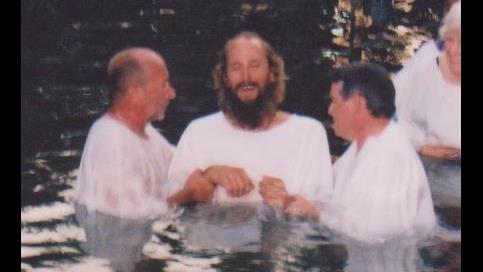
Getting baptized is super. Obedience to the word of the Lord. Happiness at the salvation granted.

Thursday, 27 July 2023

When they heard this, they were baptized in the name of the Lord Jesus. Acts 19:5

Note: You can listen to today’s commentary courtesy of our friends at “Bible in Ten” podcast. (Click Here to listen)

You can also read this commentary, with music, courtesy of our friends at “Discern the Bible” on YouTube. (Click Here to listen), or at Rumble (Click Here to listen).

In the previous verse, Paul noted that John’s baptism was one of repentance and that John told his audience that they should believe on Him who would come after him. With that, the account now continues with, “When they heard this.”

Rather, being an aorist participle, it reads, “And they, having heard.” They were listening to Paul, they were moved by his words, obviously believing what Paul had said, and so “they were baptized.”

It is the normative action that takes place upon conversion, for both Jew and Gentile, during the church age. There is belief followed by baptism. These were followers of John who believed his words about the Messiah that was coming. Paul proclaimed the Messiah that had come, thus fulfilling John’s words. And so, they were baptized “in the name of the Lord Jesus.”

These people had obviously not participated in the crucifixion of Christ Jesus. Therefore, they did not have to “repent” as Peter called out to Israel in Acts 2. This is purposefully left out of the account by Luke.

There are various ways of looking at what occurred here. The first is that they were literally baptized in water and then Paul laid his hands on them. Thus, it is a re-baptism of water. If so, it is the only explicit instance of it in the New Testament. No such record of the 11 apostles being baptized was given, and yet they had the Spirit.

However, it would be an argument from silence to say that this was not the normal practice for those who had once been baptized by John to be rebaptized into Jesus after He completed His work. In fact, this account in Acts 19 suggests that this is exactly what occurred.

Another possibility is that they were baptized into the name of Jesus by their belief, not literally in water. However, as noted in a previous commentary, it is Jesus who baptizes with the Spirit, not an apostle. The order of what occurs here is baptism, then the laying on of the hands (in the next verse), at which time the Spirit is received.

Thus, this is – with all certainty – water baptism that is being referred to. This is what occurred with those in Samaria in Acts 8, even if the time between baptism and then the laying on of hands and the reception of the Spirit was greater.

Life application: As can be seen the record of what occurs in Acts 2, 8, 10, and 19 (and in other accounts) baptism is different for each. To pick one account, such as Acts 2, and claim that this is what must happen in the church today, is arbitrary and has no merit. Each account simply describes what occurred without regard to prescribing anything.

The only normative part of the process is that all who believe are saved and the customary rite that is involved after belief is baptism. There is also no instance where a person is baptized into Jesus prior to conversion. That is also not taught anywhere in the epistles. Therefore, infant baptism has no standing within biblical Christianity.

With the church fully established and the word of God complete, the proper order for what is to be done is:

  • Hear the gospel (Romans 10:17).
  • Believe the message (Romans 10:17).
  • Receive the Spirit (Ephesians 1:13, 14).
  • Be baptized as directed by Jesus (Matthew 28:19).

Not yet been baptized? You are not fulfilling your obligation to the directive of the Lord who saved you. Go get baptized.

Lord God, how good and precious it is to our souls to be in Your presence and to share in Your goodness. For those who have believed the gospel, we are in Christ. We have gone from death to life, from futility to surety, and from hopelessness to a sure and eternal hope. Thank You, O God, for Jesus Christ our Lord. Amen.




Acts 19:4

It’s a long bridge. Washington State.

Wednesday, 26 July 2023

Then Paul said, “John indeed baptized with a baptism of repentance, saying to the people that they should believe on Him who would come after him, that is, on Christ Jesus.” Acts 19:4

Note: You can listen to today’s commentary courtesy of our friends at “Bible in Ten” podcast. (Click Here to listen)

You can also read this commentary, with music, courtesy of our friends at “Discern the Bible” on YouTube. (Click Here to listen), or at Rumble (Click Here to listen).

In the previous verse, Paul had asked the disciples that he had met, “Into what then were you baptized?” Their answer was that they were baptized into John’s baptism. With that, it next says, “Then Paul said, ‘John indeed baptized with a baptism of repentance.’”

This was the point and purpose of John’s baptism. He spoke to Israel, under the law, about their state before the law. John was calling the people back to obedience to the law because the law anticipated the coming of Christ. Three times in Matthew 3:1-12 he spoke of repentance. The word repentance comes from the Greek word metanoia. It means “a change of mind.” One is thinking one way and he is to change his mind and think another way.

In Matthew 3, when asked who he was, John cited the prophet Isaiah. A fuller portion of what Isaiah said was –

“’Comfort, yes, comfort My people!’
Says your God.
‘Speak comfort to Jerusalem, and cry out to her,
That her warfare is ended,
That her iniquity is pardoned;
For she has received from the Lord’s hand
Double for all her sins.’
The voice of one crying in the wilderness:
‘Prepare the way of the Lord;
Make straight in the desert
A highway for our God.
Every valley shall be exalted
And every mountain and hill brought low;
The crooked places shall be made straight
And the rough places smooth;
The glory of the Lord shall be revealed,
And all flesh shall see it together;
For the mouth of the Lord has spoken.’” Isaiah 40:1-5

John claimed that he was the voice calling the people to repent, to change their minds about how they were living, and to turn to God in preparation for the coming of the Lord – the Messiah. This is not at all what Paul and the other apostles proclaimed. In Acts 2, Peter did tell the people of Israel to repent, but it wasn’t in preparation for the coming of the Messiah. Rather, it was that the Messiah had come and they had crucified Him. They needed to repent of this, to change their mind about what they had done.

In the case of these disciples in Ephesus, they had been baptized into John. They had been told that the Messiah was coming and they needed to prepare themselves for that event. Paul then explains exactly what that meant with the words, “saying to the people that they should believe.”

There is no hint of repentance in the directive. The repentance John called for was directed to those of Israel under the law in anticipation of the coming Messiah. When He came, they were to believe. They would need no change of mind because their minds had been prepared for His coming. In the case of those in Acts 2, they had to change their minds because they had failed to be prepared for His coming. Now that the Messiah had come, they simply needed to believe “on Him who would come after him.”

John said He was coming. When He came, it would be evident. He would fulfill the ancient prophecies, He would be spotless before God in relation to the law, and He would fulfill the law in that capacity, etc. Their repentance, their changing of their minds, was to prepare their minds under the law to accept His fulfillment of the law. With that understood, Paul then explains who John was speaking about, saying, “that is, on Christ Jesus.”

The word Christ is Greek for the Hebrew word Messiah. Paul proclaims that Jesus is the Messiah and these disciples were to believe on Him. There is nothing affixed to that, just believe. With this verse, John the Baptist is never mentioned again in Scripture. The time of the law has given way to the time of grace. Salvation is something that is appropriated by belief in God’s provision of grace in the giving of His Son. Nothing can be added to that. The work is complete.

Life application: As noted above, the word “repent” means “to change one’s mind.” It means nothing more. The word does not mean, “turn from your sin before you can be saved.” When a person is presented with the gospel, he is told that he is a sinner – “Christ died for your sins.” If Christ died for sins, it means that there are sins in his life that Jesus needed to die for. In believing this, it is an acknowledgment by the person that he is a sinner in need of a Savior.

No list of sins is necessary to be presented to the person, identifying what it means to sin before God. The statement “Christ died for your sins” is all-encompassing. When the person believes this by faith, his sins are forgiven – all of them. Only after this occurs does a person then find out what is pleasing to God and what is displeasing to Him.

In other words, someone may be a notorious liar, a homosexual, a brawler, a thief, and a murderer. When he is given the gospel, “Do you know that you are a sinner and that Jesus died for your sins?”, the person giving the gospel may not know a single thing about that person. The person being spoken to may say, “I know I am a sinner and I know I have offended God. I am so relieved that God sent His Son to die for me. I believe!”

It is at this moment, and no other, that he is saved. He has not yet given up on any of the wicked things he has been doing. He may not even know which things he is doing are offensive to God. Only now, after his salvation, does he start to learn what he does that is in need of change. By saying, “You must give up XX, XX, and XX before you can be saved,” you have presented a false gospel of works. This person may do what he is told and he now believes he merits God’s forgiveness. This is not the gospel at all. It is an affront to God who sent His Son to die for this person’s sins. His turning from those things may not equate to belief in Jesus’ work at all.

Be sure to get the gospel down properly. If you misrepresent the gospel, you are not presenting the gospel.

O God, we just can’t seem to get grace. We say we believe it, we tell people about it, and yet we then add to what Jesus has done when telling others about what they need to do in order to be pleasing to You. We remove grace from the equation and bring back deeds of self. Forgive us of this. Help us to properly present the gospel of grace. Jesus has done it all. What we need to be saved is faith in Jesus, plus nothing. Amen.


Acts 19:3

Shipping in Washington.

Tuesday, 25 July 2023

And he said to them, “Into what then were you baptized?”
So they said, “Into John’s baptism.”
Acts 19:3

Note: You can listen to today’s commentary courtesy of our friends at “Bible in Ten” podcast. (Click Here to listen)

You can also read this commentary, with music, courtesy of our friends at “Discern the Bible” on YouTube. (Click Here to listen), or at Rumble (Click Here to listen).

In the previous verse, Paul asked the disciples he met in Ephesus if they had received the Holy Spirit when they believed. Their answer was that they had not heard about whether there is a Holy Spirit. Because of this, the narrative next says, “And he said to them, ‘Into what then were you baptized?’”

Paul’s question is obvious. If they are disciples, then how could they not know that the Holy Spirit had been given? A lot of information is left unstated so far in this account. First, in verse 1, it said, “and finding some disciples.” Paul met these people and they obviously claimed to be disciples of the Messiah. Otherwise, the content of what occurs would have no meaning.

Paul, assuming that they meant “Jesus the Messiah,” but still maybe wondering if they had received a false Messiah (see 2 Corinthians 11:4), asked about their receiving the Spirit in verse 2. Again, this must be the case because they are called disciples. At this point, they said that they were unaware of this part of the equation.

  • They are disciples, implying they are followers of someone.
  • Paul asks if they received the Spirit when they believed, implying that they claimed to be disciples of the Messiah, otherwise, Paul would not have asked this.
  • They are unaware of the giving of the Spirit.
  • Therefore, Paul asks them, “Into what then were you baptized?”

This is what has taken place. The obvious and certain meaning is that being disciples involved…? Anyone…? Yes, you., in the seventh row.

Baptism.

Very good. You get an A for the semester.

Paul would not have asked this unless it was understood that being a disciple of the Messiah involved being baptized.

With that understanding, completely supported by the surrounding text, it next says, “So they said, ‘Into John’s baptism.’”

Their answer explains the situation. They had been baptized into John’s baptism. The rite of baptism is an outward reflection of the doctrine to which one adheres to. Their doctrine looked forward to the coming Messiah and the giving of the Spirit but it did not go any further.

As John never claimed to be the Messiah, the clear inference at this point is that these people had heard that John proclaimed the Messiah was coming. They believed his words and were baptized in John’s baptism. Thus, it by default made them disciples of the coming Messiah because John had died. Certainly knowing he had, they were expecting the coming of the Messiah that John proclaimed. And more, John died before the giving of the Spirit. These disciples probably traveled back home to Ephesus, never hearing about the coming of Jesus.

To understand what the faith of these disciples was based on, take time to read Luke 3:1-22. A short portion of this larger section will give an important part of that passage –

“Now as the people were in expectation, and all reasoned in their hearts about John, whether he was the Christ or not, 16 John answered, saying to all, ‘I indeed baptize you with water; but One mightier than I is coming, whose sandal strap I am not worthy to loose. He will baptize you with the Holy Spirit and fire. 17 His winnowing fan is in His hand, and He will thoroughly clean out His threshing floor, and gather the wheat into His barn; but the chaff He will burn with unquenchable fire.’” Luke 3:15-17

Life application: John says that the One coming after Him would baptize His believers with the Holy Spirit and fire. Special note for hyperdispensationalists: This does not mean that this is the baptism Jesus refers to in Matthew 28:19. Jesus’ followers do not baptize anyone into the Holy Spirit, nor do they purify those who believe, symbolized by the fire. That is solely a work of the Lord.

In addition to proclaiming the coming Messiah, John baptized his believers. The reason for this is stated in the gospels, and it will be restated by Paul in the next verse. However, Jesus also told those who follow Him to make disciples and baptize. As noted above, the rite of baptism is an outward reflection of doctrine to which one adheres to.

This means every person who receives Jesus, believing His gospel, is to be baptized. It is a reflection of the doctrine that is adhered to when they believe – Christ’s death, burial, and resurrection. Paul’s question in the verse today clearly and unambiguously reveals that he expected that all disciples were to be baptized. Otherwise, the question would not have been asked.

If you have not been baptized as an outward demonstration of the inner change that has taken place in you, it is your responsibility to have this corrected. Be baptized, identifying yourself with the Lord who has already saved you because of your faith in Him.

Glorious Lord God, Jesus did not leave us with a long laundry list of things that we should do to honor Him. But two of the things He did leave for us to accomplish are to be baptized and to regularly observe the Lord’s Supper. May we be willing to observe these ordinances to honor Him accordingly. Amen.


Acts 19:2

The longest bridge in Washington.

Monday, 24 July 2023

he said to them, “Did you receive the Holy Spirit when you believed?”
So they said to him, “We have not so much as heard whether there is a Holy Spirit.”
Acts 19:2

Note: You can listen to today’s commentary courtesy of our friends at “Bible in Ten” podcast. (Click Here to listen)

You can also read this commentary, with music, courtesy of our friends at “Discern the Bible” on YouTube. (Click Here to listen), or at Rumble (Click here to listen).

The previous verse noted that Paul had arrived in Ephesus and met some disciples. That thought continues now, saying, “he said to them, ‘Did you receive the Holy Spirit.’” The text does not say why Paul asked this, but there is obviously something that made him suspect concerning their walk that must have precipitated the question. Further, there is no article before Holy Spirit. As Bengel notes, “the language is indefinite, to accord with the part (pro parte) of those who are being interrogated.”

With that understood, Paul next says what should be the case. Though this is a descriptive account, it carefully details what is normative with the words, “when you believed?” It is obvious that Paul understands that belief equates to reception. There is a one-to-one correspondence between the two. The verb is an aorist participle, “when you believed,” or more exactingly, “having believed.”

This is in accord with the words of Ephesians 1:13, 14 –

“In Him you also trusted, after you heard the word of truth, the gospel of your salvation; in whom also, having believed, you were sealed with the Holy Spirit of promise, 14 who is the guarantee of our inheritance until the redemption of the purchased possession, to the praise of His glory.”

It should be noted that Paul’s words of Ephesians, being a written epistle, are prescriptive. They outline what is always to be the case. Belief means sealing. It does not necessarily include what will occur in the coming verses in Acts. In other words, what occurs in these coming verses is a description of what happened at that time but it is not something that should necessarily be expected to occur. The only thing that can be expected is the sealing of the Spirit which occurs upon belief.

Expressed more fully, Paul’s words in Acts show that it is normative that the Spirit is received upon belief. That is confirmed in Ephesians. However, what occurs beyond that cannot be taken as normative, such as speaking in tongues and prophesying. These outward demonstrations that take place are described by Luke, but they are not to be taken as normative events. If they were, then Paul’s words of Ephesians would include that as well.

This is the problem with Charismatic and Pentecostal churches. They mix what is prescriptive and what is descriptive and they also take what is not normative and they assume it is normative. In this, they fail to rightly divide Scripture. This results in faulty theology. As for the account now, it continues with, “So they said to him, ‘We have not so much as heard whether there is a Holy Spirit.’”

In these words, it appears to be saying that they didn’t know of the existence of the Holy Spirit. This is not the intent of what is said. Rather, it was that they had not heard He had been given to the people of God. As Bengel says –

“…they could not have followed either Moses or John the Baptist, without hearing of the Holy Spirit Himself. [Therefore what they were ignorant of was, the effusion of the Holy Spirit peculiar to the New Testament.—V. g.]”

For example, the Holy Spirit is mentioned explicitly in Psalm 51:11, but He is inferred as far back as Genesis 1:2. He is referred to in verses such as Numbers 11:17 as well. When John the Baptist came, he spoke of the Holy Spirit in Matthew 3:11 and elsewhere. Thus, it could not be that they did not know of the existence of the Holy Spirit but of the reception of Him by believers. John 7:39 gives the sense –

“But this He spoke concerning the Spirit, whom those believing in Him would receive; for the Holy Spirit was not yet given, because Jesus was not yet glorified.”

The word “given” is inserted for clarity in this verse. It simply says, “the Holy Spirit was not yet.” Therefore, a translation such as the ERSV gives the sense of this verse in Acts –

“Nay, we did not so much as hear whether the Holy Ghost was given.”

What is being detailed here begins to explain why the account of Apollos was given just prior to this account now. If the narrative is closely analyzed and properly understood, there would not be as much poor doctrine permeating the church as there is.

Apollos “had been instructed in the way of the Lord; and being fervent in spirit, he spoke and taught accurately the things of the Lord” (Acts 18:25), even if he had not yet received the baptism Jesus spoke of. These disciples have not been so instructed. Thus, the account in Acts 19 is given to reveal to us what occurred as the church began (describing events as they happened) and to form a normative or not-normative basis for future events during similar circumstances.

In this case, it is normative and expected that when a person rightly believes, he will be sealed with the Holy Spirit. It is not normative, however, that external evidences of this sealing will occur. Further, water baptism, though expected for every believer in Jesus, is not required for being sealed with the Spirit, and thus being saved. This will continue to be fleshed out as the account continues.

Life application: Look at the difference between these two translations of this verse:

He said unto them, Have ye received the Holy Ghost since ye believed? KJV

he said to them, “Did you receive the Holy Spirit when you believed?” NKJV

Just a few words can lead to a complete misunderstanding of what is being conveyed. The word “since” does not connect the two. It could be any amount of time from belief to reception. The two verbs are in the aorist tense and therefore denote instantaneous acts. Thus, the KJV is contrary to Eph 1:13, 14. The NKJV corrects this with the word “when.”

The word “since” can be expressed as a preposition to denote the intervening between two events, such as, “I haven’t spoken to Bob since the wedding.” It can be used as a conjunction, denoting a time in the past until the time being considered, which is usually the present, such as, “Daniel has been eating durian since he got here.” It can be a conjunction signifying “because,” such as, “Wade is happy, since better protections have resulted in fewer accidents at his office.” It can also be used as an adverb, such as, “Sergio took off for a Nephilim hunt and nobody has seen him since.”

None of these accurately equate to the Greek of Acts 19:2. The verb, as noted above, is an aorist participle, most appropriately rendered “having believed.” The error introduced by the Tyndale Bible of 1526 (or earlier), was carried on by the Coverdale Bible of 1535, the Bishop’s Bible of 1568, and the Geneva Bible of 1587.

The KJV and many other translations took the easy path and simply passed on what earlier translations had set forth. This has surely led to many people coming to faulty conclusions concerning the matter being presented. And, inevitably, faulty conclusions lead to faulty doctrine.

Be wise, be studious, and be willing to check things out. Don’t just accept what you read, hear, or see on a TV program or YouTube video. Theology is hard work, but it will pay off in a sound walk with the Lord and in the right doctrine to guide your life.

Heavenly Father, may we be responsible with the time You have given us, carefully searching out Your word and making sound conclusions concerning what it presents. It is of the greatest importance to a wholesome walk with You to know what is accurate and proper. Help us in this all our days. Amen.


Acts 19:1

Astoria-Megler Bridge spanning Columbia River.

Sunday, 23 July 2023

And it happened, while Apollos was at Corinth, that Paul, having passed through the upper regions, came to Ephesus. And finding some disciples Acts 19:1

Note: You can listen to today’s commentary courtesy of our friends at “Bible in Ten” podcast. (Click Here to listen)

You can also read this commentary, with music, courtesy of our friends at “Discern the Bible” on YouTube. (Click Here to listen), or at Rumble (Click Here to listen).

In the previous verse, which ended Chapter 18, it said that Apollos vigorously refuted the Jews publicly, showing from the Scriptures that Jesus is the Christ. With that remembered, Chapter 19 begins with, “And it happened, while Apollos was at Corinth.”

The verb is present tense. Thus, it more rightly reads, “And it happened, in Apollos’ being in Corinth.” The two accounts, though presented one after the other, are occurring at the same time. This is the second and last time that Apollos is mentioned by name in Acts.

He will be mentioned again repeatedly in 1 Corinthians, and then one more time in Titus. However, the substance of his being mentioned in Acts is really found only in Acts 18:24-28. Therefore, there is a reason that Luke has been inspired to include him. He has no direct interaction with either Peter or Paul, the two main people of focus in Acts, and yet a particular section of the book has been dedicated to events surrounding him. As for the ongoing narrative, it continues with, “that Paul, having passed through the upper regions.”

Archaic translations say “coasts” instead of “regions.” But this isn’t the modern sense of coast. Instead of traveling along a seacoast, this involved inland travel along borders. From Galatia and Phrygia to Ephesus is the route. Two words are translated as the singular word “regions,” anōterika mere. The first word is found only here in Scripture. It signifies “upper.” The second word signifies a part, portion, or share. Thus, it is the “upper parts,” or “upper districts.”

Albert Barnes says, “These regions were called upper, because they were situated on the high table-land in the interior of Asia Minor, while Ephesus was in the low maritime regions, and called the low country.” After traveling through these upper parts, he “came to Ephesus.”

This shows the faithfulness of Paul to his words of Acts 18 –

“And he came to Ephesus, and left them there; but he himself entered the synagogue and reasoned with the Jews. 20 When they asked him to stay a longer time with them, he did not consent, 21 but took leave of them, saying, ‘I must by all means keep this coming feast in Jerusalem; but I will return again to you, God willing.’ And he sailed from Ephesus.” Acts 18:19-21

With Paul in Ephesus, it next says, “And finding some disciples.” Rather, the verb is an aorist participle, “And having found some disciples.” Luke is preparing the reader for the next thought to be presented.

Life application: With the short account of Apollos now complete, and with the reintroduction of Paul into the timeline, it must be asked, “What was the point of mentioning Apollos at all?” In other words, there were apostles, missionaries, and disciples all over the place at this time, spreading the word in various ways and with numerous people.

And yet, a man and the events of a short period of his time are introduced and quickly ended. With that complete, he will not be mentioned again in Luke’s narrative. This should cause us to stop and think about the “why” of what we are being told. The answer is not far off, but we can very easily miss it if we don’t intentionally ask ourselves, “Why was this included?”

As you continue to read the Bible and become more aware of such notations, take time to pause and ask yourself exactly that. This book we call the Holy Bible has been inspired by God. It is the word of God. Everything in it has been given for a purpose. So, contemplate what you have read, think about the events that occur, and consider the “why” of each thing that is included.

In this, you will be pleasing to the Lord who has put these things in it for you to consider. Think about your own situation. If you are cut off or ignored in the middle of a conversation, you will feel as if what you say is unimportant. If you speak out something and find out the person you were with wasn’t paying attention, you will be offended that they had no care about the instructions you were giving. If you write a heartfelt letter to someone and you later find out they never read it, you will wonder if you have any meaning at all to that person.

Aren’t these the same ways we treat God when we fail to heed His word, when we read it and don’t pay heed to what we have read, or when we neglect reading it altogether? As such, think of how pleased He must be when we actively participate and engage with His word! Treat your Bible time as if it is the most personal and intimate part of your life because it truly is. Just like prayer, it is a time spent with God because it is time spent hearing, heeding, and hoping in His word.

Heavenly Father, forgive us for not making Your word a priority in our lives. We cherish each letter from a close friend or family member. We long to hear the voice of those we love, we remember the words that are spoken to us by those we care about. May we be just as attentive, even more attentive, to Your precious and lovingly transmitted word. Amen.