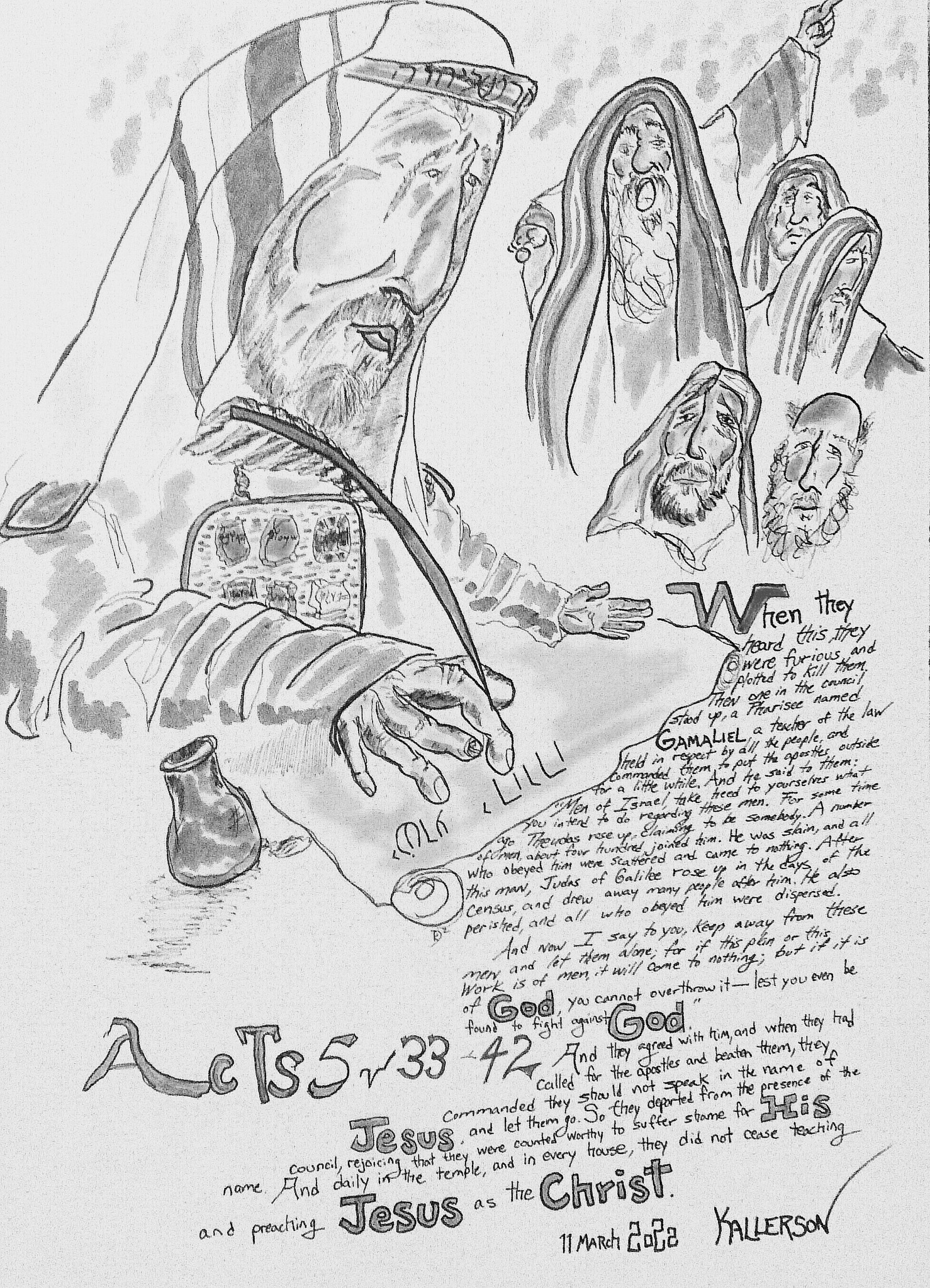
Acts 5:41

Texas Car Wash.

Monday, 21 March 2022

So they departed from the presence of the council, rejoicing that they were counted worthy to suffer shame for His name. Acts 5:41

Note: You can listen to today’s commentary courtesy of our friends at “Bible in Ten” podcast. (Click Here to listen)

You can also read this commentary, with music, courtesy of our friends at “Discern the Bible” on YouTube. (Click Here to listen), or at Rumble (Click Here to listen).

In the previous verse, the apostles were beaten. They were also commanded to not speak in (literally “upon”) the name of Jesus. After that, they were released. With their release, it now says, “So they departed from the presence of the council.”

It is certain that there was no small amount of pain among them. Being beaten with rods was not a minor thing, and only a few stripes would really smart. If they were given the full measure of the law, meaning up to forty stripes (Deuteronomy 25:3), they would be rather miserable – at least physically – as they departed. And yet, it next says they were “rejoicing.”

Despite both the physical damage inflicted to their backs, as well as the disgrace they faced in the eyes of whoever considered it, they literally rejoiced over the event. It is the fulfillment of the words of Jesus, thus providing another measure of confidence that they were doing exactly what He desired of them –

“Blessed are those who are persecuted for righteousness’ sake,
For theirs is the kingdom of heaven.
11 Blessed are you when they revile and persecute you, and say all kinds of evil against you falsely for My sake. 12 Rejoice and be exceedingly glad, for great is your reward in heaven, for so they persecuted the prophets who were before you.” Matthew 5:10-12

&

“But beware of men, for they will deliver you up to councils and scourge you in their synagogues.” Matthew 10:17

Though this was at the Sanhedrin in Jerusalem and not a synagogue, the truth remains the same. They were delivered up and they were beaten. Jesus had told them such things would occur, and they have come about. Rather than a moment of defeat, it is a time of vindication “that they were counted worthy.”

One can be brought before such a tribunal for wrongdoing, maybe theft. When that occurs and a beating is ordered, there is only disgrace. There is the disgrace of having been caught. There is the disgrace of having been convicted. There is the disgrace of the beating itself. And there is the disgrace of having everyone know that these things happened to you.

On the other hand, one can be wrongfully judged. When nothing was done to deserve a beating, and yet a beating is received, there is nothing to be ashamed of. Rather, when the truth is eventually brought forth, and it will be brought forth someday, the one who was wrongly treated will be vindicated. Peter speaks of this in his first epistle –

“But sanctify the Lord God in your hearts, and always be ready to give a defense to everyone who asks you a reason for the hope that is in you, with meekness and fear; 16 having a good conscience, that when they defame you as evildoers, those who revile your good conduct in Christ may be ashamed. 17 For it is better, if it is the will of God, to suffer for doing good than for doing evil.” 1 Peter 3:15-17

As this is true, the apostles rejoiced. They knew that their actions were sanctioned by God, and they had faithfully fulfilled the charge given to them by the angel concerning speaking out about the gospel of Jesus. Therefore, they deemed what happened to them as a point of being counted worthy “to suffer shame for His name.”

There is a difference in suffering shame and in doing that which is shameful. The verb is passive in the Greek. The shame was inflicted upon them, but they had done nothing shameful to deserve it. Hence, Vincent’s Word Studies explains the terminology of this event –

“This is an instance of what rhetoricians style an oxymoron, from ὀξύς [oxus], sharp, and μωρός [moros], foolish; a pointedly foolish saying, which is witty or impressive through sheer contradiction or paradox, as laborious idleness, sublime indifference. In this case the apostles are described as dignified by indignity.”

Life application: There are times when people may incur damage simply because they have a bumper sticker on their car that points people to Jesus. It is most upsetting to come out and find tires slashed or metal scratched or dented. It is inconvenient, it is costly, and it is just plain wasteful. At the same time, there is now a choice. “Will I take the sticker off my car to avoid more damage, or will I stand fast on my faith in Christ?”

A bumper sticker doesn’t prove faith in Christ, and it is not a necessary part of our faith, but it does indicate who we are and what we believe. A car is a temporary item that will eventually be crushed and made into something else. But what about something more personal. What if you are actually being beaten up by people because of your faith? Or maybe they are imprisoning you or even threatening your life because of Jesus?

This has happened, and it continues to happen, to people all along and throughout the world. Those who are willing to stand up for their faith are a real testimony to the One they are willing to follow, even at such a great cost. You may or may not have to face this now, but someday you might. What will you be willing to give up in order to remain faithful to the Lord? Think about that, and be ready to respond if that day should come.

Lord Jesus, You gave up heaven’s riches in order to come and restore us to Yourself. Help us to be willing to respond in the right way if we should be asked to give up our lives of ease, material wealth, freedom, or even our lives in remaining faithful to You. Grant us in that day the ability to stand fast on Your name, no matter what the cost. Amen.
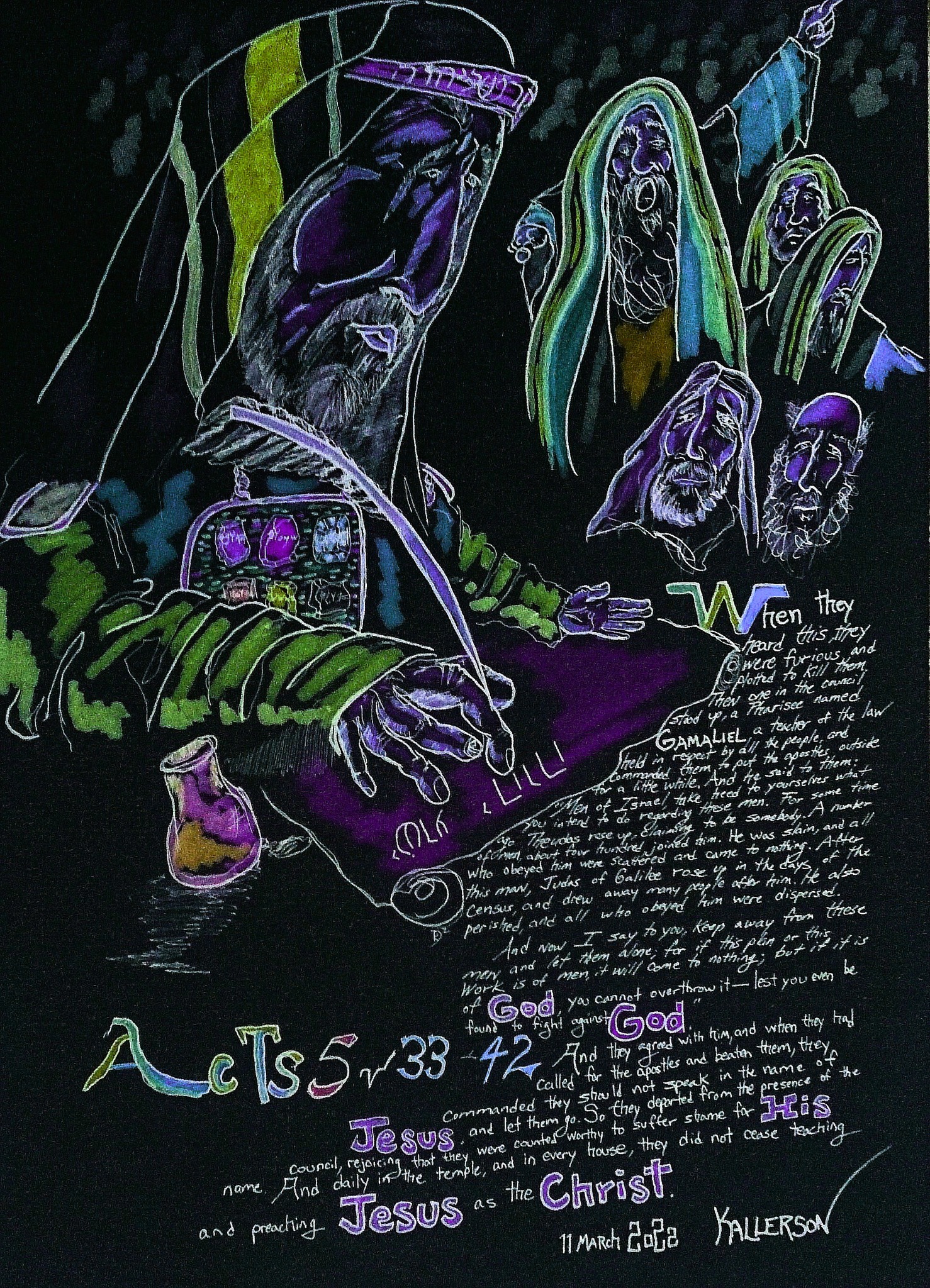
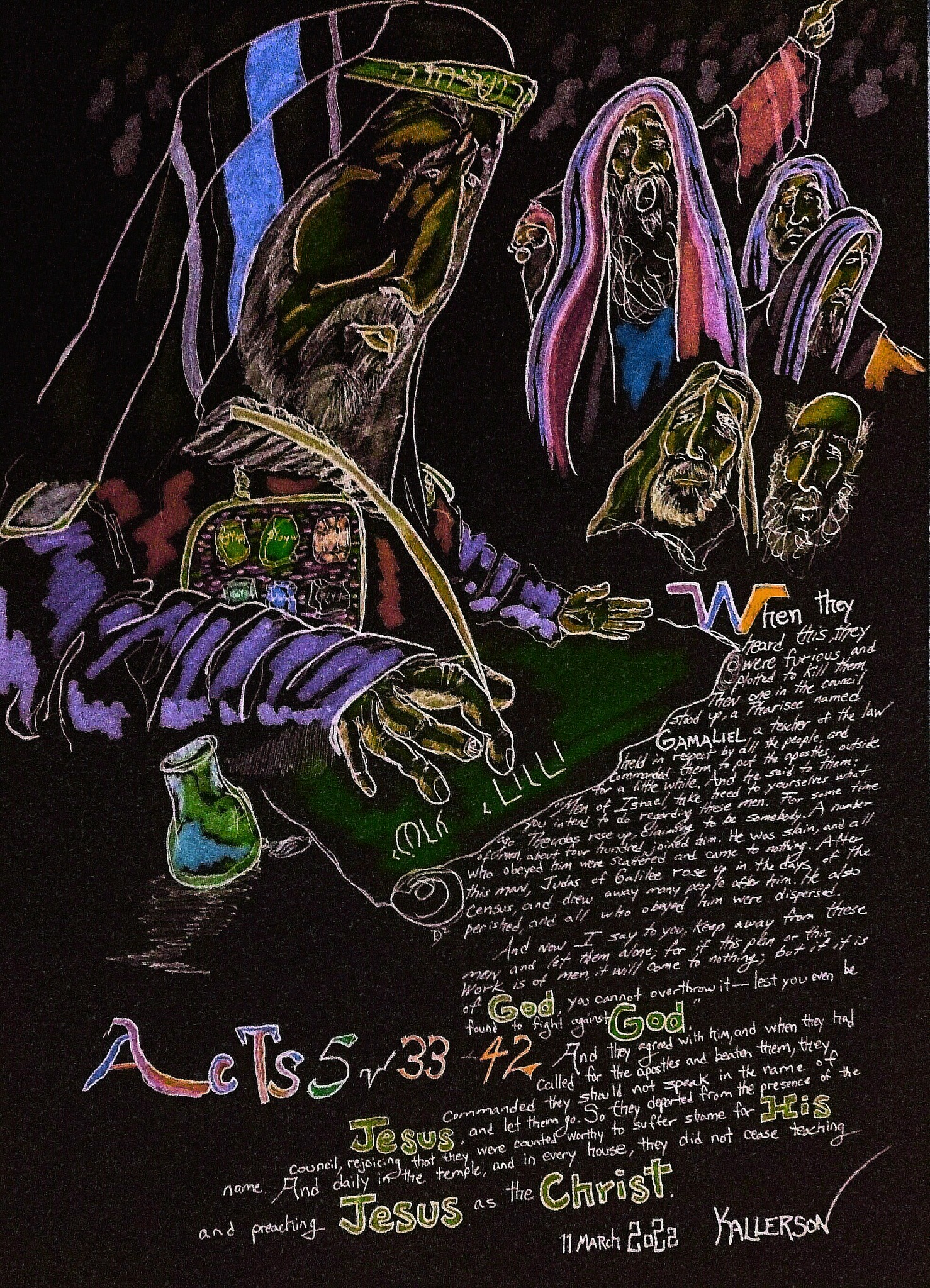


Acts 5:40

Sour grape coloring…

Sunday, 20 March 2022

And they agreed with him, and when they had called for the apostles and beaten them, they commanded that they should not speak in the name of Jesus, and let them go. Acts 5:40

Note: You can listen to today’s commentary courtesy of our friends at “Bible in Ten” podcast. (Click Here to listen).

You can also read this commentary, with music, courtesy of our friends at “Discern the Bible” on YouTube. (Click Here to listen), or at Rumble (Click Here to listen).

With Gamaliel’s recommendation now stated, Luke next records, “And they agreed with him.” His argument was convincing because it was based on precedent. Further, it was based on the assumption that if the movement of the apostles was simply the work of man, it would die out, but if it was truly the work of God, nothing could thwart it anyway. The advice was sound and reasonable. With that decided, they still could not let the apostles go away without a demonstration of their authority. Hence, it next says, “and when they had called for the apostles and beaten them.”

In such a tribunal, there must be a reason for such a punishment. However, none is given. It could be argued that Peter and John could be beaten because they had not obeyed the previous command given to them –

“So they called them and commanded them not to speak at all nor teach in the name of Jesus.” Acts 4:18

However, none of the other apostles were present at that time. As such, it would be a stretch of the law to include them in a charge of disobedience. It could only be considered a crime of guilt by association. Regardless of this, the men were probably beaten with rods according to the words of Moses –

“If there is a dispute between men, and they come to court, that the judges may judge them, and they justify the righteous and condemn the wicked, then it shall be, if the wicked man deserves to be beaten, that the judge will cause him to lie down and be beaten in his presence, according to his guilt, with a certain number of blows. Forty blows he may give him and no more, lest he should exceed this and beat him with many blows above these, and your brother be humiliated in your sight.” Deuteronomy 25:1-3

Along with the beating, they were also given a charge, as Luke notes, “they commanded that they should not speak in the name of Jesus.” It is the same command previously given. Like before, the Greek actually reads “upon the name of Jesus.” The command forbids them to speak on the authority of Jesus’ name. Unlike the charge in Acts 4, this time their directive came with an additional measure, beating them to hopefully ensure compliance. However, the apostles have already spoken as to the matter –

“But Peter and John answered and said to them, ‘Whether it is right in the sight of God to listen to you more than to God, you judge. 20 For we cannot but speak the things which we have seen and heard.’” Acts 4:19, 20

&

“But Peter and the other apostles answered and said: “We ought to obey God rather than men.” Acts 5:29

Only time will tell if the beating they received will cause them to obey men rather than God. For now, Luke ends the verse saying, “and let them go.”

With no valid justification to further incarcerate or punish the apostles, the council allowed them to leave. But there was nothing recorded by Luke about one of the key points of the entire event. The council never asked (at least nothing is recorded concerning the matter) how the apostles got out of a locked and guarded prison in the middle of the night. It appears that they were truly afraid to ask that simple question because it might open up a can of worms that could possibly divide the council.

Paul will later use his knowledge of how the council operates to do exactly that as is recorded in Acts 23:9. For now, the apostles are free to go.

Life application: Paul, writing to the saints at Philippi, gave a strong exhortation to the church about a matter that first became evident in the account of Acts 5 –

“Only let your conduct be worthy of the gospel of Christ, so that whether I come and see you or am absent, I may hear of your affairs, that you stand fast in one spirit, with one mind striving together for the faith of the gospel, 28 and not in any way terrified by your adversaries, which is to them a proof of perdition, but to you of salvation, and that from God. 29 For to you it has been granted on behalf of Christ, not only to believe in Him, but also to suffer for His sake, 30 having the same conflict which you saw in me and now hear is in me.” Philippians 1:27-30

Though the punishment was minor at this time, the apostles did suffer for the sake of Christ. A beating with rods is no pleasant thing, and it is given to correct offenders. This means that the apostles were considered offenders by the leaders of Israel. Despite the warnings and the punishment, the apostles provided the “proof of perdition” to the council and the proof of “salvation” that they possessed.

The account in Acts is descriptive. It does not provide any command that we are to act in a like manner. But Paul’s words are prescriptive. He has built upon the acts of the apostles, including himself, a sound and reasonable directive for the church to live by. This has been accepted by many martyrs over the past two thousand years. It may be that even in once Christian-friendly nations, believers may be called to act in the same manner in the days ahead.

Be mentally prepared now to accept what comes, including suffering for the sake of Christ, as an acceptable demonstration of your faith. It is our calling, and it has been directed by God in His word. Stand fast and accept what comes with gladness that your name is written in heaven.

Heavenly Father, it is evident that faith in Jesus is becoming less tolerable to the leadership of many nations. Unless it is in a faith that is unbiblical. You have asked us to stand apart from perversion, idolatry, and all wickedness. Help us in this. As churches depart from the true faith, help those of us who hold fast to it to remain strong, never departing from the right and proper path. Amen.


Acts 5:39

Bluish Purple tones…

Saturday, 19 March 2022

but if it is of God, you cannot overthrow it—lest you even be found to fight against God. Acts 5:39

Note: You can listen to today’s commentary courtesy of our friends at “Bible in Ten” podcast. (Click Here to listen).

You can also read this commentary, with music, courtesy of our friends at “Discern the Bible” on YouTube. (Click Here to listen), or at Rumble (Click Here to listen).

Gamaliel has given two examples of groups that fizzled out after their leaders died. After that, he gave his recommendation concerning the apostles, saying, “let them alone.” He then gave a part of his reasoning for this with the words, “for if this plan or this work is of men, it will come to nothing.” Now, he will finish his words with a contrasting reason why they should be left alone. That begins with, “but if it is of God.”

It is interesting that the mood of these words is different than the previous clause. There, the verb was in the subjunctive mood. Now it is in the indicative mood. Cambridge notes the difference saying, “The verb is not in the same mood as in the previous clause, and had the construction been in classical Greek, it might have indicated some opinion on Gamaliel’s part of the truth of Christianity = ‘If it is [as it is] of God.’ But in the N. T. the construction indicates no more than a simple conditional.”

Regardless of it being a simple conditional, Gamaliel has chosen his words to make a contrast between the two states. One is hypothetically from man; the other is questioned if it is really from God. If it is so, there will be a marked difference in the outcome.

Man’s work will find success or failure based on innumerable circumstances. But in the case of the nation of Israel, there is a more important element at work. Gamaliel understood this. The Lord Himself watches over the people, and He determines what their outcome will be based upon their relationship with Him.

This precept is found time and again in Deuteronomy. It is then confirmed in the prophetic writings, and it is evidenced throughout the historical writings. Clear examples of this are seen, for example, in the Song of Moses, such as –

“How could one chase a thousand,
And two put ten thousand to flight,
Unless their Rock had sold them,
And the Lord had surrendered them?” Deuteronomy 32:30

If the Lord is on the side of a person who is striving to overthrow Roman authority, nothing could stop him from doing so –

“You will chase your enemies, and they shall fall by the sword before you.
Five of you shall chase a hundred, and a hundred of you shall put ten thousand to flight;
your enemies shall fall by the sword before you.” Leviticus 26:7, 8

However, if the Lord is not with him, his attempt will fail, and he will perish. This is the point of Gamaliel’s mentioning of Theudas and Judas of Galilee. On the other hand, David had the Lord with him, and he prevailed over his foes, attained the position of king, and ruled the land. As such, his counsel is that if the movement of the apostles is led by God, “you cannot overthrow it.”

He is speaking to the spiritual leaders of the nation about matters that will affect the destiny of the nation. Gamaliel was aware of the words of Moses. If a movement had arisen that was spiritually correct before God because it was in accord with the words of Moses, and which was also confirmed by the prophets, then it absolutely could not fail. God knew the future, spoke forth through the prophets what would happen, and so it was impossible that what was prophesied could be thwarted.

The apostles had presented their case to the people, their words were heard and understood by those in the council, and they claimed that Jesus was the promised Messiah. If these things were true, and if the council continued to resist them and their message, there would be consequences. Gamaliel notes this as he finishes, saying, “lest you even be found to fight against God.”

This is a word, an adjective, found only here in Scripture, theomachos. Being an adjective, it literally means, “God-fighters.” Its kindred verb is found in Acts 23:9 when Paul was brought before this same council –

“Then there arose a loud outcry. And the scribes of the Pharisees’ party arose and protested, saying, ‘We find no evil in this man; but if a spirit or an angel has spoken to him, let us not fight against God.’”

Though nothing in history speaks of Gamaliel as a saved person, his words seem to indicate that he may have suspected that the message of the apostles was true. His words, and the way they are presented, demonstrate the thoughts of a person who is carefully watching the unfolding events of history, evaluating them from the lens of the writings which established his people, and looking to see if what those writings said matched up with the very events that were occurring before his eyes.

What he says now is certainly in accord with what Peter and the other apostles had just said moments before, “We ought to obey God rather than men” (Acts 5:29). As noted then, if the words of the apostles were true, and if they were rightly following God because of faith in Christ, it meant that the Mosaic Covenant had found its fulfillment and its end in Jesus. The hope of the New Covenant was what they proclaimed had come through His completed work. Gamaliel’s words demonstrate caution be exercised by those with whom he sat to judge.

Life application: The directions for our walk before the Lord are found in the New Testament epistles. We have entered into a New Covenant. It is not possible to have one foot in the law and one foot in Christ. The two are wholly incompatible.

As such, the warnings of the epistles are clear and unambiguous. One will either follow Christ or he will return to the law. Only one path can be taken, and there will be judgment based on which path was decided upon. If a person is saved, he is saved. That will not be lost, but to return to adherence to the law will mean zero rewards for that person.

Be wise, be circumspect, and put your faith and trust solely in the merits of Jesus Christ. What you do while in that state will be evaluated and either be counted as loss and burned up, or it will be counted as gain and be purified. For the one who returns to the law, there will only be loss. Jesus didn’t come and complete His job just so that we could try to do better after He left. What He did was perfect, fully sufficient, and finished – once and for all time.

Thank You, Lord God, for the sure hope we possess in Christ. Our salvation isn’t just given to us, it is guaranteed to us! We have an absolute hope of eternal life because of the work of Jesus. Thank You for this surety we now have! Amen and amen.


Acts 5:38

Industrial strength color in this one.

Friday, 18 March 2022

And now I say to you, keep away from these men and let them alone; for if this plan or this work is of men, it will come to nothing; Acts 5:38

Note: You can listen to today’s commentary courtesy of our friends at “Bible in Ten” podcast. (Click Here to listen).

You can also read this commentary, with music, courtesy of our friends at “Discern the Bible” on YouTube. (Click Here to listen), or at Rumble (Click Here to listen).

Gamaliel, having given two historical examples of failed leaders of the past, now gives his advice concerning the faith that is based on the leadership of Christ Jesus. This begins with his words, saying, “And now I say to you.”

Based on what had happened in the past to those who initiated uprisings, meaning Theudas and Judas of Galilee, there is a precedent that their followers will scatter and disperse when the leader has died. As such, he continues, “keep away from these men.”

The word translated as “keep away” signifies “to depart” or “stand off.” The leaders in the council “were furious and plotted to kill them” (5:33), Gamaliel is telling them to take another path and simply depart from them and not interfere. And more, he continues with, “and let them alone.”

The word signifies “to send away.” It carries with it the sense of permitting. When one is sent away, he is allowed to continue with his own devices. Gamaliel, understanding the failure of Theudas and Judas of Galilee, knew that if what the apostles were doing fell into the disfavor of Rome, it would be handled by them.

For the council to take action, it would only increase the zealotry of the followers and ultimately bring them unnecessary trouble. However, without the presence of Jesus, another option was more likely. As he next says, “for if this plan or this work is of men.”

The Greek reads, “for if this plan or this work is out of men.” The meaning is, out of their own strength, planning, or devices. Just as with the previous two examples of failed insurrections that did not have divine approval, so this might be as well. If that is the case, Gamaliel says, “it will come to nothing.”

The Greek word signifies “to loosen down.” It is what one does when he unpacks a horse or tears down a tent. It is also used to speak of the abolishing of the law or the destroying of the temple. If the movement of the apostles is out of man, it will simply collapse, either under its own weight or by another force that will cause it to be destroyed. Either way, it will not continue. As such, why should the council stir things up and cause exactly the opposite to occur?

Life application: The words of Gamaliel bear a wisdom that reflects principles found in the book of Proverbs. He gives sound advice concerning a matter that could have been handled in one of several ways. With thought and contemplation, a recommendation is put forth for consideration by the council. Before he finishes, he will also give another possible outcome for the movement of the apostles, and he will explain what would be the reason for its happening as well.

This is a sound way of presenting a case for action, and it has been based upon carefully evaluating events of the past and also how things could be affected into the future. Reading the Proverbs will give a person insight into such things. Rather than commands about how to do things, general guidelines, based upon personal insights and experiences, are given by the author for the reader to consider.

Be familiar enough with what is recorded there in Proverbs, so that when a matter arises, you can recall the words and consider them as you make your own decisions about important matters that you will certainly face at various times in your life.

Heavenly Father, You endowed Solomon with wisdom and understanding. He took some of that wisdom and wrote it down for us to consider as our own lives unfold. If we could ask for such wisdom, You would certainly say, “I have already given it to you, it is in My word.” And so, Lord, help us to search out the wisdom You gave Solomon by searching out his words that are recorded in Your word. Amen.


Acts 5:37

Black on White

Thursday, 17 March 2022

After this man, Judas of Galilee rose up in the days of the census, and drew away many people after him. He also perished, and all who obeyed him were dispersed. Acts 5:37

Note: You can listen to today’s commentary courtesy of our friends at “Bible in Ten” podcast. (Click Here to listen)

You can also read this commentary, with music, courtesy of our friends at “Discern the Bible” on YouTube. (Click Here to listen), or at Rumble (Click Here to listen).

Gamaliel just gave an example from history concerning Theudas and his band of four hundred men. He now gives a second example, saying, “After this man, Judas of Galilee rose up.” Of this name, Charles Ellicott writes –

“In one passage Josephus (Ant. xviii. 1) calls him a Gaulonite—i.e., of the country east of Galilee. Had this stood alone, St. Luke might have been charged here also with inaccuracy; but in other passages (Ant. xx. 5, § 2; Wars, ii. 8, § 1) he is described as a Galilean.”

This leaves a couple of possibilities. One is that Josephus misidentified Judas at one time in his writings. Another is that two people are being referred to by Josephus. Or, possibly, it is the same person who is first identified by the place where he was born and then by the place he was most known for. No matter what, there is an extra-biblical note supporting Luke’s writing concerning the words of Gamaliel. This person named Judas was an actual historical figure who is being referred to. Of him, Gamaliel next says, “in the days of the census.”

This is also referred to by Josephus. Albert Barnes gives sufficient detail concerning his revolt as described by Josephus –

“He says that the revolt took place under ‘Cyrenius,’ a Roman senator, who came into ‘Syria to be judge of that nation, and to take account of their substance.’ ‘Moreover,’ says he, ‘Cyrenius came himself into Judea, which was now added to the province of Syria, to take an account of their substance, and to dispose of Archelaus’ money.’ ‘Yet Judas, taking with him Saddouk, a Pharisee, became zealous to draw them to a revolt, who both said that this taxation was no better than an introduction to slavery, and exhorted the nation to assert their liberty, etc.’ ‘This’ revolt, he says, was the commencement of the series of revolts and calamities that terminated in the destruction of the city, temple, and nation.”

Also, of this account, Charles Ellicott says, “He was assisted by a Pharisee, named Sadduk, and the absolute independence of Israel was the watchword of his followers. It was unlawful, in any form, to pay tribute to Cæsar. It was lawful to use any weapons in defence of freedom.”

This then probably explains the reason for the question presented to Jesus by the Pharisees –

“Then the Pharisees went and plotted how they might entangle Him in His talk. 16 And they sent to Him their disciples with the Herodians, saying, ‘Teacher, we know that You are true, and teach the way of God in truth; nor do You care about anyone, for You do not regard the person of men. 17 Tell us, therefore, what do You think? Is it lawful to pay taxes to Caesar, or not?’
18 But Jesus perceived their wickedness, and said, ‘Why do you test Me, you hypocrites? 19 Show Me the tax money.’
So they brought Him a denarius.
20 And He said to them, ‘Whose image and inscription is this?’
21 They said to Him, ‘Caesar’s.’
And He said to them, ‘Render therefore to Caesar the things that are Caesar’s, and to God the things that are God’s.’ 22 When they had heard these words, they marveled, and left Him and went their way.” Matthew 22:15-22

This was something that would have been on the minds of the people throughout their time under Rome. If they had paid heed to the words of the Lord, things would have gone much better for them. As far as Judas, Luke continues Gamaliel’s words, saying, “and drew away many people after him.”

The lack of any specific number, unlike that of Theudas, seems to imply a greater number had followed Judas. As such, it would help explain why Gamaliel is giving a second example. The first was a man with a small force, comparable to that of David. However, where David was supported by the hand of God, Theudas was obviously not. His efforts failed. Now, Gamaliel refers to someone with a larger following, probably not unlike the number that were aligned with the teaching of Jesus, reaching into the thousands or maybe even tens of thousands by this point. However, of this Judas, Gamaliel notes that even with a larger force, “He also perished.”

Judas died or was taken prisoner by the Romans never to be heard from again. Either way, his time of leadership in the rebellion against Rome ended, “and all who obeyed him were dispersed.” Once the leader was gone, the movement allied with him ended. Those who were still alive simply went on with life, taking a new direction than the one they had been on under Judas.

Life application: It was noted above that a Pharisee named Sadduk accompanied Judas and had his own idea about how to handle the rule of Rome over them. When Jesus came, the Pharisees asked Him about this exact topic, wanting to see what He thought. They also were hoping to trap Him in His words. If He said, “No, you are not to pay taxes to Rome,” they would have had a reason to hand Him over to the Romans as an insurrectionist.

However, if He said, “Yes, you should pay the Romans,” the Pharisees would have then stirred up the people by saying, “This guy is a sellout to the Romans.” Either way, they planned to trap Jesus in His words, thus taking away His hand of guidance over the people who followed Him.

Jesus gave them an answer they were completely unprepared for. He showed that compliance with, and allegiance to, an earthly body does not mean people are being unfaithful to the Lord. Paul demonstrates this in his life and actions as well. Our duties to those over us in this world should be performed according to the station in which we are born and live. Likewise, our duties to God should be performed accordingly as well.

Let us remember this and let us live out our lives working in whatever country we are in as citizens of that country. At the same time, we are to be faithful citizens of the kingdom of the Lord Jesus, being obedient to His precepts as set forth in His word. When the two conflict, we are to defer to the Lord’s kingdom. When they do not, we should be obedient to both.

Lord God, give us wisdom in the conduct of our lives so that we will be good and faithful citizens of the nation in which we find ourselves, while still being obedient to the calling we have upon our lives in Your kingdom. May You be glorified in all that we do as we live our lives before You. Amen.