Acts 8:4

Snazzy stairway floor. State capitol. Austin Texas.

Thursday, 9 June 2022

Therefore those who were scattered went everywhere preaching the word. Acts 8:4

Note: You can listen to today’s commentary courtesy of our friends at “Bible in Ten” podcast. (Click Here to listen)

You can also read this commentary, with music, courtesy of our friends at “Discern the Bible” on YouTube. (Click Here to listen), or at Rumble (Click Here to listen).

In the previous verse, Saul was seen to make havoc on the church, dragging people off and putting them in prison. With that, Luke next records, “Therefore.”

It is because of the persecution of the church, notably by Saul, that the events now about to happen will actually come about, and which concerns “those who were scattered.”

In their desire to not be dragged away and put in prison, the believers in Jerusalem got up and left. This is what was already stated in verse 8:1, and which is being repeated now after the reason for their scattering has been explicitly stated –

“At that time a great persecution arose against the church which was at Jerusalem; and they were all scattered throughout the regions of Judea and Samaria, except the apostles.” Acts 8:1

It is true that this must have been a time of both fear and stress on the believers. Being uprooted suddenly and then rushing off to another place is a difficult change on most people, but we are being told these things for a specific reason, which is that those who were scattered “went everywhere preaching the word.”

The word translated as “everywhere” is dierchomai. It comes from dia (through) and erchomai (to come or go). It’s not that they went everywhere and preached, but that they preached everywhere they went. Wherever they passed through, on the way to the next place, they would boldly tell the people about what they knew.

As can be seen, the information now fills in what was first stated in verse 8:1. Now, and for the next several chapters, many details will continue to be filled in, and then in verse 11:19, this narrative will be called to mind again –

“Now those who were scattered after the persecution that arose over Stephen traveled as far as Phoenicia, Cyprus, and Antioch, preaching the word to no one but the Jews only. 20 But some of them were men from Cyprus and Cyrene, who, when they had come to Antioch, spoke to the Hellenists, preaching the Lord Jesus. 21 And the hand of the Lord was with them, and a great number believed and turned to the Lord.” Acts 11:19-21

This will be stated after the conversion of some from the mixed-race of the Samaritans, after the conversion of an Ethiopian eunuch, after Saul’s conversion, and after the conversion of an Italian centurion living in Caesarea. Thus, the words of Jesus in Acts 1:8 will be on their way to total fulfillment with each step being meticulously recorded by Luke –

“But you shall receive power when the Holy Spirit has come upon you; and you shall be witnesses to Me in Jerusalem, and in all Judea and Samaria, and to the end of the earth.”

Life application: As difficult as it must have been for the believers to be uprooted by the persecution they faced, and as difficult as it must have been for Paul to later contemplate his actions towards the believers he persecuted, the word of the Lord was actually being fulfilled through these things.

As the Lord said that the word would be spread even to the end of the earth, we can know that the things that seem difficult or even terrible that happen now are a part of the larger plan to make this happen. Nothing is happening that is outside of the knowledge of God, and He has the ability to use all that happens to meet His greater plan.

Let us trust this and do our best to remember it when our own times of upheaval and trial come. He is working all things out for a good end for those who are His. The word says that it is so –

“And we know that all things work together for good to those who love God, to those who are the called according to His purpose. 29 For whom He foreknew, He also predestined to be conformed to the image of His Son, that He might be the firstborn among many brethren. 30 Moreover whom He predestined, these He also called; whom He called, these He also justified; and whom He justified, these He also glorified.” Romans 8:28-30

Surely, we know that You are in control of all things Lord God. In our own times of trial and distress, we may lose sight of that. So, Lord, send us reminders along the way to help us keep our focus. We are wholly dependent on You in this, O God. May our hearts be prepared for the challenges ahead until the day when You bring us home to glory. Amen.


Acts 8:3

Fancy architecture, Texas capitol.

Wednesday, 8 June 2022

As for Saul, he made havoc of the church, entering every house, and dragging off men and women, committing them to prison. Acts 8:3

Note: You can listen to today’s commentary courtesy of our friends at “Bible in Ten” podcast. (Click Here to listen)

You can also read this commentary, with music, courtesy of our friends at “Discern the Bible” on YouTube. (Click Here to listen), or at Rumble (Click Here to listen).

It was just noted that Stephen was carried to his burial. But that did not stop the persecution of the church. In fact, Luke’s next words show that it continued, highlighting the very person who guarded the clothes of those who stoned Stephen, saying, “As for Saul.”

The name Saul is from the Hebrew Shaul. That comes from the verb shaal, meaning to inquire or ask for. Thus, it means “Asked For.” What may be implied is “Asked for (of Yah).” For example, the people of Israel had asked for a king, and the Lord gave them Saul, the first king to reign over Israel. Or it could be that a parent asks for a child and the Lord responds by granting one. The word, however, is identical in spelling to the word sheol, or the place of the dead. In this, one can imagine the grave calling out for the souls of humanity, asking for them to come and join it. Of Saul, Luke notes that “he made havoc of the church.”

The tense is imperfect. It says, “making havoc.” It shows that there was a continuous stream of him relentlessly going after the people. Also, here is a word found just this one time in Scripture and translated as “made havoc.” It signifies outrage or to maltreat. Of this word, Vincent’s Word Studies says –

“In Septuagint, Psalm 79:13, it is used of the laying waste of a vineyard by the wild boar. … Canon Farrar observes: ‘The part which he played at this time in the horrid work of persecution has, I fear, been always underrated. It is only when we collect the separate passages – they are no less than eight in number – in which allusion is made to this sad period, it is only when we weigh the terrible significance of the expressions used that we feel the load of remorse which must have lain upon him, and the taunts to which he was liable from malignant enemies’ (‘Life and Work of St. Paul’). Note the imperfect, of continued action.”

It has already been noted that the church was scattered throughout the regions of Judea and Samaria. However, the next verse will explain that this was a result of Saul’s actions. As such, it can be concluded that as soon as Stephen was stoned, he immediately started going after the believers. As mere speculation, it could be that those in the council said, “We need to crush this teaching right now, when we have the initiative.” With that, Saul responded with zeal. This would be in accord with his own words of Acts 26 –

“This I also did in Jerusalem, and many of the saints I shut up in prison, having received authority from the chief priests; and when they were put to death, I cast my vote against them. 11 And I punished them often in every synagogue and compelled them to blaspheme; and being exceedingly enraged against them, I persecuted them even to foreign cities.” Acts 26:10, 11

With this in mind, Luke says that Saul was “entering every house.” It would explain why it says “devout men” rather than “brethren” who were there to bury Stephen. The believers had fled. Only the devout non-believers were left. The persecution began right away, and the believers were hiding in their homes or taking the roads back to their own hometowns. For those who were apprehended, Luke next notes that Saul was “dragging off men and women, committing them to prison.”

The verbs continue to show an active and ongoing action by Saul. He came after the people and he kept coming after them, tirelessly chasing them down and having them incarcerated. The word “dragging” indicates that they were in a rage as they arrested the people, so much so that they grabbed body parts – the hair, the arms, the legs – and simply dragged them out to be bound up and taken away.

Noting both men and women was to show that there was no tolerance at all for anyone who held to the name of Jesus. Even if the men were primarily responsible for the households, the women were a part of the households and were thus subject to the same charges of apostasy as the men.

Life application: Saul was really the first persecutor of the church. But it didn’t end with his conversion. Rather, it has gone on steadily since those early days. One of the greatest persecutors of those who have faithfully held to Scripture is, not unsurprisingly, the Roman Catholic Church. While they have been caught up in a system of traditions, unbiblical rites and rituals, and in the adoration of the dead and of idols, faithful people have stood against this. And in their actions, they have been rounded up, sent through terrible tortures, and many were martyred.

Likewise, Christians have been killed in vast numbers by Muslims, Hindus, and people of other religions, or by those who deny any God exists – such as communists. This has been the norm, not the exception for much of the church age. The persecution of Christians has been on the increase in places like Canada, the US, Australia, Germany, and the UK in recent years. Legal battles have been played out in courts, but tolerance for the gospel has decreased in the minds of so many that it is only a matter of time before even worse comes upon believers.

Should the Lord tarry, the lines will surely be divided up between those who truly love Christ and are willing to stand up for His gospel, and those who either pay lip service to Him or are at odds with Him. Now is the time to prepare yourself for holding fast to the Lord. Stay in the word, keep Jesus in your heart and mind at all times, and determine now to never let this temporary world pull you away from Him!

Lord God, may we be found faithful to You until the end. It is a tough world, and many of us have never had to face persecutions or trials of faith. May we be prepared now so that should those times come, we will hold fast to our proclamation that Jesus is the answer to the world’s problems. Help us in this, O God. Amen.


Acts 8:2

Fancy stairs, Texas Capitol.

Tuesday, 7 June 2022

And devout men carried Stephen to his burial, and made great lamentation over him. Acts 8:2

Note: You can listen to today’s commentary courtesy of our friends at “Bible in Ten” podcast. (Click Here to listen).

You can also read this commentary, with music, courtesy of our friends at “Discern the Bible” on YouTube. (Click Here to listen), or at Rumble (Click Here to listen).

The last verse spoke of the consequences of Stephen’s stoning which noted that great persecution arose against the church, and those of the church were “all scattered throughout the regions of Judea and Samaria, except the apostles.” With that remembered, it now says, “And devout men.”

The word translated as “devout” is one that refers to being God-fearing, pious, and the like. It is used four times and each other instance refers to someone who is devout under the law –

“And behold, there was a man in Jerusalem whose name was Simeon, and this man was just and devout, waiting for the Consolation of Israel, and the Holy Spirit was upon him.” Luke 2:25

“And there were dwelling in Jerusalem Jews, devout men, from every nation under heaven.” Acts 2:5

“Then a certain Ananias, a devout man according to the law, having a good testimony with all the Jews who dwelt there, 13 came to me; and he stood and said to me, ‘Brother Saul, receive your sight.’ And at that same hour I looked up at him.” Acts 22:12, 13

It is true that any of these may have been a believer or become a believer, but their “devoutness” is in relation to the law. Further, as the previous verse specifically noted that those of the church were all scattered, Luke was surely making a point that it was men pious under the law that are being referred to now. It is a point of tenderness in an otherwise unhappy situation. From there, Luke next says that they “carried Stephen to his burial.”

Stephen means “crown.” At this point of the narrative, it is notable that despite being stoned for supposed blasphemy, he is the first recorded person in the new dispensation to receive the martyr’s crown. Thus, his name now meets up with his reward.

The word translated as “carry,” sugkomizó, is found only here. It signifies “to bring together.” Vincent’s Word Studies says, “Lit., to carry together; hence, either to assist in burying or, better, to bring the dead to the company (σύν) of the other dead. The word is used of bringing in harvest.”

Instead of simply leaving his body outside for beasts to eat, or chucking it into the valley of Hinnom (Gehenna), they removed it to a proper place. The words “to his burial” are inserted, but they surely reflect the appropriate idea. From there, it notes that they “made great lamentation over him.”

Again, it is a word found only here in the Bible, kopetos. It is a noun signifying “a beating of the breast or head while mourning.” It is an outward sign of working out an inner turmoil. Regardless as to whether these were believers or not, and the lack of calling them “brethren” points to them probably not being believers, the record is that an act of tenderness toward Stephen was carried out.

Life application: If you have traveled around the world or to various countries or states, you have surely met people who have been exceptionally pious towards “God.” This is, however, often as far as their understanding of God goes.

Humanity has the ability to do wonderful things in the care of others regardless of race, culture, or any other such distinguishing factor. Quite often, this is done by acknowledging that it is their understanding that God is overseeing their actions and He will be pleased with them.

There is nothing wrong with this, and it dispels the Calvinistic thought that there are none who actually seek after God. The words Paul uses in Romans to indicate this come from Psalm 14:1 and Psalm 53:1. In both, the same general idea is presented, that of someone who is an atheist (or at least claiming to be one) –

“The fool has said in his heart,
There is no God.’
They are corrupt, and have done abominable iniquity;
There is none who does good.” Psalm 53:1

These people, of many cultures, religions, and so on, are really seeking out how to be pleasing to the God they know is out there. But the problem isn’t with their attempts at doing good. Rather, the problem is the infection of sin in them. Until the sin can be dealt with, God cannot accept us. It is an impenetrable wall that is built up because of God’s holiness and our fallen state.

This is what Christ came to remove. His death was a sacrificial death for sin. With the sin removed, then a propitious relationship can be restored. Good works, without dealing with the sin, cannot be considered “good” to God. And more, they can easily lead to a sense of supposed worth before God. “I have done my best.” “I am not as bad as other people.” And so on. God does not grade on a curve.

God’s standard is absolute perfection. Until a person is perfected in Christ, they are not just fallen, but infinitely so. Christ Jesus! He is the answer. Remember the simple gospel and be ready to share it –

“For I delivered to you first of all that which I also received: that Christ died for our sins according to the Scriptures, and that He was buried, and that He rose again the third day according to the Scriptures.” 1 Corinthians 15:3, 4

Each of the underlined points is given in relation to sin. He died for our sin. He was buried with our sin. He rose again without sin, meaning: He had no sin of His own (Romans 6:23) and thus He is God (Romans 3:23), and our sin is left behind in His burial. Sin is removed from the equation. With the entrance into the New Covenant through belief in Christ’s work, sin is no longer imputed (2 Corinthians 5:19). Sin has been dealt with, and salvation is thus guaranteed.

Be confident in your own salvation, be ready to explain the sin problem to others, and then be ready to share with them the good news that God has seals them with His guarantee when they believe.

Lord God, if sin is the problem, and if Christ has dealt with the sin problem, then sin is no longer a problem. Restoration has come! Thank You, O God, for Jesus Christ, our atoning Sacrifice for sin. Hallelujah and Amen.


Acts 8:1

Seal of the Great State of Texas.

Monday, 6 June 2022

Now Saul was consenting to his death.
At that time a great persecution arose against the church which was at Jerusalem; and they were all scattered throughout the regions of Judea and Samaria, except the apostles.
Acts 8:1

Note: You can listen to today’s commentary courtesy of our friends at “Bible in Ten” podcast. (Click Here to listen).

You can also read this commentary, with music, courtesy of our friends at “Discern the Bible” on YouTube. (Click Here to listen), or at Rumble (Click Here to listen).

Chapter 7 ended with the death of Stephen. Chapter 8 will now build upon that as the persecution of the church takes hold. This begins with the person, Saul, who was just introduced in verse 7:58 –

“Then they cried out with a loud voice, stopped their ears, and ran at him with one accord; 58 and they cast him out of the city and stoned him. And the witnesses laid down their clothes at the feet of a young man named Saul. 59 And they stoned Stephen as he was calling on God and saying, ‘Lord Jesus, receive my spirit.’” Acts. 7:57-59

Of him, Luke records, “Now Saul was consenting to his death.” Luke uses a noun found only here in Scripture, anairesis. It is “a taking off,” or “a taking away.” In other words, Stephen’s life was taken away from him. As such, the word can indicate the state of death, murder, slaying, and so on. The ESV gives a good translation of this by saying, “execution.” Another way of conveying the thought might be, “And Saul was consenting to his termination.”

As for Paul himself, by allowing the clothes of the witnesses to be watched over by him, he agreed with what was occurring and may have even prompted each person to give his best shot, or “make that apostate pay.” With this setting the tone for the start of the chapter, the words continue with, “At that time.”

The Greek reads, “in that day.” There was no delay in moving from one event to the next as “a great persecution arose against the church.” The idea here is that if Stephen is apostate, then all those aligned with him – and who are teaching the same doctrine – are as well. There was guilt by association and those people who were aligned with him were to be weeded out.

Stephen died based on his words to the council, and they felt his words could not be condoned in others. Therefore, the persecution immediately began against the church, meaning the people who comprised the church, “which was at Jerusalem.”

Jerusalem was the focal point of all that had occurred, and it had become an established body of believers, united in their belief that Jesus is the Messiah. They met together, worshipped together, and were well established there. This has all been evidenced so far in Acts.

With the doctrine of Stephen now openly brought forth, the council perceived that his thoughts about the apostasy of the leaders did not die with Jesus, but that it had continued on with the apostles and disciples. They could not tolerate this.

Having consented to the death of Jesus, the connection made by Stephen to the past where Israel’s leaders had put the previous prophets to death could not be swept under a rug. The writings of the same prophets who were rejected by the leaders in the past had become a part of their own Scriptures!

What Stephen said was true, but in their arrogance, they rejected his words because they had already rejected the words of Jesus. Surely, they were “different” than their fathers before them. But deep inside, they knew the words against them were true. And so, the witness of these followers had to be extinguished as well. As a result of this new persecution, Luke next records, “and they were all scattered throughout the regions of Judea and Samaria.”

The words now set the tone for what Jesus had said in Acts 1:8 –

“But you shall receive power when the Holy Spirit has come upon you; and you shall be witnesses to Me in Jerusalem, and in all Judea and Samaria, and to the end of the earth.”

The actual fulfillment of His words will be seen in just a few verses. But this persecution now is the seed that will germinate and take root in those areas. The death of Stephen, and the persecution that now follows, is the means by which Jesus’ words would begin to take effect.

These people in the church probably came from those other areas and had simply settled down in Jerusalem to learn from the apostles. With the persecution now taking hold, they would return to where they were from. That is all “except the apostles.”

The apostles probably told each disciple something like, “You go. Get back to your hometown and tell the good news about Jesus. We will stay here and keep the church united, even in its dispersion.” They would be a focal point for people to return to and hear about others who had gone off to different areas, thus the church could be kept united through the efforts of the apostles.

Life application: What may seem like a catastrophe may be just the opportunity needed to get things going in a new direction. This is certainly the case with the church in Jerusalem. There was a time when people needed to separate and begin sharing the news about Jesus beyond the walls of their own houses. The persecution of the church was the spark that lit the fire of this new chance for growth in numbers and expansion in territory, but at the time, it certainly did not seem either pleasing or of great value.

The Lord, however, has plans that go beyond our own limited thinking, and so let us attempt to look for His hand in tragedies, trials, and difficulties. Let us accept that His will is to be done, and if what has happened or is happening is a part of that, we should be thankful that He can use us in such a state to continue His redemptive purposes.

When we look back someday, the wisdom displayed now, and that may be hidden at the time, will become evident. Let us trust in this.

Heavenly Father, how many times have we experienced trials and troubles, and later looked back to see just how perfectly they fit into a greater plan. And yet, the ones we face now seem daunting and even overwhelming. Help us to remember that You worked out what happened in the past, and so we can trust that You are working out what is happening now. We know that You are with us. Help us to see Your hand in the events and to remain steadfast through them. Amen.


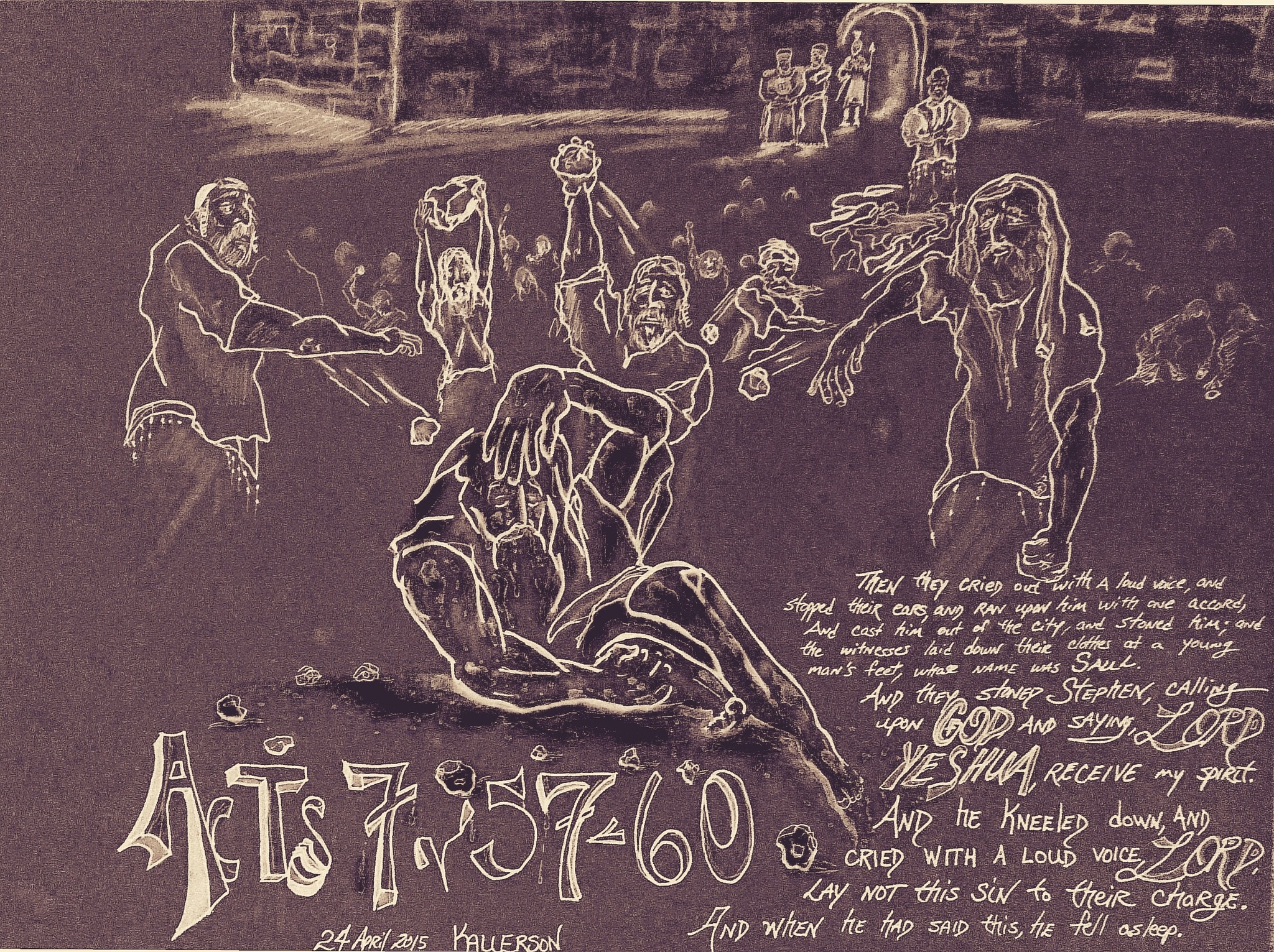
Acts 7:60

Artwork by Doug Kallerson.

Sunday, 5 June 2022

Then he knelt down and cried out with a loud voice, “Lord, do not charge them with this sin.” And when he had said this, he fell asleep. Acts 7:60

Note: You can listen to today’s commentary courtesy of our friends at “Bible in Ten” podcast. (Click Here to listen).

You can also read this commentary, with music, courtesy of our friends at “Discern the Bible” on YouTube. (Click Here to listen), or at Rumble (Click Here to listen).

The previous verse spoke of Stephen being stoned and calling out, “Lord Jesus, receive my spirit.” With that, the first recorded martyr of the church age is prepared to yield up his spirit, but he has one more thing to say while under the inspiration of the Spirit (Matthew 10:19, 20). And so, Luke records, “Then he knelt down.”

This is something Luke carefully records five times in Luke and Acts. The act of kneeling while praying is found here and in Luke 22:41, Acts 9:40, Acts 20:36, and Acts 21:5. Such a position of humility goes back to the Old Testament where Solomon knelt down before the assembly when praying at the dedication of the temple and when Daniel was said to kneel three times a day when he prayed and gave thanks before his God.

The act is then one that defines a particular communication between man and his Creator. The other instances of kneeling for prayer that have been recorded make this perfectly clear. With this noted, it next says, “and cried out with a loud voice.”

This would otherwise be perfectly unnecessary. If he had something to say to the Lord in his final moments before death, unless it was to make two points, he would have simply breathed it out to God alone. But the prayer is not for his benefit. It is for those stoning him. First, it is to once again impress upon their minds that he accepts Christ Jesus as being fully God. Secondly, it is to ask Jesus for mercy upon those set on his destruction. He had just called out, “Lord Jesus, receive my spirit.” He now calls out, “Lord.”

He uses the same word, Κύριε [Kurie], that he just used when he said “Lord Jesus.” Thus, it is without any doubt that the address is to Jesus. And in his final petition, he calls out, “do not charge them with this sin.”

First, he acknowledges that Jesus is God through his kneeling to Him in prayer. Secondly, he reaffirms that by using the term Kurie, thus tying “Lord” with the glory of God described in verse 7:56. Thirdly, he does this by acknowledging that Jesus can, in fact, impute sin or withhold the imputation of sin – something only God can do.

But there is a fourth display of the deity of the Lord to be found here. Even if Stephen knew this or not, the Holy Spirit who was inspiring him to speak did. The reason for this is that with the coming of Christ, there is a new dispensation and a more perfect means of seeking God and of obtaining His pardon.

If anyone there stoning him reflected on their own Scriptures, they would remember the last martyr recorded there, which defined the dispensation of the law. In this, they would take to heart his words then and the contrasting words of Stephen now –

“Then the Spirit of God came upon Zechariah the son of Jehoiada the priest, who stood above the people, and said to them, ‘Thus says God: “Why do you transgress the commandments of the Lord, so that you cannot prosper? Because you have forsaken the Lord, He also has forsaken you.”’ 21 So they conspired against him, and at the command of the king they stoned him with stones in the court of the house of the Lord. 22 Thus Joash the king did not remember the kindness which Jehoiada his father had done to him, but killed his son; and as he died, he said, ‘The Lord look on it, and repay!’” 2 Chronicles 24:20-22

Jesus referred to this in Matthew and Luke, reminding these same leaders of this exact event –

“And He said, ‘Woe to you also, lawyers! For you load men with burdens hard to bear, and you yourselves do not touch the burdens with one of your fingers. 47 Woe to you! For you build the tombs of the prophets, and your fathers killed them. 48 In fact, you bear witness that you approve the deeds of your fathers; for they indeed killed them, and you build their tombs. 49 Therefore the wisdom of God also said, ‘I will send them prophets and apostles, and some of them they will kill and persecute,’ 50 that the blood of all the prophets which was shed from the foundation of the world may be required of this generation, 51 from the blood of Abel to the blood of Zechariah who perished between the altar and the temple. Yes, I say to you, it shall be required of this generation.’” Luke 11:46-51

The order of the Hebrew Bible is different than how we have it. Their books go from Genesis to 2 Chronicles. As such, Abel was the first martyr recorded in their Scriptures while Zechariah was the last.

Jesus was saying that the blood of all of these would be required of all of them. The reason for this is that they rejected the word that recorded these things and continued down the same perverse path. Jesus would come to take the guilt for all sin if the one committing it would simply receive His pardon. But in not doing so, the blood guilt would remain.

Stephen now contrasts the appeal of Zechariah by asking for their sin to not be imputed to them. The Holy Spirit was telling them that this was possible because 1) Jesus had died for their sins, and 2) Jesus had risen, proving He is God. In His rising, He ascended to His rightful position of authority and had the ability to forgive any who would come to Him. And 3) it is thus a lesson concerning the law versus grace.

When the law was given, three thousand died in the first rebellion under that law (Exodus 32:28). When the Holy Spirit was given, three thousand were saved on that first day (Acts 2:41). When the law was in effect, the call was for justice against the offenders. When the dispensation of grace came into effect, the call is for mercy and pardon against the offender.

The clear and unambiguous lesson in this final verse of Acts Chapter 7 is that Jesus is God, and that through Him alone can come the forgiveness of sins. With this understood, Luke finishes the verse and the chapter with, “And when he had said this, he fell asleep.”

Rest well, Stephen, the call will not be long, and you shall be raised to receive your crown.

Life application: We need to be careful to not take the words of Stephen too far and assume that everyone is automatically forgiven since the coming of Christ. This is not taught in Scripture. Rather, all sins can be forgiven in Christ, but the offender must be willing to acknowledge his offense against God, and also acknowledge that the forgiveness can only come through the sacrifice of Jesus.

This is clearly demonstrated both here and in Jesus’ words on the cross –

“Then Jesus said, ‘Father, forgive them, for they do not know what they do.’” Luke 23:34

Before running ahead with Jesus’ words and saying that 1) everyone must forgive everyone of their wrongdoings, and 2) God in Christ automatically forgives everyone for all of their sins (both teachings are to be found in various degrees throughout Christian churches), one needs to ask the simple question, “Were the Jews collectively forgiven of their rejection of Christ Jesus or not?”

The answer is clear. Their temple was destroyed, the people fell under the promised punishments of Deuteronomy 28, and they were beaten down, exiled, and pursued exactly as the law indicated they would be. No, they were not forgiven. Nor are any others forgiven who do not come to Christ acknowledging that they have sinned.

Stephen’s call was not a call to automatically forgive them. Rather, it was the call of the Holy Spirit, through Stephen conveying a witness that Jesus is God; that He is the full, final, and forever means of obtaining forgiveness; and that grace can be bestowed, even when the attack is personally against Jesus. To attack His church is to attack Him (see Acts 9:3-5).

The forgiveness that Israel still needs, even to this day, is available. It will come someday when they call out to Jesus for it. When they do, and only when they do, will it be poured out on them. For now, any individual person – Jew or Gentile – can be forgiven by placing his faith in the gospel (the one and only gospel). For Israel the nation, they will be placed in a right standing when they acknowledge Jesus as Lord –

 “O Jerusalem, Jerusalem, the one who kills the prophets and stones those who are sent to her! How often I wanted to gather your children together, as a hen gathers her brood under her wings, but you were not willing! 35 See! Your house is left to you desolate; and assuredly, I say to you, you shall not see Me until the time comes when you say, ‘Blessed is He who comes in the name of the Lord!’” Luke 13:34, 35

When they do, the fountain of forgiveness will be poured out on them –

“In that day a fountain shall be opened for the house of David and for the inhabitants of Jerusalem, for sin and for uncleanness.” Zechariah 13:1

Pray for the lost around you. Pray for Israel. Pray for the peace of Jerusalem. These things can come about when Jesus is added to the equation. And be ready to open your mouth and speak out the gospel when the opportunity arises.

Heavenly Father, thank You for the forgiveness that comes through the shed blood of Christ. May many eyes be opened to their need to call out today for it. Amen.