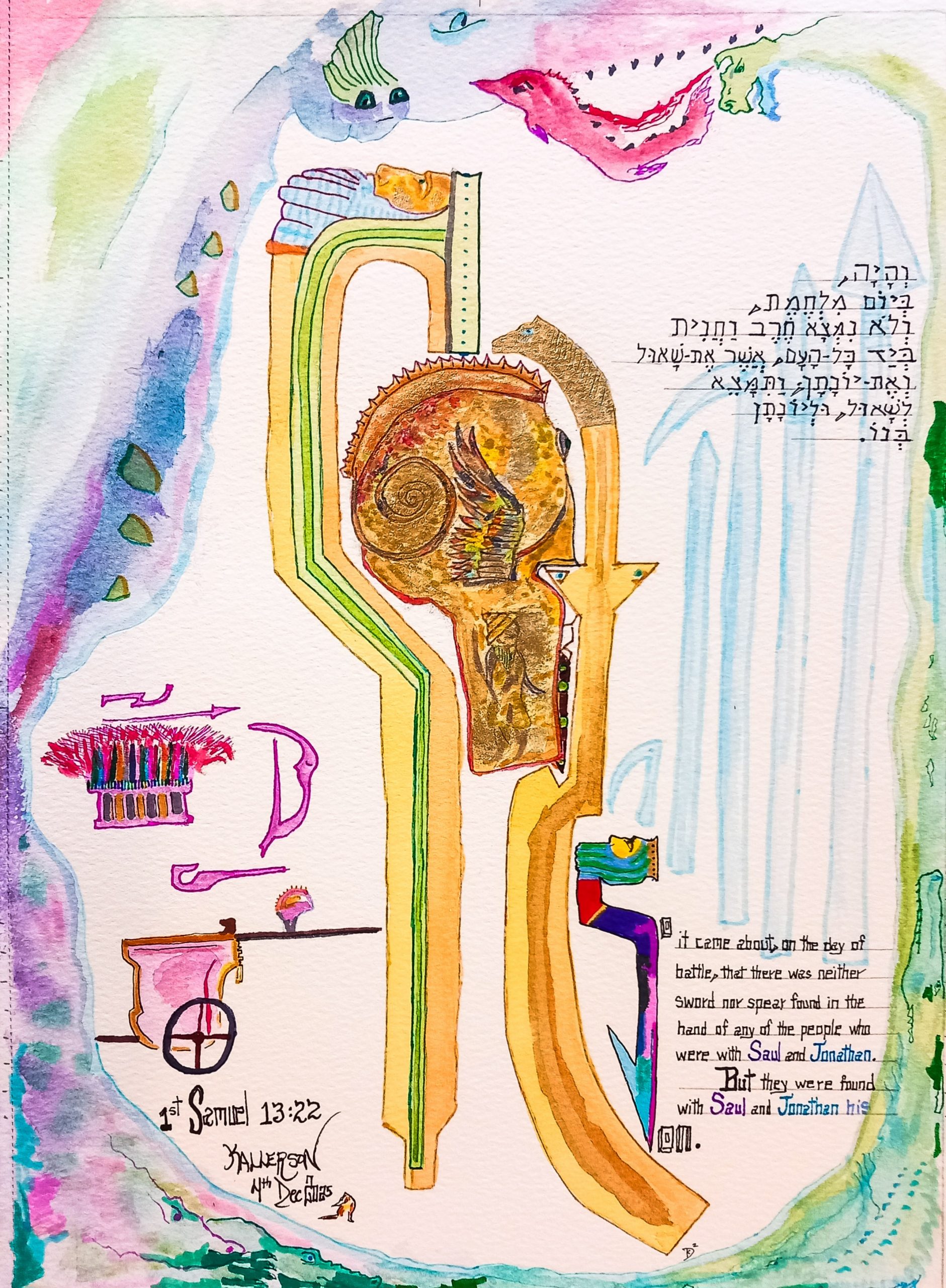
1 Samuel 6:13-21 (The Return of the Ark, Part II)

Artwork by Douglas Kallerson

1 Samuel 6:13-21
The Return of the Ark, Part II

(Typed 16 June 2025) There are not many verses to go over today, just eight. And yet, several of the verses are so odd in their terminology that even the best scholars say things like, “The Hebrew text here is hopelessly corrupt” (Ellicott).

You can expect this from the yahoos at Cambridge, but to find that most commentaries agree with the sentiment is a little disheartening.

But take heart! There is nothing wrong with them. Despite being complicated, in understanding why God says things a certain way, we will find that there is no corruption. The words flow smoothly, make very specific points, and beg us to consider why the wording is as it is.

Text Verse: “But we all, with unveiled face, beholding as in a mirror the glory of the Lord, are being transformed into the same image from glory to glory, just as by the Spirit of the Lord.” 2 Corinthians 3:18

When someone says that the words of a verse must be in error, that should make us slow down and ask why that would be the case. If something is so obscure that it doesn’t make sense, I figure it was supposed to be that way.

For example, from time to time, I will purposefully mispell words for effect. I will also intentionally misapplicate a term or a phrase to get you to stop and wonder why I said what I said.

Sometimes, I will go the whole ten yards in such a manner because I have something at the end of the comment to direct you to. If we look at obscurities in the Bible from this perspective, attempting to align them with something God is showing us from elsewhere in Scripture, we may find that He is working to peak our interest to figure out what He is pointing us to.

So, when God punts the ball to you in this way, have your glove ready and shoot for the basket! You might score a goal.

Really interesting stuff is to be found in His superior word. And so, let us turn to that precious word once again, and… May God speak to us through His word today, and may His glorious name ever be praised.

I. Mourning the Whopping (verses 13-18)

13 Now the people of Beth Shemesh were reaping their wheat harvest in the valley; and they lifted their eyes and saw the ark, and rejoiced to see it.

u-veith shemesh qotserim qetsir khitim ba’emeq vayisu eth enehem vayiru eth ha’aron vayishmekhu liroth – “And Beth Shemesh reaping harvest wheat in the valley. And they lifted their eyes, and they saw the ark. And they brightened up to see.” Beth Shemesh, House of the Sun, is located within the border of Judah. It was designated as a priestly city in Joshua 21:16.

The type of valley, the emeq, comes from amoq, depth. Figuratively, it means to be profound, such as in deep thoughts. It would be a long, broad, deep valley where grain fills the area.

The time of the wheat harvest in Israel is in late spring and early summer, around the time of Pentecost. Specifically, it is in May and June. Backdating this, it means that the battle in which the ark was taken would have been around October or November.

Wheat is considered the finest of the grains in the Bible. Jesus used wheat to represent Himself in John 12:24, where He metaphorically says, “unless a grain of wheat falls into the ground and dies, it remains alone; but if it dies, it produces much grain.”

While the people were in the fields reaping, they looked up and saw the cart with the cows pulling it and the ark on top of it.

It would have been an amazing sight. Because of it, the narrative notes that their eyes brightened. Today, we might say their eyes popped out in surprise. They watched the ark until…

14 Then the cart came into the field of Joshua of Beth Shemesh, and stood there;

veha’agalah baah el sedeh yehoshua beith hashimshi vataamod sham – “And the cart, it came unto field Joshua – Beith the Shemesh. And it stood there.” All the details about the ark’s return are purposeful. It came to Beth Shemesh and then to a particular field (sadeh), the field of Joshua, Yehovah is Salvation. Please note that in the Bible, only here and in verse 18, is the location called beith ha’shmimshi, House the Shemesh, or House the Sun. Both times, it is preceded by “field Joshua.” Upon arriving at this particular spot, it came to a halt and stood…

14 (con’t) a large stone was there.

vesham even gedolah – “And there stone, whopping.” The fact is stated for us to consider. The Lord is essentially instructing the people by directing the cows to stop right by this whopping stone. And they immediately understood what they were to do…

14 (con’t) So they split the wood of the cart and offered the cows as a burnt offering to the Lord.

vayvaqeu eth anshe ha’agalah veeth haparoth heelu olah leYehovah – “And they cleaved woods the cart. And the cows, they caused to ascend burnt offering to Yehovah.” The Lord purposefully stopped the ark at this stone. The people of Beth Shemesh, therefore, deduced that He intended for them to offer the cows on it in gratitude for the ark’s return. Therefore, this is what they did.

The cart (agalah) and the cows (parah) were used for the burnt offering at the stone (even) of Joshua (Yehovah is Salvation). Each thing is part of a story being conveyed.

15 The Levites took down the ark of the Lord and the chest that was with it,

vehalviyim horidu eth aron Yehovah veeth ha’argaz asher ito – “And the Levites caused to descend Ark Yehovah and the pannier which with it.” The people understood that the care of the ark was the responsibility of the Levites. As Beth Shemesh was designated as a priestly city, these would have been priests. Despite that, they are given the broader term Levites because of their tribal affiliation.

This task was given to them, and so it was they who took the ark and the pannier off the cart. Levi means Attached. It was the pannier…

15 (con’t) in which were the articles of gold, and put them on the large stone.

asher bo khele zahav vayasimu el ha’even ha’gedolah – “which in it articles gold, and they put unto the stone, the whopping.” The articles were placed on the stone. They were the acknowledgment from the Philistines of their guilt before the Lord. Once the site was prepared…

15 (con’t) Then the men of Beth Shemesh offered burnt offerings and made sacrifices the same day to the Lord.

veanshe beith shemesh heelu oloth vayizbekhu zevakhim bayom ha’hu leYehovah – “And men Beth Shemesh caused to ascend burnt offerings, and they sacrificed sacrifices in the day, the that, to Yehovah.” These offerings would be separate from the cows that were burnt for the guilt of the Philistines. The people would have brought their own animals to sacrifice and burn before the Lord.

16 So when the five lords of the Philistines had seen it, they returned to Ekron the same day.

I put an opening parenthesis here which will be explained later: vakhamishah sarne phelishtim rau vayashuvu eqron bayom ha’hu – “(And five axles Philistines, they saw, and they returned – Ekron, in the day, the it.” These five leaders took the time to watch the events unfold. This allowed them to give a full report to their people, assuring them that the offering had been accepted by Israel and then offered to the Lord through the burnt offering.

This assured them that what had come upon them was a result of Israel’s unfaithfulness, that they had no right to it, and that giving it back to Israel was the proper course of action.

Ekron comes from aqar, to pluck up or uproot. But that is from the same as eqer, an offshoot or descendant. Hence, the name could mean either Offshoot or Uprooted.

17 These are the golden tumors which the Philistines returned as a trespass offering to the Lord: one for Ashdod, one for Gaza, one for Ashkelon, one for Gath, one for Ekron;

veeleh tekhore ha’zahav asher heshivu phelishtim asham leYehovah leashdod ekhad leazah ekhad leashqelon ekhad legath ekhad leeqron ekhad – “And these, boils the gold, which they caused to return, the Philistines – guilt – to Yehovah. To Ashdod, one. To Gaza, one. To Ashkelon, one. To Gath, one. To Ekron, one.” The listing is provided to show that all five major cities acknowledged their guilt before the Lord. They are returning their guilt in the form of images of their boils.

This is the second and last use of the word tekhor, boil. It was used in verse 11 and now here.

Ashdod means Fire of Beloved. Gaza (Azah) is a feminine form coming from az, strong. It signifies Strong or Strong Place. The change from Azah to Gaza is because of the pronunciation of the letter ayin at the beginning of the name. It has a strong sound towards the back of the throat.

From there, the Greek translates this hard ayin with the letter gamma in an attempt to closely reproduce the sound. With the g sound introduced, it has carried forward into our modern English name, Gaza.

Ashkelon comes from shaqal, to weigh, as in weighing money. The -on (vav-nun) at the end localizes it. Hence, it is Weighing Place or Market. Gath means Winepress.

18 and the golden rats, according to the number of all the cities of the Philistines

veakhbere ha’zahav mispar kal are phelishtim – “And mice, the golden, number all cities Philistines.” These were the five golden mice suggested by the diviners in verse 6:4. They, along with the five golden buboes, which are images of the boils, were placed in the pannier when the cart was readied to be returned. These five rats were…

18 (con’t) belonging to the five lords, both fortified cities and country villages,

The NKJV jumbles the clauses a bit: lakhameshet ha’seranim meir mivtsar vead kopher haperazi – “To the five, the axles, from city fortification, and until village, the rustic.” The listing of types of cities and the word “all” in the previous clause causes confusion. Keil, in an attempt to eliminate this, says –

“The priests had only proposed that five golden mice should be sent as compensation, as well as five boils (1 Samuel 6:4). But the Philistines offered as many images of mice as there were towns and villages in their five states, no doubt because the plague of mice had spread over the whole land, whereas the plague of boils had only fallen upon the inhabitants of those towns to which the ark of the covenant had come. In this way the apparent discrepancy between 1 Samuel 6:4 and 1 Samuel 6:18 is very simply removed.” Keil

There is no reason to assume this. The five mice represent the entire Philistine enclave. The reason for the additional words is to signify exactly that. It is saying that the offering was to cover everything within their borders, from large city to unwalled village. From there…

18 (con’t) even as far as the large stone of Abel

vead avel ha’gedolah – “and until Mourning the Whopping.” The words “and until” signify the scope of the atonement. All of the cities were listed, but there is a time reference conjoined to the locational reference. Both are included in the words “and until.” Keil, however, says –

“But ועד (even unto) is quite unsuitable here, as no further local definition is required after the foregoing הפּרי כּפר ועד [vead kopher ha’perazi], and it is impossible to suppose that the Philistines offered a golden mouse as a trespass-offering for the great stone upon which the ark was placed. We must therefore alter ועד [vead: and until] into ועד [veed: and witness]: ‘And the great stone is witness (for ועד in this sense, see Genesis 31:52) to this day in the field of Joshua the Bethshemeshite,’ sc., of the fact just described.”

He is saying that it should read that the stone is a witness rather than a location. It is true that this is a possible translation, making it an explanation. Here is the difference:

To the five, the axles, from city fortification, and until village, the rustic, and until Mourning the Whopping, which they caused to deposit upon her Ark Yehovah until the day, the this, in field Joshua – Beth Shemesh (as a location).

To the five, the axles, from city fortification, and until village, the rustic. And witness: Mourning, the whopping, which they caused to deposit upon her Ark Yehovah until the day, the this, in field Joshua – Beth Shemesh (As a witness).

Keil’s explanation would be ingenious if it referred to a witness for the return of the ark from the Philistines rather than the extent of the atonement for the land of the Philistines. However, the boundary was already defined by the Philistines in verse 9 –

“And you will see: If road its boundary will ascend – Beit Shemesh – He! He did to us the evil, the whopping, the this. And if not, and we will know, for not His hand it touched in us. Mishap, it, it became to us.” V. 6:9

Therefore, it is certainly referring to both the location and the timing of the event. The cows with the ark stopped at the whopping stone in the field of Joshua, thus ending the control of the ark by the Philistines both locationally and in time.

As for the final designation, “Mourning, the Whopping,” that is my translation and is at odds with all other translations, but it is correct. To understand the various translational differences, an explanation is needed.

The word is avel. It can mean one of several things due to the plastic nature of the word, as you will see below. First, however, some think it is a misspelling of even, the stone where the cows stopped, as some translations make it. That is always a convenient explanation –

אבן – even
אבל – avel

The NKJV leaves the idea of the stone alone but calls the stone Abel, making it a name. The reason for this is in the next clause, where it says it is the stone where the ark was placed. They are actually correct, but the translation doesn’t resolve anything for the reader because they punted and transliterated the word from avel to Abel.

The word avel may signify a meadow. Such a root signifies to be grassy, and thus a meadow as in Judges 11:33. It also may be the same as avel, seen in Genesis 50:11. If so, it means mourning. The HAW Theological Wordbook identifies it from another root as meaning Stream or Brook.

The answer to why this is Mourning the Whopping is so simple it’s hard to figure why translations don’t identify it as such. The next verse will provide the resolution. For now…

18 (con’t) on which they set the ark of the Lord, which stone remains to this day in the field of Joshua of Beth Shemesh.

A closing parenthesis goes here. Also, the NKJV inserts a great deal not in the text, but it does help clarify what is going on: asher hinikhu aleha eth aron Yehovah ad hayom hazeh bisdeh yehoshua beith ha’shimshi – “which they caused to deposit upon her Ark Yehovah until the day, the this, in field Joshua – Beth the Shemesh.)”

This means the stone is called avel (Mourning). It is at the border of the land of the Philistines. Thus, the guilt offering covers the entire Philistine enclave, even to the point where the ark was returned to Israel at this location. But why is the stone called mourning? That is seen in the next verse…

Serving the law is a trap that leads to death
As surely as addiction will kill you
It is like being stuck on crystal meth
In the end comes your just due

God has done it all through Jesus Christ0
Observing the law will only offend
Through His shed blood alone, has sin been priced
Anything else will lead to a bad end

“The gospel is too simple, too easy,” you say
“I have to earn my way apart from Christ!”
It won’t happen, friend, no how, no way
Through Jesus alone is your soul to be priced

I. Wound Whopping (verses 19-21)

19 Then He struck the men of Beth Shemesh, because they had looked into the ark of the Lord.

vayakh beanshe beith shemesh ki rau baaron Yehovah – “And He caused to strike in men Beth Shemesh, for they looked in Ark Yehovah.” The context tells us the words are referring to the Lord, but the last direct reference to Him (not the ark) was in verse 15, where the men of Beth Shemesh made sacrifices to Him.

This then shows that Keil’s change of “and until” to “and witness” is not correct. The reference was to both the “territory of” as well as “the time with” the ark in relation to the Philistines. The narrative continues with what occurred after the sacrifice to Him.

Of the reason why the people died, Keil says that combining the word “look” with “in” “means to look upon or at a thing with lust or malicious pleasure; and here it no doubt signifies a foolish staring.”

Cambridge says, “The priests of Beth-shemesh must have known that even the Levites were forbidden to look upon the furniture of the Holy of Holies upon pain of death (Numbers 4:19-20), but instead of hastening to cover it with befitting reverence, they left it exposed to the public gaze.”

These and other such references are incorrect. The text says they looked “in” the ark, not “at” the ark. And the word “look” with “in” does not mean “with lust or malicious pleasure.” It means to look in. Nothing else.

What they did comprised the greatest offense that the people could commit and justifies the calamity they brought upon themselves. The tablets of the law were inside the ark. They were written by the finger of God as a summary of the Law of Moses.

These were placed inside the ark, secreted away. It reveals the absolute holiness of the law before God. In essence, “This is My standard. It is what is expected at all times. But I know that you cannot meet it. Therefore, I am placing these in My ark. Each year, atonement will be made for the infractions you commit. The blood of the atonement, which is sprinkled on the mercy seat, will be the covering for your sins in My eyes.”

The meaning is that if the blood of atonement (the covering) is not seen by the Lord, there is no atonement, no covering for their imperfection in relation to the perfection expected in the presence of God. By lifting the mercy seat, they had symbolically removed God’s mercy from that which witnesses to their failings. There could be only one penalty for such blasphemy. The thought is exactingly expressed in the words of the first Passover –

“Now the blood shall be a sign for you on the houses where you are. And when I see the blood, I will pass over you; and the plague shall not be on you to destroy you when I strike the land of Egypt.” Exodus 12:13

With no covering of blood, death is to be expected, therefore…

19 (con’t) He struck fifty thousand and seventy men of the people,

vayakh baam shivim ish khamishim eleph ish – “And He caused to strike in the people seventy man fifty thousand man.” There is a wide variety of change in these numbers depending on the source text. There are also innumerable explanations as to what the meaning is.

One possibility says that seventy men died and fifty cattle died. The reason is that the word eleph, thousand, is the same as the word for herd or oxen. This is suggested because it is thought impossible that fifty thousand in one city could be struck.

However, it doesn’t say that. It says first that He caused to strike in men Beth Shemesh. It next says He caused to strike in the people, which is then stated as seventy man fifty thousand man. That could mean seventy people who looked in the ark and fifty thousand of Israel in general, regardless of location.

The point is that two sets of numbers, regardless of the details, have been provided. It is these numbers, seventy and fifty thousand, that are the focus of the narrative.

Seventy or “…7 x 10 signifies perfect spiritual order carried out with all spiritual power and significance. Both spirit and order are greatly emphasized” (Bullinger).

Fifty thousand is the product of fifty and tens. Fifty “is the number of jubilee or deliverance. It is the issue of 7 x 7 (72), and points to deliverance and rest following on as the result of the perfect consummation of time” (Bullinger).

Of the number ten, Bullinger says, “Completeness of order, marking the entire round of anything, is, therefore, the ever-present signification of the number ten. It implies that nothing is wanting; that the number and order are perfect; that the whole cycle is complete.”

Of this terrible but self-inflicted disaster…

19 (con’t) and the people lamented because the Lord had struck the people with a great slaughter.

The words explain the meaning of the name of the stone: vayitavelu ha’am ki hikah Yehovah baam makah gedolah – “And they mourned themselves, the people, for He caused to strike, Yehovah, in the people – wound whopping.” The word aval, to mourn, is used. One can see the connection to the word used in verse 18 –

אבל – evel/avel: Mourning
אבל – aval: to mourn

The event is what gave the name. The naming of the stone preceded the reason for its naming. This has already been seen in 1 Samuel with the stone Eben the Ezer. It is a common occurrence in Scripture. The parentheses, when rightly placed, explain the matter. Despite this, Lange and Keil object –

“Kimchi’s explanation of אָבֵל as the name [the Heb. word means “mourning”] given to the stone on account of the mourning made there (1 Samuel 6:19) is a fanciful expedient, which has also no support in the context, since nothing is afterwards said of a mourning at this stone.” Lange

“The conjecture of Kimchi, that this stone was called Abel (luctus), on account of the mourning which took place there (see 1 Samuel 6:19), is extremely unnatural. Consequently there is no other course left than to regard אבל as an error in writing for אבן, according to the reading, or at all events the rendering, adopted by the lxx and Targum.” Keil

Keil decides to change the word of God to suit his analysis. Lange’s note that “nothing is afterwards said of a mourning at this stone” disregards the entire premise for the naming of the stone, something that occurs hundreds of times in Scripture.

An event takes place, and from it, a person or place is given a name. This is at least the fourth time we have seen this occur so far in 1 Samuel: Samuel, Ebenezer, Ichabod, and now Mourning. Several other likely instances have also been explained.

The people realized that what they did caused the Lord to strike them. The place was named based on the event, but the lesson they learned brought them to understand the nature of Yehovah…

20 And the men of Beth Shemesh said, “Who is able to stand before this holy Lord God?

vayomeru anshe veith shemesh mi yukhal laamod liphne Yehovah ha’elohim ha’qadosh hazeh – “And they said, men Beth Shemesh, ‘Who he will to stand to faces Yehovah, the God, the holy, the this?’” The people thought they would look into the ark and see the tablets placed there so long before by Moses. It would be a great story to tell the grandkids someday.

However, by uncovering them, they removed the only barrier between them and the absolute holiness of God as revealed in those two tablets. What He had done in writing them was an extension of His very being –

“Now it was so, when Moses came down from Mount Sinai (and the two tablets of the Testimony were in Moses’ hand when he came down from the mountain), that Moses did not know that the skin of his face shone while he talked with Him. 30 So when Aaron and all the children of Israel saw Moses, behold, the skin of his face shone, and they were afraid to come near him. 31 Then Moses called to them, and Aaron and all the rulers of the congregation returned to him; and Moses talked with them. 32 Afterward all the children of Israel came near, and he gave them as commandments all that the Lord had spoken with him on Mount Sinai. 33 And when Moses had finished speaking with them, he put a veil on his face. 34 But whenever Moses went in before the Lord to speak with Him, he would take the veil off until he came out; and he would come out and speak to the children of Israel whatever he had been commanded. 35 And whenever the children of Israel saw the face of Moses, that the skin of Moses’ face shone, then Moses would put the veil on his face again, until he went in to speak with Him.” Exodus 34:29-35

Israel is being schooled through their interactions with the Lord in relation to the Law of Moses. Each thing recorded in the Bible from their history was intended to teach them about who He is, their nature in relation to Him, and to point them to their need for Christ.

Instead, rabbinic commentaries obscure the intent, hide the truth of what is happening, exalt the people as if they are special and have acceptable access to God, and they diminish His glory in the process. The word, however, is telling them otherwise…

20 (con’t) And to whom shall it go up from us?”

veel mi yaaleh mealenu – “And unto who it will ascend from upon us?” Like the Philistines, the people of Beth Shemesh know that they cannot stand before God and His holiness, and so they ask where the ark can be taken so that it is no longer among them…

21 So they sent messengers to the inhabitants of Kirjath Jearim,

vayishlekhu malakhim el yosheve qiryath yearim – “And they sent messengers unto ‘inhabiting Kiriath Jearim.’” It doesn’t say why they chose Kiriath Jearim instead of sending it back to Shiloh, but what matters is what the text says. Kirjath Jearim means City of Forests or City of Honeycombs.

*21 (fin) saying, “The Philistines have brought back the ark of the Lord; come down and take it up with you.”

lemor heshivu phelishtim eth aron Yehovah redu haalu otho alekhem – “to say, ‘They caused to return, Philistines, Ark Yehovah. You must descend, and you must cause to ascend it unto you.’” Without any further explanation, the chapter ends with these words.

The ark is at Beth Shemesh. They have had calamity heaped upon them because of what they did, and they want the ark moved. Therefore, the appeal is made that it be taken from them in the lowland to a place of higher elevation.

The number is set at two
They form a whole. My word, it contains
No other number will do
But in these two, is the severing of your chains

They provide what you need
To find and be granted eternal life
So study up, and do it with speed
In them is found the ending of strife

It is not one, five, seven, or three
No, the testaments are numbered at just two
In them are words to make you free
Just these two suffice. Nothing else will do

III. Christ in the Contents

The account is a logical step that follows the previous passages. Chapter 4 referred to the time when Christ came, fulfilled the law, and ended the Aaronic priesthood, symbolized by the death of Eli, Hophni, and Phinehas.

The state of Israel at that time was declared to be Inglorious. The land was denuded of its glory when the ark was taken by the Philistines. It appeared that the Weakeners had prevailed. However, Chapter 5 showed that they were plagued because they possessed the Ark.

That chapter was set forth as a proposition. In essence, “What would be the case if the Weakeners possessed Jesus?” It shows that it could not be. Thus, a plan was devised to return the ark to Israel. The period of time it was with them was seven months.

Seven is the number of spiritual perfection, completeness, and divine completion. It represents the Holy Spirit’s work, the culmination of God’s plans. It is a sign of divine worship and obedience.

Typologically, this is the time between Christ’s death and resurrection. With the proposition of what it would be like if the Weakeners retained the ark, the account brings the ark back to Israel with the acknowledgment of what occurred to them.

They were instructed to not return it emptily, meaning without acknowledging they had no right to it and that it was the Lord who caused their woes. Thus, they were to return their guilt to the Lord. Only in doing this would they be healed. As such, they were told to send back images of their buboes and of the rats from each of the axles, meaning leaders.

The buboes and rats signify uncleanness under the law. The same word concerning the buboes, ophalim, was used in the written Hebrew of Deuteronomy as designated by Moses –

“The Lord will strike you with the boils of Egypt, with tumors, with the scab, and with the itch, from which you cannot be healed.” Deuteronomy 28:27

The mice are noted in Leviticus –

“These also shall be unclean to you among the creeping things that creep on the earth: the mole, the mouse, and the large lizard after its kind.” Leviticus 11:29

The akbar, mouse, is derived from the same word as spider, akkavish. The word gives the sense of entangling, just as a mouse weaves together its nest. This is the type of person who is spoken of by both Paul in Galatians 5:1, 2–

“Stand fast therefore in the liberty by which Christ has made us free, and do not be entangled again with a yoke of bondage. Indeed I, Paul, say to you that if you become circumcised, Christ will profit you nothing.”

The mouse is the person who weaves the law into the grace of Christ, and thus rejects Him. This is exactly what the Weakeners would do. They are acknowledging this by returning the ark along with the images of their guilt. In admitting such fault, it said in verse 5, “And you will give to God Israel glory.”

This means that they are taking the weight of their supposed deeds and giving God the weight (glory) He is due, something exactingly described in verse 6, “And why you will enweigh your heart according to which they enweighed, Egypt and Pharaoh, their heart?”

Next, verse 7, says “you must take and you must make cart new, one.” The peculiar and specific wording points to the Bible. The cart, agalah, comes from agol, circle or round. Thus, it is a turning. This is something seen in a previous Genesis sermon. The Bible is like a wheel. It is that which revolves from the beginning to the end, bringing about that which has been.

The thought of “From paradise to paradise” gets the point across. It starts there, and it ends there. The revolution is what gets one back to where things began. There is one cart, the number of unity and primacy. It means there is no second.

And yet, it is then given two milking cows. Two is the number of division. There is a contrast and yet a confirmation of a whole. The cow, parah, is derived from parar. The root signifies to break, annul, etc. In this case, the two cows signify the two testaments as evidenced by the term milking. The two testaments are what provide the milk of the word (1 Peter 2:2) to God’s people.

The Bible (the cart) is hitched to the milking cows. Thus, it is a single unit. The purpose of the Bible with two testaments is to break man’s fallen state under the authority of the devil.

However! There were those gender discords concerning the cows, where they were spoken of in the masculine. There is one word of God, a masculine noun in both Hebrew and Greek, even if there are two testaments. The female testaments comprise a single masculine unit that has never been yoked.

With the inclusion of the New Testament, there is a new, single cart. The word was incomplete without it. The idea of something new being offered to God is repeatedly seen. An animal that was worked was not suitable to offer to God. Jesus sat on a donkey that had never been ridden, He was laid in a tomb that had never been used, etc.

An unyoked cow is an animal that has never been worked. The symbolism of this was exactingly described in the passage concerning the Red Heifer. The idea of a yoke on an animal is subjection. On a person, it conveys the idea of degradation.

The thought looks to Christ, who, though born under the yoke of the law, was born sinless under it. In other words, the law is a yoke because of sin. For one who is sinless and who remains sinless, there is no yoke of bondage; there is no subjugation to sin. This is why Jesus said to the people –

“Come to Me, all you who labor and are heavy laden, and I will give you rest. 29 Take My yoke upon you and learn from Me, for I am gentle and lowly in heart, and you will find rest for your souls. 30 For My yoke is easy and My burden is light.” Matthew 11:28-30

In addition to His state under the law, not being yoked is also explained in Christ’s voluntary service before the Lord. As a yoke implies bondage and forced labor, an animal that has never been yoked has lived free from such constraints. Such was true with Christ, as the author of Hebrews explains –

Previously saying, “Sacrifice and offering, burnt offerings, and offerings for sin You did not desire, nor had pleasure in them” (which are offered according to the law), then He said, “Behold, I have come to do Your will, O God.” He takes away the first that He may establish the second. 10 By that will we have been sanctified through the offering of the body of Jesus Christ once for all. Hebrews 10:8-10

Christ voluntarily came to do God’s will, and He voluntarily placed Himself under the law. His sacrifice replaced these very sacrifices which are mentioned under the law, because His covenant replaced the covenant through which they came. What could never actually bring God pleasure is replaced by that which pleased God the most.

Verse 8 had the interesting expression, “And you will take Ark Yehovah and you will give it unto the cart.” It perfectly described Jesus, the fulfillment of the ark typology. He is placed in the Word of God because He is the Word of God.

Understanding this, the test was to separate the cows’ sons from them, put the guilt (the images) in the pannier, and see if it would ascend its boundary to Beth Shemesh, House of the Sun. It is a reference to the work of Jesus, as described in Malachi 4.

In that sermon, it said, “Christ’s coming is equated to a Righteousness Sun that shone over Israel. The people could not meet the demands of the law, but He could and did. His work fulfilled all righteousness (the extremities of the Righteousness Sun) for the people, thus healing them from the infection of sin that separated them from God.”

That is just what is asked for by the Philistines when they returned the ark. When the cows were let go, they ignored their primal instincts and headed straight for Beth Shemesh. It is precisely what the Bible asks us to do. We are to go to what Christ did, not what we might do, as the cure for our sin.

Verse 13 referred to the time of year, the wheat harvest. Pentecost occurs at the time of the wheat harvest, but this does not specifically refer to that. Rather, the wheat harvest follows the barley.

Barley (seorah), for reference, comes from sear, hair. It is the crop of hairy ears. Hair signifies awareness, particularly an awareness of sin. It is the time of the law. The wheat harvest follows that, and thus represents the time of grace. First, Christ fulfills the law, and then comes grace. Jesus metaphorically used wheat to refer to Himself in John 12 –

“Most assuredly, I say to you, unless a grain of wheat falls into the ground and dies, it remains alone; but if it dies, it produces much grain.” John 12:24

Beth Shemesh is provided here as evidence of the completed work of Christ. In Malachi, it focused on the righteousness aspect of the sun, not the sun itself. The righteousness defines the sun. More exactly, righteousness itself is equated to a sun.

To understand this, think of the song “Peace Train” by Cat Stevens. He equates peace to a train that ran throughout the land. The completion of Christ’s work is a Righteousness Sun rising over the people who fear the name of the Lord.

The symbolism is not only the acknowledgment of Christ’s death, which any Judaizer will avow, but of His resurrection. It proves He is God and that He has fulfilled and annulled the law. That is why the cows came unto “field Joshua – House THE Sun.” 

As seen elsewhere, the field is typologically given as a reference to the world. Joshua, the Lord is Salvation, anticipates Jesus, the Lord (Yehovah) who is Salvation (Yeshua). Remembering that the term, House the Sun is seen only these two times in the Bible, and that it is only stated after the name of Joshua, it is telling us that only through Jesus (Yehovah incarnate) is salvation to be found. 

Everything in the thought pictures Jesus, what He has done, or how it applies to His people: the field of Joshua, the whopping stone, the ark, the cart, the cows, the atonement, all of it.

The offering to the Lord is a way of saying, “Everything is complete in Christ. It is all offered to You.” Specifically noting that the articles of gold were placed on the stone and that the things sent from the Philistines were made into this offering is saying that if they give up their law observance, the plague (the guilt) would be removed from them. Their atonement cannot come from themselves, but only from Christ.

Seeing this, it says the Philistine leaders returned to Ekron that same day. The meaning is Uprooted (aqar). It is a double entendre. Those who remain under law observance will be uprooted, but those who acknowledge Christ alone for salvation will have their sins uprooted. They will be the offshoot (eqer) of their response to the law or the Lord.

The listing of the five cities is a typological hint that there is grace upon any and all of the Philistines if they come to Christ and give up on law observance. We are being provided an object lesson in what is on God’s mind concerning this most important subject

Verse 18 introduced the stone Mourning the Whopping. It was given in anticipation of what would occur. What is being conveyed is that the ark, Jesus, was resurrected and presented to Israel. The Weakeners, meaning those who try to weaken the faith of others by mandating law observance and telling them what they need to do to be right with God, have been dealt with. Thus, the closing of the parenthesis.

However, the people of Israel, symbolized by the people of Beth Shemesh who had been presented the Ark (Christ), ignored His work on their behalf. It is reflected in the two sets of numbers which describe the people being struck, seventy and fifty. The numbers were previously explained.

They point to the period of time when Israel would suffer the punishment of “looking at the law” without the atoning blood of Christ.

In other words, Israel rejected the lesson of the Weakeners just provided, assumed that they were acceptable to God through the Law of Moses, and rejected the atonement that only Jesus could provide. This is typologically represented in the ark and its Leviticus 16 Day of Atonement rites.

If His atonement is removed from the Law, only death will result. This will continue until Israel comes to God through Him. That is seen in the messengers being sent to the inhabitants of Kirjath Jearim, City of Forests or City of Honeycombs. As seen in previous sermons, Abarim says –

“The verb יער (ya’ar) isn’t used in the Bible and it’s a complete mystery what it might have meant. Noun יער (ya’ar) is the common word for forest or thicket, and the identical noun יער (ya’ar) means honeycomb. It is, of course, perfectly possible that these two nouns are not two but one, describing something general like a thing that consists of many elements, which contain energetic nutrients (either fruits or honey) …” Abarim

Therefore, this is an explanation of the church, a group derived from many people, each filled with individual fruit of the Spirit. This is supportable by the comparison of Israel to a forest in Micah 7:14 –

“Tend Thy people with Thy staff, the flock of Thy heritage, That dwell solitarily, as a forest [ya’ar] in the midst of the fruitful field; Let them feed in Bashan and Gilead, as in the days of old” (JPS Tanakh).

In other words, the Ark, Jesus, is being offered to the church during this dispensation. The account of the Philistines having the ark and returning it to Israel has been provided to show the choices that people might make in regard to Jesus, law observance, and cleansing from sin because of the latter.

It has also been given to show the effects of the work of Christ in relation to Israel at this time. Along with that, other lessons have been carefully highlighted. The truth that there is one source from God concerning His word (cart new, one) is seen. It is the number of unity and primacy. The number excludes all difference.

Thus, the Koran is proven false. The Bhagavad Gita is proven false. And so forth. But the fact that there are two, and only two, testaments (the cows hitched to the cart) within the Bible is also seen. The apocrypha is excluded. The Book of Mormon is to be rejected. The Talmud is also heresy. None of these are sanctioned by God as His word.

In this account, the Philistines (Judaizers, Hebrew Roots, Sabbatarians, etc.) are proven wrong, but they can be forgiven if they give up on a claim to Christ’s work. Israel is seen to be in a bad spot without the atonement of Christ.

But the church is clearly set forth in the presentation. The ark (Jesus) has been offered to them. The opening verses of Chapter 7 will show that the offer is accepted.

We are being shown what is on God’s mind. And that what, above all, is a Who. We are being shown how to be right once again with Him through what He has personally done in uniting with humanity in the body of Christ.

Nothing else can restore us to Him because Christ is One and God is One. Christ is God incarnate. He is the only One who can cover our sins so that God can find us acceptable. Without Jesus, our sin covering is removed, and our sin before God is exposed.

Let us learn the lesson provided in this marvelous portion of God’s word. Look to Jesus, trust in Jesus, and hold fast to Jesus alone. Don’t insert yourself or your futile attempt to impress God through law observance. Christ already did that for you. Amen.

Closing Verse: “Therefore, my brethren, you also have become dead to the law through the body of Christ, that you may be married to another—to Him who was raised from the dead, that we should bear fruit to God.” Romans 7:4

Next Week: 1 Samuel 7:1-9 It’s a great story to tell, and we will tell it till its done… (And He Judged, Samuel, Part I) (13th 1 Samuel Sermon)

The Lord has you exactly where He wants you. He has a good plan and purpose for you. He is the One who abases the haughty and exalts the humble. He regards the lowly, and the proud He knows from afar. So yield yourself to Him, trust Him, and believe His word. In this, He will do great things for you and through you.

1 Samuel 6:13-21 (CG)

13 And Beth Shemesh reaping harvest wheat in the valley. And they lifted their eyes, and they saw the ark. And they brightened up to see. 14 And the cart, it came unto field Joshua – Beith the Shemesh. And it stood there. And there stone, whopping. And they cleaved woods the cart. And the cows, they caused to ascend burnt offering to Yehovah. 15 And the Levites caused to descend Ark Yehovah and the pannier which with it, which in it articles gold, and they put unto the stone, the whopping. And men Beth Shemesh caused to ascend burnt offerings, and they sacrificed sacrifices in the day, the that, to Yehovah. 16 (And five axles Philistines, they saw, and they returned – Ekron, in the day, the it.

17 And these, boils the gold, which they caused to return, the Philistines – guilt – to Yehovah. To Ashdod, one. To Gaza, one. To Ashkelon, one. To Gath, one. To Ekron, one. 18 And mice, the golden, number all cities Philistines. To the five, the axles, from city fortification, and until village, the rustic, and until Mourning the Whopping, which they caused to deposit upon her Ark Yehovah until the day, the this, in field Joshua – Beth the Shemesh.)

19 And He caused to strike in men Beth Shemesh, for they looked in Ark Yehovah. And He caused to strike in the people seventy man fifty thousand man. And they mourned themselves, the people, for He caused to strike, Yehovah, in the people – wound whopping.

20 And they said, men Beth Shemesh, “Who he will to stand to faces Yehovah, the God, the holy, the this? And unto who it will ascend from upon us?” 21 And they sent messengers unto ‘inhabiting Kiriath Jearim,’ to say, “They caused to return, Philistines, Ark Yehovah. You must descend, and you must cause to ascend it unto you.”


1 Samuel 6:13-21 (NKJV)

13 Now the people of Beth Shemesh were reaping their wheat harvest in the valley; and they lifted their eyes and saw the ark, and rejoiced to see it. 14 Then the cart came into the field of Joshua of Beth Shemesh, and stood there; a large stone was there. So they split the wood of the cart and offered the cows as a burnt offering to the Lord. 15 The Levites took down the ark of the Lord and the chest that was with it, in which were the articles of gold, and put them on the large stone. Then the men of Beth Shemesh offered burnt offerings and made sacrifices the same day to the Lord. 16 So when the five lords of the Philistines had seen it, they returned to Ekron the same day.

17 These are the golden tumors which the Philistines returned as a trespass offering to the Lord: one for Ashdod, one for Gaza, one for Ashkelon, one for Gath, one for Ekron; 18 and the golden rats, according to the number of all the cities of the Philistines belonging to the five lords, both fortified cities and country villages, even as far as the large stone of Abel on which they set the ark of the Lord, which stone remains to this day in the field of Joshua of Beth Shemesh.

19 Then He struck the men of Beth Shemesh, because they had looked into the ark of the Lord. He struck fifty thousand and seventy men of the people, and the people mourned because the Lord had struck the people with a great slaughter.

20 And the men of Beth Shemesh said, “Who is able to stand before this holy Lord God? And to whom shall it go up from us?” 21 So they sent messengers to the inhabitants of Kirjath Jearim, saying, “The Philistines have brought back the ark of the Lord; come down and take it up with you.”


1 Samuel 6:1-12 (The Return of the Ark, Part I)

Artwork by Douglas Kallerson

1 Samuel 6:1-12
The Return of the Ark, Part I

(Typed 9 June 2025) What is the most important part of your life? What is it that captivates your thoughts and your motivations more than anything else? For some people, it is baseball or other sports. Others may have an addiction that consumes them. Some find their greatest joy to be the Lord.

I hope the latter is the case for each of you, but only you can set the Lord as your chief joy. And even if He is, how easy it is for us to get distracted from Him!

Other things constantly pull at us, which then divert our attention from Him. Among those diversions, problems at work, financial struggles, difficulties with friends or family, and so forth can steal our joy and deprive us of motivation, interfering with our relationship with Him.

There is also something else that can hinder our walk with Him, even if our hearts are totally set on Him…

Text Verse: “Unto You I lift up my eyes,
O You who dwell in the heavens.” Psalm 123:1

Walking with the Lord means that our life is in tune with Him. I have met many people who are head-over-heels in love with Jesus. They cannot get enough of Him, and they direct their lives and energy toward Him.

Most of us have probably seen or met people like that. But what happens if our lives and the energy that we direct towards Him are inappropriately aligned with what He expects of us?

The only way to avoid that is to know what His word says. Anyone who really wants to exert himself to please the Lord should know what is pleasing to Him.

In the sermon today, the Philistines have a problem. A recommendation is made to solve it, and a plan is enacted. But there is a lingering question as to whether it will work out and resolve their situation.

By observing a couple of milk cows, they will get their answer. But it is the cows that are really the highlight of what is being said. They have inner impulses working to redirect them, urging them to veer from the path, turn around, and so forth.

And yet, they keep pressing forward because the call upon them is stronger than anything else. Despite being cows, we can learn from them. Let us do so.

It’s all to be found in His superior word. And so, let us turn to that precious word once again, and… May God speak to us through His word today, and may His glorious name ever be praised.

I. He Gleaned Himself in Them (verses 1-6)

Now the ark of the Lord was in the country of the Philistines seven months.

vayehi aron Yehovah bisedeh phelishtim shivah khodashim – “And it was, Ark Yehovah, in field Philistines seven months.” The term “field” was used in Ruth 1:2 when referring to Moab. It is a term often used with reference to a foreign country, not where the narrator is. This shows that Canaan is the place from which the author is writing. He is including us in the narrative as he writes. In typology, the field represents the world in general.

The timeframe reveals that the plagues didn’t just occur overnight. Rather, they came into effect and increased when the ark came to a particular location. It took a full seven months to confirm that the presence of the ark, based upon its movements to the various cities, caused the plagues.

Seven is the number of spiritual perfection, completeness, and divine completion. It represents the Holy Spirit’s work, the culmination of God’s plans, and it is a sign of divine worship and obedience.

And the Philistines called for the priests and the diviners,

vayiqreu phelishtim lakohanim velaqosemim – “And they called, Philistines, to the priests and to ‘the divinings.’” In this clause, “the Philistines” refers to the leaders (the axles) of the Philistines mentioned in verse 4. The formal national decision to return the ark has been made, but they next consult the religious and spiritual leaders for advice.

The word for priest, kohen, is the same as that used to indicate the priests of Israel. They are the mediators in religious services. The other group is designated by a verb, qasem. That is derived from a primitive root signifying to distribute.

The verb being a plural participle means they are “the divinings.”

As such, they will determine a matter by lot, casting certain objects, consulting the entrails of animals, or some other way.

Their job was to determine the will of their gods, acting as interpreters of matters of the spiritual realm, etc. The decision to send the ark back to Israel has been made, but the Philistines want to ensure that it is sent in a manner agreed upon by these religious and spiritual men. Thus, the Philistines have come to them…

2 (con’t) saying, “What shall we do with the ark of the Lord?

Rather: lemor mah naaseh laaron Yehovah – “to say, ‘What we will do to Ark Yehovah?’” In the previous chapter, each time the Philistines referred to the ark, they called it Ark God Israel. They now use the term Ark Yehovah, acknowledging His name.

It appears that they have gained a respect for the Lord from the events that have taken place. He is Yehovah, and they acknowledge Him as such.

Also, they are not asking what to do with the ark as in “shall we keep it or return it?” Rather, they are asking what they shall do to it when they return it. As noted above, the decision to return it has been made, and so…

2 (con’t) Tell us how we should send it to its place.”

hodiunu bameh neshalekhenu limeqomo – “You must cause to know, us, in what we will send it to its place.” The words “in what” signify “how” or “in what manner.” The ark has caused both plague and death. They want that to cease by removing the ark from them. Therefore, they seek what spiritual manner of appeasement will take the hand of the Lord off of them.

Before Israel was defeated in battle, they brought the ark to the battlefield, as if it, regardless of the Lord’s presence, were the key to their success. On the other hand, the Philistines see that even if the ark is removed from them, the Lord can still afflict them…

So they said, “If you send away the ark of the God of Israel, do not send it empty;

vayomeru im meshalekhim eth aron elohe Yisrael al teshalekhu otho reqam – “And they said, ‘If sending Ark God Israel, not you will send it emptily.’” The adverb reqam, emptily, does not mean “empty inside the ark.” The tablets were inside it, not having been removed by the Philistines. This is certain because they are referred to in 1 Kings –

“Nothing was in the ark except the two tablets of stone which Moses put there at Horeb, when the Lord made a covenant with the children of Israel, when they came out of the land of Egypt.” 1 Kings 8:9

In this verse, “emptily” means “without an offering to accompany it in a demonstration of contrition.” This is something that cultures and people in general understand. Even if we can determine that God is self-sufficient, it is still understood that there are obligations for us to acknowledge Him.

Because they have done wrong, they need to do acts of contrition, acknowledging their personal offense. They also need to acknowledge that all blessings ultimately come from Him. This is the purpose of the innumerable religious systems that have been set up in the cultures and societies of the world.

Though certainly being unknown to them, the precept was mandated by the Lord in the law. It is a precept stated twice in Exodus and once in Deuteronomy –

“Three times a year all your males shall appear before the Lord your God in the place which He chooses: at the Feast of Unleavened Bread, at the Feast of Weeks, and at the Feast of Tabernacles; and they shall not appear before the Lord empty-handed [reqam: emptily]17 Every man shall give as he is able, according to the blessing of the Lord your God which He has given you.” Deuteronomy 16:16, 17

The reasons for this being a point of law included ensuring the people fulfilled the obligation, that the offerings were appropriate to the holiness of the Lord, etc.

Without the law, the people’s conduct would be arbitrary, just as is the case with all nations. Such offerings would be unsuited to the expectations and nature of the true God. They would also fail to be suitable typological representations of Christ.

As for the Philistine’s acknowledgement of wrongdoing…

3 (con’t) but by all means return it to Him with a trespass offering.

ki hashev tashivu lo asham – “For returning, you must cause to return to Him – guilt.” This means that they are acknowledging their guilt. The offering takes the place of that guilt. Therefore, they are returning their state of guilt via that offering.

The word asham is used to describe the trespass offerings so carefully detailed in Leviticus. For example, “This is the ram of guilt. By sacrificing it to the Lord, the state of guilt is removed.” The Philistines understand they bear guilt. How to remove it is what is in question. Once it has been removed…

3 (con’t) Then you will be healed, and it will be known to you why His hand is not removed from you.”

az terapheu venoda lakhem lamah lo thasur yado mikem – “Then you will be cured, and it was known to you why not it will turn aside, His hand, from you.” The imperfect verb tells us that the affliction is ongoing at this time. Once the ark is returned along with the guilt, the hand of Yehovah would be lifted from them. From there, the understanding that the plagues and death were because of their guilt would become apparent.

Then they said, “What is the trespass offering which we shall return to Him?”

vayomeru mah ha’asham asher nashiv lo – “And they said, ‘What the guilt which we will cause to return to Him?’” The NKJV’s “trespass offering” is correct in describing what will be sent, but that offering is only representative of their state of guilt. It is this state that they refer to.

4 (con’t) They answered, “Five golden tumors and five golden rats, according to the number of the lords of the Philistines.

vayomeru mispar sarne phelishtim khamishah aphele zahav va’khamishah akhbere zahav – “And they said, ‘Number axles Philistines, five buboes – gold, and five mice – gold.” The five leaders stand in place of the five cities with their people. They represent all the Philistines and the land that had been afflicted.

Five is the number of grace.

4 (con’t) For the same plague was on all of you and on your lords.

Rather: ki magephah akhath lekulam u-lesarnekhem – “For stroke one to all them and to your axles.’” The change in pronoun from them to your is a way of saying, “The plague came upon everyone, including you.” The axles stand as representative of the people. They were not exempt from being affected. Because of this…

Therefore you shall make images of your tumors and images of your rats that ravage the land,

vaasithem tsalme aphelekhem vetsalme akhberekhem hamashkithim eth ha’arets – “And you made images your buboes, and images your mice the ‘causing to ruin the land.’” This is the first mention of the mice in the text. Of this plague, Cambridge says –

“Aristotle, in his History of Animals (VI. 37) says, ‘In many places mice are wont to appear in the fields in such unspeakable numbers, that scarce anything is left of the whole crop. So rapidly do they consume the corn, that in some cases small farmers have observed their crops ripe and ready for the sickle on one day, and coming the next with the reapers, have found them entirely devoured.’” Cambridge

As noted previously, I suggest that the affliction on the people is a result of these mice, carrying plague with them and causing the buboes. The two logically stand together. Scholars are united in the reason for their recommendation. For example –

“It was a general custom in the nations of antiquity to offer to the deity, to whom sickness or recovery from sickness was ascribed, likenesses of the diseased parts; so, too, those who had escaped from shipwreck would offer pictures, or perhaps their garments, to Neptune, or, as some tell us, to Isis. (See, for instance, Horace, Carm. i. 5.) Slaves and gladiators would present their arms to Hercules; captives would dedicate their chains to some deity. This practice has found favour in more modern times. In the fifth century Christians—Theodoret tells us—would often offer in their churches gold or silver hands and feet, or eyes, as a thank-offering for cures effected in reply to prayer. Similar votive offerings are still made in Roman Catholic countries.” Charles Ellicott

In other words, Yehovah afflicted them through rats and buboes. Thus, that is the sign of guilt upon them. As such, replicating these things is an acknowledgment of that which is to be returned to Him. That is explained in the next words…

5 (con’t) and you shall give glory to the God of Israel;

unethatem lelohe Yisrael kavod – “And you gave to God Israel glory.” By sending the images, they acknowledge the One who sent the plagues. It is also an acknowledgment of their guilt that brought about His judgment. It is also an affirmation that He can end the plagues if He accepts their guilt.

5 (con’t) perhaps He will lighten His hand from you, from your gods, and from your land.

ulay yaqel eth yado mealekhem u-meal elohekhem u-meal artsekhem – “if not He will cause to lighten His hand from upon you, and from upon your gods, and from upon your land.” It has already been acknowledged that the five leaders are representative of the people. Therefore, the “upon you” is referring to them and their people collectively.

The weight “upon your gods” was seen when Dagon was toppled and broken. The other gods, though not mentioned, may have been similarly afflicted.

The weight “upon your land” signifies the destruction of crops, something only implied but intended. Further, verse 13 will note that the people of Beth Shemesh were reaping wheat. As such, it is the time when the rats would find plenty of available food.

As this occurred over a seventy-day period, the destruction may have also involved some of the earlier barley harvest. Things would be grim, and the warning is that it could become more so…

Why then do you harden your hearts as the Egyptians and Pharaoh hardened their hearts?

Rather: velamah thekhabedu eth levavkhem kaasher kibedu mitsrayim u-pharoh eth libam – “And why you will enweigh your heart according to which they enweighed, Egypt and Pharaoh, their heart?” This speaks of self-glorification instead of glorifying God. The meaning is clear. The memory of Israel’s exodus remained in the collective mind of the Philistines.

The singular, “their heart,” speaks of Egypt collectively, represented by Pharaoh. He had made his heart heavy, glorifying himself instead of Yehovah. His decision was deemed as national rebellion against the Lord.

This warning to the five leaders is exactly what was prophesied in the first Song of Moses, as noted in Exodus 15 –

“The people will hear and be afraid;
Sorrow will take hold of the inhabitants of Philistia.” Exodus 15:14

If they continued in their rebellion, they would suffer greater afflictions, just as Egypt did. Understanding this, they continue with…

6 (con’t) When He did mighty things among them, did they not let the people go, that they might depart?

halo kaasher hithalel bahem vayshalekhum vayelekhu – “Not according to which He gleaned Himself in them and they sent them, and they walked.” The verb alal, to effect thoroughly, is used. As such, it signifies to glean.

When crops are harvested, there may be leftover stalks or fallen grain. However, when gleaners go through the field, they thoroughly gather any remnant of the harvest. The sense is given in the words of Pharaoh’s servants as the judgments of the Lord came upon them –

“Then Pharaoh’s servants said to him, ‘How long shall this man be a snare to us? Let the men go, that they may serve the Lord their God. Do you not yet know that Egypt is destroyed?’” Exodus 10:7

In the gleaning of Egypt, Pharaoh finally relented and let the people go. The same word was used by the Lord in this same context in Exodus 10 –

“And to purpose: you will tell in ears your son and son your son which I gleaned [alal] Myself in Egypt, and My signs which I put in them, and you will know for I Yehovah.” Exodus 10:2 (CG)

The Philistines also heard and remembered what came upon Israel, just as Israel did. The warning is that the same will continue for them if they don’t act accordingly.

Notice how these priests and diviners rightly associate the people with the Lord and are rightly associating the Ark of the Lord, representative of the Lord, with the people. They are intimately connected in thought. Thus, the ark must be returned…

Head straight on the road to glory
Do not divert at any cost
Pay heed to the gospel story
So that your life isn’t turned and tossed

Keep on the highway, do not divert
And to the left or right, do not look
Onto the supposed shortcuts, do not skirt
Pay attention to the words in His book

Jesus! Keep your eyes on Jesus!
Don’t let anything hold you back
He is the treasure God has set before us
Eyes on Him, and stay on track

II. Walking and Lowing (Verses 7-12)

Now therefore, make a new cart,

veatah kekhu vaasu agalah khadashah ekhat – “And now, you must take and you must make cart new, one.” With the word “take” preceding “make,” it seems the words are confused. One doesn’t make a new cart out of an old cart. The words mean that they are to take a new cart, one never used before, and make it ready.

The agalah, cart, is from the same root as agol, circular or round, as is egel, a calf. The idea is that which revolves coming back to itself in a full turn, and thus a wheeled cart. The reason a calf comes from that root is because it will frisk around, dancing and twirling.

This will be a new rolling, a new cart.

One is the number of unity. Bullinger says –

“As a cardinal number it denotes unity; as an ordinal it denotes primacy. Unity being indivisible, and not made up of other numbers, is therefore independent of all others, and is the source of all others. So with the Deity. The great First Cause is independent of all. All stand in need of Him, and He needs no assistance from any. ‘One’ excludes all difference, for there is no second with which it can either harmonise or conflict.”

Along with that…

7 (con’t) take two milk cows which have never been yoked,

There are three gender discords in this verse. The first is in this clause: ushete pharoth aloth asher lo alah alehem ol – “and two cows, milking, which not it ascended upon them [masc. pl.] yoke.” The parah, cow, comes from par, a bull. That, in turn, comes from parar, to disannul, break, cause to cease, etc.

These are cows, not heifers, as some translations state. Before a female cow has her first calf, she is referred to as a heifer. Once she gives birth to a calf, she is then officially designated as a cow. In this case, these are milking cows, meaning that they have given birth.

These cows were never to have had a yoke raised upon them. The word is ol, yoke, coming from the same word alal, to affect thoroughly, used in the previous verse.

The idea of a yoke on an animal is subjection. On a person, it conveys the idea of degradation. It would be unbefitting for the purpose of returning the ark if these cows had previously been placed under a yoke.

Two is the number of division or difference. The difference is usually one of enmity or being contrary in nature. Despite this, the number two confirms a whole. There is night and day. They are contrary in nature, and yet they confirm the whole of a day.

There is the Old Covenant and the New. They are at enmity, law versus grace, but they confirm the totality of Israel’s interactions with God.

Of these two cows…

7 (con’t) and hitch the cows to the cart;

vaasartem eth haparoth baagalah – “And you yoked the cows in the cart.” The word asar signifies to yoke or hitch. They had never been yoked before, but now they will be. After that…

7 (con’t) and take their calves home, away from them.

vahashevothem benehem meakharehem habayethah – “and you caused to return their sons [masc. pl.]  from after them [masc. pl.]  the house-ward.” The sons (calves) of the cows were to be separated from them. Thus, it is a test.

The cows would never leave their little ones unless they were externally affected. Likewise, they would never leave their home area and go unguided to another place unless they were externally affected.

Then take the ark of the Lord and set it on the cart;

Rather: u-leqakhtem eth aron Yehovah unethatem otho el ha’agalah – “And you took Ark Yehovah and you gave it unto the cart.” It is an interesting expression, but it signifies that the cart is taking possession of the Ark, hence “you will give.”

8 (con’t) and put the articles of gold which you are returning to Him as a trespass offering in a chest by its side.

v’eth kele ha’zahav asher hashevotem lo asham tasimu vaargaz mitsido – “And articles the gold which you caused to return to Him, guilt, you will put in the pannier from its side.” The articles of gold are those described in verse 4, the buboes and the mice. They are to be inserted into an argaz, a pannier.

A pannier is a hanging basket, like those on the sides of bikes or motorcycles. These are especially important for carrying Bibles. People who bring bags to the store for carrying their groceries carry grocery panniers. A great dual-use idea would be to fill your grocery pannier with tracts, leaving them in interesting locations in the store while doing your shopping. Be inventive and evangelical in your next shopping trip!

This word, argaz, is a word found only three times in the Bible, all in this account. It is derived from ragaz, to quiver (with any violent emotion, especially anger or fear). The idea is that the pannier is hanging on the side of the cart. Thus, it will quiver or vibrate as the cart rattles along. After inserting the articles…

8 (con’t) Then send it away, and let it go.

veshilakhtem otho v’halakh – “And you sent it and it walked.” Once the things were readied, the cart was to be sent off, maybe with a “Hiyah!” and a push like John Wayne might do. Once set free to walk…

And watch: if it goes up the road to its own territory, to Beth Shemesh, then He has done us this great evil.

u-reithem im derekh gevulo yaaleh beith shemesh hu asah lanu eth haraah hagedolah hazoth – “And you saw: If road its boundary it will ascend – Beit Shemesh – He! He did to us the evil, the whopping, the this.”

The ark, not merely the cart, is the focus. If it ascends on the border road and heads into Israel to Beth Shemesh, House of the Sun, it will be a sign that the evils that came upon the Philistines were because of the Lord. On the other hand…

9 (con’t) But if not, then we shall know that it is not His hand that struck us—it happened to us by chance.”

veim lo veyadanu ki lo yado nageah banu miqreh hu hayah lanu – “And if not, and we knew, for not His hand it touched in us. Mishap, it, it became to us.”

If the ark remains, that would be a sign to them that the Lord hadn’t struck them. This is their logical conclusion because if it were Him, the afflictions had the intended purpose of getting them to send the ark back.

The word used to describe the matter if it wasn’t the Lord’s doing is miqreh. It is a noun signifying something met with or a happening. In this case, because it was negative, it was a mishap.

With their directives set forth…

10 Then the men did so; they took two milk cows and hitched them to the cart, and shut up their calves at home.

There are two more gender discords: vayaasu ha’anashim ken vayiqehu shete pharoth aloth vayaasrum baagalah ve’eth benehem kalu vabayith – “And they did, the men, thus. And they took two cows, milking, and they yoked them [masc. pl.] in the cart. And their sons [masc. pl.] they restrained in the house.”

Just as directed, the men, meaning the five leaders, followed through. Because the cows were separated from their young, there would be lowing from both groups.

There are several reasons why cows low: communicating, hunger, mating calls, stress and distress, warning of danger, and contentment. In this case, stress and distress are a natural result of a cow being separated from her calf.

11 And they set the ark of the Lord on the cart, and the chest with the gold rats and the images of their tumors.

vayasimu eth aron Yehovah ha’agalah veeth ha’argaz veeth akhbere ha’zahav veeth tsalme tekhorehem – “And they set Ark Yehovah unto the cart, and the pannier, and the mice, the gold, and images their boils.” This time, it says they set the ark on the cart. They included with it the pannier and its golden contents.

The word tekhor, boil, is seen for the first of two times. It is from an unused root signifying to burn. Thus, it is a burning inflammation, a boil. With everything prepared…

12 Then the cows headed straight for the road to Beth Shemesh,

vayisharnah haparoth baderekh al derekh beith shemesh – “And they straightened, the cows, in the road upon road Beth Shemesh.” The verb yashar signifies to be straight or even. In this case, it signifies that they headed directly on the road without veering, heading straight for Beth Shemesh…

12 (con’t) and went along the highway,

bimsilah akhath – “in highway one.” The word mesilah, highway, is derived from salal, to mound up. Thus, it is an elevated road, meaning a highway. In this case, the cows got on that one highway and continued on it without being diverted onto any other adjoining road. And more, they were…

12 (con’t) lowing as they went,

halekhu halokh vegao – “They walked, walking and lowing.” The word gaah, to bellow, and thus, to low, is seen only here and in Job 6:5. The inference is that they were lowing because they were separated from their young. Despite this, the force that impelled them was stronger than the innate urge to return to their young.

To enhance the thought, the same thought from before is stated differently…

12 (con’t) and did not turn aside to the right hand or the left.

velo saru yamin u-shemol – “and not they veered right and left.” It was eyes forward and no diverting for these cows. They were set on a firm, straight course. As they went, they were carefully being watched to see how things would turn out…

*12 (fin) And the lords of the Philistines went after them to the border of Beth Shemesh.

There is another gender discord: vesarne phelishtim holekhim akharehem ad gevul beith shamesh – “And axles, Philistines, walking after them [masc. pl.] until boundary Beith Shemesh.” The five leaders of the Philistines personally verified the event, following the cows until they reached the boundary of Beth Shemesh.

They followed so as not to distract the cows. Once the cows got to the border, it was sufficient evidence to know it was not by mishap but by divine direction.

The words of verse 12 concerning these cows speak of an internal pull that was too strong to overcome. If only we were like them in regard to our relationship with the Lord, things sure would go better for us in our daily lives.

Their calves were behind them, but the pull of the Lord was stronger than the motherly instinct that they were created with. Man has all kinds of natural instincts in him as well. There are urges and desires that we often find overwhelming, and some of them are not healthy.

However, our desire to please the Lord can become our greatest impetus for walking in this life if we allow Him to guide us. In such a case, the first thing we need to do is to remember the simple words of Hebrews 12:1, “Eyeballing unto the ‘faith Pioneer and Completer,’ Jesus” (CG).

He is the main goal and desire that we should set before us at all times. That initially comes with our faith in the gospel. It is what has changed innumerable lives in human history. The worst of offenders have come to the foot of the cross and been cleansed.

From there, many set their goal and pursue Jesus with all the zeal they can muster. There is nothing wrong, and everything right, about this. To complement that goal, though, there should be more than the desire to please Him, but to know Him personally.

It is unreasonable to have a best friend or wife that you don’t know anything about. Rather, such people in our lives are those we get to know personally and intimately in various ways. This is where the Bible comes in.

If we are going to carefully eyeball Jesus while ignoring the distractions that surround us, we need to know what those distractions are and how to avoid them. We will also want to actively pursue what is pleasing to Him.

It would likewise be unreasonable for us to seek to annoy our best friend or wife. But without knowing what annoys them, we might do that, even if unintentionally.

God gave us the word so that we can avoid causing harm to our relationship with Him. Even if we have the best intentions, we may someday find out that the things we do in our walk now have caused just that to happen.

When we read and rightly apply the word to our lives, this can be avoided. It is my heart’s desire that you would faithfully pick up this word, read it, contemplate what you read, study it diligently, and all the while keep your heart geared toward Jesus.

It is possible to get so caught up in doctrine that we can lose our first love. So watch that as well. Jesus! Let your greatest love and desire remain Jesus, the Subject of this word.

For now, let’s be encouraged by the words of Paul in our closing verse. And next week, we will hopefully come to a resolution as to what this chapter is telling us. Stay tuned for that.

Closing Verse: “Brethren, I do not count myself to have apprehended; but one thing I do, forgetting those things which are behind and reaching forward to those things which are ahead, 14 I press toward the goal for the prize of the upward call of God in Christ Jesus.” Philippians 3:13, 14

Next Week: 1 Samuel 6:13-21 It’s like the Harlem Globetrotters without Meadowlark. It just won’t do… (The Return of the Ark, Part II) (12th 1 Samuel sermon)

The Lord has you exactly where He wants you. He has a good plan and purpose for you. He is the One who abases the haughty and exalts the humble. He regards the lowly, and the proud He knows from afar. So yield yourself to Him, trust Him, and believe His word. In this, He will do great things for you and through you.

1 Samuel 6:1-12 (CG)

6 And it was, Ark Yehovah, in field Philistines seven months. 2 And they called, Philistines, to the priests and to ‘the divinings,’ to say, “What we will do to Ark Yehovah? You must cause to know, us, in what we will send it to its place.”

3 And they said, “If sending Ark God Israel, not you will send it emptily. For returning, you must cause to return to Him – guilt. Then you will be cured, and it was known to you why not it will turn aside, His hand, from you.”

4 And they said, “What the guilt which we will cause to return to Him?”

And they said, “Number axles Philistines, five buboes – gold, and five mice – gold. For stroke one to all them and to your axles. 5 And you made images your buboes and images your mice the ‘causing to ruin the land.’ And you gave to God Israel glory, if not He will cause to lighten His hand from upon you, and from upon your gods, and from upon your land. 6 And why you will enweigh your heart according to which they enweighed, Egypt and Pharaoh, their heart? Not according to which He gleaned Himself in them, and they sent them, and they walked. 7 And now, you must take and you must make cart new, one, and two cows, milking, which not it ascended upon them yoke. And you yoked the cows in the cart, and you caused to return their sons from after them the house-ward. 8 And you took Ark Yehovah and you gave it unto the cart. And articles the gold which you caused to return to Him, guilt, you will put in the pannier from its side. And you sent it and it walked. 9 And you saw: If road its boundary will ascend – Beit Shemesh – He! He did to us the evil, the whopping, the this. And if not, and we knew, for not His hand it touched in us. Mishap, it, it became to us.”

10 And they did, the men, thus. And they took two cows, milking, and they yoked them in the cart. And their sons they restrained in the house. 11 And they set Ark Yehovah unto the cart, and the pannier, and the mice, the gold, and images their boils. 12 And they straightened, the cows, in the road upon road Beth Shemesh in thoroughfare one. They walked, walking and lowing, and not they veered right and left. And axles, Philistines, walking after them until boundary Beith Shemesh.


1 Samuel 6:1-12 (NKJV)

Now the ark of the Lord was in the country of the Philistines seven months. And the Philistines called for the priests and the diviners, saying, “What shall we do with the ark of the Lord? Tell us how we should send it to its place.”

So they said, “If you send away the ark of the God of Israel, do not send it empty; but by all means return it to Him with a trespass offering. Then you will be healed, and it will be known to you why His hand is not removed from you.”

Then they said, “What is the trespass offering which we shall return to Him?”

They answered, “Five golden tumors and five golden rats, according to the number of the lords of the Philistines. For the same plague was on all of you and on your lords. Therefore you shall make images of your tumors and images of your rats that ravage the land, and you shall give glory to the God of Israel; perhaps He will lighten His hand from you, from your gods, and from your land. Why then do you harden your hearts as the Egyptians and Pharaoh hardened their hearts? When He did mighty things among them, did they not let the people go, that they might depart? Now therefore, make a new cart, take two milk cows which have never been yoked, and hitch the cows to the cart; and take their calves home, away from them. Then take the ark of the Lord and set it on the cart; and put the articles of gold which you are returning to Him as a trespass offering in a chest by its side. Then send it away, and let it go. And watch: if it goes up the road to its own territory, to Beth Shemesh, then He has done us this great evil. But if not, then we shall know that it is not His hand that struck us—it happened to us by chance.”

10 Then the men did so; they took two milk cows and hitched them to the cart, and shut up their calves at home. 11 And they set the ark of the Lord on the cart, and the chest with the gold rats and the images of their tumors. 12 Then the cows headed straight for the road to Beth Shemesh, and went along the highway, lowing as they went, and did not turn aside to the right hand or the left. And the lords of the Philistines went after them to the border of Beth Shemesh.


1 Samuel 5:1-12 (Pandemonium, Whopping)

Artwork by Douglas Kallerson

1 Samuel 5:1-12
Pandemonium, Whopping

(Typed 2 June 2025) In Romans, Paul gives reasons why God is just and how even our unrighteousness demonstrates the righteousness of God. One of his lines of reasoning is found in verse 3:7. He asks, “For if the truth of God has increased through my lie to His glory, why am I also still judged as a sinner?”

The word “for” looks back to the previous two examples that he gave. He makes his case by citing arguments people could give to justify both their sin and why God should overlook it. He then says, “if the truth of God has increased through my lie…”

God, throughout His word as well as through the moral compass He has placed within man, lets us know that sin will be punished. In punishing sin, God demonstrates His holiness. His punishment of our sin because of His holiness demonstrates that He is truthful in His judgments.

He says He will punish, and then He follows through. This validates the truth of God to us and thus brings Him glory. As such, God is proven truthful and even glorified through my lying, so how can He punish me? I have only increased His glory… see the great thing I have done!

Text Verse: “Now we know that whatever the law says, it says to those who are under the law, that every mouth may be stopped, and all the world may become guilty before God. 20 Therefore by the deeds of the law no flesh will be justified in His sight, for by the law is the knowledge of sin.” Romans 3:19, 20

The argument just proposed about God being glorified through my lying reflects the faulty reasoning of someone attempting to justify his perverse actions. There are several points that have to be considered. The first is that the lying is actually intended to do the opposite of what is claimed.

Lying is intended to protect and elevate self, not God. When a person lies, it is motivated by self-serving interests, not another’s glory.

Second, if “the truth of God is increased through my lie to His glory” because He has promised to judge sin, then if He doesn’t judge my sin, the truth of God isn’t increased through my lie at all!

The question, “Why am I also still judged as a sinner?” is invalidated by the faulty premise of the question. Also, God doesn’t need man to be glorified. He is glorious in and of Himself.

The “glory” which is reasoned by the one proposing the argument is the glory of God in the eyes of His creation, not His innate glory. Likewise, the truth of God isn’t “increased” in God. Rather, God is truth. And so, the increase is found in our realization of His truth.

God’s character isn’t dependent on man, and He isn’t dependent on what we think about Him. Our perceptions of Him don’t change His innate truth or glory.

The answer to “Why am I still judged as a sinner?” is found in the fact that I am a sinner, and I am deserving of punishment based on my sin. To attempt to justify sin by using faulty reasoning can only add to my judgment. It will not fool God into throwing up His hands and overlooking my misdeeds.

What does this have to do with the ark being carried to the Philistines? The passage today will reveal that those who think they are pleasing to God during this dispensation through law observance are only fooling themselves.

This is a profound truth that is to be found in His superior word. And so, let us turn to that precious word once again, and… May God speak to us through His word today, and may His glorious name ever be praised.

I. In the Buboes (verses 1-7)

Then the Philistines took the ark of God and brought it from Ebenezer to Ashdod.

u-phelishtim laqekhu eth aron ha’elohim vayviuhu me’even ha’ezer ashdodah – “And Philistines, they took Ark the God and they caused to bring it from Stone, the Helper Ashdod-ward.”

With the capture of the ark and the death of Eli and his sons, the narrative now turns solely to the details about the ark while it is in captivity. It is the time that the land is denuded of its glory. That is seen in the words of Psalm 78 –

“So that He forsook the tabernacle of Shiloh,
The tent He had placed among men,
61 And delivered His strength into captivity,
And His glory into the enemy’s hand.
62 He also gave His people over to the sword,
And was furious with His inheritance.
63 The fire consumed their young men,
And their maidens were not given in marriage.
64 Their priests fell by the sword,
And their widows made no lamentation.” Psalm 78:60-64

Ashdod is one of the five capital cities of the Philistines at this time. In the New Testament, it is known as Azotus (Acts 8:40). Today, it is a beautiful city in Israel. It sits along the coast between Tel Aviv and Ashkelon, which is north of Gaza.

Strong’s indicates Ashdod means Ravager based on the root shadad, to devastate or destroy. Abarim gives several possibilities, such as Mountain Slope, Ravine Bottom, Fortress, Demon Place, or Furrowed Field. They also provide the unusual name Fire of David based on esh, fire, and dod, David. Using that logic, it would also mean Fire of the Beloved.

Philistines means Weakeners. Ebenezer, with the article (even ha’ezer), would mean Stone the Helper.

When the Philistines took the ark of God, they brought it into the house of Dagon

vayiqhu phelishtim eth aron ha’elohim vayaviu oto beith dagon – “And they took, Philistines, Ark the God and they caused to bring it temple Dagon.” The words are similar to the previous verse but show the progression of events –

And Philistines, they took Ark the God, and they caused to bring Him from Stone, the Hepler Ashdod-ward.
And they took, Philistines, Ark the God, and they caused to bring Him temple Dagon.

The reason for bringing the ark to the house of Dagon is to use it as an offering to their god. It is intended to be a proof that Dagon is greater than the God of Israel. Because of this…

2 (con’t) and set it by Dagon.

vayatsigu otho etsel dagon – “And they caused to position it aside Dagon.” The word yatsag, to permanently place, is used. It is more definitive than the normal word, sum, to set. They have positioned the ark as a permanent reminder of their victory over Israel, and thus, the God of Israel.

Dagon comes from dag, fish. This signifies abundance. Hence, the word daga means to multiply or increase. The word dagan refers to cereal crops in general, thus natural abundance. Therefore, Dagon can mean Fish, Increase, or Cultivation of Natural Abundance.

The Philistines’ cities are coastal, thus, having a fish as their deity is logical, at least from a fallen human standpoint. The idol representing Dagon was believed to have the upper half reflecting a man and the lower half reflecting a fish.

One Assyrian depiction has a man cloaked in a fish with the mouth of the fish looking like one of the pointy hats of Catholic bishops. The rest of the fish hung like a garment around the man.

And when the people of Ashdod arose early in the morning, there was Dagon, fallen on its face to the earth before the ark of the Lord.

vayashkimu ashdodim mimakhorath vehineh dagon nophel lephanav artsah liphne aron Yehovah – “And they caused to rise early, Ashdodites, from morrow. And behold! Dagon falling to his face, earthward, to faces Ark Yehovah.”

Rising early in the morning appears to indicate a priestly duty, such as making an offering to their god. For this or some other reason, they went in to attend to Dagon. However, despite the ark having been positioned aside Dagon, it is Dagon that is lying prostrate before the ark. The idea of triumph is thus turned on its head, or maybe better, “fallen on its face!”

Despite this, the Philistines have not yet clued into the significance of the matter…

3 (con’t) So they took Dagon and set it in its place again.

vayiqekhu eth dagon vayashivu otho limeqomo – “And they took Dagon, and they caused to set it in its place.” When one has to lift up his god and set it in place, it should be obvious that it is not a god. Obviously, they carried the ark in, and so they could assume this is a comparable event. But the ark is the place where the God of Israel dwelt, not Him.

Despite that, the ark is typologically given to represent Jesus, but that is not the point at this time. The Philistines have misunderstood the nature of the ark, assuming it is like their god. The Lord is instructing them that this is not the case…

And when they arose early the next morning, there was Dagon, fallen on its face to the ground before the ark of the Lord.

vayashkimu vaboqer mimakhorath vehineh dagon nophel lephanav artsah liphne aron Yehovah – “And they caused to rise early in the morning from morrow. And behold! Dagon falling to its face, earthward, to faces Ark Yehovah.” After righting Dagon and having it stand all day long, they must have figured all was good. However, a repeat of the previous night revealed that such was not the case. And more…

4 (con’t)  The head of Dagon and both the palms of its hands were broken off on the threshold;

Rather: verosh dagon ushtei kapoth yadav keruthoth el hamiphtan – “And head Dagon, and two palms its hands, cut unto the threshold.” The meaning is that the two parts of the idol that were specifically human in appearance were cut off.  The form would be a fish, but the head was cut off.

Likewise, the palms of the hands would appear like human hands. Thus, they were sliced off from the hands. And more, they lay upon the miphtan, threshold. This is a new word seen twice in this account, five times in Ezekiel, and once in Zephaniah 1:9.

It is from the word pethen, an asp. That is derived from an unused root signifying to twist. The connection is that the threshold is stretched out as the asp stretches out.

The rosh, head, signifies that which is chief, first, of highest importance, etc. The, kaph, palm (and sole), signifies possession and/or the state of something. Thus, Dagon is not the chief god, it has no authority, and it possesses nothing. Of this failed god, it next says…

4 (con’t)  only Dagon’s torso was left of it.

Rather: raq dagon nishar alav – “Only Dagon, it was left, upon it.” The meaning is that the fish part remained. And it wasn’t as if the idol had fallen over and the things were broken off. Rather, the head and palms were cut off and lying on the threshold, separate from it. It was an evident, visual event that could not be explained away.

Therefore neither the priests of Dagon nor any who come into Dagon’s house tread on the threshold of Dagon in Ashdod to this day.

al ken, lo yidre’khu kohane dagon vekal habaim beith dagon al miphtan dagon beashdod ad ha’yom hazeh – “Upon thus not they tread, priests Dagon and all the ‘coming house Dagon,’ upon threshold Dagon in Ashdod until the day, the this.” Because of the events that occurred, a new and superstitious practice took hold. Rather than stepping on the threshold, they would step over it. Of this, Clarke rightly states –

“Thus it was ordered, in the Divine providence, that, by a religious custom of their own, they should perpetuate their disgrace, the insufficiency of their worship, and the superiority of the God of Israel.” Adam Clarke

The words “until the day, the this” indicate that the narrative was written and compiled some amount of time later. It was a practice that endured and became a regular part of their customs when going before Dagon.

The practice of leaping over the threshold is something that the inhabitants of Jerusalem took up, as indicated in Zephaniah 1 –

“And it shall be,
In the day of the Lord’s sacrifice,
That I will punish the princes and the king’s children,
And all such as are clothed with foreign apparel.
In the same day I will punish
All those who leap over the threshold,
Who fill their masters’ houses with violence and deceit.” Zephaniah 1:8, 9

It is debated whether this habit was adopted from the narrative in 1 Samuel or not. The same word, miphtan, is used in both, and there is no other reference to the habit. It appears that someone probably heard of the practice and adopted it at the temple in Jerusalem as people tend to do.

But the hand of the Lord was heavy on the people of Ashdod,

vatikhbad yad Yehovah el ha’ashdodim – “And it heavy, hand Yehovah, unto the Ashdodites.” This is the first of two times the name Yehovah will be mentioned apart from the ark. Both are the narrator referring to the hand of Yehovah being on the people as punishment.

The hand is the position of power and authority. The hand of Yehovah being heavy upon those of Ashdod means that He is wielding His power and authority against them.

They thought they were superior to Him and Israel because they prevailed in battle, but the lesson was for Israel to learn from, not because of their greatness. At the same time, those of Ashdod would also learn…

6 (con’t) and He ravaged them and struck them with tumors, both Ashdod and its territory.

The written and the oral Hebrew are different: vayshimem vayak otham baophalim eth ashdod veeth gevuleha – “And He caused to ravage them, and He caused to strike them in the buboes, Ashdod and her borders.” The written Hebrew says baophalim, in the XXX. The problem is that no one is sure what ophalim are. In verse 6:5, it says –

“And you will make images your buboes [ophalim] and images your mice the ‘causing to ruin’ the land. And you will give to God Israel glory, if not He will cause to lighten His hand from upon you, and from upon your gods, and from upon your land.”

As such, it is something that is caused by rats. Due to the difficulty of the translation, the oral Hebrew is changed to batekhorim, “in the tumors,” in both verses. Deuteronomy 28:27 uses the same word, ophalim, which the oral also changes to tekhorim, tumors.

“The Lord will strike you with the boils of Egypt, with tumors, with the scab, and with the itch, from which you cannot be healed.” Deuteronomy 28:27

I have translated ophalim as buboes. These are painful, swollen lymph nodes, resulting from bubonic plague. These buboes can turn black and necrotic. This will cause the surrounding tissue to rot away. They can also rupture with discharges of large amounts of pus. Thus, this analysis is perfectly in line with the words of verse 6:4.

Each time the word “tumors” is used in these verses by the NKJV, it is from the oral rather than the written Hebrew. Despite this, the written, ophalim, should be considered the correct rendering.

And when the men of Ashdod saw how it was, they said, “The ark of the God of Israel must not remain with us,

vayiru anshe ashdod ki khen veameru lo yeshev aron elohe Yisrael imanu – “And they saw, men Ashdod, for thus. And they said, ‘Not it will sit, Ark God Israel, with us.’” There is an understanding that the plague upon them was a result of the ark they possessed. However, they apparently think that the plague is a result of their location, or them as a particular people, and not necessarily because of the ark being taken from Israel.

This would be a logical assumption because they had won the battle. Otherwise, they would have lost. As for them, they say…

7 (con’t) for His hand is harsh toward us and Dagon our god.”

ki qashetah yado alenu veal dagon elohenu – “For it severe upon us and upon Dagon our god.” They are the people of Dagon. The ark has brought trouble upon them and on the god of their temple. In order to resolve the matter, they will devise other plans…

When a god isn’t a god, shouldn’t we know?
How is it that we can’t get this right?
Let us not worship what is false, even if though…
We don’t know the true God by sight

To not know what is true is one thing
But to worship what we know is false is another
To do this would make us a ding-a-ling (aling)
Let us not be ding-a-lings, brother

We can seek out the true while rejecting the rong
This is what we should do
To this unknown God, we should sing our song
Until we know He who is true

II. To Kill Me and My People

Therefore they sent and gathered to themselves all the lords of the Philistines, and said, “What shall we do with the ark of the God of Israel?”

vayishlekhu vayaasephu eth kal sarne phelishtim alehem vayomeru mah naaseh laaron elohe Yisrael – “And they will send, and they will gather all axles Philistines unto them, and they said, ‘What we do to Ark God Israel?’” The word that describes the leaders of the five major cities of the Philistines is seren, an axle. Thus, the leader is the central figure upon whom the city turns.

The leaders are called because a problem and its cause have been identified. They know it would be unwise to arbitrarily return the ark to Israel, but it would also be unwise to move the ark to another Philistine city without an agreement to do so.

Therefore, they have called the leaders to discuss and decide…

8 (con’t) And they answered, “Let the ark of the God of Israel be carried away to Gath.” So they carried the ark of the God of Israel away.

vayomeru gath yisov aron elohe Yisrael vayasebu eth aron elohe Yisrael – “And they said, ‘Gath! It will turn, Ark God Israel.’ And they caused to turn Ark God Israel.” The decision is to turn the ark from Ashdod to Gath. Ostensibly, there was no temple of Dagon there. Therefore, the lords could see what happened. If nothing, it would tell them that the conflict was between the Lord and Dagon.

The meaning of Gath is Winepress. In Scripture, the winepress is a place of judgment symbolized by the treading out of grapes. However, in treading out grapes, there is also a sense of joy because of the produce derived from the process. This is seen in the symbolism of Revelation –

“Then another angel came out of the temple which is in heaven, he also having a sharp sickle.
18 And another angel came out from the altar, who had power over fire, and he cried with a loud cry to him who had the sharp sickle, saying, ‘Thrust in your sharp sickle and gather the clusters of the vine of the earth, for her grapes are fully ripe.’ 19 So the angel thrust his sickle into the earth and gathered the vine of the earth, and threw it into the great winepress of the wrath of God. 20 And the winepress was trampled outside the city, and blood came out of the winepress, up to the horses’ bridles, for one thousand six hundred furlongs.” Revelation 14:17-20

So it was, after they had carried it away, that the hand of the Lord was against the city with a very great destruction;

vayhi akhare hesobu otho vatehi yad Yehovah bair mehumah gedolah meod – “And it will be after they caused to turn it, and it was, hand Yehovah, in the city – pandemonium, whopping, very.” As before, the hand of the Lord, His power and authority, is brought to bear against the city. In turn, that caused severe pandemonium.

The word mehumah signifies an uproar. It is derived from hum, to make an uproar. It is an onomatopoetic expression where the noise of the events hums out in profuse and profound panic and pandemonium…

9 (con’t) and He struck the men of the city, both small and great, and tumors broke out on them.

vayakh eth anshe ha’ir miqaton vead gadol vayisateru lahem ophalim – “And He caused to strike men the city, from diminutive and until great, and it was erupted to them buboes.” The word sathar is found only here. It signifies to erupt, burst, or break out. This is exactly what buboes do.

And more, these eruptions were indiscriminate in who they came upon. From the smallest to the greatest, it affected them all. Because of this, and not cluing into the obvious trouble they were in…

10 Therefore they sent the ark of God to Ekron.

vayshalekhu eth aron ha’elohim eqron – “And they will send, Ark the God, Ekron.” After the breakouts in Ashdod and Gath, they decided to give it another try by sending it to Ekron. The name comes from aqar, to pluck up or uproot. But that is from the same as eqer, an offshoot or descendant. Hence, the name could mean either Offshoot or Uprooted.

10 (con’t) So it was, as the ark of God came to Ekron, that the Ekronites cried out, saying, “They have brought the ark of the God of Israel to us, to kill us and our people!”

vayhi kevo aron ha’elohim eqron vayizeaqu ha’eqronim lemor hesabu elay eth aron elohe Yisrael lahamitheni veeth ami – “And it was, according to coming, Ark the God, Ekron, and they shrieked, the Ekronites, to say, “They caused to bring unto me Ark God Israel to cause to kill me and my people.”

The change from the plural to the singular reveals the mindset of the people. First, they all shrieked, and then they all, individually, referred to themselves and those they lived with.

There is an obvious time lapse here that must be ascertained from the words of verse 11. The ark was brought to Ekron and, as it says, “according to coming,” things devolved for them. It seems likely that they had heard of the disaster that befell the other cities.

However, whether that was the case or not, it became immediately apparent that they were being affected by the presence of the ark, be it after a day, a week, or whatever. Therefore, hoping that before further danger could come upon them…

11 So they sent and gathered together all the lords of the Philistines,

vayishlekhu vayaasphu eth kal sarne phelishtim – “And they sent, and they gathered all axles Philistines.” They sent out messengers, certainly in haste, to bring their complaints before the lords of the cities. Even if the leaders had not yet added the numbers together, the people of Ekron had, and they wanted nothing more to do with the ark.

Once the deaths started, the gathering of the lords was called for…

11 (con’t) and said, “Send away the ark of the God of Israel, and let it go back to its own place, so that it does not kill us and our people.”

vayomeru shalekhu eth aron elohe Yisrael veyashov limqomo velo yamith othi veeth ami – “And they said, ‘You must send Ark God Israel, and may you return it to its place, and not it must cause to kill me and my people.” Again, the words go from the plural to the singular.

They know that the ark must be returned to Israel. Its presence had brought misery and death to three cities, and the stubbornness of keeping it needed to end.

11 (con’t) For there was a deadly destruction throughout all the city;

Rather: ki hayethah mehumath maveth bekal ha’ir – “For it was pandemonium – death in all the city.” The city was in complete uproar from what was occurring. One can almost see body collectors walking through the city with wagons calling, “Bring out your dead. Bring out your dead,” in an attempt to keep the place from becoming overwhelmed with stench and rot…

11 (con’t) the hand of God was very heavy there.

kavedah meod yad ha’elohim sham – “It was heavy, very, hand the God there.” This is the first time that the term elohim, God, is used without being connected to the ark. And more, the narrator says, “the God.”

As always, the use of the article is expressive. It refers to the one true God in relation to man. It is used to reveal those who are in a right relationship with Him, or to contrast those who are not in a right relationship with Him. In this case, it is apparent that the Philistines are not in a right relationship with Him…

12 And the men who did not die were stricken with the tumors,

vehaanashim asher lo methu huku ba’ophalim – “And the men not they died, they were caused to be struck in the buboes.” The plague caught up with everyone. Many died, but those who didn’t still faced the excruciating pains of the plague. It was such a catastrophe that the people cried out in anguish…

*12 (fin) and the cry of the city went up to heaven.

vataal saveath ha’ir ha’shamayim – “And it ascended, vociferation the city, the heavens.” The noun shavah is used. It signifies a hallooing, meaning a cry for help. The intent is that these Philistines have concluded that the all-powerful hand of the God of Israel, who dwells in the heavens, had come upon them. Thus, their cry was directed to Him, even if they didn’t know Him personally.

Death in the city! Bring out your dead
There is nothing but loss since the ark came
Many have suffered plagues and bled
Because of their God, Yehovah by name

We must return Him to His land
The ark must return to Israel
We have been afflicted by His mighty hand
If we don’t return it, things won’t go well

Hear our cry, You in the heavens
We will return the ark as we know is right
We swear the oath, swearing by sevens
The ark will return and be gone from our sight

III. An Explanation of the Verses

The events of this chapter occur at the time when Israel was denuded. The glory has departed. The Philistines, the Weakeners, have taken the ark from Stone the Helper to Ashdod, Fire of Beloved.

They took it into the House of Dagon, meaning House of Increase, placing it, supposedly permanently, next to Increase. However, the next day, Increase fell on its face before Yehovah. Undeterred, the priests set it up again in its place.

A second time, they went in to find Increase fallen on its face before Yehovah, but this time its head and its palms had been cut off and cast to the threshold. This signifies Increase is not the first or head god. In fact, it possesses nothing.

Despite this, the priests and others continued to come to the house of Increase but would not tread on the threshold. The very place where they should have learned their lesson about Dagon not being a god became a place of reverence towards it.

Only after this are the plagues and buboes mentioned, so it appears these were a result of not learning the lesson of Dagon. At that time, it was said that the hand of Yehovah was heavy upon the Ashdodites.

That word, kaved, heavy, is the root of the word kavod, glory, used in the previous chapter to signify that the glory had been denuded from Israel. Those who took it now face the weight of the hand of the Lord for having done this.

Despite that, perhaps thinking that this was a result of their location and/or a conflict with Dagon, Increase, they gathered the lords and asked what should be done.

Instead of sending it back to Israel, they decided to send it to Gath, Winepress, signifying a place of judgment. That, however, turned into another disaster upon the people with the plague of buboes.

It was next sent to Ekron, Uprooted. That led to panic among the people and more disaster upon them throughout the city. Because of that, it was recommended to send the ark back to Israel.

The narrator at that time noted that the hand of the God was very heavy, kaved meod, upon them. At the time of the denuding of Israel, there is the heavy hand upon the Weakeners.

Each of the cities has a name that signifies some type of judgment. Ashdod appears most likely to mean Fire of Beloved. As such, it would signify a burning of the Lord against it, such as is noted in Zephaniah 2:4. Gath, Winepress, signifies judgment as noted in Revelation. Ekron, Uprooted, forms a clear picture of judgment, such as in Amos 9:15 and Matthew 15:13.

As has been seen previously, the Philistines picture those who weaken the faith of others, particularly through law observance. The purpose of the passage is to show that judgment should be expected during the time of Israel’s being denuded of its glory for those who fail to live by faith.

Instead, they should expect only judgment. The example given in the introduction about increasing God’s glory through sin exactingly explains why Dagon, Increase, is named in this passage.

Those who have rejected faith in Christ and who believe they can merit God’s favor through the law, epitomized by the Philistines (Weakeners), are trusting in a false god.

The proposition set forth in these verses is based on the attitude of some who exist during our present dispensation. It is not intended as a picture of everything that happens with Jesus during this time.

Instead, it is only a proposition of what will happen based on people’s attitude when considering their position in relation to the now obsolete law.

Some supposedly attempt to increase the glory of God through observance of the law, but are doing it with faulty reasoning. If they truly wanted to glorify God, they would be trusting in the full, finished, final, and forever work of Christ, who is God.

Instead, their true purpose is self-exaltation. Because of this, as Paul says in Romans 3:9, their condemnation, meaning their judgment, is just.

God is not looking for people who want to impress themselves, others, or Him. He looks for those willing to trust Him and what He has done through Jesus Christ. There is no substitute for this.

There is no excuse for sin, and all sin is dealt with through punishment. For those in Christ, it was dealt with through His crucifixion. Those who are not in Christ must face their own punishment.

As you go about your day, don’t try to rationalize away your wrongdoings. Once you have accepted that sin necessitates a penalty, take the time to give God praise for what He has done for you through Jesus. The cross of Calvary was a high price for the sins we so easily dismiss. Amen.

Closing Verse: “But now the righteousness of God apart from the law is revealed, being witnessed by the Law and the Prophets, 22 even the righteousness of God, through faith in Jesus Christ, to all and on all who believe.” Romans 3:21, 22

Next Week: 1 Samuel 6:1-12 The Philistines took it and it wasn’t so fun… (The Return of the Ark, Part I) (11th 1 Samuel sermon)

The Lord has you exactly where He wants you. He has a good plan and purpose for you. He is the One who abases the haughty and exalts the humble. He regards the lowly, and the proud He knows from afar. So yield yourself to Him, trust Him, and believe His word. In this, He will do great things for you and through you.

1 Samuel 5 (CG)

5 And Philistines, they took Ark the God, and they caused to bring it from Stone, the Helper Ashdod-ward. 2 And they took, Philistines, Ark the God, and they caused to bring it temple Dagon. And they caused to set it aside Dagon. 3 And they caused to rise early, Ashdodites, from morrow. And behold! Dagon falling to his face, earthward, to faces Ark Yehovah. And they took Dagon, and they caused to set it in its place. 4 And they caused to rise early in the morning from morrow. And behold! Dagon falling to its face, earthward, to faces Ark Yehovah. And head Dagon, and two palms its hands, cut unto the threshold. Only Dagon, it was left, upon it. 5 Upon thus, not they tread, priests Dagon and all the ‘coming house Dagon,’ upon threshold Dagon in Ashdod until the day, the this.

6 And it heavy, hand Yehovah, unto the Ashdodites. And He caused to ravage them, and He caused to strike them in the buboes, Ashdod and her borders. 7 And they saw, men Ashdod, for thus. And they said, “Not it will sit, Ark God Israel, with us. For it severe upon us and upon Dagon our god. 8 And they will send, and they will gather all axles Philistines unto them, and they said, ‘What we do to Ark God Israel?’

And they said, ‘Gath! It will turn, Ark God Israel.’ And they caused to turn Ark God Israel. 9 And it will be after they caused to turn it, and it was, hand Yehovah, in the city – pandemonium, whopping, very. And He caused to strike men the city, from diminutive and until great, and it was erupted to them buboes.

10 And they will send, Ark the God, Ekron. And it was, according to coming, Ark the God, Ekron, and they shrieked, the Ekronites, to say, “They caused to bring unto me Ark God Israel to cause to kill me and my people. 11 And they sent, and they gathered all axles Philistines, and they said, ‘You must send Ark God Israel, and may you return it to its place, and not it must cause to kill me and my people. For it was pandemonium – death in all the city. It was heavy, very, hand the God there. 12 And the men not they died, they were caused to be struck in the buboes. And it ascended, vociferation the city, the heavens.


1 Samuel 5 (NKJV)

Then the Philistines took the ark of God and brought it from Ebenezer to Ashdod. When the Philistines took the ark of God, they brought it into the house of Dagon and set it by Dagon. And when the people of Ashdod arose early in the morning, there was Dagon, fallen on its face to the earth before the ark of the Lord. So they took Dagon and set it in its place again. And when they arose early the next morning, there was Dagon, fallen on its face to the ground before the ark of the Lord. The head of Dagon and both the palms of its hands were broken off on the threshold; only Dagon’s torso was left of it. Therefore neither the priests of Dagon nor any who come into Dagon’s house tread on the threshold of Dagon in Ashdod to this day.

But the hand of the Lord was heavy on the people of Ashdod, and He ravaged them and struck them with tumors, both Ashdod and its territory. And when the men of Ashdod saw how it was, they said, “The ark of the God of Israel must not remain with us, for His hand is harsh toward us and Dagon our god.” Therefore they sent and gathered to themselves all the lords of the Philistines, and said, “What shall we do with the ark of the God of Israel?”

And they answered, “Let the ark of the God of Israel be carried away to Gath.” So they carried the ark of the God of Israel away. So it was, after they had carried it away, that the hand of the Lord was against the city with a very great destruction; and He struck the men of the city, both small and great, and tumors broke out on them.

10 Therefore they sent the ark of God to Ekron. So it was, as the ark of God came to Ekron, that the Ekronites cried out, saying, “They have brought the ark of the God of Israel to us, to kill us and our people!” 11 So they sent and gathered together all the lords of the Philistines, and said, “Send away the ark of the God of Israel, and let it go back to its own place, so that it does not kill us and our people.” For there was a deadly destruction throughout all the city; the hand of God was very heavy there. 12 And the men who did not die were stricken with the tumors, and the cry of the city went up to heaven.


1 Samuel 4:12-22 (Inglorious)

Artwork by Douglas Kallerson

1 Samuel 4:12-22
Inglorious

(Typed 26 May 2025) In 2 Corinthians 3:7, Paul says, “But if the ministry of death, written and engraved on stones, was glorious, so that the children of Israel could not look steadily at the face of Moses because of the glory of his countenance, which glory was passing away.”

The glory of the Old Covenant and the law that stemmed from it were called a “ministry of death” that was “written and engraved on stones.” The Ten Commandments represented the whole Law of Moses.

Paul explains that it was so glorious “that the children of Israel could not look steadily at the face of Moses because of the glory of his countenance, which glory was passing away.” The glory of God radiated from Moses after he beheld the Divine glory.

This was a part of his ministry as the lawgiver to the people. It showed the splendor of God’s plan in the giving and tending to the law through Moses. And yet, Paul shows that this amazing glory “was passing away.”

In other words, Paul equates the Mosaic Law with the passing away of the glory of the light emanating from Moses. There would be a time when the law would fade into history, being replaced with something even more glorious.

Text Verse: “For if what is passing away was glorious, what remains is much more glorious.” 2 Corinthians 3:11

In 2 Corinthians 3:8, Paul asks, “how will the ministry of the Spirit not be more glorious?” Paul doesn’t call it the “ministry of life” in contrast to the “ministry of death.” Instead, he calls it the “ministry of the Spirit.”

The Spirit, meaning the Holy Spirit, is life. And so the contrast of death is made instead to the physical, tangible stone with carved letters. Because of the use of “the Spirit” in place of the law, it is speaking of the entire process of the transmission of the gospel – His work at Pentecost, His influence on the apostles, including their work and their writings, which are now the New Testament, and the continued preaching and evaluation of the Bible. This, and so much more, is the “ministry of the Spirit.”

It is this Spirit which is more glorious, and which will reveal glories ahead. This is seen in the use of the preposition en, in, which denotes the permanent nature of the glory. Also, the verb translated as “will be” is in the future tense. It shows that what is yet to be revealed contains surpassing glory. Everything about the new surpasses the old, both in the present and in what is yet to be revealed.

In 2 Corinthians 3:9, Paul says, “For if the ministry of condemnation had glory, the ministry of righteousness exceeds much more in glory.” He changed “the ministry of death” to “the ministry of condemnation,” and “the ministry of the Spirit” to “the ministry of righteousness.”

In other words, the law brought death. Associated with that death is condemnation. The law was ineffectual in saving anyone. However, the Spirit brings life, and with that comes righteousness. The Spirit is sufficient to quicken our spirit to live, and also grant Christ’s righteousness to the one who is so quickened.

Hints and shadows of this coming glory and the truths associated with it, along with what is contrasted to the lesser glory of the law, are to be found throughout His superior word. And so, let us turn to that precious word once again, and… May God speak to us through His word today, and may His glorious name ever be praised.

I. Your Two Sons, They Died (verses 12-17)

12 Then a man of Benjamin ran from the battle line the same day,

vayarats ish Binyamin meha’maarakhah – “And he will run, man Benjamin, from the arrangement.” In ancient battles, there were usually men appointed or selected as runners to carry word of the battle to those who needed to know how it was going. This is seen, for example, in 2 Samuel 18 –

“Then Ahimaaz the son of Zadok said, ‘“Let me run now and take the news to the king, how the Lord has avenged him of his enemies.’
20 And Joab said to him, ‘You shall not take the news this day, for you shall take the news another day. But today you shall take no news, because the king’s son is dead.’ 21 Then Joab said to the Cushite, ‘Go, tell the king what you have seen.’ So the Cushite bowed himself to Joab and ran.” 2 Samuel 18:19-21

This particular runner was from Benjamin, Son of the Right Hand. Rabbinic tradition is so laughable, it is worth noting. They claim this was Saul who snatched from Goliath the tablets of the law taken out of the ark. Writings like that remind us why we should consider their commentaries suspect. Of this man, it says…

12 (con’t) and came to Shiloh with his clothes torn and dirt on his head.

vayavo Shiloh bayom ha’hu u-madav qeruim vaadamah al rosho – “And he came, Shiloh, in the day, the it, and his garments rent, and ground upon his head.” Cambridge estimates the distance as not more than twenty miles. Google puts a steady jog for this distance at a bit less than three hours, so the word arriving on the same day is a perfectly plausible pronouncement.

The torn garments are an outward sign of mourning, indicating great grief and distress. The same is true with dirt on one’s head. The practice is something found in both testaments. In Acts, Paul spoke to the men of Jerusalem about his calling. When he mentioned that he was selected to go to the Gentiles, the reaction of the Jews is quite telling –

“And they listened to him until this word, and then they raised their voices and said, “Away with such a fellow from the earth, for he is not fit to live!” 23 Then, as they cried out and tore off their clothes and threw dust into the air.” Acts 22:22, 23

Man was taken from the dust of the earth. Thus, there is a sense of mourning (or rage in the case of Paul’s audience) to the point of death. Shiloh means Tranquility.

13 Now when he came, there was Eli, sitting on a seat by the wayside watching,

The written and the spoken Hebrew differ, and both are extremely complicated: vaayavo vehineh eli yoshev al ha’kise yakh derekh metsapeh – “And he came. And Behold! Eli sitting upon the throne, cause to strike – road, watching.” The spoken says, “And he came. And Behold! Eli sitting upon the throne, hand road, watching.”

Because of the complexity of the words, the default position is for scholars to say the word “strike” is a copyist’s error. The words are similar in the Hebrew –

יך – strike
יד – hand

The location of the throne is identified in verse 18 as bead yad ha’shaar, “beside hand the gate,” not yad derek, hand road. However, because the word yad is used there, scholars assume this verse is in error and it should say hand.

As bead, beside, is not included here, it requires a real stretch to try to make the two verses somehow align. Undoubtedly, the written rendering using the word strike is surely correct. Eli means Foster Son. As for Eli’s actions, the verb is causative. The nervous habit is explained by the next words…

13 (con’t) for his heart trembled for the ark of God.

ki hayah libo khared al aron ha’elohim – “For it was, his heart, fearful upon Ark the God.” Eli is sitting on his throne in trepidation concerning the ark. It is causing him to strike the road that leads through the gate of the tabernacle, like with a cane, foot, or something else. It is a sign of nervous agitation…

13 (con’t) And when the man came into the city and told it, all the city cried out.

veha’ish ba lehagid bair vatizeaq kal ha’ir – “And the man, he came to cause to declare in the city. And she will shriek, all the city.” The runner’s job was to announce the events of the battle. Upon his declaration, it is as if the city itself shrieked in anguish at the events…

14 When Eli heard the noise of the outcry, he said, “What does the sound of this tumult mean?

vayishma eli eth qol hatseaqah vayomer meh qol he’hamon ha’zeh – “And he heard, Eli, voice the shriek, and he said, ‘What – voice the tumult, the this?’” This confirms that Eli was not sitting on the side of the road leading into the city. If he were, he would have been the first to meet the man. Instead, he heard the rest of the city crying out. Verse 1:9 tells us where he would be located –

“Now Eli the priest was sitting on the seat by the doorpost of the tabernacle of the Lord.” 1 Samuel 1:9

He would be in this same place, plopped down as usual. While at the doorposts of the gate entering into the tabernacle area, he had been sitting anxiously and striking the road. When he heard the cry of the city, he asked what was going on…

14 (con’t) And the man came quickly and told Eli.

veha’ish mihar vayavo vayaged leeli – “And the man, he hurried, and he came, and he caused to declare to Eli.” Eli was the judge of Israel and the high priest. The message would be for him first and foremost. However, as the runner entered the city, he told those in the common areas as he continued toward Eli…

15 Eli was ninety-eight years old,

veeli ben tishim u-shemoneh shanah – “And Eli, son ninety and eight year.” This is another reason to dismiss the thought that Eli was sitting by the road on the way to the city. He is old and blind. It would do no good for him to go sit there. He sat in his usual spot doing what he did most of the time.

The number ninety-eight is 7×14. Seven is associated with spiritual perfection, completeness, and divine completion. It represents the Holy Spirit’s work, the culmination of God’s plans, and is a sign of divine worship and obedience. Fourteen “being a multiple of seven, partakes of its significance; and, being double that number, implies a double measure of spiritual perfection” (Bullinger).

15 (con’t) and his eyes were so dim that he could not see.

There is a numerical discord: veenav qamah ve’lo yakhol liroth – “and his eyes – it stood, and not he able to see.” The feminine singular, it stood, is believed to be an abstract conception where the lifeless eyes are united in thought into one member. There is more to it than that, though. The same expression is used in 1 Kings 14:4 using a masculine plural –

“And Ahijah not he able to see for they stood (masc. pl.) his eyes.”

In the Bible, the eye is used to indicate one’s spiritual state, focus, and understanding. It is used when referring to seeing spiritual truths or being blind toward them. This leads to the moral character or intentions of a person, such as referring to a good eye or a bad eye to indicate one’s level of generosity.

16 Then the man said to Eli, “I am he who came from the battle. And I fled today from the battle line.”
And he said, “What happened, my son?

vayomer ha’ish el eli anokhi haba min ha’maarakhah vaani min ha’maarakhah nas’ti ha’yom vayomer meh hayah ha’davar beni – “And he said, the man, to Eli, ‘I “the coming from the arrangement.” And I, from the arrangement, I fled, the day.’ And he said, ‘What it was, the word, my son?’”

The repetition of the words by the man signifies that he was designated to bring the word to Eli. He is “the coming from the arrangement.” As soon as the battle was lost, he would have set out with word for Eli and the people, arriving that same day.

Hearing that he fled is ominous enough, but it doesn’t answer what Eli needed to know, Thus, his question concerning the word, meaning what occurred during the battle. The response will be bad news upon bad news, each clause worse than the previous…

17 So the messenger answered and said, “Israel has fled before the Philistines,

vayaan ham’baser vayomer nas Yisrael liphne phelishtim – “And he heeded, the announcing, and said, ‘He fled, Israel, to faces Philistines.” There is a new word, basar. It is derived from a root signifying to be fresh. As such, it refers to the act of announcing, as in bringing fresh news.

Israel was routed. They could not withstand the onslaught of the Philistines, and so they turned from the battle and fled. Israel means He Strives with God. Philistines means Weakeners.

17 (con’t) and there has been a great slaughter among the people.

vegam magephah gedolah hayethah vaam – “And also stroke whopping it was in the people.” The same word, magephah, was used to describe the plagues upon Egypt and upon disobedient Israel after the sin of Peor.

The word is derived from nagaph, to strike, gore, etc. The idea is that the people were so overwhelmed by the Philistines that it was as if a pestilence had rushed through them, thoroughly demolishing them. And more…

17 (con’t) Also your two sons, Hophni and Phinehas, are dead;

vegam shene vanekha methu khapeni u-phinekhas – “And also two your sons, they died – Hophni and Phinehas.” The ‘announcing’ guy elevates the tragedy that has befallen Israel’s judge and priest. There was a great stroke among Israel before they fled, and Eli’s sons were a part of that catastrophe.

This fulfills the word of the Lord to Eli through the man of God –

“And this to you the sign which it will come: unto two your sons, unto Hophni and Phinehas – in day one, they will die – they two.” 1 Samuel 2:34

Hophni means My Hollow or Hollow of the Lord. Phinehas means Mouth of Brass and thus Mouth of Judgment. There is yet more bad news ahead for Eli…

17 (con’t) and the ark of God has been captured.”

va’aron ha’elohim nil’qakhah – “And Ark the God, it was taken.” This is the most distressing of all of the news. It meant the end of the Lord’s presence among the people. They had brought it to the battle as a sort of talisman, assuming the Lord would not abandon them. He corrected that wrong thinking in His departure from them.

Who will mediate when the law is done?
Who will be there when the ark is gone?
Can we somehow from our sins run?
Or will they cling to us as time marches on?

Lord, without Your presence, what will happen to Israel?
What will happen to Your people without You near?
Your word indicates things won’t go so well
Bad times lie ahead, this I fear

Who will mediate when the law is done?
Who will be there when the ark is gone?
We will turn our eyes to Your Son
Yes, henceforth to Him our attention is drawn

II. For It Was Taken (verses 18-22)

18 Then it happened, when he made mention of the ark of God, that Eli fell off the seat backward by the side of the gate;

vayhi kehaz’kiro eth aron ha’elohim va’yipol me’al ha’kise akhoranith bead yad ha’shaar – “And it was, according to his causing to remember Ark the God, and he fell from upon the throne backwards beside hand the gate.”

These words help clarify the confusion in verse 13. Eli is beside the hand of the gate. In 2 Samuel 18, it says of David, “And he stood, the king, unto hand the gate.” Eli is “beside” the hand of the gate. David stood “unto hand the gate.”

The meaning of the gate’s hand is probably not its doorpost. A completely different word is used to describe it in 1 Samuel 1:9. It may be the lever device that secures the gate, something accomplished by the hand. Either way, what is described here is not at all what is described in verse 13. As for Eli falling…

18 (con’t) and his neck was broken and he died, for the man was old and heavy.

vatishaver maphraq’to vayamoth ki zaqen ha’ish vekhaved – “And it was broken, his joint. And he died, for he aged, the man, and heavy.” It is a word found only here, miphreqeth. It is derived from paraq, to break off or crunch. As such, it refers to a joint of the neck, meaning a vertebra.

The news of the loss of the ark was so shocking to Eli that he toppled over backwards. Due to his age and his sizeable carriage, he snapped his neck…

18 (con’t) And he had judged Israel forty years.

The words are emphatic: vehu shaphat eth Yisrael arbaim shanah – “And he, he judged Israel forty years.” He would have been 58 when he began judging Israel, since he died at 98. Of the number forty, Bullinger says –

“It is the product of 5 and 8, and points to the action of grace (5), leading to and ending in revival and renewal (8). This is certainly the case where forty relates to a period of evident probation.”

The tragedy and suffering that came upon Israel in a single day is unparalleled to this point in their history. And yet, even more bad news lies ahead…

19 Now his daughter-in-law, Phinehas’ wife, was with child, due to be delivered;

Rather: vekhalatho esheth pinekhas harah lalath – “And his completer, wife Phinehas, pregnant – to bear.” The word kalah, completer, is used. No other translation uses the word completer. Instead, they say daughter-in-law. However, that is a description, not a translation.

The word kalah is derived from kalal, to complete or make perfect. Therefore, it is also often translated as daughter-in-law, such as Judah’s daughter-in-law, Tamar, or Ruth, the daughter-in-law of Naomi. It is also translated in the Song of Songs as bride. But that is not its meaning either, even if it explains her position.

The thought is that the son, and thus the family, is made complete with the acquisition of his bride. As such, the designation is bestowed upon her as the one who completes or perfects the son. And more, she is the one to bring a son, an heir, into the family, completing it. She is the completer…

19 (con’t) and when she heard the news that the ark of God was captured, and that her father-in-law and her husband were dead,

vatishma eth hashemuah el hilaqah aron ha’elohim u-meth khamiha veishah – “And she heard the hearing unto taken Ark the God, and he died, her bulwark, and her husband.” The words of woe are stated in descending order. First, the Ark of the God is taken. Next, her kham, her bulwark, meaning her father-in-law, is noted.

Again, nobody translates the word this way, but it is derived from khomah, a wall of protection. It is only found twice in this passage, and twice in Genesis 38 in the account of Judah and Tamar. A father-in-law would be the head of the household until he died. He thus symbolizes the safety and security of the home, guarding it and protecting it.

Lastly, her husband is dead as well. Placing Eli before him in the list is because Eli is not only the guard, but he is the judge and priest of Israel. Because of the tragedy…

19 (con’t) she bowed herself and gave birth, for her labor pains came upon her.

vatikhera vateled ki neheph’khu aleha tsireha – “And she bowed, and she bore. For overturned upon her, her throes.” The word tsiyr is introduced. It signifies a hinge. It is used figuratively here to indicate her throes, as in physical pressure, such as when a hinge is pressed as it is turned.

In her anguish at the sad tidings, she went into labor and delivered her child in both mental and physical anguish, the former leading to the latter.

20 And about the time of her death

u-kheeth muthah – “And according to time her death.” The narrator speaks of her death as a matter of fact. She was set to die, and as that came about…

20 (con’t) the women who stood by her said to her, “Do not fear, for you have borne a son.”

vatedaberenah ha’nitsavoth aleha al tirei ki ven yaladath – “And she spoke, the ‘being stationed upon her,’ ‘Not you will fear, for son you bore.’” The verb natsav, to station, is used to describe the attending woman. When she went into sudden labor, a woman was called and stationed upon her to help with the delivery.

Knowing the pain and anguish she was enduring, she did what any reasonable attendant would do by trying to encourage her and cheer her up, proclaiming that a son was born to her. Despite her caring attempt to reassure her…

20 (con’t) But she did not answer, nor did she regard it.

velo anetah velo shathah libah – “And not she heeded, and not she placed her heart.” The word anah generally means to respond, but that is only an extension based on first heeding. It is derived from a root signifying to eye. One eyes, then heeding takes place. In heeding, a response is generally given.

Because they normally occur almost simultaneously, the final action is what we think of. For example, in Genesis 23:14, it says, “And heeded Ephron, Abraham, to say to him…” He heard, heeded, and responded.

In the case of this woman, she didn’t even eye the child. There was no acknowledgment of it at all. And more, her affections for it were completely lacking, as seen in the words “and not she placed her heart.” Without looking at him or giving any motherly affection to him, it next says…

21 Then she named the child Ichabod,

vatiq’ra lanaar i khavod – “And she called to the lad, ‘Inglorious!’” When a name is given, Scripture usually says, “And she called his name…” That is not the case here. It may be that she is naming him, but it appears she is making a proclamation concerning the state of Israel at this time.

She understood what the events meant, and her dying words reflected that as she called out to him. Regardless, the name is assigned to him based on her proclamation (or naming), as is seen in 1 Samuel 14:3, where he is called Ichabod.

The meaning of the name is uncertain. The iy is what is debated. It may be a particle of negation, thus “no.” It may be an interjection, “alas.” It also may be an interrogative, “Where?” The second half comes from kavod, weight, but meaning glory. The next words would favor No Glory and thus Inglorious…

21 (con’t) saying, “The glory has departed from Israel!”

lemor galah khavod miyisrael – “To say, ‘It denuded, glory from Israel.’” The words seem confusing, as if this verse and the next are a tautology, but this is not the case. The words here are those of the narrator, referring to what she will say in verse 22.

If the glory has been stripped from Israel, one would think her intent is Inglorious. But she may also be asking, “Where is the glory?”

Whichever is correct, these words are important in understanding a statement made in Judges –

“Then the children of Dan set up for themselves the carved image; and Jonathan the son of Gershom, the son of Manasseh, and his sons were priests to the tribe of Dan until the day of the captivity of the land.” Judges 18:30

This makes it appear like Judges was written after the Babylonian exile. But the words are based on this verse. The word galah is used in Judges 18:30 and is speaking of the denuding of the land, not the captivity of the people. Thus, it is referring to this incident.

As for the word translated as glory, kavod, it literally signifies weight, but it is always given in a figurative sense of that which is splendid or glorious. It is cognate, however, to the word kaved, heavy, used to describe Eli in verse 18. Thus, there is somewhat of a play on words in the thought.

The land is uncovered without the weight, meaning glory…

21 (con’t) because the ark of God had been captured and because of her father-in-law and her husband.

el hilaqah aron ha’elohim veel khamiha veishah – “unto taken Ark the God, and unto her bulwark, and her husband.” The words of the narrator continue. He says her proclamation was made because the glory was denuded from Israel when the “Ark of ‘the God’” was taken, in the death of Eli, and in the death of her husband…

22 And she said, “The glory has departed from Israel, for the ark of God has been captured.”

Rather: vatomer galah khavod miyisrael ki nil’qakh aron ha’elohim – “And she said, ‘It denuded, glory from Israel.’ For it was taken – Ark the God.” The words “It denuded, glory Israel,” are the words of the woman. The last clause is the narrator explaining the matter.

Whereas she had ascribed the denuding of Israel based on the taking of the ark and the two deaths, the narrator quotes her words and ascribes the denuding to the taking of the ark alone.

Narrator: “And she called to the lad, ‘Inglorious,’ to say, ‘It denuded, glory from Israel’ unto taken Ark the God, and unto her bulwark, and her husband.”

Narrator: And she said,

Woman: “It denuded, glory from Israel.”

Narrator: For it was taken – Ark the God.

Understanding this, the narrative is complete.

The glory has departed, it has gone away
But we should have known this would be the case
It was destined to end sometime, someday
Just as the glory faded from Moses’ face

The glory that replaced it is glorious indeed
A surpassing glory has filled this place
Not like the law that Israel failed to heed
Because the glory faded from Moses’ face

The New Covenant is better by far
We should have known this would be the case
Nothing can its glory mar
Because it bears the radiance of Jesus’ face

III. Death of the Foster Son

Verse 12 identified the runner as a man from Benjamin. As he is the runner and announcer, he didn’t die in the battle. He is a man of Son of the Right Hand, an allusion to Jesus as the Son of the Right Hand of God.

Saying He went to Shiloh, Tranquility, would signify His appearing before the Father with the evidence of His completed work –

“This hope we have as an anchor of the soul, both sure and steadfast, and which enters the Presence behind the veil, 20 where the forerunner has entered for us, even Jesus, having become High Priest forever according to the order of Melchizedek.” Hebrews 6:19

The torn clothes and the ground on His head reflect His humanity in relation to His passion. That is speculation, but it fits with the idea of man being taken from the adamah, the ground. Jesus in His humanity completed the work on behalf of Adam’s fallen seed.

Verse 13 referred to Eli (Foster Son) sitting on his throne. He is in the position of judgment. Eli has pictured those of Israel under the law through the mediation of Aaron, the foster son without full rights of adoption.

The verses about Eli striking the road indicate that the law knows it has an end. It was never intended to be a permanent arrangement. The picture is that the law senses its end coming, and it nervously strikes the way into the tabernacle, anticipating that end.

Saying his heart was “fearful upon the “Ark ‘the God’” is based on that premise. Saying “Ark ‘the God’” speaks of those who are in a right relationship with God or as a contrast to those who are not. As a side note, the ark is already taken. The sons are already dead.

These things are being told in a sequence because that is how things happen, but what Christ did was an all-at-once thing. We are seeing the process from its various angles. The shrieking of the city is an acknowledgment of this. Those under the law are no longer in a right relationship with God. This is being disclosed to the Foster Son.

Verse 15 noted Eli’s age, 98. As I noted, it is a multiple of 7 and 14, spiritual perfection, completeness, and divine completion (7), and even a double measure of it (14). The time is complete, all has been fulfilled, and it is accomplished by God in Christ.

The unusual wording, “and his eyes, it stood, and not he able to see” refers to the blindness of Israel concerning Christ –

“For I do not desire, brethren, that you should be ignorant of this mystery, lest you should be wise in your own opinion, that blindness in part has happened to Israel until the fullness of the Gentiles has come in.” Romans 11:25

That blindness continues to this day in Israel. The singular stands for the whole and reveals the myopic nature of the law. It is incapable of seeing the glory of Christ. Those under it are blind to it. The singular standing for the whole is also seen, for example, in verse 17, where it says, “And he fled, Israel…” As there, the singular refers to the whole.

Verse 17 noted that the man fled the battle. This does not necessarily mean in fear. The word signifies to vanish away. It usually has a negative connotation, but he was a messenger. It was his duty to vanish from the lines. The word is used in a positive sense in Psalm 60 –

“You gave to ‘fearful you’ flag to raise itself [nus] from faces truth. Selah” Psalm 60:4 (CG)

Verse 17 introduced the word basar, announcing. It is a word used again and again in announcing good news –

“How beautiful upon the mountains
Are the feet of him who brings good news,
Who proclaims peace,
Who brings glad tidings [m’baser: announcing] of good things,
Who proclaims salvation,
Who says to Zion,
‘Your God reigns!’” Isaiah 52:7

The announcement wouldn’t seem like good news. It was a whopping stroke, and the ark was lost. That came along with the deaths of Hollow (the Lord’s place for filling, meaning the place ‘for’ the law) and Mouth of Judgment (the judgment of God upon the people based on the law).

Despite seemingly not so good news, it is a self-inflicted wound. One can either accept the gospel or be separated from God. The Philistines, the Weakeners took the ark, Christ, from the people. They are still doing it to this day as people continue to mandate law-observance in their theology. The law and grace are mutually exclusive. One must live by one or the other.

At the same time, the law and everything associated with it for a relationship with God ended. When Eli heard that, he remembered the “Ark ‘the God,’” signifying Jesus, and fell backwards at the hand of the gate. Those under the law no longer have the mediation of Aaron.

Falling at the “hand the gate” signifies that there is no longer access to the sanctuary for those under the law. The breaking of the neck also implies permanency. The law is essentially permanently “snapped” from God’s redemptive allowances.

The note about him being old and heavy signifies the ending of that which had glory but which was destined to end, as our text verse indicated.

Noting that he judged Israel forty years signifies the probationary period known as the law was ending in “revival and renewal,” a perfect description provided by Bullinger and realized in the completed work of Jesus Christ.

As for the completer of Eli’s house, when she heard of the taking of the ark, the death of her bulwark and husband, she bowed down and bore her son. The typology signifies all born under the law from that point on. That was reflected in the words “according to time her death.”

Calling Eli her bulwark tends to the idea of the law being a guard, as Paul says about the law in Galatians 3. There, he calls it just that, a guard. The people under it were “kept for the faith which would afterward be revealed.” With Eli (Foster Son) dead, the law is no longer a guard.

Despite the birth of her son, she did not heed or place her heart. The futility of being the completer of an obsolete law is highlighted. There is nothing worth completing. Thus, the child, meaning one born under the law after that point, is Inglorious.

Without the ark, without Jesus, Israel is denuded of glory. She ascribed this to the loss of the ark, her bulwark, and her husband, but the narrator ascribes this denuding to being solely because the “Ark ‘the God’” was taken.

This is how the chapter ends, and it is a strong but sad testament to those who reject the work of Jesus Christ and continue to attempt to merit God’s favor through law observance. Christ is stolen away from them by the Weakeners, and they will never see the glory of God without Him.

The giving of the law was glorious. It was glorious in the display at its giving. It was glorious in its contents. It was glorious in how it was administered throughout its duration.

And yet, it was a ministry of death. It showed that man cannot fulfill its requirements. Thus, it only brought condemnation apart from the temporary provisions to keep Israel until the coming of Christ.

However, the covenant that came through the work of Jesus is a ministry of life. It excels in that it brings life, contrasted with the law, which brought forth death. Where the law brought condemnation, the New Covenant brings salvation.

Where the law was written on stone, grace is written on the hearts. In Jesus, there is full pardon of sin. In Jesus, there is the sure hope of restoration with God. In Jesus, there is the prospect of eternal life. In all ways, the glory of the law is shown to have no glory compared to the work of Jesus on our behalf.

Israel, however, has not yet received Jesus Christ as a collective whole. Daniel 9 shows that they have seven more years in the prophetic timeline to do so. These years are yet future. A temple will be rebuilt, sacrifices will be made, and the Old Covenant, even though ineffective for salvation, will be employed during those seven years.

Though unacceptable for a relationship with God, the observance of law during the tribulation will be a time preparing them for an acceptable relationship with Him through Jesus.

God will reach out, one last time, to the nation of Israel during those end times for their reconciliation to Him. It is coming, and may that day be soon! As for any now who accept Jesus, Jew or Gentile, we have the assured hope of eternal glory because of the completed work of Jesus Christ. Be sure to accept what He has done. Put away all personal attempts to merit what God has already done for us through Him.

Closing Verse: “He also gave His people over to the sword,
And was furious with His inheritance.
63 The fire consumed their young men,
And their maidens were not given in marriage.
64 Their priests fell by the sword,
And their widows made no lamentation.” Psalm 78:62-64

Next Week: 1 Samuel 5:1-12 Like plutonium when with wife shopping… (Pandemonium, Whopping) (10th 1 Samuel Sermon)

The Lord has you exactly where He wants you. He has a good plan and purpose for you. He alone is the perfect example of love – untarnished, unblemished, and completely pure and holy. He offers this love to you. So, follow Him, live for Him, and trust Him, and He will do marvelous things for you and through you.

1 Samuel 4:12-22 (CG)

12 And he will run, man Benjamin, from the arrangement. And he came, Shiloh, in the day, the it, and his garments rent, and ground upon his head. 13 And he came. And Behold! Eli sitting upon the throne, cause to strike – road, watching. For was, it his heart, fearful upon Ark the God. And the man, he came to cause to declare in the city. And she will shriek, all the city. 14 And he heard, Eli, voice the shriek, and he said, “What – voice the tumult, the this?” And the man, he hurried, and he came, and he caused to declare to Eli. 15 And Eli, son ninety and eight year, and his eyes – it stood, and not he able to see.

16 And he said, the man, to Eli, “I ‘the coming from the arrangement.’ And I, from the arrangement, I fled, the day.”

And he said, “What it was, the word, my son?”

17 And he heeded, the announcing, and said, “He fled, Israel, to faces Philistines, and also stroke whopping it was in the people, and also two your sons, they died – Hophni and Phinehas. And Ark the God, it was taken.”

18 And it was, according to his causing to remember Ark the God, and he fell from upon the throne backwards beside hand the gate. And it was broken, his joint. And he died, for he aged, the man, and heavy. And he, he judged Israel forty years

19 And his completer, wife Phinehas, pregnant – to bear. And she heard the hearing unto taken Ark the God, and he died, her bulwark, and her husband. And she bowed, and she bore. For overturned upon her, her throes. 20 And according to time her death, and she spoke, the ‘being stationed upon her,’ “Not you will fear, for son you bore.” And not she heeded, and not she placed her heart. 21 And she called to the lad, “Inglorious,” to say, “It denuded, glory from Israel unto taken Ark the God, and unto her bulwark, and her husband.” 22 And she said, “It denuded, glory from Israel.” For it was taken – Ark the God.

1 Samuel 4:12-22 (NKJV)

12 Then a man of Benjamin ran from the battle line the same day, and came to Shiloh with his clothes torn and dirt on his head. 13 Now when he came, there was Eli, sitting on a seat by the wayside watching, for his heart trembled for the ark of God. And when the man came into the city and told it, all the city cried out. 14 When Eli heard the noise of the outcry, he said, “What does the sound of this tumult mean?” And the man came quickly and told Eli. 15 Eli was ninety-eight years old, and his eyes were so dim that he could not see.

16 Then the man said to Eli, “I am he who came from the battle. And I fled today from the battle line.”

And he said, “What happened, my son?”

17 So the messenger answered and said, “Israel has fled before the Philistines, and there has been a great slaughter among the people. Also your two sons, Hophni and Phinehas, are dead; and the ark of God has been captured.”

18 Then it happened, when he made mention of the ark of God, that Eli fell off the seat backward by the side of the gate; and his neck was broken and he died, for the man was old and heavy. And he had judged Israel forty years.

19 Now his daughter-in-law, Phinehas’ wife, was with child, due to be delivered; and when she heard the news that the ark of God was captured, and that her father-in-law and her husband were dead, she bowed herself and gave birth, for her labor pains came upon her. 20 And about the time of her death the women who stood by her said to her, “Do not fear, for you have borne a son.” But she did not answer, nor did she regard it. 21 Then she named the child Ichabod, saying, “The glory has departed from Israel!” because the ark of God had been captured and because of her father-in-law and her husband. 22 And she said, “The glory has departed from Israel, for the ark of God has been captured.”


1 Samuel 4:1-11 (He Came, God, Unto the Encampment)

Artwork by Douglas Kallerson.

1 Samuel 4:1-11
He Came, God, Unto the Encampment

(Typed 19 May 2025) Humans have a propensity to treat God, or some aspect of Him, like a talisman. This is the basis of idolatry.

For example, Buddhists’ gods are not just external beings that are there to tend to the people, receive worship, and so forth. There are statues of Buddha that they pray to, and they carry things around which they think will protect them, etc.

Hinduism is similar, but it takes things to another level. Hindus form things and then call those things gods. In other words, the thing that is formed by man becomes a god. This is not unique to Hinduism. In fact, Isaiah 44:9-17 records the Israelites doing exactly that.

This is just one of the innumerable ways that Israel strayed from proper worship of the Lord. One of the ways they treated the Lord shamefully is found in the passage today. They suffered defeat at the hands of the Philistines, so they brought the Ark of the Lord out to battle in hopes of making things better.

The ark became a talisman to them. It wasn’t the Lord or their relationship with Him that they were concerned about. Instead, it was the ark that they thought would bring them the victory. Many hundreds of years later, the people had still learned nothing…

Text Verse: “Do not trust in these lying words, saying, ‘The temple of the Lord, the temple of the Lord, the temple of the Lord are these.” Jeremiah 7:4

In Jeremiah’s time, the people were trusting in the temple of the Lord for their safety and security. Their relationship with Him didn’t matter at all, as testified to by Jeremiah and the other prophets of his time.

The people went on doing whatever corrupt thing they wanted, assuming they had a pass because they had the temple of the Lord among them. But the temple of the Lord is only an edifice constructed for the presence of the Lord in a limited sense.

Solomon acknowledged this when he said, “But will God indeed dwell on the earth? Behold, heaven and the heaven of heavens cannot contain You. How much less this temple which I have built!” (1 Kings 8:27).

The special presence of the Lord in the temple was conditioned upon the obedience of the people. Jeremiah told the people this and was almost executed for it. Had it not been for the words of Micah, who proclaimed essentially the same thing, a prophet whose writings were already canonized, Jeremiah would have met his end.

What are you trusting in to be right with God? Do you think your association with a church will make you pleasing to God? Will a close friendship with a supposed “holy” person, the amount you give to a church, or some other things do it?

Will observing the laws God has set forth in His word make you right with Him? Many people observed the law during Jesus’ time, and His words were often harsh and direct toward them. He never told them to ignore God’s laws, but their observance of the law was lacking something.

Think. Consider what God will accept. The Bible is the source for us to know, with all certainty, what God is looking for in order to have a right relationship with Him. Whether it was during the time of the law or after its annulment and the introduction of the New Covenant, what God is looking for is faith.

This is a certain truth that is to be found in His superior word. And so, let us turn to that precious word once again, and… May God speak to us through His word today, and may His glorious name ever be praised.

I. May It Come in Our Midst (verses 1-4)

And the word of Samuel came to all Israel.

vayhi devar shemuel lekhal Yisrael – “And it is, word Samuel, to all Israel.” There is a great deal of dissension on where these words belong. Various manuscripts, such as the Vulgate, Septuagint, Syriac, and Arabic, place them at the end of Chapter 3 in order to disassociate them from the coming narrative.

In other words, if Samuel was receiving the word, and if the battle was a failure, how can that be reconciled? Catholic Bibles, following the Vulgate, have this clause at the end of Chapter 3. Even some non-Catholic Bibles follow this pattern.

After this clause, Samuel will not be mentioned again until verse 7:3. Samuel means Asked from God. What I suggest is that the account after this clause is an explanatory insert, like a lengthy parenthetical statement that ends in Chapter 7 when the narrative is again picked up –

“And it is, word Samuel, to all Israel. … And He spoke, Samuel, unto all house Israel, to say, ‘If in all your heart you returning unto Yehovah, you must cause to turn aside gods the foreign in your midst, and the Ashtaroth, and you must cause to erect your heart unto Yehovah you must serve Him to His separation. And may He deliver you from hand Philistines.” 4:1 … 7:3 (CG)

The need to divert from the Hebrew is eliminated and the abruptness of this first clause of the chapter is softened by following this approach. The rest of the intervening verses provide an explanation of how things came to the point where Samuel is the one instructing Israel when the narrative arrives there.

1 (con’t) Now Israel went out to battle against the Philistines,

vayetse Yisrael liqrath pelishtim lamilkhamah – “And he went out, Israel, to encounter Philistines to the battle.” These words provide a connection back to Judges 13:1 –

“Again the children of Israel did evil in the sight of the Lord, and the Lord delivered them into the hand of the Philistines for forty years.”

Assumptions have to be made concerning this forty-year period, but it began before the birth of Samson as noted in Judges 13:5. Allowing time for Samson to grow and assume his role, it says in Judges 15:20 that he judged Israel 20 years in the days of the Philistines.

This would bring the forty-year period into the early time of 1 Samuel. It is probable that the judgeship of Eli was contemporary with Samson, something that was seen elsewhere in Judges. This seems like a strong possibility because it says in 1 Samuel 7 –

“Then Samuel spoke to all the house of Israel, saying, ‘If you return to the Lord with all your hearts, then put away the foreign gods and the Ashtoreths from among you, and prepare your hearts for the Lord, and serve Him only; and He will deliver you from the hand of the Philistines.’” 1 Samuel 7:3

Following that, in 1 Samuel 7:13, it says –

“So the Philistines were subdued, and they did not come anymore into the territory of Israel. And the hand of the Lord was against the Philistines all the days of Samuel.”

If 1 Samuel 7:13 is the end of the forty-year period mentioned in Judges 13:1, it would mean that the time of Eli fits into that period, ending with this statement during Samuel’s day. Without exact dating, it is hard to be dogmatic as to the exact chronology of events. Despite this, Israel is set to engage the Philistines, still during the time of the judges.

The Philistines have not been mentioned since Judges 16:30 –

“Then Samson said, ‘Let me die with the Philistines!’ And he pushed with all his might, and the temple fell on the lords and all the people who were in it. So the dead that he killed at his death were more than he had killed in his life.” Judges 16:30

Their name signifies Weakeners…

1 (con’t) and encamped beside Ebenezer;

vayakhanu al ha’even ha’ezer – “And they inclined upon the Stone, the Helper.” The words are anticipatory of the name given later, and they may further complicate the chronology. The reason is that this name is not given until Chapter 7 –

“And the men of Israel went out of Mizpah and pursued the Philistines, and drove them back as far as below Beth Car. 12 Then Samuel took a stone and set it up between Mizpah and Shen, and called its name Ebenezer [even ha’azer: Stone, the Helper], saying, ‘Thus far the Lord has helped us.’” 1 Samuel 7:11, 12

Here in Chapter 4, it twice uses the definite article, “the Stone, the Helper,” identifying it as something already named. Thus, the name anticipates the events of Chapter 7. Ezer is derived from the noun ezer, help or helper. Thus, it is The Stone The Helper.

Because the name is explained in Chapter 7, it leans to the notion that the account here is an explanatory insert, and the first clause fits naturally with the words of 7:3 as indicated earlier.

1 (con’t) and the Philistines encamped in Aphek.

u-phelishtim khanu vaapheq – “And Philistines, they inclined in Aphek.” There are various locations named Aphek. This being near Eben-ezer may be the city recorded in Judah in Joshua 12:18. The name is derived from the verb aphaq, to contain. Reflexively, it would mean to restrain or force oneself.

Because of this, some identify it as Strength, Enclosure, or Fortress. Others identify it as the action itself, and thus, Control, Restraint, or Discipline.

Then the Philistines put themselves in battle array against Israel. And when they joined battle,

vayaarkhu phelishtim liqrath Yisrael vatitosh ha’milkhamah – “And they arranged, Philistines, to encounter Israel. And it spread, the battle.” The verb natash comes from a root signifying to pound. When you pound something, it spreads out. As such, think of the battle spreading out as the men engaged in battle. During this spreading engagement…

2 (con’t) Israel was defeated by the Philistines,

vayinageph Yisrael liphne phelishtim – “And he was smitten, Israel, to faces Philistines.” It is an indication that the events occurred when Israel was delivered to the Philistines for forty years. The Lord is using this time of affliction to humble Israel as a means of bringing them back to Himself. But the cost is high…

2 (con’t) who killed about four thousand men of the army in the field.

vayaku vamaarakhah basadeh kearbaath alaphim ish – “And they caused to kill in the arrangement in the field according to four thousand man.” Nothing was said about how many engaged the battle or from what tribes. Also, nothing is recorded concerning the Philistine numbers. The focus is on the dead, the number of which is a multiple of four and ten.

Four is “the number four always has reference to all that is created. It is emphatically the number of Creation; of man in his relation to the world as created; while six is the number of man in his opposition to and independence of God. It is the number of things that have a beginning, of things that are made, of material things, and matter itself. It is the number of material completeness. Hence it is the world number, and especially the ‘city’ number.” E.W. Bullinger

Ten signifies “Completeness of order, marking the entire round of anything, is, therefore, the ever-present signification of the number ten. It implies that nothing is wanting; that the number and order are perfect; that the whole cycle is complete.” E.W. Bullinger

Saying that they were killed in the field could be seen as a superfluous addition. As it says nothing of Israel being put to flight, where else would they be killed? As such, the words are intentionally stated to further accentuate the number for the sake of typology.

And when the people had come into the camp,

The words are in the singular: vayavo ha’am el ha’makhaneh – “And he came, the people, unto the encampment.” The massing of men refers to the host of Israel joined as one (he). It is in response to the first words concerning the battle in the previous verse –

4:2 – And he went out, Israel, to encounter Philistines to the battle.
4:3 – And he came, the people, unto the encampment.

3 (con’t) the elders of Israel said, “Why has the Lord defeated us today before the Philistines?

vayomeru ziqne Yisrael lamah nagaphnu Yehovah ha’yom liphne phelishtim – “And they said, aged Israel, ‘Why He smitten us, Yehovah, the day, to faces Philistines?’” Not much has changed in the past two thousand years. It is as if they have no clue why God would allow them to be defeated by their enemy.

“We are the people of the Lord! Why does all this bad stuff keep happening to us?” They are the people of the Lord under the Law of Moses, an exceptional situation that requires exceptional adherence to the law.

To not adhere is to bring a curse upon oneself. The law itself explicitly states this. Paul reexplains it for those who fail to understand –

“For as many as are of the works of the law are under the curse; for it is written, ‘Cursed is everyone who does not continue in all things which are written in the book of the law, to do them.’ 11 But that no one is justified by the law in the sight of God is evident, for ‘the just shall live by faith.’ 12 Yet the law is not of faith, but ‘the man who does them shall live by them.’” Galatians 3:10-12

So, what did Israel do that brought the curse? The answer is in Psalm 78 –

“Yet they tested and provoked the Most High God,
And did not keep His testimonies,
57 But turned back and acted unfaithfully like their fathers;
They were turned aside like a deceitful bow.
58 For they provoked Him to anger with their high places,
And moved Him to jealousy with their carved images.” Psalm 78:56-58

Immediately following these verses in the psalm are the details of the account before us today, which will be cited as our closing verse. Failing to understand the reason for their state of condemnation, the narrative continues…

3 (con’t) Let us bring the ark of the covenant of the Lord from Shiloh to us,

niqekhah elenu mishiloh eth aron berith Yehovah – “We must take unto us from Shiloh Ark Covenant Yehovah.” As noted earlier, Israel is treating the ark like a talisman. Gideon won victory over the Midianites without the presence of the ark, knowing that the Lord was with him.

God is not limited to a particular place, even if His presence can be more pronounced in a particular place, such as when He dwelt between the cherubim of the ark, or when sealing the indwelt believer.

Israel failed to determine the root cause of their defeat. Instead, they trusted that an implement made by man for worshiping the Lord had a particular power that extended beyond His abilities.

Shiloh means Tranquility.

3 (con’t) that when it comes among us it may save us from the hand of our enemies.”

veyavo beqirbenu veyoshienu mikaph oyevenu – “And may it come in our midst. And He will cause to save us from palm ‘our hatings.’” There are various ways these words could be translated, depending on how one perceives their intent.

Calling it the Ark Covenant Yehovah signifies that in their minds the ark is intricately connected to the covenant –

“And may it come in our midst. And may it cause to save us from palm ‘our hatings.” The ark must be brought and it will save the people. The presence of the ark is capable of saving the people because it represents the covenant and they are the covenant people. Therefore, the Lord will respond simply because the ark is there.

“And may it come in our midst. And may He cause to save us from palm ‘our hatings.” The ark must be brought for the Lord to save His people. This limits the power of the Lord to the presence of the ark, or at least that its presence signifies a binding appeal to the covenant.

“And may He come in our midst. And may He cause to save us from palm ‘our hatings.” The presence of the Lord is united with the ark. In bringing the ark, the Lord comes to the camp. With the Lord in the camp, He will then save Israel based on the covenant cut between them.

Such differences are not insignificant. Each tells its own story about how Israel understood its relationship with the Lord.

The words “palm ‘our hatings’” need explanation. Though the hand and palm are similar in meaning, the yad, hand, signifies power and/or authority. The kaph, palm (and sole), signifies possession and/or the state of something. Thus, Israel is not merely under the authority of the Philistines. Rather, it has become a possession of theirs.

So the people sent to Shiloh,

Again, the people are referred to in the singular: vayishlakh ha’am Shiloh – “And he sent, the people, Shiloh.” The entire gathering singularly sends for the ark to be brought from Shiloh…

4 (con’t) that they might bring from there the ark of the covenant of the Lord of hosts, who dwells between the cherubim.

vayisu misham eth aron berith Yehovah tsevaoth yoshev ha’keruvim – “And they lifted, from there, Ark Covenant Yehovah Sabaoth, sitting the cherubim.” The name is changed from the previous verse. It is now the Ark of the Covenant of Yehovah Sabaoth. He is the Lord of the hosts of Israel. As such, He is expected to wield His power among the hosts, thus defeating their enemy…

4 (con’t) And the two sons of Eli, Hophni and Phinehas, were there with the ark of the covenant of God.

vesham shene vene eli im aron berith ha’elohim khapheni u-phinekhas – “And there, two sons Eli with Ark Covenant the God, Hophni and Phinehas.” The narrative mentions the two sons to set up the continued narrative and to show how the words of the Lord to Eli would come to their fulfillment.

Being with the ark implies they would go with the ark. Also, its name changes again. This time it is Ark Covenant the God. It is the same term first introduced in Judges 20:27.

The use of the article is expressive. It refers to the one true God in relation to man. It is used to reveal those who are in a right relationship with Him, or to contrast those who are not in a right relationship with Him. It is already understood from the previous sermon that they are not in a right standing with God.

Eli means Foster Son. Hophni means My Hollow. Phinehas means Mouth of Brass, and thus, Mouth of Judgment.

Woe to us! We are doomed
The Lord is not with us today
Seeking out our faults, His eye has zoomed
Our sin is revealed, we have nothing to say

Let us tend to this situation
We can easily fix it, let’s do it right away
We are Israel, the great nation
We can do it here and now, yes, let’s do it today!

Get the ark! Bring it out! All will be swell
God can’t turn us down when we have it on display
With it among us, things will go well
This will turn out to be a glorious day

II. Hophni and Phinehas (verses 5-11)

And when the ark of the covenant of the Lord came into the camp, all Israel shouted so loudly that the earth shook.

vayhi kevo aron berith Yehovah el ha’makhaneh vayariu khal Yisrael teruah gedolah vatehom ha’arets – “And it is, according to entering Ark Covenant Yehovah unto the encampment, and they shouted, all Israel, acclamation whopping. And it was agitated – the earth.” The ark itself brought about the thundering excitement of the people.

If they had faith in the Lord apart from the ark, one would expect that they would be like David, who exalted the Lord as he entered into battle. The ark is never referred to in that passage. Rather, when he faced Goliath, it said –

“You come to me with a sword, with a spear, and with a javelin. But I come to you in the name of the Lord of hosts, the God of the armies of Israel, whom you have defied.” 1 Samuel 17:45

Likewise, in Judges 20, it said the people went up to Bethel, where the ark was kept, to offer burnt offerings and peace offerings before the Lord. At that time, they humbled themselves before Him, not using the ark as a talisman for victory by bringing it back to the battle with them.

This has not been the attitude of the people in this account. Only by the presence of the ark are they aroused to a fevered pitch. In the first battle, they assumed the Lord was there with them. When that was proven false, they decided to bring out their talisman to wield the power of the Lord for their victory.

Now when the Philistines heard the noise of the shout, they said, “What does the sound of this great shout in the camp of the Hebrews mean?

vayishmeu phelishtim eth qol ha’teruah vayome’ru meh qol ha’teruah ha’gedolah ha’zoth bemakhaneh ha’ivrim vayedeu – “And they heard, Philistines, voice the acclamation. And they said, ‘What voice the acclamation, the whopping, the this, in encampment the Hebrews?’”

This is the first time since Deuteronomy 15 that the term Hebrew has been used. It is derived from Eber, an ancestor who was the great, great-grandson of Noah. His name is derived from the noun ever, signifying the region beyond or on the other side. That is from the verb avar, to cross over. Thus, it signifies Crosser Over.

The uproar was so great, it was clearly heard in the Philistines’ camp. It was such a resounding cry that they must have been shocked. Israel had just been defeated, losing four thousand men. And yet, their bravado has suddenly reached a fevered pitch. You can almost hear the Philistines saying, “What on earth is going on over there?”

6 (con’t) Then they understood that the ark of the Lord had come into the camp.

Rather: ki aron Yehovah ba el ha’makhaneh – “For Ark Yehovah, it came unto the encampment.” It is simply a statement of fact, not an understanding of the Philistines. Whenever the understanding came about, their reaction was…

So the Philistines were afraid, for they said, “God has come into the camp!”

vayireu ha’pelishtim ki ameru ba elohim el ha’makhaneh – “And they feared, the Philistines, for they said, ‘He came, god, unto the encampment.’” Saying god in the singular (the verb is singular) does not negate that they are polytheists. They are simply making a statement that a god has come into the camp.

They have their own god, Dagon, who will be introduced later, and the narrative later confirms that they are thinking of one god among many. Regardless of that, however, is the fact that they are doing what the Israelites have done by uniting the ark with the presence of Israel’s God, as if one equals the other.

As such, they are in great fear at the news…

7 (con’t) And they said, “Woe to us! For such a thing has never happened before.

vayomeru o lanu ki lo hayethah kazoth ethmol shilshom – “And they said, ‘Woe to us! For not it was according to this – time before, trebly.” The words ethmol shilshom, time before, trebly, form an idiom. It is equivalent to saying, “The time before, even three times as much.” Thus, it refers to searching their extended memory concerning times past and coming up with nothing.

No such event as this had happened to them before, and they did not know how to process it.

Woe to us! Who will deliver us from the hand of these mighty gods?

o lanu mi yatsilenu miyad ha’elohim ha’adirim ha’eleh – “Woe to us! Who he will cause to deliver us from hand the gods, the majesties, the these.” The adjectives and pronouns are plural. Thus, the word elohim is to be translated in the plural as “gods.” To the Philistines, there are many gods united in one hand.

It is inconceivable that they thought this was the One true God. If that were so, they would not have their own god, Dagon. As such, their concept of the word elohim is not what the Bible presents when referring to the true God. They continue with the plural to substantiate this…

8 (con’t) These are the gods who struck the Egyptians with all the plagues in the wilderness.

eleh hem ha’elohim ha’makim eth mitsrayim bekhal makah ba’midbar – “These, they, the gods, the ‘causing to strike Egypt’ in all wound in the wilderness.” The pronouns and verb are plural this time. Therefore, it demands the plural rendering “gods.”

The word makah, wound, is given as an all-encompassing thought concerning the things that came upon Egypt, culminating in their destruction in the sea. This was remembered by the Philistines. It was an event that was prophesied in the Song of Moses –

“The people will hear and be afraid;
Sorrow will take hold of the inhabitants of Philistia.” Exodus 15:14

It is, however, the greatness of the Lord, not the greatness of Israel, that is exalted in the song. The faithfulness of the Lord to the covenant means that, despite Israel’s faithlessness, and indeed in connection with it, the Lord will reveal His greatness through them. In this case, it means through their defeat and what transpires because of it.

The Philistines don’t know this, so they must whip themselves into a greater fevered pitch than Israel. As such, there is no assurance that Israel will prevail just because of the Lord’s presence.

Egypt means Double Trouble.

Rather than seeming victory, Israel’s defeat is assured…

Be strong and conduct yourselves like men, you Philistines,

hithkhazequ vihyu laanashim pelishtim – “You must seize yourselves and you must be to men, Philistines!” Israel’s bringing the ark of the Lord to the camp is what stimulates the Philistines to action. They have their proverbial backs against the wall. Therefore, they set themselves wholeheartedly to what is coming. As additional motivation, the call continues…

9 (con’t) that you do not become servants of the Hebrews, as they have been to you.

pen taavdu la’ivrim kaasher avedu lakhem – “Lest you will serve to Hebrews according to which they served to you.” Israel served the Philistines because of their unfaithfulness to the Lord. The Philistines didn’t know this, but they did know they did not want to be servants to the Hebrews. Therefore, the words warn them of the consequences of failure. Therefore…

9 (con’t) Conduct yourselves like men, and fight!”

Rather: vihyithem laanashim venilkhamtem – “And you became to men, and you were fought!” The Philistines have gone from fear to motivation to surety of battle. They will not run from battle but allow themselves to be engaged by the enemy. This is their only choice to avoid being enslaved.

10 So the Philistines fought, and Israel was defeated, and every man fled to his tent.

Rather: vayilakhamu phelishtim vayinageph, Yisrael vayanusu ish leohalav – “And they were fought, Philistines, and he was smitten, Israel. And they fled, man to his tents.” Israel engaged the battle against the Philistines, and yet it is Israel, each man, who fled.

The seemingly jumbled-up wording, “they fled, man to his tents,” is an idiomatic expression used to indicate that all of the people fled, each man to his individual tents. In a house, there are rooms, but in a man’s camp, there are various tents. For example, Abraham had a tent, Sarah would have had her tent, etc. Thus, it is an all-encompassing statement of the man’s possessions.

10 (con’t) There was a very great slaughter, and there fell of Israel thirty thousand foot soldiers.

vatehi ha’makah gedolah meod vayipol miyisrael sheloshim eleph ragli – “And it was, the wound – whopping very. And he fell, from Israel, thirty thousand footman.” Instead of the wound falling upon the Philistines as it did upon Egypt in the wilderness, it fell upon Israel in a superlative way because of the loss of thirty thousand men.

Bullinger says the number thirty, “being 3 x 10, denotes in a higher degree the perfection of Divine order, as marking the right moment.”

11 Also the ark of God was captured;

vaaron elohim nilqakh – “And Ark God, it was taken.” Here, the article is left off. Instead of Ark the God, it says Ark God. It is removed from Israel by the Philistines. What happens to it is the subject of Chapter 5 and a part of Chapter 6. As for the ark’s attendants…

*11 (fin) and the two sons of Eli, Hophni and Phinehas, died.

u-shene vene eli methu khapeni u-phinekhas – “And two sons Eli, they died – Hophni and Phinehas.” Eli, Foster Son, is left without a son due to his failings in regard to their wickedness. It is the fulfillment of the word of the Lord spoken through Samuel.

When the battle is lost, it seems the end
Victory has been stolen away
We have lost brother and we have lost friend
The battle is lost on this tragic day

What will become of Israel
The presence of the Lord has been carried away
What will happen to us? Only time will tell
The battle is lost on this tragic day

But God can bring good out of what is evil
He has a plan to guide the way
He will overcome sin and the power of the devil
What lies ahead is a glorious day

III. A Better Priesthood

In verse 1, it noted that the word of Samuel was to all Israel. The words anticipate the events of Chapter 7. But to get there, the narrative concerning Eli, his sons, and the ark needs to be dealt with. Therefore, Israel, He Stives With God, went out to encounter the Philistines, the Weakeners, in battle.

In typology, they are those who strive to weaken the faith of others. Saying that Israel inclined upon ha’even ha’ezer, The Stone the Helper, is anticipatory of the naming of the place in Chapter 7. As such, it indicates that this is an insert, and the events, though tragic, are not the end of the story.

In Scripture, the Lord is called our Help numerous times, such as –

“Our soul waits for the Lord;
He is our help [ezer] and our shield.” Psalm 33:20

He is the Stone of Help regardless of the events that take place in this story. In fact, though seemingly contradictory, He is the Stone of Help for Israel at this time.

The Philistines inclined in Aphek, Constrain or, reflexively, Restrain. They are there to constrain Israel. In the battle, Israel was defeated, losing four thousand. The numbers signify that which is created (the world number), and the number of completeness of a cycle, where nothing is wanting.

A dispensation of the world has come to its termination. The elders of Israel cannot comprehend the loss to those who would weaken their faith. During the time of the law, faith is obscured by works. The Weakeners use the law to afflict the people.

A remedy for their loss is to bring the Ark Covenant Yehovah from Shiloh, Tranquility. The typology shows that it is the time to bring Jesus (of which the Ark is emblematic) from heaven to accomplish His mission, saving Israel from “‘palm’ our enemies.”

Israel is under the possession of the Weakeners. This is what the law does. It possesses those under it. The Gentiles were not under the Law of Moses. It had no possession over them. They are under other law, but that is not what is being dealt with. It is just an example for understanding.

Verse 4 noted the lifting of the ark from Shiloh. This is a way of describing Christ’s cross –

“Lo, My servant doth act wisely, He is high, and hath been lifted up [asah: to lift], And hath been very high.” Isaiah 53:13 (YLT)

At that time, it is called “Ark Covenant Yehovah Sabaoth.” As noted, “He is expected to wield His power among the hosts, thus defeating their enemy.” Saying “sitting the cherubim” indicates atonement. On the ark, the cherubim were on the Mercy Seat, looking downward at the place of atonement, anticipating Christ’s sacrifice.

In the same verse, it noted the two sons of Eli, Foster Son, named Hophni, My Hollow, and Phinehas, Mouth of Judgment.

As seen previously, Eli anticipates those of Israel under the law through the mediation of Aaron, the foster son without full rights of adoption. His sons are representative of the two aspects of the Aaronic Priesthood.

The Lord’s hollow, His place for filling, was used for the law. It is how the efforts between the people and the Lord came about. Likewise, the Mouth of Judgment spoke forth the judgment of God upon the people based on the law.

At that time, Eli’s sons are noted with Ark Covenant the God. In other words, it refers to those who are in a right relationship with Him or to contrast those who are not. None under the law are in a right relationship with Him because of the law. They must be brought out from under the law through faith, something even David spoke of while living under the law –

“Blessed is he whose transgression is forgiven,
Whose sin is covered.
Blessed is the man to whom the Lord does not impute iniquity,
And in whose spirit there is no deceit.” Psalm 32:1, 2

Paul explains David’s words in Romans 4.

Verse 5 again noted “Ark Covenant Yehovah.” It anticipates Jesus, the Fulfiller of the Covenant. The shout of Israel is ascribed to the Hebrews, Crossers Over. It is the victory cry of those who have crossed over into the New Covenant through Christ’s shed blood.

The Philistines, Weakeners, not understanding the events, were terrified. They remembered the freeing of Israel from Egypt, Double Trouble. That is indicative of life under sin and without God. Man is born in sin, and he cannot redeem himself. Thus, he is in double trouble.

Verse 7 noted, “He came, God, unto the camp.” That is what is on the minds of the Philistines, and it is the reality seen in Scripture. Jesus is God. The text is stating a fact in one way, even if it was intended another way by the Philistines.

The same God who defeated Egypt had now come into the camp. The Philistines, Weakeners, understand that a spiritual battle is taking place and they must prevail. And so, the call is to be men, and they will be fought.

At this point, the victory appears to be won by the Philistines. Israel fled, and thirty thousand fell. However, the number indicates that what happened is completely within the plan and providence of God. It is the higher degree of perfection of Divine order marking the right moment (thirty) where all is complete and nothing is wanting (ten).

This is true despite the capture of the Ark God and the death of Hophni and Phinehas. The capturing of the ark, signifying the death of Christ, and its removal to the land of the Philistines has a purpose. The death of Hophni and Phinehas marked the end of the Aaronic priesthood, the means of mediation and judgment under the Old Covenant.

“For on the one hand there is an annulling of the former commandment because of its weakness and unprofitableness, 19 for the law made nothing perfect; on the other hand, there is the bringing in of a better hope, through which we draw near to God.” Hebrews 7:18, 19

This completes the verses for today. Next week, more in relation to the ending of the law will be seen. All of these things happened at the same time, however, in Christ’s atoning death. Despite that, the narrative has to take them individually to reveal what God in Christ is doing.

For example, in Christ’s death, the law is annulled. There is, at the same time, the introduction of the New Covenant. There is also atonement for sin, justification before God, being sanctified and set apart to God, etc. These and so many other things were accomplished and finalized on the cross of Calvary.

But to understand each facet, these Old Testament stories are provided. Hanging the king of Ai revealed something concerning Christ’s work. Killing a thousand men with the jawbone of a donkey revealed something else.

Jephthah sacrificed his daughter and gave us other pictures. Each of these, and a host of other stories, has been compiled by God from the history of Israel to show us what He has done and is doing in redemptive history. And every detail of it is only understandable when viewed through the lens of Christ.

Let us have this attitude as we read God’s word. We should search it out and contemplate what He is telling us. It is a treasure of infinite value because it is that which tells us of His love for us as realized in the giving of Christ. Hold fast to this word, and fix your eyes on Jesus. May it be so, to the glory of God.

Closing Verse: “When God heard this, He was furious,
And greatly abhorred Israel,
60 So that He forsook the tabernacle of Shiloh,
The tent He had placed among men,
61 And delivered His strength into captivity,
And His glory into the enemy’s hand.” Psalm 78:59-61

Next Week: 1 Samuel 4:12-22 It happened because they were not victorious… (Inglorious) (9th 1 Samuel Sermon)

The Lord has you exactly where He wants you. He has a good plan and purpose for you. He alone is the perfect example of love – untarnished, unblemished, and completely pure and holy. He offers this love to you. So, follow Him, live for Him, and trust Him, and He will do marvelous things for you and through you.

1 Samuel 4:1-11 (CG)

4 And it is, word Samuel, to all Israel.

———————

And he went out, Israel, to encounter Philistines to the battle. And they inclined upon the stone, the Helper. And Philistines, they inclined in Aphek. 2 And they arranged, Philistines, to encounter Israel. And it spread, the battle. And he was smitten, Israel, to faces Philistines. And they caused to kill in the arrangement in the field according to four thousand man. 3 And he came, the people, unto the encampment. And they said, aged Israel, “Why He smitten us, Yehovah, the day to faces Philistines? We must take unto us from Shiloh Ark Covenant Yehovah. And may it come in our midst. And He will cause to save us from palm ‘our hatings.’” 4 And he sent, the people, Shiloh. And they lifted, from there, Ark Covenant Yehovah Sabaoth, sitting the cherubim. And there, two sons Eli with Ark Covenant the God, Hophni and Phinehas.

5 And it is, according to entering Ark Covenant Yehovah unto the encampment, and they shouted, all Israel, acclamation whopping. And it was agitated – the earth. 6 And they heard, Philistines, voice the acclamation. And they said, “What voice the acclamation, the whopping, the this, in encampment the Hebrews?” For Ark Yehovah, it came unto the encampment. 7 And they feared, the Philistines, for they said, “He came, god, unto the encampment.” And they said, “Woe to us! For not it was according to this – time before, trebly. 8 Woe to us! Who he will cause to deliver us from hand the gods, the majesties, the these. These, they, the gods, the ‘causing to strike Egypt’ in all wound in the wilderness. 9 You must seize yourselves and you must be to men, Philistines! Lest you will serve to Hebrews according to which they served to you. And you became to men, and you were fought!”

10 And they were fought, Philistines, Israel. And they fled, man to his tents. And it was, the wound – whopping very. And he fell, from Israel, thirty thousand footman. 11 And Ark God, it was taken. And two sons Eli, they died – Hophni and Phinehas.


1 Samuel 4:1-11 (NKJV)

And the word of Samuel came to all Israel.

Now Israel went out to battle against the Philistines, and encamped beside Ebenezer; and the Philistines encamped in Aphek. Then the Philistines put themselves in battle array against Israel. And when they joined battle, Israel was defeated by the Philistines, who killed about four thousand men of the army in the field. And when the people had come into the camp, the elders of Israel said, “Why has the Lord defeated us today before the Philistines? Let us bring the ark of the covenant of the Lord from Shiloh to us, that when it comes among us it may save us from the hand of our enemies.” So the people sent to Shiloh, that they might bring from there the ark of the covenant of the Lord of hosts, who dwells between the cherubim. And the two sons of Eli, Hophni and Phinehas, were there with the ark of the covenant of God.

And when the ark of the covenant of the Lord came into the camp, all Israel shouted so loudly that the earth shook. Now when the Philistines heard the noise of the shout, they said, “What does the sound of this great shout in the camp of the Hebrews mean?” Then they understood that the ark of the Lord had come into the camp. So the Philistines were afraid, for they said, “God has come into the camp!” And they said, “Woe to us! For such a thing has never happened before. Woe to us! Who will deliver us from the hand of these mighty gods? These are the gods who struck the Egyptians with all the plagues in the wilderness. Be strong and conduct yourselves like men, you Philistines, that you do not become servants of the Hebrews, as they have been to you. Conduct yourselves like men, and fight!”

10 So the Philistines fought, and Israel was defeated, and every man fled to his tent. There was a very great slaughter, and there fell of Israel thirty thousand foot soldiers. 11 Also the ark of God was captured; and the two sons of Eli, Hophni and Phinehas, died.