Exodus 23:20-33
Covenant Promises and Expectations
From simple logic of what God must be like, we learn that in Him there is no change. We don’t need the Bible to discern this, but the Bible bears it out. He is the same yesterday, today, and forever. However, we cannot use that as a principle which then means that the law which He gave to Israel is eternally binding on us.
Some people follow that line of reasoning, but it is flawed. Rather, God has progressively revealed His intentions to the people of the world. When the law was fulfilled in Christ, He annulled it through the New Covenant in His blood. And yet, there are many precepts which are constant.
One of them is that when we are obedient to Him in the manner He has revealed to us, things will go well. When we aren’t, things won’t. Some of the precepts in today’s verses reflect that. Though the law is set aside in Christ, following some of its precepts will inevitably lead to a good end.
This doesn’t mean we’re obligated to them, but if we follow through with them, things will naturally go better than if we don’t. Further, there is the truth that whatever God has thus far revealed is to be adhered to. At this time, we are living in the Dispensation of Grace. We are expected to receive Jesus Christ by faith and trust in His works alone for our salvation.
When we fail to do this and instead trust in our own works, we will not be right with Him. And even though we are under grace, we are not given license to sin. Should we ignore the precepts of the New Testament, we will suffer. At all times, God is calling us to continually return to Him and to cling to Him.
Text Verse: “For I am the Lord, I do not change;
Therefore you are not consumed, O sons of Jacob.
7 Yet from the days of your fathers
You have gone away from My ordinances
And have not kept them.
Return to Me, and I will return to you,”
Says the Lord of hosts.
“But you said,
‘In what way shall we return?’” Malachi 3:6-7
The way we are to return to the Lord is by following the precepts that He lays down for us at any given time in redemptive history. Christ is our Savior and though we may receive Him, we may walk away from Him. In so doing, we will only injure ourselves.
However, if we remain obedient, our expectation is that of many rewards when we stand before Him. God does not force Himself upon us. Instead He grants us the free will to choose. Adam didn’t choose so wisely. Israel didn’t choose so wisely. The church has continuously divided because many fail to choose wisely.
In our sermon verses today is another chiasm for us to ponder. I needed something to do on my trip to Chicago last week and so I went through these verses with the intent of seeing if one was there. Sure enough, one is. The lesson for you… use your time wisely. If you have a few hours, pull our your Bible and study!
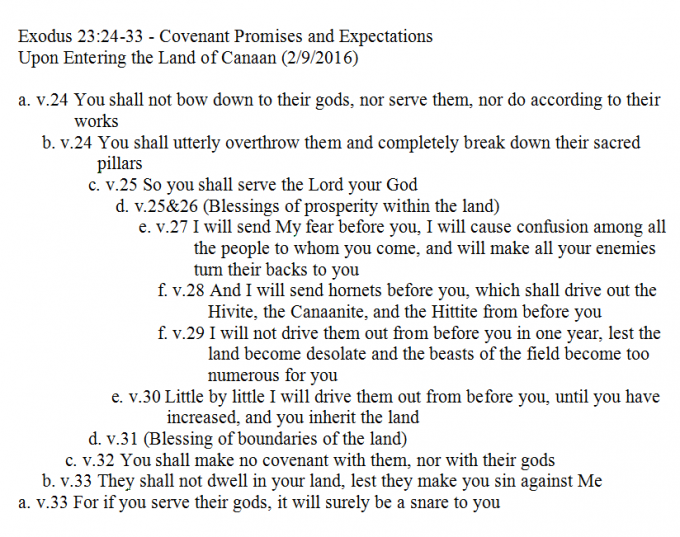
Following God’s laws has never been hard, but our human nature says, “I can do it better my own way.” God tells us time and time again that this is not true. He made us and He knows what is best for us. For Israel at the giving of the law, He told them what was best in order for things to go well. These truths are to be found in His superior word. And so let’s turn to that precious word once again and… May God speak to us through His word today and may His glorious name ever be praised.
I. My Angel will go Before You (verses 20-26)
The words of today’s verses close out the initial giving of the law to the people. These words are “the Book of the Covenant.” After this, Moses will go down the mountain and present them to Israel. They have already vowed to accept the words of the Lord and to be obedient to them on two separate occasions.
The first was in Chapter 19. After arriving at Sinai, Moses went up and was given an initial set of words to repeat to Israel. After receiving the word, he came back down and this was recorded –
“So Moses came and called for the elders of the people, and laid before them all these words which the Lord commanded him. 8 Then all the people answered together and said, ‘All that the Lord has spoken we will do.'” Exodus 19:7, 8
After that, the Ten Commandments were thundered out in the hearing of the people. In their horror and dread, they told Moses –
“You speak with us, and we will hear; but let not God speak with us, lest we die.” Exodus 20:19
After that, Moses ascended the mountain once again and was given the words of Exodus 20:22 – 23:33. Each of these was carefully laid out in sets of tens and which harmoniously developed a theme of God’s expected standards for His people. These words now close out those decades of verses with the expected promises for adherence to them. The first promise is a great one indeed…
20 “Behold, I send an Angel before you
hinneh anoki sholeakh malakh l’phanekha – “Behold, I send Angel before your face.” It is a wonderful promise to Moses. It is one of comfort and assurance that he will not be alone in leading the people of Israel to where they are to go.
It is highly debated who this Angel is. Scholars, both Jewish and Christian alike, have debated this and proposed numerous possibilities. Is it Moses? Is it Joshua? Is it an angel? Is it the Lord? It certainly isn’t Moses because the pronoun is in the singular. The address is to him alone.
Many translations capitalize the word to signify their trust that it is in fact the Lord. This is correct. One must let Scripture interpret Scripture. The pillar of cloud which was first seen in Exodus 13:21, and which was explicitly mentioned last in Exodus 14:24, has continued to be with Israel. It will continue to be noted later in Exodus 33, in Numbers 14, and as late as Deuteronomy 31:15.
In Exodus 33:3, there will be a time when the Lord tests Moses with these words –
“Go up to a land flowing with milk and honey; for I will not go up in your midst, lest I consume you on the way, for you are a stiff-necked people.”
Also, Paul explicitly ties incidents of the wilderness wanderings to the Presence of Christ among them in 1 Corinthians 10. In verse 10:9, he says that in their conduct, they tempted Christ. Therefore, the Angel who is promised to go before them is, in fact, the Lord.
The pillar of cloud obscures His glory. Within that veil is Christ, “the brightness of His glory and the express image of His person” (Hebrews 1:3). This promise of the presence of the Angel will not be without cost to the people. We will see this in the verses, chapters, and books which lie ahead.
20 (con’t) …to keep you in the way
lishmarekha ba’derek – These words certainly have a triple signification. The first is that Israel will be guided in the proper course to take as they travel towards Canaan. The Lord is directing them according to a set plan, and each stop is where He wants them physically to ensure that they arrive when He wants and where He wants. In this route, they will be safely conducted by Him.
The second reason is as an instruction for the people. To “keep you in the way” isn’t speaking of just a physical way, but it is also speaking on the lines of morality and obedience. The last time the word “way” or derek was used, it was in exactly this manner –
“And you shall teach them the statutes and the laws, and show them the way in which they must walk and the work they must do.” Exodus 18:20
And finally, each stop is recorded as a pictorial lesson for us today. It is to show us Christ. We have seen that numerous times already, and that will continue to be the case with each stop and each thing that occurs at each stop. Christ is being revealed to us!
20 (con’t) and to bring you into the place which I have prepared.
The place He is speaking of is obviously Canaan. The promise was made to the patriarchs that the land would be theirs. Abraham was told this and it was passed down to each generation since then –
“Know certainly that your descendants will be strangers in a land that is not theirs, and will serve them, and they will afflict them four hundred years. 14 And also the nation whom they serve I will judge; afterward they shall come out with great possessions. 15 Now as for you, you shall go to your fathers in peace; you shall be buried at a good old age. 16 But in the fourth generation they shall return here, for the iniquity of the Amorites is not yet complete.” Genesis 15:13-16
In those words, we see the reason why the Lord delayed the promise. It was because “the iniquity of the Amorites” was not yet complete. The Lord was patient with the inhabitants of the land. Until their iniquity had reached its full measure, He granted them the right to continue in the land.
However, the time was drawing near for that to end. Their wickedness was so great that, like those before the flood, the only remedy was their destruction. Instead of a flood of water, they would be destroyed by the flood of the Lord’s army, Israel.
Despite this being the case, these words are given as a picture of the future granting of a place for the redeemed of the Lord, that of heaven. It is what the land of Canaan only anticipated –
“‘Let not your heart be troubled; you believe in God, believe also in Me. 2 In My Father’s house are many mansions; if it were not so, I would have told you. I go to prepare a place for you. 3 And if I go and prepare a place for you, I will come again and receive you to Myself; that where I am, there you may be also. 4 And where I go you know, and the way you know.’
5 Thomas said to Him, ‘Lord, we do not know where You are going, and how can we know the way?’
6 Jesus said to him, ‘I am the way, the truth, and the life. No one comes to the Father except through Me.'” John 14:1-6
Just as the Lord had prepared Canaan for Israel, the same Lord who came to live among us has given us an even greater promise. We have a home reserved for us, eternal in the heavens.
21 Beware of Him and obey His voice;
When taken together with the rest of Scripture, in this verse we have a picture of the Trinity. First, Moses is told to “beware of Him and obey His voice.” This is speaking of the Angel who is being sent before them. The author of Hebrews ascribes the words to obey His voice at this time to the Holy Spirit –
“Therefore, as the Holy Spirit says:
‘Today, if you will hear His voice,
8 Do not harden your hearts as in the rebellion,
In the day of trial in the wilderness,
9 Where your fathers tested Me, tried Me,
And saw My works forty years.'” Hebrews 3:7-9
In Exodus 20:1 the Ten Commandments began with the words, “Then God spoke…” Immediately after that in verse 2, came the words, “I am the Lord your God.” In Hebrews, the admonition to obey is said to have been spoken by the Holy Spirit. Thus, so far, both the Father and the Holy Spirit are specifically noted. At the end of this verse, the Son’s role will be noted as well.
21 (con’t) do not provoke Him, for He will not pardon your transgressions;
It is the Son to whom judgment has been granted. It is He who pardons and it is He who finds guilt. All authority is granted to Him on earth and in heaven. This is seen even in the Old Testament with the following words…
21 (con’t) for My name is in Him.
We are being shown a picture of the Trinity here. As the Lord God, or Yehovah Elohim, says that His name is in Him, then as Adam Clarke notes, “…the Jehovah dwells in Him.” He is spoken of as a separate Person, and yet in Him dwells the fullness of the Godhead bodily. Charles Ellicott notes that –
“God and His Name are in Scripture almost convertible terms. He is never said to set His Name in a man.” Charles Ellicott
The word translated as “in Him” is b’qirbow. It means, “In His inward parts.” In other words, it is united to Him. If the essence of Yehovah dwells in Him, then this is speaking of the third member of the Trinity – the divine Logos – the word of God; Jesus the Christ. Therefore, these words return us, once again, to John 14 –
“Believe Me that I am in the Father and the Father in Me, or else believe Me for the sake of the works themselves.” John 14:11
22 But if you indeed obey His voice and do all that I speak, then I will be an enemy to your enemies and an adversary to your adversaries.
This is a fascinating verse to consider. In the first clause, there is a change from the third person to the first person. It says, “…if you obey His voice.” It then says, “…and do all that I speak.” This is known as a perikhoresis. It’s a Greek term which is derived from two separate words, peri, which means “around,” and khorein, which in this context means “to go forward.”
It is a tenet which is seen throughout Scripture, but which is often highlighted and magnified by the words of Jesus, particularly in the Gospel of John. It gives the idea of “indwelling” which then conveys and realizes fellowship between the members of the Godhead. This is seen, for example, in John 15:26 –
“But when the Helper comes, whom I shall send to you from the Father, the Spirit of truth who proceeds from the Father, He will testify of Me.”
Even in the Old Testament, multiple clues as to the nature of the Godhead are given. This is a beautiful example of one of them.
Next, this is a conditional verse. It is based on obedience. In it there are four individual thoughts containing three repetitions. The first thought, which is also a repetition is an emphasis in the command – ki im shamoa tishma b’qolow – “but if listening you shall listen to His voice.”
The second thought is based on their listening. It is the application of it – v’asita kol asher a’dabber – “and do all that I speak.” One can’t do unless one first hears and heeds. If one hears, it doesn’t mean they will heed. But if they do, then they will apply what they heard and turn it into action. This then is the obedience of the law.
If these two conditions are met, then there will be rewards, both of which are repetitions based on contrast. The first is v’ayavti eth oyevekha – “then I will be an enemy to your enemies.” The second is v’sarti eth sorerekha – “and an adversary to your adversaries.”
In this, two very similar verbs are used. The first is tsuwr which is used for the first time in Scripture. It comes from a primitive root meaning to cramp. From it, one gets the sense of binding up an enemy or afflicting them by besieging them.
The second word is tsarar. It carries the same meaning as tsuwr and it was first used in Exodus 12:34 when it said that the Israelites had their kneading bowls bound up in their clothes on their shoulders. Now it is being used for the first time in the sense of one’s enemies.
Third, the words can’t be only limited to the time before entering Canaan. We have already seen that heeding the voice of the Lord is used by the author of Hebrews to speak of our relationship with Christ. But he was quoting the 95th Psalm there in Hebrews. The psalmist spoke of “Today” just as the author of Hebrews did.
Therefore, this is speaking of how God deals with His covenant people. “Today if you hear His voice…” The promise began at Sinai and it continues to be recalled to God’s people since then. And finally, what is implied, but as yet unstated, is that if they don’t obey, there will be consequences. The opposite of what He promises here is explicitly noted in Leviticus 26 –
“And I will bring a sword against you that will execute the vengeance of the covenant; when you are gathered together within your cities I will send pestilence among you; and you shall be delivered into the hand of the enemy.” Leviticus 26:25
Before we go on, I should ask, after considering the words of this verse, do you think the Lord works any differently today? It is to our benefit to follow the advice here – “Listening you shall listen to His voice and do all that He speaks.” We are under the New Covenant and in the Dispensation of Grace, but we still have many commands and admonitions which have been given to us to heed.
23 For My Angel will go before you and bring you in to the Amorites and the Hittites and the Perizzites and the Canaanites and the Hivites and the Jebusites; and I will cut them off.
In verse 20 it said “I will send an Angel.” Now it says malaki or “My Angel.” There is nothing here to preclude it being Christ. Rather, Malachi 3:1 uses the same word, malak, to describe first John the Baptist and then Christ Jesus –
“‘Behold, I send My messenger,
And he will prepare the way before Me.
And the Lord, whom you seek,
Will suddenly come to His temple,
Even the Messenger of the covenant,
In whom you delight.
Behold, He is coming,’
Says the Lord of hosts.” Malachi 3:1
It is Christ who will go before Israel, taking them into the Land of Promise. And the Lord promises to “cut them off.” In this, it means as collective people groups. Not all were cut off. Some were eventually assimilated into Israel. One of David’s leading military men was Uriah the Hittite who was the husband of Bathsheba.
David was also noted as having bought the threshing floor of Araunah the Jebusite who dwelt among them. Even in Jesus’ time, a person is identified as being a woman of Canaan in Matthew.
24 You shall not bow down to their gods,
lo tishtakhaveh l’elohehem – As most of us already know, bowing down to a god is considered a way of honoring them and paying reverence to them. In so doing, it is an implicit act of trust that they can meet one’s needs. It can also imply that one expects return benefits from them. This was utterly forbidden for them to do.
This is something that is not only common in the RCC today, it is the standard daily ritual, particularly statues of Mary and the saints, as well as supposed relics of dead folk.
24 (con’t) nor serve them,
v’lo ta’abedem – To serve an idol is more than bowing down to them. It can be placing food before them, burning incense to them, singing to them, praying to them, or praising them. Again, this is SOP in the RCC. All of these are done daily at the Vatican and in most subordinate locations.
Within the RCC, they attempt to make a distinction between what is offered to idols: dulia, hyperdulia, and latria. Dulia is supposedly honor and recognition accorded to idols. Hyper-dulia is “lots and lots of dulia.” This is accorded to Mary. Then there is latria which is worship of God.
These distinctions are seen in word, not in practice, and they are exactly what comprise the closing words of John’s first epistle –
“Little children, keep yourselves from idols. Amen.” 1 John 5:21
24 (con’t) nor do according to their works;
v’lo taaseh kemaasehem – This is speaking of the cultic practices of those who followed these false gods. Some were sexual in nature, some included human sacrifice, self flagellation, etc. These were utterly forbidden. They were to keep from the idols and they were to keep from practicing the rites involved with the idols. In 1 Kings 11, Solomon is noted for having completely blown it in these three ways –
“For it was so, when Solomon was old, that his wives turned his heart after other gods; and his heart was not loyal to the Lord his God, as was the heart of his father David. 5 For Solomon went after Ashtoreth the goddess of the Sidonians, and after Milcom the abomination of the Ammonites. 6 Solomon did evil in the sight of the Lord, and did not fully follow the Lord, as did his father David. 7 Then Solomon built a high place for Chemosh the abomination of Moab, on the hill that is east of Jerusalem, and for Molech the abomination of the people of Ammon. 8 And he did likewise for all his foreign wives, who burned incense and sacrificed to their gods.”
24 (con’t) but you shall utterly overthrow them
ki hares taharesem – “in overthrowing, you shall overthrow them.” This is speaking of the false gods. They were to be proven exactly that; false. Their altars were to be destroyed and their temples were to be torn down. There was to be nothing left of them. Even their foundations were to be destroyed.
24 (con’t) and completely break down their sacred pillars.
v’shaber t’shaber matsevotehem – “…in breaking, you shall break their pillars.” The false gods are identified with the images which represent them. They were to be utterly broken down. They were to be crushed, burned, and left as nothing more than refuse.
It was the practice of conquering forces to take the idols of the vanquished nations and keep them as trophies of victory. However, this was not to be condoned in Israel. They were false, they couldn’t save their own people, and they could only entice Israel to eventually look to them for what they could never provide. Unfortunately, King Amaziah failed in all respects concerning this 24th verse of Exodus 23 –
“Now it was so, after Amaziah came from the slaughter of the Edomites, that he brought the gods of the people of Seir, set them up to be his gods, and bowed down before them and burned incense to them.” 2 Chronicles 25:14
How hopeless we are as a species! We reject what is good and right and honorable and give our allegiance to the passing wind.
25 “So you shall serve the Lord your God,
In contrast to serving the false gods of Canaan, they are instructed to serve Yehovah Elohekem, or “Yehovah your God.” He alone is Israel’s God and He alone was to be served by them. In return for this, they could expect His divine favor…
25 (con’t) and He will bless your bread and your water.
This doesn’t just mean that their food will be healthy, but that it will be abundant. They will not lack food or water when they are in a right relationship with the Lord. What is implicit here is that if they fail to serve Him, bread and water would be lacking in both quantity and quality.
25 (con’t) And I will take sickness away from the midst of you.
Ellicott notes that, “Half the sicknesses from which men suffer are directly caused by sin, and would disappear if men led godly, righteous, and sober lives. Others, as plague and pestilence, are scourges sent by God to punish those who have offended Him.”
If they served the Lord, they would be blessed with health and vitality. This verse follows directly on the last use of the word translated as sickness, makhaleh, which was in Exodus 15:26 –
“If you diligently heed the voice of the Lord your God and do what is right in His sight, give ear to His commandments and keep all His statutes, I will put none of the diseases on you which I have brought on the Egyptians. For I am the Lord who heals you.”
Again, what is implied is that the opposite will certainly be true for a failure to adhere to the Book of the Covenant.
26 No one shall suffer miscarriage or be barren in your land;
This is probably speaking of both people and animals. When people are well fed and live in clean conditions, which the law will later give instructions for, then those in the land would naturally not face these types of problems.
This probably is not intended as anything more than a general pronouncement. Godly women such as Hannah and Elizabeth were both barren for extended periods. However, the Lord eventually favored them both.
26 (con’t) I will fulfill the number of your days.
Again, when one follows the guidelines given in the law, they can expect to live long, normal lives. The Bible gives us guidelines for right and healthy living because it is written by the One who fashioned us. He knows what is right and best for us. By following His words and seeking after Him, we will naturally be better off.
When we depart from His way, of course we can expect early death through disease because of things like sexual sins, or through trauma because of things like a bullet in our noggin. Look at the world today. The words of the Bible are normally borne out in how we conduct our lives. For the wicked, the psalms give a good general picture of life –
“But You, O God, shall bring them down to the pit of destruction;
Bloodthirsty and deceitful men shall not live out half their days;
But I will trust in You.” Psalm 55:3
I will send My Messenger before you, He will lead the way
He is the Head of the army of the Lord
He is the King of My People, and to you I say
He will go before you always, He – My spoken Word
Have no fear of your enemies, they are already defeated
I have sent My fear before you, to break open a way
Even the enemy of death has been unseated
Over him My Son prevailed at the dawning of the day
My Name is in Him and so have no fear
It is your enemies to whom my fear has gone out
So in the exalted name of Jesus, send out a hearty cheer
Yes, in His name shall you give a resounding shout
I. I Will Send My Fear Before You (verses 27-33
27 “I will send My fear before you, I will cause confusion among all the people to whom you come,
These promises are conditional. The first two were literally fulfilled, using the same word. The “fear” or emah certainly came to the people of Canaan prior to Israel’s arrival. Rahab the harlot, using the same word emah, told this to the spies who visited her-
“I know that the Lord has given you the land, that the terror of you has fallen on us, and that all the inhabitants of the land are fainthearted because of you. 10 For we have heard how the Lord dried up the water of the Red Sea for you when you came out of Egypt, and what you did to the two kings of the Amorites who were on the other side of the Jordan, Sihon and Og, whom you utterly destroyed.” Joshua 2:9, 10
The confusion or hamam was first seen in the Bible in Exodus 14 when the Lord confused the Egyptians as they pursued Israel through the Red Sea. In Joshua 10:10, the same word is used again to describe the Lord confusing Joshua’s enemies in battle.
27 (cont) and will make all your enemies turn their backs to you.
The opposite of the final promise is actually what is seen in Scripture. In Joshua 7, it is Israel, not their enemies who turned their oreph, or necks in battle. One of the congregation violated the law concerning the destruction of Jericho. Because of this, in their next battle, they were routed, turned their necks, and ran.
The conditional nature of these promises is highlighted through the use of the selected words as they are later used in the book of Joshua. The Lord is asking us to look at them and see how it is we who are either obedient to the Lord and flourish, or who turn from Him and falter. If so, we turn out to be our own worst enemies.
28 And I will send hornets before you, which shall drive out the Hivite, the Canaanite, and the Hittite from before you.
This verse introduces the tsirah, or hornet, into the Bible. It is the first of just three times that they are mentioned. The word comes from tsara which means to be leprous. Also, there is an article in front of “hornet.” It is “the hornet.” The language here is to be taken metaphorically.
First, similar terminology is used concerning bees in Deuteronomy 1:44 and Psalm 118:12. There, they are equated with one’s enemies. Secondly, Joshua says that this was fulfilled in the case of the Amorites in Joshua 24:12 –
“I sent the hornet before you which drove them out from before you, also the two kings of the Amorites, but not with your sword or with your bow.”
There it said it was the hornet that drove out the two kings of the Amorites. And yet, Moses, speaking of the same battle, shows that it was, in fact, Israel who defeated them –
“And at that time we took the land from the hand of the two kings of the Amorites who were on this side of the Jordan, from the River Arnon to Mount Hermon…” Deuteronomy 3:8
This is repeated in Deuteronomy 4:47 and it is referring to the kings Sihon and Og. What I speculate this is referring to is that there is a connection between the hornet and its associated word meaning leprosy.
The Lord promised health and long life to Israel if they held to His laws. As they were going in to a land defiled by those things which are opposed to a healthy lifestyle, the enemy had been afflicted with disease to the point where they were incapable of standing up to Israel’s armies.
Thus, “the hornet” is a metaphor for God’s judgment of sickness upon them, preparing them for destruction by Israel. This is only speculation, but the Bible records that Israel actually faced these foes in battle. Thus it is a reasonable explanation for the term “the hornet” which is said to have gone before them.
29 I will not drive them out from before you in one year, lest the land become desolate and the beasts of the field become too numerous for you.
There is a bit tied up in this verse. First, it is a certainty that the inhabitants are to be driven out. However, there is an incremental process which is to take place. We look at the Lord’s plans as if He is slacking, but this is not the case. It is only from our short life spans that we decide things should move more quickly.
But the Lord is looking at the long-term. If all of the inhabitants were taken out at once, the land would become desolate. The word shemamah, or desolation is introduced into Scripture here. The land was inhabited, and there were fields, crops, fruit trees, wells, houses, etc. everywhere.
If all the people were taken out at once, there would have been an insufficient number of people to take them over. The productivity would have been lost. Further, these nations were collectively destroyed, but not all individuals were. Some of them came into the people of Israel and actually lead even to Christ Himself – Rahab and Bathsheba are but two known for sure.
Further, it is later stated that some of the inhabitants were left in order to test Israel and see if they would keep the way of the Lord or not. This is seen in Judges 2:21-23. And finally, it was because the beasts of the field would become too numerous. This actually occurred after the exile of the ten tribes. In 2 Kings, we read this –
“And it was so, at the beginning of their dwelling there, that they did not fear the Lord; therefore the Lord sent lions among them, which killed some of them.” 2 Kings 17:25
It was noted after the Franco-German war that many districts in France had an explosion of wolves. These wouldn’t just be physically harmful to people, but they would be devastating to flocks and they would bring diseases with them as well. The Lord knew these things would occur and so he determined to methodically take care of the occupation of Canaan…
30 Little by little I will drive them out from before you, until you have increased, and you inherit the land.
meat meat agareshenu mippanekha – “little little I will drive them out from before your face.” The idea here is the completed explanation from the previous verse. It implies that Israel will be fruitful and multiply. They will increase in numbers and as they do they will be able to assume the responsibility for the land.
It is, in picture, somewhat like what Adam could have done in the Garden of Eden. If he was obedient, then he would have increased there, but in his disobedience, he was cast out to the east. In a similar way, Israel was given this wonderful land of Promise and they were told to increase there, being obedient to the Lord.
Instead of this, they were eventually driven out and sent east to Babylon. The pattern repeated itself. From abundance to want, from a land of delight to a land of captivity, and from the west to the east – both Adam and Israel failed to keep the good things they had been given. The Lord had done all the work; all they needed to do was exercise faith, trust, and obedience. Both failed.
31 And I will set your bounds from the Red Sea to the sea, Philistia, and from the desert to the River.
The boundaries of the land are defined here and they cause those who deny predictive prophecy no end of stress. It wasn’t until the time of Solomon that this prophecy was actually realized, and yet the Lord told them that this would be the land they received.
The Red Sea is the southern extremity, the sea Philistia, or the Mediterranean was to be the western border. The desert, meaning where they are now in Sinai, was to be the land border on the south, and the River, meaning the Euphrates, was to be their border to the north and east.
The term for “the river,” which is ha’nahar, cannot be taken as meaning the Jordan. It is later explicitly described as the Euphrates twice in Deuteronomy and once in Joshua. This immense expanse of land is what was promised to Israel after it having first been promised to their forefather Abraham in Genesis 15:18.
31 (con’t) For I will deliver the inhabitants of the land into your hand, and you shall drive them out before you.
This verse here clearly explains the previous conundrum concerning the term “the hornet.” The Lord says He will deliver the inhabitants of the land into the hands of Israel. When He does, they are to respond by driving the people out. Thus, the term “the hornet” must be taken metaphorically. The Lord prepared the people for being driven out and Israel accomplished the matter.
32 You shall make no covenant with them,
Interestingly, the Book of the Covenant, which begins in Exodus 20:22, began with a warning against idolatry. It now closes with the same theme. It is an exceptional warning to the people that they were to take heed and not participate in any idolatrous worship. They were admonished to keep far from it.
In these words, the people are warned to not cut any covenant with the people. This was violated almost immediately after they entered the Land of Promise. Joshua failed to check with the Lord concerning a covenant with the Gibeonites and he, in fact, made a covenant with them. This wasn’t the only such infraction either, in Judges 2:2, 3 we read –
“And you shall make no covenant with the inhabitants of this land; you shall tear down their altars.’ But you have not obeyed My voice. Why have you done this? 3 Therefore I also said, ‘I will not drive them out before you; but they shall be thorns in your side, and their gods shall be a snare to you.”
What is important to understand is that such a covenant was normally not only with the people. There was more to it than a simple treaty…
32 (con’t) nor with their gods.
In making a covenant with a people group, it was the custom to acknowledge the god or gods of that people group. Sometimes it was implicit, at other times it was explicit. Sacrifices would be made and then acknowledgement of the god’s ability to protect and to keep secure the covenant was involved.
Thus, by cutting such a covenant, it was acknowledging the belief system of the other group. This is, unfortunately, now what has happened between many Christian sects and Judaism, Islam, Hinduism, etc. There is either an implicit or an explicit acknowledgment of the power of the false gods, or of the incorrect faith in the true God, of these other religions.
This shows the epitome of contempt for the One true God when it occurs. Like Israel of old, many will face the same sad end because of their failure to hold to the Lord alone.
33 They shall not dwell in your land, lest they make you sin against Me.
Allowing pagans to remain in the land will inevitably result in turning from the Lord. This is seen time and time again in the Bible. If a person became a part of the covenant people, they had to give up on their religion and turn to the Lord.
Ruth, for example, was one who was famous for having clung to the Lord God of Israel. But for those who didn’t cling to Him, only trouble could result. This is the story of America today. Little by little, false religions have crept in and the collective heart of the people has turned from Him.
There is no longer a fear of the Lord, and the land has devolved into utter wickedness because of it. This was the final warning to Israel. Like them, we failed to take heed…
*33 (fin) For if you serve their gods, it will surely be a snare to you.”
Making alliances with those who worship other gods will inevitably result in a weakening of the true faith. It is as a snare by which one is caught. This is the first time that the word moqesh, or snare is used in this way concerning the true faith.
It is as if one is walking along, and without even seeing it lying there, they step in it and are set on a path to destruction. This is the end for all who mingle the true faith with that which is false. Unfortunately, Israel failed to heed, and unfortunately, we have failed to heed as well.
The gospel has gone out, it has been well received by the world, and now it is on a path of apostasy from which it will probably not recover. The Lord will take action and He will destroy Mystery Babylon from the face of the earth. All who are a part of her will be destroyed with her.
But before that day comes, there is still a chance to get right with the Lord. There is time to call on Christ and be saved from the inevitable. You see, the book is written and the judgments are already laid out. All we can do is endure until He calls us home to be with Him.
After that occurs, the world will be cast into a time of global destruction. It is all because we have failed to simply receive the word and stand fast on it. Today if you hear His voice, do not harden your heart. Call on Jesus and be reconciled to God through Him. Let me tell you how to you can, even right now…
Closing Verse: “Little children, keep yourselves from idols. Amen.” 1 John 5:21
Next Week: Exodus 24:1-8 Israel agreed to the word He sent… (This is the Blood of the Covenant) (65th Exodus Sermon)
The Lord has you exactly where He wants you. He has a good plan and purpose for you. Even if a deep ocean lies ahead of You, He can part the waters and lead you through it on dry ground. So follow Him and trust Him and He will do marvelous things for you and through you.
Covenant Promises and Expectations
Behold, I send an Angel before you
To keep you in the way
And to bring you into the place
Which I have prepared; it is waiting you there today
Beware of Him and obey His voice
Him do not provoke
For He will not pardon your transgressions
For My name is in Him; do as I spoke
But if you indeed obey His voice
And do all that I speak: you my word with you do carry
Then I will be an enemy to your enemies
And to your adversaries an adversary
For My Angel will go before you
And bring you in to the Amorites
And the Hittites and the Perizzites too
And the Canaanites and the Hivites and the Jebusites
And I will cut them off, this I will do
You shall not bow down to their gods
Nor serve them, nor do according to the works they make
But you shall utterly overthrow them
And their sacred pillars down you shall completely break
So you shall serve the Lord your God
And He will bless your bread and your water too
And I will take sickness away
From the midst of you
No one shall suffer miscarriage
Or be barren in your land
I will fulfill the number of your days
Pay heed to this word; please understand
I will send My fear before you
I will cause confusion, it is true
Among all the people to whom you come
And will make all your enemies turn their backs to you
And I will send hornets before you
Which shall drive out the Hivite
The Canaanite, and the Hittite from before you too
I will not drive them out from before you in one year
Lest becomes desolate the land
And the beasts of the field that cause fear
Become too numerous for you, lest they get out of hand
Little by little I will drive them out
From before you until you have increased
And you inherit the land
And any terror from them will have ceased
And I will set your bounds
From the Red Sea to Philistia’s sea
And from the desert to the River
All this, your territory shall be
For I will deliver the inhabitants
Of the land into your hand
And you shall drive them out before you
This I proclaim for you to understand
You shall make no covenant with them
Nor with their gods, I tell you now plainly
They shall not dwell in your land
Lest they make you sin against Me
For if you serve their gods
It will surely be a snare to you
And so I admonish you now
This thing you shall not do
Help us Lord to follow in Your way
Help us to live rightly according to Your word
Let our lives be dedicated to you, renewed each day
And let our deeds be for the sake of our Lord
Great are You, O God, and worthy of our praise
Your word is perfect and Your ways are just and true
And so we shall follow You with obedient hearts always
Unto the ages of ages we will praise and glorify You
Hallelujah and Amen…