Leviticus 16:11-22
Yom Kippur
The Day of Atonement, Part II
Like part I of the Day of Atonement sermons, for the second week in a row, I spent about 14 hours working on the content of this one. It was a long and tiring Monday, and I didn’t really feel any further along at the end of the day than I was when I started concerning much of the substance behind the verses.
The content from the Hebrew is complicated, it is very hard to properly piece together, and there are several possibilities for the meaning of many of these 12 verses. So much so, in fact, that I spent about an hour talking to my friends Sergio and Rhoda in Israel trying to figure out a correct meaning of just two of them.
This doesn’t mean that all is lost. In fact, at the end of the day the opposite was true. I was twelve verses farther along in understanding everything that is being relayed and the pictures were coming out slowly but surely. One of the problems with evaluating these verses, is that most commentaries, if not all, rely heavily on later Jewish commentaries which add in many things to the rituals of this chapter which are completely irrelevant to what the Lord is saying. Because of this, tradition has taken over much of the basic words of instruction.
In the evaluation of these Leviticus 16 verses, I am purposefully refraining from any extra-biblical content, such as those Jewish writings which detail the rituals, in order to keep the original intent of what is said here. The only time I have or will introduce anything written later, is when it won’t interfere with a proper evaluation of these verses.
This is important, because in using the descriptions of what occurred at temple times, and of what the later writings of the Talmud state, the symbolism of what is being pictured is actually confused. Error is then introduced into what should otherwise be fully understood from these verses alone. It is the constant mistake of those who evaluate such passages, and it has led to many misunderstandings of what is being presented for us to learn.
This is not to say that all such writings are bad, but there is a basic instruction given in Scripture which gives us the necessary details to find Christ. Quite often, the later writings seem to purposefully hide what we should see. What we are to find in Scripture is Jesus, and that which is recorded in the Old is only given to lead us to the New. We have to keep remembering this. Everything points to Christ and His completion of these things.
Text Verse: “For on the one hand there is an annulling of the former commandment because of its weakness and unprofitableness, 19 for the law made nothing perfect; on the other hand, there is the bringing in of a better hope, through which we draw near to God.” Hebrews 7:18, 19
In Christ, the “former commandment,” meaning the Law of Moses, is annulled. This is, as the author of Hebrews notes, because of it “weakness and unprofitableness.” That sounds very stern, but he then explains it by saying that “the law made nothing perfect.”
Only Christ could do that. The Law was given to lead us to Him. That includes the Leviticus 16, Day of Atonement, rituals. We just need to keep looking for Him. In so doing, we will be fully informed on what we are seeing now. This is the beauty of studying the law. In doing so, we will not only find Christ, but the things of the New Testament make all the more sense.
Things in the New which seem hard to understand find their source in the Old. In understanding the Old, we can then understand the New. This is how it is. Marvelous things are revealed when we study His superior word. And so let’s turn to that precious word once again and… May God speak to us through His word today and may His glorious name ever be praised.
I. A Bull For a Sin Offering (verses 11-14)
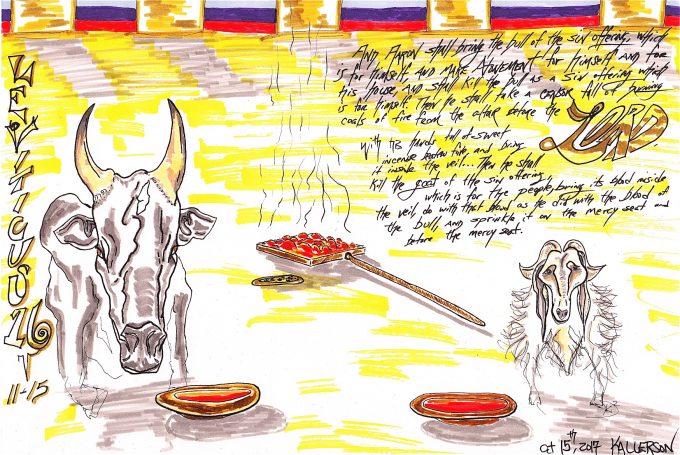
11 “And Aaron shall bring the bull of the sin offering, which is for himself, and make atonement for himself and for his house, and shall kill the bull as the sin offering which is for himself.
Following the specific order of the ritual, the high priest is now instructed to bring forward the bull of his sin offering. The order so far is that he 1) bathed; 2) dressed in white holy garments; 3) presented at the door of the tent a bull for a sin offering; 4) presented at the door of the tent two goats for a sin offering for the congregation; 5) cast lots on the two goats – one for Yehovah, and the other for Azazel. Now, comes his sixth act of the day.
Here it notes that this bull which is brought near, “is for himself and for his house” in order to make atonement for them. This is the bull which was introduced in general in verse 6. The par, or bull, comes from the word parar which carries the meaning of defeat, or make void. The idea of Christ is seen clearly in this. It is He who defeated the devil, making void that which the devil had wrought, through the sacrifice of Himself.
As we have seen from the earlier sacrifices noted in Leviticus, the high priest must sacrifice first for himself, and only then can he sacrifice for the sins of the people. This is stated by the author of Hebrews to make certain a theological point in verses 5:1-3–
“For every high priest taken from among men is appointed for men in things pertaining to God, that he may offer both gifts and sacrifices for sins. 2 He can have compassion on those who are ignorant and going astray, since he himself is also subject to weakness. 3 Because of this he is required as for the people, so also for himself, to offer sacrifices for sins.”
Aaron bore his own sin, a truth highlighted by the New Testament in order to demonstrate, perfectly and completely, the fallible nature of the Aaronic priesthood. If Israel’s high priest bore sin, and if he continued to bear sin year after year, then he was never made perfect, nor could he make anyone else perfect.
Further, none of his house was exempt. If he conceived a child just after the Day of Atonement, that child would still be born in sin and under sin’s power. The truth is inescapable. Thus, though the high priest is a type of Christ in his duties and garments, the bull being presented is also.
Without the bull, there is no transfer of sin, and without Christ, there is no true atonement. As this is so, the high priest personally kills the bull. In type and picture, all – including Israel’s high priest – are responsible for the death of Christ. None can come to God apart from Him.
12 Then he shall take a censer full of burning coals of fire from the altar before the Lord,
After sacrificing the bull, the next thing he is to do is to take ha’makhtah or “the censer,” full of burning coals. The definite article is not superfluous at all. In verse 10:1, the two sons of Aaron, Nadab and Abihu, committed several violations before the Lord, causing them to die. One was that they took censers that were not authorized for this purpose. Makhtah, or censer, comes from khathah, “to take.”
Aaron is to take “the censer” which was specifically ordained for this task, and to then fill it with gakhale, or burning coals. This is the first time that gekhel or burning coal is used in Scripture. It is from an unused root meaning “to glow” or “kindle,” thus it is a burning ember. These were to be obtained me’al ha’mizbeakh miliphne Yehovah, or from off the altar before the Lord.
Pretty much every commentary and scholar says that these coals are to come from the altar of burnt sacrifice outside. That is the perpetually burning fire which was sanctified by the fire of the Lord at the end of Chapter 9. But, it is more likely that these were taken from the altar of incense which stands before the veil.
The incense and the censer would both have been kept inside the Holy Place. The incense was always to be burning on the coals of the fire in this golden altar according to Exodus 30:8. Therefore, the fire was already sanctified to be used for incense before the Lord. Further, the same term is used again in verse 18. In both cases, it is called “the altar that is before the Lord.”
12 (con’t) with his hands full of sweet incense beaten fine,
The words, qetoreth, or “incense,” and sam, or “fragrant,” are stated together. This is the special incense which was mandated for this specific purpose back in Exodus 30. It is the holy incense which was composed of exacting ingredients and proportions which were reserved to the Lord alone. The Lord specifically stated, “Whoever makes any like it, to smell it, he shall be cut off from his people” (Exodus 30:38).
Every detail of the composition of that incense pointed to the Person and work of Christ. If you missed that sermon, go back and watch it. The symbolism of Leviticus 16 will come more fully alive by seeing the meaning of that which is now to be burnt before the Lord. The Bible explicitly explains what incense pictures and therefore we need go no further than what it says –
“Now when He had taken the scroll, the four living creatures and the twenty-four elders fell down before the Lamb, each having a harp, and golden bowls full of incense, which are the prayers of the saints.” Revelation 5:8
Incense pictures prayer. This is seen in both testaments. As it is prayers of the saints, and as the ingredients picture Christ and His work, it is reflective of those who are in Christ and whose prayers are made acceptable to God only because of Him.
In the case of the high priest now, he is instructed to have both hands filled with sweet incense beaten fine. It is not yet placed on the coals, but rather it will be after entering the Most Holy Place. As it is beaten fine, when it is placed on the embers, it will make an immense amount of smoke. That, combined with the fact that it is in a small and completely closed room, it will literally envelope the room in smoke.
12 (con’t) and bring it inside the veil.
v’hevi mi’beit la’paroketh – “and bring from house for veil.” As I noted last week, and will repeat again, the paroketh, or veil, is the dividing line between the Holy Place and the Most Holy Place. Cherubim were woven into it, symbolizing the fracture between God and Man which resulted at the fall. When man was removed from the presence of the Lord, cherubim were placed at the east of the garden to guard the way to the tree of life.
The cherubim on the veil likewise faced east. Access has been cut off for man to dwell with the Lord, or to even temporarily enter His presence. Only the high priest, and only once a year, could go behind this veil in order to make atonement for the people. The veil pictures Christ, the One and only means of gaining access to God. It is through Him alone that this can come about. That the veil is Christ is seen in Hebrews –
“Therefore, brethren, having boldness to enter the Holiest by the blood of Jesus, 20 by a new and living way which He consecrated for us, through the veil, that is, His flesh.” Hebrews 10:19, 20
13 And he shall put the incense on the fire before the Lord, that the cloud of incense may cover the mercy seat that is on the Testimony, lest he die.
Once behind the veil, the high priest was then to put the incense on the fire before the Lord. Almost all commentators state that this was then to prevent him from seeing the holy items and the place where the Lord dwelt, or else he would die. This is not correct. The ark was seen as it was made; it was seen by the priests as the tabernacle was taken down and raised during its time of movement, and the high priest could obviously see the Ark and the Mercy Seat as he walked in, prior to putting the incense on the coals.
The reason for the incense is stated right here, v’kisah anan ha’qetoreth eth ha’kapporeth asher al ha’edut w’lo yamut – “and cover cloud the incense the mercy seat which (is) over the testimony that not he die.” It is the mercy seat that is over the testimony which is singled out here.
In other words, the tablets of the Testimony are inside the ark. The mercy seat is above the ark. Incense is a symbol of prayer. The Ten Commandments are representative of the entire law, a law which condemns. Only wrath can come from a violation of the law, and only a satisfaction of the law through the shedding of blood of an innocent Substitute can appease the wrath.
The incense then is covering the mercy seat which covers the law; a law which brings death. In the death of the Substitute, life is granted. But when Aaron came back into the Most Holy place with the blood, without the incense, he would be visible. As the atonement is for him, he would die before the Lord, having been seen by the Lord. The incense, picturing prayer, is for him to be covered from the Lord, not for the Lord to be covered from him. It is the same as at the Passover. The people were to remain inside, only the blood was to be seen outside. As the Lord said then, “And when I see the blood, I will pass over you” (Exodus 12:13).
At the time of atonement, there must be only that which provides atonement visible. The picture of Christ is obvious. The prayers of the people who call on Christ will be saved through His death. The Lord does not see the sinner, but He hears their prayers because of Christ, and because of Christ alone – symbolized by the ingredients of the incense, all of which picture Him.
14 He shall take some of the blood of the bull and sprinkle it with his finger on the mercy seat on the east side; and before the mercy seat he shall sprinkle some of the blood with his finger seven times.
What is implied, but what is not specifically stated, is that he would then exit the Most Holy Place to get the blood of the bull in order to sprinkle it before the Lord. As his hands were full of the incense, and as he was also carrying the censer with the coals, he could not have also held the bowl full of blood.
With the blood now in his possession, he is instructed to sprinkle it with his finger. Due to the obscurity of the Hebrew, there are different views on what the words say. Some take the two clauses as two different sprinklings. One is with his finger either on, or before, the mercy seat once, and then he is to sprinkle before the mercy seat, meaning on the ground, or at least in the direction of the mercy seat, seven times. Thus, eight sprinklings.
Some unite the two clauses, the second explaining the first. This would mean that he sprinkled only seven times at the front of the mercy seat. A third view is that he is to sprinkle it on the mercy seat seven times, and also before the mercy seat seven times, thus fourteen total. This would mean that the mercy seat is considered an altar. Atonement is made for it.
It is hard to be dogmatic about which is correct. At the time of the second temple, there was no ark. And therefore, the priest went in and sprinkled once in the air, and seven times on the ground in a line to the place where the ark would have been.
I propose that the blood of atonement is made upon the Mercy Seat, and atonement for the Holy place is made with the seven sprinklings before it. First it is sprinkled on the east side of the mercy seat. In the Bible, the east side is the place of exile, and enmity with God. Sprinkling it there is intended to appease His wrath upon those who are in this place of exile and enmity.
In other words, it is a picture of Christ, coming to our land of exile and shedding His blood in this place of exile to reconcile us to God once again. After that, atonement is next made for the tent of meeting by sprinkling the blood before the mercy seat seven times.
Seven is the number of spiritual perfection in Scripture. The high priest would sprinkle the blood before the mercy seat to atone for the Holy Place. This seems correct based on verse 16. One way or another, blood was specifically sprinkled on the mercy seat. This was proof of death, and it was also intended that the Lord would see the blood, and atonement would be provided.
As a side note, the reason for the seven sprinklings has met with fanciful interpretation by some who claim that this is the number of times that Christ shed His blood during His time leading up to the cross. However, no such analysis is born out by the writers of the gospels. That has to be forced in order to arrive at the number.
He shed blood when He wept, He was pierced in His hands and His feet – do we count that as 1 cumulatively, 2 for the hands and 2 for the feet, or 4 for the 4 appendages? He certainly bled when He was whipped, but the record does not say this. He probably bled when the crown of thorns was placed on His head, but the record doesn’t say that. He bled internally through bruising, but that doesn’t qualify for shed blood. In the end, we can only use what is explicit, and doing so leaves nothing which matches what is called for here.
Simply, seven is the number of spiritual perfection. There is no reason to go beyond this basic and full explanation. As Christ Jesus is the embodiment of spiritual perfection, the seven sprinklings is emblematic of this innate perfection which was given for the sins of His people. They are done to petition the Lord’s mercy and to acknowledge the death of the innocent substitute.
An offering for sin to restore the peace
I come to petition my God at the burnt altar
Until I do, the enmity will never cease
But knowing He will forgive, in this I will not falter
At the altar, and by the door of the tent
The animal is slain, its life ebbs away
In that exchange, God’s wrath is spent
Harmony is restored, and has come a new day
Innocent and pure, no fault of its own
The death truly touches my heart
But in this exchange, I am clearly shown
That only through death, can there be a new start
Thank God that Another can die in my place
In His death I can again look upon God’s face
II. The Sin Offering for the People (verses 15-19)
15 “Then he shall kill the goat of the sin offering, which is for the people, bring its blood inside the veil, do with that blood as he did with the blood of the bull, and sprinkle it on the mercy seat and before the mercy seat.
Once the high priest’s sin was atoned for, the sins of the people could then be atoned for. The priest would retreat to the altar of burnt offering and there kill the people’s goat offering. Once bled out, he would reenter inside the veil to sprinkle the blood as before.
Remember the typology is important. The high priest pictures Christ our High Priest. The goat is Christ our Substitute. The shed blood is the life of Christ poured out for His people. The veil is Christ’s body which was, according to Matthew 27:51, torn asunder at the moment Christ died, thus allowing access for man into the presence of the Lord once again. For those in Christ, the guarding cherubim at the Garden of Eden, guard no more.
The incense reflects Christ’s nature and qualities. For those in Christ, our prayers are made acceptable to God, through Him, once again. The Ark is Christ who embodies the law. The Mercy Seat is Christ our place of propitiation. On an on, we need to remember that all detail is pointing to Christ.
Here, the Hebrew says that the blood is sprinkled both on and before the Ark, not only on. However, the Greek translation of the Old Testament leaves the word “and” out, and so once again, it is hard to be dogmatic about the sprinklings.
16 So he shall make atonement for the Holy Place, because of the uncleanness of the children of Israel, and because of their transgressions, for all their sins; and so he shall do for the tabernacle of meeting which remains among them in the midst of their uncleanness.
As with several other verses, this is variously translated and commented on. A large number of translations and scholars say that the two major clauses detail two separate actions. The first is that the rite has made atonement for the Most Holy place, and then the second clause is that he is then next to do so for the tent of meeting. If this were so, it would be a very imprecise order. No specifics about what he is to do to the tabernacle are given. Rather, the second clause seems explanatory. The ISV translates it in this manner –
“Then he is to make atonement on the sacred place on account of the uncleanness of the Israelis, their transgressions, and all their sins. This is how he is to act in the Tent of Meeting, which will remain with them in the middle of their uncleanness.” ISV
The sprinkling of the blood is what makes atonement first for the people’s sins when it is on the Mercy Seat. It is then for the Holy Place, and thus for the Tent of meeting as a whole. That is represented by the seven sprinklings before the mercy seat. The people are unclean, and they require atonement because the Lord resides in the tent of meeting which is among them. Further, the very utensils and dwelling place became defiled because of the sins of the people. Annually, this uncleanness needed to be atoned for.
17 There shall be no man in the tabernacle of meeting when he goes in to make atonement in the Holy Place, until he comes out, that he may make atonement for himself, for his household, and for all the assembly of Israel.
The reasons for this should be obvious. First, only the priests could enter into the tent of meeting, but even they were considered defiled, and so only one representative for them could go in and out with the required sacrifices. Their impure presence would nullify the rite which was being accomplished.
Secondly, as the high priest went in and out of the Most Holy Place, anyone in the Holy Place could look behind the veil as he went in and out. This was absolutely forbidden. And thirdly, it is typical of the work of Christ being the only acceptable work for atonement and mediation before God. No works of any person, nor any mediation by anyone else, is acceptable for bringing us near to God once again. So much for prayers to Mary and Peter!
On any day, even on this most holy Day of Atonement, this place where the Lord resided, which is in type heaven itself, was shut up from the eyes and physical access of man. This is explained in Hebrews –
“…the Holy Spirit indicating this, that the way into the Holiest of All was not yet made manifest while the first tabernacle was still standing.” Hebrews 9:8
Only in Christ could entrance into the true place where the Lord resides be made manifest. It is through Him that access for His people is made possible.
18 And he shall go out to the altar that is before the Lord, and make atonement for it, and shall take some of the blood of the bull and some of the blood of the goat, and put it on the horns of the altar all around.
Scholars are 50/50 divided on whether this is speaking of the Golden Altar of Incense, or the Altar of Burnt Offering. Each gives convincing reasons for one or the other based on the chronology of events which take place in the account. But only one is correct. I would go with the Golden Altar. First, it was specifically stated that this altar was to be atoned for once a year on the Day of Atonement. That is recorded in Exodus 30:10 –
“And Aaron shall make atonement upon its horns once a year with the blood of the sin offering of atonement; once a year he shall make atonement upon it throughout your generations. It is most holy to the Lord.”
Secondly, no such required atonement was specified for the Altar of Burnt Offering except during the ordination process, and so the general atonement made for the tent of meeting also atoned for it. Thirdly, it is because of what the Golden Altar of incense does that this was necessary. It is the one channel between the Lord and His people each day as the incense, reflecting prayers, would waft through the veil and into the Most Holy Place. And fourthly, the Altar of Burnt Offering was for the sacrifices of the people at all times, but no burnt, grain, or drink offering was ever to be made upon the Golden Altar. Thus atonement from the sin offering was required.
There is the inescapable truth that both the blood of the bull, and the blood of the goat, were mixed together in one application. For atonement before the Lord, Aaron had to sacrifice for himself. Then for the people, another sacrifice was made. But in the mingling of the blood of both, we see that each individual sacrifice actually points to One true sacrifice.
Both priest and commoner require Christ. The sacrifices are made in a sequence in type and picture, but in reality, they are one sacrifice made one time in the death of Christ.
This acknowledgment of the death of Christ, the blood of these two animals, was on the horns of the altar, thus making atonement for it. The prayers of the people were considered acceptable only because of the death of Christ. It is His death which allows our prayers, sinful as they may be, to be accepted by God. It is an astonishing thing to consider that even the prayers of man are deemed so sinful that God cannot hear them apart from Jesus.
19 Then he shall sprinkle some of the blood on it with his finger seven times, cleanse it, and consecrate it from the uncleanness of the children of Israel.
The seven–fold sprinkling is, like all other times, that which signifies spiritual perfection. It is emblematic of the spiritually full and complete atonement which Christ’s shed blood provides. What is most notable here is that just after the death of the bull, the bringing in of incense was the first thing accomplished in order to begin the atonement process.
Now atoning for the altar of incense with the blood of the bull is again the last part of the process. As incense signifies prayer, it is a remarkable attestation to the importance of prayer to God. Prayers in Christ cover us, and at the same time they reveal us. In type as we saw in Exodus 30, the altar of incense is tied directly to both the ark of the covenant and the mercy seat. In fact, they are so intimately connected, that the author of Hebrews says that this altar is actually on the other side of the veil. Here is what he says –
“For a tabernacle was prepared: the first part, in which was the lampstand, the table, and the showbread, which is called the sanctuary; 3 and behind the second veil, the part of the tabernacle which is called the Holiest of All, 4 which had the golden censer and the ark of the covenant overlaid on all sides with gold, in which were the golden pot that had the manna, Aaron’s rod that budded, and the tablets of the covenant; 5 and above it were the cherubim of glory overshadowing the mercy seat.” Hebrews 9:2-5
This description by the author of Hebrews is not in error. Rather John Lange explains what is intended –
“For this reason we would rather find a theological idea than an archæological error in that passage of the Epistle to the Hebrews (9:4) which puts it in the Holy of holies. For this is the altar which by its incense symbolizes the prayer of the high-priest (Rev. 5:8; Heb. 5:7).” John Lange
As I mentioned in the last sermon, there is a play on words occurring which is provided to give insights into the work of Christ. The veil, or paroketh, comes from the word perek which means “cruelty” or “rigor.” That then comes from an unused root meaning to “break apart” or “fracture.” In this, we can see where cruelty or rigor then comes into play.
On the other side of the veil is the mercy seat, or kapporeth, which indicates “a satisfaction.” This comes from the word kaphar, which in this situation means “to appease” or “to satisfy.” The two words, paroketh and kapporeth, are spelled with the same letters, but the letter kaph is simply moves forward. Kaph is represented by an open hand and signifies “to open, allow, or tame.”
On one side there is cruelty and rigor; on the other side, there is mercy, or satisfaction. The only thing that would pass through this veil each day would be the smell of the incense as it wafted into the air. As Christ is the veil, that is our one means of access to God at this time. It is our prayers mediated by Christ, rising to Him.
As a pictorial lesson for us concerning the blood of these animals, both picturing Christ, being applied to the mercy seat, which also pictures Christ, we can go to the Gospel of John to see the fulfillment of what is pictured here in Leviticus. On the Day of Atonement, the blood was applied on the mercy seat. That was fashioned so that there was a cherubim on each end of it, and the blood would be applied in the middle. In John 20, we read this –
But Mary stood outside by the tomb weeping, and as she wept she stooped down and looked into the tomb. 12 And she saw two angels in white sitting, one at the head and the other at the feet, where the body of Jesus had lain. 13 Then they said to her, “Woman, why are you weeping?”
She said to them, “Because they have taken away my Lord, and I do not know where they have laid Him.”
14 Now when she had said this, she turned around and saw Jesus standing there, and did not know that it was Jesus. 15 Jesus said to her, “Woman, why are you weeping? Whom are you seeking?”
She, supposing Him to be the gardener, said to Him, “Sir, if You have carried Him away, tell me where You have laid Him, and I will take Him away.”
16 Jesus said to her, “Mary!”
She turned and said to Him, “Rabboni!” (which is to say, Teacher).
17 Jesus said to her, “Do not cling to Me, for I have not yet ascended to My Father; but go to My brethren and say to them, ‘I am ascending to My Father and your Father, and to My God and your God.’” John 20:11-17
Mary looked into the tomb. And what did she see? “…two angels in white sitting, one at the head and the other at the feet, where the body of Jesus had lain.” A picture was being made of the true Mercy Seat where the blood of Christ sprinkled the Seat of God’s Mercy, cleansing those of the earth who come to Him through it.
The two angels were there, fulfilling the picture given to Moses about 1500 years earlier. It is in Christ where we are designated, or appointed, to meet with God. Christ is no random meeting place as if He could be there or somewhere else. Nor in Christ is there some random time of meeting, as if He may be in or He may not be in. Rather, He is the designated place of meeting.
As I said in our first sermon, the Greek translation of the word “mercy seat” is hilastérion. It is the same word used in the New Testament for the term “mercy seat” in Hebrews 9:5, and “propitiation” in Romans 3:25. Christ is our Mercy Seat, and He is our place of propitiation. His atoning death is the fulfillment of this ancient rite described now in Leviticus. Feast fulfilled.
We have sinned and now we realize what we have done
We rejected God’s offer, the Gift he sent to us
We have crucified our Lord, God’s perfect Son
Together we have rejected the Lord Jesus
But we did it in ignorance and so there is hope
For us there is an offering for sin
It is through His blood, atonement unlimited in scope
Through Him peace is restored, and there can be fellowship again
Thank God for His tender mercies upon us
Thank God for this marvelous thing He has done
Through the cross of Calvary and the death of Jesus
We are whole once again, and the victory is won
III. To an Uninhabited Land (verses 20-22)
20 “And when he has made an end of atoning for the Holy Place, the tabernacle of meeting, and the altar, he shall bring the live goat.
With the atonement for the priests and the people, as well as the other specific items now accomplished, the attention is now brought back to the living goat. What will happen to it? The words now say that it shall be brought near to serve its intended purpose.
21 Aaron shall lay both his hands on the head of the live goat, confess over it all the iniquities of the children of Israel, and all their transgressions, concerning all their sins, putting them on the head of the goat, and shall send it away into the wilderness by the hand of a suitable man.
Here the term “both hands” instead of “hand” is used. It is unique in all of the sacrifices. This is indicating, in the most poignant manner possible, that the confession is for both the house of the priesthood, and for the common people. He stands as the mediator to confess for all.
In this confession are all of the avonot, or iniquities, and all the pisheham, or transgresssions, concerning their khatotam, or sins. This is the full range of sins, from the smallest to the greatest which violate divine law. These were to be placed on the head of this goat. The sins have already been atoned for by the death of the other animals – the bull and the goat for the Lord. But this goat is now considered guilt-laden, and so it is going to be sent away into the wilderness, the abode of Azazel, by the had of a suitable man.
The word used to describe this man is itti. It is found only this once in Scripture, and it signifies a man who stands in readiness. The word comes from eth, meaning time, and thus he is a timely man, or a man of years and discretion suitable to the task. This man also pictures Christ who “when the fullness of the time had come, God sent forth His Son, born of a woman, born under the law, to redeem those who were under the law, that we might receive the adoption as sons” (Galatians 4:4).
The sins are to be to be carried back to Azazel who had enticed them to sin in the first place. This goat bore guilt. This is not at all like the bird of purification from leprosy where the live bird was released. Nothing there hints that the live bird bore guilt. Rather it was dunked into the blood of the live bird, symbolizing death, and then set free in an open field, symbolizing the resurrection.
Here the first goat which was slain represents the sacrifice for sin; Christ’s atoning death. The second represents the effect of that sacrifice. They are two sides of the same coin. The sin is completely removed from the people. As the first goat was for the Lord, the second is for Azazel. What the first goat cannot picture because it is now dead, the second goat is now used to show that the sin is removed – both of which are accomplished by Christ.
This is a truth which is seen in salvation. Christ died for all sins of all people potentially; Christ died only for those who acknowledge Him as their sin-Bearer actually. As long as we fail to come to Him, the death has no effect. But when we come to Him, our sins are removed completely and wholly, la’Azazel.
*22 The goat shall bear on itself all their iniquities to an uninhabited land; and he shall release the goat in the wilderness.
This goat, after having the iniquities of the people confessed over it, was then the one to bear all of those iniquities into what the Hebrew calls eretz gezerah, or a land cut off. The word is only used this one time in Scripture, but it comes from the word gazar which is used in Isaiah 53:8 saying –
“He was taken from prison and from judgment,
And who will declare His generation?
For He was cut off from the land of the living.” Isaiah 53:8
This goat was to be taken to a place completely uninhabited, and which was totally severed from the place of the Lord. There were to be no roads or any other identifying ways that would cause this goat to return to the camp of God’s people. This is, as the Bible shows quite a few times elsewhere, the haunt of evil spirits.
Here we have now an understanding that this goat is being sent to Azazel. This means that Azazel can do no harm to Israel because their sins are forgiven. Instead, he must be content with the goat which has taken Israel’s place. A natural translation of Azazel is either “one who has separated himself from God,” or “he who has separated himself.” It is to Azazel that the goat is sent.
The symbolism we are to see is that any and all who have confessed their sin over this goat have their sins carried away to a barren place with no hope of them ever returning. You talk about eternal salvation! You talk about once-saved-always-saved! It is right here in the Bible, in the Old Testament. The sins are forgiven and gone – forever.
However, those who do not confess over this goat of removal do not have their sins removed. For them, there is only one possible place to go. Their sins remain, and they are for Azazel. Thus, there is a time when they, with their sins, will be cast to that barren place from which there is no return. But at that time, it will no longer be barren. The sin of history, along with all unredeemed humanity will be there. It is a place of eternal corruption from which no soul shall ever escape. Such is the cost of being set apart la’Azazel. It is either your sin alone, or you with your sin, which is heading there.
The parting question for us today is, “Have we received Christ Jesus as our atoning Sacrifice?” It is He alone who fulfills these many pictures of what we are looking at. And He alone can bring us back home to our heavenly Father. This will become evident enough in the final verses of the passage, and with an evaluation of what everything we have looked at in this chapter means.
But maybe we won’t make it until then. There is always that chance that our next day won’t come. It isn’t the kind of thing we think about often, but it is something we should consider. This is especially so unless we are right with God. And there is only one way that it can happen. We need to have our sins taken care of, and that can only come about through what these verses picture – Christ Jesus. If you have never called on Him and asked Him to bear your sin-guilt away, it is high time you do.
Closing Verse: But Christ came as High Priest of the good things to come, with the greater and more perfect tabernacle not made with hands, that is, not of this creation. 12 Not with the blood of goats and calves, but with His own blood He entered the Most Holy Place once for all, having obtained eternal redemption. Hebrews 9:11, 12
Next Week: Leviticus 16:23-34 For sure, when these verses are spent, we shall say marvelous things we did see… (Yom Kippur, The Day of Atonement, Part III) (29th Leviticus Sermon)
The Lord has you exactly where He wants you. He has a good plan and purpose for you. Even if you have a lifetime of sin heaped up behind you, He can wash it away and purify you completely and wholly. So follow Him and trust Him and He will do marvelous things for you and through you.
Yom Kippur, The Day of Atonement
“And Aaron shall bring the bull of the sin offering
Which is for himself, and make atonement for himself
———-so shall he do
And for his house, and shall kill the bull as the sin offering
Which is for himself, as I instruct now to you
Then he shall take a censer full
Of burning coals of fire from the altar before the Lord
With his hands full of sweet incense beaten fine
And bring it inside the veil, according to this word
And he shall put the incense
On the fire before the Lord
That the cloud of incense may cover the mercy seat
———-that is on the Testimony
Lest he die. Pay careful heed to this word
He shall take some of the blood of the bull
And sprinkle it with his finger on the mercy seat on the east side
And before the mercy seat he shall sprinkle some of the blood
With his finger seven times; to this instruction he shall abide
“Then he shall kill the goat of the sin offering
Which is for the people, bring its blood inside the veil
———-so shall he complete
Do with that blood as he did with the blood of the bull
And sprinkle it on the mercy seat and before the mercy seat
So he shall make atonement for the Holy Place
Because of the uncleanness of the children of Israel
And because of their transgressions
For all their sins; of which I am aware of very well
And so he shall do for the tabernacle of meeting
———-as to you I address
Which remains among them in the midst of their uncleanness
There shall be no man in the tabernacle of meeting
When he goes in to make atonement in the Holy Place, so do I tell
Until he comes out, that he may make atonement for himself
For his household, and for all the assembly of Israel
And he shall go out to the altar that is before the Lord
And make atonement for it, in this he shall not falter
And shall take some of the blood of the bull
———-and some of the blood of the goat
And put it all around on the horns of the altar
Then he shall sprinkle some of the blood
On it with his finger seven times, so to you I tell
Cleanse it, and consecrate it
From the uncleanness of the children of Israel
“And when he has made an end of atoning for the Holy Place
Please do take careful note
The tabernacle of meeting, and the altar
He shall bring the live goat
Aaron shall lay both his hands on the head of the live goat
Confess over it all the iniquities of the children of Israel
And all their transgressions, concerning all their sins
Putting them on the head of the goat as to you I now tell
And shall send it away into the wilderness
By the hand of a suitable man; pay heed to this address
The goat shall bear on itself all their iniquities
To an uninhabited land
And he shall release the goat in the wilderness
This is something for you to carefully understand
Lord God, You have sent Jesus to atone for sin
We thank You for doing what we could not do
Through Him new life can begin
And so, O God, we call out through Him to You
Hear our cry for mercy, upon sinners such as us
Know that we trust in Your word, and Your power to save
We are freed from sin’s bondage through Jesus
It was for us that His precious life You gave
Hallelujah! To You, O God, our voices we raise
Hallelujah! To You, O God, we give all of our praise
Hallelujah and Amen…